

"Cancun upgrade is imminent, and you still don't know what L2 is?"
You don’t need to know the underlying principles of L2, but if you want to invest in L2, please read the following:
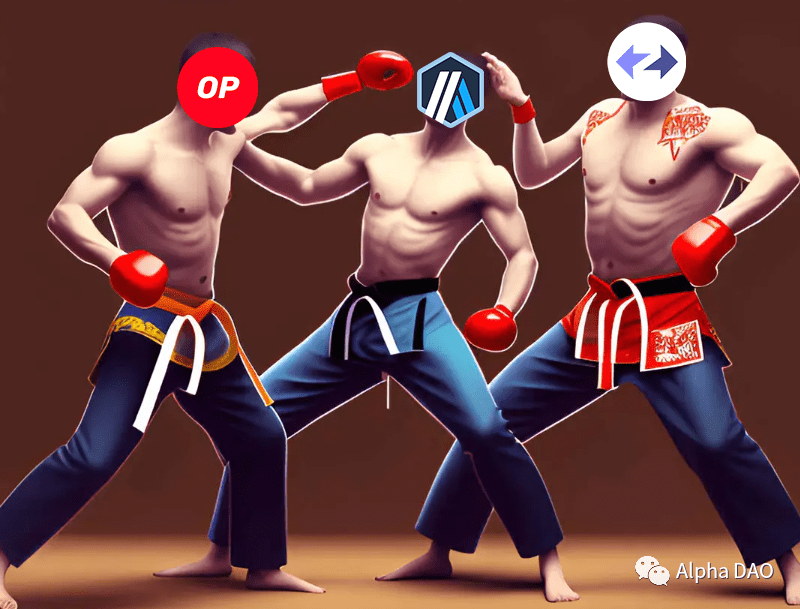
1. Where is the profit point?
Many people ask how Layer2 makes a profit?
Income: GAS fees paid by everyone to L2
Expenses: GAS fees paid by L2 to Ethereum
L2 is essentially a business of making a quick buck by charging fees.
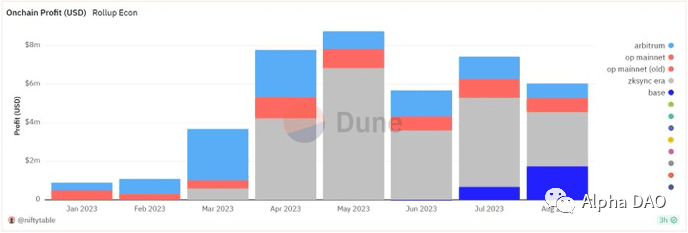
Arb and OP make around 1 million US dollars per month through this; while the more popular Base and ZK can make 2-3 million US dollars per month.
2. The Importance of Cancun Upgrade to L2
Why is Ethereum’s Cancun upgrade so important for L2?
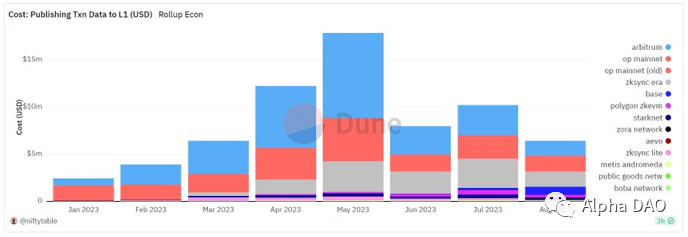
The most important upgrade of Cancun, EIP-4844, allows L2 to transfer data to Ethereum's Blob area instead of Ethereum (to use an analogy, it is like developing a new area in land planning)
L2 expenses are greatly reduced. Business people know that when expenses are reduced, profits will go up. If Cancun is upgraded, assuming that L2 does not reduce fees, the gross profit can theoretically double easily.
3. "L2 Gas Reduction"
Of course, L2 will also reduce fees in theory.
Now L2 is a completely homogeneous competition. For example, OP launched Stack, and Arb and ZK followed suit in a hurry. After all, your competitors have done it, but you haven’t, which puts you at a disadvantage in the competition.
What about the bull market? There are more geese, and they are stronger, so the feathers you can pluck will be even more.
After all, the unit of the hair is ETH, and the current price is calculated in USD just for the convenience of understanding. In the bull market, L2 will take 10 million US dollars per month, and I fully believe it.
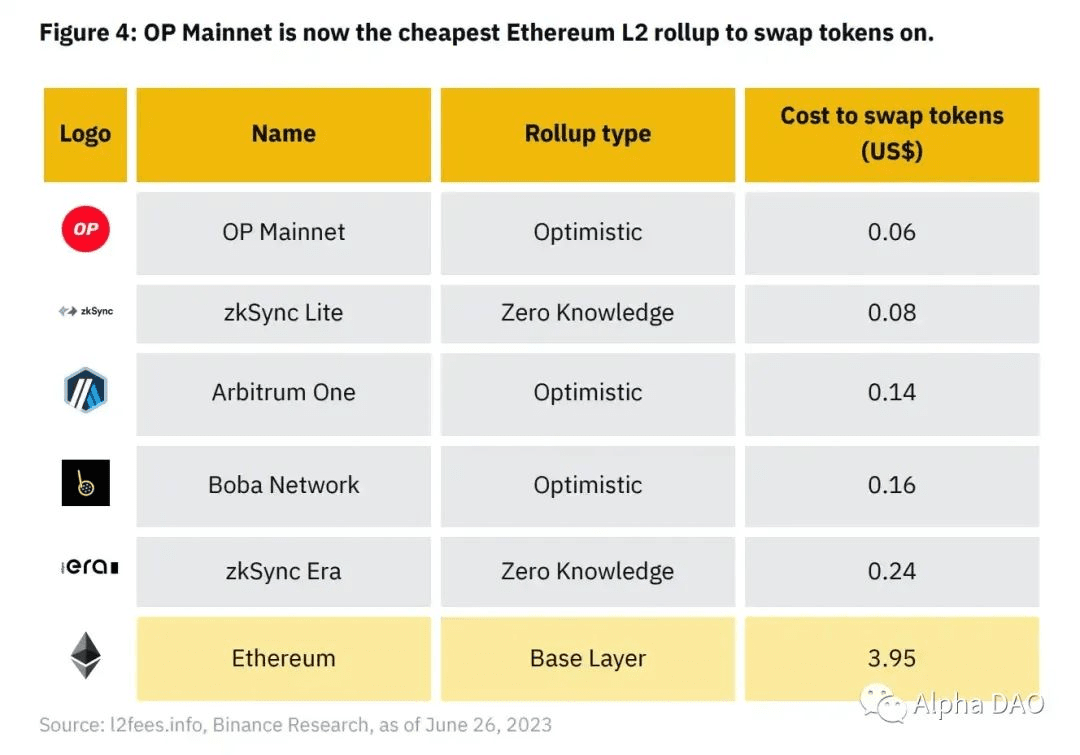
4. Token Selection
This also brings up another question: Why doesn’t L2 use its own tokens as GAS fees?
Most L2s do not use their own tokens as GAS, and the reason is very simple. First, ETH is more popular with users, and using ETH as GAS is more orthodox.
The second is the real deal - you can earn Ether. You have to know that the project party has no shortage of its own tokens. If GAS earns a lot of its own tokens, it always feels less cost-effective than earning ETH directly.
5. "L2 operation trends"
So the trend of L2 is clear:
Increase income (activity)
For example, they keep using airdrops to lure you, or secretly encourage local dogs, Free Mint NFT, etc.
Increase revenue (average order value)
Use your brain on MEV.
Reduce spending (on yourself)
Embrace the Cancun upgrade; use the cheaper DA tier.
Reduce expenses (cooperation)
"Carpool" with other L2s, share L2 gateways, share sequencers, etc. to reduce GAS.
6. "L2 positioning of each company"
L2 has evolved into new trends, including Superchain, L3 and Hyperchain.
Optimism’s OP stack is on its way to becoming a superchain with high interoperability, and the Bedrock upgrade represents an initial step toward realizing their vision.
Arbitrum is also at the forefront of scaling Ethereum, developing L3 networks through Arbitrum Orbit, providing a permissionless framework for deploying custom chains on Arbitrum L2.
zkSync proposes Hyperchain, a set of customizable trustless linked blockchains that enable hyper-scalability, improved composability, and enhanced security.
StarkWare is developing a multi-layer solution, exploring L3 for custom extensions and leveraging L2 for general-purpose extensions.
Polygon 2.0 aims to create the “value layer of the internet” by unifying its suite of L2 solutions, which include Polygon PoS, Supernets, and zkEVM.
7. Comprehensive comparison of L2 of various companies
Characterized by its dynamic and competitive nature, each network brings its unique perspective, seeking common ground while reserving differences.
Main project features:
Optimism: Differentiates itself through its Superchain thesis. It provides a fully open source framework, but this may lead to other rollups using the OP Stack that distract from Optimism’s liquidity and users.
zkSync: Has some overlap with Optimism, but differs from Optimism and Arbitrum in execution strategy.
Arbitrum: Provides a permissionless platform for creating L3 chains, but still requires DAO approval for developing L2s using Arbitrum’s IP.
Starknet: Adopts a multi-layer structure and uses fractal expansion L3s.
Polygon: Opted for a more integrated model, combining its L2 products together.
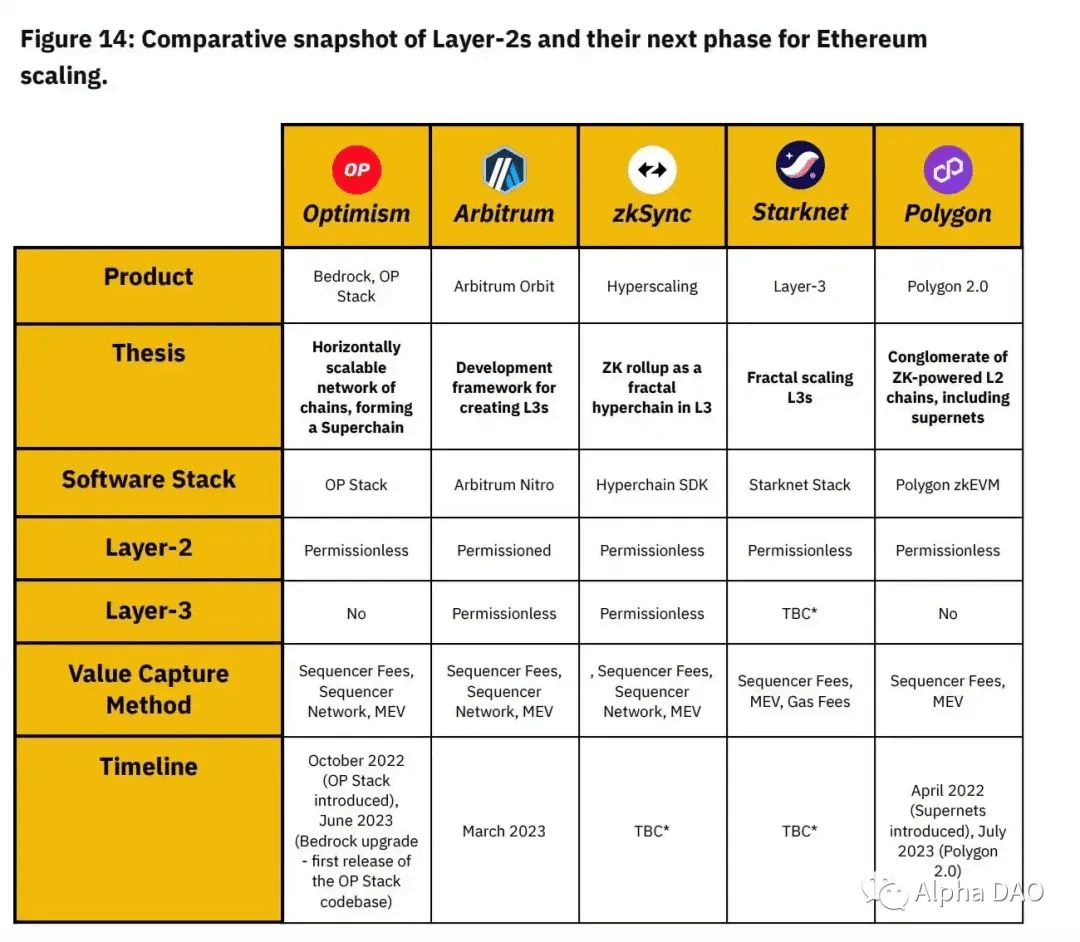
These L2 visions, while different, all have customized and application-specific chains at their core.
Conclusion
The L2 ecosystem has made significant progress in enhancing the scalability, efficiency, and availability of the industry.
The next phase of L2 evolution is being discussed within the industry, resulting in a variety of different visions and approaches.
Despite many different opinions, the common goal is to achieve infinite scalability and hope that the world of Web3 can scale as seamlessly as Web2.
Currently, this field is still in its infancy and specific methods and practices have not yet been fully determined.
✏️Disclaimer: This article is for reference only, DYOR
A Chinese Web3 community that does not serve as cannon fodder; tracks the latest hot topics, interprets industry tracks; takes advantage of the wind and shares common prosperity.