

Where there are people, there is the world.
Everyone wants to have a resounding name in the world. In the world of Web3, the domain name is that name.
In some ways, a domain name is also an identity that is easier to understand than an address.
However, at present, each chain and ecosystem seems to have its own domain name service, forming isolated islands from each other, lacking linkage and ecological effects. There is no unified framework and standard for the allocation, management and technical connection of different domain names.
From a more macro perspective, these issues all involve whether the entire domain name track can develop in the long run.
We might as well enter the arena of Web3 domain names, observe the melee behind these issues, and witness the establishment of the rules of the arena.
Web3 Domain Name Competition
In the Web3 world, everyone has an on-chain address, but most people cannot remember the combination of numbers and letters for themselves and others. In the Web2 world, we may not know the IP address of Baidu’s homepage.
The reason why we can enter baidu.com to access the Baidu website is because the DNS (domain name service) behind it is at work: it parses and converts the readable and easy-to-record URL into an IP address, allowing us to access it smoothly.
ENS's opening ceremony
Similarly, ENS was the first to establish itself in the Web3 world, providing a DNS-like service: it encapsulates disordered and complex on-chain addresses to form readable and easy-to-remember domain names such as 123.eth, and then resolves them into corresponding addresses when accessed.
Among them, the essence of ENS is still an on-chain contract. Each domain name will be minted into NFT, and users can freely register, trade, transfer and manage it.
The design logic of ENS is not complicated, and its registration and resolution functions are basically the same as domain name services in the traditional Internet.
However, its emergence has created the possibility for users to overcome the inconvenience of on-chain addresses, reducing the probability of transfer errors. At the same time, registering your own ENS domain name can also show your personality and form an aggregation function similar to a personal homepage: you can link your various social media addresses and assets on a web page under an ENS domain name.
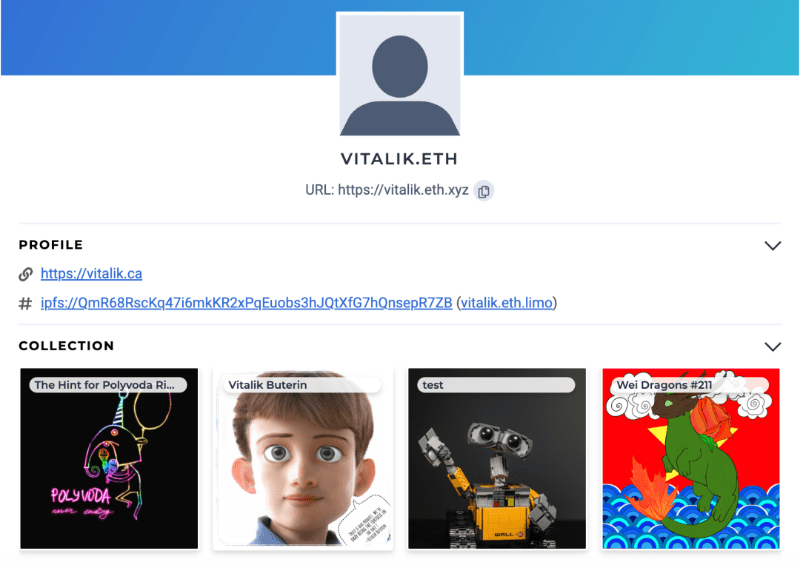
So far, while ensuring the sovereignty of user data, ENS has achieved the unity of uniqueness, readability and aggregation of on-chain address access paths. From the user's perspective, Web3 also has the familiar "custom nickname", and the obscure "0x" has been personalized.
A chaotic battle among various sects
ENS took the lead and .eth’s reputation gradually expanded.
However, there are many schools of thought in the entire Web3 world. All the experts in the new public chain competition are bound to be unwilling to lag behind in the domain name track and establish their own domain name systems within the ecosystem;
At the same time, various exchanges, Dapps, NFT-related projects, and domain name solution providers also hope to make a name for themselves, so they will naturally get a piece of the pie in the domain name market. Domain names with non-public chain suffixes also appear.
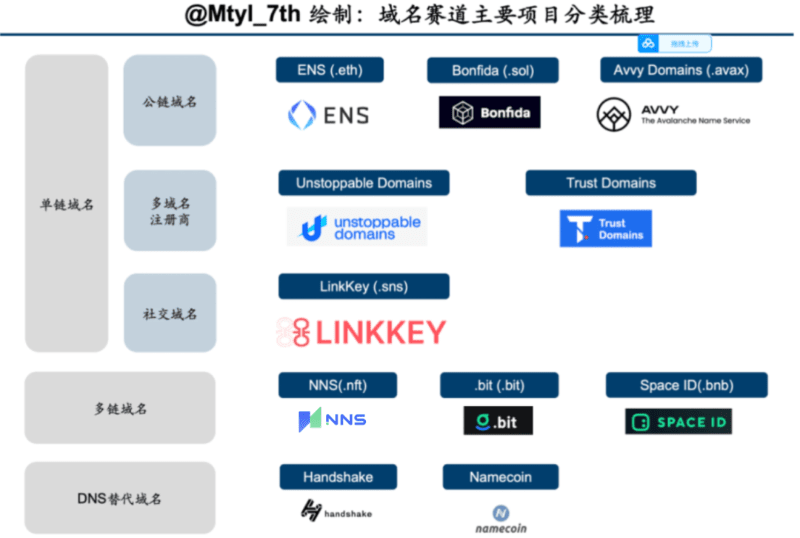
Image source: Chuan Lin - A&T Capital: "A comprehensive interpretation of Web3 domain names: application scenarios, track conditions, and future challenges"
Competition has thus become inevitable, but the negative externalities caused by the chaos caused by the growth of each industry will create pain points faced by the entire industry:
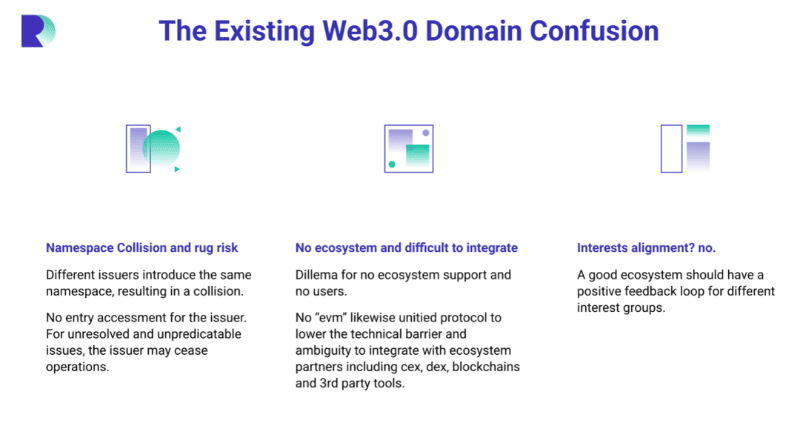
The first is the risk of domain name collision and fraud.
Since there is no definite rule for the allocation of top-level domains, for example, if a domain name with the .abc suffix is released by project A first, project B may no longer be able to provide the suffix to users; or if project B also releases a domain name with the .abc suffix, A and B will inevitably fall into a melee and dispute over the suffix conflict.
At the same time, the "zero-width character" problem in ENS also shows the possibility of domain name fraud. Two domain names that look the same to the human eye may contain characters that are not displayed, which can easily lead to transfer errors. There is also a lack of a recognized way to distinguish "Li Kui" from "Li Gui" in the market; in addition, do domain names with different suffixes but the same prefix point to the same user? When transferring money, users will obviously be confused about whether 123.abc and 123.cba are the same person, and may check in different browsers.
The second is the complexity of cross-ecological docking.
There are both single-chain domain names and multi-chain domain names, as well as space for cross-chain display domain names. Each has its own docking rules, technology, and presentation methods;
As a web3 project, the registration, use, update, maintenance, and transfer of domain names with different suffixes must follow the rules of different domain name publishers, and it is also troublesome to adapt and connect one by one. Can you imagine that parsing and jumping to Baidu's website has one set of rules, and Google's has another set of rules?
Finally, there is a lack of common interests among players in the track.
Different public chains, exchanges and project owners all have their own plans and hope to gain an advantage in the competition. Faced with domain names with similar functions, it is inevitable that each will fight for itself, but there is no way to form a joint force, resulting in isolated domain name islands between ecosystems.
Under the guidance of parochialism and localism, the development of A has little to do with B. The industry lacks a driver who can open up a global perspective to promote the allocation, coordination and ecological construction of domain name track resources.
When the entire domain name track faces common problems, it also means that a common solution is needed.
Registry3, setting new rules for the game
In the melee over domain names, the influence of various schools and factions does not seem to have achieved sustained incremental development.
The emergence of ENS guarantees ownership from the demand side, that is, the domain name and the resolved content and business belong to you. However, the problems on the supply side are gradually magnified:
Which domain names should be assigned to whom, which domain name is real, how do domain names on different chains communicate with each other, and how to reduce the cost of docking?
The key to solving the above problems lies in establishing a set of universally recognized, inclusive, and clear rules (protocols and standards). Only when all players in the domain name market follow the same set of rules can friction be reduced and efficiency improved.
Such rules have already had successful precedents in the Web2 Internet.
ICANN, the Internet Corporation for Assigned Names and Numbers, sets the rules for domain name allocation and management in the traditional Internet world. It is responsible for the unified allocation of IP address space, the management of generic top-level domains (such as .com) and country and regional top-level domains (such as .US, etc.).
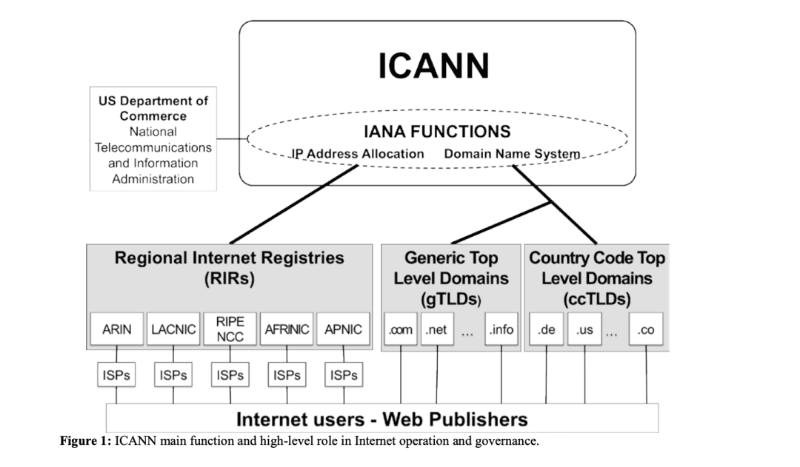
Image source: MIT academic paper: Understanding the Complexity of ICANN in a Growing and Changing Internet
You can simply understand that ICANN has formed a set of global unified standards to solve the problems of which domain names are issued to whom, how to register and connect, etc. It is precisely because of the same rules that global Internet domain names can operate healthily, and related applications and ecosystems can be built on these rules.
Decentralized ICANN, the new rules for Registry3
This set of old rules in Web2 is also instructive for Web3.
In the Web3 domain name race, we also need a similar organization to establish a new set of rules to deal with the allocation of domain names and the coordination of interests of all parties.
The new project Registry3, which has recently emerged, is committed to building this new set of rules: creating a domain name allocation framework that can promote fairness and openness in Web3, and accelerating the large-scale application of Web3 domain names through a complete internal toolkit.
Further research on its product functions revealed that Registry3 is more like a "decentralized ICANN" that attempts to establish a set of industry standards for Web3 domain names. Its product design covers domain name allocation, technical docking, and management, among other aspects:
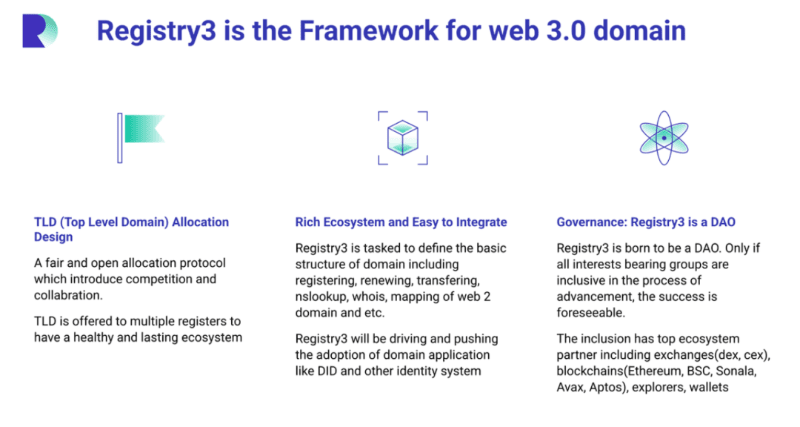
The first is the design of the allocation rules and CA functions of the Web3 top-level domain.
As mentioned above, when two domain name registrars both open domain name registration services with the suffix ".abc", disputes may arise over the order in which the suffixes were occupied and the authenticity of the businesses they represent. ICANN has adopted unified management for top-level domains (such as .US and .UK) and allocated domain name resources to different countries, thus avoiding suffix conflicts.
Similarly, Registry3 will design a fair and open protocol and introduce a competition and cooperation mechanism to conditionally issue top-level domains with different suffixes in Web3 to multiple domain name registrars to solve a series of problems caused by suffix conflicts. At present, its products are still in the early stages, and the specific design and competition rules have not been fully announced, but we predict that there is a design that uses tokens to pledge, bid and transfer top-level domains.
In addition, Registry3 also considers the design of CA (certificate service). Due to the existence of zero-width characters and other issues, some domain names that look the same are actually not certified. Currently, they are only identified by platforms such as Little Fox Wallet and Opensea, and the identification methods of each platform are inconsistent. The design of Registry3 is to issue certificates to legally registered domain names to confirm the authenticity and validity of the domain names, so as to avoid corresponding domain name fraud problems.
The second is to unify and simplify the docking process of domain name services.
In an environment of domain name chaos, accessing ".eth" requires the use of the ENS SDK, while accessing ".bnb" requires the use of the SpaceID SDK, and there is a lack of a unified process.
Registry3 defines a unified set of specifications for domain name technology docking. In the case of multiple suffix domain names, there is no need to dock different SDKs one by one. All domain name registrars only need to use the unified SDK of Registry3.
At the same time, similar to ICANN, domain name registration-related processes and links such as domain name resolution, renewal, transfer, bidding and whois query services are also a set of standards. The transfer of domain names between different chains and ecosystems will become smoother and more convenient.
It is precisely because of the uniformity of this domain name service that, for example, when exchanges, wallets and other applications in the industry have access to .nft domain names through Registry3, when some new projects with the .nft suffix appear, they no longer need to confirm and evaluate the security of new projects one by one, simplifying domain name-related identification and docking matters.
Finally, domain name-related matters are managed in a DAO manner.
ICANN is a centralized organization formed in the Web2 environment based on a specific historical and international environment. In Web3, the DAO organizational form is more suitable for the management of domain name-related matters.
In the domain name matter, exchanges, wallets, various Dapps and even Web2 domain name agencies are all stakeholders, and they will sooner or later participate in the domain name docking, identification and jump processes. Therefore, it is a very natural step to let stakeholders participate in Registry3 in the form of DAO. When a new project registers a domain name, DAO members will also participate in the project's security assessment, and the domain name will be issued only after certain conditions are met.
At the same time, members of the DAO have formed an alliance, jointly responsible for the overall web3 domain name, and can also obtain common interests, such as reducing domain name docking costs, identifying domain name fraud, and multi-ecological interoperability of domain names.
Implementation of rules: chains, nodes and ecology
In addition, the members of these DAOs also correspond to Registry3's design of public chains and nodes.
In the concept of Registry3, its products will be carried by a public chain, and nodes including exchanges, wallets and other Dapp members will jointly operate and maintain the stability of the Registry3 chain in a decentralized manner.
On this chain, all registration, update, maintenance, transfer and query activities in the entire Web3 domain name system can be considered as on-chain transactions, and nodes also need to verify and process these transactions. Therefore, Registry3 is equivalent to creating a "domain name chain" to specifically handle matters related to domain names.
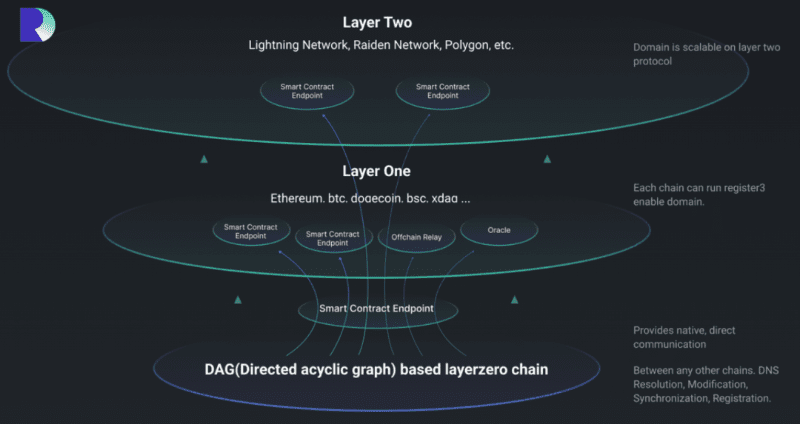
This domain name chain is more in the L0 position, providing domain name registration, regulation and coordination services to other L1s; at the same time, any L1 blockchain can run Registry3 to enable the domain name services it provides, and can also be extended to L2.
In terms of node design, Registry3 adopts an open hierarchical model: organizations with a stake in the domain name and of a larger scale, such as top exchanges, wallets, other public chain representatives and regulators, serve as root nodes to maintain the operation of the chain; other important ecological partners join as VIP nodes, and any other interested person can also join Registry3 as a node, assume the role of a node, and share the staking income together.
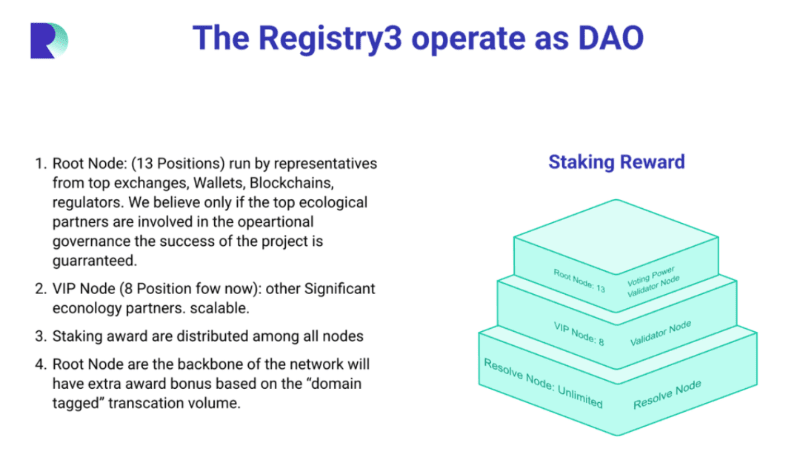
Under the design of the chain and nodes, Registry3 has formed a relatively clear ecological construction route. In addition to covering the operation and development of its own DAO, the income generated by domain name registration, renewal and certificate services will also be distributed to nodes to incentivize them to maintain the stable operation of the chain; at the same time, part of the fees will also be used to support small and medium-sized Dapps and promote their support for Registry3's domain name services.
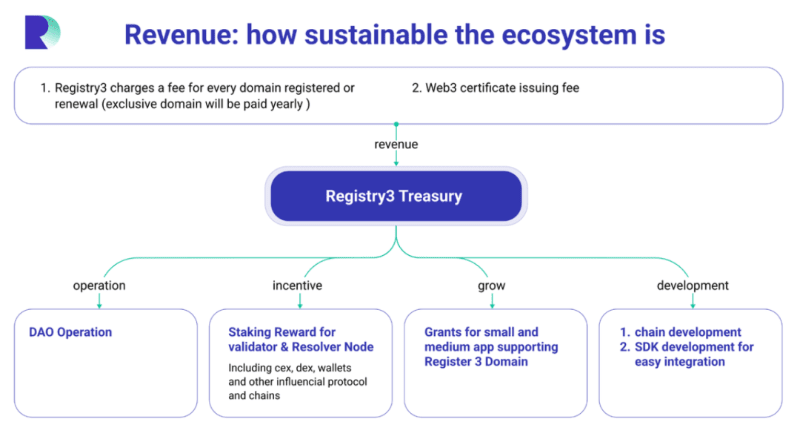
Once the rules are established and implemented, it will all depend on whether Registry3 is able to enforce them.
MetaScan's experience
When Registry3 wants to develop a unified standard for Web3 domain names, it must be familiar with the rules of domain name and have the ability to integrate resources inside and outside the industry. I'm afraid this is not something that an outsider can do.
MetaScan is the backer of Registry3. Prior to this, MetaScan had incubated two products: TwitterScan, a tool for analyzing social media trends in the crypto industry, and NNS (NFT Name Service), a cross-chain domain name service.
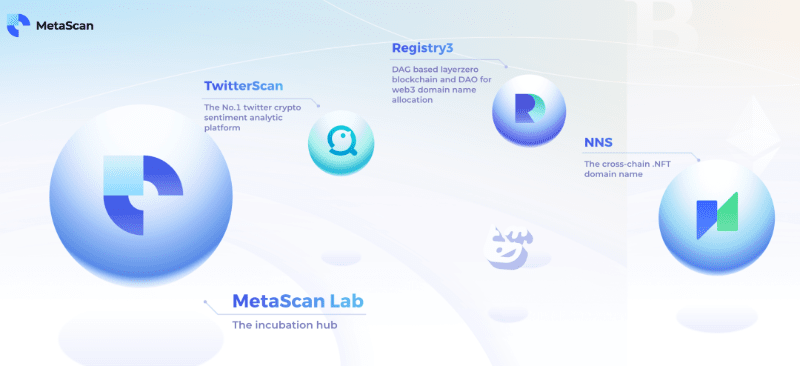
The API provided by the former is used by well-known CEXs such as OKX, Huobi, and Bybit, while the latter is a project completely related to domain names and DIDs. In the process of building these two projects, MetaScan will inevitably establish connections with the upstream and downstream industries through data indexing business, and will also empathize with Web3 domain name design and pain points.
The experience gained from these past projects can provide good resources for the development of Registry3:
The users and partners accumulated by TwitterScan can be smoothly imported into Registry3 under the same ecosystem, making it relatively easier to become nodes in its DAO. At the same time, NNS's development experience and framework in domain name design can also serve as the baseline for Registry3. In addition to the domain name registration function, more related scenarios can be expanded. For example, NNS's on-chain reputation system already supports users to quickly connect to Web2 identities through Link3 and TwitterScan. With this as a starting point, achievements and professional skills on Web2 large-scale game platforms and development platforms can be imported, making the information behind domain names and identities richer.
From tracking industry trends from an external perspective, to participating in building your own domain name service, and then to personally participating in the construction of standards for the entire domain name track, it is more like an inevitable accumulation of experience: the experience accumulated by focusing on a certain point in the industry will gradually become the confidence to solve the overall pain points of the industry.
The emergence of projects like Registry3 has taken the exploration of building de facto standards for the domain name track one step further. When the rules of the arena are formed and there is a better collaboration model between ecosystems, the explosion of upper-level applications and the influx of incremental users will become possible.
The story of Web3 is still going on, and every Builder’s dedicated performance will eventually bring a full house of users.