



Written by: Small Cap Scientist
Compiled by: TechFlow
The genesis pool and public sale of $GRAIL are ongoing on the Camelot DEX on Arbitrum.
Excellent collaborations, game-changing $GRAIL token economics, and creative plans for NFT-based liquidity are a few reasons why it may win the Arbitrum DEX war and are worth diving into.

Following the direction of DeFi development, Uniswap and SushiSwap will have cross-chain liquidity for most of the top currency pairs, such as USDC/ETH or ETH/WBTC.
So it makes more sense to target your incentives towards the native pairs on Arbitrum and leverage those major currencies elsewhere for deeper liquidity.
The team is taking a unique approach by focusing on Arbitrum-native projects and concentrating on project collaboration.
The liquidity provided by users is often not sticky because it chases the highest APR. On the other hand, what projects need is long-term LPs to concentrate liquidity in 1 DEX.
With this in mind, Camelot decided to heavily incentivize their partners to maintain liquidity on their platform.
To date, partners include GMX, Umami, JonesDAO, Buffer Finance, Sperax, Spell, GMD, and Nitro!
Protocols like GMX could potentially give Camelot market making and potentially move its liquidity over, which is what differentiates Camelot from other DEX launches. The team even shares some of the same advisors as GMX.
The JonesDAO team is also working with Camelot and marketing it on social media.
This is a huge win for these protocols as they gain a share of the Camelot DEX through the partnership, can incentivize LPs with $GRAIL, and aggregate deeper liquidity than the major DEXs.
As these projects all collaborate and incentivize liquidity, it becomes a competition between projects to incentivize liquidity. Extremely attractive models and users should be the biggest long-term beneficiaries with deep liquidity.
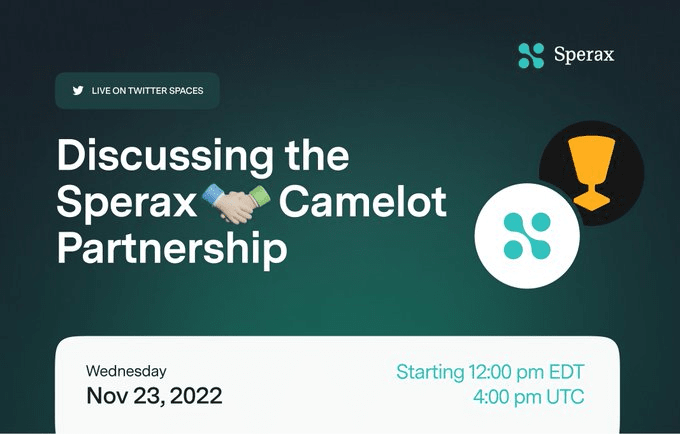
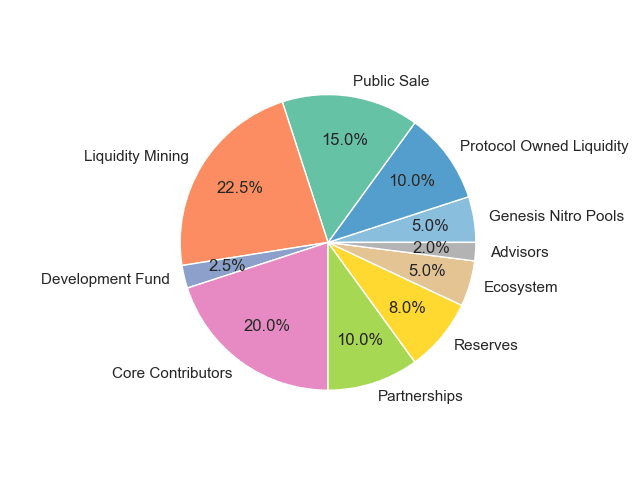
About 25% of the total supply is reserved for partners (10%), reserves (8%), ecosystem (5%), and development funds (2.5%).
This means that they are heavily incentivizing their current partners to use Camelot as their primary DEX, while also setting aside reserves for future partners.
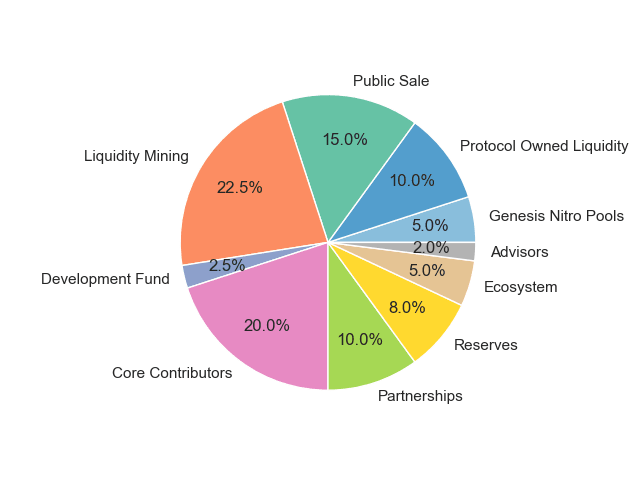
An incredible feature for partners is Camelot Nitro Pools.
Their spNFTs allow projects to set parameters such as minimum LP amount, time locks, or whitelists to selectively incentivize LP rewards. These provide unlimited options for selective LPs.
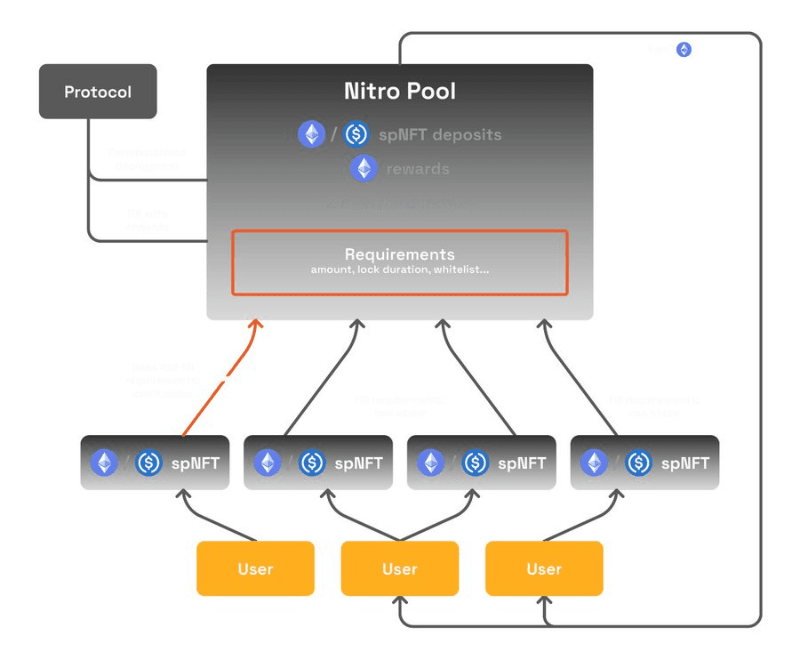
Let’s take a look at an example:
$JONES can use the Nitro pool to say: "Any user who has locked JONES/ETH for 6 months, has at least $500 in LP, and is whitelisted by the team can deposit." Then 50,000 JONES are allocated to the pool.
Rewards = Loyalty + Long-term holders.
Ideally, in the future you will be able to use your long spNFT positions as collateral for borrowing.
In the roadmap, it will unlock a whole layer to incentivize long-term liquidity for projects. Your LP project can even do 0 interest loans.
A less discussed Camelot feature, they will charge fees on a per-pair basis for utilizing dynamic and directional swaps.
This allows for charging cmUMAMI/UMAMI etc. by direction. (e.g. 0.01% cmUMAMI for buying, 2% for exiting). This will help stabilize volatility during extreme events.
Dynamic fees allow for the implementation of a system based on the volatility of individual currency pairs, which is usually done at the exchange level. From this we can understand that the system is very focused on developing new features/functionality for its partner projects.
What excites me the most is their token economics.
I’ve been waiting for DEXs to use something like a dual token system. Their $GRAIL / $xGRAIL system is not exactly the same as what I describe below, but it has a lot of the same advantages.
$GRAIL is liquid, while $xGRAIL is the vesting and profit sharing token for the DEX.
Example: You get 100% APR in $JONES-$ETH LP, 60% APR in the form of $GRAIL liquidity, and 40% in the form of $xGRAIL.
It aligns LPs with the long-term success of the protocol.
$xGRAIL is a non-transferable token that you can stake to earn a portion of protocol fees (paid in ETH/USDC LP), participate in governance, or increase the yield of your LPs.
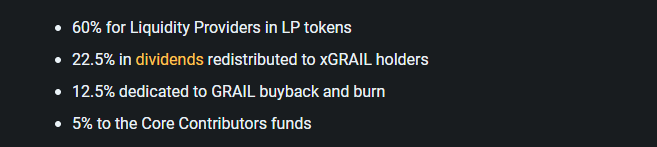
22.5% of exchange fees will be allocated to $xGRAIL staking, so users and partner projects will profit from increasing DEX volume.
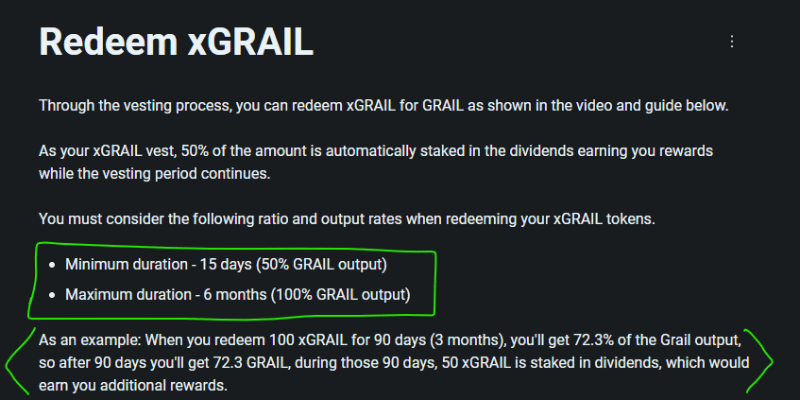
We can redeem $GRAIL with $xGRAIL, but if you want a 1:1 return, it will take some time.
The minimum $xGRAIL vesting period is 15 days, at a ratio of 0.5:1. The maximum $xGRAIL vesting period is 1:1, which takes 6 months.
This keeps the $GRAIL circulation low while giving users flexibility.
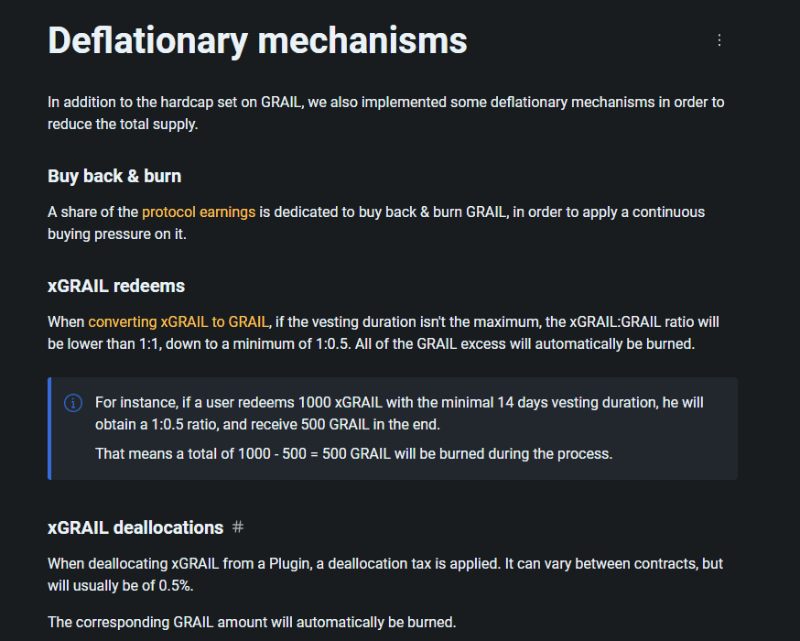
Camelot also achieves deflation by using a 12.5% swap fee to buy back $GRAIL for destruction and $xGRAIL redemption fees.
This helps with inflation concerns and makes their model more similar to $ETH, where increased transaction volume could cost the protocol fewer tokens over time.
The token distribution highlights that most of the dilution came from $xGRAIL in the first year, while $GRAIL (blue) only grew by about 50%.
Keep in mind that it is not possible to take into account redemptions (inflation for GRAIL) or burns (deflation) of xGRAIL.
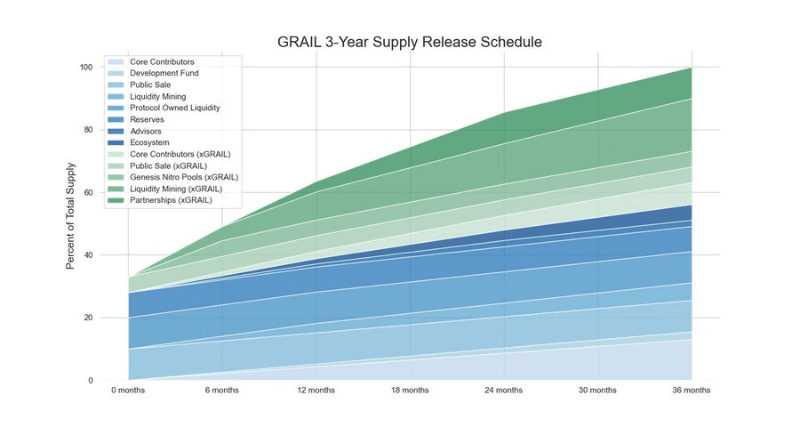
At the time of publication, there are approximately 35,000 of the 100,000 total supply of $GRAIL + $xGRAIL.
Notable user supplies:
10k PooL(GRAIL)
15k Public Sale (10k GRAIL + 5k xGRAIL)
5k Genesis Nitro Pools (xGRAIL distributed over 6 months).
Genesis Farm is a free way to provide liquidity and earn $xGRAIL with a vesting period of 6 months or more.
These deposits close within a few days, and there is no need to lock up liquidity to start earning money.
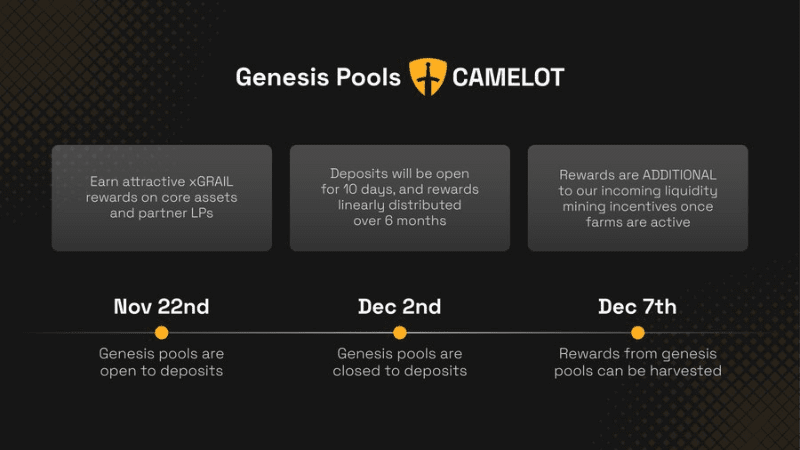
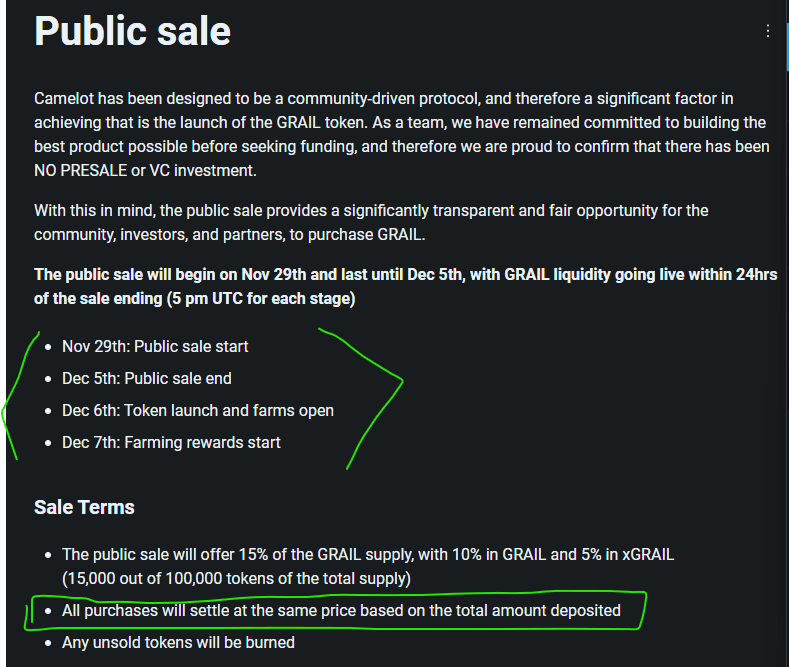
The public sale also currently runs until December 5th and represents 15% of the total GRAIL supply.
All purchases are settled at the same FDV, so there is plenty of time to buy.
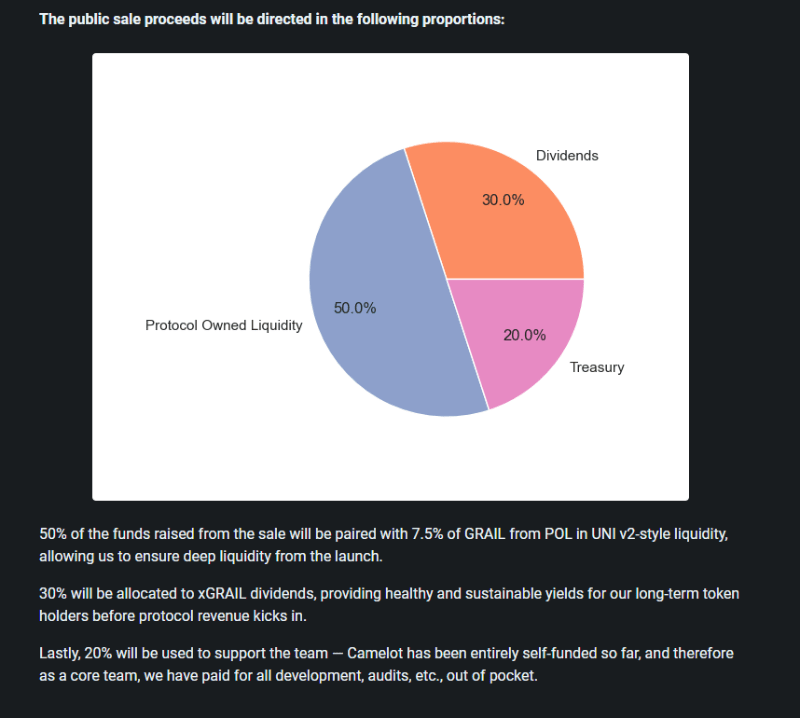
30% of the proceeds will be used to bootstrap $xGRAIL proceeds. This is like a kickback to buyers of the public sale, and for Genesis Farms, the higher the FDV sold, the better.
50% of the public sale proceeds will be used to fund the launch of GRAIL PoL.
The Camelot public sale has raised $1m, which means the FDV is around $7m with almost 5 days left. I expect it to end much higher.
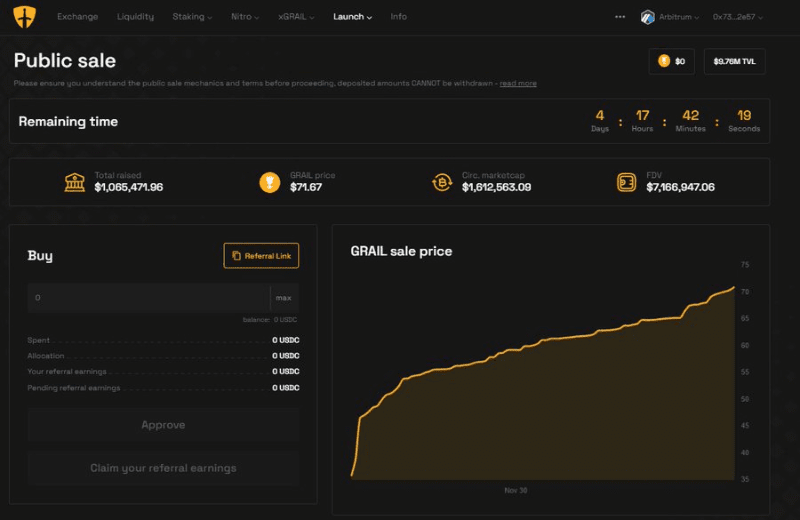
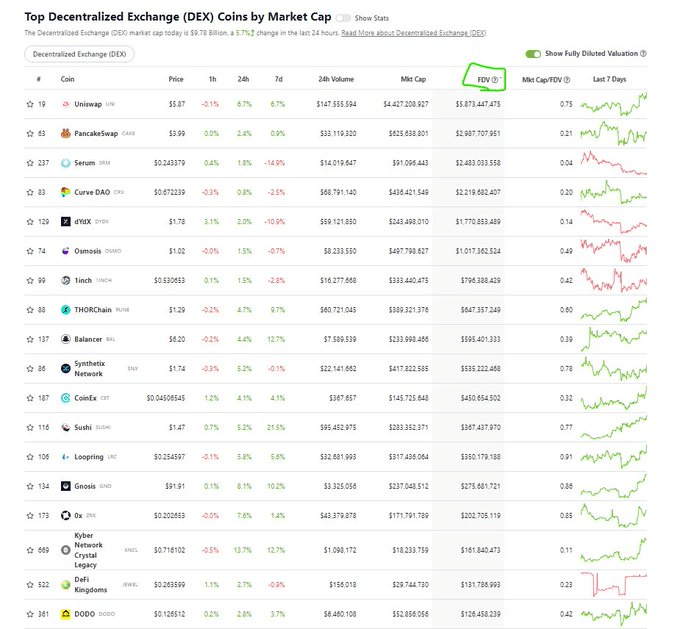
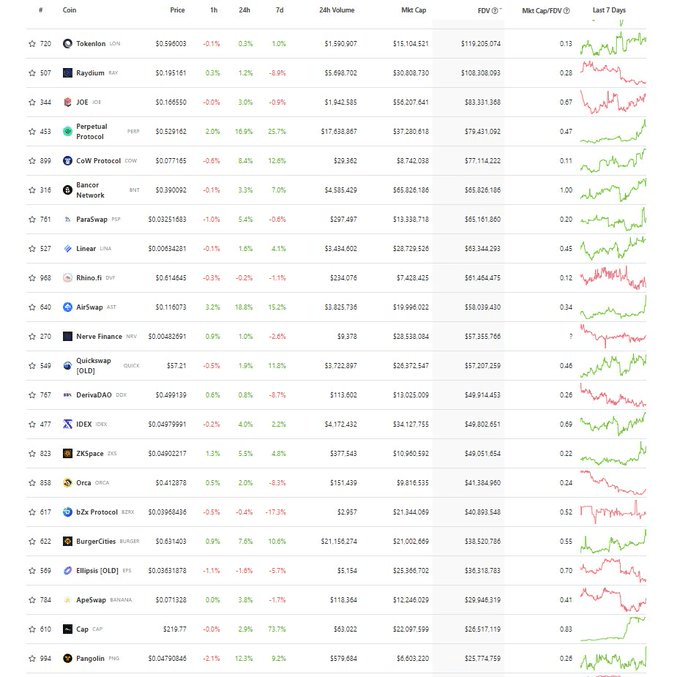
Comparing their FDV to other top DEX platforms, I think there is still a lot of room for improvement:
$OSMO: $1 billion
$JOE: $85 million
$JEWEL: $131 million
$BOO: $19 million
It’s worth noting that Arbitrum also has huge upside compared to most sidechains or other L2s.
Original link