
#verifiablecomputing
verifiablecomputing
929 views
24 Discussing
Hot
Latest

CAN AI BE TRUSTED WITHOUT PROOF? $OPG ANSWERS THAT 🔥
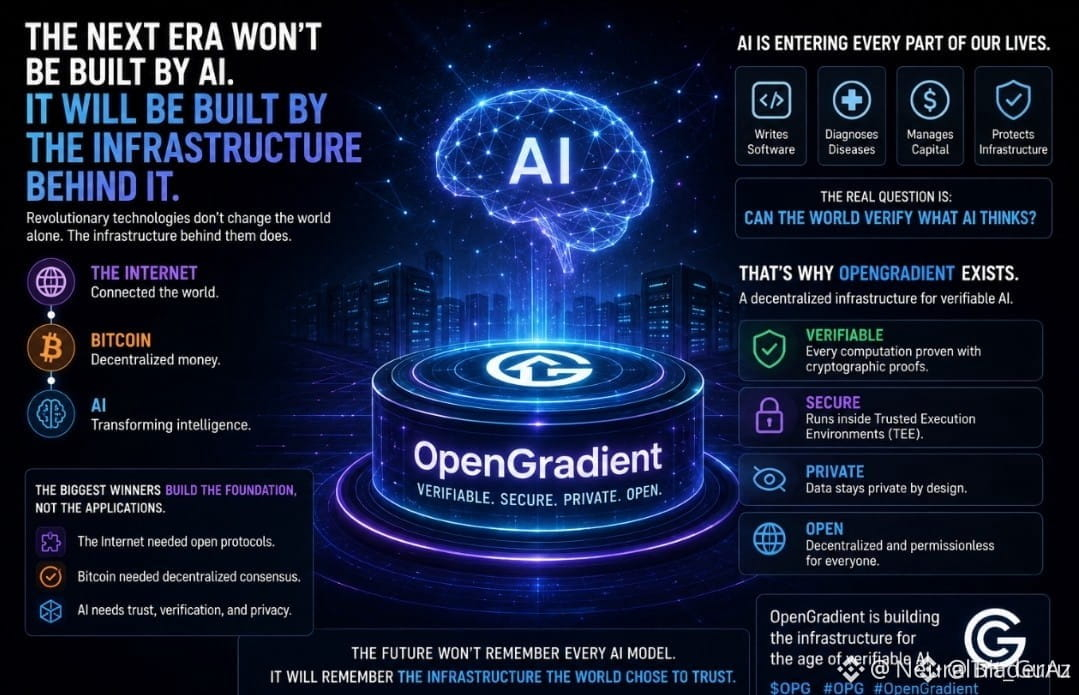
As AI models become commoditized, the real competitive moat shifts from intelligence to verifiability. OpenGradient builds infrastructure where every inference is independently provable — not just consistent. This changes the trust model from reputation-based to evidence-based.
If critical systems in finance, healthcare, or autonomous decisions rely on AI, verification is no longer optional. The market is beginning to price this shift. Is verification the next bottleneck in AI adoption?
Not financial advice. Always manage your risk.
#OPG #AI #VerifiableComputing #DeAI
🔑
CAN AI BE TRUSTED WITHOUT PROOF? $OPG ANSWERS THAT 🔥
As AI models become commoditized, the real competitive moat shifts from intelligence to verifiability. OpenGradient builds infrastructure where every inference is independently provable — not just consistent. This changes the trust model from reputation-based to evidence-based.
If critical systems in finance, healthcare, or autonomous decisions rely on AI, verification is no longer optional. The market is beginning to price this shift. Is verification the next bottleneck in AI adoption?
Not financial advice. Always manage your risk.
#OPG #AI #VerifiableComputing #DeAI
🔑
As AI models become commoditized, the real competitive moat shifts from intelligence to verifiability. OpenGradient builds infrastructure where every inference is independently provable — not just consistent. This changes the trust model from reputation-based to evidence-based.
If critical systems in finance, healthcare, or autonomous decisions rely on AI, verification is no longer optional. The market is beginning to price this shift. Is verification the next bottleneck in AI adoption?
Not financial advice. Always manage your risk.
#OPG #AI #VerifiableComputing #DeAI
🔑
2
33

$OPG BUILDING THE INFRASTRUCTURE FOR TRUSTED AI EXECUTION 🔥
The next AI revolution won't be won by smarter models alone — it will be decided by infrastructure that guarantees security, privacy, and verifiable execution. As AI enters finance, healthcare, and critical systems, users will demand proof that outputs are genuine and manipulation‑free.
Major players like NVIDIA, Microsoft Azure, and Google Cloud are already pouring capital into confidential computing. OpenGradient is solving this at the protocol level by combining Trusted Execution Environments with cryptographic verification — enabling AI that is private, secure, and independently verifiable without centralized gatekeepers.
Which layer of the AI stack do you think captures the most long‑term value — the model or the infrastructure?
Not financial advice. Always manage your risk.
#OPG #AI #Infrastructure #VerifiableComputing
⚡
$OPG BUILDING THE INFRASTRUCTURE FOR TRUSTED AI EXECUTION 🔥
The next AI revolution won't be won by smarter models alone — it will be decided by infrastructure that guarantees security, privacy, and verifiable execution. As AI enters finance, healthcare, and critical systems, users will demand proof that outputs are genuine and manipulation‑free.
Major players like NVIDIA, Microsoft Azure, and Google Cloud are already pouring capital into confidential computing. OpenGradient is solving this at the protocol level by combining Trusted Execution Environments with cryptographic verification — enabling AI that is private, secure, and independently verifiable without centralized gatekeepers.
Which layer of the AI stack do you think captures the most long‑term value — the model or the infrastructure?
Not financial advice. Always manage your risk.
#OPG #AI #Infrastructure #VerifiableComputing
⚡
The next AI revolution won't be won by smarter models alone — it will be decided by infrastructure that guarantees security, privacy, and verifiable execution. As AI enters finance, healthcare, and critical systems, users will demand proof that outputs are genuine and manipulation‑free.
Major players like NVIDIA, Microsoft Azure, and Google Cloud are already pouring capital into confidential computing. OpenGradient is solving this at the protocol level by combining Trusted Execution Environments with cryptographic verification — enabling AI that is private, secure, and independently verifiable without centralized gatekeepers.
Which layer of the AI stack do you think captures the most long‑term value — the model or the infrastructure?
Not financial advice. Always manage your risk.
#OPG #AI #Infrastructure #VerifiableComputing
⚡
1
18

·
--
Bullish
I’m genuinely amazed at how much faith we put in AI decisions even though a small mistake could have huge consequences.
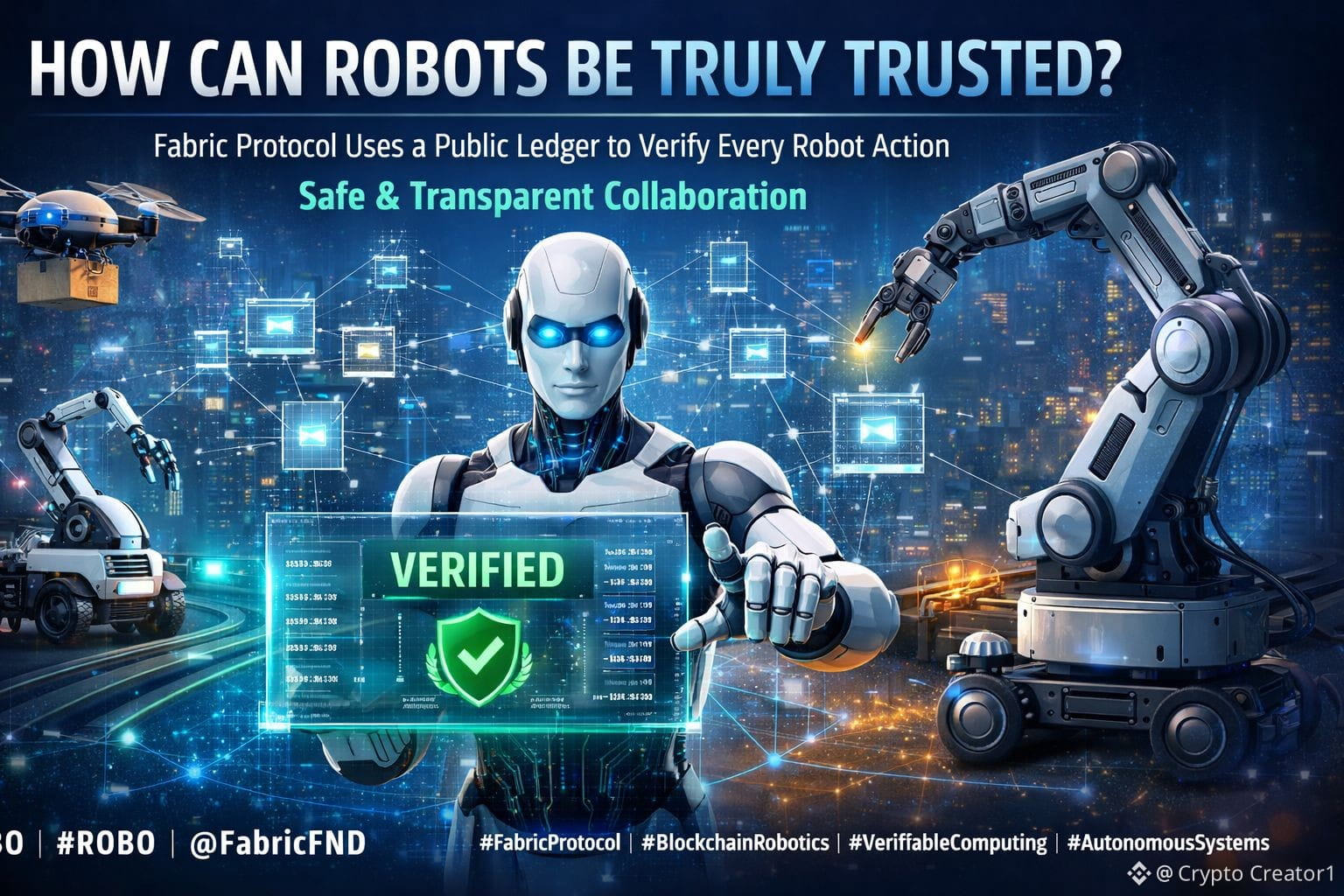
That’s why I find Fabric Protocol so fascinating. It records every robot action on a public ledger so we’re not just relying on trust every decision can actually be verified.
To me if human machine collaboration is truly the future, transparency verification and reliable systems are more than just tech they’re a promise that we can make the future safer and smarter.. #FabricProtocol #BlockchainRobotics #VerifiableComputing
$ROBO
#ROBO
@FabricFND #robo $ROBO
{spot}(ROBOUSDT)
I’m genuinely amazed at how much faith we put in AI decisions even though a small mistake could have huge consequences.
That’s why I find Fabric Protocol so fascinating. It records every robot action on a public ledger so we’re not just relying on trust every decision can actually be verified.
To me if human machine collaboration is truly the future, transparency verification and reliable systems are more than just tech they’re a promise that we can make the future safer and smarter.. #FabricProtocol #BlockchainRobotics #VerifiableComputing
$ROBO
#ROBO
@Fabric Foundation #robo $ROBO
That’s why I find Fabric Protocol so fascinating. It records every robot action on a public ledger so we’re not just relying on trust every decision can actually be verified.
To me if human machine collaboration is truly the future, transparency verification and reliable systems are more than just tech they’re a promise that we can make the future safer and smarter.. #FabricProtocol #BlockchainRobotics #VerifiableComputing
$ROBO
#ROBO
@Fabric Foundation #robo $ROBO
2
12
170

Article
Fabric Protocol: Rethinking Trust in the Age of Autonomous Machines.#ROBO @FabricFND $ROBO
Introduction
We are entering an era in which machines are no longer confined to factory lines or research labs. They are beginning to move among us — assisting in hospitals, navigating warehouses, supporting infrastructure, and even entering our homes. As robotics becomes more autonomous and more integrated into daily life, a quiet but profound question emerges:
Can we truly trust the systems we are building?
Fabric Foundation proposes an answer through Fabric Protocol, a global open network designed to coordinate the construction, governance, and collaborative evolution of general-purpose robots. Rather than treating trust as an afterthought, the protocol attempts to embed it directly into infrastructure — through verifiable computing, public ledger coordination, and agent-native systems.
This article reflects on what that means — not only technically, but philosophically and socially — as we design the foundations of human-machine collaboration.
1. The Quiet Shift: From Intelligence to Accountability
For years, innovation in robotics has focused on intelligence better models, better sensors, better autonomy. Yet intelligence alone does not guarantee safety or alignment. In fact, as systems grow more capable, opacity grows alongside them.
Fabric Protocol reframes the problem. It asks:
What if the true bottleneck is not intelligence but accountability?
By introducing verifiable computing and transparent coordination mechanisms, the protocol suggests that robotic systems should be auditable, governable, and continuously aligned with shared standards. It shifts the emphasis from what robots can do to how their actions can be verified.
This shift feels subtle yet it may prove foundational.
2. Architecture as a Philosophy of Trust
When we look at Fabric Protocol’s architecture, we see more than technical layers. We see a philosophy expressed in infrastructure.
Verifiable Computing
Instead of asking society to trust opaque algorithms, the protocol enables computations to be cryptographically proven. In doing so, it replaces assumption with evidence.
Public Ledger Coordination
By coordinating data, computation, and regulation through a public ledger, the system creates a shared record of robotic identity, updates, and compliance. It introduces institutional memory — something autonomous systems will increasingly require.
Modular Governance
Governance is not imposed; it is structured to evolve. Communities, regulators, and contributors can adapt standards as technology advances, without compromising safety.
Together, these layers suggest a broader insight:
Trust is not a feature it is an architecture.
3. Agent-Native Infrastructure: Machines as Participants
Traditionally, infrastructure has been designed for humans. Machines were tools endpoints in a system built around people.
Fabric Protocol introduces the idea of agent-native infrastructure, where robots possess identity, follow enforceable rules, and participate directly in coordination frameworks.
This is a meaningful evolution.
It suggests a future where machines are not merely controlled but are integrated into structured ecosystems of accountability. A robot is not just a device; it becomes a network participant governed by transparent protocols.
That shift carries both promise and responsibility.
4. Governance in a Fragmented World
One of the most pressing challenges in robotics is regulatory fragmentation. Standards differ across industries and nations. Innovation moves quickly; policy moves carefully.
Fabric Protocol attempts to bridge this divide by embedding compliance and governance mechanisms into a shared coordination layer. Instead of treating regulation as an external constraint, it becomes part of the system’s design.
This approach raises a thoughtful possibility:
What if governance could evolve at the speed of software without sacrificing rigor?
In that sense, the protocol does not merely support robots; it supports the institutions that must oversee them.
5. Human-Machine Collaboration: Safety by Construction.
As robots work alongside humans in warehouses, hospitals, or public spaces collaboration must be predictable. Not just technically functional, but socially acceptable.
Through verifiable constraints, transparent updates, and shared behavioral standards, Fabric Protocol attempts to make safety intrinsic rather than reactive.
It acknowledges a reality we often overlook:
Trust is built slowly, but it can be broken quickly.
Embedding accountability at the protocol level may help ensure that as robotic capabilities expand, public confidence does not erode.
Conclusion: Engineering Trust for the Long Term.
Fabric Protocol represents more than a technological proposal. It represents a perspective on the future of autonomy.
By combining:
Verifiable computation
Public ledger coordination
Modular governance
Agent-native infrastructure
it frames robotics not just as a field of innovation, but as a domain requiring durable trust systems.
As we reflect on the accelerating pace of automation, one thing becomes clear: intelligence alone will not define the next era. Infrastructure will. Governance will. Transparency will.
If robotics is to become truly general-purpose and globally integrated, then the foundations must be as thoughtful as the machines themselves.
Fabric Protocol invites us to consider that trust is not something we grant to technology it is something we must deliberately design into it.
Support technologies that build trust through transparency and accountability.
The future of robotics depends on responsible infrastructure — and informed voices like yours.
#ROBO
#FabricProtocol
#RoboticsGovernance
#VerifiableComputing
Fabric Protocol: Rethinking Trust in the Age of Autonomous Machines.
#ROBO @Fabric Foundation $ROBO
Introduction
We are entering an era in which machines are no longer confined to factory lines or research labs. They are beginning to move among us — assisting in hospitals, navigating warehouses, supporting infrastructure, and even entering our homes. As robotics becomes more autonomous and more integrated into daily life, a quiet but profound question emerges:
Can we truly trust the systems we are building?
Fabric Foundation proposes an answer through Fabric Protocol, a global open network designed to coordinate the construction, governance, and collaborative evolution of general-purpose robots. Rather than treating trust as an afterthought, the protocol attempts to embed it directly into infrastructure — through verifiable computing, public ledger coordination, and agent-native systems.
This article reflects on what that means — not only technically, but philosophically and socially — as we design the foundations of human-machine collaboration.
1. The Quiet Shift: From Intelligence to Accountability
For years, innovation in robotics has focused on intelligence better models, better sensors, better autonomy. Yet intelligence alone does not guarantee safety or alignment. In fact, as systems grow more capable, opacity grows alongside them.
Fabric Protocol reframes the problem. It asks:
What if the true bottleneck is not intelligence but accountability?
By introducing verifiable computing and transparent coordination mechanisms, the protocol suggests that robotic systems should be auditable, governable, and continuously aligned with shared standards. It shifts the emphasis from what robots can do to how their actions can be verified.
This shift feels subtle yet it may prove foundational.
2. Architecture as a Philosophy of Trust
When we look at Fabric Protocol’s architecture, we see more than technical layers. We see a philosophy expressed in infrastructure.
Verifiable Computing
Instead of asking society to trust opaque algorithms, the protocol enables computations to be cryptographically proven. In doing so, it replaces assumption with evidence.
Public Ledger Coordination
By coordinating data, computation, and regulation through a public ledger, the system creates a shared record of robotic identity, updates, and compliance. It introduces institutional memory — something autonomous systems will increasingly require.
Modular Governance
Governance is not imposed; it is structured to evolve. Communities, regulators, and contributors can adapt standards as technology advances, without compromising safety.
Together, these layers suggest a broader insight:
Trust is not a feature it is an architecture.
3. Agent-Native Infrastructure: Machines as Participants
Traditionally, infrastructure has been designed for humans. Machines were tools endpoints in a system built around people.
Fabric Protocol introduces the idea of agent-native infrastructure, where robots possess identity, follow enforceable rules, and participate directly in coordination frameworks.
This is a meaningful evolution.
It suggests a future where machines are not merely controlled but are integrated into structured ecosystems of accountability. A robot is not just a device; it becomes a network participant governed by transparent protocols.
That shift carries both promise and responsibility.
4. Governance in a Fragmented World
One of the most pressing challenges in robotics is regulatory fragmentation. Standards differ across industries and nations. Innovation moves quickly; policy moves carefully.
Fabric Protocol attempts to bridge this divide by embedding compliance and governance mechanisms into a shared coordination layer. Instead of treating regulation as an external constraint, it becomes part of the system’s design.
This approach raises a thoughtful possibility:
What if governance could evolve at the speed of software without sacrificing rigor?
In that sense, the protocol does not merely support robots; it supports the institutions that must oversee them.
5. Human-Machine Collaboration: Safety by Construction.
As robots work alongside humans in warehouses, hospitals, or public spaces collaboration must be predictable. Not just technically functional, but socially acceptable.
Through verifiable constraints, transparent updates, and shared behavioral standards, Fabric Protocol attempts to make safety intrinsic rather than reactive.
It acknowledges a reality we often overlook:
Trust is built slowly, but it can be broken quickly.
Embedding accountability at the protocol level may help ensure that as robotic capabilities expand, public confidence does not erode.
Conclusion: Engineering Trust for the Long Term.
Fabric Protocol represents more than a technological proposal. It represents a perspective on the future of autonomy.
By combining:
Verifiable computation
Public ledger coordination
Modular governance
Agent-native infrastructure
it frames robotics not just as a field of innovation, but as a domain requiring durable trust systems.
As we reflect on the accelerating pace of automation, one thing becomes clear: intelligence alone will not define the next era. Infrastructure will. Governance will. Transparency will.
If robotics is to become truly general-purpose and globally integrated, then the foundations must be as thoughtful as the machines themselves.
Fabric Protocol invites us to consider that trust is not something we grant to technology it is something we must deliberately design into it.
Support technologies that build trust through transparency and accountability.
The future of robotics depends on responsible infrastructure — and informed voices like yours.
#ROBO
#FabricProtocol
#RoboticsGovernance
#VerifiableComputing
Introduction
We are entering an era in which machines are no longer confined to factory lines or research labs. They are beginning to move among us — assisting in hospitals, navigating warehouses, supporting infrastructure, and even entering our homes. As robotics becomes more autonomous and more integrated into daily life, a quiet but profound question emerges:
Can we truly trust the systems we are building?
Fabric Foundation proposes an answer through Fabric Protocol, a global open network designed to coordinate the construction, governance, and collaborative evolution of general-purpose robots. Rather than treating trust as an afterthought, the protocol attempts to embed it directly into infrastructure — through verifiable computing, public ledger coordination, and agent-native systems.
This article reflects on what that means — not only technically, but philosophically and socially — as we design the foundations of human-machine collaboration.
1. The Quiet Shift: From Intelligence to Accountability
For years, innovation in robotics has focused on intelligence better models, better sensors, better autonomy. Yet intelligence alone does not guarantee safety or alignment. In fact, as systems grow more capable, opacity grows alongside them.
Fabric Protocol reframes the problem. It asks:
What if the true bottleneck is not intelligence but accountability?
By introducing verifiable computing and transparent coordination mechanisms, the protocol suggests that robotic systems should be auditable, governable, and continuously aligned with shared standards. It shifts the emphasis from what robots can do to how their actions can be verified.
This shift feels subtle yet it may prove foundational.
2. Architecture as a Philosophy of Trust
When we look at Fabric Protocol’s architecture, we see more than technical layers. We see a philosophy expressed in infrastructure.
Verifiable Computing
Instead of asking society to trust opaque algorithms, the protocol enables computations to be cryptographically proven. In doing so, it replaces assumption with evidence.
Public Ledger Coordination
By coordinating data, computation, and regulation through a public ledger, the system creates a shared record of robotic identity, updates, and compliance. It introduces institutional memory — something autonomous systems will increasingly require.
Modular Governance
Governance is not imposed; it is structured to evolve. Communities, regulators, and contributors can adapt standards as technology advances, without compromising safety.
Together, these layers suggest a broader insight:
Trust is not a feature it is an architecture.
3. Agent-Native Infrastructure: Machines as Participants
Traditionally, infrastructure has been designed for humans. Machines were tools endpoints in a system built around people.
Fabric Protocol introduces the idea of agent-native infrastructure, where robots possess identity, follow enforceable rules, and participate directly in coordination frameworks.
This is a meaningful evolution.
It suggests a future where machines are not merely controlled but are integrated into structured ecosystems of accountability. A robot is not just a device; it becomes a network participant governed by transparent protocols.
That shift carries both promise and responsibility.
4. Governance in a Fragmented World
One of the most pressing challenges in robotics is regulatory fragmentation. Standards differ across industries and nations. Innovation moves quickly; policy moves carefully.
Fabric Protocol attempts to bridge this divide by embedding compliance and governance mechanisms into a shared coordination layer. Instead of treating regulation as an external constraint, it becomes part of the system’s design.
This approach raises a thoughtful possibility:
What if governance could evolve at the speed of software without sacrificing rigor?
In that sense, the protocol does not merely support robots; it supports the institutions that must oversee them.
5. Human-Machine Collaboration: Safety by Construction.
As robots work alongside humans in warehouses, hospitals, or public spaces collaboration must be predictable. Not just technically functional, but socially acceptable.
Through verifiable constraints, transparent updates, and shared behavioral standards, Fabric Protocol attempts to make safety intrinsic rather than reactive.
It acknowledges a reality we often overlook:
Trust is built slowly, but it can be broken quickly.
Embedding accountability at the protocol level may help ensure that as robotic capabilities expand, public confidence does not erode.
Conclusion: Engineering Trust for the Long Term.
Fabric Protocol represents more than a technological proposal. It represents a perspective on the future of autonomy.
By combining:
Verifiable computation
Public ledger coordination
Modular governance
Agent-native infrastructure
it frames robotics not just as a field of innovation, but as a domain requiring durable trust systems.
As we reflect on the accelerating pace of automation, one thing becomes clear: intelligence alone will not define the next era. Infrastructure will. Governance will. Transparency will.
If robotics is to become truly general-purpose and globally integrated, then the foundations must be as thoughtful as the machines themselves.
Fabric Protocol invites us to consider that trust is not something we grant to technology it is something we must deliberately design into it.
Support technologies that build trust through transparency and accountability.
The future of robotics depends on responsible infrastructure — and informed voices like yours.
#ROBO
#FabricProtocol
#RoboticsGovernance
#VerifiableComputing
1
8
160
Log in to explore more content
Join global crypto users on Binance Square
⚡️ Get latest and useful information about crypto.
💬 Trusted by the world’s largest crypto exchange.
👍 Discover real insights from verified creators.
Email / Phone number
Trending Topics
1
#KazakhstanCutsOilOutputForecastTo96MTons
505 views
54 Discussing
2
#JapanNoAdditionalOilReserveReleaseInSepOct
367 views
41 Discussing
3
#SamsungSKHynixLeveragedETFsPostFirstMonthlyOutflow
226 views
36 Discussing
4
#BTCReaches$80000
23,356 views
416 Discussing
5
#ThailandToExpandSECDigitalAssetProbePowers
999 views
75 Discussing
6
#OilHoldsLosses
12,931 views
422 Discussing
7
#ZECBreaksKeyResistanceUp75.5%
28,074 views
605 Discussing
8
#KOSPI200NightFuturesFall1.77%
8,393 views
259 Discussing
9
#GoldHits$4700EndingSixMonthCorrection
1,086 views
48 Discussing
10
#SKHynixFalls5.63%AfterUnionRejectsWageDeal
9,460 views
273 Discussing