
#strategysells2
strategysells2
323 views
43 Discussing
Hot
Latest


·
--
Verified
strategy raised a big pile of cash last week and most of it didnt go into bitcoin
#StrategySells2.09MMSTRSharesFor$244.7M
they sold mstr stock like always. the new part is where it went. only a small slice bought $BTC, the bulk went into buying back their own strc preferred
one read, its smart defense. retiring strc under face value cuts the dividend load and calms the credit side. other read, the biggest corporate bid in btc just got quieter while spot is soft
if issue stock to buy coins turns into issue stock to protect the balance sheet, other treasury companies copy it and that weekly bid thins out
the line im watching isnt the btc chart, its strc getting back near 100. that frees the next atm round to flow into coins again
strategy raised a big pile of cash last week and most of it didnt go into bitcoin
#StrategySells2.09MMSTRSharesFor$244.7M
they sold mstr stock like always. the new part is where it went. only a small slice bought $BTC , the bulk went into buying back their own strc preferred
one read, its smart defense. retiring strc under face value cuts the dividend load and calms the credit side. other read, the biggest corporate bid in btc just got quieter while spot is soft
if issue stock to buy coins turns into issue stock to protect the balance sheet, other treasury companies copy it and that weekly bid thins out
the line im watching isnt the btc chart, its strc getting back near 100. that frees the next atm round to flow into coins again
1
639

·
--
Strategy sells MSTR to raise funds|Only a small portion actually went to buying coins|Look at BTC’s funding structure first
My stance is cautious. I wouldn’t take the headline “Strategy buys 485 BTC” at face value as evidence of strong corporate buying. The topic being discussed on Binance Square is #StrategySells2.09MMSTRSharesFor$244.7M. I checked Strategy’s Form 8-K filed with the U.S. Securities and Exchange Commission on November 16: from November 9 to 15, the company sold 2,087,040 shares of MSTR common stock through its ATM program, raising net proceeds of $244.7 million. During the same period, it purchased 485 BTC for $33.4 million, at an average cost of approximately $68,887 per coin, including fees. As of November 15, it held a total of 850,849 BTC. This is an official disclosure of transactions that took place last week—not an implication from a picture posted by Saylor, nor a new purchase today.
What really matters is distinguishing where the money went. A footnote in the 8-K breaks down the $244.7 million in net proceeds from MSTR sales: $33.4 million went toward buying BTC, $206.3 million toward repurchasing STRC preferred stock, and $5 million was allocated to cash in U.S. dollars. At the same time, the company repurchased STRC for a total of $228.1 million, of which another $21.8 million came from cash and interest on short-term investments. It would be incorrect to say that “all $244.7 million went to buying coins” or that “the entire $228.1 million came from new MSTR issuance.” Repurchasing preferred stock and buying BTC are different balance-sheet actions: the former may improve the financing structure and reduce future dividend pressure, while the latter is direct spot demand. Whether this can improve the company’s ability to buy coins going forward will depend on financing conditions in the capital markets and the company’s future official disclosures; it should not be assumed to be a definite positive in advance.
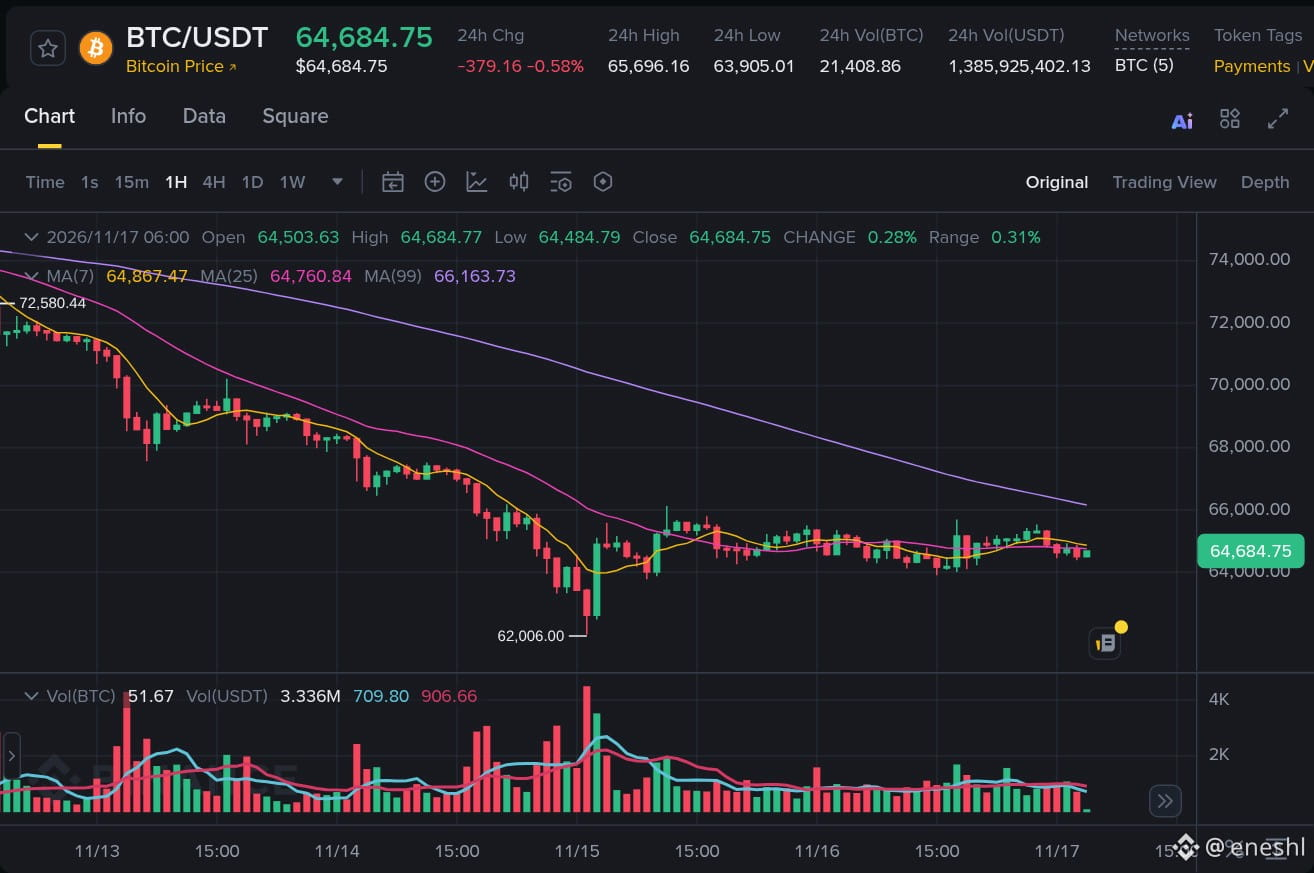
The market did not immediately reverse course in response to last week’s filing. I checked Binance BTC/USDT: the latest price was around $64,029, down about 1.63% over the rolling 24 hours, with a low of $63,336 and a high of $65,535. This quote only shows that, at the time of writing, the price was still in the lower half of the range; it does not prove that Strategy was entirely responsible for the decline. The Farside table shows total net inflows of about $7.9 million into U.S. spot BTC funds on November 16. The November 17 column had not yet been fully updated, so a blank entry should not be treated as a net outflow. My key levels are support at $63,336 and resistance at $65,535: a break below the former would mean short-term support has failed; only a sustained hold above the latter would indicate that concerns about fund flows may be starting to ease.
If I were trading this myself, I would stay out for now and keep only a plan for a small spot long position, capped at 4% of account equity, with no leverage. The trigger would be a four-hour BTC/USDT close above $65,600, followed by a retest that holds above $65,500, with no significant deterioration in updated fund flows. Only then would I open a position in two tranches. The first target is $67,000, where I would sell half; the second target is $68,500. I would set the initial stop at $64,800. If, after the breakout, a four-hour candle closes back below $65,500, I would close the remaining position. If the price first breaks below $63,336, I would cancel the plan outright and wait for new support to form. The key is to keep monitoring the actual allocation between coin purchases and buybacks in Strategy’s next 8-K, rather than infer that it has increased its holdings based on a single holdings chart.
#StrategySells2.09MMSTRSharesFor$244.7M #BTC
The above is only my personal market observation and does not constitute investment advice.

·
--
Strategy’s MSTR sale sparks debate|SEC filing breaks down where the funds went|BTC still waiting for a breakout
My view is to check the filing first, rather than chase the price just because “Strategy bought crypto again.” Binance Square is discussing #StrategySells2.09MMSTRSharesFor$244.7M. Strategy’s November 16 Form 8-K states that from November 9 to 15, the company sold 2,087,040 shares of MSTR common stock through its ATM program, generating net proceeds of $244.7 million; during the same period, it purchased 485 BTC for $33.4 million and repurchased $228.1 million of STRC preferred stock. Both shares were sold and crypto was bought, so it would be misleading to draw a conclusion based on just one figure. The BTC purchase took place last week; the announcement date does not mean a new transaction happened today. As of November 15, the company held 850,849 BTC.
Where the funds went matters more than a slogan. The filing’s footnotes make clear that $33.4 million of MSTR sale proceeds went toward buying BTC, $206.3 million went toward repurchasing STRC, and $5 million was added to U.S. dollar cash. The total STRC repurchase amounted to $228.1 million, with the remaining $21.8 million coming from cash and interest on short-term investments. In other words, the company did increase its BTC holdings during the same period, but most of the funds went toward preferred-stock capital management. Not all of the sale proceeds can be counted as spot-market buying, and it would be wrong to say that Strategy sold BTC. The STRC repurchase could improve the trading conditions of its financing instrument, but its impact on the company’s future ability to buy crypto will depend on subsequent disclosures; it should not be treated as a certainty in advance.
The market significance of this story lies in corporate financing structure, not the direction of a single 485-BTC purchase. If common-stock financing continues and more funds go toward preferred-stock repurchases, the market may revise downward its expectation that “weekly financing will necessarily lead to large BTC purchases.” Conversely, stable cash management could also support long-term financing, but new disclosures are needed to prove that. On Binance spot markets, BTC was around $65,121 at approximately 11:38 a.m. Beijing time, up about 0.33% over 24 hours, with a low of $63,905 and a high of $65,696. The price has yet to break above the range, so the current rebound cannot be attributed entirely to Strategy’s filing. $65,696 is the upside confirmation level, while $63,905 is the downside risk line.
If I were trading this myself, I would not chase the price right now. I would only consider a small spot long position, with a maximum total allocation of 5%. I would buy in two 2.5% tranches only if BTC breaks convincingly above $65,696, then holds above $65,000 on a pullback, and ETF flows and the company’s subsequent official disclosures do not deteriorate significantly. I would take half off at the first target of $67,000, then gradually close the rest at the second target of $68,500. I would stop out if the price falls back to $64,500 after entry, or close the position proactively if it fails to hold above $65,696 within 48 hours. If it first breaks below $63,905, I would cancel the long plan outright and wait for new evidence about capital flows, rather than bet on a corporate narrative with high leverage.
Sources: Strategy’s November 16 SEC Form 8-K and company announcement; Binance BTCUSDT spot-market data. #StrategySells2.09MMSTRSharesFor$244.7M #BTC
The above is solely my personal market commentary and does not constitute investment advice.

3
Log in to explore more content
Join global crypto users on Binance Square
⚡️ Get latest and useful information about crypto.
💬 Trusted by the world’s largest crypto exchange.
👍 Discover real insights from verified creators.
Email / Phone number
Trending Topics
1
#IsAnthropic’s$1.5TMarketCapJustified?
45,734 views
224 Discussing
2
#BTCBelow$62KAmidHikeFearsAndShiftToAnthropic
7,224 views
60 Discussing
3
#NvidiaBoardReportedlySplitOverHuang’sReturn
203,492 views
1,667 Discussing
4
#CanGTA6'sLaunchLiftTTWOShares?
161,781 views
1,196 Discussing
5
#BlackRockBitcoinETFRecordsLargestDailyOutflow
0 views
1 Discussing
6
#LedgerProbesTamperedWalletsInBerlinAndDubai
13,539 views
198 Discussing
7
#13FInstitutionsBitcoinSpotETPHoldingsHitRecord
26,692 views
268 Discussing
8
#BTCRemainsUnderPressureAfterHawkishFOMCMinutes
374,082 views
2,496 Discussing
9
#StrategySTRCPreferredSlips3.65%Below$100Par
12,877 views
98 Discussing
10
#MASToUpgradeSGDTestnetToSGDigitalLedger
49,654 views
455 Discussing