
#strategybtcputchase
strategybtcputchase
446 views
12 Discussing
Hot
Latest

Verified
FOGO Fundamental Analysis: Building Crypto Like a Real Trading Desk$FOGO (@fogo ) isn’t trying to be “just another fast L1.” The team’s pitch is blunt: build a blockchain that feels like a real exchange matching engine, not a general-purpose computer.
Here’s the breakdown in plain terms:
### 1. The Core Thesis: Speed for Real Trading
Most chains optimize for throughput. @FOGO optimizes for latency.
Target: 40ms block times and ∼1.3s finality. In stress tests they’ve hit 46k TPS, with bursts near 100k.
Why does 40ms matter? On a 400ms chain, a market maker’s quote can go stale before they can cancel it. That forces wider spreads and less liquidity. At 40ms, you can update quotes almost in real-time. That’s what DEXs, perps, and orderbooks actually need to compete with CEXs.
### 2. How They’re Building It
SVM + Firedancer: @FOGO runs the Solana Virtual Machine so devs can port code easily. But instead of multiple validator clients, they’re going with a single Firedancer-based client. The logic: a chain is only as fast as its slowest client. Exchanges don’t run 5 matching engines for philosophy — they run 1 for performance.
Multi-Local Consensus: This is their big idea. Validators are grouped into geographic zones — Tokyo, London, NY, etc. When a zone is "active," only those validators propose and vote. That cuts cross-continent delay. Zones rotate every epoch so no region can dominate long term. If a zone fails, the network falls back to slower global consensus.
Curated Validators: It’s not fully permissionless at launch. You need stake + ops approval. Underperformers can be kicked. The trade-off is clear: sacrifice some decentralization to guarantee consistent performance.
### 3. Development So Far
- Team: Founded by ex-Wall Street execs who’ve actually run trading desks. That shows in the product choices.
- Funding: $5.5M seed → $8M community round on Echo with 3,000+ angels → $7M strategic sale on Binance at $350M FDV.
- Mainnet: Launched in 2025. At launch they scrapped a $20M presale and airdropped to “FOGO Flames” points holders instead.
- Ecosystem: 10+ live dApps already. Valiant DEX, Fogolend, Brasa liquid staking. The goal is to double that quickly.
- Infra: Multi-region RPCs, Pyth oracles, and tooling aimed squarely at trading apps.
- Token: $@FOGO is for gas + staking. ∼65% of circulating supply got staked right after mainnet. Listed on Binance, OKX, Bybit, Bitget, Gate, etc.
### 4. Roadmap: What’s Next
The team keeps it focused, not fluffy. Key items for 2025-2026:
1. Client: Finish transition from hybrid to pure Firedancer for max performance.
2. Ecosystem Growth: Push to 20-25 live dApps. Heavy focus on-chain orderbooks, perp DEXs, and anything that needs deterministic 40ms execution.
3. Validator Network: Expand the curated set while keeping the performance bar high. Keep zone rotation working smoothly.
4. MEV Protection: Roll out batch auctions and other tooling so low latency doesn’t just mean faster sandwich bots.
5. Institutional Adoption: Partnerships with market makers and trading firms. The whole design is for them.
### 5. Strengths vs Risks
Strengths: Clear niche. SVM compatibility means low dev friction. Strong early staking and exchange listings. Team understands trading.
Risks: The centralization trade-offs. Single client + curated set + zoned consensus = faster, but fewer validators active at once. And the 40ms promise has to hold up under a real market crash, not just in tests.
Bottom line: If you believe the future of on-chain finance is trading, then @FOGO is making the most direct bet on it. It’s not a general-purpose chain. It’s a chain built to do one thing really well: execute trades faster and more predictably.
Here’s a visual summarizing the @FOGO stack and roadmap:
Let me know if you want me to compare $@FOGO vs Solana/Monad, or dive deeper into the tokenomics and unlocks.
#FOGO #strategyBtcputchase
$PROM
FOGO Fundamental Analysis: Building Crypto Like a Real Trading Desk
$FOGO (@Fogo Official ) isn’t trying to be “just another fast L1.” The team’s pitch is blunt: build a blockchain that feels like a real exchange matching engine, not a general-purpose computer.
Here’s the breakdown in plain terms:
### 1. The Core Thesis: Speed for Real Trading
Most chains optimize for throughput. @FOGO optimizes for latency.
Target: 40ms block times and ∼1.3s finality. In stress tests they’ve hit 46k TPS, with bursts near 100k.
Why does 40ms matter? On a 400ms chain, a market maker’s quote can go stale before they can cancel it. That forces wider spreads and less liquidity. At 40ms, you can update quotes almost in real-time. That’s what DEXs, perps, and orderbooks actually need to compete with CEXs.
### 2. How They’re Building It
SVM + Firedancer: @FOGO runs the Solana Virtual Machine so devs can port code easily. But instead of multiple validator clients, they’re going with a single Firedancer-based client. The logic: a chain is only as fast as its slowest client. Exchanges don’t run 5 matching engines for philosophy — they run 1 for performance.
Multi-Local Consensus: This is their big idea. Validators are grouped into geographic zones — Tokyo, London, NY, etc. When a zone is "active," only those validators propose and vote. That cuts cross-continent delay. Zones rotate every epoch so no region can dominate long term. If a zone fails, the network falls back to slower global consensus.
Curated Validators: It’s not fully permissionless at launch. You need stake + ops approval. Underperformers can be kicked. The trade-off is clear: sacrifice some decentralization to guarantee consistent performance.
### 3. Development So Far
- Team: Founded by ex-Wall Street execs who’ve actually run trading desks. That shows in the product choices.
- Funding: $5.5M seed → $8M community round on Echo with 3,000+ angels → $7M strategic sale on Binance at $350M FDV.
- Mainnet: Launched in 2025. At launch they scrapped a $20M presale and airdropped to “FOGO Flames” points holders instead.
- Ecosystem: 10+ live dApps already. Valiant DEX, Fogolend, Brasa liquid staking. The goal is to double that quickly.
- Infra: Multi-region RPCs, Pyth oracles, and tooling aimed squarely at trading apps.
- Token: $@FOGO is for gas + staking. ∼65% of circulating supply got staked right after mainnet. Listed on Binance, OKX, Bybit, Bitget, Gate, etc.
### 4. Roadmap: What’s Next
The team keeps it focused, not fluffy. Key items for 2025-2026:
1. Client: Finish transition from hybrid to pure Firedancer for max performance.
2. Ecosystem Growth: Push to 20-25 live dApps. Heavy focus on-chain orderbooks, perp DEXs, and anything that needs deterministic 40ms execution.
3. Validator Network: Expand the curated set while keeping the performance bar high. Keep zone rotation working smoothly.
4. MEV Protection: Roll out batch auctions and other tooling so low latency doesn’t just mean faster sandwich bots.
5. Institutional Adoption: Partnerships with market makers and trading firms. The whole design is for them.
### 5. Strengths vs Risks
Strengths: Clear niche. SVM compatibility means low dev friction. Strong early staking and exchange listings. Team understands trading.
Risks: The centralization trade-offs. Single client + curated set + zoned consensus = faster, but fewer validators active at once. And the 40ms promise has to hold up under a real market crash, not just in tests.
Bottom line: If you believe the future of on-chain finance is trading, then @FOGO is making the most direct bet on it. It’s not a general-purpose chain. It’s a chain built to do one thing really well: execute trades faster and more predictably.
Here’s a visual summarizing the @FOGO stack and roadmap:
Let me know if you want me to compare $@FOGO vs Solana/Monad, or dive deeper into the tokenomics and unlocks.
#FOGO #strategyBtcputchase
$PROM
Here’s the breakdown in plain terms:
### 1. The Core Thesis: Speed for Real Trading
Most chains optimize for throughput. @FOGO optimizes for latency.
Target: 40ms block times and ∼1.3s finality. In stress tests they’ve hit 46k TPS, with bursts near 100k.
Why does 40ms matter? On a 400ms chain, a market maker’s quote can go stale before they can cancel it. That forces wider spreads and less liquidity. At 40ms, you can update quotes almost in real-time. That’s what DEXs, perps, and orderbooks actually need to compete with CEXs.
### 2. How They’re Building It
SVM + Firedancer: @FOGO runs the Solana Virtual Machine so devs can port code easily. But instead of multiple validator clients, they’re going with a single Firedancer-based client. The logic: a chain is only as fast as its slowest client. Exchanges don’t run 5 matching engines for philosophy — they run 1 for performance.
Multi-Local Consensus: This is their big idea. Validators are grouped into geographic zones — Tokyo, London, NY, etc. When a zone is "active," only those validators propose and vote. That cuts cross-continent delay. Zones rotate every epoch so no region can dominate long term. If a zone fails, the network falls back to slower global consensus.
Curated Validators: It’s not fully permissionless at launch. You need stake + ops approval. Underperformers can be kicked. The trade-off is clear: sacrifice some decentralization to guarantee consistent performance.
### 3. Development So Far
- Team: Founded by ex-Wall Street execs who’ve actually run trading desks. That shows in the product choices.
- Funding: $5.5M seed → $8M community round on Echo with 3,000+ angels → $7M strategic sale on Binance at $350M FDV.
- Mainnet: Launched in 2025. At launch they scrapped a $20M presale and airdropped to “FOGO Flames” points holders instead.
- Ecosystem: 10+ live dApps already. Valiant DEX, Fogolend, Brasa liquid staking. The goal is to double that quickly.
- Infra: Multi-region RPCs, Pyth oracles, and tooling aimed squarely at trading apps.
- Token: $@FOGO is for gas + staking. ∼65% of circulating supply got staked right after mainnet. Listed on Binance, OKX, Bybit, Bitget, Gate, etc.
### 4. Roadmap: What’s Next
The team keeps it focused, not fluffy. Key items for 2025-2026:
1. Client: Finish transition from hybrid to pure Firedancer for max performance.
2. Ecosystem Growth: Push to 20-25 live dApps. Heavy focus on-chain orderbooks, perp DEXs, and anything that needs deterministic 40ms execution.
3. Validator Network: Expand the curated set while keeping the performance bar high. Keep zone rotation working smoothly.
4. MEV Protection: Roll out batch auctions and other tooling so low latency doesn’t just mean faster sandwich bots.
5. Institutional Adoption: Partnerships with market makers and trading firms. The whole design is for them.
### 5. Strengths vs Risks
Strengths: Clear niche. SVM compatibility means low dev friction. Strong early staking and exchange listings. Team understands trading.
Risks: The centralization trade-offs. Single client + curated set + zoned consensus = faster, but fewer validators active at once. And the 40ms promise has to hold up under a real market crash, not just in tests.
Bottom line: If you believe the future of on-chain finance is trading, then @FOGO is making the most direct bet on it. It’s not a general-purpose chain. It’s a chain built to do one thing really well: execute trades faster and more predictably.
Here’s a visual summarizing the @FOGO stack and roadmap:
Let me know if you want me to compare $@FOGO vs Solana/Monad, or dive deeper into the tokenomics and unlocks.
#FOGO #strategyBtcputchase
$PROM
153


Article
OpenLedger (OPEN): Powering the Future of Payable AI@Openledger (OPEN) is an emerging AI-focused blockchain infrastructure project that sits at the intersection of two of the strongest narratives in crypto today: artificial intelligence and decentralization. Instead of being just another Layer-2 chain, @Openledger positions itself as a “data economy protocol” where AI models, datasets, and contributors are transparently tracked and rewarded on-chain.
At its core, the project tries to solve a fundamental issue in today’s AI industry:
👉 Data contributors and model builders rarely get paid fairly.
@Openledger solution is what it calls “Payable AI” — making intelligence itself a monetizable asset.
🔍 Core Value Proposition
@Openledger introduces a system where every step of AI development is recorded, attributed, and rewarded on-chain.
Every dataset → traceable
Every model → accountable
Every output → linked to contributors
This is powered by a mechanism called Proof of Attribution, which ensures that contributors are compensated based on their actual impact on AI outputs.
💡 In simple terms:
If your data helps train a model that generates value, you get paid — automatically.
This creates a YouTube-like economy for AI, where creators of data and models earn recurring rewards.
⚙️ Technology & Architecture
@Openledger is not just a token — it’s a full-stack ecosystem. Its main components include:
1. Datanets
Community-owned datasets where users upload and monetize data.
Think: decentralized data marketplaces
Enables domain-specific AI training
2. ModelFactory
A no-code tool for building and fine-tuning AI models.
Lowers entry barrier for developers
Encourages mass adoption
3. OpenLoRA
Efficient deployment layer that allows multiple AI models to run on limited hardware.
Reduces cost
Improves scalability
4. Layer-2 Blockchain
EVM-compatible (Ethereum ecosystem integration)
Records all actions (training, inference, rewards)
Ensures transparency and immutability
👉 This combination makes @Openledger more of an AI infrastructure protocol rather than a simple crypto project.
💰 Tokenomics (OPEN Token)
The OPEN token is central to the ecosystem and has strong utility design:
Gas fees for all network operations
Governance voting rights
Staking for validators & AI agents
Rewards for contributors (data + models)
Payments for AI services (training & inference)
📊 Key numbers:
Total Supply: 1 billion tokens
Initial circulation: ~21.5%
Large allocation toward ecosystem incentives
💡 This token model aligns incentives across:
developers + users + data providers + validators
🚀 Developments & Progress
@Openledger is still relatively early-stage but has made notable progress:
✔️ 1. Mainnet & Infrastructure Launch
Deployment of its AI-focused Layer-2 blockchain
Smart contracts audited and live
✔️ 2. Ecosystem Tools Built
Datanets, ModelFactory, OpenLoRA already operational
Full AI lifecycle supported (data → model → deployment)
✔️ 3. Token Launch & Listings
Token launched around mid-2025
Early listings on exchanges increased visibility
✔️ 4. Early Market Position
Positioned as a small-to-mid cap AI crypto
Competing in the same narrative as projects like decentralized AI protocols
🗺️ Roadmap & Future Direction
While OpenLedger’s roadmap is evolving, its trajectory is clear from documentation and ecosystem design:
🔮 Near-Term Focus
Expansion of Datanets (data ecosystems)
More AI models and agents deployed on-chain
Increased developer adoption
🔮 Mid-Term Vision
Growth of AI agent economy
Integration with more dApps and external platforms
Improved scalability via Layer-2 optimization
🔮 Long-Term Vision
Becoming the standard infrastructure for decentralized AI
Building a fully self-sustaining AI economy
Expanding token utility across all ecosystem layers
👉 Essentially, OpenLedger aims to be:
“The blockchain layer for AI ownership and monetization.”
📊 Strengths (Bull Case)
✔ Strong narrative (AI + Crypto)
✔ Real utility beyond speculation
✔ Innovative Proof of Attribution model
✔ Full-stack ecosystem (not just a token)
✔ Incentive alignment across participants
⚠️ Risks (Bear Case)
❗ Early-stage execution risk
❗ Adoption dependency (needs users + data)
❗ Competition from other AI crypto projects
❗ Complex model may slow mainstream understanding
🧠 Final Verdict
@Openledger is one of the more fundamentally interesting projects in the AI-crypto sector. Unlike hype-driven tokens, it is attempting to build real infrastructure for a decentralized AI economy.
If the team succeeds in attracting developers, data contributors, and real AI use cases, OPEN could evolve into a key protocol layer for AI monetization.
However, like most early-stage crypto projects, its success will depend heavily on execution, adoption, and ecosystem growth.
#SECHaltsInnovationExemption
#openleague #strategyBtcputchase
OpenLedger (OPEN): Powering the Future of Payable AI
@OpenLedger (OPEN) is an emerging AI-focused blockchain infrastructure project that sits at the intersection of two of the strongest narratives in crypto today: artificial intelligence and decentralization. Instead of being just another Layer-2 chain, @OpenLedger positions itself as a “data economy protocol” where AI models, datasets, and contributors are transparently tracked and rewarded on-chain.
At its core, the project tries to solve a fundamental issue in today’s AI industry:
👉 Data contributors and model builders rarely get paid fairly.
@OpenLedger solution is what it calls “Payable AI” — making intelligence itself a monetizable asset.
🔍 Core Value Proposition
@OpenLedger introduces a system where every step of AI development is recorded, attributed, and rewarded on-chain.
Every dataset → traceable
Every model → accountable
Every output → linked to contributors
This is powered by a mechanism called Proof of Attribution, which ensures that contributors are compensated based on their actual impact on AI outputs.
💡 In simple terms:
If your data helps train a model that generates value, you get paid — automatically.
This creates a YouTube-like economy for AI, where creators of data and models earn recurring rewards.
⚙️ Technology & Architecture
@OpenLedger is not just a token — it’s a full-stack ecosystem. Its main components include:
1. Datanets
Community-owned datasets where users upload and monetize data.
Think: decentralized data marketplaces
Enables domain-specific AI training
2. ModelFactory
A no-code tool for building and fine-tuning AI models.
Lowers entry barrier for developers
Encourages mass adoption
3. OpenLoRA
Efficient deployment layer that allows multiple AI models to run on limited hardware.
Reduces cost
Improves scalability
4. Layer-2 Blockchain
EVM-compatible (Ethereum ecosystem integration)
Records all actions (training, inference, rewards)
Ensures transparency and immutability
👉 This combination makes @OpenLedger more of an AI infrastructure protocol rather than a simple crypto project.
💰 Tokenomics (OPEN Token)
The OPEN token is central to the ecosystem and has strong utility design:
Gas fees for all network operations
Governance voting rights
Staking for validators & AI agents
Rewards for contributors (data + models)
Payments for AI services (training & inference)
📊 Key numbers:
Total Supply: 1 billion tokens
Initial circulation: ~21.5%
Large allocation toward ecosystem incentives
💡 This token model aligns incentives across:
developers + users + data providers + validators
🚀 Developments & Progress
@OpenLedger is still relatively early-stage but has made notable progress:
✔️ 1. Mainnet & Infrastructure Launch
Deployment of its AI-focused Layer-2 blockchain
Smart contracts audited and live
✔️ 2. Ecosystem Tools Built
Datanets, ModelFactory, OpenLoRA already operational
Full AI lifecycle supported (data → model → deployment)
✔️ 3. Token Launch & Listings
Token launched around mid-2025
Early listings on exchanges increased visibility
✔️ 4. Early Market Position
Positioned as a small-to-mid cap AI crypto
Competing in the same narrative as projects like decentralized AI protocols
🗺️ Roadmap & Future Direction
While OpenLedger’s roadmap is evolving, its trajectory is clear from documentation and ecosystem design:
🔮 Near-Term Focus
Expansion of Datanets (data ecosystems)
More AI models and agents deployed on-chain
Increased developer adoption
🔮 Mid-Term Vision
Growth of AI agent economy
Integration with more dApps and external platforms
Improved scalability via Layer-2 optimization
🔮 Long-Term Vision
Becoming the standard infrastructure for decentralized AI
Building a fully self-sustaining AI economy
Expanding token utility across all ecosystem layers
👉 Essentially, OpenLedger aims to be:
“The blockchain layer for AI ownership and monetization.”
📊 Strengths (Bull Case)
✔ Strong narrative (AI + Crypto)
✔ Real utility beyond speculation
✔ Innovative Proof of Attribution model
✔ Full-stack ecosystem (not just a token)
✔ Incentive alignment across participants
⚠️ Risks (Bear Case)
❗ Early-stage execution risk
❗ Adoption dependency (needs users + data)
❗ Competition from other AI crypto projects
❗ Complex model may slow mainstream understanding
🧠 Final Verdict
@OpenLedger is one of the more fundamentally interesting projects in the AI-crypto sector. Unlike hype-driven tokens, it is attempting to build real infrastructure for a decentralized AI economy.
If the team succeeds in attracting developers, data contributors, and real AI use cases, OPEN could evolve into a key protocol layer for AI monetization.
However, like most early-stage crypto projects, its success will depend heavily on execution, adoption, and ecosystem growth.
#SECHaltsInnovationExemption
#openleague #strategyBtcputchase
At its core, the project tries to solve a fundamental issue in today’s AI industry:
👉 Data contributors and model builders rarely get paid fairly.
@OpenLedger solution is what it calls “Payable AI” — making intelligence itself a monetizable asset.
🔍 Core Value Proposition
@OpenLedger introduces a system where every step of AI development is recorded, attributed, and rewarded on-chain.
Every dataset → traceable
Every model → accountable
Every output → linked to contributors
This is powered by a mechanism called Proof of Attribution, which ensures that contributors are compensated based on their actual impact on AI outputs.
💡 In simple terms:
If your data helps train a model that generates value, you get paid — automatically.
This creates a YouTube-like economy for AI, where creators of data and models earn recurring rewards.
⚙️ Technology & Architecture
@OpenLedger is not just a token — it’s a full-stack ecosystem. Its main components include:
1. Datanets
Community-owned datasets where users upload and monetize data.
Think: decentralized data marketplaces
Enables domain-specific AI training
2. ModelFactory
A no-code tool for building and fine-tuning AI models.
Lowers entry barrier for developers
Encourages mass adoption
3. OpenLoRA
Efficient deployment layer that allows multiple AI models to run on limited hardware.
Reduces cost
Improves scalability
4. Layer-2 Blockchain
EVM-compatible (Ethereum ecosystem integration)
Records all actions (training, inference, rewards)
Ensures transparency and immutability
👉 This combination makes @OpenLedger more of an AI infrastructure protocol rather than a simple crypto project.
💰 Tokenomics (OPEN Token)
The OPEN token is central to the ecosystem and has strong utility design:
Gas fees for all network operations
Governance voting rights
Staking for validators & AI agents
Rewards for contributors (data + models)
Payments for AI services (training & inference)
📊 Key numbers:
Total Supply: 1 billion tokens
Initial circulation: ~21.5%
Large allocation toward ecosystem incentives
💡 This token model aligns incentives across:
developers + users + data providers + validators
🚀 Developments & Progress
@OpenLedger is still relatively early-stage but has made notable progress:
✔️ 1. Mainnet & Infrastructure Launch
Deployment of its AI-focused Layer-2 blockchain
Smart contracts audited and live
✔️ 2. Ecosystem Tools Built
Datanets, ModelFactory, OpenLoRA already operational
Full AI lifecycle supported (data → model → deployment)
✔️ 3. Token Launch & Listings
Token launched around mid-2025
Early listings on exchanges increased visibility
✔️ 4. Early Market Position
Positioned as a small-to-mid cap AI crypto
Competing in the same narrative as projects like decentralized AI protocols
🗺️ Roadmap & Future Direction
While OpenLedger’s roadmap is evolving, its trajectory is clear from documentation and ecosystem design:
🔮 Near-Term Focus
Expansion of Datanets (data ecosystems)
More AI models and agents deployed on-chain
Increased developer adoption
🔮 Mid-Term Vision
Growth of AI agent economy
Integration with more dApps and external platforms
Improved scalability via Layer-2 optimization
🔮 Long-Term Vision
Becoming the standard infrastructure for decentralized AI
Building a fully self-sustaining AI economy
Expanding token utility across all ecosystem layers
👉 Essentially, OpenLedger aims to be:
“The blockchain layer for AI ownership and monetization.”
📊 Strengths (Bull Case)
✔ Strong narrative (AI + Crypto)
✔ Real utility beyond speculation
✔ Innovative Proof of Attribution model
✔ Full-stack ecosystem (not just a token)
✔ Incentive alignment across participants
⚠️ Risks (Bear Case)
❗ Early-stage execution risk
❗ Adoption dependency (needs users + data)
❗ Competition from other AI crypto projects
❗ Complex model may slow mainstream understanding
🧠 Final Verdict
@OpenLedger is one of the more fundamentally interesting projects in the AI-crypto sector. Unlike hype-driven tokens, it is attempting to build real infrastructure for a decentralized AI economy.
If the team succeeds in attracting developers, data contributors, and real AI use cases, OPEN could evolve into a key protocol layer for AI monetization.
However, like most early-stage crypto projects, its success will depend heavily on execution, adoption, and ecosystem growth.
#SECHaltsInnovationExemption
#openleague #strategyBtcputchase
88

Article
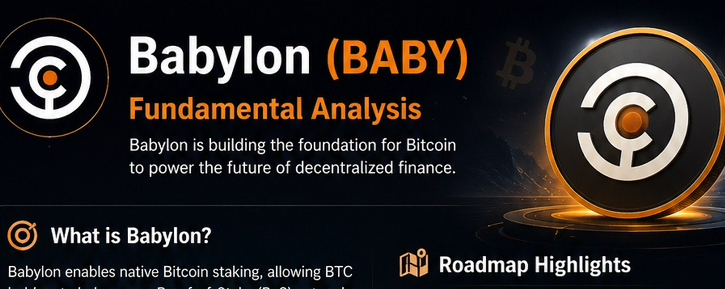
Babylon (BABY): A Comprehensive Fundamental Analysis, Recent Developments & Future Roadmap$Babylon is one of the most interesting Bitcoin-focused projects in the crypto market because it aims to make Bitcoin productive without requiring users to wrap or bridge their BTC. Instead of leaving Bitcoin idle in wallets, Babylon allows it to help secure Proof-of-Stake (PoS) networks while remaining self-custodied. This approach solves one of Bitcoin’s biggest limitations: generating utility without sacrificing security.
One of @Babylon’s biggest milestones was the launch of Babylon Genesis, which introduced native Bitcoin staking as a core part of its ecosystem. This marked an important step toward building what the team calls the BTCFi (Bitcoin Finance) ecosystem, where Bitcoin becomes an active financial asset instead of simply a store of value. (@Babylon Foundation)
The development team has maintained a steady pace of innovation. Recent updates include work on Bitcoin multi-staking, allowing one Bitcoin stake to secure multiple networks simultaneously, expansion of EVM compatibility for easier deployment of DeFi applications, and continued research into trustless Bitcoin liquidity solutions. These upgrades are designed to attract both developers and long-term Bitcoin holders. (@Babylon)
Looking ahead, @Babylon roadmap remains ambitious. The project plans to expand its multi-staking infrastructure, complete EVM integration, improve cross-chain connectivity, and continue developing Trustless Bitcoin Vaults (TBVs). These vaults are expected to let users use Bitcoin as collateral for lending and other DeFi activities without giving up custody of their coins. The team is also working on tokenomics improvements and ecosystem partnerships to strengthen long-term adoption. (@Babylon)
From a fundamental perspective, @Babylon biggest strengths are its focus on Bitcoin security, strong research foundation, and clear long-term vision. Rather than competing directly with other Layer-1 blockchains, it aims to become essential infrastructure for Bitcoin-based decentralized finance. If BTCFi continues to grow over the coming years, @Babylon could become one of the key projects enabling that ecosystem.
However, investors should also consider the risks. @Babylon is still in an early growth phase, and much of its future value depends on successful execution of its roadmap, developer adoption, ecosystem partnerships, and overall crypto market conditions. Competition in the Bitcoin DeFi sector is also increasing, meaning sustained innovation will be necessary.
Overall, @Babylon appears to be a fundamentally strong project with a unique value proposition. While short-term price movements may remain volatile, its long-term success will largely depend on delivering its roadmap and attracting real users, developers, and institutional participation.
#babylon #strategyBtcputchase
#PredictionMarketsCFCTCBacking
Babylon (BABY): A Comprehensive Fundamental Analysis, Recent Developments & Future Roadmap
$Babylon is one of the most interesting Bitcoin-focused projects in the crypto market because it aims to make Bitcoin productive without requiring users to wrap or bridge their BTC. Instead of leaving Bitcoin idle in wallets, Babylon allows it to help secure Proof-of-Stake (PoS) networks while remaining self-custodied. This approach solves one of Bitcoin’s biggest limitations: generating utility without sacrificing security.
One of @Babylon’s biggest milestones was the launch of Babylon Genesis, which introduced native Bitcoin staking as a core part of its ecosystem. This marked an important step toward building what the team calls the BTCFi (Bitcoin Finance) ecosystem, where Bitcoin becomes an active financial asset instead of simply a store of value. (@Babylon Foundation)
The development team has maintained a steady pace of innovation. Recent updates include work on Bitcoin multi-staking, allowing one Bitcoin stake to secure multiple networks simultaneously, expansion of EVM compatibility for easier deployment of DeFi applications, and continued research into trustless Bitcoin liquidity solutions. These upgrades are designed to attract both developers and long-term Bitcoin holders. (@Babylon)
Looking ahead, @Babylon roadmap remains ambitious. The project plans to expand its multi-staking infrastructure, complete EVM integration, improve cross-chain connectivity, and continue developing Trustless Bitcoin Vaults (TBVs). These vaults are expected to let users use Bitcoin as collateral for lending and other DeFi activities without giving up custody of their coins. The team is also working on tokenomics improvements and ecosystem partnerships to strengthen long-term adoption. (@Babylon)
From a fundamental perspective, @Babylon biggest strengths are its focus on Bitcoin security, strong research foundation, and clear long-term vision. Rather than competing directly with other Layer-1 blockchains, it aims to become essential infrastructure for Bitcoin-based decentralized finance. If BTCFi continues to grow over the coming years, @Babylon could become one of the key projects enabling that ecosystem.
However, investors should also consider the risks. @Babylon is still in an early growth phase, and much of its future value depends on successful execution of its roadmap, developer adoption, ecosystem partnerships, and overall crypto market conditions. Competition in the Bitcoin DeFi sector is also increasing, meaning sustained innovation will be necessary.
Overall, @Babylon appears to be a fundamentally strong project with a unique value proposition. While short-term price movements may remain volatile, its long-term success will largely depend on delivering its roadmap and attracting real users, developers, and institutional participation.
#babylon #strategyBtcputchase
#PredictionMarketsCFCTCBacking
One of @Babylon’s biggest milestones was the launch of Babylon Genesis, which introduced native Bitcoin staking as a core part of its ecosystem. This marked an important step toward building what the team calls the BTCFi (Bitcoin Finance) ecosystem, where Bitcoin becomes an active financial asset instead of simply a store of value. (@Babylon Foundation)
The development team has maintained a steady pace of innovation. Recent updates include work on Bitcoin multi-staking, allowing one Bitcoin stake to secure multiple networks simultaneously, expansion of EVM compatibility for easier deployment of DeFi applications, and continued research into trustless Bitcoin liquidity solutions. These upgrades are designed to attract both developers and long-term Bitcoin holders. (@Babylon)
Looking ahead, @Babylon roadmap remains ambitious. The project plans to expand its multi-staking infrastructure, complete EVM integration, improve cross-chain connectivity, and continue developing Trustless Bitcoin Vaults (TBVs). These vaults are expected to let users use Bitcoin as collateral for lending and other DeFi activities without giving up custody of their coins. The team is also working on tokenomics improvements and ecosystem partnerships to strengthen long-term adoption. (@Babylon)
From a fundamental perspective, @Babylon biggest strengths are its focus on Bitcoin security, strong research foundation, and clear long-term vision. Rather than competing directly with other Layer-1 blockchains, it aims to become essential infrastructure for Bitcoin-based decentralized finance. If BTCFi continues to grow over the coming years, @Babylon could become one of the key projects enabling that ecosystem.
However, investors should also consider the risks. @Babylon is still in an early growth phase, and much of its future value depends on successful execution of its roadmap, developer adoption, ecosystem partnerships, and overall crypto market conditions. Competition in the Bitcoin DeFi sector is also increasing, meaning sustained innovation will be necessary.
Overall, @Babylon appears to be a fundamentally strong project with a unique value proposition. While short-term price movements may remain volatile, its long-term success will largely depend on delivering its roadmap and attracting real users, developers, and institutional participation.
#babylon #strategyBtcputchase
#PredictionMarketsCFCTCBacking
71
Log in to explore more content
Join global crypto users on Binance Square
⚡️ Get latest and useful information about crypto.
💬 Trusted by the world’s largest crypto exchange.
👍 Discover real insights from verified creators.
Email / Phone number
Trending Topics
1
#AppleDebutsFoldablePhone
672 views
53 Discussing
2
#US10YTreasuryYieldHitsHighestSinceNov2023
4,303 views
116 Discussing
3
#USTreasuryToBuyBackUpTo$6BLongDatedDebt
8,693 views
127 Discussing
4
#BitcoinSurpasses$79K
53,874 views
250 Discussing
5
#BrentCrudeTops$100
109,585 views
374 Discussing
6
#USADPWeeklyEmploymentRises12000
81,534 views
1,039 Discussing
7
#BankOfAmericaGroupPilotsUSBDCStablecoin
62,374 views
832 Discussing
8
#RippleLobbiesToAdvanceCLARITYActVote
94,566 views
1,086 Discussing
9
#GrayscaleZcashETFTops$500M
14,282 views
123 Discussing
10
#LAPTOPFoundationXAccountSuspended
3,568 views
64 Discussing