
#rsa
rsa
2,950 views
9 Discussing
Hot
Latest

·
--
Came across a pretty substantial DeepMind paper: a human working with AI agents analyzed cryptographic systems and uncovered two weaknesses in older 1024-bit RSA.
One concerns signatures. In the PKCS#1 v1.5 setting, when an attacker can control most of the signature contents, padding adds almost no extra difficulty; the theoretical cost of forging a short digest is also reduced considerably (the official estimate is roughly 1,600-fold—not an end-to-end measurement). In practice, two collaborating agents reproduced and successfully carried out a known 1024-bit instance in under four days, using about 391 core-years—roughly 3.5 times faster than the original report.
The other concerns factoring in batches. With so-called “fan factories,” after precomputation equivalent to one factorization, factoring another 1024-bit modulus of the same size costs only about 1/58 as much as with traditional NFS, and is roughly 30 times cheaper than the main term in Coppersmith’s 1993 MNFS. The algebraic identities were verified in Lean 4, but the full factory hasn’t actually been implemented yet.
The paper is clear: commonly used RSA keys of 2048 bits and above are not within the threat scope. The keys that need to be retired are the old 1024-bit ones still in use.
#DeepMind #RSA #AI
Came across a pretty substantial DeepMind paper: a human working with AI agents analyzed cryptographic systems and uncovered two weaknesses in older 1024-bit RSA.
One concerns signatures. In the PKCS#1 v1.5 setting, when an attacker can control most of the signature contents, padding adds almost no extra difficulty; the theoretical cost of forging a short digest is also reduced considerably (the official estimate is roughly 1,600-fold—not an end-to-end measurement). In practice, two collaborating agents reproduced and successfully carried out a known 1024-bit instance in under four days, using about 391 core-years—roughly 3.5 times faster than the original report.
The other concerns factoring in batches. With so-called “fan factories,” after precomputation equivalent to one factorization, factoring another 1024-bit modulus of the same size costs only about 1/58 as much as with traditional NFS, and is roughly 30 times cheaper than the main term in Coppersmith’s 1993 MNFS. The algebraic identities were verified in Lean 4, but the full factory hasn’t actually been implemented yet.
The paper is clear: commonly used RSA keys of 2048 bits and above are not within the threat scope. The keys that need to be retired are the old 1024-bit ones still in use.
#DeepMind #RSA #AI
One concerns signatures. In the PKCS#1 v1.5 setting, when an attacker can control most of the signature contents, padding adds almost no extra difficulty; the theoretical cost of forging a short digest is also reduced considerably (the official estimate is roughly 1,600-fold—not an end-to-end measurement). In practice, two collaborating agents reproduced and successfully carried out a known 1024-bit instance in under four days, using about 391 core-years—roughly 3.5 times faster than the original report.
The other concerns factoring in batches. With so-called “fan factories,” after precomputation equivalent to one factorization, factoring another 1024-bit modulus of the same size costs only about 1/58 as much as with traditional NFS, and is roughly 30 times cheaper than the main term in Coppersmith’s 1993 MNFS. The algebraic identities were verified in Lean 4, but the full factory hasn’t actually been implemented yet.
The paper is clear: commonly used RSA keys of 2048 bits and above are not within the threat scope. The keys that need to be retired are the old 1024-bit ones still in use.
#DeepMind #RSA #AI

·
--
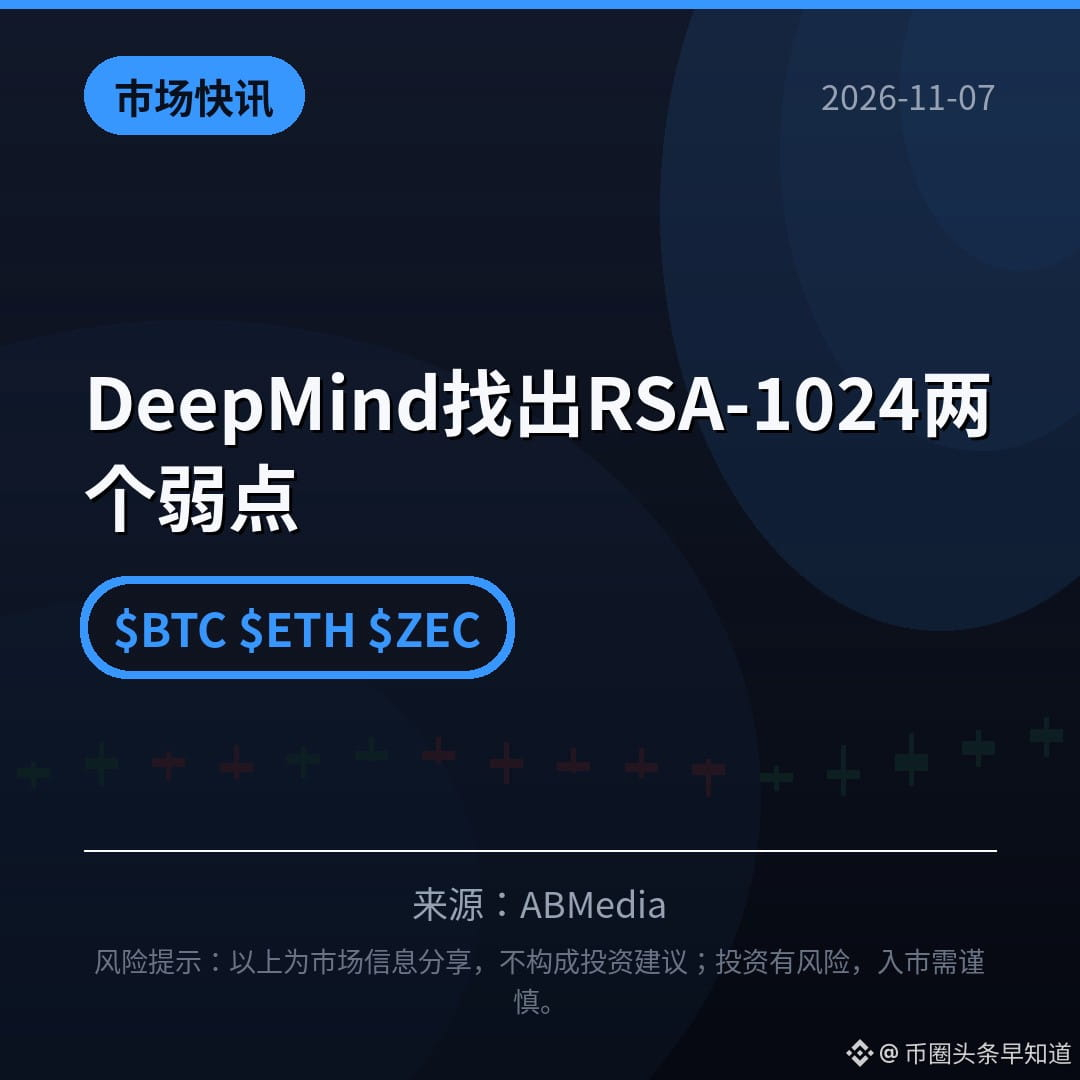
【Market Update】DeepMind Finds Two Weaknesses in RSA-1024
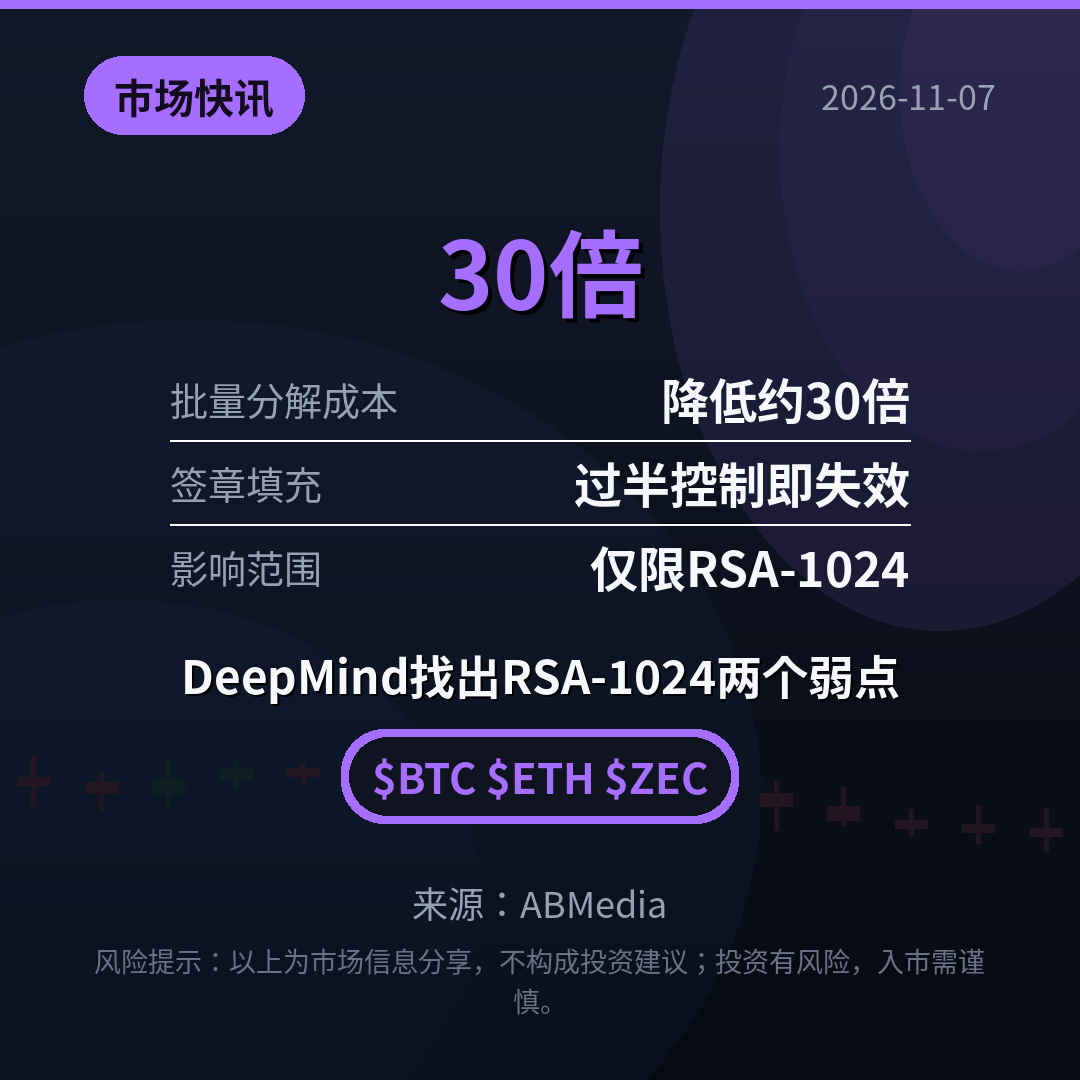
On November 6, DeepMind announced two cryptography studies: AI agents identified two weaknesses in 1024-bit RSA. When an attacker controls more than half of the signed blocks, signature padding protection fails; batch factoring reduces the cost per key by about 30 times. This only affects the deprecated RSA-1024; current 2048-bit protocols remain secure. What do you think?
$BTC $ETH $ZEC
#DeepMind #RSA #Cryptography Security
(Source: ABMedia)
⚠️Risk Disclaimer: The above is shared for market information purposes only and does not constitute investment advice. Investing involves risk; please exercise caution.
【Market Update】DeepMind Finds Two Weaknesses in RSA-1024
On November 6, DeepMind announced two cryptography studies: AI agents identified two weaknesses in 1024-bit RSA. When an attacker controls more than half of the signed blocks, signature padding protection fails; batch factoring reduces the cost per key by about 30 times. This only affects the deprecated RSA-1024; current 2048-bit protocols remain secure. What do you think?
$BTC $ETH $ZEC
#DeepMind #RSA #Cryptography Security
(Source: ABMedia)
⚠️Risk Disclaimer: The above is shared for market information purposes only and does not constitute investment advice. Investing involves risk; please exercise caution.
On November 6, DeepMind announced two cryptography studies: AI agents identified two weaknesses in 1024-bit RSA. When an attacker controls more than half of the signed blocks, signature padding protection fails; batch factoring reduces the cost per key by about 30 times. This only affects the deprecated RSA-1024; current 2048-bit protocols remain secure. What do you think?
$BTC $ETH $ZEC
#DeepMind #RSA #Cryptography Security
(Source: ABMedia)
⚠️Risk Disclaimer: The above is shared for market information purposes only and does not constitute investment advice. Investing involves risk; please exercise caution.
10

$NVDAB world cup fever is upon us standing firm behind our nation even though we lost our opening match stronger together we keep our heads high and focus on our upcoming matches Bafana Bafana#RSA #BinancePickAndWin
$NVDAB world cup fever is upon us standing firm behind our nation even though we lost our opening match stronger together we keep our heads high and focus on our upcoming matches Bafana Bafana#RSA #BinancePickAndWin
9
Log in to explore more content
Join global crypto users on Binance Square
⚡️ Get latest and useful information about crypto.
💬 Trusted by the world’s largest crypto exchange.
👍 Discover real insights from verified creators.
Email / Phone number
Trending Topics
1
#JobsReportRaisesHikeOdds
575,848 views
3,607 Discussing
2
#CPITestsDecemberRateOutlook
183,650 views
1,298 Discussing
3
#US Data Center Rules May Constrain AI Expansion
80,550 views
236 Discussing
4
#ARKPlans14ThematicETFsCoveringAIAndTokenizedMarkets
5,085 views
74 Discussing
5
#WillAnthropicListOnTime
179,012 views
1,514 Discussing
6
#WillUS-IranTensionsBoostSafe-HavenDemand?
86,151 views
612 Discussing
7
#BitcoinETFsSee$412MNetOutflows
17,533 views
81 Discussing
8
#HKSFCPlansToRestrictCryptoAndExchangeTerms
71,310 views
624 Discussing
9
#TradFiForBeginners
102,468 views
1,103 Discussing
10
#FinCENAndFedWithdraw$250CryptoTransferProposal
10,886 views
19 Discussing