

#onchaintrust
onchaintrust
1,073 views
28 Discussing
Hot
Latest
·
--
Article
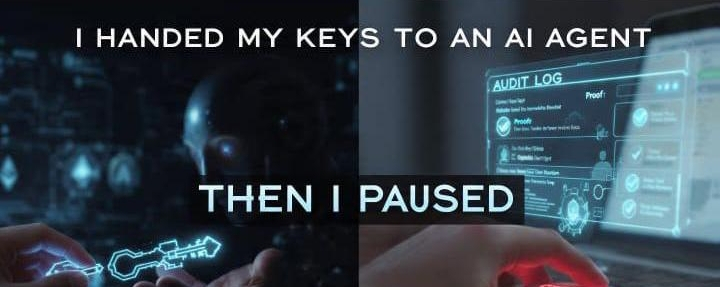
**Everyone's clapping at AI agent demos.
I'm just wondering... who's watching the agent? 🤔****Everyone's clapping at AI agent demos.
I'm just wondering... who's watching the agent? 🤔**
For years crypto said *"don't trust, verify"*.
*We left banks because we didn't want someone else deciding for our money.*
Now we're handing keys to software that thinks faster than us.
And we're calling it progress.
But we talk about both like the risk is the same.
That's why @NewtonProtocol caught my Attention.
Not for another AI narrative. God knows we have enough.
But because it asks the question nobody wants to sit with:
*What happens AFTER the AI clicks "confirm"?*
AI is smart enough to read 10 chains & pick "best" APY.
The problem is Proof.
If my agent drains my wallet at 3am...
What do I tell my future self?
"The model decided it was optimal"?
That's not an answer. That's a shrug.
**> *Seatbelts were invisible... until they weren't.*
*> Security is like that. Nobody cares until the crash.**
Newton doesn't pretend AI is perfect.
It doesn't sell "set and forget".
It builds a layer where AI can act,
but every action leaves a cryptographic proof.
Not a log file anyone can fake.
Something you can actually check.
Let the agent work inside boundaries you set.
And make sure you can see WHY it did what it did?
$NEWT isn't selling hype.
It's building seatbelts for the AI age.
Boring right now. Obvious later.
If AI will manage money, "I think it worked" can't be the standard anymore.
It has to be "I can prove it worked".
*Agree? Type PROOF if you agree.*
#verifiableAI #OnChainTrust $NEWT
**Everyone's clapping at AI agent demos. I'm just wondering... who's watching the agent? 🤔**
**Everyone's clapping at AI agent demos.
I'm just wondering... who's watching the agent? 🤔**
For years crypto said *"don't trust, verify"*.
*We left banks because we didn't want someone else deciding for our money.*
Now we're handing keys to software that thinks faster than us.
And we're calling it progress.
But we talk about both like the risk is the same.
That's why @NewtonProtocol caught my Attention.
Not for another AI narrative. God knows we have enough.
But because it asks the question nobody wants to sit with:
*What happens AFTER the AI clicks "confirm"?*
AI is smart enough to read 10 chains & pick "best" APY.
The problem is Proof.
If my agent drains my wallet at 3am...
What do I tell my future self?
"The model decided it was optimal"?
That's not an answer. That's a shrug.
**> *Seatbelts were invisible... until they weren't.*
*> Security is like that. Nobody cares until the crash.**
Newton doesn't pretend AI is perfect.
It doesn't sell "set and forget".
It builds a layer where AI can act,
but every action leaves a cryptographic proof.
Not a log file anyone can fake.
Something you can actually check.
Let the agent work inside boundaries you set.
And make sure you can see WHY it did what it did?
$NEWT isn't selling hype.
It's building seatbelts for the AI age.
Boring right now. Obvious later.
If AI will manage money, "I think it worked" can't be the standard anymore.
It has to be "I can prove it worked".
*Agree? Type PROOF if you agree.*
#verifiableAI #OnChainTrust $NEWT
I'm just wondering... who's watching the agent? 🤔**
For years crypto said *"don't trust, verify"*.
*We left banks because we didn't want someone else deciding for our money.*
Now we're handing keys to software that thinks faster than us.
And we're calling it progress.
But we talk about both like the risk is the same.
That's why @NewtonProtocol caught my Attention.
Not for another AI narrative. God knows we have enough.
But because it asks the question nobody wants to sit with:
*What happens AFTER the AI clicks "confirm"?*
AI is smart enough to read 10 chains & pick "best" APY.
The problem is Proof.
If my agent drains my wallet at 3am...
What do I tell my future self?
"The model decided it was optimal"?
That's not an answer. That's a shrug.
**> *Seatbelts were invisible... until they weren't.*
*> Security is like that. Nobody cares until the crash.**
Newton doesn't pretend AI is perfect.
It doesn't sell "set and forget".
It builds a layer where AI can act,
but every action leaves a cryptographic proof.
Not a log file anyone can fake.
Something you can actually check.
Let the agent work inside boundaries you set.
And make sure you can see WHY it did what it did?
$NEWT isn't selling hype.
It's building seatbelts for the AI age.
Boring right now. Obvious later.
If AI will manage money, "I think it worked" can't be the standard anymore.
It has to be "I can prove it worked".
*Agree? Type PROOF if you agree.*
#verifiableAI #OnChainTrust $NEWT
16
6
133

·
--

Article
Why $SIGN is here to stayTrends come and go.
Infrastructure endures.
The reason $SIGN is positioned to last isn’t rooted in speculation it’s anchored in utility that solves a persistent problem: how to establish trust in a trustless environment.
At its core, @ethsign is not building for cycles. It is engineering a system where agreements, attestations, and identities can be verified without reliance on centralized authorities. That need does not disappear with market conditions — it intensifies as more value, coordination, and governance move on-chain.
$SIGN exists within that framework as more than a transactional asset. It facilitates participation, aligns incentives, and underpins the mechanics of verifiable commitments across a decentralized stack.
What makes it durable is simple:
The demand for trust-minimized agreements is permanent
The shift toward digital sovereignty is accelerating
The infrastructure layer is still early, but inevitable
Markets may fluctuate, narratives may rotate — but systems that redefine how humans coordinate tend to outlive both.
$SIGN isn’t here for attention.
It’s here because the future requires it.
#SignDigitalSovereignInfr a #Web3Infrastructur e #OnChainTrust t #DigitalSovereignt
Why $SIGN is here to stay
Trends come and go.
Infrastructure endures.
The reason $SIGN is positioned to last isn’t rooted in speculation it’s anchored in utility that solves a persistent problem: how to establish trust in a trustless environment.
At its core, @ethsign is not building for cycles. It is engineering a system where agreements, attestations, and identities can be verified without reliance on centralized authorities. That need does not disappear with market conditions — it intensifies as more value, coordination, and governance move on-chain.
$SIGN exists within that framework as more than a transactional asset. It facilitates participation, aligns incentives, and underpins the mechanics of verifiable commitments across a decentralized stack.
What makes it durable is simple:
The demand for trust-minimized agreements is permanent
The shift toward digital sovereignty is accelerating
The infrastructure layer is still early, but inevitable
Markets may fluctuate, narratives may rotate — but systems that redefine how humans coordinate tend to outlive both.
$SIGN isn’t here for attention.
It’s here because the future requires it.
#SignDigitalSovereignInfr a #Web3Infrastructur e #OnChainTrust t #DigitalSovereignt
Infrastructure endures.
The reason $SIGN is positioned to last isn’t rooted in speculation it’s anchored in utility that solves a persistent problem: how to establish trust in a trustless environment.
At its core, @ethsign is not building for cycles. It is engineering a system where agreements, attestations, and identities can be verified without reliance on centralized authorities. That need does not disappear with market conditions — it intensifies as more value, coordination, and governance move on-chain.
$SIGN exists within that framework as more than a transactional asset. It facilitates participation, aligns incentives, and underpins the mechanics of verifiable commitments across a decentralized stack.
What makes it durable is simple:
The demand for trust-minimized agreements is permanent
The shift toward digital sovereignty is accelerating
The infrastructure layer is still early, but inevitable
Markets may fluctuate, narratives may rotate — but systems that redefine how humans coordinate tend to outlive both.
$SIGN isn’t here for attention.
It’s here because the future requires it.
#SignDigitalSovereignInfr a #Web3Infrastructur e #OnChainTrust t #DigitalSovereignt
2
49
Log in to explore more content
Join global crypto users on Binance Square
⚡️ Get latest and useful information about crypto.
💬 Trusted by the world’s largest crypto exchange.
👍 Discover real insights from verified creators.
Email / Phone number
Trending Topics
1
#EthereumDropsBelow$2300
1,814 views
77 Discussing
2
#BitcoinSlipsBelow$80KAgain
4,694 views
46 Discussing
3
#ThailandLaunchesWORPTStablecoinToQRPaymentApp
7,726 views
210 Discussing
4
#StrategySkipsBitcoinPurchasesSpends$205MOnSTRCBuybacks
4,317 views
75 Discussing
5
#BitmineAdds10452ETH
45,415 views
659 Discussing
6
#SouthKoreaConsidersEducationTaxOnCryptoExchanges
25,570 views
521 Discussing
7
#OCCUrgesCommunityBanksToEnterStablecoinPayments
19,814 views
356 Discussing
8
#RippleWinsFullApprovalAsNationalTrustBank
27,463 views
347 Discussing
9
#AkashSelectsSolanaAsMigrationTarget
12,577 views
170 Discussing
10
#OndoToOpenSubscriptionsForOpenAIPreIPOTokenizedNotes
728 views
25 Discussing