
#hyperliquid
hyperliquid
6M views
13,391 Discussing
Hot
Latest

·
--
Bullish
🔥 HYPE Analysis — Is Hyperliquid Still a Strong Buy?
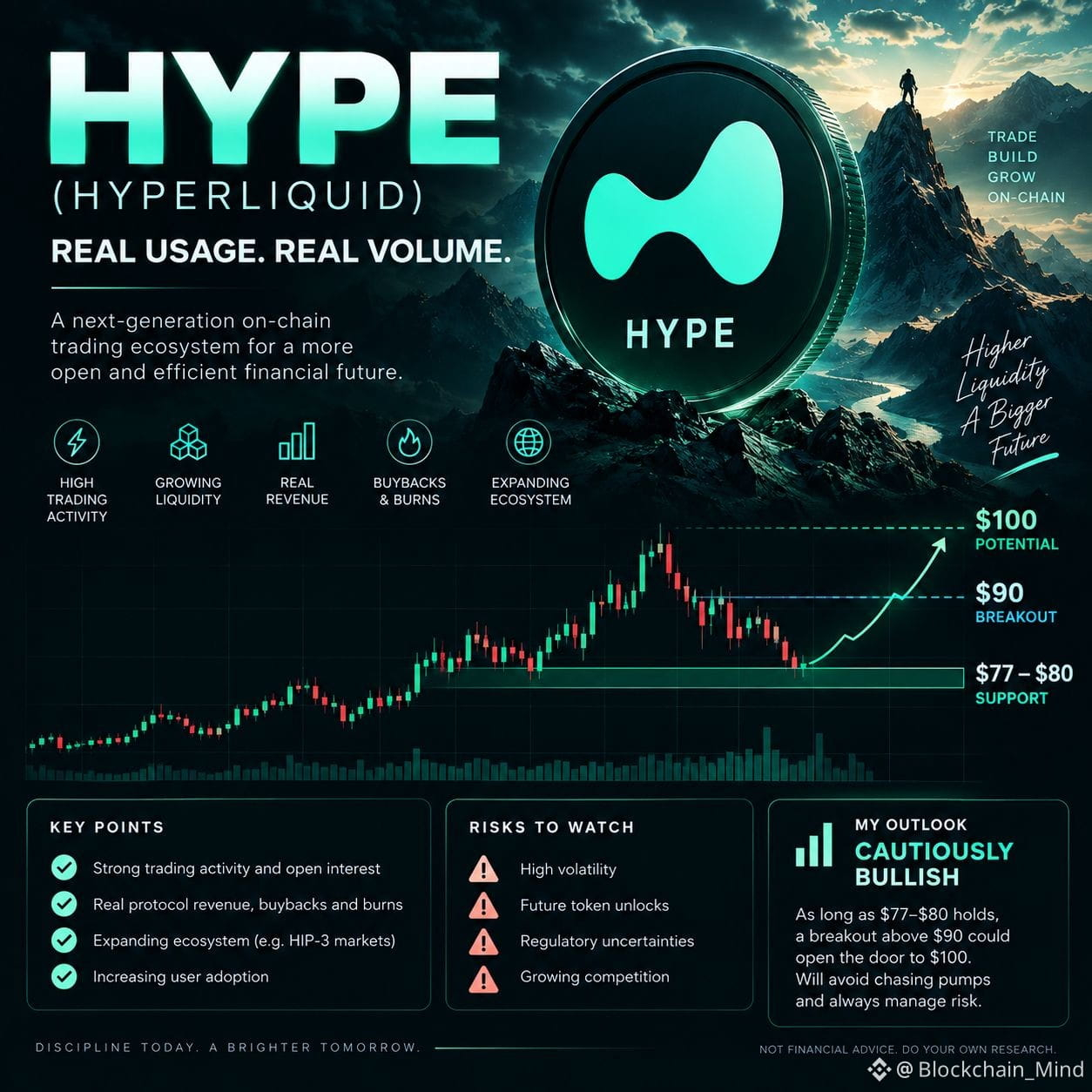
HYPE remains one of the most interesting altcoins to watch. Hyperliquid has built a strong decentralized trading ecosystem, with high trading activity, growing liquidity and increasing open interest.
The token is currently trading around the $80 area after pulling back from the $86–$90 zone.
📈 Bullish Case
If HYPE can hold the $77–$80 support zone and break above $90 with strong volume, the next psychological target could be around $100.
The biggest strength of HYPE is its connection to Hyperliquid's real protocol activity. Revenue, buybacks and token burns can create stronger fundamental support than purely speculative altcoins.
⚠️ Risks
HYPE has already experienced a major price increase, so volatility remains high. Future token unlocks could also create selling pressure, while competition and regulatory risks should not be ignored.
🎯 My Opinion
I remain cautiously bullish on HYPE.
I would watch $77–$80 closely. Holding this area keeps the bullish structure alive, while a confirmed breakout above $90 could signal another strong move.
Personally, I would avoid chasing a sudden pump and instead wait for confirmation and manage risk carefully.
Not financial advice. Always do your own research before investing.
#Hyperliquid
$HYPER
{spot}(HYPERUSDT)
#bnb $BNB
{future}(BNBUSDT)
🔥 HYPE Analysis — Is Hyperliquid Still a Strong Buy?
HYPE remains one of the most interesting altcoins to watch. Hyperliquid has built a strong decentralized trading ecosystem, with high trading activity, growing liquidity and increasing open interest.
The token is currently trading around the $80 area after pulling back from the $86–$90 zone.
📈 Bullish Case
If HYPE can hold the $77–$80 support zone and break above $90 with strong volume, the next psychological target could be around $100.
The biggest strength of HYPE is its connection to Hyperliquid's real protocol activity. Revenue, buybacks and token burns can create stronger fundamental support than purely speculative altcoins.
⚠️ Risks
HYPE has already experienced a major price increase, so volatility remains high. Future token unlocks could also create selling pressure, while competition and regulatory risks should not be ignored.
🎯 My Opinion
I remain cautiously bullish on HYPE.
I would watch $77–$80 closely. Holding this area keeps the bullish structure alive, while a confirmed breakout above $90 could signal another strong move.
Personally, I would avoid chasing a sudden pump and instead wait for confirmation and manage risk carefully.
Not financial advice. Always do your own research before investing.
#Hyperliquid
$HYPER
#bnb $BNB
HYPE remains one of the most interesting altcoins to watch. Hyperliquid has built a strong decentralized trading ecosystem, with high trading activity, growing liquidity and increasing open interest.
The token is currently trading around the $80 area after pulling back from the $86–$90 zone.
📈 Bullish Case
If HYPE can hold the $77–$80 support zone and break above $90 with strong volume, the next psychological target could be around $100.
The biggest strength of HYPE is its connection to Hyperliquid's real protocol activity. Revenue, buybacks and token burns can create stronger fundamental support than purely speculative altcoins.
⚠️ Risks
HYPE has already experienced a major price increase, so volatility remains high. Future token unlocks could also create selling pressure, while competition and regulatory risks should not be ignored.
🎯 My Opinion
I remain cautiously bullish on HYPE.
I would watch $77–$80 closely. Holding this area keeps the bullish structure alive, while a confirmed breakout above $90 could signal another strong move.
Personally, I would avoid chasing a sudden pump and instead wait for confirmation and manage risk carefully.
Not financial advice. Always do your own research before investing.
#Hyperliquid
$HYPER
#bnb $BNB
115

·
--
Article
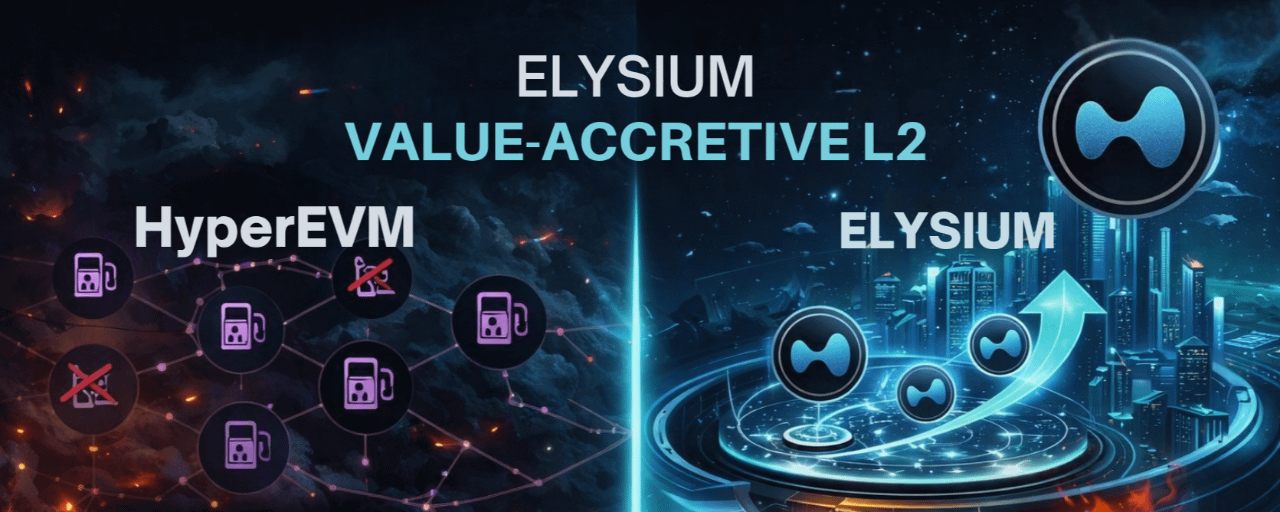
Elysium: A New Era for Hyperliquid – Analyzing the First Value-Accretive L2In Web3 today, a lot of activities has been happening and layer 2 (L2) solutions have become the backbone of scaling blockchains, but most follow a familiar pattern: they extract value from their Layer 1 (L1) without returning it. Arbitrum, Optimism, and zkSync all rely on #Ethereum for settlement, yet their sequencer fees and gas dynamics accrue primarily to the L2 operators, not Ethereum stakers. Hyperliquid’s Elysium breaks this mold. It is designed not as a parasitic L2, but as a value-accretive engine that strengthens #Hyperliquid and #Kinetiq at their core.
Traditional L2s vs. Elysium
Traditional L2s:Gas is paid in ETH, but sequencer fees flow to the L2 operator.Ethereum acts as a settlement layer, not a growth engine.Value leakage: activity on the L2 does not directly reinforce Ethereum’s token economy.Elysium:Gas is paid in HYPE, embedding demand for Hyperliquid’s native token.Sequencer fees are redistributed to builders, the treasury, and KNTQ buy & burn.Instead of siphoning value, Elysium recycles it back into Hyperliquid and Kinetiq, creating a closed-loop economy.
This makes Elysium the first L2 designed to amplify its parent ecosystem rather than drain it.
Why Hyperliquid Needs Elysium Now
Hyperliquid’s HyperEVM has been a powerful foundation for decentralized perpetuals, but it faces bottlenecks:
Throughput limits: Spot trading and PropAMMs are constrained by execution ceilings.Latency: Builders deploying new markets encounter delays in settlement and liquidity routing.Scalability gap: Without higher throughput, Hyperliquid risks losing ground to faster competitors.
Elysium addresses these pain points by unlocking high-performance rails for spot trading, programmable AMMs, and token launches, all natively integrated into Hyperliquid.
Core Innovations of Elysium
HYPE as GasEvery transaction consumes HYPE, creating direct demand pressure.Unlike ETH-based L2s, this ensures Hyperliquid’s native token is the heartbeat of the system.Supercharged Spot Trading & PropAMMsElysium enables high-throughput spot markets and programmable AMMs.Builders can deploy custom liquidity strategies without hitting HyperEVM’s ceiling.This expands market diversity and deepens liquidity.Token Generation LifecycleElysium provides rails for new token launches directly within Hyperliquid.Projects can bootstrap liquidity, integrate with PropAMMs, and plug into Kinetiq’s staking ecosystem.This keeps innovation native, rather than forcing projects to migrate elsewhere.
Sequencer Fee Model – Aligning Incentives
Elysium’s fee distribution is radical in its alignment:
25% → Builders: Rewards innovation and market creation.25% → Treasury: Funds ecosystem growth, audits, and security.50% → KNTQ Buy & Burn: Permanently reduces supply, making KNTQ hyper-deflationary.
This model ensures:
Builders are incentivized to expand the ecosystem.The treasury sustains long-term resilience.KNTQ holders benefit from relentless deflation, turning governance into a value-capturing asset.
Human-Centric Perspective
For traders, Elysium means faster, cheaper markets.
For builders, it means direct rewards for innovation.
For holders, it means their governance token becomes scarcer with every block.
This is economic engineering. By embedding $HYPE into gas and routing sequencer fees into KNTQ deflation, Hyperliquid and Kinetiq have created a closed-loop system where every transaction strengthens the core.
Conclusion
Elysium represents a new era for Hyperliquid: the first L2 that accrues value back to its parent ecosystem. It solves HyperEVM’s bottlenecks, supercharges trading and token launches, and introduces a sequencer fee model that makes KNTQ structurally deflationary.
If successful, Elysium could set a precedent for how L2s should be designed not as extractors, but as amplifiers of their L1s. Hyperliquid doesn’t just need Elysium; it needs it now, as the technical and economic lifeline that ensures its long-term dominance.
#Write2Earn #BitcoinReboundsTo$79K
Elysium: A New Era for Hyperliquid – Analyzing the First Value-Accretive L2
In Web3 today, a lot of activities has been happening and layer 2 (L2) solutions have become the backbone of scaling blockchains, but most follow a familiar pattern: they extract value from their Layer 1 (L1) without returning it. Arbitrum, Optimism, and zkSync all rely on #Ethereum for settlement, yet their sequencer fees and gas dynamics accrue primarily to the L2 operators, not Ethereum stakers. Hyperliquid’s Elysium breaks this mold. It is designed not as a parasitic L2, but as a value-accretive engine that strengthens #Hyperliquid and #Kinetiq at their core.
Traditional L2s vs. Elysium
Traditional L2s:Gas is paid in ETH, but sequencer fees flow to the L2 operator.Ethereum acts as a settlement layer, not a growth engine.Value leakage: activity on the L2 does not directly reinforce Ethereum’s token economy.Elysium:Gas is paid in HYPE, embedding demand for Hyperliquid’s native token.Sequencer fees are redistributed to builders, the treasury, and KNTQ buy & burn.Instead of siphoning value, Elysium recycles it back into Hyperliquid and Kinetiq, creating a closed-loop economy.
This makes Elysium the first L2 designed to amplify its parent ecosystem rather than drain it.
Why Hyperliquid Needs Elysium Now
Hyperliquid’s HyperEVM has been a powerful foundation for decentralized perpetuals, but it faces bottlenecks:
Throughput limits: Spot trading and PropAMMs are constrained by execution ceilings.Latency: Builders deploying new markets encounter delays in settlement and liquidity routing.Scalability gap: Without higher throughput, Hyperliquid risks losing ground to faster competitors.
Elysium addresses these pain points by unlocking high-performance rails for spot trading, programmable AMMs, and token launches, all natively integrated into Hyperliquid.
Core Innovations of Elysium
HYPE as GasEvery transaction consumes HYPE, creating direct demand pressure.Unlike ETH-based L2s, this ensures Hyperliquid’s native token is the heartbeat of the system.Supercharged Spot Trading & PropAMMsElysium enables high-throughput spot markets and programmable AMMs.Builders can deploy custom liquidity strategies without hitting HyperEVM’s ceiling.This expands market diversity and deepens liquidity.Token Generation LifecycleElysium provides rails for new token launches directly within Hyperliquid.Projects can bootstrap liquidity, integrate with PropAMMs, and plug into Kinetiq’s staking ecosystem.This keeps innovation native, rather than forcing projects to migrate elsewhere.
Sequencer Fee Model – Aligning Incentives
Elysium’s fee distribution is radical in its alignment:
25% → Builders: Rewards innovation and market creation.25% → Treasury: Funds ecosystem growth, audits, and security.50% → KNTQ Buy & Burn: Permanently reduces supply, making KNTQ hyper-deflationary.
This model ensures:
Builders are incentivized to expand the ecosystem.The treasury sustains long-term resilience.KNTQ holders benefit from relentless deflation, turning governance into a value-capturing asset.
Human-Centric Perspective
For traders, Elysium means faster, cheaper markets.
For builders, it means direct rewards for innovation.
For holders, it means their governance token becomes scarcer with every block.
This is economic engineering. By embedding $HYPE into gas and routing sequencer fees into KNTQ deflation, Hyperliquid and Kinetiq have created a closed-loop system where every transaction strengthens the core.
Conclusion
Elysium represents a new era for Hyperliquid: the first L2 that accrues value back to its parent ecosystem. It solves HyperEVM’s bottlenecks, supercharges trading and token launches, and introduces a sequencer fee model that makes KNTQ structurally deflationary.
If successful, Elysium could set a precedent for how L2s should be designed not as extractors, but as amplifiers of their L1s. Hyperliquid doesn’t just need Elysium; it needs it now, as the technical and economic lifeline that ensures its long-term dominance.
#Write2Earn #BitcoinReboundsTo$79K
Traditional L2s vs. Elysium
Traditional L2s:Gas is paid in ETH, but sequencer fees flow to the L2 operator.Ethereum acts as a settlement layer, not a growth engine.Value leakage: activity on the L2 does not directly reinforce Ethereum’s token economy.Elysium:Gas is paid in HYPE, embedding demand for Hyperliquid’s native token.Sequencer fees are redistributed to builders, the treasury, and KNTQ buy & burn.Instead of siphoning value, Elysium recycles it back into Hyperliquid and Kinetiq, creating a closed-loop economy.
This makes Elysium the first L2 designed to amplify its parent ecosystem rather than drain it.
Why Hyperliquid Needs Elysium Now
Hyperliquid’s HyperEVM has been a powerful foundation for decentralized perpetuals, but it faces bottlenecks:
Throughput limits: Spot trading and PropAMMs are constrained by execution ceilings.Latency: Builders deploying new markets encounter delays in settlement and liquidity routing.Scalability gap: Without higher throughput, Hyperliquid risks losing ground to faster competitors.
Elysium addresses these pain points by unlocking high-performance rails for spot trading, programmable AMMs, and token launches, all natively integrated into Hyperliquid.
Core Innovations of Elysium
HYPE as GasEvery transaction consumes HYPE, creating direct demand pressure.Unlike ETH-based L2s, this ensures Hyperliquid’s native token is the heartbeat of the system.Supercharged Spot Trading & PropAMMsElysium enables high-throughput spot markets and programmable AMMs.Builders can deploy custom liquidity strategies without hitting HyperEVM’s ceiling.This expands market diversity and deepens liquidity.Token Generation LifecycleElysium provides rails for new token launches directly within Hyperliquid.Projects can bootstrap liquidity, integrate with PropAMMs, and plug into Kinetiq’s staking ecosystem.This keeps innovation native, rather than forcing projects to migrate elsewhere.
Sequencer Fee Model – Aligning Incentives
Elysium’s fee distribution is radical in its alignment:
25% → Builders: Rewards innovation and market creation.25% → Treasury: Funds ecosystem growth, audits, and security.50% → KNTQ Buy & Burn: Permanently reduces supply, making KNTQ hyper-deflationary.
This model ensures:
Builders are incentivized to expand the ecosystem.The treasury sustains long-term resilience.KNTQ holders benefit from relentless deflation, turning governance into a value-capturing asset.
Human-Centric Perspective
For traders, Elysium means faster, cheaper markets.
For builders, it means direct rewards for innovation.
For holders, it means their governance token becomes scarcer with every block.
This is economic engineering. By embedding $HYPE into gas and routing sequencer fees into KNTQ deflation, Hyperliquid and Kinetiq have created a closed-loop system where every transaction strengthens the core.
Conclusion
Elysium represents a new era for Hyperliquid: the first L2 that accrues value back to its parent ecosystem. It solves HyperEVM’s bottlenecks, supercharges trading and token launches, and introduces a sequencer fee model that makes KNTQ structurally deflationary.
If successful, Elysium could set a precedent for how L2s should be designed not as extractors, but as amplifiers of their L1s. Hyperliquid doesn’t just need Elysium; it needs it now, as the technical and economic lifeline that ensures its long-term dominance.
#Write2Earn #BitcoinReboundsTo$79K
94

·
--
Bearish
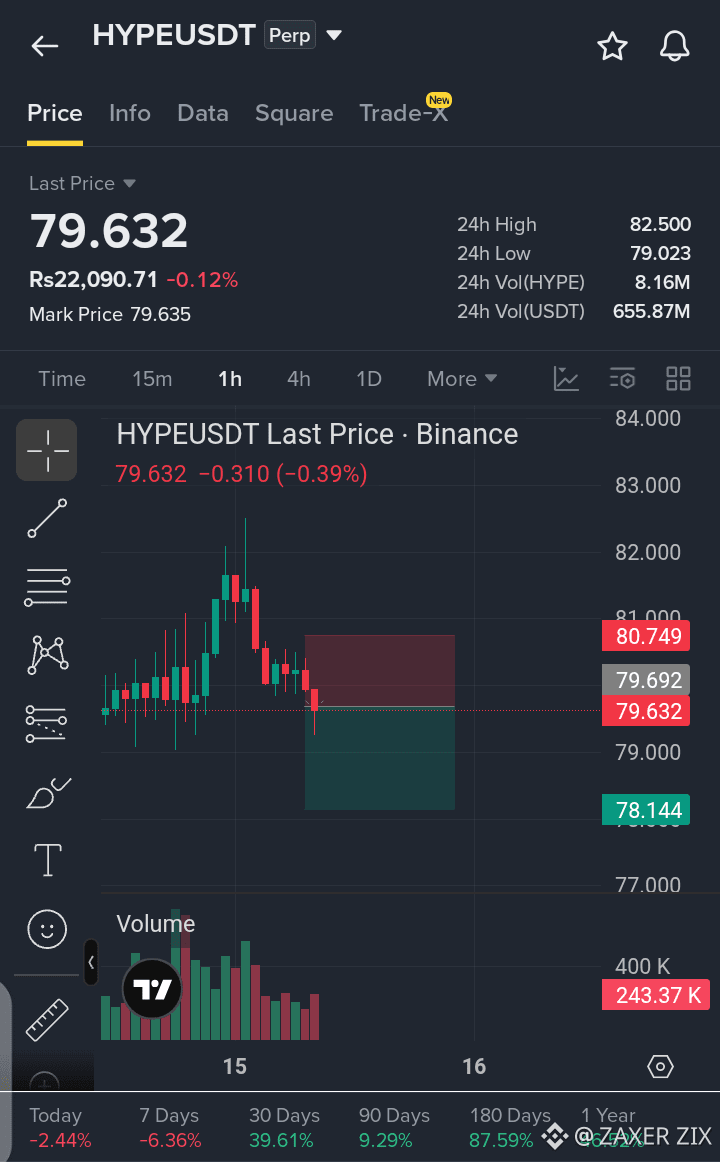
$HYPE is entering the short zone...🔻
SHORT: $79.40–$80.90
TP1: $78
TP2: $77
SL: $82
Manage your risk.
{future}(HYPEUSDT)
#Hyperliquid #hypeusdt #SHORT📉
$HYPE is entering the short zone...🔻
SHORT: $79.40–$80.90
TP1: $78
TP2: $77
SL: $82
Manage your risk.
#Hyperliquid #hypeusdt #SHORT📉
SHORT: $79.40–$80.90
TP1: $78
TP2: $77
SL: $82
Manage your risk.
#Hyperliquid #hypeusdt #SHORT📉
2
1
76

Binance might squeeze HYPE buybacks
Hyperliquid has been flying on token buybacks, but Binance competition might starve the revenue stream needed to keep the momentum alive. This could be a major headwind for HYPE.
#Hyperliquid #BuybackSustainability
Binance might squeeze HYPE buybacks
Hyperliquid has been flying on token buybacks, but Binance competition might starve the revenue stream needed to keep the momentum alive. This could be a major headwind for HYPE.
#Hyperliquid #BuybackSustainability
Hyperliquid has been flying on token buybacks, but Binance competition might starve the revenue stream needed to keep the momentum alive. This could be a major headwind for HYPE.
#Hyperliquid #BuybackSustainability
37

$HYPE SUPPLY SHRINKING FAST AS HYPERLIQUID ERASES $3.88B FROM CIRCULATION PERMANENTLY! 🔒💥
Smart money mechanics in full effect. Hyperliquid just devoured another 17,710 $HYPE off the market in 24 hours at $78.37, pushing cumulative burns to a staggering 48.6 million tokens. 🦈
That is nearly 5% of the total 1 billion supply permanently vaporized, representing $3.88 billion in locked liquidity value. 🔒 When a protocol aggressively bids and burns its own supply at scale, sell-side liquidity thins out rapidly, turning every sustained bid into potential explosive momentum. 📊
How long before this massive structural supply squeeze forces an aggressive reprice across the board? 👇
⚠️ Not financial advice. Always manage your risk. 🛡️
🏷️ #HYPE #Hyperliquid #TokenBurn #Crypto
🔥 ⚡
$HYPE SUPPLY SHRINKING FAST AS HYPERLIQUID ERASES $3.88B FROM CIRCULATION PERMANENTLY! 🔒💥
Smart money mechanics in full effect. Hyperliquid just devoured another 17,710 $HYPE off the market in 24 hours at $78.37, pushing cumulative burns to a staggering 48.6 million tokens. 🦈
That is nearly 5% of the total 1 billion supply permanently vaporized, representing $3.88 billion in locked liquidity value. 🔒 When a protocol aggressively bids and burns its own supply at scale, sell-side liquidity thins out rapidly, turning every sustained bid into potential explosive momentum. 📊
How long before this massive structural supply squeeze forces an aggressive reprice across the board? 👇
⚠️ Not financial advice. Always manage your risk. 🛡️
🏷️ #HYPE #Hyperliquid #TokenBurn #Crypto
🔥 ⚡
Smart money mechanics in full effect. Hyperliquid just devoured another 17,710 $HYPE off the market in 24 hours at $78.37, pushing cumulative burns to a staggering 48.6 million tokens. 🦈
That is nearly 5% of the total 1 billion supply permanently vaporized, representing $3.88 billion in locked liquidity value. 🔒 When a protocol aggressively bids and burns its own supply at scale, sell-side liquidity thins out rapidly, turning every sustained bid into potential explosive momentum. 📊
How long before this massive structural supply squeeze forces an aggressive reprice across the board? 👇
⚠️ Not financial advice. Always manage your risk. 🛡️
🏷️ #HYPE #Hyperliquid #TokenBurn #Crypto
🔥 ⚡
32

·
--
Hyperliquid ($HYPE) Gains Momentum with Strong Volume
Hyperliquid ($HYPE) is trending with a robust 24-hour volume of $516M, placing it at the #6 spot. Despite a modest 1.53% gain, the liquidity and market interest are significant. $HYPE is known for its innovative trading and lending protocols, attracting traders and institutions. The strong volume indicates ongoing institutional activity and market confidence. Traders should watch for any major developments that could further boost momentum. ⚡
Follow for more crypto setups.
#HahaProfit #Hyperliquid
Hyperliquid ($HYPE ) Gains Momentum with Strong Volume
Hyperliquid ($HYPE ) is trending with a robust 24-hour volume of $516M, placing it at the #6 spot. Despite a modest 1.53% gain, the liquidity and market interest are significant. $HYPE is known for its innovative trading and lending protocols, attracting traders and institutions. The strong volume indicates ongoing institutional activity and market confidence. Traders should watch for any major developments that could further boost momentum. ⚡
Follow for more crypto setups.
#HahaProfit #Hyperliquid
Hyperliquid ($HYPE ) is trending with a robust 24-hour volume of $516M, placing it at the #6 spot. Despite a modest 1.53% gain, the liquidity and market interest are significant. $HYPE is known for its innovative trading and lending protocols, attracting traders and institutions. The strong volume indicates ongoing institutional activity and market confidence. Traders should watch for any major developments that could further boost momentum. ⚡
Follow for more crypto setups.
#HahaProfit #Hyperliquid
1

·
--
Hyperliquid $HYPE Gains Momentum with High Volume
Hyperliquid ($HYPE) is trending with a 24h volume of $516M, placing it at #6 in trending rank. The coin is seeing increased interest, likely due to its robust liquidity and low fees. $HYPE’s recent 1.55% price gain is modest, but the high volume suggests strong underlying demand. Traders should keep an eye on this high-cap asset as it continues to attract attention. ⚡
Follow for daily crypto updates.
#DeGenYuv #Hyperliquid
Hyperliquid $HYPE Gains Momentum with High Volume
Hyperliquid ($HYPE ) is trending with a 24h volume of $516M, placing it at #6 in trending rank. The coin is seeing increased interest, likely due to its robust liquidity and low fees. $HYPE ’s recent 1.55% price gain is modest, but the high volume suggests strong underlying demand. Traders should keep an eye on this high-cap asset as it continues to attract attention. ⚡
Follow for daily crypto updates.
#DeGenYuv #Hyperliquid
Hyperliquid ($HYPE ) is trending with a 24h volume of $516M, placing it at #6 in trending rank. The coin is seeing increased interest, likely due to its robust liquidity and low fees. $HYPE ’s recent 1.55% price gain is modest, but the high volume suggests strong underlying demand. Traders should keep an eye on this high-cap asset as it continues to attract attention. ⚡
Follow for daily crypto updates.
#DeGenYuv #Hyperliquid
34

·
--
Bullish
🚨 $HYPE FUTURES — 79.567. BULLS READY FOR 90 OR BEARS TAKE CONTROL?
{future}(HYPEUSDT)
$HYPE — 79.567 | +0.16%
HYPE is sitting at a key decision area.
The next confirmed move could create a much bigger futures setup.
No blind entry. No chasing. Watch the levels.
🔥 HYPE FUTURES TRADE MAP
79.567 — Current Price
↓
🎯 82.00 — First Target
↓
🔥 84.00 — Breakout Trigger
↓
🚀 87.00 — Next Target
↓
🚀 90.00 — Major Target
↓
🚀 95.00 — Extended Target
💰 POTENTIAL UPSIDE FROM 79.567
82.00 → +3.05%
84.00 → +5.57%
87.00 → +9.34%
90.00 → +13.11%
95.00 → +19.40%
Price movement only — before fees, funding and leverage.
📈 BULLISH CASE
If HYPE holds the recent structure and confirms strength above 82–84:
Higher Low
↓
82–84 Reclaim
↓
🎯 87
↓
🚀 90
↓
🚀 95 if momentum expands
📉 BEARISH CASE
If HYPE loses its support structure and fails to reclaim it:
Support Breakdown
↓
Lower High
↓
Failed Reclaim
↓
🔻 73
↓
🔻 68–69 if selling pressure accelerates
⚡ FUTURES BIAS
🟢 82–84 breakout + hold → LONG BIAS
🔴 Support breakdown + failed reclaim → SHORT BIAS
⚪ No confirmation → NO TRADE
🎯 KEY LEVEL: 84.00
A clean breakout and hold above this area could put 87 → 90 → 95 into focus.
If price rejects, patience is better than chasing.
⚠️ RISK
HYPE can move aggressively in both directions. Futures leverage magnifies gains and losses. Keep position size controlled and define invalidation before entering.
🔥 79.567 NOW. 84 IS THE TEST. 90 IS THE TARGET.
Will HYPE break 84 and start the next leg — or will bears reject the move first? 👀
#Hyperium #Hyperliquid #BinanceFutures #FuturesTrading #cryptotrading
::
🚨 $HYPE FUTURES — 79.567. BULLS READY FOR 90 OR BEARS TAKE CONTROL?
$HYPE — 79.567 | +0.16%
HYPE is sitting at a key decision area.
The next confirmed move could create a much bigger futures setup.
No blind entry. No chasing. Watch the levels.
🔥 HYPE FUTURES TRADE MAP
79.567 — Current Price
↓
🎯 82.00 — First Target
↓
🔥 84.00 — Breakout Trigger
↓
🚀 87.00 — Next Target
↓
🚀 90.00 — Major Target
↓
🚀 95.00 — Extended Target
💰 POTENTIAL UPSIDE FROM 79.567
82.00 → +3.05%
84.00 → +5.57%
87.00 → +9.34%
90.00 → +13.11%
95.00 → +19.40%
Price movement only — before fees, funding and leverage.
📈 BULLISH CASE
If HYPE holds the recent structure and confirms strength above 82–84:
Higher Low
↓
82–84 Reclaim
↓
🎯 87
↓
🚀 90
↓
🚀 95 if momentum expands
📉 BEARISH CASE
If HYPE loses its support structure and fails to reclaim it:
Support Breakdown
↓
Lower High
↓
Failed Reclaim
↓
🔻 73
↓
🔻 68–69 if selling pressure accelerates
⚡ FUTURES BIAS
🟢 82–84 breakout + hold → LONG BIAS
🔴 Support breakdown + failed reclaim → SHORT BIAS
⚪ No confirmation → NO TRADE
🎯 KEY LEVEL: 84.00
A clean breakout and hold above this area could put 87 → 90 → 95 into focus.
If price rejects, patience is better than chasing.
⚠️ RISK
HYPE can move aggressively in both directions. Futures leverage magnifies gains and losses. Keep position size controlled and define invalidation before entering.
🔥 79.567 NOW. 84 IS THE TEST. 90 IS THE TARGET.
Will HYPE break 84 and start the next leg — or will bears reject the move first? 👀
#Hyperium #Hyperliquid #BinanceFutures #FuturesTrading #cryptotrading
::
$HYPE — 79.567 | +0.16%
HYPE is sitting at a key decision area.
The next confirmed move could create a much bigger futures setup.
No blind entry. No chasing. Watch the levels.
🔥 HYPE FUTURES TRADE MAP
79.567 — Current Price
↓
🎯 82.00 — First Target
↓
🔥 84.00 — Breakout Trigger
↓
🚀 87.00 — Next Target
↓
🚀 90.00 — Major Target
↓
🚀 95.00 — Extended Target
💰 POTENTIAL UPSIDE FROM 79.567
82.00 → +3.05%
84.00 → +5.57%
87.00 → +9.34%
90.00 → +13.11%
95.00 → +19.40%
Price movement only — before fees, funding and leverage.
📈 BULLISH CASE
If HYPE holds the recent structure and confirms strength above 82–84:
Higher Low
↓
82–84 Reclaim
↓
🎯 87
↓
🚀 90
↓
🚀 95 if momentum expands
📉 BEARISH CASE
If HYPE loses its support structure and fails to reclaim it:
Support Breakdown
↓
Lower High
↓
Failed Reclaim
↓
🔻 73
↓
🔻 68–69 if selling pressure accelerates
⚡ FUTURES BIAS
🟢 82–84 breakout + hold → LONG BIAS
🔴 Support breakdown + failed reclaim → SHORT BIAS
⚪ No confirmation → NO TRADE
🎯 KEY LEVEL: 84.00
A clean breakout and hold above this area could put 87 → 90 → 95 into focus.
If price rejects, patience is better than chasing.
⚠️ RISK
HYPE can move aggressively in both directions. Futures leverage magnifies gains and losses. Keep position size controlled and define invalidation before entering.
🔥 79.567 NOW. 84 IS THE TEST. 90 IS THE TARGET.
Will HYPE break 84 and start the next leg — or will bears reject the move first? 👀
#Hyperium #Hyperliquid #BinanceFutures #FuturesTrading #cryptotrading
::
1
86

Ran Neuner points out Hyperliquid’s massive moat, but warns that regulatory heat is its ultimate boss battle. Decentralized perp DEXs are winning on product, but compliance will test their limits. #Hyperliquid #DeFi #CryptoRegulation
Ran Neuner points out Hyperliquid’s massive moat, but warns that regulatory heat is its ultimate boss battle. Decentralized perp DEXs are winning on product, but compliance will test their limits. #Hyperliquid #DeFi #CryptoRegulation

·
--
Bullish
$HYPE is displaying structural strength amidst market consolidation. Institutional disclosures confirm 74.9M inHYPE exposure across major entities, while ongoing protocol token burns keep circulating supply tight. If price holds above $75 support on this current pull-back, a retest of the $89.60 resistance zone appears viable over the medium term. How are you managing risk during this consolidation phase?
{future}(HYPEUSDT)
#Hyperliquid , #defi , #CryptoNews , #altcoins
$HYPE is displaying structural strength amidst market consolidation. Institutional disclosures confirm 74.9M inHYPE exposure across major entities, while ongoing protocol token burns keep circulating supply tight. If price holds above $75 support on this current pull-back, a retest of the $89.60 resistance zone appears viable over the medium term. How are you managing risk during this consolidation phase?
#Hyperliquid , #defi , #CryptoNews , #altcoins
#Hyperliquid , #defi , #CryptoNews , #altcoins
1_Hannah_2:
bullish
2
2
119

·
--
$HYPE is one of the few altcoin charts I’d rather watch than chase.
Here’s the setup I’m looking for:
Break the local resistance → volume expands → retest holds.
If that sequence happens, momentum traders have something to work with.
If the breakout happens without volume, I’d stay out.
No confirmation = no trade.
Would you trade the breakout or wait for the retest? 👀
$HYPE #Hyperliquid #crypto #Trading
{future}(HYPEUSDT)
$HYPE is one of the few altcoin charts I’d rather watch than chase.
Here’s the setup I’m looking for:
Break the local resistance → volume expands → retest holds.
If that sequence happens, momentum traders have something to work with.
If the breakout happens without volume, I’d stay out.
No confirmation = no trade.
Would you trade the breakout or wait for the retest? 👀
$HYPE #Hyperliquid #crypto #Trading
Here’s the setup I’m looking for:
Break the local resistance → volume expands → retest holds.
If that sequence happens, momentum traders have something to work with.
If the breakout happens without volume, I’d stay out.
No confirmation = no trade.
Would you trade the breakout or wait for the retest? 👀
$HYPE #Hyperliquid #crypto #Trading
175

·
--
Bearish
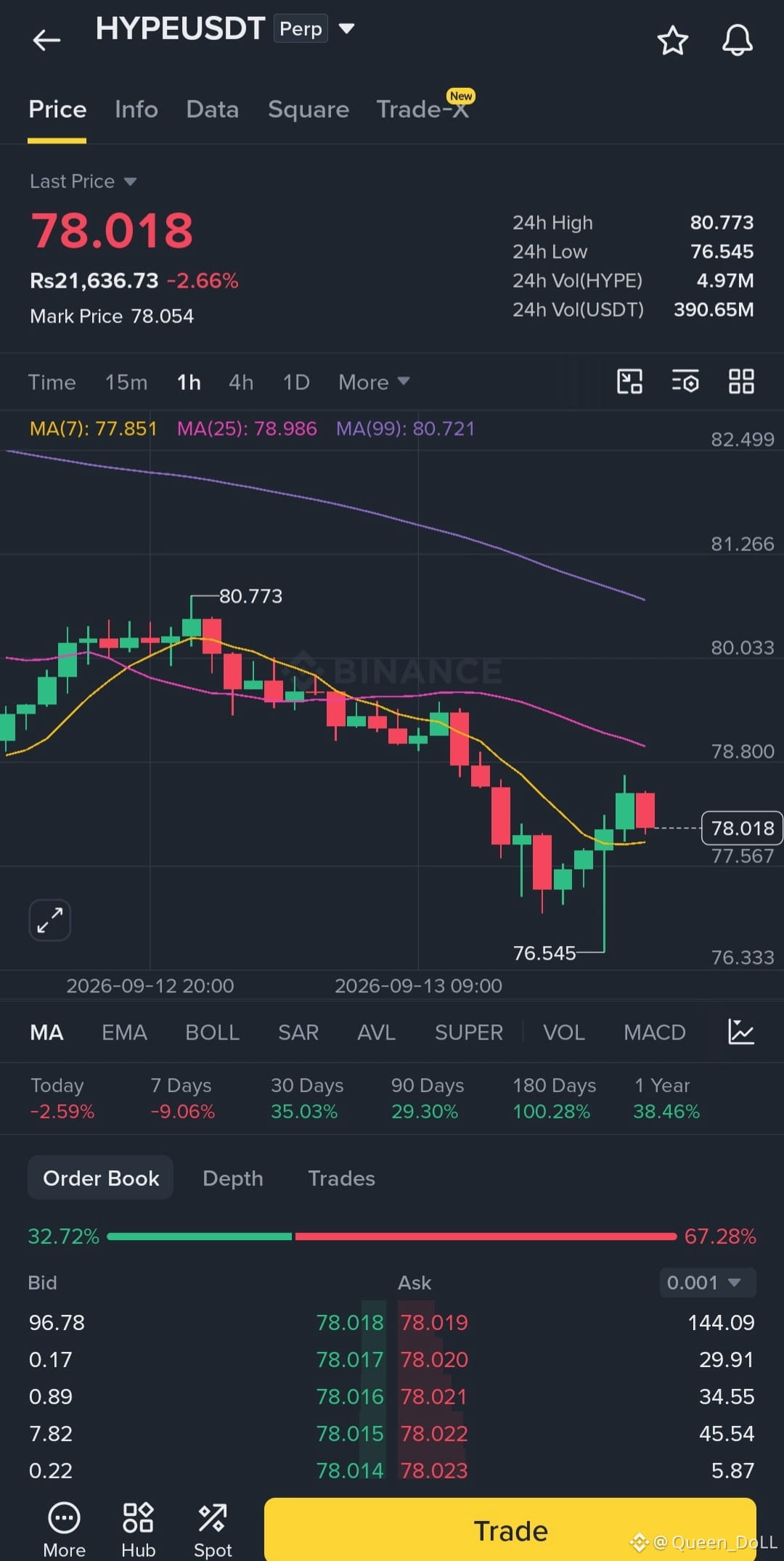
🚨 $HYPE /USDT — BEARISH SHORT SIGNAL 🚨
Signal: SHORT / SELL 🔴
Entry Zone: $78.00 – $78.40
TP1: $77.50
TP2: $77.00
TP3: $76.55
TP4: $75.80
Stop Loss: $79.10
Analysis:
HYPE is trading below the MA(25) and MA(99), keeping the 1H trend bearish.
Sell-side pressure is also dominant, while the recent bounce from $76.55 is struggling to break higher.
⚠️ A strong move above $79.10 invalidates the short setup.
{future}(HYPEUSDT)
#HYPE #Hyperliquid #crypto #cryptotrading #Binance
🚨 $HYPE /USDT — BEARISH SHORT SIGNAL 🚨
Signal: SHORT / SELL 🔴
Entry Zone: $78.00 – $78.40
TP1: $77.50
TP2: $77.00
TP3: $76.55
TP4: $75.80
Stop Loss: $79.10
Analysis:
HYPE is trading below the MA(25) and MA(99), keeping the 1H trend bearish.
Sell-side pressure is also dominant, while the recent bounce from $76.55 is struggling to break higher.
⚠️ A strong move above $79.10 invalidates the short setup.
#HYPE #Hyperliquid #crypto #cryptotrading #Binance
Signal: SHORT / SELL 🔴
Entry Zone: $78.00 – $78.40
TP1: $77.50
TP2: $77.00
TP3: $76.55
TP4: $75.80
Stop Loss: $79.10
Analysis:
HYPE is trading below the MA(25) and MA(99), keeping the 1H trend bearish.
Sell-side pressure is also dominant, while the recent bounce from $76.55 is struggling to break higher.
⚠️ A strong move above $79.10 invalidates the short setup.
#HYPE #Hyperliquid #crypto #cryptotrading #Binance
1
135

·
--
$HYPE Hits $88 New ATH! Is $100 Next? 🚀
$HYPE doesn't stop.
✅ New All-Time High: $88 (Previous ATH $86.71 on Aug 27)
✅ Strongest altcoin after Bitcoin's $81K breakout
✅ Hyperliquid - No.1 Decentralized Perps Exchange, directly buying back tokens from open market using trading fees
Why it's pumping?
Hyperliquid's tokenomics simple - Trading fees = $HYPE buyback from open market. More volume = more buyback.
Are you bullish on $HYPE?
Not financial advice. NFA / DYOR.
$HYPER
{spot}(HYPERUSDT)
$BTC
{spot}(BTCUSDT)
$ZEC
{spot}(ZECUSDT)
#hyperliquid #Altcoins👀🚀 #CryptoNews #BinanceSquare
$HYPE Hits $88 New ATH! Is $100 Next? 🚀
$HYPE doesn't stop.
✅ New All-Time High: $88 (Previous ATH $86.71 on Aug 27)
✅ Strongest altcoin after Bitcoin's $81K breakout
✅ Hyperliquid - No.1 Decentralized Perps Exchange, directly buying back tokens from open market using trading fees
Why it's pumping?
Hyperliquid's tokenomics simple - Trading fees = $HYPE buyback from open market. More volume = more buyback.
Are you bullish on $HYPE?
Not financial advice. NFA / DYOR.
$HYPER
$BTC
$ZEC
#hyperliquid #Altcoins👀🚀 #CryptoNews #BinanceSquare
$HYPE doesn't stop.
✅ New All-Time High: $88 (Previous ATH $86.71 on Aug 27)
✅ Strongest altcoin after Bitcoin's $81K breakout
✅ Hyperliquid - No.1 Decentralized Perps Exchange, directly buying back tokens from open market using trading fees
Why it's pumping?
Hyperliquid's tokenomics simple - Trading fees = $HYPE buyback from open market. More volume = more buyback.
Are you bullish on $HYPE?
Not financial advice. NFA / DYOR.
$HYPER
$BTC
$ZEC
#hyperliquid #Altcoins👀🚀 #CryptoNews #BinanceSquare

1
314

·
--
Bullish
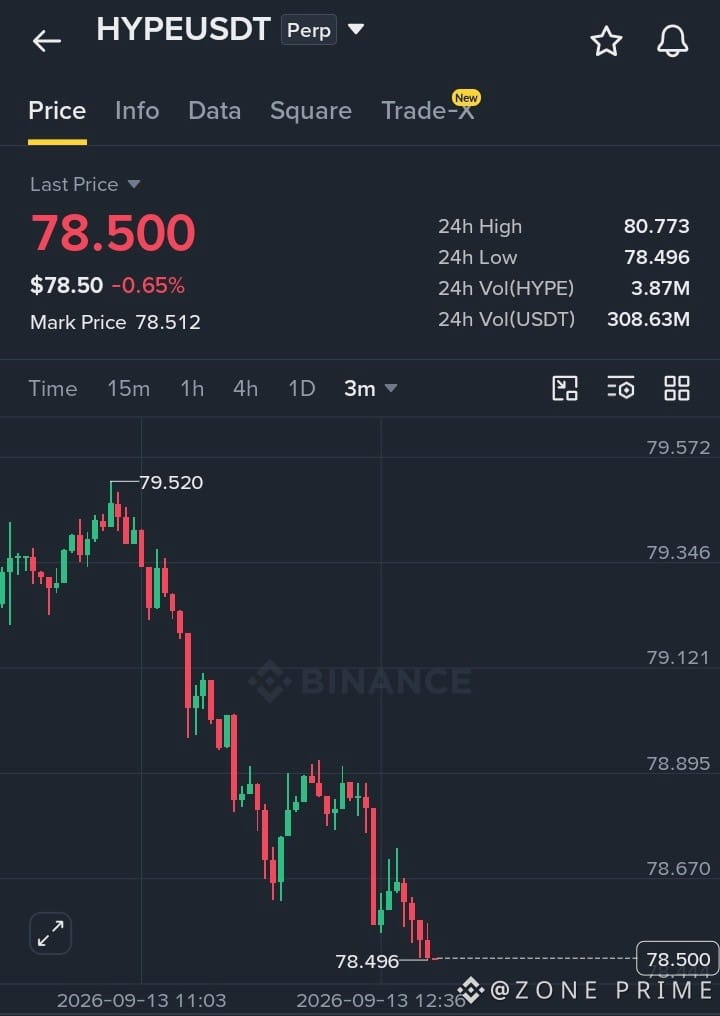
$HYPE /USDT — LONG SETUP 📈 🚀 💯 🔥
Entry: 78.496 - 78.670
TP1: 78.895
TP2: 79.121
TP3: 79.346
Stop: 78.200
Demand floor holding firmly above 78.496 following sell-side sweep. ⚡
Active gamma weighted delta expansion and aggressive bid side orderflow defense signal an immediate impulse rebound toward overhead supply.
#hype #hypeusdt #hyperliquid #crypto #Write2Earn $HYPE
{future}(HYPEUSDT)
$HYPE /USDT — LONG SETUP 📈 🚀 💯 🔥
Entry: 78.496 - 78.670
TP1: 78.895
TP2: 79.121
TP3: 79.346
Stop: 78.200
Demand floor holding firmly above 78.496 following sell-side sweep. ⚡
Active gamma weighted delta expansion and aggressive bid side orderflow defense signal an immediate impulse rebound toward overhead supply.
#hype #hypeusdt #hyperliquid #crypto #Write2Earn $HYPE
Entry: 78.496 - 78.670
TP1: 78.895
TP2: 79.121
TP3: 79.346
Stop: 78.200
Demand floor holding firmly above 78.496 following sell-side sweep. ⚡
Active gamma weighted delta expansion and aggressive bid side orderflow defense signal an immediate impulse rebound toward overhead supply.
#hype #hypeusdt #hyperliquid #crypto #Write2Earn $HYPE
429

·
--
🔥 **$HYPE DESERVES ATTENTION!**
Hyperliquid remains one of the major altcoins traders are watching alongside BTC, ETH, SOL and XRP.
📍 **Entry Zone:** Pullback into previous support
✅ **Confirmation:** Breakout above local resistance + volume expansion
🛑 **Stop Loss:** Below confirmed support
🎯 **TP1:** Previous swing high
🎯 **TP2:** New breakout high
📈 **Resistance:** Recent swing high
📉 **Support:** Breakout/retest zone
❌ **Invalidation:** Failed breakout + strong close below support
⚠️ **Best strategy:** Don't chase a green candle. Wait for the breakout and retest.
#HYP🔥 **HYPE DESERVES ATTENTION!**
Hyperliquid remains one of the major altcoins traders are watching alongside BTC, ETH, SOL and XRP.
📍 **Entry Zone:** Pullback into previous support
✅ **Confirmation:** Breakout above local resistance + volume expansion
🛑 **Stop Loss:** Below confirmed support
🎯 **TP1:** Previous swing high
🎯 **TP2:** New breakout high
📈 **Resistance:** Recent swing high
📉 **Support:** Breakout/retest zone
❌ **Invalidation:** Failed breakout + strong close below support
⚠️ **Best strategy:** Don't chase a green candle. Wait for the breakout and retest.
#HYPE #Hyperliquid #Crypto #Altcoins #BinanceSquareE #Hyperliquid #Crypto #Altcoins #BinanceSquare
{future}(HYPEUSDT)
{spot}(BTCUSDT)
🔥 **$HYPE DESERVES ATTENTION!**
Hyperliquid remains one of the major altcoins traders are watching alongside BTC, ETH, SOL and XRP.
📍 **Entry Zone:** Pullback into previous support
✅ **Confirmation:** Breakout above local resistance + volume expansion
🛑 **Stop Loss:** Below confirmed support
🎯 **TP1:** Previous swing high
🎯 **TP2:** New breakout high
📈 **Resistance:** Recent swing high
📉 **Support:** Breakout/retest zone
❌ **Invalidation:** Failed breakout + strong close below support
⚠️ **Best strategy:** Don't chase a green candle. Wait for the breakout and retest.
#HYP🔥 **HYPE DESERVES ATTENTION!**
Hyperliquid remains one of the major altcoins traders are watching alongside BTC, ETH, SOL and XRP.
📍 **Entry Zone:** Pullback into previous support
✅ **Confirmation:** Breakout above local resistance + volume expansion
🛑 **Stop Loss:** Below confirmed support
🎯 **TP1:** Previous swing high
🎯 **TP2:** New breakout high
📈 **Resistance:** Recent swing high
📉 **Support:** Breakout/retest zone
❌ **Invalidation:** Failed breakout + strong close below support
⚠️ **Best strategy:** Don't chase a green candle. Wait for the breakout and retest.
#HYPE #Hyperliquid #Crypto #Altcoins #BinanceSquareE #Hyperliquid #Crypto #Altcoins #BinanceSquare
Hyperliquid remains one of the major altcoins traders are watching alongside BTC, ETH, SOL and XRP.
📍 **Entry Zone:** Pullback into previous support
✅ **Confirmation:** Breakout above local resistance + volume expansion
🛑 **Stop Loss:** Below confirmed support
🎯 **TP1:** Previous swing high
🎯 **TP2:** New breakout high
📈 **Resistance:** Recent swing high
📉 **Support:** Breakout/retest zone
❌ **Invalidation:** Failed breakout + strong close below support
⚠️ **Best strategy:** Don't chase a green candle. Wait for the breakout and retest.
#HYP🔥 **HYPE DESERVES ATTENTION!**
Hyperliquid remains one of the major altcoins traders are watching alongside BTC, ETH, SOL and XRP.
📍 **Entry Zone:** Pullback into previous support
✅ **Confirmation:** Breakout above local resistance + volume expansion
🛑 **Stop Loss:** Below confirmed support
🎯 **TP1:** Previous swing high
🎯 **TP2:** New breakout high
📈 **Resistance:** Recent swing high
📉 **Support:** Breakout/retest zone
❌ **Invalidation:** Failed breakout + strong close below support
⚠️ **Best strategy:** Don't chase a green candle. Wait for the breakout and retest.
#HYPE #Hyperliquid #Crypto #Altcoins #BinanceSquareE #Hyperliquid #Crypto #Altcoins #BinanceSquare
88

·
--
📊 Abraxas Capital today’s operations:
▪️ Bought 13,700 ETH, about $34.24 million
▪️ Holds a short position of nearly $1 billion on Hyperliquid
▪️ Includes 178,500 ETH short positions, about $437 million
#ETH #Hyperliquid #Cryptocurrency
📊 Abraxas Capital today’s operations:
▪️ Bought 13,700 ETH, about $34.24 million
▪️ Holds a short position of nearly $1 billion on Hyperliquid
▪️ Includes 178,500 ETH short positions, about $437 million
#ETH #Hyperliquid #Cryptocurrency
▪️ Bought 13,700 ETH, about $34.24 million
▪️ Holds a short position of nearly $1 billion on Hyperliquid
▪️ Includes 178,500 ETH short positions, about $437 million
#ETH #Hyperliquid #Cryptocurrency
135

·
--
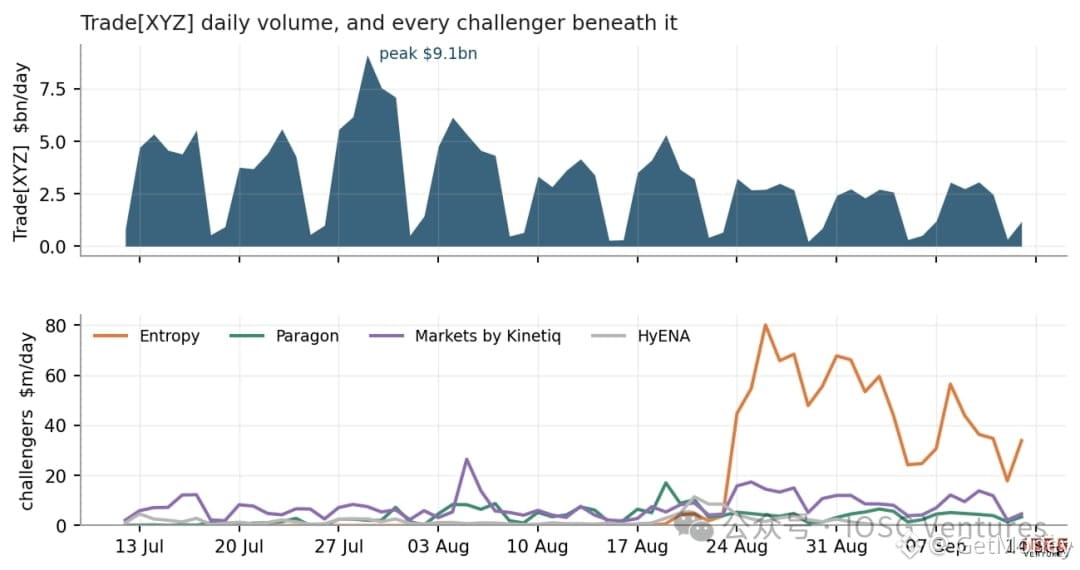
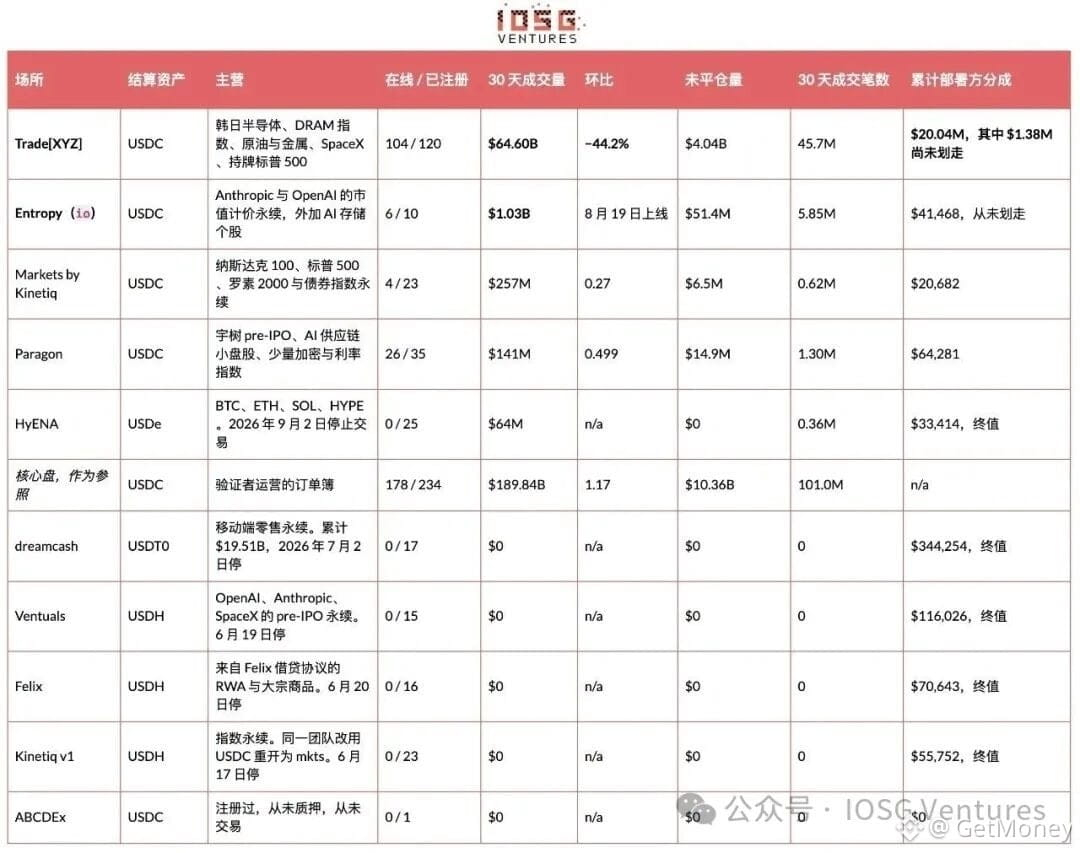
📰 In this retrospective on IOSG’s HIP-3 review of Hyperliquid, what’s most striking isn’t the line about “90% of the teams just serving as escorts,” but the fact that in ten perpetual market makers that can continue indefinitely, Trade[XYZ] alone captured 97.8% of the trading volume over a 30-day period. The other nine, frankly, didn’t fare nearly as well.
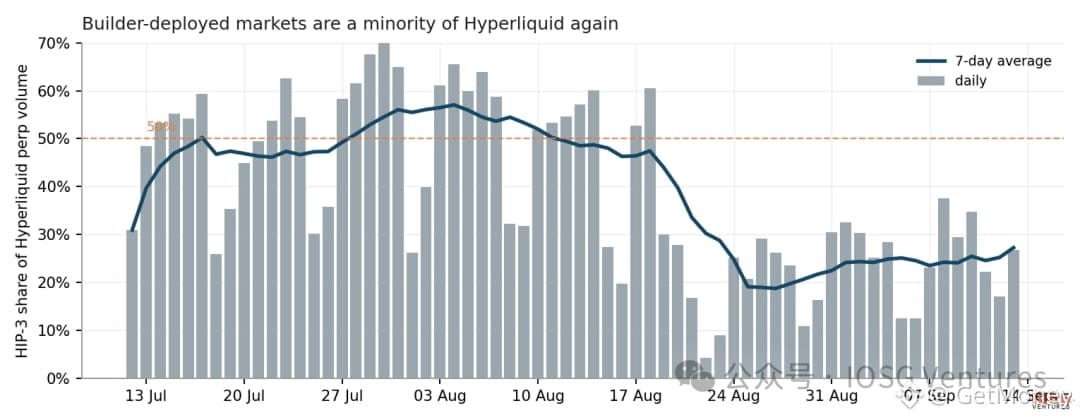
🔥 But interpreting the market leader’s month-over-month trading volume drop of 44.2% as simply share being taken sounds a bit too quick as well. Over the past 30 days, Trade[XYZ] traded about $64.6B; its 7-day average volume fell from $5.36B at the start of August to $2.01B. Meanwhile, during the same period, Hyperliquid’s core perpetual trading volume actually rose by 117%. HIP-3’s share fell from 57.1% to 25.8%. Yes, a larger denominator plays a role here—but the absolute trading volume has clearly contracted as well.
💡 The reason the article breaks things down this way feels more like the underlying target itself has gotten quieter. In the storage and AI segment, real market trading volume dropped 25.7%; in the corresponding order book, Trade[XYZ] saw a 49.7% decline. About half of that can be explained by traditional market factors; the remaining gap is much closer to issues within the platform itself. There’s no evidence of selling pressure—more like there’s simply less room to move each day.
👀 Among the challengers, Entropy had been leading consecutively for a week on Nebius, and open interest even rose against the tide to $51.40M. Paragon launched 26 markets and grew monthly trading volume by 49.9%. But the settlement assets still act like a sieve: every market using non-USDC stablecoins stopped trading entirely; the remaining six all used USDC. Either way, after locking up roughly $40M worth of HYPE, only a small number are truly able to run. Do you think this is a case of the sector’s hype cooling off, or that competition for HIP-3 just genuinely hasn’t been executed well?
#Hyperliquid #HIP3 #链上数据 #加密市场
📰 In this retrospective on IOSG’s HIP-3 review of Hyperliquid, what’s most striking isn’t the line about “90% of the teams just serving as escorts,” but the fact that in ten perpetual market makers that can continue indefinitely, Trade[XYZ] alone captured 97.8% of the trading volume over a 30-day period. The other nine, frankly, didn’t fare nearly as well.
🔥 But interpreting the market leader’s month-over-month trading volume drop of 44.2% as simply share being taken sounds a bit too quick as well. Over the past 30 days, Trade[XYZ] traded about $64.6B; its 7-day average volume fell from $5.36B at the start of August to $2.01B. Meanwhile, during the same period, Hyperliquid’s core perpetual trading volume actually rose by 117%. HIP-3’s share fell from 57.1% to 25.8%. Yes, a larger denominator plays a role here—but the absolute trading volume has clearly contracted as well.
💡 The reason the article breaks things down this way feels more like the underlying target itself has gotten quieter. In the storage and AI segment, real market trading volume dropped 25.7%; in the corresponding order book, Trade[XYZ] saw a 49.7% decline. About half of that can be explained by traditional market factors; the remaining gap is much closer to issues within the platform itself. There’s no evidence of selling pressure—more like there’s simply less room to move each day.
👀 Among the challengers, Entropy had been leading consecutively for a week on Nebius, and open interest even rose against the tide to $51.40M. Paragon launched 26 markets and grew monthly trading volume by 49.9%. But the settlement assets still act like a sieve: every market using non-USDC stablecoins stopped trading entirely; the remaining six all used USDC. Either way, after locking up roughly $40M worth of HYPE, only a small number are truly able to run. Do you think this is a case of the sector’s hype cooling off, or that competition for HIP-3 just genuinely hasn’t been executed well?
#Hyperliquid #HIP3 #链上数据 #加密市场
🔥 But interpreting the market leader’s month-over-month trading volume drop of 44.2% as simply share being taken sounds a bit too quick as well. Over the past 30 days, Trade[XYZ] traded about $64.6B; its 7-day average volume fell from $5.36B at the start of August to $2.01B. Meanwhile, during the same period, Hyperliquid’s core perpetual trading volume actually rose by 117%. HIP-3’s share fell from 57.1% to 25.8%. Yes, a larger denominator plays a role here—but the absolute trading volume has clearly contracted as well.
💡 The reason the article breaks things down this way feels more like the underlying target itself has gotten quieter. In the storage and AI segment, real market trading volume dropped 25.7%; in the corresponding order book, Trade[XYZ] saw a 49.7% decline. About half of that can be explained by traditional market factors; the remaining gap is much closer to issues within the platform itself. There’s no evidence of selling pressure—more like there’s simply less room to move each day.
👀 Among the challengers, Entropy had been leading consecutively for a week on Nebius, and open interest even rose against the tide to $51.40M. Paragon launched 26 markets and grew monthly trading volume by 49.9%. But the settlement assets still act like a sieve: every market using non-USDC stablecoins stopped trading entirely; the remaining six all used USDC. Either way, after locking up roughly $40M worth of HYPE, only a small number are truly able to run. Do you think this is a case of the sector’s hype cooling off, or that competition for HIP-3 just genuinely hasn’t been executed well?
#Hyperliquid #HIP3 #链上数据 #加密市场

20

·
--
$HYPE
{future}(HYPEUSDT)
HYPE (HYPEUSDT) — Professional Market Analysis 📊
HYPE remains a token of interest for crypto traders monitoring momentum, volatility, and market sentiment within the decentralized trading ecosystem.
📈 Market Outlook:
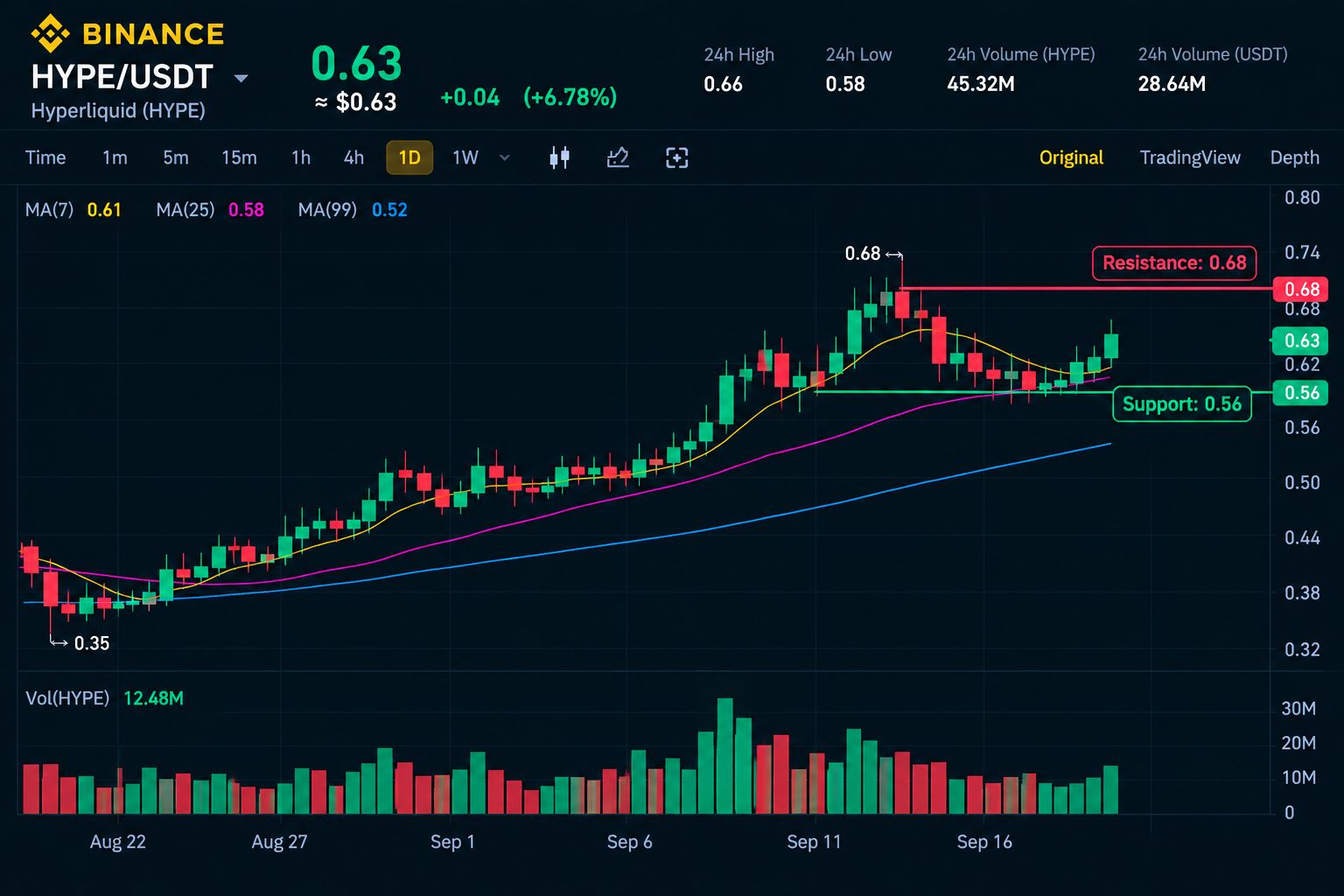
HYPEUSDT traders should watch price action, trading volume, and key support and resistance levels. Strong buying pressure accompanied by rising volume could indicate renewed bullish momentum, while weak demand may lead to consolidation or a short-term pullback.
🚀 Bullish Scenario:
A confirmed breakout above resistance, supported by strong volume, could attract fresh buyers and create an opportunity for further upside.
⚠️ Bearish Scenario:
Failure to maintain important support levels may increase selling pressure and lead to a deeper correction.
💎 Trading Insight:
Monitor candlestick patterns, volume confirmation, and broader market conditions before entering a trade. HYPE can experience significant volatility, so disciplined risk management is essential.#Hyperliquid #Ethereum #BTC☀️ #Binance #Write2Earn!
$HYPE
HYPE (HYPEUSDT) — Professional Market Analysis 📊
HYPE remains a token of interest for crypto traders monitoring momentum, volatility, and market sentiment within the decentralized trading ecosystem.
📈 Market Outlook:
HYPEUSDT traders should watch price action, trading volume, and key support and resistance levels. Strong buying pressure accompanied by rising volume could indicate renewed bullish momentum, while weak demand may lead to consolidation or a short-term pullback.
🚀 Bullish Scenario:
A confirmed breakout above resistance, supported by strong volume, could attract fresh buyers and create an opportunity for further upside.
⚠️ Bearish Scenario:
Failure to maintain important support levels may increase selling pressure and lead to a deeper correction.
💎 Trading Insight:
Monitor candlestick patterns, volume confirmation, and broader market conditions before entering a trade. HYPE can experience significant volatility, so disciplined risk management is essential.#Hyperliquid #Ethereum #BTC☀️ #Binance #Write2Earn!
HYPE (HYPEUSDT) — Professional Market Analysis 📊
HYPE remains a token of interest for crypto traders monitoring momentum, volatility, and market sentiment within the decentralized trading ecosystem.
📈 Market Outlook:
HYPEUSDT traders should watch price action, trading volume, and key support and resistance levels. Strong buying pressure accompanied by rising volume could indicate renewed bullish momentum, while weak demand may lead to consolidation or a short-term pullback.
🚀 Bullish Scenario:
A confirmed breakout above resistance, supported by strong volume, could attract fresh buyers and create an opportunity for further upside.
⚠️ Bearish Scenario:
Failure to maintain important support levels may increase selling pressure and lead to a deeper correction.
💎 Trading Insight:
Monitor candlestick patterns, volume confirmation, and broader market conditions before entering a trade. HYPE can experience significant volatility, so disciplined risk management is essential.#Hyperliquid #Ethereum #BTC☀️ #Binance #Write2Earn!
133

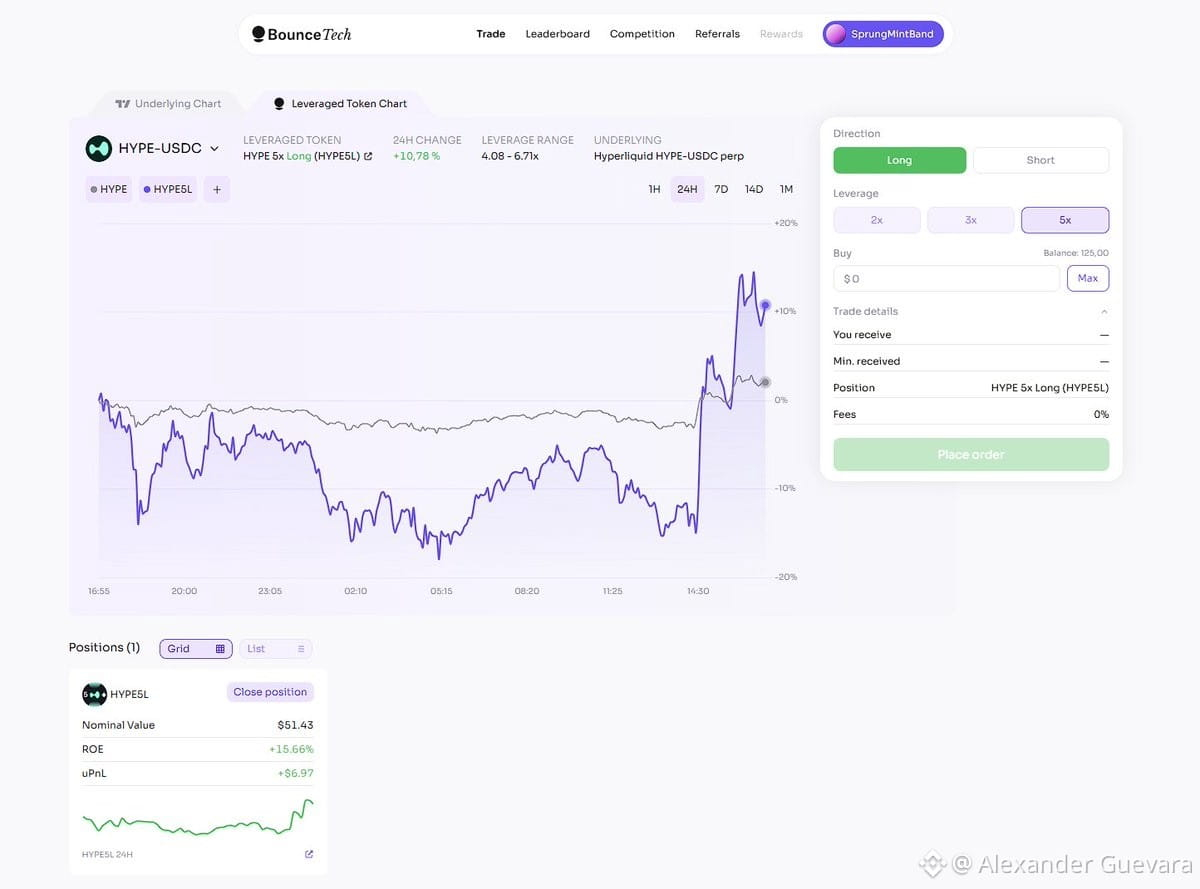
I just came across something VERY VERY INTERESTING 😵
BounceTech @BounceTech is a DeFi protocol live on mainnet since 2026 built on Hyperliquid (it brings together HyperEVM and HyperCore).
Let me explain the IDEA because it’s REALLY GOOD:
1/ You deposit USDC and in return mint an ERC-20 token that corresponds to a specific position, for example HYPE Long 5x.
What you get is a liquid leveraged token in your wallet equivalent to having, for example, $500 in HYPE after depositing $100. Also, the protocol supports 200+ listed assets on Hyperliquid.
2/ What happens behind the scenes? The protocol opens and rebalances perpetual positions on Hyperliquid to maintain the target leverage.
3/ So, you simply choose the direction of the asset, but YOU ARE NOT LIQUIDATED like in a normal perp. If HYPE goes down in price, the token just loses value, but the same applies in reverse if you positioned in Short.
4/ At all times you can exchange that token for the value of your assets in USDC, and you could also use it in DeFi within a pool or in a Lending protocol when this kind of integration exists.
Interesting, right?
Plus, it’s totally EARLY and has big potential. It’s listed on DeFiLlama and its TVL, while still low, is already close to 1M, but its volume is already in the hundreds of millions.
Also, the contracts have been audited more than once (fixing the bugs that were found), it has a bug bounty, there’s a VC behind it, and the off-chain rebalancer is designed with Hyperliquid agent wallets with no withdrawal permission (so an external wallet wouldn’t be able to withdraw funds).
I’m already testing it; if you want to take a look too, here’s my link: https://bounce.tech/trade/GOLD5L …
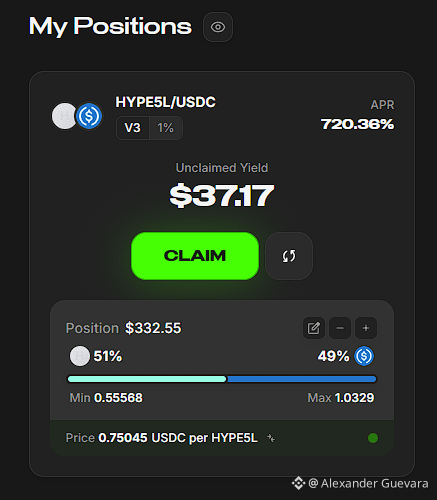
And one more detail that’s even better for those of us who like farming: TOP— you can do farming with this position through the PRJX DEX and get an even higher return.
#Hyperliquid #defi #DeFiLlama #Wallet #TrendingTopic $BTC $MSFTB $HYPE
I just came across something VERY VERY INTERESTING 😵
BounceTech @BounceTech is a DeFi protocol live on mainnet since 2026 built on Hyperliquid (it brings together HyperEVM and HyperCore).
Let me explain the IDEA because it’s REALLY GOOD:
1/ You deposit USDC and in return mint an ERC-20 token that corresponds to a specific position, for example HYPE Long 5x.
What you get is a liquid leveraged token in your wallet equivalent to having, for example, $500 in HYPE after depositing $100. Also, the protocol supports 200+ listed assets on Hyperliquid.
2/ What happens behind the scenes? The protocol opens and rebalances perpetual positions on Hyperliquid to maintain the target leverage.
3/ So, you simply choose the direction of the asset, but YOU ARE NOT LIQUIDATED like in a normal perp. If HYPE goes down in price, the token just loses value, but the same applies in reverse if you positioned in Short.
4/ At all times you can exchange that token for the value of your assets in USDC, and you could also use it in DeFi within a pool or in a Lending protocol when this kind of integration exists.
Interesting, right?
Plus, it’s totally EARLY and has big potential. It’s listed on DeFiLlama and its TVL, while still low, is already close to 1M, but its volume is already in the hundreds of millions.
Also, the contracts have been audited more than once (fixing the bugs that were found), it has a bug bounty, there’s a VC behind it, and the off-chain rebalancer is designed with Hyperliquid agent wallets with no withdrawal permission (so an external wallet wouldn’t be able to withdraw funds).
I’m already testing it; if you want to take a look too, here’s my link: https://bounce.tech/trade/GOLD5L …
And one more detail that’s even better for those of us who like farming: TOP— you can do farming with this position through the PRJX DEX and get an even higher return.
#Hyperliquid #defi #DeFiLlama #Wallet #TrendingTopic $BTC $MSFTB $HYPE
BounceTech @BounceTech is a DeFi protocol live on mainnet since 2026 built on Hyperliquid (it brings together HyperEVM and HyperCore).
Let me explain the IDEA because it’s REALLY GOOD:
1/ You deposit USDC and in return mint an ERC-20 token that corresponds to a specific position, for example HYPE Long 5x.
What you get is a liquid leveraged token in your wallet equivalent to having, for example, $500 in HYPE after depositing $100. Also, the protocol supports 200+ listed assets on Hyperliquid.
2/ What happens behind the scenes? The protocol opens and rebalances perpetual positions on Hyperliquid to maintain the target leverage.
3/ So, you simply choose the direction of the asset, but YOU ARE NOT LIQUIDATED like in a normal perp. If HYPE goes down in price, the token just loses value, but the same applies in reverse if you positioned in Short.
4/ At all times you can exchange that token for the value of your assets in USDC, and you could also use it in DeFi within a pool or in a Lending protocol when this kind of integration exists.
Interesting, right?
Plus, it’s totally EARLY and has big potential. It’s listed on DeFiLlama and its TVL, while still low, is already close to 1M, but its volume is already in the hundreds of millions.
Also, the contracts have been audited more than once (fixing the bugs that were found), it has a bug bounty, there’s a VC behind it, and the off-chain rebalancer is designed with Hyperliquid agent wallets with no withdrawal permission (so an external wallet wouldn’t be able to withdraw funds).
I’m already testing it; if you want to take a look too, here’s my link: https://bounce.tech/trade/GOLD5L …
And one more detail that’s even better for those of us who like farming: TOP— you can do farming with this position through the PRJX DEX and get an even higher return.
#Hyperliquid #defi #DeFiLlama #Wallet #TrendingTopic $BTC $MSFTB $HYPE
44

·
--
You can even trade pre-IPO AI companies on-chain — Hyperliquid’s perpetual tied to Anthropic’s Pre-IPO is still moving today.
According to BlockBeats, on September 14 the Anthropic pre-IPO market (ANTH) deployed by Entropy for HIP-3 quoted at about 2139, with about $9.18 million in 24-hour trading volume. The pricing logic is roughly: $1 corresponds to an implied valuation of about $1 billion, so this price point is equivalent to a narrative position on the order of $2.14 trillion. The contract is purely synthetic exposure, with no equity, voting rights, or dividends.
These markets are lively, but price discovery may not be reliable, and there’s a heavy early-stage bubble feel. That OpenAI contract was previously pulled after nearly zero trades — just because something can be listed doesn’t mean anyone actually comes to trade it. The AI safety narrative has been loudly debated this week; on-chain valuation narratives are staying lively too. When mood indicators look okay, don’t mistake it for a primary-market quote.
$HYPE #Hyperliquid #Anthropic #AI
You can even trade pre-IPO AI companies on-chain — Hyperliquid’s perpetual tied to Anthropic’s Pre-IPO is still moving today.
According to BlockBeats, on September 14 the Anthropic pre-IPO market (ANTH) deployed by Entropy for HIP-3 quoted at about 2139, with about $9.18 million in 24-hour trading volume. The pricing logic is roughly: $1 corresponds to an implied valuation of about $1 billion, so this price point is equivalent to a narrative position on the order of $2.14 trillion. The contract is purely synthetic exposure, with no equity, voting rights, or dividends.
These markets are lively, but price discovery may not be reliable, and there’s a heavy early-stage bubble feel. That OpenAI contract was previously pulled after nearly zero trades — just because something can be listed doesn’t mean anyone actually comes to trade it. The AI safety narrative has been loudly debated this week; on-chain valuation narratives are staying lively too. When mood indicators look okay, don’t mistake it for a primary-market quote.
$HYPE #Hyperliquid #Anthropic #AI
According to BlockBeats, on September 14 the Anthropic pre-IPO market (ANTH) deployed by Entropy for HIP-3 quoted at about 2139, with about $9.18 million in 24-hour trading volume. The pricing logic is roughly: $1 corresponds to an implied valuation of about $1 billion, so this price point is equivalent to a narrative position on the order of $2.14 trillion. The contract is purely synthetic exposure, with no equity, voting rights, or dividends.
These markets are lively, but price discovery may not be reliable, and there’s a heavy early-stage bubble feel. That OpenAI contract was previously pulled after nearly zero trades — just because something can be listed doesn’t mean anyone actually comes to trade it. The AI safety narrative has been loudly debated this week; on-chain valuation narratives are staying lively too. When mood indicators look okay, don’t mistake it for a primary-market quote.
$HYPE #Hyperliquid #Anthropic #AI
41
Log in to explore more content
Join global crypto users on Binance Square
⚡️ Get latest and useful information about crypto.
💬 Trusted by the world’s largest crypto exchange.
👍 Discover real insights from verified creators.
Email / Phone number
Trending Topics
1
#FedRateWatch
186,897 views
1,326 Discussing
2
#BitcoinSlidesTo$76000
155 views
36 Discussing
3
#BitcoinReboundsTo$79K
44,563 views
341 Discussing
4
#StrategyMarketCapPassesFord
2,003 views
205 Discussing
5
#ClarityActOddsHalveOnPolymarket
1,669 views
165 Discussing
6
#US30YTreasuryYieldTops5.40%
4,300 views
149 Discussing
7
#BessentEndorsesFinalClarityActDraft
18,909 views
444 Discussing
8
#ZamaOpens16ConfidentialMorphoVaults
7,687 views
216 Discussing
9
#USDCOnChainVolumeTops$100Trillion
1,188 views
34 Discussing
10
#BitcoinSpotETFsNetInflow$160M
2,072 views
86 Discussing