
#gestaoderisco
gestaoderisco
68,190 views
221 Discussing
Hot
Latest

·
--
See translation
Trading, uma das maiores habilidades não é saber quando entrar no mercado, mas também saber quando sair.
Antes de cada operação, considera estas quatro regras:
Define quanto estás disposto a perder.
Nunca arrisques todo o teu capital numa única operação.
Utiliza o Stop-Loss de acordo com a tua estratégia.
Não operes por impulso ou desejo de recuperar perdas.
Lembra-te: nenhuma estratégia elimina completamente o risco. O mercado das criptomoedas pode ser bastante volátil.
Um bom investidor não pensa apenas no próximo lucro. Também pensa em como preservar o seu capital.
💬 Pergunta do dia: Qual destas quatro regras consideras mais importante para um trader iniciante?
S360 — Aprende. Investe. Conquista.
#S360 #BinanceSquare #GestaoDeRisco #Trading #criptomoedas

106

·
--
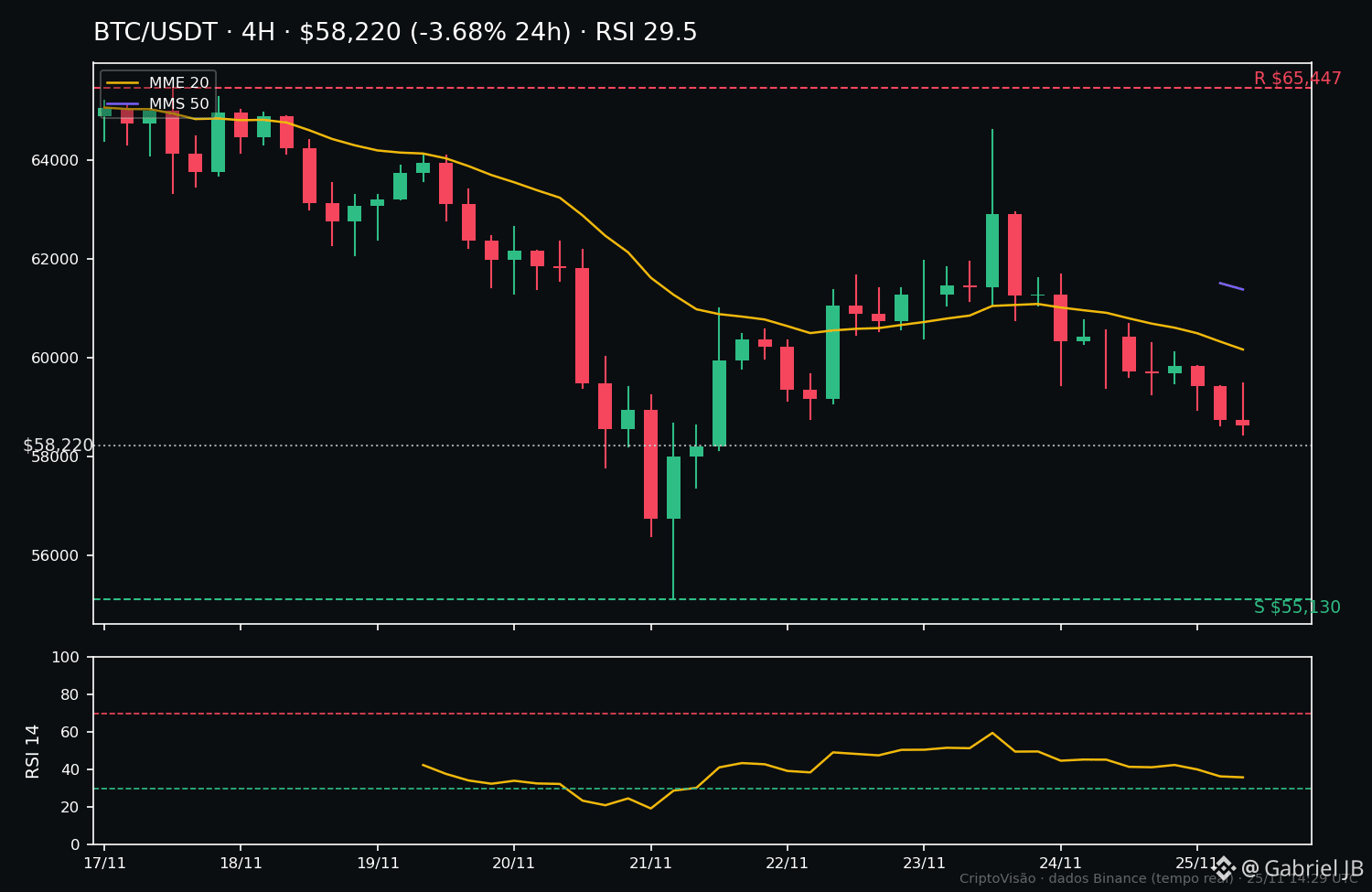
BTC tests support at $58,055: can your account handle the 1% rule?
The $BTC is at $58,223.57 (-3.7% in 24h, RSI 29.5), right on top of the $58,055 support. It has already touched the day's low, $57,989.73, and is holding for now. This is where risk management stops being theory.
The 1% rule says: risk no more than 1% of your account per trade. In a $1,000 account, that's $10. The stop goes below support, not at a round number: $57,700. The distance is $523.57 per BTC.
The math is simple: $10 ÷ $523.57 = 0.0191 BTC. And 0.0191 BTC costs $1,112 — more than the entire account. In spot, without leverage, that position won't fit. A tight stop near support requires a larger account than you might think.
The solution isn't to increase the risk — it's to widen the stop to the next real level, the floor of the last 7 days, $55,130. Then the distance is $3,093.57 per BTC, and the same 1% rule gives you 0.0032 BTC, worth about $188. That fits a $1,000 account — and even a $100 one ($18.82).
And the risk/reward? Up to the 20-period average ($60,498), the potential gain is $2,274.72 versus $523.57 of risk: 4.35 to 1. It passes the minimum 2-to-1 filter. But if the 4h close falls below $58,055, the thesis is dead — and the next floor is $55,130.
Preserving capital is strategy No. 1. Position size isn't determined by how much you want to gain — it's determined by how much you can afford to lose.
Have you done this calculation before entering a trade? Let us know in the comments. 👇
#Bitcoin #GestaoDeRisco #CriptoVisao
4
·
--
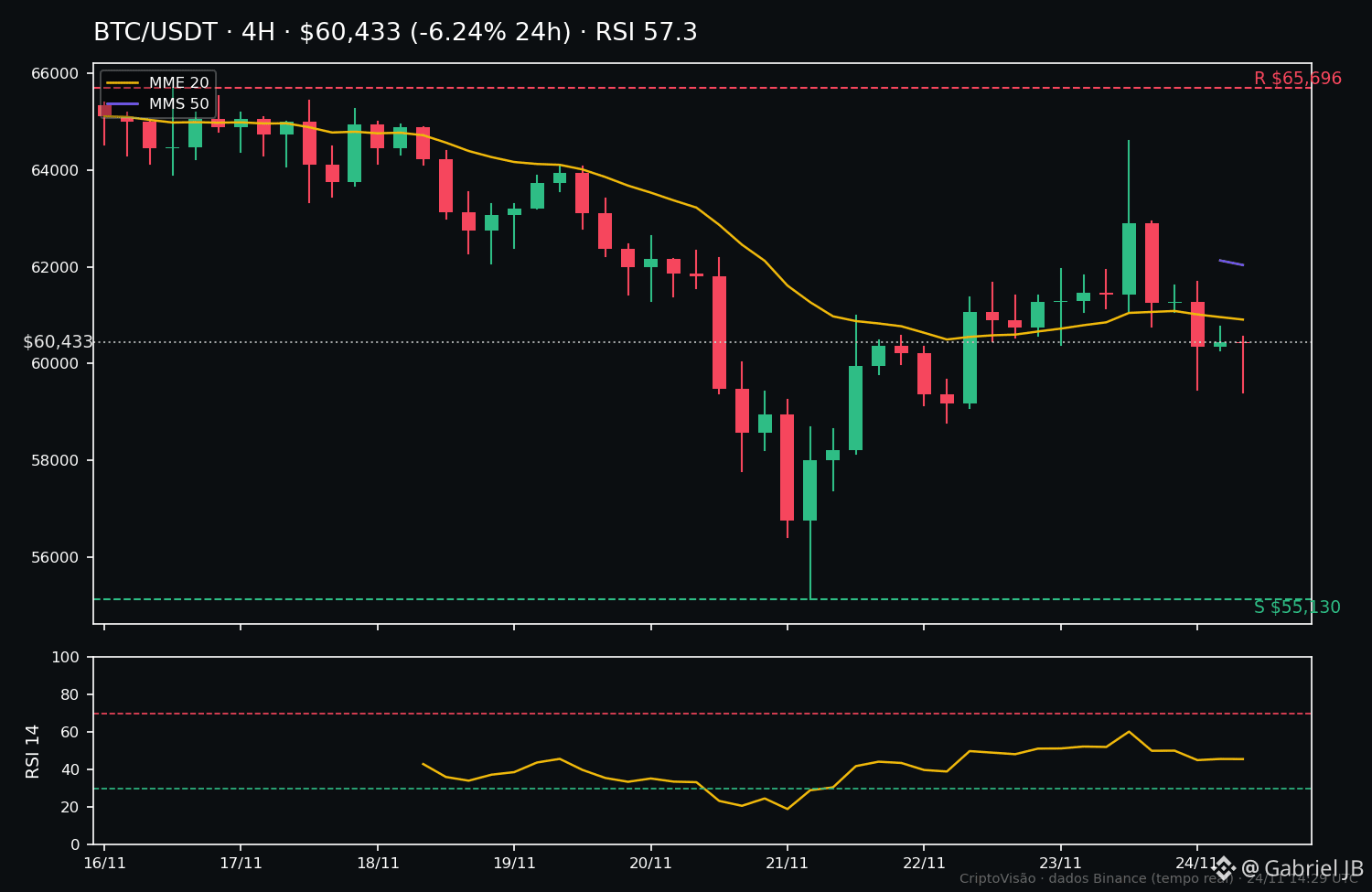
$BTC tests the $60,500 support: how many consecutive stop-outs can your account withstand?
$BTC is at US$ 60.490,97 (-5,94% in 24h, -7,2% in 7 days), right at the 20-period average (US$ 60.500,95) and about US$ 1.100 from the day's low of US$ 59.390,86. The RSI is neutral at 57,3. This is exactly the level to do the math—before entering, not after.
Example with a US$ 1.000 account and the 1% per trade rule:
1️⃣ Set your stop based on the structure, not a round number. Stop below today's low: US$ 59.150. Risk per BTC: 60.490,97 − 59.150 = US$ 1.340,97.
2️⃣ 1% of the account is US$ 10. Position: 10 ÷ 1.340,97 = 0,00746 BTC (about US$ 451). The rest of the money stays on the sidelines—that's what keeps you in the game.
3️⃣ Now for the calculation almost nobody does: how many consecutive stop-outs can you withstand?
• At 1% per trade: 5 consecutive losses = −4,9% of the account. 10 in a row = −9,6%.
• At 5% per trade: 5 consecutive losses = −22,6%. 10 in a row = −40,1%.
Same losing streak, same market—the only difference is the size of the bet. Someone risking 5% per trade is halfway to ruin after 10 stop-outs. Someone risking 1% still has 90% of their account to try again.
And the entry filter, using today's levels: up to the 50-period average (US$ 62.038,05), the risk/reward ratio is 1,15:1—not approved. Up to the week's high (US$ 65.696,16), it's 3,88:1—approved. The level determines whether it's worth it.
Preserving capital is strategy number one. The market offers another opportunity tomorrow—the account has to still be there.
How many consecutive losses can your account withstand today? Do the math and tell us in the comments. 👇
#Bitcoin #GestaoDeRisco #CryptoVision
11
·
--
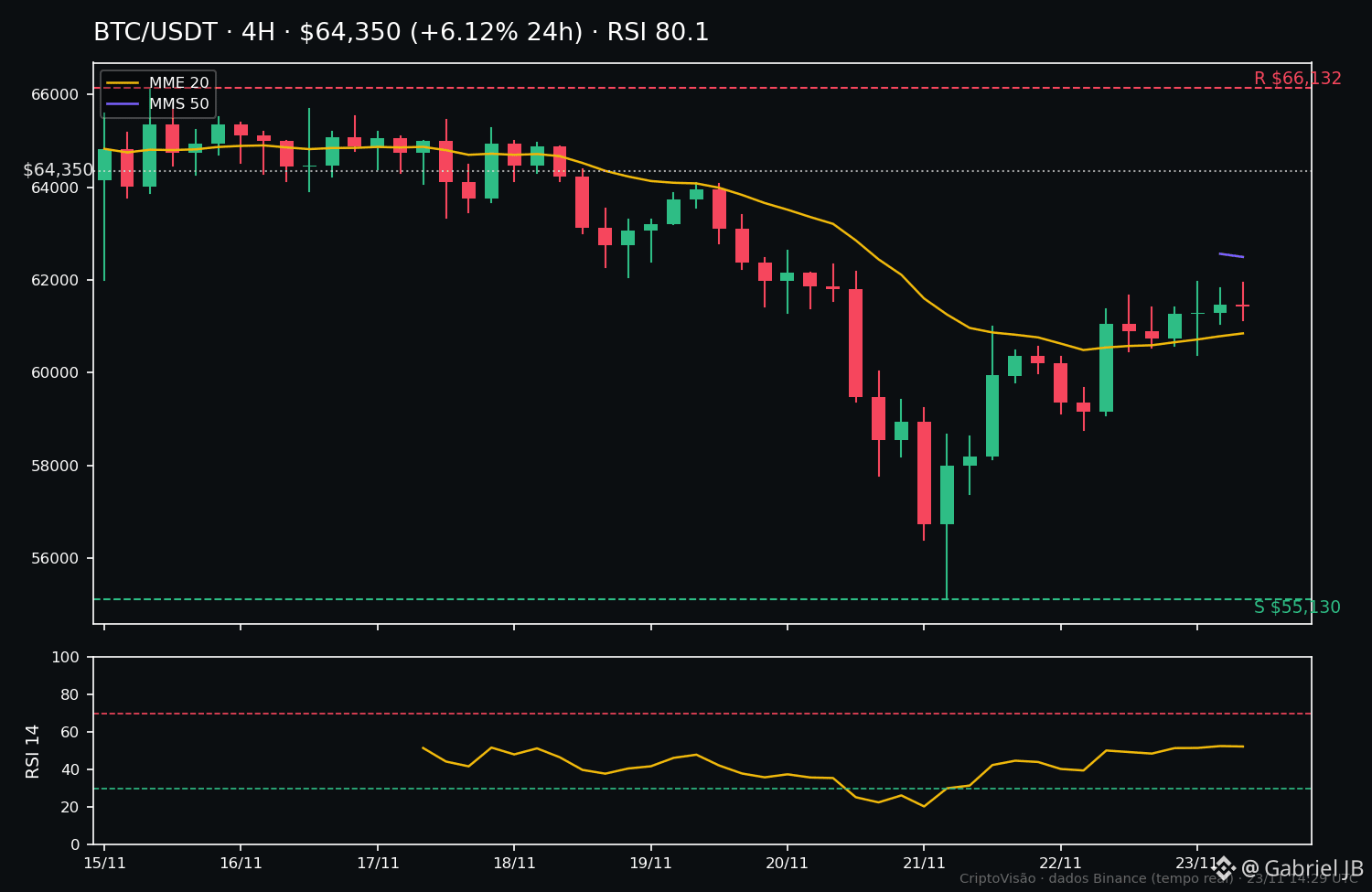
BTC rises 6% in a day and nears the 7-day high: the risk of chasing the rally
The $BTC is at $64,306 — up 6.0% in the last 24 hours, with the RSI at 80.1, in overbought territory. The price is above the 4-hour SMA-20 ($60,039) and SMA-50 ($62,496), and 2.8% below the 7-day high ($66,132). This is exactly when risk management matters most: chasing a vertical rally means accepting the worst risk/reward of the day.
Let’s do the math together, using an example $1,000 account and 1% risk per trade ($10):
Chase it now — entry at $64,306, stop below the SMA-50, at $62,200. Risk of $2,106 per BTC, position size of 0.0047 BTC (about $305). Target at the 7-day high, $66,132: gain of $1,826, risk/reward of 0.87:1. Below the 2:1 minimum. Entry rejected.
Wait for the retest — entry at $62,700, on a retest of the SMA-50, stop below the 24-hour low ($60,386), at $60,300. Risk of $2,400 per BTC, position size of 0.0042 BTC (about $261). Same target: gain of $3,432, risk/reward of 1.43:1. Better, but still below 2:1.
The lesson: after a 6% rally with the RSI in overbought territory, the extended price compresses your risk/reward from both sides — either you enter at a high price, or your stop is far away. The disciplined move is to wait: either for a deeper pullback, or for a 4-hour close above $66,132, which turns the high into support and changes the math. Preserving capital is strategy No. 1 — the market will offer another entry tomorrow.
Have you ever bought near the top of a rally because you were afraid of missing out? What would you do differently today? 👇
$BTC #Bitcoin #GestaoDeRisco #CryptoVision
11
·
--
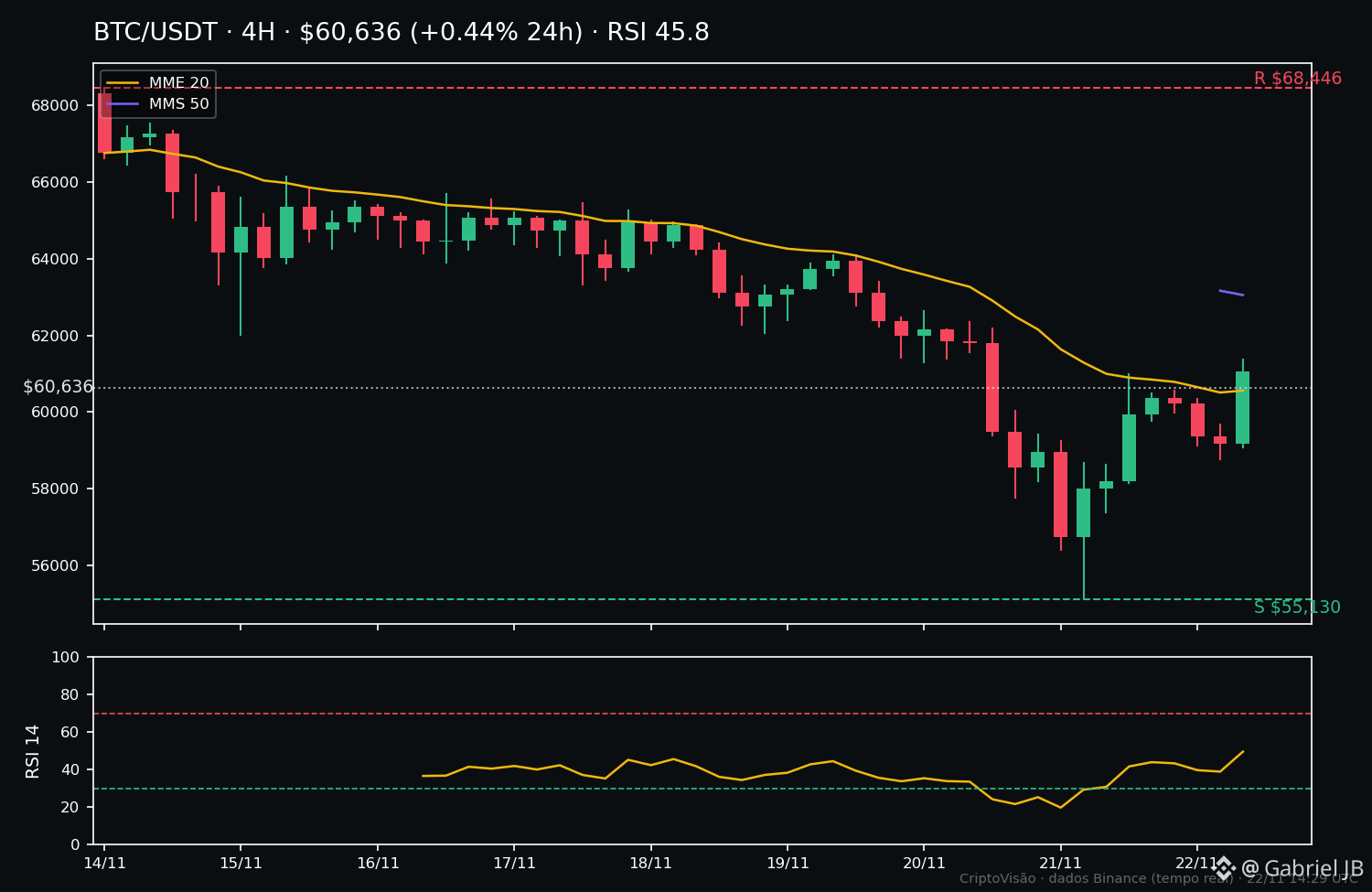
BTC tests the 20-period average: can your stop withstand $2,901 of noise? 📉
The $BTC is at $60,667, right up against the 20-period average ($60,551) — and the low over the last 24 hours was $58,769. Today's lesson: don't place your stop at a round number. Place it outside the noise.
Today's noise can be measured: 24-hour high of $61,670 minus low of $58,769 = a $2,901 swing in a single day. A stop at $60,000, just $667 below the price, would already have been triggered today — the low was $58,769.
The calculation, step by step, for a $1,000 account:
1. 1% rule: maximum risk per trade = $10.
2. Stop outside the noise: below the 24-hour low, at $58,500.
3. Risk per BTC: $60,667 - $58,500 = $2,167.
4. Position size: $10 ÷ $2,167 = 0.0046 BTC (about $280).
And the risk/reward filter: reaching the 50-period average ($63,052) would mean a gain of $2,385 — an R:R of 1.10:1, below the minimum of 2:1. The entry only passes the filter if the target is the 7-day high ($68,446), with an R:R of 3.59:1. The takeaway: a wide stop requires a distant target — or an entry closer to support.
Notice the contrast: entering near support, at $58,900, with the same $58,500 stop, risks only $400 per BTC — the 1% position size increases to 0.025 BTC (about $1,473), and the R:R to the 50-period average jumps to 10.38:1. Same risk, same stop — only your entry point changes.
Preserving capital is strategy No. 1. The stop protects you from noise; position size protects you from ruin.
What about you: do you place your stop at a round number or based on the chart structure? 👇
#Bitcoin #GestaoDeRisco #CriptoVisao
35
·
--
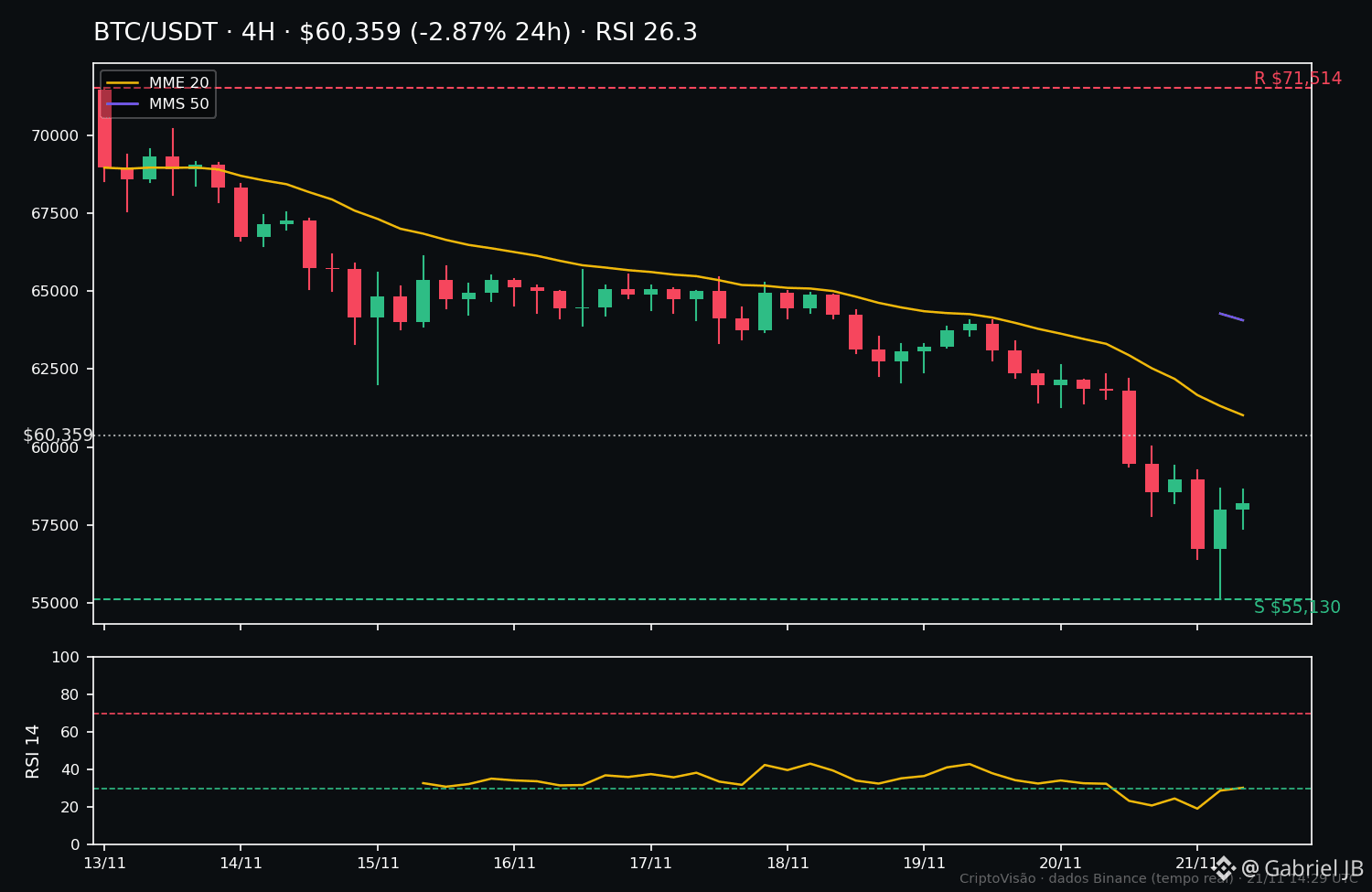
The US$55,130 floor held: how much is it worth risking today?
The $BTC is trading at US$60,333.67 (-2.93% in 24h / -15.6% in 7 days). This morning it touched the 7-day floor of US$55,130 and rebounded to a high of US$62,153.17. RSI is 26.3, in oversold territory, below the 20-period average (US$61,607.94).
Today's lesson: your daily risk budget.
Example account: US$1,000. Rule: 1% per trade = US$10 of risk. Daily limit: 3% = US$30. Three consecutive stop-outs and the day is over — no “just one more.”
Example using today's levels:
Entry: US$60,333.67. Stop below the floor: US$54,800. Risk per BTC: US$5,533.67.
Position = US$10 ÷ US$5,533.67 = 0.00181 BTC (~US$109).
Target at the 24-hour high of US$62,153.17: gain of US$1,819.50 per BTC. Risk/reward ratio: 0.33:1.
Verdict: rejected. The stop is too far away and the target too close. With the floor 9.4% away, the trade is only worthwhile if the target is higher — or if you wait for a better price.
Preserving capital is strategy #1. How many 1% trades are you willing to lose in a day before stopping? 👇
#Bitcoin #GestaoDeRisco #CriptoVisao
11
·
--
Floor breached today: the stop determines position size
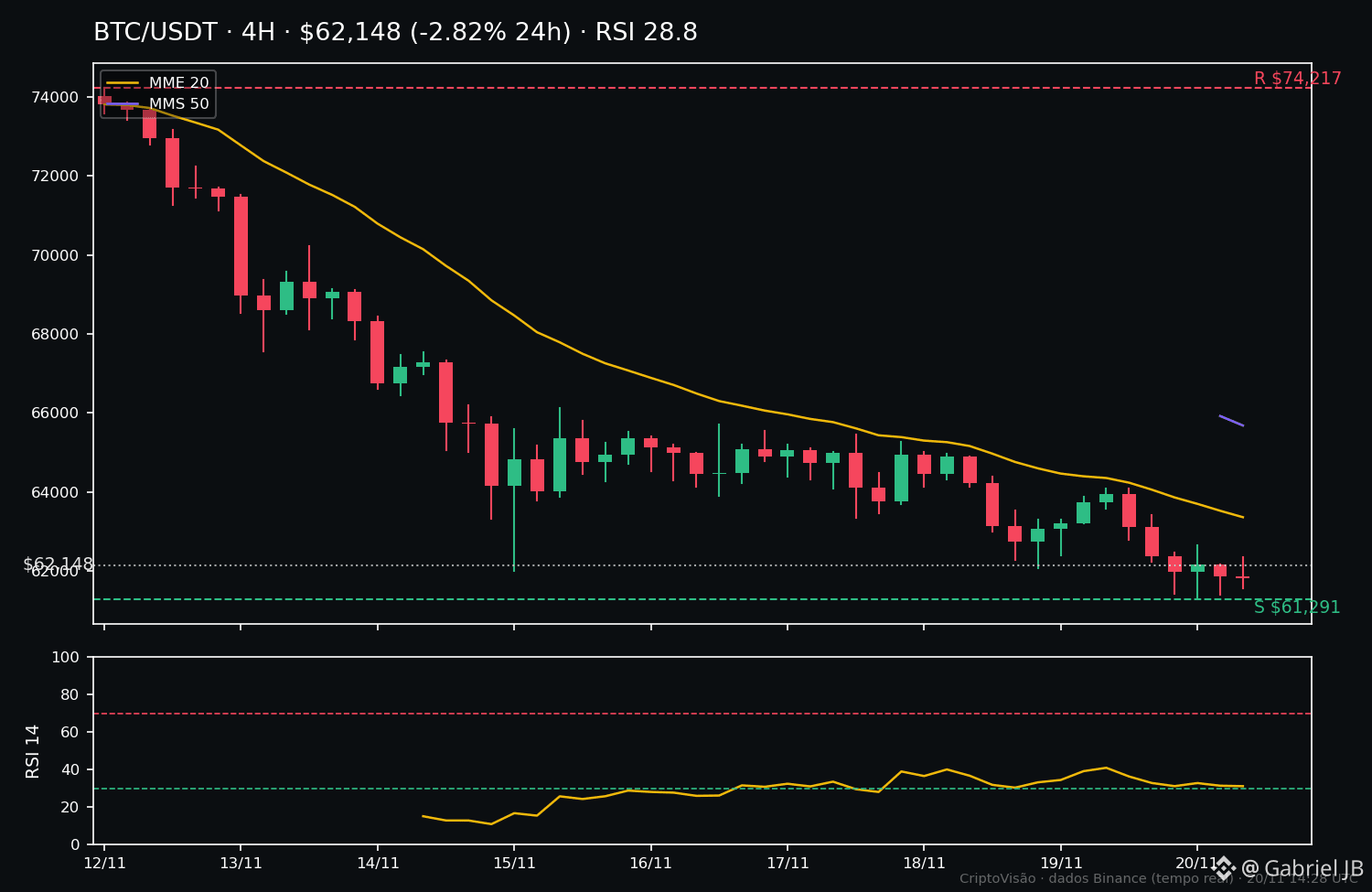
$BTC is at $62,150 now: -2.8% in 24 hours and -16.26% in 7 days. The $62,006 floor, which had held for 6 days, was breached this morning — with a 24-hour low of $61,230 — and the price moved back above the level. RSI is at 28.8, in oversold territory, and the price remains below the 4-hour moving averages (SMA-20 at $63,462).
Today's lesson: it's not gut feeling that determines how much to buy — it's the distance to the stop.
The 1% rule: in a $1,000 account, the maximum risk per trade is $10. The formula is simple: position = $10 ÷ distance to the stop.
Example using the current numbers:
• Entry: $62,150
• Structural stop: $61,000, below the 7-day low ($61,290)
• Distance: $1,150 per BTC
• Position: 10 ÷ 1,150 = 0.0087 BTC, about $540
Yesterday, with the price at $63,954 and the same stop, the distance was $2,254 — the same rule only allowed 0.0044 BTC. Same dollar risk, half the size. Anyone who always buys the same amount in BTC risks twice as much when the stop is farther away.
And the final filter: with a target at the 24-hour high ($64,060), the gain would be $1,910 against $1,150 of risk — 1.66:1, below the minimum of 2:1. The calculation says to wait for a better price or a higher target.
Preserving capital is strategy #1: the stop protects the account, and the right position size protects the rest.
Do you calculate your position size before entering, or decide based on gut feeling?
#Bitcoin #GestaoDeRisco #CriptoVisao
5
·
--
Floor for $BTC at US$62,006: the math that rejects the entry
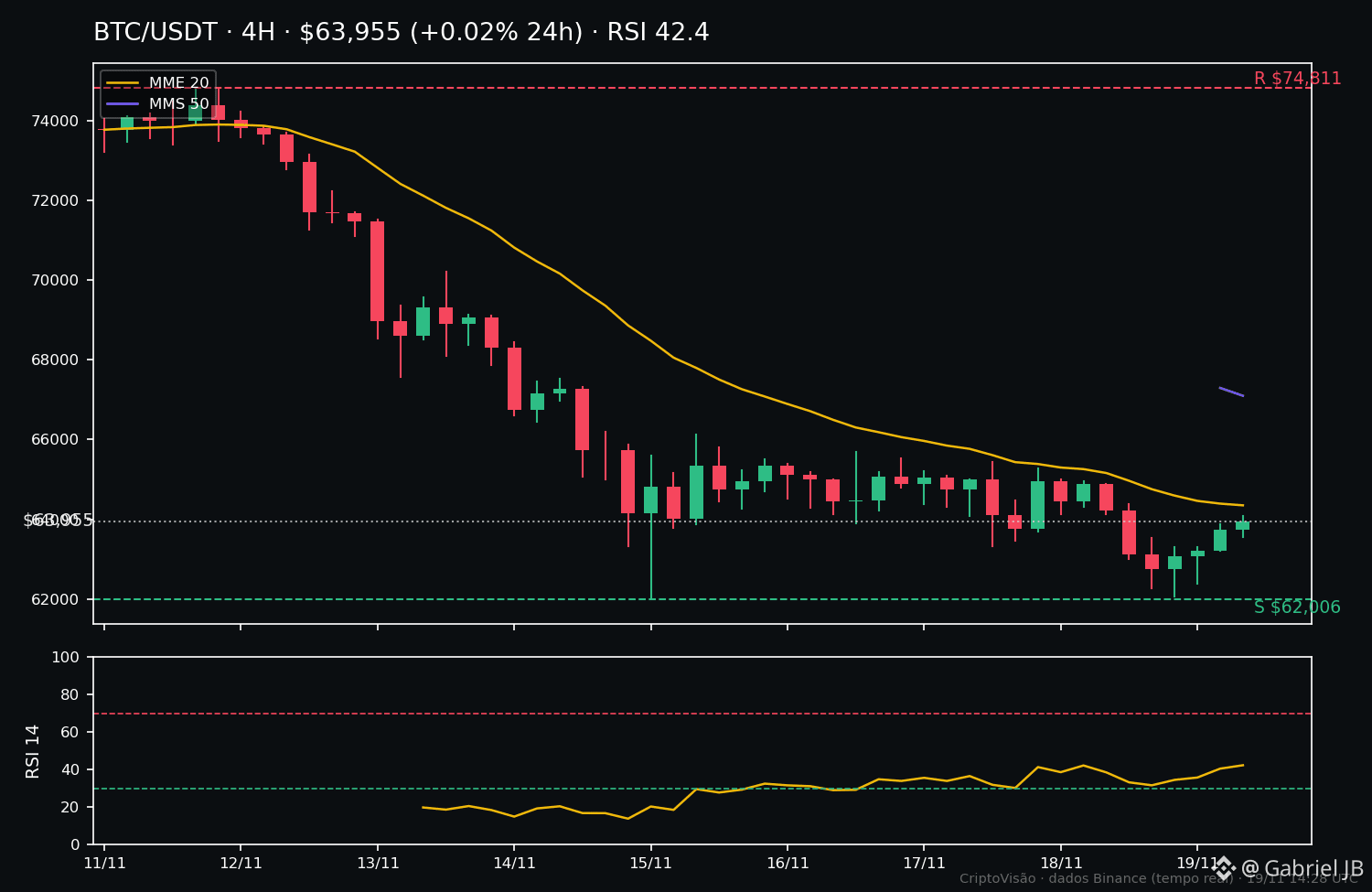
$BTC at US$63,954 (+0.01% in 24h, −13.32% in 7 days), RSI 42.4 (neutral), below the 20-period average (US$64,243.60). The weekly floor, US$62,006, has been tested for the 6th consecutive day — 24h low: US$62,063, just 0.09% above it.
The golden rule: only enter with a minimum risk/reward ratio of 2:1. Here’s the calculation using today’s numbers:
1. Structural stop: below the floor — US$61,700.
2. Target: the 20-period average — US$64,243.60.
Entry at the current price (US$63,954):
Risk: 63,954 − 61,700 = US$2,254 per BTC
Gain: 64,243.60 − 63,954 = US$289.60 per BTC
R:R = 0.13:1 — REJECTED
Entry right at the floor (US$62,300, if the floor holds):
Risk: 62,300 − 61,700 = US$600 per BTC
Gain: 64,243.60 − 62,300 = US$1,943.60 per BTC
R:R = 3.24:1 — APPROVED
Same stop, same target — only the entry changes. With the 1% rule (a US$1,000 account, risking US$10 per trade): at the mid-range entry, the position is 0.0044 BTC and the gain would be US$1.29; at the floor entry, 0.0167 BTC and a gain of US$32.39. Note: 0.0167 BTC costs about US$1,038 — the tight stop requires nearly the entire account.
Preserving capital is the number-one strategy: if the trade doesn’t add up, staying out is a decision too. 📊
Do you calculate risk/reward before entering — or do you jump in on impulse? 👇
#Bitcoin #GestaoDeRisco #CryptoVision
1
·
--
Floor at US$62,006, 3% away: The 1% rule that protects your account
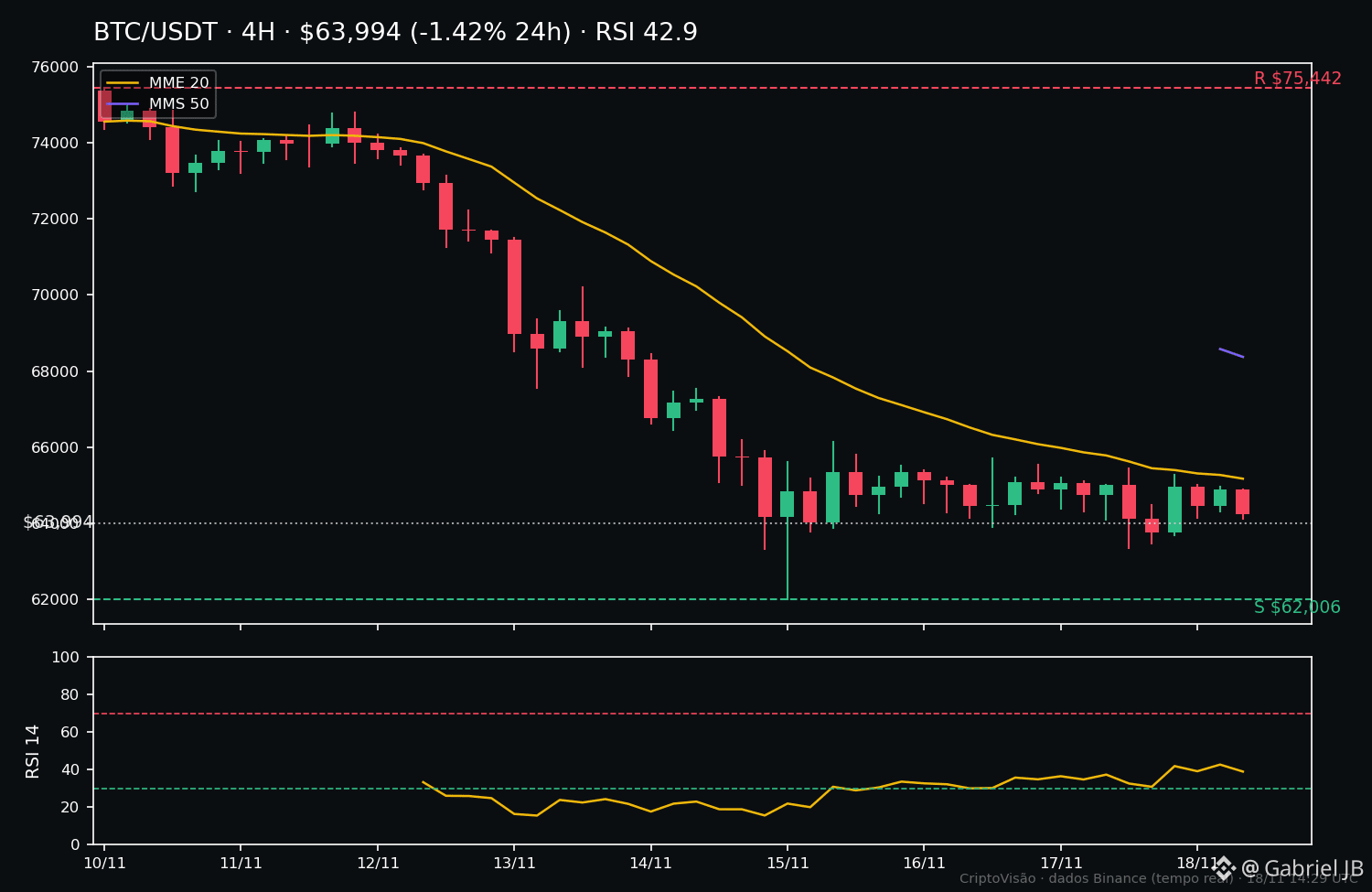
The $BTC is at US$63,947 (-1.51% in 24h, -13.86% for the week), testing today's low of US$63,336. Just below is the week's floor, US$62,006 — holding for 4 days. If it gives way, the drop will accelerate. This is where risk management decides everything.
The 1% rule: never risk more than 1% of your account on a single trade. In a US$1,000 account, that's US$10. That's not the position size — it's the maximum you can lose if the stop is triggered.
The calculation, step by step:
1. Entry: US$63,947. Stop: US$61,700, below the US$62,006 floor.
2. Risk per BTC: 63,947 - 61,700 = US$2,247.
3. Position: US$10 / US$2,247 = 0.00445 BTC, about US$285.
If the stop is triggered, you lose US$10 — 1% of your account. Without the rule, with all US$1,000 in the trade, the same exit would cost US$35.
But there's a catch: the nearest target is today's high of US$65,447. Potential gain: US$1,500 per BTC versus US$2,247 of risk — a risk/reward ratio of 0.67:1. Position sizing protects you, but it doesn't turn a bad entry into a good one: with this R:R, the entry doesn't qualify.
Preserving capital is strategy No. 1. The market will offer another opportunity tomorrow — your account has to be there to take advantage of it.
And you, do you calculate your position size before entering, or decide "by eye"?
#Bitcoin #GestaoDeRisco #CriptoVisao
2
·
--
The US$62,006 floor held: why are 5 small stops worth more than an all-in?
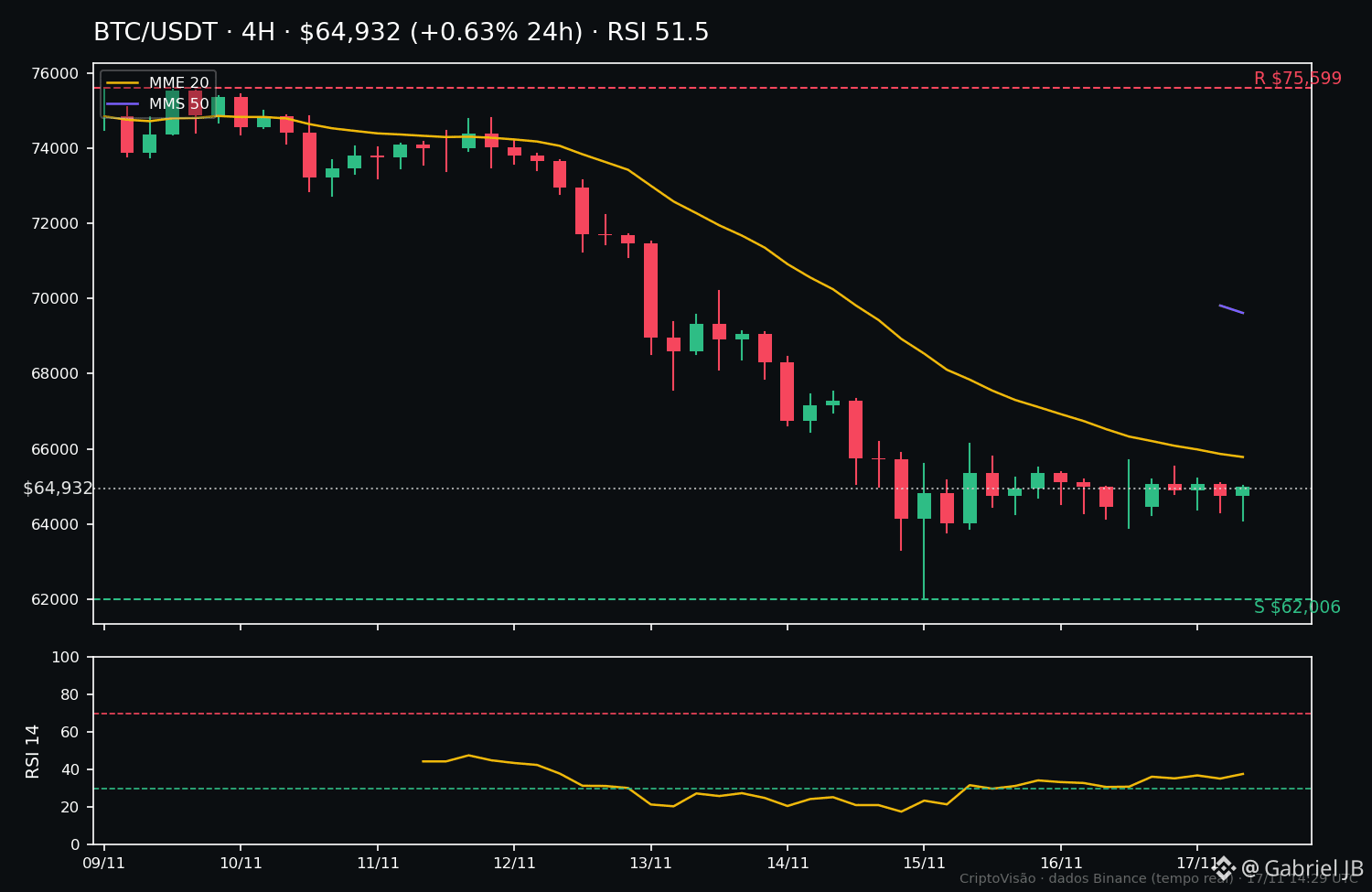
The $BTC is at US$64,908 today (+0.6% in 24h, -13.17% in 7 days). The 7-day low, US$62,006, is still intact—and the price is now testing the 20-period moving average, US$65,153, from below. RSI is at 51.5, neutral: no euphoria, no panic. This is the ideal scenario to talk about position sizing.
The calculation, step by step, using a US$1,000 account as an example:
1. Structural stop: below the low, at US$61,700—not just any round number.
2. Risk per $BTC: US$64,908 - US$61,700 = US$3,208, or 4.94%.
3. 1% rule: maximum risk of US$10 per trade. Position = US$10 / US$3,208 = 0.00312 $BTC, worth about US$202.
Now compare: an all-in of US$1,000 with the same stop loses US$49.40 in a single trade—almost 5% of the account at once. Five trades risking US$10 each lose US$50 in total in the worst-case scenario—but spread across five different ideas, and you’re still in the game even after being wrong four times. The all-in puts almost the same amount on a single bet.
Preserving capital is strategy No. 1: those who survive can trade tomorrow. And note: with a target at the 50-period moving average, US$69,617, the risk/reward ratio is 1.47:1—below the 2:1 minimum many traders require. Getting the position size right also means knowing when to wait.
And you: do you calculate your position size before entering, or decide on impulse? 👇
#Bitcoin #GestaoDeRisco #CriptoVisao
The US$62,006 floor held: why are 5 small stops worth more than an all-in?
The $BTC is at US$64,908 today (+0.6% in 24h, -13.17% in 7 days). The 7-day low, US$62,006, is still intact—and the price is now testing the 20-period moving average, US$65,153, from below. RSI is at 51.5, neutral: no euphoria, no panic. This is the ideal scenario to talk about position sizing.
The calculation, step by step, using a US$1,000 account as an example:
1. Structural stop: below the low, at US$61,700—not just any round number.
2. Risk per $BTC : US$64,908 - US$61,700 = US$3,208, or 4.94%.
3. 1% rule: maximum risk of US$10 per trade. Position = US$10 / US$3,208 = 0.00312 $BTC , worth about US$202.
Now compare: an all-in of US$1,000 with the same stop loses US$49.40 in a single trade—almost 5% of the account at once. Five trades risking US$10 each lose US$50 in total in the worst-case scenario—but spread across five different ideas, and you’re still in the game even after being wrong four times. The all-in puts almost the same amount on a single bet.
Preserving capital is strategy No. 1: those who survive can trade tomorrow. And note: with a target at the 50-period moving average, US$69,617, the risk/reward ratio is 1.47:1—below the 2:1 minimum many traders require. Getting the position size right also means knowing when to wait.
And you: do you calculate your position size before entering, or decide on impulse? 👇
#Bitcoin #GestaoDeRisco #CriptoVisao
8
·
--
Buy $BTC now? The stop says no—do the math 🛡️
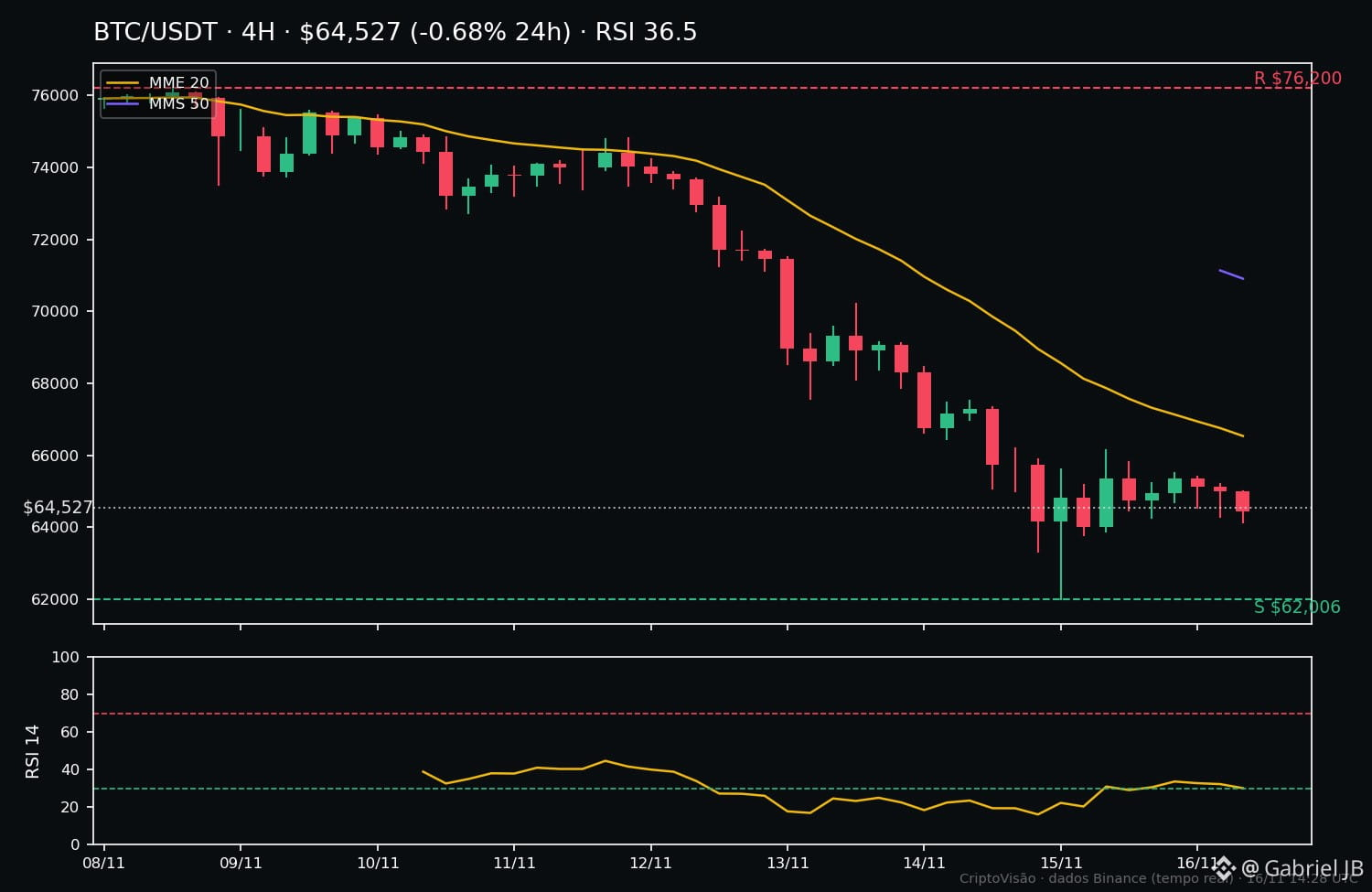
$BTC today: US$ 64.499,80 (-0,77% in 24h, -15,11% in 7 days). RSI 36,5, neutral, and the price remains below the 4h moving averages. The 7-day low, US$ 62.006, held yesterday—and resistance is US$ 66.456, the low it lost on 14/11. The price is in the middle of the range: the worst place to enter.
Today's lesson: don't set your stop at a round number. Not US$ 64.000 just because it looks nice—put it below the structure, below the actual low: US$ 61.700.
Let's do the math together, using a US$ 1.000 account:
1) Risk per BTC: entry at US$ 64.499,80 − stop at US$ 61.700 = US$ 2.799,80.
2) The 1% rule: the most you risk per trade is US$ 10.
3) Position size: US$ 10 ÷ US$ 2.799,80 = 0,00357 BTC, about US$ 230. That's all your risk allows.
4) Risk/reward: the target is resistance at US$ 66.456 → a gain of US$ 1.956,20. R:R of 0,70:1—below the minimum of 1,5:1. The entry FAILS.
The level is what matters: either wait for a retest of the US$ 62.006 low, or stay out. Preserving capital is strategy No. 1.
What about you: do you place your stop below the structure or at a round number? Tell us in the comments 👇
#Bitcoin #RiskManagement
7
·
--
3 trades of 1% can be ONE 3% risk 📉
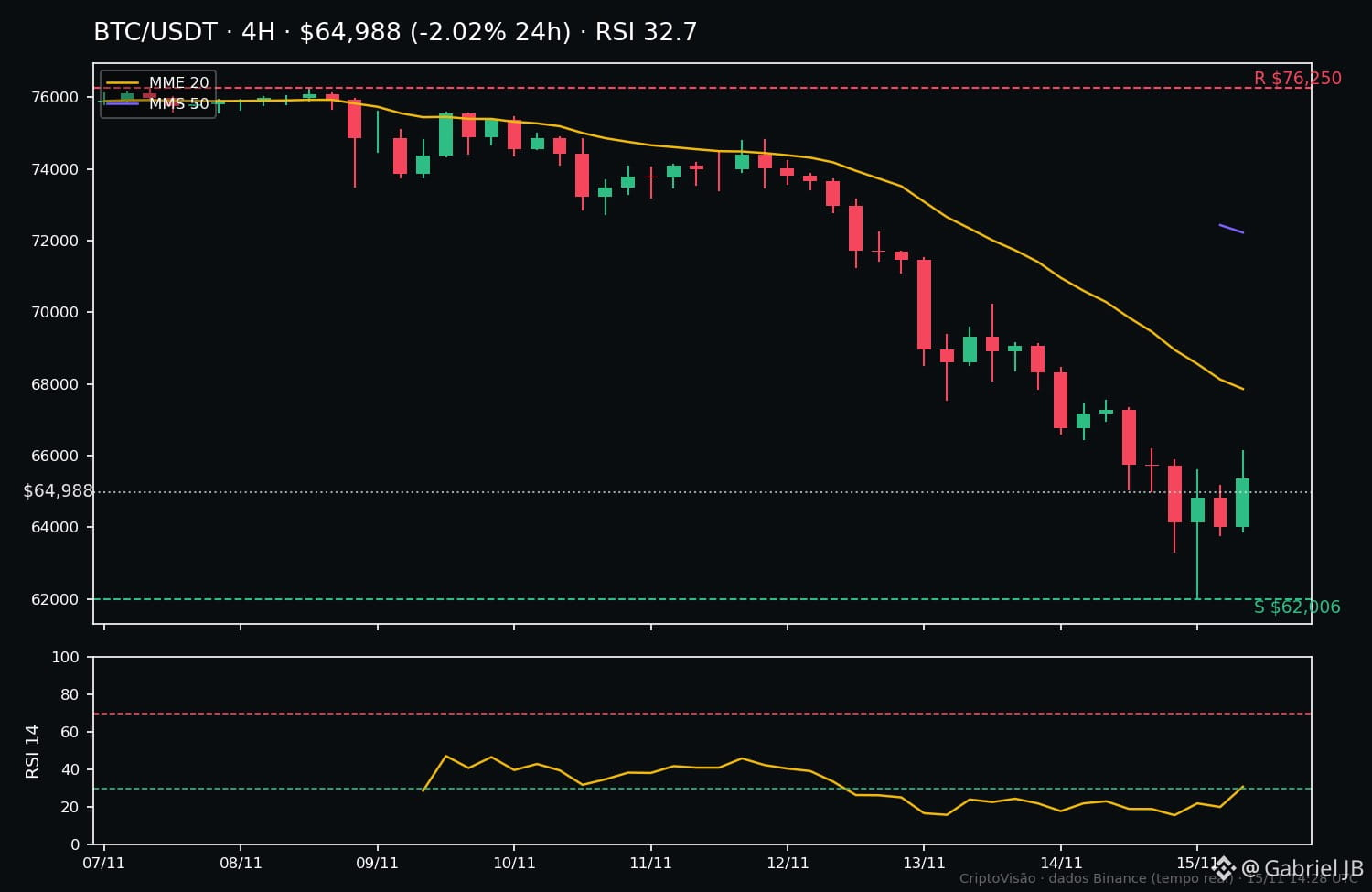
The $BTC is at US$ 64,997 today, down 13.89% in 7 days, with the week's low at US$ 62,006. The RSI-14 is at 32.7 and the price remains below the 4h moving averages. ETH fell 20.39% in the same week. When the market falls, everything falls together — correlation is working against those who don't account for it.
The trap: opening 1% in BTC, 1% in ETH, and 1% in SOL seems like risking 1% per trade. In practice, that's ~3% on a single bet, because all three move together. The real risk is the sum of correlated positions, not the risk of each one.
The calculation, on a US$ 1,000 account:
• 1% risk = US$ 10 per trade.
• Entry at US$ 64,997, stop at US$ 61,700 — below the actual support at US$ 62,006, not at a round number.
• Risk per BTC: US$ 3,297. Position: 10 ÷ 3,297 = 0.00303 BTC (~US$ 197).
• Target at the 20-period moving average (US$ 68,281): reward of US$ 3,284, R:R of 1:1 — below the 1:2 minimum. Trade rejected. The best trade today is no trade.
And remember: 10 stops of 1% cost 9.6% of your account. Ten trades risking 10% cost 65%. Several small stops are better than going all-in — preserving capital is strategy #1.
Do you add up the risk of your correlated positions before entering?
#Bitcoin #GestaoDeRisco #CriptoVisao
21
·
--
$BTC is up 5.5% from the low — and that’s when FOMO bites
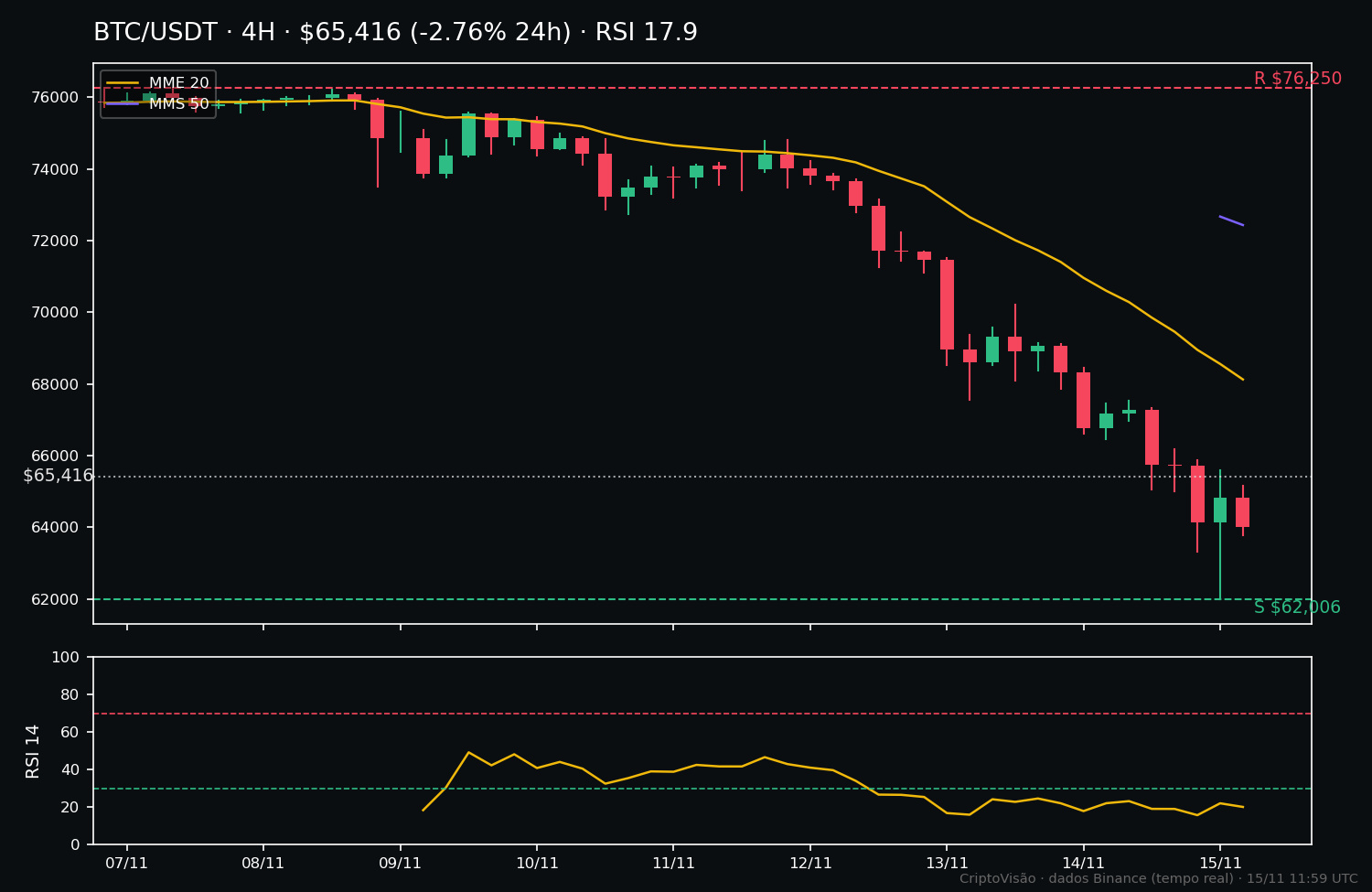
$BTC fell as low as US$62,006 overnight — a new 7-day low — and is now at US$65,412. It’s up 5.5% from the bottom. And this is exactly when many people make the mistake of the day: buying the bounce out of FOMO, without confirmation.
The mistake: seeing the price rise quickly after a week of -15.6% and rushing in, afraid of “missing the turnaround.” The problem? The price is right up against resistance at US$66,456 — the 7-day floor it lost yesterday. Without a 4-hour close above that level, this may just be a breather within the downtrend, not a reversal. Anyone buying here is buying just below resistance, with the RSI-14 at 17.9 and the price still below the 4-hour moving averages (US$68,704 / US$72,433).
Why it costs money: if resistance holds and the price falls back to US$62,006, anyone who jumped in on the momentum loses ~5% in the blink of an eye — and, worse, gets stuck in a long position in a market that still hasn’t confirmed any bottom.
The simple rule: a bounce isn’t a reversal. Wait for a 4-hour close above US$66,456. If it doesn’t close above, there’s no entry — just patience. And if you do enter, set a stop below US$62,006 and risk a maximum of 1% of your account per trade.
Have you ever fallen for FOMO on a bounce that then crashed? Tell us in the comments 👇
$BTC
#Bitcoin #CriptoVisao #RiskManagement
43
·
--
$BTC lost the weekly floor — and this is where the risk of ruin decides who stays in the game 📉
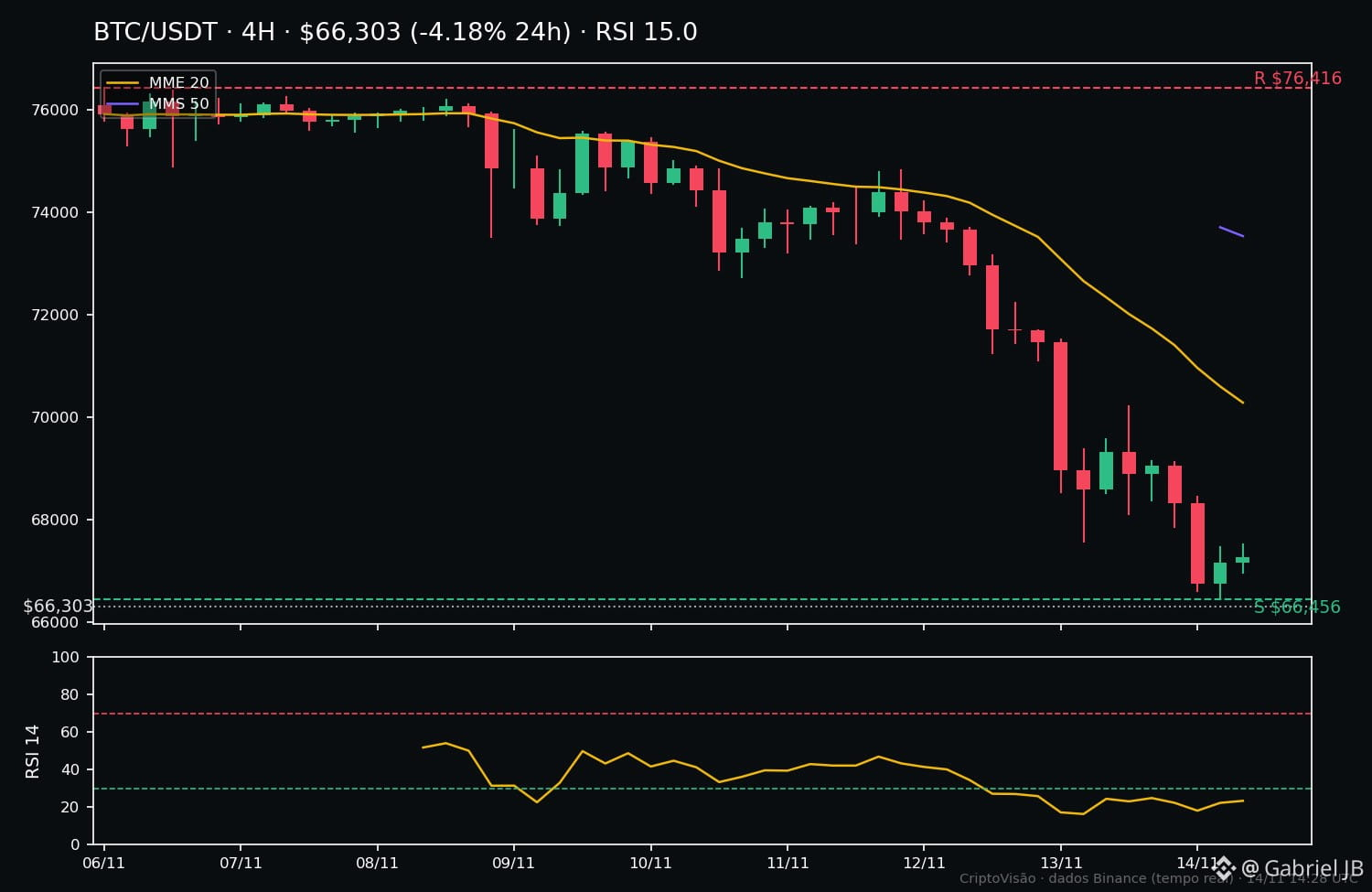
$BTC is currently at US$ 66,303, down 11.38% for the week, with an RSI-14 of 15.0 (extreme oversold). The 7-day floor of US$ 66,456 has been breached — the 24-hour low is US$ 65,962, and the nearest resistance is the 24-hour high at US$ 69,488.
Today’s lesson isn’t about getting the direction right. It’s about surviving a losing streak — the risk of ruin.
Example with a US$ 1,000 account:
• Risk 1% per trade = US$ 10. Ten consecutive losses: the account drops to ~US$ 904 (-9.6%). To recover, you only need +10.6%.
• Risk 5% per trade = US$ 50. Ten consecutive losses: the account drops to ~US$ 599 (-40.1%). To recover, you need +67%.
• Risk 10% per trade = US$ 100. Ten consecutive losses: the account drops to ~US$ 349 (-65.1%). To recover, you need +187%.
The math is unforgiving: the higher the risk per trade, the harder it is to get back. And in a week like this — with $BTC down 11% and the RSI at 15 — consecutive losses aren’t a hypothetical; they’re the normal scenario.
Rule of thumb: risk 1% per trade. With US$ 1,000, that’s US$ 10. If your stop is US$ 500 from your entry price, your position size is US$ 10 ÷ US$ 500 = 0.02 $BTC. The stop determines the size — never the other way around.
Preserving capital is strategy No. 1. Those who survive can trade tomorrow.
And you: have you calculated how many consecutive losses your account can withstand? 👇
#Bitcoin #GestaoDeRisco #CriptoVisao
$BTC lost the weekly floor — and this is where the risk of ruin decides who stays in the game 📉
$BTC is currently at US$ 66,303, down 11.38% for the week, with an RSI-14 of 15.0 (extreme oversold). The 7-day floor of US$ 66,456 has been breached — the 24-hour low is US$ 65,962, and the nearest resistance is the 24-hour high at US$ 69,488.
Today’s lesson isn’t about getting the direction right. It’s about surviving a losing streak — the risk of ruin.
Example with a US$ 1,000 account:
• Risk 1% per trade = US$ 10. Ten consecutive losses: the account drops to ~US$ 904 (-9.6%). To recover, you only need +10.6%.
• Risk 5% per trade = US$ 50. Ten consecutive losses: the account drops to ~US$ 599 (-40.1%). To recover, you need +67%.
• Risk 10% per trade = US$ 100. Ten consecutive losses: the account drops to ~US$ 349 (-65.1%). To recover, you need +187%.
The math is unforgiving: the higher the risk per trade, the harder it is to get back. And in a week like this — with $BTC down 11% and the RSI at 15 — consecutive losses aren’t a hypothetical; they’re the normal scenario.
Rule of thumb: risk 1% per trade. With US$ 1,000, that’s US$ 10. If your stop is US$ 500 from your entry price, your position size is US$ 10 ÷ US$ 500 = 0.02 $BTC . The stop determines the size — never the other way around.
Preserving capital is strategy No. 1. Those who survive can trade tomorrow.
And you: have you calculated how many consecutive losses your account can withstand? 👇
#Bitcoin #GestaoDeRisco #CriptoVisao
149
·
--
$BTC lost support — and this is where risk management decides who stays in the game 📉
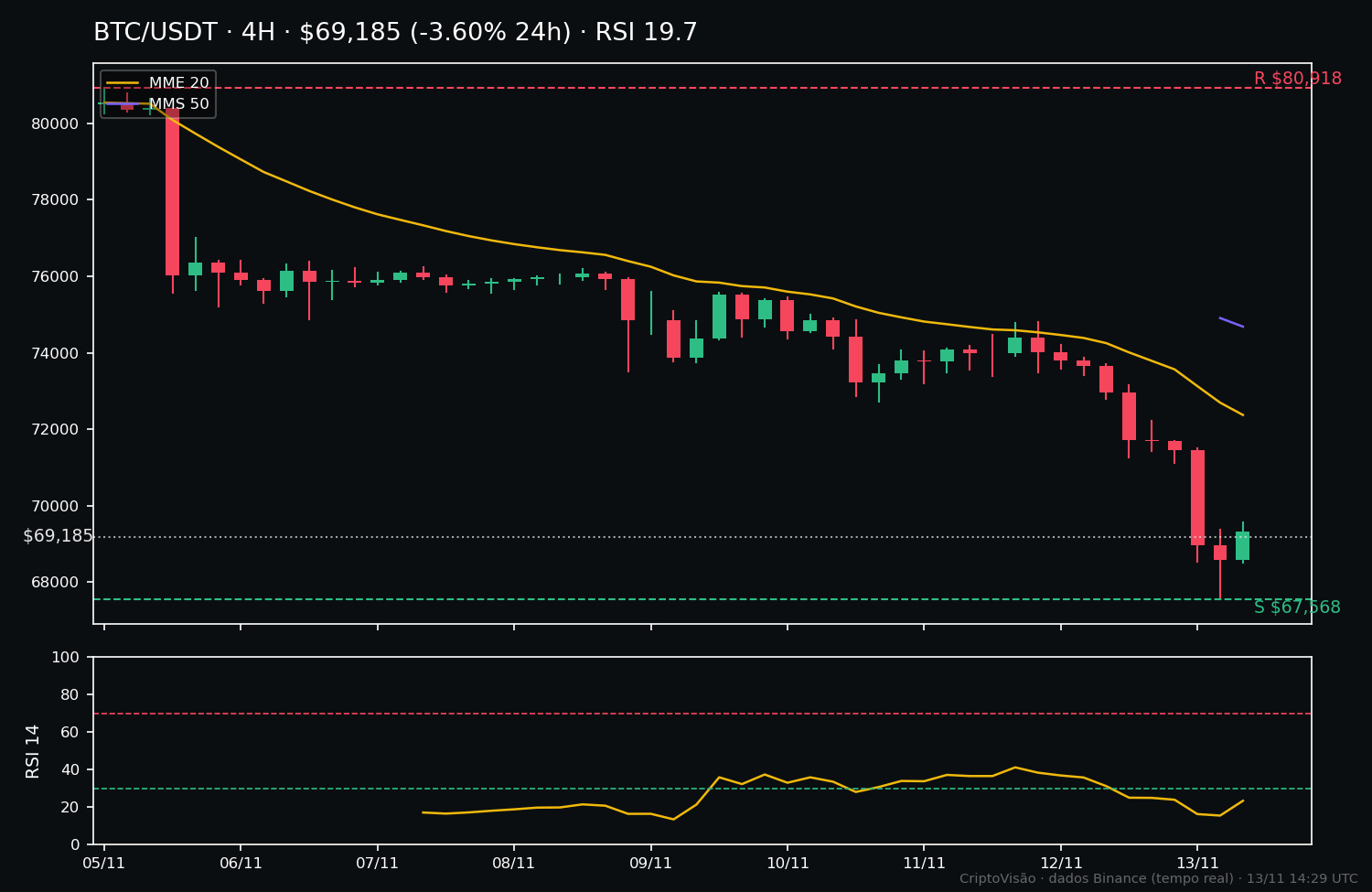
Bitcoin is at $69,195 today, down 13.94% for the week, with an RSI-14 of 19.7 (oversold). The $72,727 support level, which had held for days, broke yesterday. This week’s new support is the low of $67,568; the nearest resistance is the 24-hour high of $72,288.
Today’s lesson, using a $500 account as an example:
1. The 1% per-trade rule: the most you can lose on a trade is $5. That’s not the position value — it’s the amount you’d lose if the stop is triggered.
2. Place your stop at a structural level, not a round number: with support at $67,568, the stop goes below it, at $67,400. Entry at $69,195 → risk of $1,795 per BTC.
3. The stop determines your position size: $5 ÷ $1,795 = 0.0028 BTC (about $194). The stop determines the size — never the other way around.
4. Check the risk/reward ratio before entering: target at $72,288 → potential gain of $3,093 per BTC. Risk/reward ratio of 1.72:1. The minimum I recommend is 1:2. The result: this trade FAILS the test. The best trade today is no trade at all.
5. Ten small stop-outs are better than one all-in: 10 losses of 1% leave a $500 account with about $452 (-9.6%). One lost all-in trade leaves the account at $0. Preserving capital is strategy #1 — those who survive can trade again tomorrow.
What about you: do you calculate your position size based on your stop, or do you still trade by gut feeling? 👇
#Bitcoin #GestaoDeRisco #CriptoVisao
7
·
--
The $BTC broke the week's support. Now what? Your risk management is what decides.
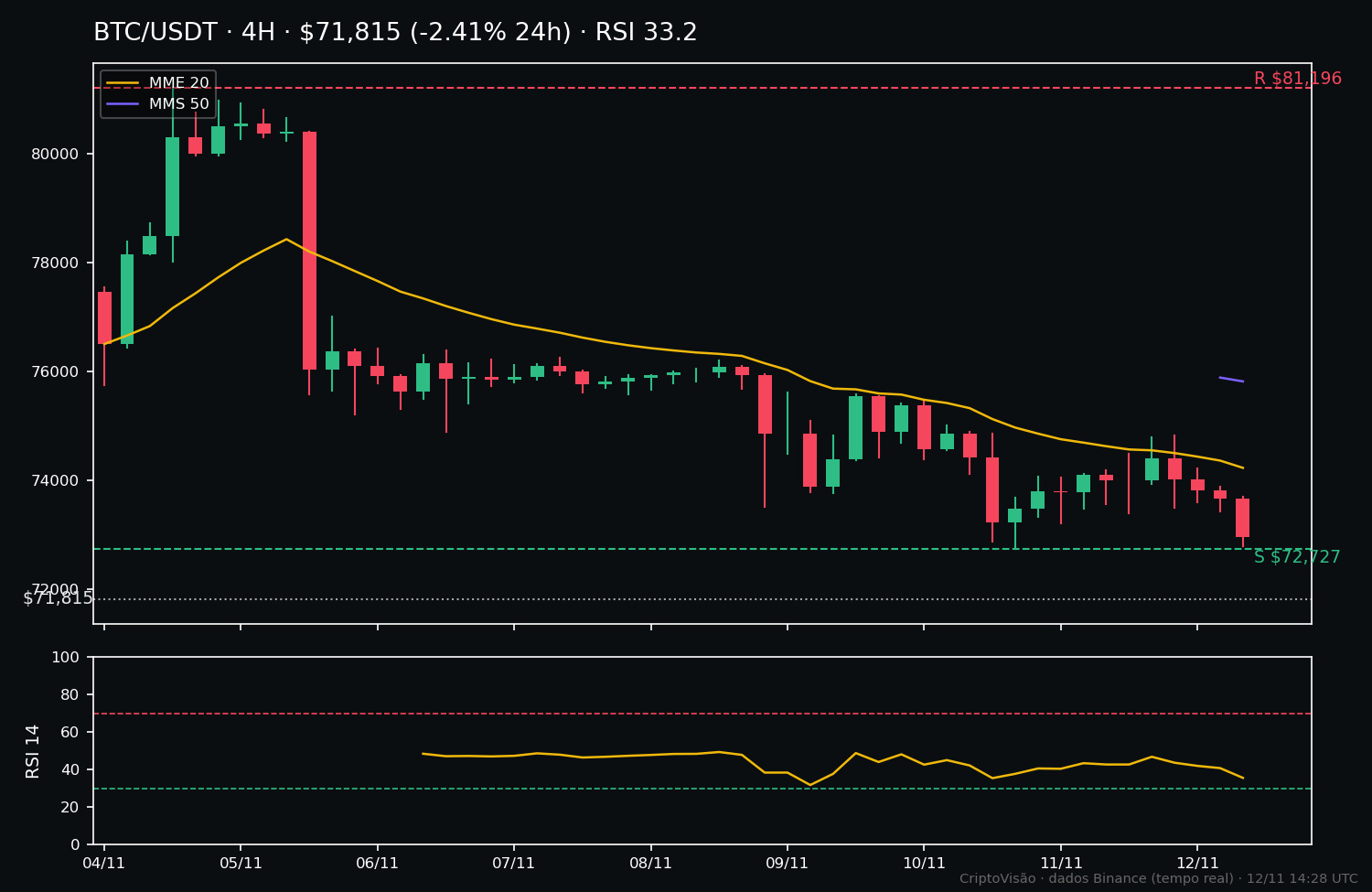
The $BTC is at $71,819 (-2.39% in 24h; -4.63% in 7 days), below the 20- and 50-period averages ($74,151 and $75,809), with the RSI-14 at 33.2. The low for the last 7 days was $72,727 — the price is already below it. Anyone whose stop was «below support» was stopped out. That's how the market works: yesterday's support doesn't protect today's trade.
Today's lesson, with real numbers — to repeat in any trade:
1️⃣ The 1% rule: with a $1,000 account, you risk a maximum of $10 per trade. That's not the position size — it's the maximum you're willing to lose if the stop is triggered.
2️⃣ The stop follows the structure, not a round number. The low for the last 24 hours is $71,777. A technical stop goes below it, with room for noise: $71,100. Distance from the current price: $719 per $BTC.
3️⃣ The stop determines the position size: $10 ÷ $719 = 0.0139 $BTC, worth around $999. The stop tells you how much to buy — never the other way around.
4️⃣ Risk/reward ratio before entering: the first obstacle above is the 20-period average, at $74,151. Potential gain: $2,332 per $BTC. Risk: $719. A ratio of 3.2 to 1 — above the minimum of 2 to 1. This test approves the entry; below 2 to 1, the best trade is no trade.
5️⃣ Why ten small stops are worth more than an all-in: ten 1% stops leave the account at $904 (-9.6%), and recovering requires +10.6%. An all-in that loses 50% requires +100% just to break even. Surviving is strategy No. 1 — profit comes later.
Preserving capital isn't fear. It's what keeps you in the game for the next setup. 📉
What's your risk rule per trade: 1%, 2%, or do you not have one yet?
#Bitcoin #GestaoDeRisco #CriptoVisao
The $BTC broke the week's support. Now what? Your risk management is what decides.
The $BTC is at $71,819 (-2.39% in 24h; -4.63% in 7 days), below the 20- and 50-period averages ($74,151 and $75,809), with the RSI-14 at 33.2. The low for the last 7 days was $72,727 — the price is already below it. Anyone whose stop was «below support» was stopped out. That's how the market works: yesterday's support doesn't protect today's trade.
Today's lesson, with real numbers — to repeat in any trade:
1️⃣ The 1% rule: with a $1,000 account, you risk a maximum of $10 per trade. That's not the position size — it's the maximum you're willing to lose if the stop is triggered.
2️⃣ The stop follows the structure, not a round number. The low for the last 24 hours is $71,777. A technical stop goes below it, with room for noise: $71,100. Distance from the current price: $719 per $BTC .
3️⃣ The stop determines the position size: $10 ÷ $719 = 0.0139 $BTC , worth around $999. The stop tells you how much to buy — never the other way around.
4️⃣ Risk/reward ratio before entering: the first obstacle above is the 20-period average, at $74,151. Potential gain: $2,332 per $BTC . Risk: $719. A ratio of 3.2 to 1 — above the minimum of 2 to 1. This test approves the entry; below 2 to 1, the best trade is no trade.
5️⃣ Why ten small stops are worth more than an all-in: ten 1% stops leave the account at $904 (-9.6%), and recovering requires +10.6%. An all-in that loses 50% requires +100% just to break even. Surviving is strategy No. 1 — profit comes later.
Preserving capital isn't fear. It's what keeps you in the game for the next setup. 📉
What's your risk rule per trade: 1%, 2%, or do you not have one yet?
#Bitcoin #GestaoDeRisco #CriptoVisao
32
·
--
The $BTC fell 10% in 7 days — and that’s where the costliest mistake lies 📉
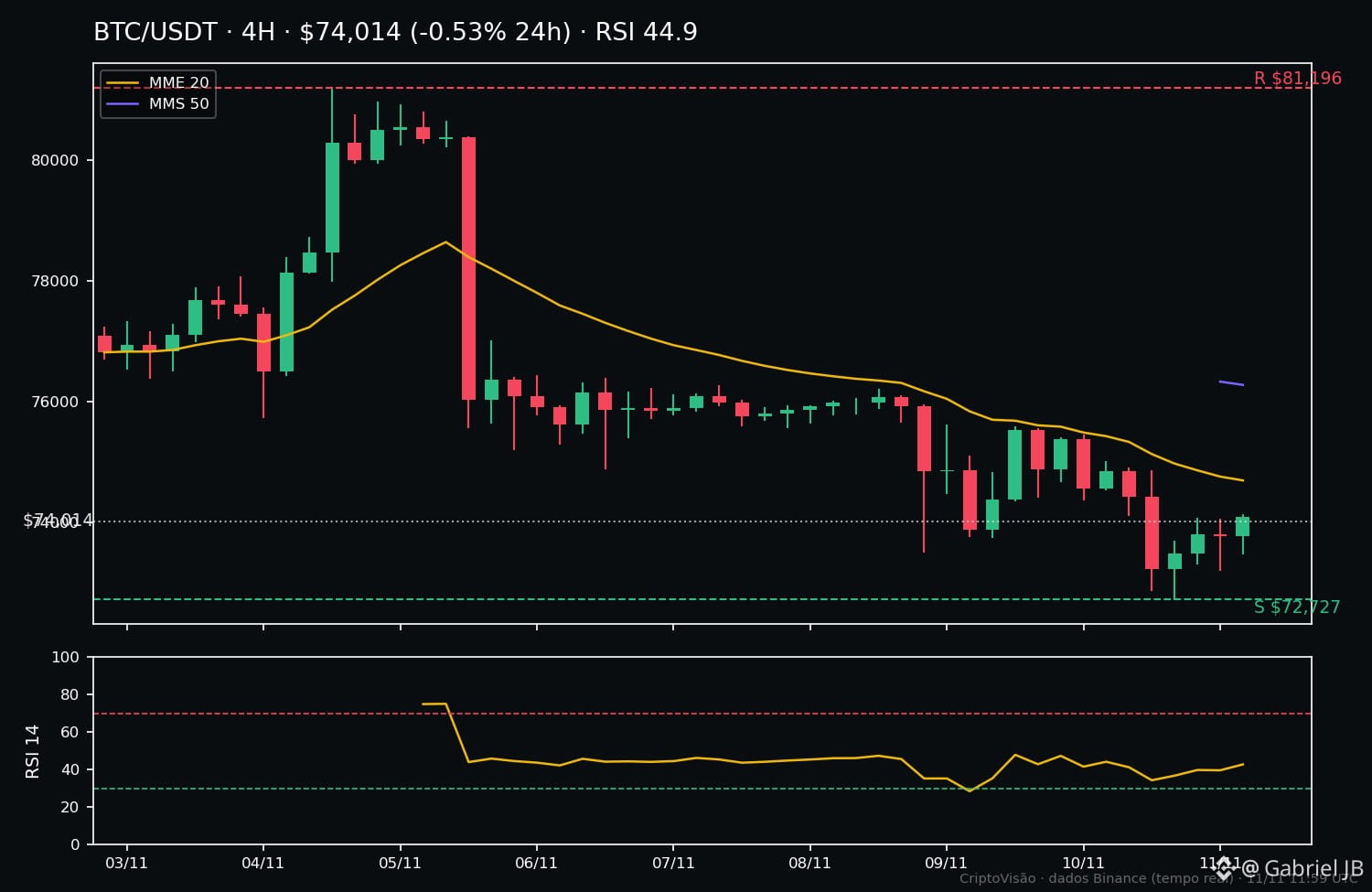
The $BTC fell from US$ 81.196 to US$ 72.727 in 7 days (-10.4%). Today it’s at US$ 74.014, still below the 20- and 50-period averages on the 4h chart (US$ 74.789 and US$ 76.276), with RSI-14 at 44.9 — neutral, with no sign of a reversal.
The mistake of the day: buying the dip just because “it’s already fallen a lot.” A falling price isn’t a cheap price. Without confirmation, every “discount” could just be the middle of the drop — and anyone who buys without a plan becomes hostage to the next candle.
The simple rule: wait for confirmation. A 4h close above the 20-period average (US$ 74.789) or a higher low shows that buyers have returned. Without that, it’s a bet, not analysis.
And if you enter: place a stop below the 7-day low (US$ 72.727). If that level is breached, the thesis is dead — exit and reassess. Anyone who doesn’t set a stop before entering ends up making decisions emotionally afterward.
Have you ever bought a dip that kept falling? Tell us in the comments 👇
$BTC
#Bitcoin #CriptoVisao #RiskManagement
50
·
--
The 1% rule that separates those who survive from those who go broke on $BTC 📊
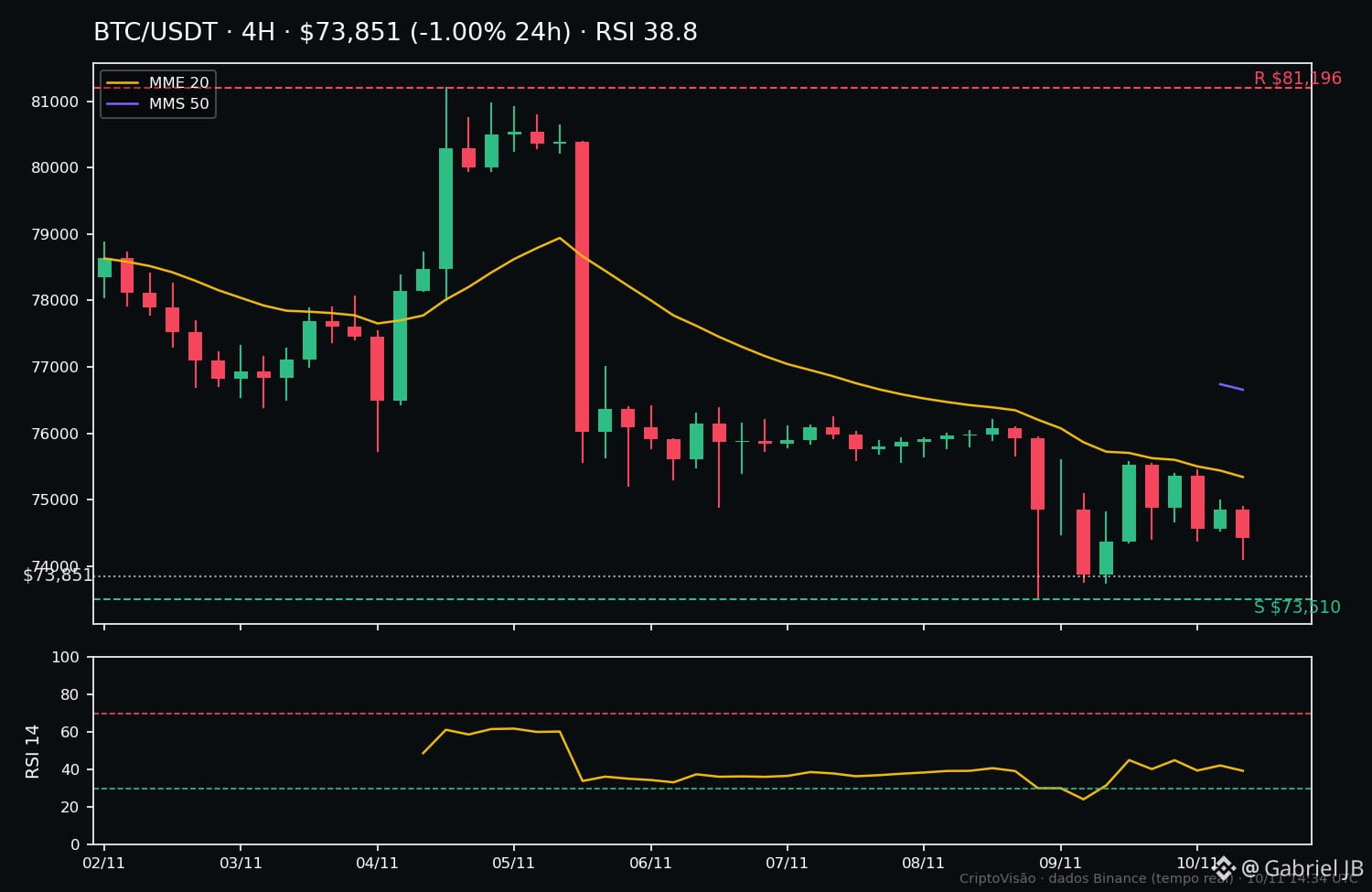
$BTC is trading at US$73,707 (-1.08% in 24h; -5.36% in 7 days), below the 20- and 50-period moving averages on the 4h chart, with the week's support at US$73,510 and resistance at US$81,196. It's the perfect scenario to practice the calculation that best protects an account — before thinking about profit.
Example account: US$1,000. The 1% rule = US$10 risk per trade. That's not the position size: it's the maximum you're willing to lose if the stop is triggered.
Step 1 — place the stop below actual support. Weekly support: US$73,510. Stop: US$72,950. It's not a round number: the chart structure dictates it. Risk per BTC: 73,707 − 72,950 = US$757.
Step 2 — the stop determines the position size. US$10 ÷ US$757 = 0.0132 BTC, about US$974. Notice: the position is large, but the risk is still only US$10.
Step 3 — the risk/reward test. First realistic target: US$75,347 (20-period moving average, 4h). Reward: 75,347 − 73,707 = US$1,640 per BTC. Risk/reward = 2.2:1 — above the 2:1 minimum. The entry passes the test. Below 2:1, the best decision is not to enter.
And why are several small stops worth more than an all-in? 10 consecutive 1% stops leave the account down 9.6% — you can recover with a 10.6% gain. A 50% loss on an all-in requires a 100% gain just to get back to zero. Preserving capital is strategy No. 1: those who survive stay in the game.
What's your risk limit per trade: 1% or 2%? Let us know in the comments. 👇
#Bitcoin #GestaoDeRisco #CryptoVision
4
·
--
Position size determines whether you survive — not being right 📐
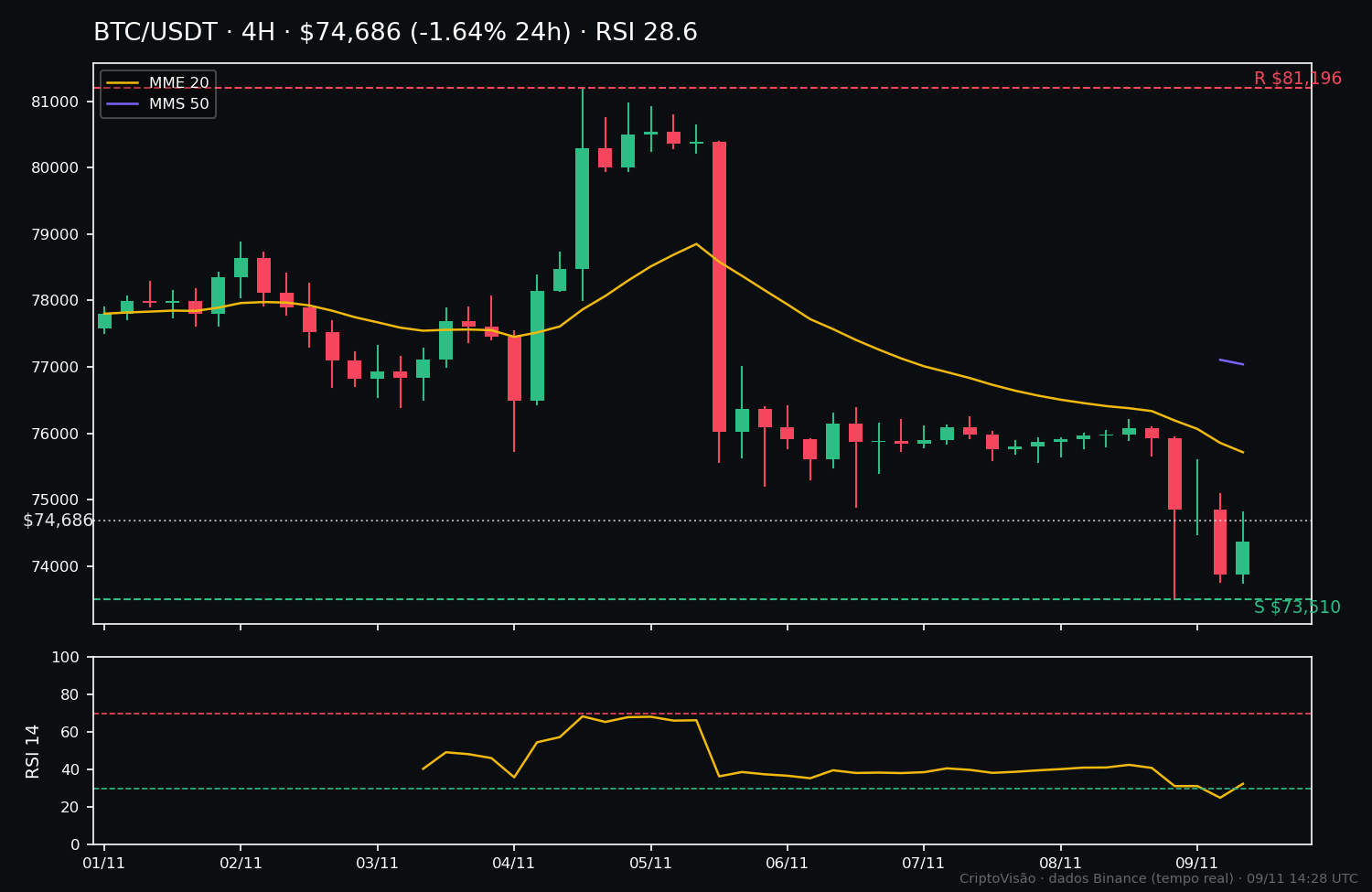
$BTC today: $74.696 (-1.6% in 24h). Weekly support: $73.510. Resistance: $81.196. RSI at 28.6, in oversold territory, and the price remains below the 20- and 50-period moving averages. Today’s calculation, step by step, using a $1,000 account as an example:
1️⃣ Define the risk: 1% of the account = $10 per trade. That’s the maximum you’re willing to lose if the stop is triggered.
2️⃣ Place the stop based on market structure: below actual support, at $73.100 — not at some arbitrary round number. Distance from entry: $74.696 − $73.100 = $1.596 per BTC.
3️⃣ The stop determines the position size: $10 ÷ $1.596 = 0,0063 BTC, about $468. It’s not the amount you “think” is right — it’s what the risk allows.
Risk/reward test: target at resistance, $81.196 − $74.696 = $6.500 in potential gains versus $1.596 in risk. A 4.1-to-1 ratio — above the minimum of 2-to-1, so the trade passes the test. Caveat: the short-term trend remains bearish, so the numbers give it the green light, but the context calls for caution.
Why does this matter? Ten 1% stop-outs cost about 9.6% of your account — you stay in the game. Ten 10% bets cost 65%. Preserving capital is strategy No. 1.
Do you already calculate your position size before entering, or do you decide by gut feeling? 👇
#Bitcoin #GestaoDeRisco #CryptoVision
8
·
--
The account that survives isn't the one that gets it right most often — it's the one that risks less per trade
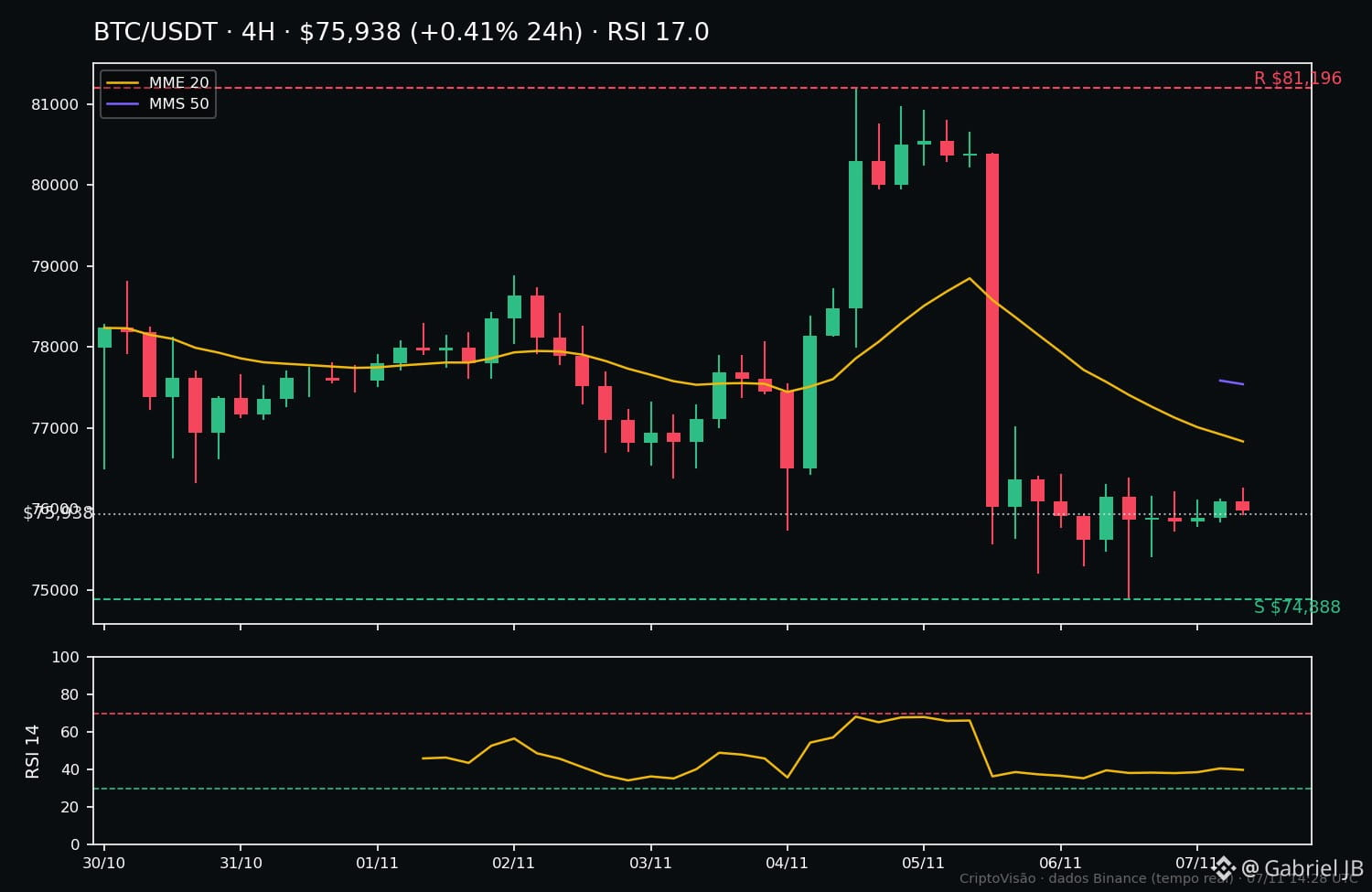
$BTC is currently at US$75,940.29, trading below the 20- and 50-period moving averages (4h), with the RSI-14 at 17, in oversold territory. This week's support: US$74,888. Resistance: US$81,196.
Today's lesson is simple: before thinking about profits, decide how much you can afford to lose.
1. The 1% rule: with a US$1,000 account, risk no more than US$10 per trade. It would take 100 consecutive losing trades to wipe out the account — and nobody loses 100 times in a row when following a method.
2. Place your stop below support, not at a round number: entry near US$75,940, stop at US$74,700, just below support at US$74,888. Risk per coin: US$1,240.
3. Position size is determined by risk, not by what you want: US$10 ÷ US$1,240 = 0.008 BTC (about US$612 in exposure). Risk determines position size — never the other way around.
4. Only enter if the reward makes it worthwhile: with a target at the US$81,196 resistance, the potential gain is US$5,256 — more than 4 times the risk. The minimum rule is 1 to 2. If it's below that, wait for the next opportunity.
Several small stop-outs keep you in the game. Going all-in takes you out of it for good. Preserving capital is strategy No. 1. 📉
What's your risk rule per trade — 1% or 2%? Tell us in the comments. 👇
#Bitcoin #GestaoDeRisco #CriptoVisao
18
Log in to explore more content
Join global crypto users on Binance Square
⚡️ Get latest and useful information about crypto.
💬 Trusted by the world’s largest crypto exchange.
👍 Discover real insights from verified creators.
Email / Phone number
Trending Topics
1
#CanMarketsReboundAfterThanksgiving?
4,291 views
122 Discussing
2
#CouldSpaceX’sOrbitalDataCentersBoostAIChipDemand?
3,716 views
89 Discussing
3
#EvolveAtBinanceBlockchainWeek
634,347 views
6,446 Discussing
4
#CorePCEBeatLiftsFedHikeOdds
143,915 views
1,161 Discussing
5
#BitcoinAndStocksSlipAgainAmidTrump’sTariffPlans
200,386 views
1,976 Discussing
6
#JensenHuangSaysNvidiaDoesn’tNeedASuccessionPlan
96,601 views
1,195 Discussing
7
#NasdaqFuturesSlideMoreThan3%
37,646 views
345 Discussing
8
#USOctoberPCEPriceIndexAt0.3%MoM
43,212 views
351 Discussing
9
#BitcoinETFsPostRecord$4.94BNovemberOutflows
7,615 views
46 Discussing
10
#TetherInvestsInArgentinasLemon
16,405 views
200 Discussing