
#duks
duks
511 views
19 Discussing
Hot
Latest


#dusk $DUSK We always see that when a campaign is running, the price of that coin stays high.
But as soon as the campaign ends, the price goes down.
What do you call this?
Do you think $DUK.US S will stay at the current price or will it go down?
Drop your opinion in the comment box.
#DUKS #BinanceSquare #CryptoDiscussion
But as soon as the campaign ends, the price goes down.
What do you call this?
Do you think $DUK.US S will stay at the current price or will it go down?
Drop your opinion in the comment box.
#DUKS #BinanceSquare #CryptoDiscussion

🇺🇸 U.S. Treasury Unveils Rules for Issuing and Selling Stablecoins
Starting in 2027, issuers and crypto trading platforms will face new restrictions in the stablecoin space in the U.S. market. Under the proposal, beginning January 18 of next year, issuers will have to obtain a federal or state license.
Platforms will also be able to sell stablecoins issued abroad, but only if the foreign issuer complies with U.S. laws and agreements between the U.S. and the country where it is regulated.
Beginning July 18, 2028, broader restrictions are proposed: crypto exchanges and services will not be able to offer customers in the U.S. stablecoins “unless the payment stablecoin is issued by an authorized payment stablecoin issuer.”
U.S. Treasury Secretary Scott Bessent said these rules will provide businesses with regulatory clarity, and will help “strengthen the role of the U.S. dollar,” adding that he welcomed public participation in the discussion. The deadline for comments is 60 days after publication.
#duks
@Binance
Starting in 2027, issuers and crypto trading platforms will face new restrictions in the stablecoin space in the U.S. market. Under the proposal, beginning January 18 of next year, issuers will have to obtain a federal or state license.
Platforms will also be able to sell stablecoins issued abroad, but only if the foreign issuer complies with U.S. laws and agreements between the U.S. and the country where it is regulated.
Beginning July 18, 2028, broader restrictions are proposed: crypto exchanges and services will not be able to offer customers in the U.S. stablecoins “unless the payment stablecoin is issued by an authorized payment stablecoin issuer.”
U.S. Treasury Secretary Scott Bessent said these rules will provide businesses with regulatory clarity, and will help “strengthen the role of the U.S. dollar,” adding that he welcomed public participation in the discussion. The deadline for comments is 60 days after publication.
#duks
@Binance

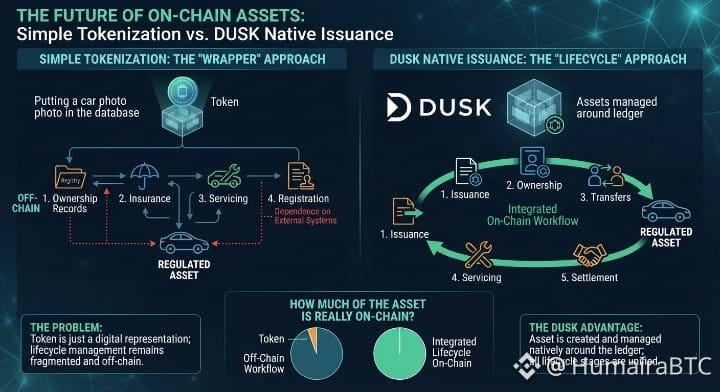
#dusk $DUSK I started wondering about something while digging into DUSK.
When someone says “this bond is on-chain,” what exactly is on-chain?
Imagine putting a car’s photo into a digital database.
The photo is digital.
But the actual ownership records, insurance, servicing and registration are still sitting in different offices.
That’s roughly the problem I found with simple tokenization.
A token can represent a financial asset while the real asset lifecycle still depends on separate systems.
DUSK takes a different route with native issuance.
Instead of treating the blockchain token as just a wrapper, the asset can be created and managed around the ledger itself — with issuance, ownership, transfers, servicing and settlement designed as part of the same workflow.
That distinction sounds small.
But it changes the question from:
“Can we put a financial asset on-chain?”
to:
“Can the asset actually live through its lifecycle on-chain?”
I think that’s why DUSK adopted native issuance.
The goal isn’t another token.
It’s reducing the number of separate records and handoffs that a regulated asset depends on.
And that makes me wonder:
If the underlying financial workflow still lives off-chain, how much of that asset did we really put on-chain?
@Dusk $DUSK #duks
When someone says “this bond is on-chain,” what exactly is on-chain?
Imagine putting a car’s photo into a digital database.
The photo is digital.
But the actual ownership records, insurance, servicing and registration are still sitting in different offices.
That’s roughly the problem I found with simple tokenization.
A token can represent a financial asset while the real asset lifecycle still depends on separate systems.
DUSK takes a different route with native issuance.
Instead of treating the blockchain token as just a wrapper, the asset can be created and managed around the ledger itself — with issuance, ownership, transfers, servicing and settlement designed as part of the same workflow.
That distinction sounds small.
But it changes the question from:
“Can we put a financial asset on-chain?”
to:
“Can the asset actually live through its lifecycle on-chain?”
I think that’s why DUSK adopted native issuance.
The goal isn’t another token.
It’s reducing the number of separate records and handoffs that a regulated asset depends on.
And that makes me wonder:
If the underlying financial workflow still lives off-chain, how much of that asset did we really put on-chain?
@Dusk $DUSK #duks
#dusk $DUSK I’m studying the @Dusk project.
#duks They’re trying to bring Privacy + Compliance together on the blockchain. The idea of a Confidential Smart Contract is very big for the future.
What do you all think about $DUSK ?
In the next bull run, will the demand for Privacy Coins increase?
Let us know in the comments 👇
$DUK.US
#duks They’re trying to bring Privacy + Compliance together on the blockchain. The idea of a Confidential Smart Contract is very big for the future.
What do you all think about $DUSK ?
In the next bull run, will the demand for Privacy Coins increase?
Let us know in the comments 👇
$DUK.US
Log in to explore more content