
#btcstaking
btcstaking
21,152 views
151 Discussing
Hot
Latest

Bitcoin yield models are transitioning from centralized lending toward self custodial staking, DeFi vaults, and wrapped BTC strategies through 2026.
#BitcoinYield #BTCStaking
Bitcoin yield models are transitioning from centralized lending toward self custodial staking, DeFi vaults, and wrapped BTC strategies through 2026.
#BitcoinYield #BTCStaking
#BitcoinYield #BTCStaking
1
5

·
--
BTCFi Narrative|Babylon TBV Opens a New Paradigm for BTCFi $BABY
Today, we’ll focus on how Babylon TBV is opening up a new paradigm for BTCFi. There’s plenty of room to imagine.
Traditional BTC has limited ways to participate in DeFi. wBTC requires trusting a custodian, while tBTC relies on cross-chain bridges—both carry centralized risks. TBV uses on-chain Bitcoin scripts to enable self-custodied staking, allowing BTC to participate in DeFi without leaving the Bitcoin network.
The innovation is this: BTC holders can earn yield without selling their coins. Staking rewards are distributed in $BABY , while still preserving upside exposure to BTC. After Aave integration, BTC can also be used as collateral for borrowing, further unlocking liquidity. With BTC’s market value exceeding $70 billion, even unlocking a small portion of it to DeFi is a massive incremental market.
The current price of $BABY has not been found; 24h N/A; market cap not disclosed; FDV not disclosed. Protocol TVL not found; rank not found. GitHub submissions in the last 90 days not found; stars not found.
The BTCFi narrative has big potential, but the pace of real-world deployment depends on ecosystem integration progress. Watch three metrics: TVL growth, the number of integrated PoS chains, and the number of DeFi protocol integrations. Continuous improvements in these metrics indicate that the narrative is becoming real.
No rush—let the bullets fly for a moment.
#baby #Babylon #BTCStaking @BabylonLabs_io
BTCFi Narrative|Babylon TBV Opens a New Paradigm for BTCFi $BABY
Today, we’ll focus on how Babylon TBV is opening up a new paradigm for BTCFi. There’s plenty of room to imagine.
Traditional BTC has limited ways to participate in DeFi. wBTC requires trusting a custodian, while tBTC relies on cross-chain bridges—both carry centralized risks. TBV uses on-chain Bitcoin scripts to enable self-custodied staking, allowing BTC to participate in DeFi without leaving the Bitcoin network.
The innovation is this: BTC holders can earn yield without selling their coins. Staking rewards are distributed in $BABY , while still preserving upside exposure to BTC. After Aave integration, BTC can also be used as collateral for borrowing, further unlocking liquidity. With BTC’s market value exceeding $70 billion, even unlocking a small portion of it to DeFi is a massive incremental market.
The current price of $BABY has not been found; 24h N/A; market cap not disclosed; FDV not disclosed. Protocol TVL not found; rank not found. GitHub submissions in the last 90 days not found; stars not found.
The BTCFi narrative has big potential, but the pace of real-world deployment depends on ecosystem integration progress. Watch three metrics: TVL growth, the number of integrated PoS chains, and the number of DeFi protocol integrations. Continuous improvements in these metrics indicate that the narrative is becoming real.
No rush—let the bullets fly for a moment.
#baby #Babylon #BTCStaking @BabylonLabs_io
Today, we’ll focus on how Babylon TBV is opening up a new paradigm for BTCFi. There’s plenty of room to imagine.
Traditional BTC has limited ways to participate in DeFi. wBTC requires trusting a custodian, while tBTC relies on cross-chain bridges—both carry centralized risks. TBV uses on-chain Bitcoin scripts to enable self-custodied staking, allowing BTC to participate in DeFi without leaving the Bitcoin network.
The innovation is this: BTC holders can earn yield without selling their coins. Staking rewards are distributed in $BABY , while still preserving upside exposure to BTC. After Aave integration, BTC can also be used as collateral for borrowing, further unlocking liquidity. With BTC’s market value exceeding $70 billion, even unlocking a small portion of it to DeFi is a massive incremental market.
The current price of $BABY has not been found; 24h N/A; market cap not disclosed; FDV not disclosed. Protocol TVL not found; rank not found. GitHub submissions in the last 90 days not found; stars not found.
The BTCFi narrative has big potential, but the pace of real-world deployment depends on ecosystem integration progress. Watch three metrics: TVL growth, the number of integrated PoS chains, and the number of DeFi protocol integrations. Continuous improvements in these metrics indicate that the narrative is becoming real.
No rush—let the bullets fly for a moment.
#baby #Babylon #BTCStaking @BabylonLabs_io
53

#baby $BABY
BTC staking is changing forever. Are you ready? 🤔💡
The game has officially shifted. @BabylonLabs_io ($BABY) is enabling self-custodial BTC staking directly on the Bitcoin network. No more middlemen, just true ownership. 💎📈
This isn't just about a coin; it’s a technological jump for the entire Bitcoin ecosystem. Total control meets secure rewards.
Are you watching this narrative unfold or are you taking part? Share your strategy in the comments! 👇✨
#baby #crypto #BTCStaking
#baby $BABY
BTC staking is changing forever. Are you ready? 🤔💡
The game has officially shifted. @BabylonLabs_io ($BABY ) is enabling self-custodial BTC staking directly on the Bitcoin network. No more middlemen, just true ownership. 💎📈
This isn't just about a coin; it’s a technological jump for the entire Bitcoin ecosystem. Total control meets secure rewards.
Are you watching this narrative unfold or are you taking part? Share your strategy in the comments! 👇✨
#baby #crypto #BTCStaking
BTC staking is changing forever. Are you ready? 🤔💡
The game has officially shifted. @BabylonLabs_io ($BABY ) is enabling self-custodial BTC staking directly on the Bitcoin network. No more middlemen, just true ownership. 💎📈
This isn't just about a coin; it’s a technological jump for the entire Bitcoin ecosystem. Total control meets secure rewards.
Are you watching this narrative unfold or are you taking part? Share your strategy in the comments! 👇✨
#baby #crypto #BTCStaking

74

Bitcoin sitting in your wallet is safe — but it's also silent. It doesn't do anything for you besides wait.
What pulled me into Babylon is that it gives BTC a job without touching its security. No wrapping, no bridging, no handing custody to a third party. Your Bitcoin stays exactly where it is, and it still helps secure other networks and earns for doing it.
The part that stood out most: if something goes wrong on the validator side, the protocol can prove and penalize it directly on the Bitcoin chain itself. Not on some separate, less-tested system — on Bitcoin's own security layer.
BABY is the token that keeps this whole system running — gas, governance, staking rewards. It's live on Binance, easy to access without hunting on smaller exchanges.
Bitcoin doesn't have to just sit there anymore. That shift alone changed how I think about holding BTC long-term.
#BABY #Binance #BTCstaking
@babylonlabs_io #baby $BABY
{future}(BABYUSDT)
{alpha}(560x277add739c6e0477616948357af9e79fe1ec9b80)
{future}(DEXEUSDT)
What matters most before you stake a coin?"
Bitcoin sitting in your wallet is safe — but it's also silent. It doesn't do anything for you besides wait.
What pulled me into Babylon is that it gives BTC a job without touching its security. No wrapping, no bridging, no handing custody to a third party. Your Bitcoin stays exactly where it is, and it still helps secure other networks and earns for doing it.
The part that stood out most: if something goes wrong on the validator side, the protocol can prove and penalize it directly on the Bitcoin chain itself. Not on some separate, less-tested system — on Bitcoin's own security layer.
BABY is the token that keeps this whole system running — gas, governance, staking rewards. It's live on Binance, easy to access without hunting on smaller exchanges.
Bitcoin doesn't have to just sit there anymore. That shift alone changed how I think about holding BTC long-term.
#BABY #Binance #BTCstaking
@BabylonLabs_io #baby $BABY
What matters most before you stake a coin?"
What pulled me into Babylon is that it gives BTC a job without touching its security. No wrapping, no bridging, no handing custody to a third party. Your Bitcoin stays exactly where it is, and it still helps secure other networks and earns for doing it.
The part that stood out most: if something goes wrong on the validator side, the protocol can prove and penalize it directly on the Bitcoin chain itself. Not on some separate, less-tested system — on Bitcoin's own security layer.
BABY is the token that keeps this whole system running — gas, governance, staking rewards. It's live on Binance, easy to access without hunting on smaller exchanges.
Bitcoin doesn't have to just sit there anymore. That shift alone changed how I think about holding BTC long-term.
#BABY #Binance #BTCstaking
@BabylonLabs_io #baby $BABY
What matters most before you stake a coin?"
Security of the mechanism
0%
APY / rewards
0%
Who's backing the project
0%
I mainly follow price
0%
0 votes • Voting closed
1
1
189

At first, I judged Bitcoin mostly by its price. Green candles felt like progress, while red days made people question its future. Over time, I realized the market was only showing one side of the story.
What makes Bitcoin truly valuable isn't just its scarcity—it's the security it has built over years. That security has become an asset in itself, not only protecting Bitcoin but also creating opportunities for other ecosystems.
That's why Babylon caught my attention. Instead of asking Bitcoin to become something new, it leverages Bitcoin's proven security to strengthen Proof-of-Stake networks through native BTC staking. It feels less like changing Bitcoin and more like extending its impact.
The way I evaluate crypto projects has changed too. I don't just ask whether a token can rally. I ask whether the protocol solves a real infrastructure problem that will still matter years from now. Strong foundations usually outlast short-term narratives.
Babylon still has to prove itself through adoption, execution, and developer growth. But if the industry continues moving toward stronger infrastructure, Bitcoin's security could become one of crypto's most valuable building blocks.
So here's the question:
Will Bitcoin's greatest contribution be its price, or the security it can provide to the entire blockchain ecosystem?
@babylonlabs_io $BABY #BTCStaking
#baby $BABY
At first, I judged Bitcoin mostly by its price. Green candles felt like progress, while red days made people question its future. Over time, I realized the market was only showing one side of the story.
What makes Bitcoin truly valuable isn't just its scarcity—it's the security it has built over years. That security has become an asset in itself, not only protecting Bitcoin but also creating opportunities for other ecosystems.
That's why Babylon caught my attention. Instead of asking Bitcoin to become something new, it leverages Bitcoin's proven security to strengthen Proof-of-Stake networks through native BTC staking. It feels less like changing Bitcoin and more like extending its impact.
The way I evaluate crypto projects has changed too. I don't just ask whether a token can rally. I ask whether the protocol solves a real infrastructure problem that will still matter years from now. Strong foundations usually outlast short-term narratives.
Babylon still has to prove itself through adoption, execution, and developer growth. But if the industry continues moving toward stronger infrastructure, Bitcoin's security could become one of crypto's most valuable building blocks.
So here's the question:
Will Bitcoin's greatest contribution be its price, or the security it can provide to the entire blockchain ecosystem?
@BabylonLabs_io $BABY #BTCStaking
#baby $BABY
What makes Bitcoin truly valuable isn't just its scarcity—it's the security it has built over years. That security has become an asset in itself, not only protecting Bitcoin but also creating opportunities for other ecosystems.
That's why Babylon caught my attention. Instead of asking Bitcoin to become something new, it leverages Bitcoin's proven security to strengthen Proof-of-Stake networks through native BTC staking. It feels less like changing Bitcoin and more like extending its impact.
The way I evaluate crypto projects has changed too. I don't just ask whether a token can rally. I ask whether the protocol solves a real infrastructure problem that will still matter years from now. Strong foundations usually outlast short-term narratives.
Babylon still has to prove itself through adoption, execution, and developer growth. But if the industry continues moving toward stronger infrastructure, Bitcoin's security could become one of crypto's most valuable building blocks.
So here's the question:
Will Bitcoin's greatest contribution be its price, or the security it can provide to the entire blockchain ecosystem?
@BabylonLabs_io $BABY #BTCStaking
#baby $BABY
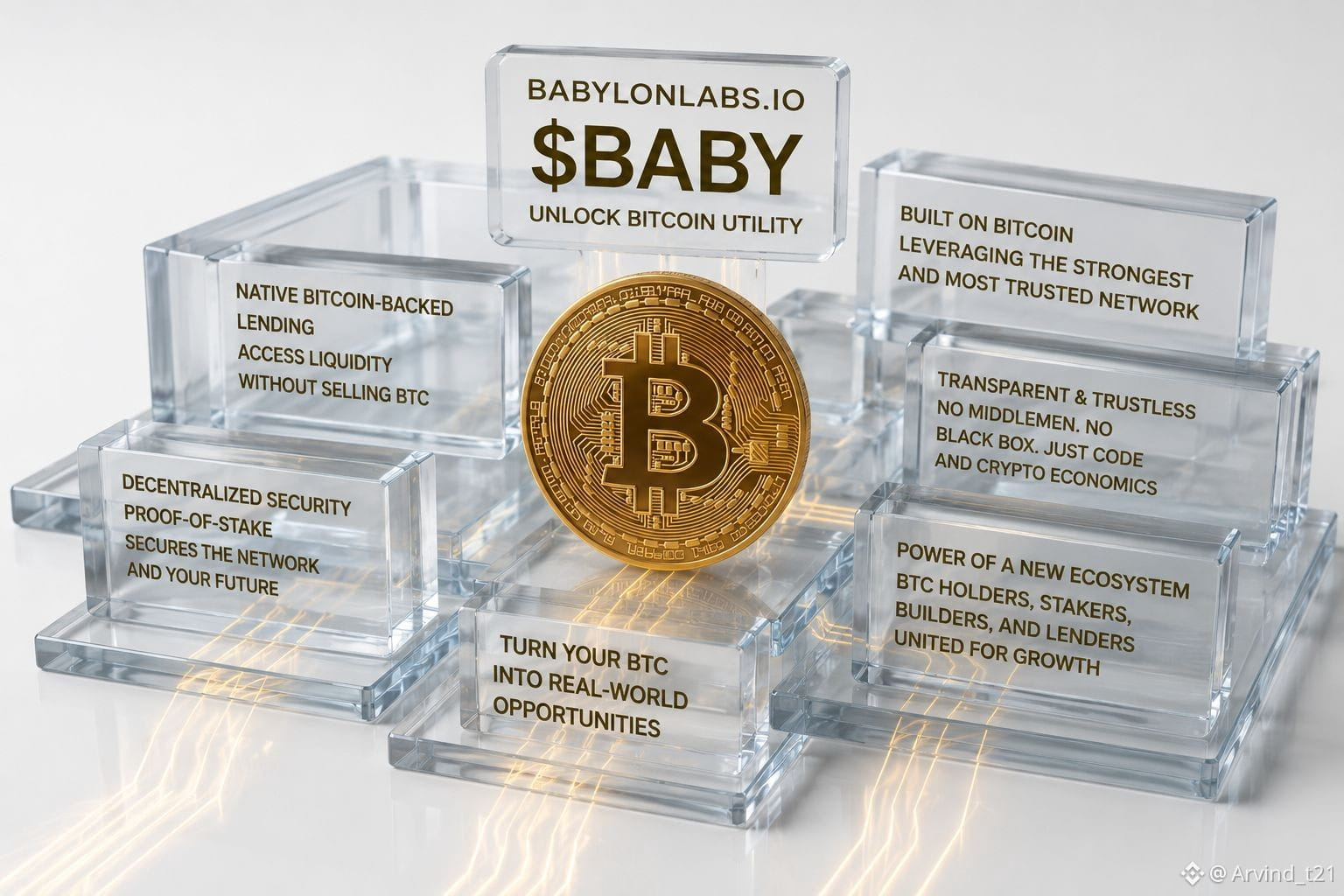
78
#baby $BABY Wrapped BTC had 1 job.
And it failed.
Bridges got hacked. Funds got lost.
Risk was too high.
Babylon fixed it.
Stake your BTC natively.
Keep it on Bitcoin.
Earn $BABY while securing the future.
Security + Yield.
Finally.
@BabylonLabs_io $BABY #baby #Bitcoin #BTCStaking
#baby $BABY Wrapped BTC had 1 job.
And it failed.
Bridges got hacked. Funds got lost.
Risk was too high.
Babylon fixed it.
Stake your BTC natively.
Keep it on Bitcoin.
Earn $BABY while securing the future.
Security + Yield.
Finally.
@BabylonLabs_io $BABY #baby #Bitcoin #BTCStaking
And it failed.
Bridges got hacked. Funds got lost.
Risk was too high.
Babylon fixed it.
Stake your BTC natively.
Keep it on Bitcoin.
Earn $BABY while securing the future.
Security + Yield.
Finally.
@BabylonLabs_io $BABY #baby #Bitcoin #BTCStaking
92

·
--
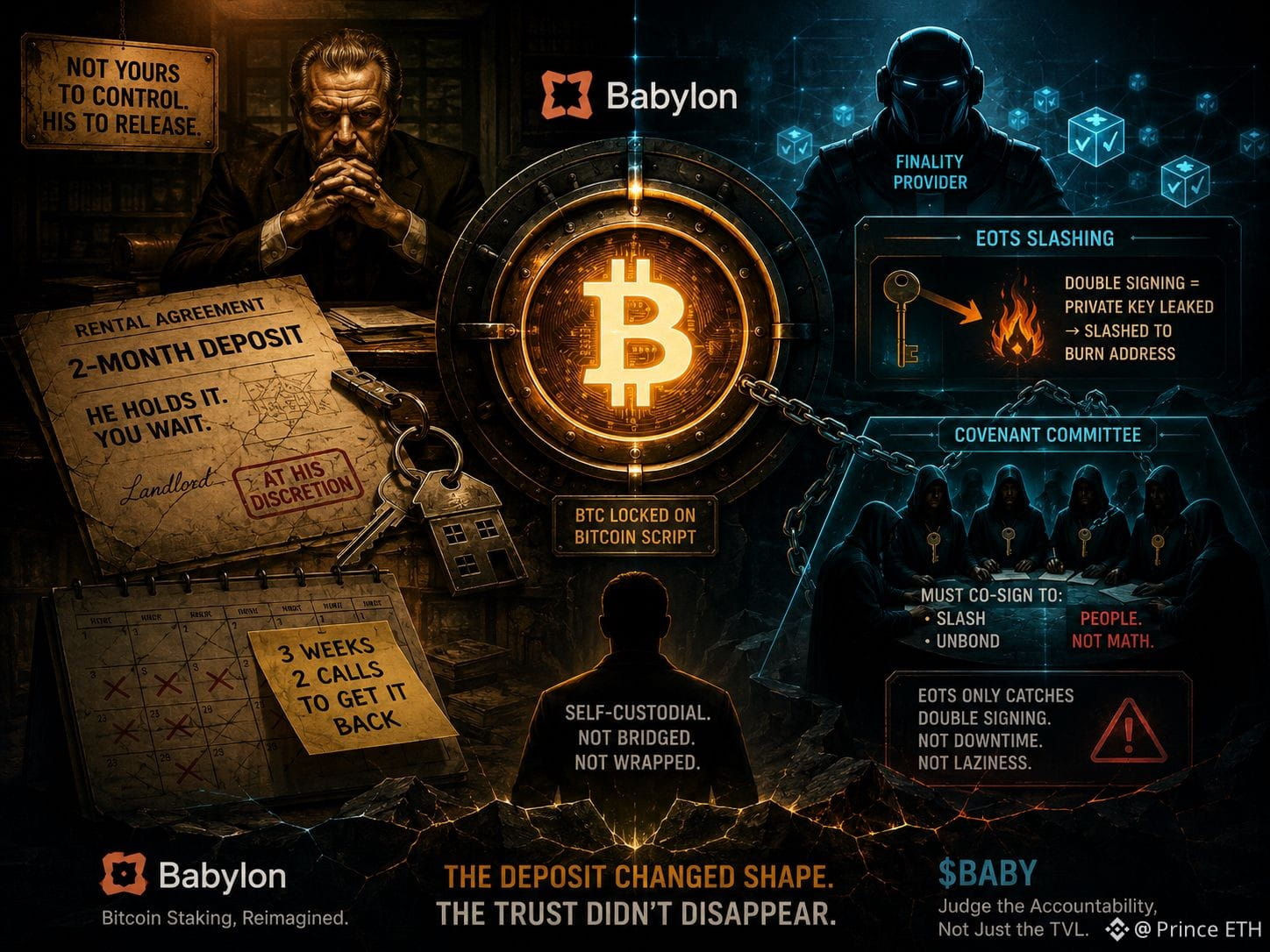
When I rented my first apartment, the landlord asked for a two-month deposit before handing me the keys, cash he would hold until I moved out and he had checked every wall. I did everything right for three years, no damage, rent always on time.
Getting that money back still took him three weeks and two phone calls, because the deposit was never really mine to control. It was his to release.
That is exactly the same arrangement most staking protocols run on: someone else has to hold the thing that can punish a validator for misbehaving.
Babylon takes the landlord out of the first step, at least. A staker locks BTC directly on the Bitcoin network in a self-custodial vault, a UTXO governed by Bitcoin Script opcodes enforcing a timelock, never bridged or wrapped onto another chain. The staker then delegates to a finality provider, who votes on blocks using that stake as backing.
If the provider ever signs two conflicting blocks at the same height, an Extractable One-Time Signature scheme, or EOTS, mathematically leaks their private key, and that leaked key is what authorizes a pre-agreed slashing transaction, sending the funds to a burn address with no custodian ever holding them.
Self-critique: the deposit did not disappear, it just changed shape. Executing that slashing, and unbonding, on Babylon still requires sign-off from a covenant committee, a defined group that must co-sign the transaction before either can happen.
That is not a cryptographic condition floating free of people, it is a specific set of parties whose honesty and availability the staker is trusting, the way I once trusted my landlord's mood and calendar. EOTS also only catches one failure mode, double signing, so a provider who goes offline or votes lazily walks away with no penalty.
Babylon's real test was never whether the deposit moved. $BABY should be evaluated based on the accountability of its finality providers and covenant committee, not just on how much BTC has flowed into the staking contracts.
@babylonlabs_io #baby #BTCStaking #bitcoin
When I rented my first apartment, the landlord asked for a two-month deposit before handing me the keys, cash he would hold until I moved out and he had checked every wall. I did everything right for three years, no damage, rent always on time.
Getting that money back still took him three weeks and two phone calls, because the deposit was never really mine to control. It was his to release.
That is exactly the same arrangement most staking protocols run on: someone else has to hold the thing that can punish a validator for misbehaving.
Babylon takes the landlord out of the first step, at least. A staker locks BTC directly on the Bitcoin network in a self-custodial vault, a UTXO governed by Bitcoin Script opcodes enforcing a timelock, never bridged or wrapped onto another chain. The staker then delegates to a finality provider, who votes on blocks using that stake as backing.
If the provider ever signs two conflicting blocks at the same height, an Extractable One-Time Signature scheme, or EOTS, mathematically leaks their private key, and that leaked key is what authorizes a pre-agreed slashing transaction, sending the funds to a burn address with no custodian ever holding them.
Self-critique: the deposit did not disappear, it just changed shape. Executing that slashing, and unbonding, on Babylon still requires sign-off from a covenant committee, a defined group that must co-sign the transaction before either can happen.
That is not a cryptographic condition floating free of people, it is a specific set of parties whose honesty and availability the staker is trusting, the way I once trusted my landlord's mood and calendar. EOTS also only catches one failure mode, double signing, so a provider who goes offline or votes lazily walks away with no penalty.
Babylon's real test was never whether the deposit moved. $BABY should be evaluated based on the accountability of its finality providers and covenant committee, not just on how much BTC has flowed into the staking contracts.
@BabylonLabs_io #baby #BTCStaking #bitcoin
Getting that money back still took him three weeks and two phone calls, because the deposit was never really mine to control. It was his to release.
That is exactly the same arrangement most staking protocols run on: someone else has to hold the thing that can punish a validator for misbehaving.
Babylon takes the landlord out of the first step, at least. A staker locks BTC directly on the Bitcoin network in a self-custodial vault, a UTXO governed by Bitcoin Script opcodes enforcing a timelock, never bridged or wrapped onto another chain. The staker then delegates to a finality provider, who votes on blocks using that stake as backing.
If the provider ever signs two conflicting blocks at the same height, an Extractable One-Time Signature scheme, or EOTS, mathematically leaks their private key, and that leaked key is what authorizes a pre-agreed slashing transaction, sending the funds to a burn address with no custodian ever holding them.
Self-critique: the deposit did not disappear, it just changed shape. Executing that slashing, and unbonding, on Babylon still requires sign-off from a covenant committee, a defined group that must co-sign the transaction before either can happen.
That is not a cryptographic condition floating free of people, it is a specific set of parties whose honesty and availability the staker is trusting, the way I once trusted my landlord's mood and calendar. EOTS also only catches one failure mode, double signing, so a provider who goes offline or votes lazily walks away with no penalty.
Babylon's real test was never whether the deposit moved. $BABY should be evaluated based on the accountability of its finality providers and covenant committee, not just on how much BTC has flowed into the staking contracts.
@BabylonLabs_io #baby #BTCStaking #bitcoin
4
2
216

Verified
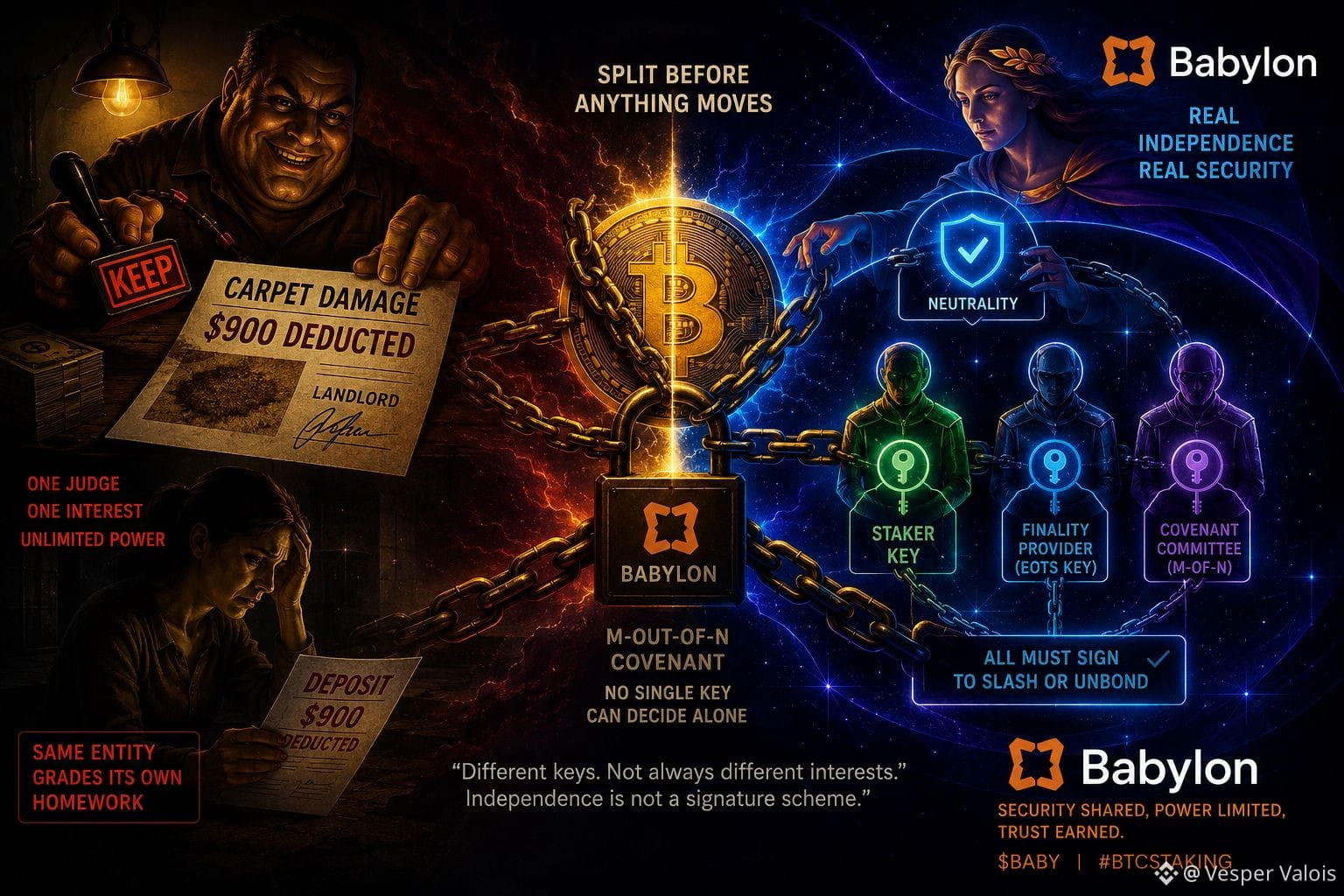
When a friend of mine moved out of her rental last year, the property manager kept $900 of her deposit for "carpet damage." There was no independent inspector, no move-in photos on file, nothing but his own walkthrough three days after she left. The person deciding how much damage existed was the same person who got to keep whatever he didn't return. She only saw most of that money again after she mentioned small claims court in an email.
That's the same pattern that shows up in staking and restaking. Slashing is supposed to be decided by someone neutral, not the staker or the operator being penalized. But in most designs, that neutrality is only enforced at the level of separate keys or addresses. Nothing in the cryptography stops the people behind those keys from being the same operation wearing two hats. A check can look procedurally separate while functionally grading its own homework.
@babylonlabs_io splits every stake across three distinct keys before anything can move: the staker, the Finality Provider identified by its EOTS key, and a Covenant Committee that must co-sign as an M-out-of-N multisig before slashing or early unbonding can execute. The staking script is invalid on its face if any of those keys repeat within a single stake.
Self-critique: that uniqueness rule is a cryptographic guarantee, not an organizational one. It proves no single key plays two roles. It cannot prove that the N committee seats are held by N genuinely separate parties rather than affiliated operators or shared infrastructure quietly holding several seats at once. My friend's landlord could have brought in a second signature on that damage report too, as long as it came from someone who owed him favors. A different name on the form isn't the same as a different interest in the outcome, and no signature scheme can tell you who is actually sitting behind a key.
$BABY should be evaluated based on the real independence of who holds those covenant seats, not just on whether their keys are technically distinct from one another.
#BTCStaking #baby $KOMA $BANK
When a friend of mine moved out of her rental last year, the property manager kept $900 of her deposit for "carpet damage." There was no independent inspector, no move-in photos on file, nothing but his own walkthrough three days after she left. The person deciding how much damage existed was the same person who got to keep whatever he didn't return. She only saw most of that money again after she mentioned small claims court in an email.
That's the same pattern that shows up in staking and restaking. Slashing is supposed to be decided by someone neutral, not the staker or the operator being penalized. But in most designs, that neutrality is only enforced at the level of separate keys or addresses. Nothing in the cryptography stops the people behind those keys from being the same operation wearing two hats. A check can look procedurally separate while functionally grading its own homework.
@BabylonLabs_io splits every stake across three distinct keys before anything can move: the staker, the Finality Provider identified by its EOTS key, and a Covenant Committee that must co-sign as an M-out-of-N multisig before slashing or early unbonding can execute. The staking script is invalid on its face if any of those keys repeat within a single stake.
Self-critique: that uniqueness rule is a cryptographic guarantee, not an organizational one. It proves no single key plays two roles. It cannot prove that the N committee seats are held by N genuinely separate parties rather than affiliated operators or shared infrastructure quietly holding several seats at once. My friend's landlord could have brought in a second signature on that damage report too, as long as it came from someone who owed him favors. A different name on the form isn't the same as a different interest in the outcome, and no signature scheme can tell you who is actually sitting behind a key.
$BABY should be evaluated based on the real independence of who holds those covenant seats, not just on whether their keys are technically distinct from one another.
#BTCStaking #baby $KOMA $BANK
That's the same pattern that shows up in staking and restaking. Slashing is supposed to be decided by someone neutral, not the staker or the operator being penalized. But in most designs, that neutrality is only enforced at the level of separate keys or addresses. Nothing in the cryptography stops the people behind those keys from being the same operation wearing two hats. A check can look procedurally separate while functionally grading its own homework.
@BabylonLabs_io splits every stake across three distinct keys before anything can move: the staker, the Finality Provider identified by its EOTS key, and a Covenant Committee that must co-sign as an M-out-of-N multisig before slashing or early unbonding can execute. The staking script is invalid on its face if any of those keys repeat within a single stake.
Self-critique: that uniqueness rule is a cryptographic guarantee, not an organizational one. It proves no single key plays two roles. It cannot prove that the N committee seats are held by N genuinely separate parties rather than affiliated operators or shared infrastructure quietly holding several seats at once. My friend's landlord could have brought in a second signature on that damage report too, as long as it came from someone who owed him favors. A different name on the form isn't the same as a different interest in the outcome, and no signature scheme can tell you who is actually sitting behind a key.
$BABY should be evaluated based on the real independence of who holds those covenant seats, not just on whether their keys are technically distinct from one another.
#BTCStaking #baby $KOMA $BANK
16
8
187

·
--
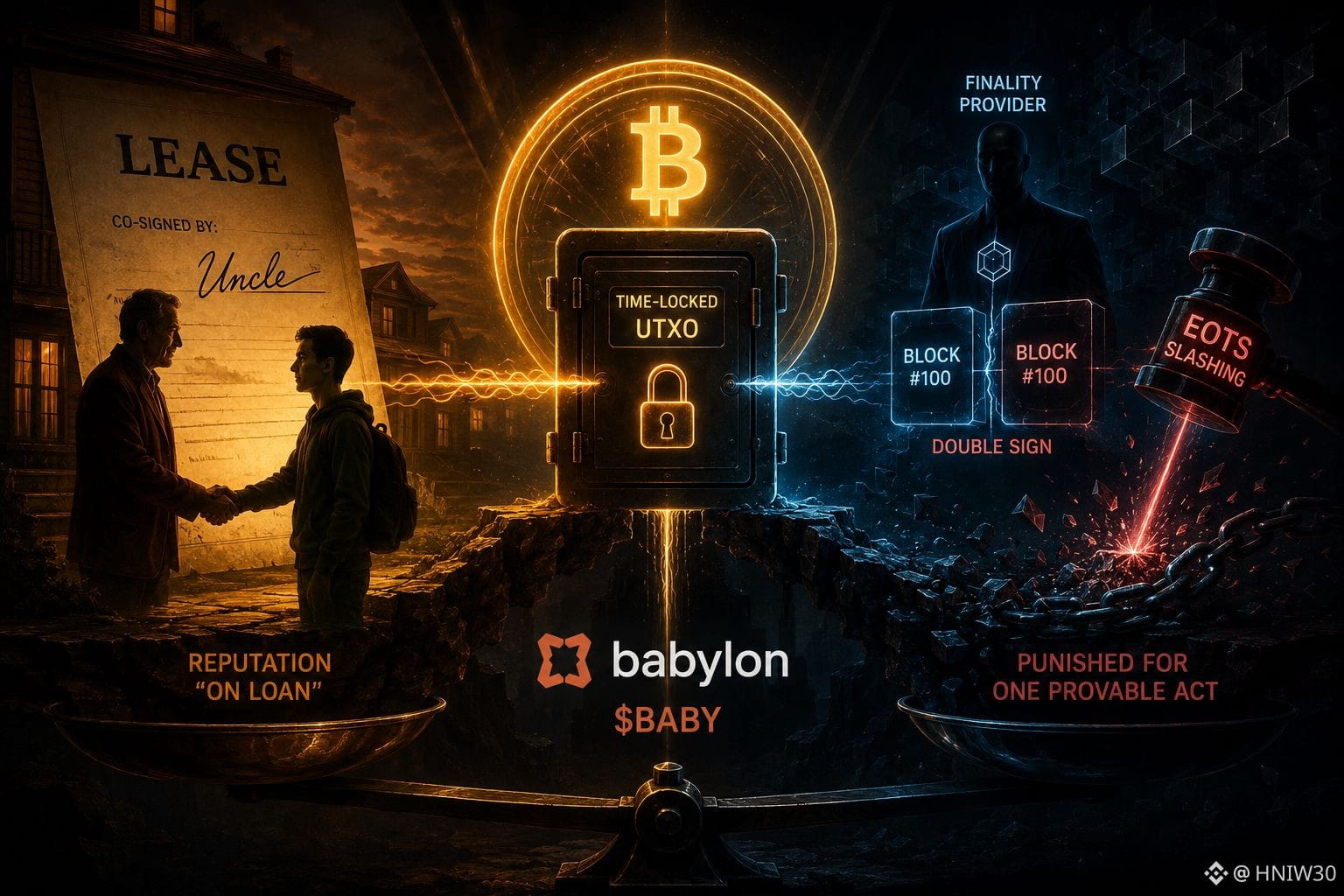
When I was twenty-three, my first landlord refused to hand me a lease on my own signature. I had a steady job but no credit history behind me, nothing on paper to point to.
My uncle sat across from the property manager and co-signed. Afterward he told me flatly: I'm not paying your rent, but if you skip it, I'm the one they call first. He never gave me his reputation. He attached it to mine, on his own terms, for a limited stretch of time.
Crypto has the same pattern. It calls this shared security: one system lending its economic weight to a younger one without giving up ownership.
Babylon ( @babylonlabs_io ) applies that logic to Bitcoin itself. A staker locks BTC inside a staking transaction built with Bitcoin script, a time-locked UTXO that never leaves their own wallet. No bridge, no wrapped token, no custodian holding the keys.
That locked value gets delegated to a Finality Provider, an entity that votes on blocks for the Bitcoin Supercharged Network it secures. If the provider double signs two conflicting blocks, Extractable One-Time Signatures let anyone reconstruct its private key from those two signatures and submit a slashing transaction, enforced by Bitcoin script rather than a custodian's word.
My uncle's signature carried judgment, not just liability. He had watched me hold a job and pay back small debts. If I skipped rent, he could call my parents, sue me, or simply refuse to vouch for me again. That is broad and adjustable trust.
Extractable One-Time Signatures cover something narrower: a provider is only punished for one provable act, double signing. One that is slow, careless, or quietly complicit in a bad governance vote never trips the mechanism at all. Bitcoin's weight guards against a single failure mode, silent on the rest.
$BABY should be evaluated based on how completely Babylon's slashing conditions cover a young network's real failure modes, not just on how much Bitcoin it has managed to attract.
#baby #BTCStaking $GIGGLE $IDOL
When I was twenty-three, my first landlord refused to hand me a lease on my own signature. I had a steady job but no credit history behind me, nothing on paper to point to.
My uncle sat across from the property manager and co-signed. Afterward he told me flatly: I'm not paying your rent, but if you skip it, I'm the one they call first. He never gave me his reputation. He attached it to mine, on his own terms, for a limited stretch of time.
Crypto has the same pattern. It calls this shared security: one system lending its economic weight to a younger one without giving up ownership.
Babylon ( @BabylonLabs_io ) applies that logic to Bitcoin itself. A staker locks BTC inside a staking transaction built with Bitcoin script, a time-locked UTXO that never leaves their own wallet. No bridge, no wrapped token, no custodian holding the keys.
That locked value gets delegated to a Finality Provider, an entity that votes on blocks for the Bitcoin Supercharged Network it secures. If the provider double signs two conflicting blocks, Extractable One-Time Signatures let anyone reconstruct its private key from those two signatures and submit a slashing transaction, enforced by Bitcoin script rather than a custodian's word.
My uncle's signature carried judgment, not just liability. He had watched me hold a job and pay back small debts. If I skipped rent, he could call my parents, sue me, or simply refuse to vouch for me again. That is broad and adjustable trust.
Extractable One-Time Signatures cover something narrower: a provider is only punished for one provable act, double signing. One that is slow, careless, or quietly complicit in a bad governance vote never trips the mechanism at all. Bitcoin's weight guards against a single failure mode, silent on the rest.
$BABY should be evaluated based on how completely Babylon's slashing conditions cover a young network's real failure modes, not just on how much Bitcoin it has managed to attract.
#baby #BTCStaking $GIGGLE $IDOL
My uncle sat across from the property manager and co-signed. Afterward he told me flatly: I'm not paying your rent, but if you skip it, I'm the one they call first. He never gave me his reputation. He attached it to mine, on his own terms, for a limited stretch of time.
Crypto has the same pattern. It calls this shared security: one system lending its economic weight to a younger one without giving up ownership.
Babylon ( @BabylonLabs_io ) applies that logic to Bitcoin itself. A staker locks BTC inside a staking transaction built with Bitcoin script, a time-locked UTXO that never leaves their own wallet. No bridge, no wrapped token, no custodian holding the keys.
That locked value gets delegated to a Finality Provider, an entity that votes on blocks for the Bitcoin Supercharged Network it secures. If the provider double signs two conflicting blocks, Extractable One-Time Signatures let anyone reconstruct its private key from those two signatures and submit a slashing transaction, enforced by Bitcoin script rather than a custodian's word.
My uncle's signature carried judgment, not just liability. He had watched me hold a job and pay back small debts. If I skipped rent, he could call my parents, sue me, or simply refuse to vouch for me again. That is broad and adjustable trust.
Extractable One-Time Signatures cover something narrower: a provider is only punished for one provable act, double signing. One that is slow, careless, or quietly complicit in a bad governance vote never trips the mechanism at all. Bitcoin's weight guards against a single failure mode, silent on the rest.
$BABY should be evaluated based on how completely Babylon's slashing conditions cover a young network's real failure modes, not just on how much Bitcoin it has managed to attract.
#baby #BTCStaking $GIGGLE $IDOL
271
·
--
Capital Tracking|Babylon BTC Staking $BABY N/A
Straight to the point: take a look at Babylon’s BTC staking data. First, see how many coins are locked.
The protocol’s TVL: currently not found. This is the total amount of BTC locked in Babylon’s vault. The higher the TVL, the more BTC holders are willing to lock their coins to earn yield. Phase-1 Cap-1: the initial cap was 1,000 BTC. It sold out instantly, indicating real demand.
$BABY current price: not found; 24h: N/A; highest: not found; lowest: not found; amplitude: N/A percentage points. Circulating market cap: not disclosed. FDV: not disclosed. 24h trading volume: not disclosed.
When it comes to staking rewards, Binance previously launched a Babylon BTC staking campaign, offering BABY rewards with an annualized rate of up to 2.5%. Compared with other DeFi options, the yield isn’t particularly high, but the safety is based on BTC on-chain self-custody—there’s no risk of a contract being hacked.
To gauge TVL growth, look at three indicators: new staked amount, unlock amount, and net inflow. A consistently positive net inflow means capital is entering; when it turns negative, it means profit-takers are withdrawing.
Now that the direction is clear, you control the pace.
#baby #Babylon #BTCStaking @BabylonLabs_io
Capital Tracking|Babylon BTC Staking $BABY N/A
Straight to the point: take a look at Babylon’s BTC staking data. First, see how many coins are locked.
The protocol’s TVL: currently not found. This is the total amount of BTC locked in Babylon’s vault. The higher the TVL, the more BTC holders are willing to lock their coins to earn yield. Phase-1 Cap-1: the initial cap was 1,000 BTC. It sold out instantly, indicating real demand.
$BABY current price: not found; 24h: N/A; highest: not found; lowest: not found; amplitude: N/A percentage points. Circulating market cap: not disclosed. FDV: not disclosed. 24h trading volume: not disclosed.
When it comes to staking rewards, Binance previously launched a Babylon BTC staking campaign, offering BABY rewards with an annualized rate of up to 2.5%. Compared with other DeFi options, the yield isn’t particularly high, but the safety is based on BTC on-chain self-custody—there’s no risk of a contract being hacked.
To gauge TVL growth, look at three indicators: new staked amount, unlock amount, and net inflow. A consistently positive net inflow means capital is entering; when it turns negative, it means profit-takers are withdrawing.
Now that the direction is clear, you control the pace.
#baby #Babylon #BTCStaking @BabylonLabs_io
Straight to the point: take a look at Babylon’s BTC staking data. First, see how many coins are locked.
The protocol’s TVL: currently not found. This is the total amount of BTC locked in Babylon’s vault. The higher the TVL, the more BTC holders are willing to lock their coins to earn yield. Phase-1 Cap-1: the initial cap was 1,000 BTC. It sold out instantly, indicating real demand.
$BABY current price: not found; 24h: N/A; highest: not found; lowest: not found; amplitude: N/A percentage points. Circulating market cap: not disclosed. FDV: not disclosed. 24h trading volume: not disclosed.
When it comes to staking rewards, Binance previously launched a Babylon BTC staking campaign, offering BABY rewards with an annualized rate of up to 2.5%. Compared with other DeFi options, the yield isn’t particularly high, but the safety is based on BTC on-chain self-custody—there’s no risk of a contract being hacked.
To gauge TVL growth, look at three indicators: new staked amount, unlock amount, and net inflow. A consistently positive net inflow means capital is entering; when it turns negative, it means profit-takers are withdrawing.
Now that the direction is clear, you control the pace.
#baby #Babylon #BTCStaking @BabylonLabs_io
48

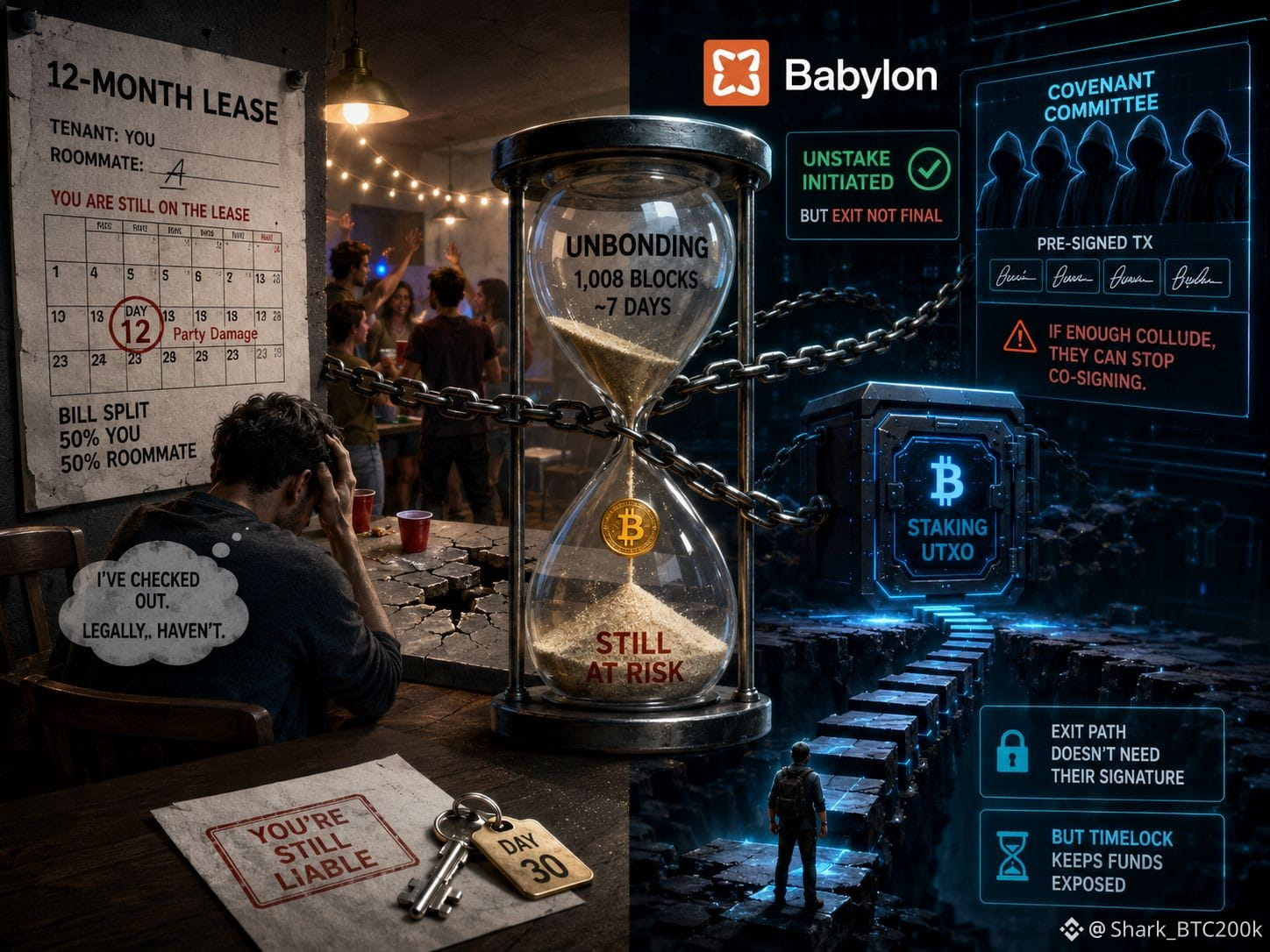
Two years ago, my roommate and I signed a twelve-month lease. When I found a new place, I gave the landlord the required thirty days notice, but my name stayed on the lease until day thirty. On day twelve, my roommate threw a party that cracked the kitchen counter, and the landlord split the bill between both names still on it. I had checked out mentally. Legally, I had not.
The same pattern shows up in staking. People click unstake and move the funds into the safe column in their head immediately, without checking whether the protocol can still reach that money until unbonding finishes. Starting an exit is not the same as completing one, and whatever the other party does during that gap still lands on you.
@babylonlabs_io 's staking UTXO gives a staker an exit path that never needs the finality provider's signature, since the spending conditions simply omit that key. The covenant committee's signatures, including a pre-signed copy of the future unbonding transaction, get collected before the stake goes active, so by the time a staker wants out, only their own signature is missing. Even so, the unbonding output does not open right away: Babylon currently sets that floor at 1,008 blocks, about seven days, during which BTC can still be slashed if the finality provider double signs first.
Self-critique: that seven day window is day twelve of the lease again. A dashboard that marks unbonding as done the moment someone clicks exit invites people to feel safe before the mechanics agree.
There is a second thing worth naming: the covenant committee is a specific, named set of signers standing in for something Bitcoin cannot yet do natively, and the documentation itself admits that if enough of them turned dishonest together, they could simply stop cosigning new requests. Self-custodial does not mean no one else is involved.
$BABY should be evaluated based on whether the exposure window and the committee's role get surfaced to a staker in the moment, not only on whether the slashing cryptography holds up in the abstract.
#BTCStaking #baby $BLESS $HOME
Two years ago, my roommate and I signed a twelve-month lease. When I found a new place, I gave the landlord the required thirty days notice, but my name stayed on the lease until day thirty. On day twelve, my roommate threw a party that cracked the kitchen counter, and the landlord split the bill between both names still on it. I had checked out mentally. Legally, I had not.
The same pattern shows up in staking. People click unstake and move the funds into the safe column in their head immediately, without checking whether the protocol can still reach that money until unbonding finishes. Starting an exit is not the same as completing one, and whatever the other party does during that gap still lands on you.
@BabylonLabs_io 's staking UTXO gives a staker an exit path that never needs the finality provider's signature, since the spending conditions simply omit that key. The covenant committee's signatures, including a pre-signed copy of the future unbonding transaction, get collected before the stake goes active, so by the time a staker wants out, only their own signature is missing. Even so, the unbonding output does not open right away: Babylon currently sets that floor at 1,008 blocks, about seven days, during which BTC can still be slashed if the finality provider double signs first.
Self-critique: that seven day window is day twelve of the lease again. A dashboard that marks unbonding as done the moment someone clicks exit invites people to feel safe before the mechanics agree.
There is a second thing worth naming: the covenant committee is a specific, named set of signers standing in for something Bitcoin cannot yet do natively, and the documentation itself admits that if enough of them turned dishonest together, they could simply stop cosigning new requests. Self-custodial does not mean no one else is involved.
$BABY should be evaluated based on whether the exposure window and the committee's role get surfaced to a staker in the moment, not only on whether the slashing cryptography holds up in the abstract.
#BTCStaking #baby $BLESS $HOME
The same pattern shows up in staking. People click unstake and move the funds into the safe column in their head immediately, without checking whether the protocol can still reach that money until unbonding finishes. Starting an exit is not the same as completing one, and whatever the other party does during that gap still lands on you.
@BabylonLabs_io 's staking UTXO gives a staker an exit path that never needs the finality provider's signature, since the spending conditions simply omit that key. The covenant committee's signatures, including a pre-signed copy of the future unbonding transaction, get collected before the stake goes active, so by the time a staker wants out, only their own signature is missing. Even so, the unbonding output does not open right away: Babylon currently sets that floor at 1,008 blocks, about seven days, during which BTC can still be slashed if the finality provider double signs first.
Self-critique: that seven day window is day twelve of the lease again. A dashboard that marks unbonding as done the moment someone clicks exit invites people to feel safe before the mechanics agree.
There is a second thing worth naming: the covenant committee is a specific, named set of signers standing in for something Bitcoin cannot yet do natively, and the documentation itself admits that if enough of them turned dishonest together, they could simply stop cosigning new requests. Self-custodial does not mean no one else is involved.
$BABY should be evaluated based on whether the exposure window and the committee's role get surfaced to a staker in the moment, not only on whether the slashing cryptography holds up in the abstract.
#BTCStaking #baby $BLESS $HOME
11
2
421
·
--
Partnership Updates | Babylon Ecosystem Upgrade $BABY
Let’s take a look at Babylon and review the progress of Babylon’s ecosystem partnerships. Pull up the partnership list.
The Ledger integration is already live. Users can directly manage BTC staking operations on their Ledger hardware wallets, reducing the entry barrier. Binance has previously launched a Babylon BTC staking campaign, offering BABY rewards with an annualized yield of up to 2.5 percentage points. The Aave V4 integration will bring TBV into the DeFi lending market, with plans to go live in April 2026. a16z Crypto led an investment round of $15 million.
GitHub data: effective submissions in the last 90 days—no data found; number of Stars—no data found. Development activity reflects the team’s release cadence, and ongoing commits indicate the team is actively working.
$BABY current price: 0.010386, 24h -2.63%, volume 6.49M, market cap 44.51M, FDV 113.26M. Rank: 452. Protocol TVL—no data found.
For ecosystem partnerships, look at how deeply they get implemented—not at how big the logo wall looks. The Ledger integration lowering the user barrier is real, and the Aave integration opening up DeFi use cases is also real. Next, focus on the number of newly integrated PoS chains and TVL growth.
The logic is laid out—judge for yourself.
#baby #Babylon #BTCStaking @BabylonLabs_io
Partnership Updates | Babylon Ecosystem Upgrade $BABY
Let’s take a look at Babylon and review the progress of Babylon’s ecosystem partnerships. Pull up the partnership list.
The Ledger integration is already live. Users can directly manage BTC staking operations on their Ledger hardware wallets, reducing the entry barrier. Binance has previously launched a Babylon BTC staking campaign, offering BABY rewards with an annualized yield of up to 2.5 percentage points. The Aave V4 integration will bring TBV into the DeFi lending market, with plans to go live in April 2026. a16z Crypto led an investment round of $15 million.
GitHub data: effective submissions in the last 90 days—no data found; number of Stars—no data found. Development activity reflects the team’s release cadence, and ongoing commits indicate the team is actively working.
$BABY current price: 0.010386, 24h -2.63%, volume 6.49M, market cap 44.51M, FDV 113.26M. Rank: 452. Protocol TVL—no data found.
For ecosystem partnerships, look at how deeply they get implemented—not at how big the logo wall looks. The Ledger integration lowering the user barrier is real, and the Aave integration opening up DeFi use cases is also real. Next, focus on the number of newly integrated PoS chains and TVL growth.
The logic is laid out—judge for yourself.
#baby #Babylon #BTCStaking @BabylonLabs_io
Let’s take a look at Babylon and review the progress of Babylon’s ecosystem partnerships. Pull up the partnership list.
The Ledger integration is already live. Users can directly manage BTC staking operations on their Ledger hardware wallets, reducing the entry barrier. Binance has previously launched a Babylon BTC staking campaign, offering BABY rewards with an annualized yield of up to 2.5 percentage points. The Aave V4 integration will bring TBV into the DeFi lending market, with plans to go live in April 2026. a16z Crypto led an investment round of $15 million.
GitHub data: effective submissions in the last 90 days—no data found; number of Stars—no data found. Development activity reflects the team’s release cadence, and ongoing commits indicate the team is actively working.
$BABY current price: 0.010386, 24h -2.63%, volume 6.49M, market cap 44.51M, FDV 113.26M. Rank: 452. Protocol TVL—no data found.
For ecosystem partnerships, look at how deeply they get implemented—not at how big the logo wall looks. The Ledger integration lowering the user barrier is real, and the Aave integration opening up DeFi use cases is also real. Next, focus on the number of newly integrated PoS chains and TVL growth.
The logic is laid out—judge for yourself.
#baby #Babylon #BTCStaking @BabylonLabs_io
22
·
--
Bearish
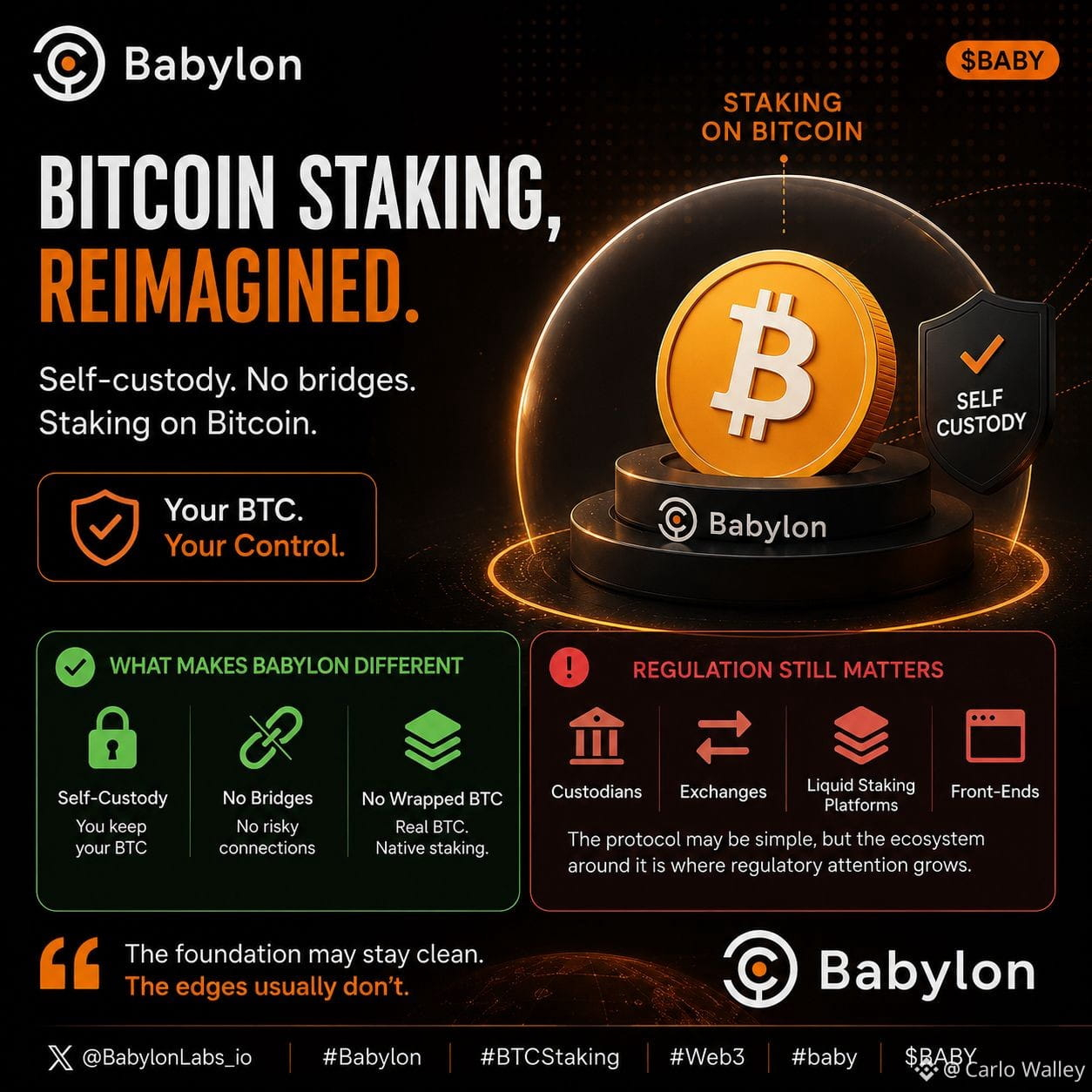
Babylon feels different from most staking projects because it doesn't ask you to give up custody of your BTC.
$BABY
{future}(BABYUSDT)
Your Bitcoin stays in self-custody. No bridges, no wrapped assets, no custody trade-offs. That alone removes a major layer of risk.
But regulation doesn't disappear—it simply shifts. As exchanges, custodians, and staking platforms build on top of Babylon, the legal focus moves from the protocol itself to the products built around it.
The protocol may stay simple. The ecosystem around it probably won't.
#Babylon #bitcoin #BTCStaking #baby $BABY @babylonlabs_io
Babylon feels different from most staking projects because it doesn't ask you to give up custody of your BTC.
$BABY
Your Bitcoin stays in self-custody. No bridges, no wrapped assets, no custody trade-offs. That alone removes a major layer of risk.
But regulation doesn't disappear—it simply shifts. As exchanges, custodians, and staking platforms build on top of Babylon, the legal focus moves from the protocol itself to the products built around it.
The protocol may stay simple. The ecosystem around it probably won't.
#Babylon #bitcoin #BTCStaking #baby $BABY @BabylonLabs_io
$BABY
Your Bitcoin stays in self-custody. No bridges, no wrapped assets, no custody trade-offs. That alone removes a major layer of risk.
But regulation doesn't disappear—it simply shifts. As exchanges, custodians, and staking platforms build on top of Babylon, the legal focus moves from the protocol itself to the products built around it.
The protocol may stay simple. The ecosystem around it probably won't.
#Babylon #bitcoin #BTCStaking #baby $BABY @BabylonLabs_io
4
2
49
·
--
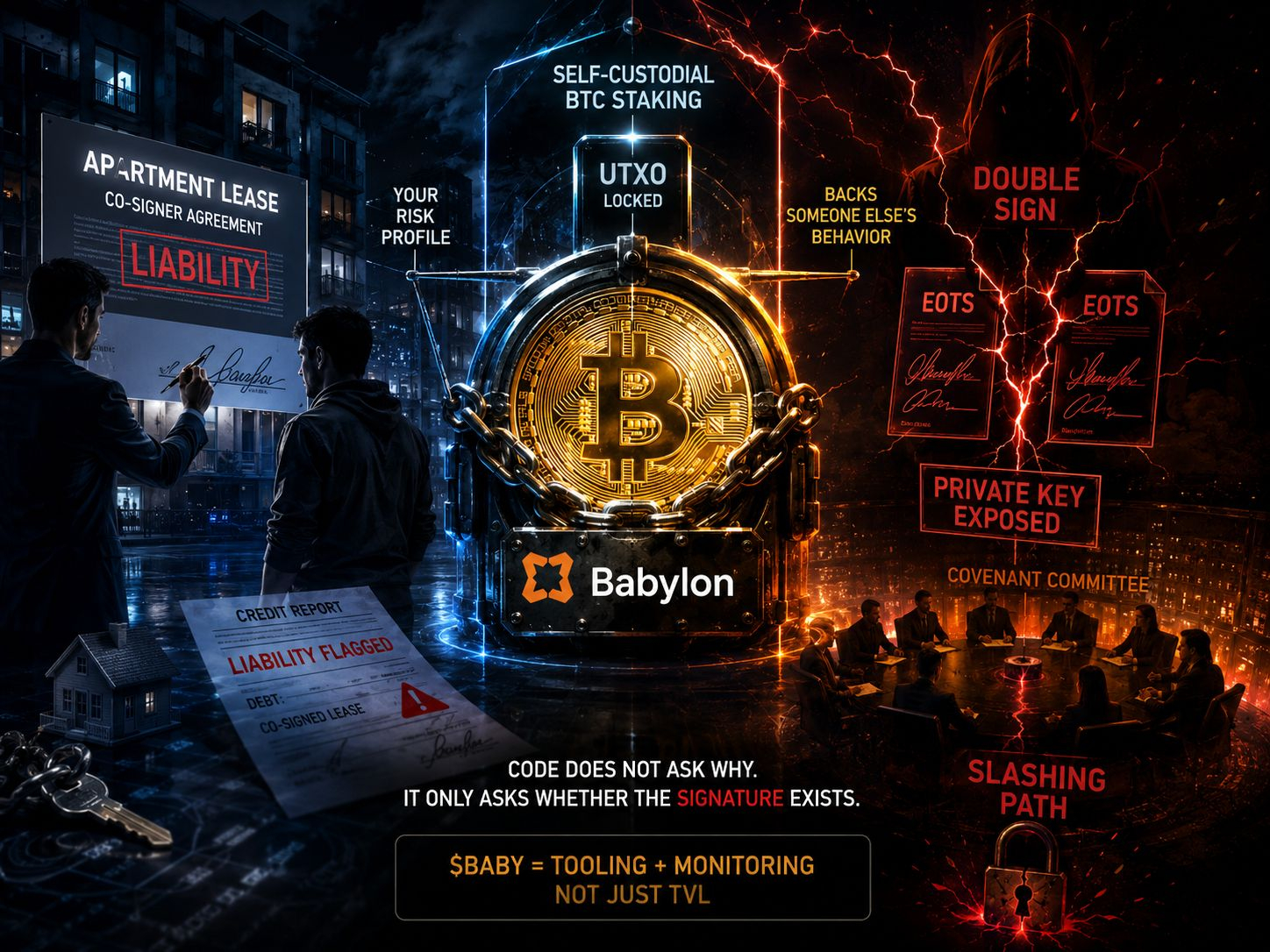
Two years ago I co-signed my cousin's apartment lease. The property manager was blunt about it: if he stopped paying rent, they would come to me first, not through eviction.
He never missed a payment. But when I applied for my own mortgage last year, the loan officer flagged his lease as a liability on my file, a debt I had never touched that was still shaping my risk profile.
That's the same pattern crypto security usually runs on: back something by moving it, into a bridge, a wrapped token, a custodian's cold storage. Self-custodial BTC staking skips the move entirely: nothing changes hands, but the coins' presence still backs someone else's behavior.
Babylon's Bitcoin staking works through a self-custodial UTXO. Your BTC gets locked in a Bitcoin script with multiple spending paths, but the private key never leaves your possession. You delegate to a finality provider, who signs blocks using Extractable One-Time Signatures, EOTS for short.
The danger only appears if that provider double-signs. Two conflicting EOTS signatures can be combined to mathematically expose their private key, unlocking a slashing path that a covenant committee already co-signed when your stake began. Nobody at Babylon enforces anything in real time.
Self-critique: a human guarantor can be reasoned with. My cousin's landlord could have called me and we could have talked it through, found room for an honest mistake. Babylon's slashing has no such room.
If a finality provider double-signs because of a misconfigured backup node or a botched failover, not malice, the slashing fires the same as if they had stolen the funds outright.
I would have eaten a hit to my credit the same way, even if my cousin's missed payment had a good reason behind it. Code does not ask why. It only asks whether the signature exists.
$BABY should be evaluated on how well its finality-provider tooling and monitoring prevent accidental double-signing, not just on how much bitcoin the protocol has locked.
#baby #BTCStaking #BTCFi @babylonlabs_io
Two years ago I co-signed my cousin's apartment lease. The property manager was blunt about it: if he stopped paying rent, they would come to me first, not through eviction.
He never missed a payment. But when I applied for my own mortgage last year, the loan officer flagged his lease as a liability on my file, a debt I had never touched that was still shaping my risk profile.
That's the same pattern crypto security usually runs on: back something by moving it, into a bridge, a wrapped token, a custodian's cold storage. Self-custodial BTC staking skips the move entirely: nothing changes hands, but the coins' presence still backs someone else's behavior.
Babylon's Bitcoin staking works through a self-custodial UTXO. Your BTC gets locked in a Bitcoin script with multiple spending paths, but the private key never leaves your possession. You delegate to a finality provider, who signs blocks using Extractable One-Time Signatures, EOTS for short.
The danger only appears if that provider double-signs. Two conflicting EOTS signatures can be combined to mathematically expose their private key, unlocking a slashing path that a covenant committee already co-signed when your stake began. Nobody at Babylon enforces anything in real time.
Self-critique: a human guarantor can be reasoned with. My cousin's landlord could have called me and we could have talked it through, found room for an honest mistake. Babylon's slashing has no such room.
If a finality provider double-signs because of a misconfigured backup node or a botched failover, not malice, the slashing fires the same as if they had stolen the funds outright.
I would have eaten a hit to my credit the same way, even if my cousin's missed payment had a good reason behind it. Code does not ask why. It only asks whether the signature exists.
$BABY should be evaluated on how well its finality-provider tooling and monitoring prevent accidental double-signing, not just on how much bitcoin the protocol has locked.
#baby #BTCStaking #BTCFi @BabylonLabs_io
He never missed a payment. But when I applied for my own mortgage last year, the loan officer flagged his lease as a liability on my file, a debt I had never touched that was still shaping my risk profile.
That's the same pattern crypto security usually runs on: back something by moving it, into a bridge, a wrapped token, a custodian's cold storage. Self-custodial BTC staking skips the move entirely: nothing changes hands, but the coins' presence still backs someone else's behavior.
Babylon's Bitcoin staking works through a self-custodial UTXO. Your BTC gets locked in a Bitcoin script with multiple spending paths, but the private key never leaves your possession. You delegate to a finality provider, who signs blocks using Extractable One-Time Signatures, EOTS for short.
The danger only appears if that provider double-signs. Two conflicting EOTS signatures can be combined to mathematically expose their private key, unlocking a slashing path that a covenant committee already co-signed when your stake began. Nobody at Babylon enforces anything in real time.
Self-critique: a human guarantor can be reasoned with. My cousin's landlord could have called me and we could have talked it through, found room for an honest mistake. Babylon's slashing has no such room.
If a finality provider double-signs because of a misconfigured backup node or a botched failover, not malice, the slashing fires the same as if they had stolen the funds outright.
I would have eaten a hit to my credit the same way, even if my cousin's missed payment had a good reason behind it. Code does not ask why. It only asks whether the signature exists.
$BABY should be evaluated on how well its finality-provider tooling and monitoring prevent accidental double-signing, not just on how much bitcoin the protocol has locked.
#baby #BTCStaking #BTCFi @BabylonLabs_io
4
1
120

#baby
Writing
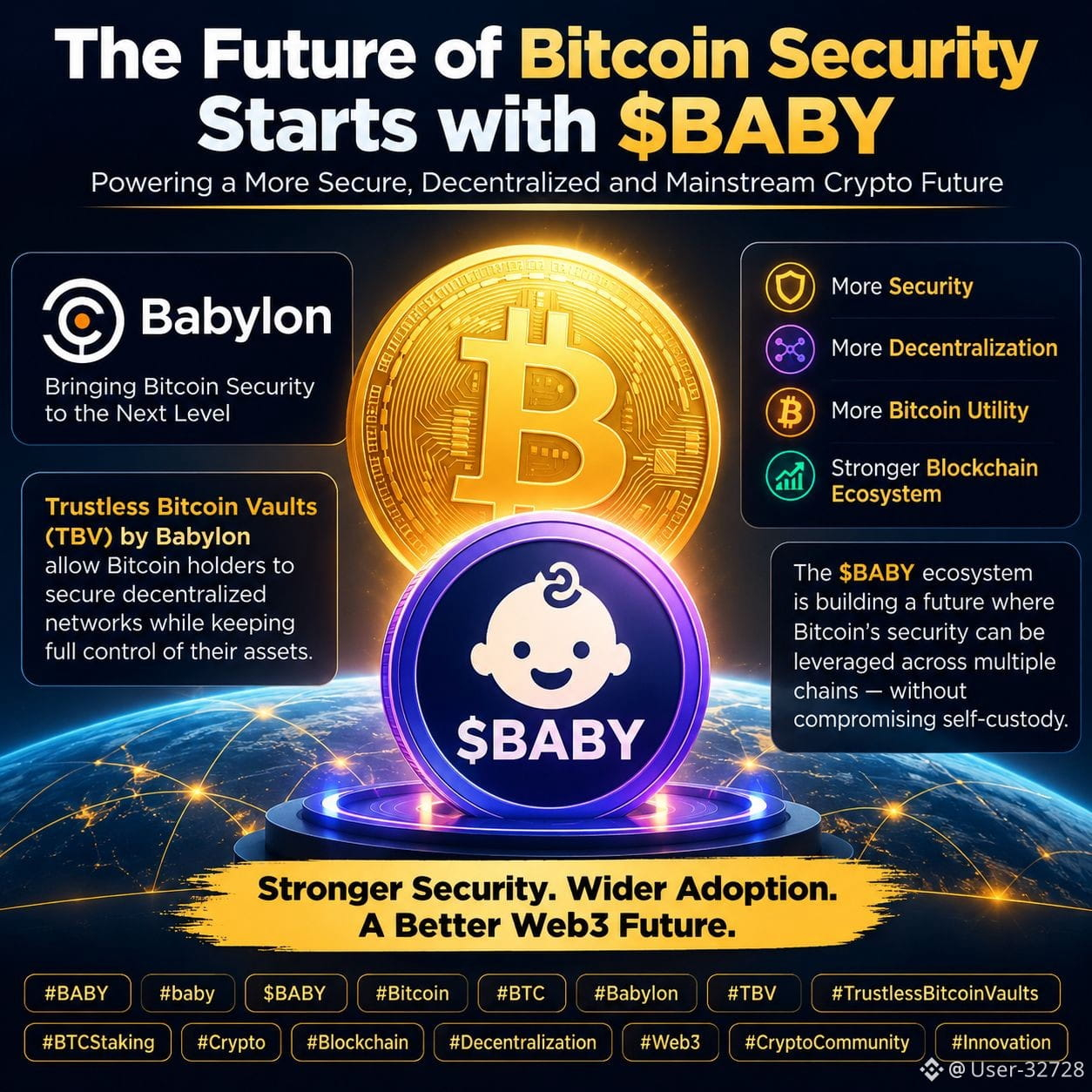
🚀 The Future of Bitcoin Security Starts with $BABY
Bitcoin is the most trusted and secure blockchain in the world, but its potential goes far beyond simply holding BTC.
With Babylon and Trustless Bitcoin Vaults (TBV), Bitcoin holders can help secure decentralized networks while maintaining full control of their assets. This innovation brings together security, transparency, and decentralization in a way that aligns with the original vision of blockchain technology.
As adoption grows, solutions like TBV could play a major role in expanding Bitcoin’s utility across the crypto ecosystem. Instead of leaving BTC idle, users can contribute to network security while supporting the growth of a more decentralized future.
The $BABY ecosystem is building toward a world where Bitcoin’s security can be leveraged across multiple chains without compromising self-custody or trustlessness.
🔹 More Security
🔹 More Decentralization
🔹 More Bitcoin Utility
🔹 Stronger Blockchain Ecosystem
The future of decentralized security is being built today, and $BABY is helping lead the way.
#BABY #baby $BABY #Bitcoin #BTC #Babylon #TBV #TrustlessBitcoinVaults #BTCStaking
#baby
Writing
🚀 The Future of Bitcoin Security Starts with $BABY
Bitcoin is the most trusted and secure blockchain in the world, but its potential goes far beyond simply holding BTC.
With Babylon and Trustless Bitcoin Vaults (TBV), Bitcoin holders can help secure decentralized networks while maintaining full control of their assets. This innovation brings together security, transparency, and decentralization in a way that aligns with the original vision of blockchain technology.
As adoption grows, solutions like TBV could play a major role in expanding Bitcoin’s utility across the crypto ecosystem. Instead of leaving BTC idle, users can contribute to network security while supporting the growth of a more decentralized future.
The $BABY ecosystem is building toward a world where Bitcoin’s security can be leveraged across multiple chains without compromising self-custody or trustlessness.
🔹 More Security
🔹 More Decentralization
🔹 More Bitcoin Utility
🔹 Stronger Blockchain Ecosystem
The future of decentralized security is being built today, and $BABY is helping lead the way.
#BABY #baby $BABY #Bitcoin #BTC #Babylon #TBV #TrustlessBitcoinVaults #BTCStaking
Writing
🚀 The Future of Bitcoin Security Starts with $BABY
Bitcoin is the most trusted and secure blockchain in the world, but its potential goes far beyond simply holding BTC.
With Babylon and Trustless Bitcoin Vaults (TBV), Bitcoin holders can help secure decentralized networks while maintaining full control of their assets. This innovation brings together security, transparency, and decentralization in a way that aligns with the original vision of blockchain technology.
As adoption grows, solutions like TBV could play a major role in expanding Bitcoin’s utility across the crypto ecosystem. Instead of leaving BTC idle, users can contribute to network security while supporting the growth of a more decentralized future.
The $BABY ecosystem is building toward a world where Bitcoin’s security can be leveraged across multiple chains without compromising self-custody or trustlessness.
🔹 More Security
🔹 More Decentralization
🔹 More Bitcoin Utility
🔹 Stronger Blockchain Ecosystem
The future of decentralized security is being built today, and $BABY is helping lead the way.
#BABY #baby $BABY #Bitcoin #BTC #Babylon #TBV #TrustlessBitcoinVaults #BTCStaking
53
·
--
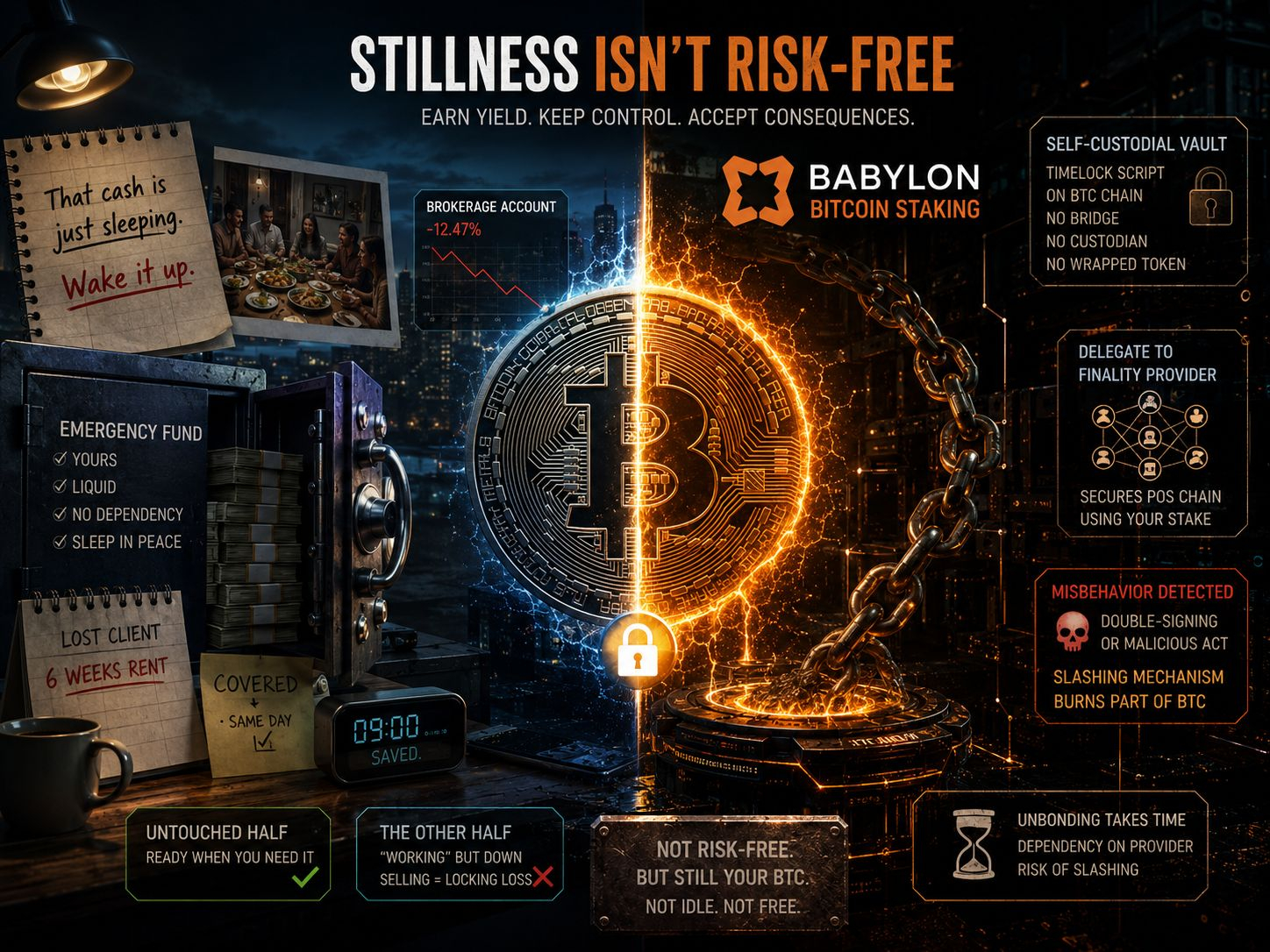
"That cash is just sleeping," he'd say. "Wake it up." My cousin spent years calling my emergency fund lazy money. Every family dinner, same lecture: move it into an index fund, let it work.
Last spring I finally moved half of it into a brokerage account. Two months later I lost a client and needed six weeks of rent, fast. The untouched half covered it the same day. The half that was "working" was down for the quarter, and selling it meant locking in the loss.
That's the same lecture DeFi gives Bitcoin. A wallet holding BTC that isn't staked, bridged, or lent out somewhere gets treated as capital doing nothing.
Babylon breaks that assumption at the mechanism level. Staked BTC goes into a self-custodial vault secured by a timelock script on Bitcoin's own chain, not a bridge contract, not a custodian, not a wrapped token on another network.
The staker delegates to a finality provider, whose economic backing comes from that stake's presence and helps secure a separate proof-of-stake chain. If the provider double-signs or acts maliciously, the slashing mechanism can burn part of the delegated BTC. The coin itself never moves.
Self-critique: the comparison only holds so far. My emergency fund was mine to spend the second I needed it, no delay, no dependency on anyone else's behavior. Staked BTC isn't quite that free.
Unbonding takes time, and once you delegate, your stillness depends on a finality provider you don't control. If they misbehave, part of that untouched BTC gets burned anyway, through no action of your own. Nothing visibly moved, but it wasn't risk-free.
That's the real test for Babylon's stillness thesis. $BABY should be evaluated based on finality provider reliability and unbonding liquidity, not only on how much BTC gets reported as staked.
#baby #BTCStaking #Bitcoin @babylonlabs_io
"That cash is just sleeping," he'd say. "Wake it up." My cousin spent years calling my emergency fund lazy money. Every family dinner, same lecture: move it into an index fund, let it work.
Last spring I finally moved half of it into a brokerage account. Two months later I lost a client and needed six weeks of rent, fast. The untouched half covered it the same day. The half that was "working" was down for the quarter, and selling it meant locking in the loss.
That's the same lecture DeFi gives Bitcoin. A wallet holding BTC that isn't staked, bridged, or lent out somewhere gets treated as capital doing nothing.
Babylon breaks that assumption at the mechanism level. Staked BTC goes into a self-custodial vault secured by a timelock script on Bitcoin's own chain, not a bridge contract, not a custodian, not a wrapped token on another network.
The staker delegates to a finality provider, whose economic backing comes from that stake's presence and helps secure a separate proof-of-stake chain. If the provider double-signs or acts maliciously, the slashing mechanism can burn part of the delegated BTC. The coin itself never moves.
Self-critique: the comparison only holds so far. My emergency fund was mine to spend the second I needed it, no delay, no dependency on anyone else's behavior. Staked BTC isn't quite that free.
Unbonding takes time, and once you delegate, your stillness depends on a finality provider you don't control. If they misbehave, part of that untouched BTC gets burned anyway, through no action of your own. Nothing visibly moved, but it wasn't risk-free.
That's the real test for Babylon's stillness thesis. $BABY should be evaluated based on finality provider reliability and unbonding liquidity, not only on how much BTC gets reported as staked.
#baby #BTCStaking #Bitcoin @BabylonLabs_io
Last spring I finally moved half of it into a brokerage account. Two months later I lost a client and needed six weeks of rent, fast. The untouched half covered it the same day. The half that was "working" was down for the quarter, and selling it meant locking in the loss.
That's the same lecture DeFi gives Bitcoin. A wallet holding BTC that isn't staked, bridged, or lent out somewhere gets treated as capital doing nothing.
Babylon breaks that assumption at the mechanism level. Staked BTC goes into a self-custodial vault secured by a timelock script on Bitcoin's own chain, not a bridge contract, not a custodian, not a wrapped token on another network.
The staker delegates to a finality provider, whose economic backing comes from that stake's presence and helps secure a separate proof-of-stake chain. If the provider double-signs or acts maliciously, the slashing mechanism can burn part of the delegated BTC. The coin itself never moves.
Self-critique: the comparison only holds so far. My emergency fund was mine to spend the second I needed it, no delay, no dependency on anyone else's behavior. Staked BTC isn't quite that free.
Unbonding takes time, and once you delegate, your stillness depends on a finality provider you don't control. If they misbehave, part of that untouched BTC gets burned anyway, through no action of your own. Nothing visibly moved, but it wasn't risk-free.
That's the real test for Babylon's stillness thesis. $BABY should be evaluated based on finality provider reliability and unbonding liquidity, not only on how much BTC gets reported as staked.
#baby #BTCStaking #Bitcoin @BabylonLabs_io
7
2
137
·
--
Lending Innovation|Babylon TBV + Aave $BABY
From a different angle, the integration of Babylon and Aave is a key step toward the realization of TBV. It’s highly significant.
Core logic: Babylon’s Trustless Bitcoin Vaults combined with Aave V4’s hub-and-spoke architecture enables BTC holders to lock BTC in the TBV as collateral to borrow on Aave—without transferring custody rights and without wrapping BTC. Planned to launch in April 2026.
This addresses an old problem with BTC in DeFi. Previously, to use BTC as DeFi collateral, you either had to sell BTC to get ETH or use wBTC but trust the custodian. The TBV solution lets BTC participate in DeFi under a self-custody premise: holders keep their upside exposure to BTC while also obtaining lending liquidity.
$BABY ’s role in the ecosystem is protocol governance and incentives. Staking BABY allows participants to take part in protocol decision-making, and BTC stakers receive BABY rewards. Currently, $BABY has a circulating market cap of 44.18M, FDV of 112.41M, ranks 453, with 24h trading volume of 6.99M.
Points of focus: the growth speed of TVL after the Aave integration goes live, as well as borrowing volume and liquidation conditions. Continuous growth in BTC-collateralized borrowing indicates that market demand is real.
Once you’ve got the direction figured out, you control the pace.
#baby #Babylon #BTCStaking @BabylonLabs_io
Lending Innovation|Babylon TBV + Aave $BABY
From a different angle, the integration of Babylon and Aave is a key step toward the realization of TBV. It’s highly significant.
Core logic: Babylon’s Trustless Bitcoin Vaults combined with Aave V4’s hub-and-spoke architecture enables BTC holders to lock BTC in the TBV as collateral to borrow on Aave—without transferring custody rights and without wrapping BTC. Planned to launch in April 2026.
This addresses an old problem with BTC in DeFi. Previously, to use BTC as DeFi collateral, you either had to sell BTC to get ETH or use wBTC but trust the custodian. The TBV solution lets BTC participate in DeFi under a self-custody premise: holders keep their upside exposure to BTC while also obtaining lending liquidity.
$BABY ’s role in the ecosystem is protocol governance and incentives. Staking BABY allows participants to take part in protocol decision-making, and BTC stakers receive BABY rewards. Currently, $BABY has a circulating market cap of 44.18M, FDV of 112.41M, ranks 453, with 24h trading volume of 6.99M.
Points of focus: the growth speed of TVL after the Aave integration goes live, as well as borrowing volume and liquidation conditions. Continuous growth in BTC-collateralized borrowing indicates that market demand is real.
Once you’ve got the direction figured out, you control the pace.
#baby #Babylon #BTCStaking @BabylonLabs_io
From a different angle, the integration of Babylon and Aave is a key step toward the realization of TBV. It’s highly significant.
Core logic: Babylon’s Trustless Bitcoin Vaults combined with Aave V4’s hub-and-spoke architecture enables BTC holders to lock BTC in the TBV as collateral to borrow on Aave—without transferring custody rights and without wrapping BTC. Planned to launch in April 2026.
This addresses an old problem with BTC in DeFi. Previously, to use BTC as DeFi collateral, you either had to sell BTC to get ETH or use wBTC but trust the custodian. The TBV solution lets BTC participate in DeFi under a self-custody premise: holders keep their upside exposure to BTC while also obtaining lending liquidity.
$BABY ’s role in the ecosystem is protocol governance and incentives. Staking BABY allows participants to take part in protocol decision-making, and BTC stakers receive BABY rewards. Currently, $BABY has a circulating market cap of 44.18M, FDV of 112.41M, ranks 453, with 24h trading volume of 6.99M.
Points of focus: the growth speed of TVL after the Aave integration goes live, as well as borrowing volume and liquidation conditions. Continuous growth in BTC-collateralized borrowing indicates that market demand is real.
Once you’ve got the direction figured out, you control the pace.
#baby #Babylon #BTCStaking @BabylonLabs_io
181
·
--
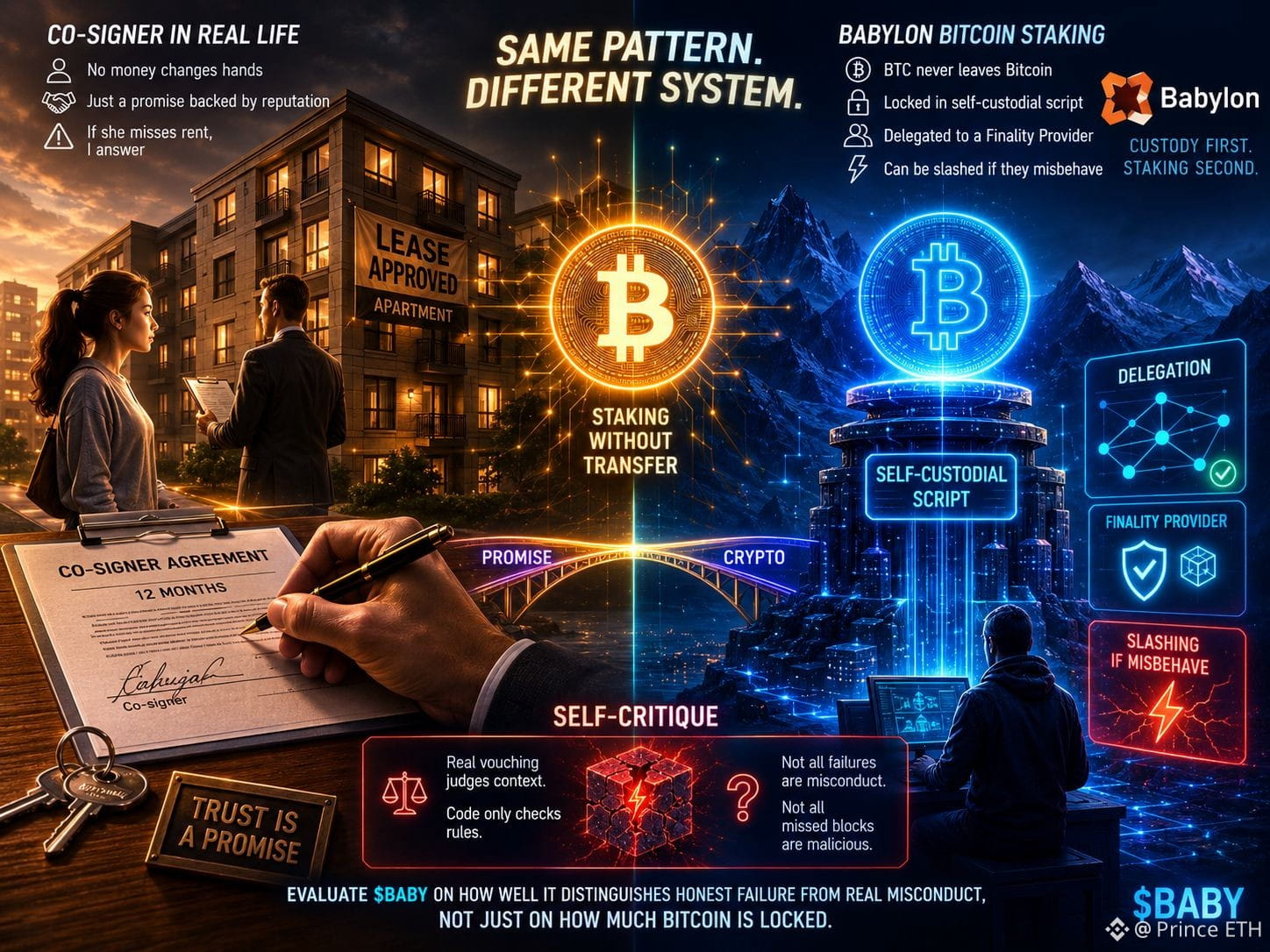
A few years ago a friend needed a co-signer for her first apartment. She had the job and the deposit, but not the three months of pay stubs the leasing office wanted as proof. I did not give her money or hold her deposit. I signed a form saying if she missed rent, the property manager could come after me instead. Nothing physical changed hands. The only thing that moved was a promise, my name attached to her ability to pay for twelve months.
That is the same pattern crypto uses to describe putting something at risk. Staking and collateralizing almost always assume the asset itself has to move first, into a contract, a custodian, a bridge, before it can back anything. The object travels, and the risk travels with it.
Babylon's staking design questions that assumption. The Bitcoin being staked never leaves the Bitcoin chain or the owner's own keys, staying locked in a self-custodial script rather than a custodian's wallet or a bridge contract. It can still be penalized if the validator it is delegated to acts dishonestly. @babylonlabs_io placing the custody question before the staking question changes what is actually being asked of the asset: not hand this over so we know you are serious, but keep it, and answer for what you attached it to.
Self-critique: I did not sign that lease and disappear for a year. When her payment was two days late once, I called the landlord myself, because I could tell the difference between carelessness and an actual crisis. A slashing condition cannot make that distinction. It does not know if a validator went offline from malice or a power outage. It only knows a signature was missing at a specific block. Real vouching is an ongoing judgment call, renewed or withdrawn based on context nobody can fully encode. Code can enforce a rule. It cannot read a situation.
$BABY should be evaluated on how much room its finality provider and slashing design leave for telling an honest failure apart from real misconduct, not just on how much Bitcoin has been locked into it.
#BTCStaking #baby $BLESS $SKYAI
A few years ago a friend needed a co-signer for her first apartment. She had the job and the deposit, but not the three months of pay stubs the leasing office wanted as proof. I did not give her money or hold her deposit. I signed a form saying if she missed rent, the property manager could come after me instead. Nothing physical changed hands. The only thing that moved was a promise, my name attached to her ability to pay for twelve months.
That is the same pattern crypto uses to describe putting something at risk. Staking and collateralizing almost always assume the asset itself has to move first, into a contract, a custodian, a bridge, before it can back anything. The object travels, and the risk travels with it.
Babylon's staking design questions that assumption. The Bitcoin being staked never leaves the Bitcoin chain or the owner's own keys, staying locked in a self-custodial script rather than a custodian's wallet or a bridge contract. It can still be penalized if the validator it is delegated to acts dishonestly. @BabylonLabs_io placing the custody question before the staking question changes what is actually being asked of the asset: not hand this over so we know you are serious, but keep it, and answer for what you attached it to.
Self-critique: I did not sign that lease and disappear for a year. When her payment was two days late once, I called the landlord myself, because I could tell the difference between carelessness and an actual crisis. A slashing condition cannot make that distinction. It does not know if a validator went offline from malice or a power outage. It only knows a signature was missing at a specific block. Real vouching is an ongoing judgment call, renewed or withdrawn based on context nobody can fully encode. Code can enforce a rule. It cannot read a situation.
$BABY should be evaluated on how much room its finality provider and slashing design leave for telling an honest failure apart from real misconduct, not just on how much Bitcoin has been locked into it.
#BTCStaking #baby $BLESS $SKYAI
That is the same pattern crypto uses to describe putting something at risk. Staking and collateralizing almost always assume the asset itself has to move first, into a contract, a custodian, a bridge, before it can back anything. The object travels, and the risk travels with it.
Babylon's staking design questions that assumption. The Bitcoin being staked never leaves the Bitcoin chain or the owner's own keys, staying locked in a self-custodial script rather than a custodian's wallet or a bridge contract. It can still be penalized if the validator it is delegated to acts dishonestly. @BabylonLabs_io placing the custody question before the staking question changes what is actually being asked of the asset: not hand this over so we know you are serious, but keep it, and answer for what you attached it to.
Self-critique: I did not sign that lease and disappear for a year. When her payment was two days late once, I called the landlord myself, because I could tell the difference between carelessness and an actual crisis. A slashing condition cannot make that distinction. It does not know if a validator went offline from malice or a power outage. It only knows a signature was missing at a specific block. Real vouching is an ongoing judgment call, renewed or withdrawn based on context nobody can fully encode. Code can enforce a rule. It cannot read a situation.
$BABY should be evaluated on how much room its finality provider and slashing design leave for telling an honest failure apart from real misconduct, not just on how much Bitcoin has been locked into it.
#BTCStaking #baby $BLESS $SKYAI
4
1
169

·
--
Verified
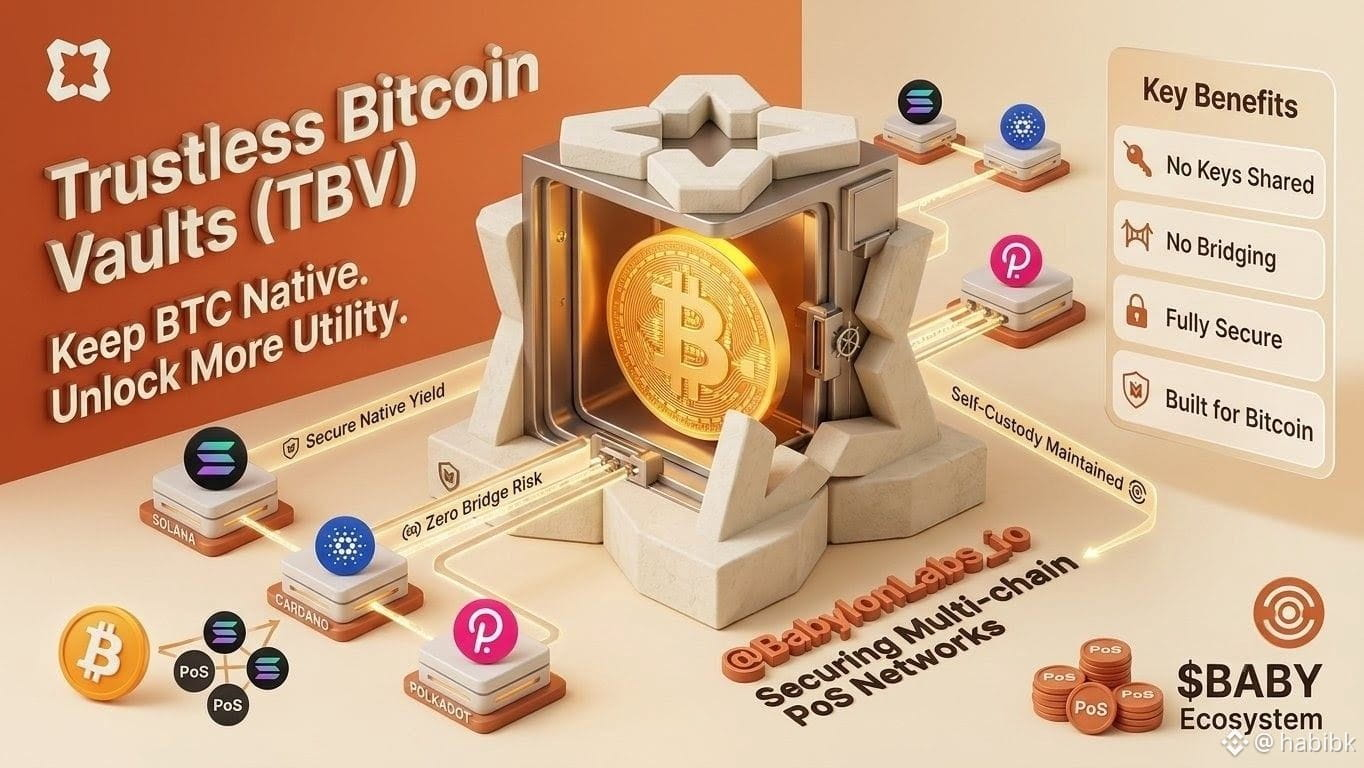
Bitcoin has always been known for its unmatched security, but its potential doesn't have to stop there.
@babylonlabs_io is opening a new path with Trustless Bitcoin Vaults, allowing Bitcoin to strengthen multi-chain Proof-of-Stake networks without compromising the security that makes BTC unique.
This approach shows that Bitcoin can do more than simply sit idle. It can actively contribute to securing decentralized ecosystems while staying trustless.
I'm excited to see how $BTC staking evolves from here, and I believe $BABY is helping shape that future. The combination of Bitcoin's security and modern PoS innovation is a direction worth watching.
#baby #Bitcoin #BTCStaking $BABY
{future}(BABYUSDT)
{future}(BTCUSDT)
Bitcoin has always been known for its unmatched security, but its potential doesn't have to stop there.
@BabylonLabs_io is opening a new path with Trustless Bitcoin Vaults, allowing Bitcoin to strengthen multi-chain Proof-of-Stake networks without compromising the security that makes BTC unique.
This approach shows that Bitcoin can do more than simply sit idle. It can actively contribute to securing decentralized ecosystems while staying trustless.
I'm excited to see how $BTC staking evolves from here, and I believe $BABY is helping shape that future. The combination of Bitcoin's security and modern PoS innovation is a direction worth watching.
#baby #Bitcoin #BTCStaking $BABY
@BabylonLabs_io is opening a new path with Trustless Bitcoin Vaults, allowing Bitcoin to strengthen multi-chain Proof-of-Stake networks without compromising the security that makes BTC unique.
This approach shows that Bitcoin can do more than simply sit idle. It can actively contribute to securing decentralized ecosystems while staying trustless.
I'm excited to see how $BTC staking evolves from here, and I believe $BABY is helping shape that future. The combination of Bitcoin's security and modern PoS innovation is a direction worth watching.
#baby #Bitcoin #BTCStaking $BABY
66
26
220

·
--
🚨 $200 Guaranteed BABY Rewards + 1,990,000 BABY Prize Pool
Bitcoin is finally earning yield — without giving up custody.
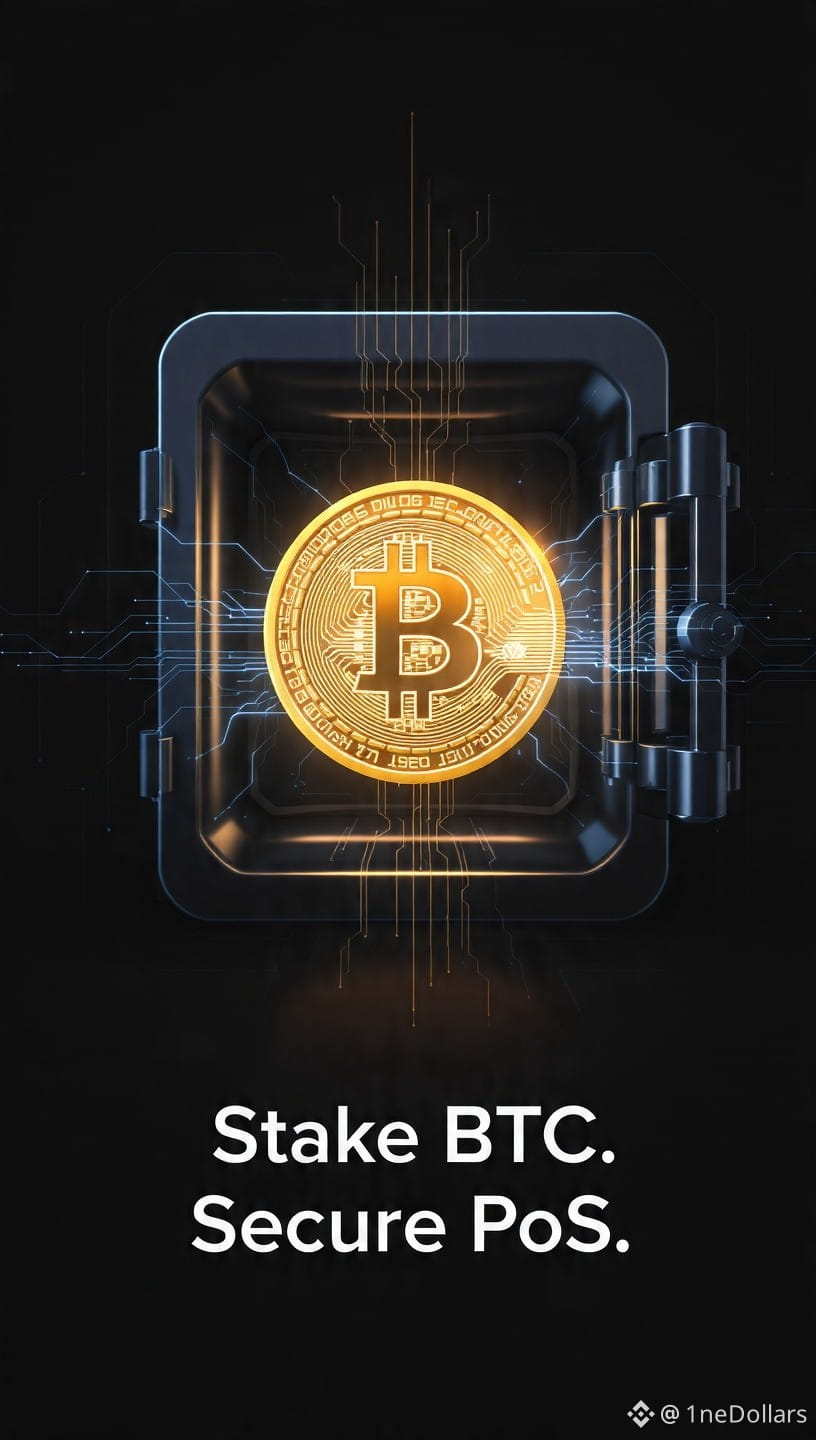
@babylonlabs_io just launched Trustless Bitcoin Vaults (TBV):
Stake NATIVE BTC on Bitcoin. No wrapping. No bridges.
Your BTC helps secure PoS chains and you earn rewards.
Here’s how YOU can earn:
1. Complete the campaign tasks daily
2. Post original content about Babylon TBV
3. All eligible creators get guaranteed BABY rewards up to $200
The prize pool grows with us:
Top 15 creators share 239,000
Everyone else shares 1,751,000
Total Pool: 1,990,000 🔥
The more creators join, the bigger the pool unlocks.
Less than 25% joined = 60% unlock | Over 50% joined = 100% unlock
If you believe Bitcoin should be more than just "digital gold",
this is your chance to earn while spreading the word.
Who’s posting today? Drop your post below 👇
$BABY #baby #Bitcoin #BTCStaking
{spot}(BABYUSDT)
🚨 $200 Guaranteed BABY Rewards + 1,990,000 BABY Prize Pool
Bitcoin is finally earning yield — without giving up custody.
@BabylonLabs_io just launched Trustless Bitcoin Vaults (TBV):
Stake NATIVE BTC on Bitcoin. No wrapping. No bridges.
Your BTC helps secure PoS chains and you earn rewards.
Here’s how YOU can earn:
1. Complete the campaign tasks daily
2. Post original content about Babylon TBV
3. All eligible creators get guaranteed BABY rewards up to $200
The prize pool grows with us:
Top 15 creators share 239,000
Everyone else shares 1,751,000
Total Pool: 1,990,000 🔥
The more creators join, the bigger the pool unlocks.
Less than 25% joined = 60% unlock | Over 50% joined = 100% unlock
If you believe Bitcoin should be more than just "digital gold",
this is your chance to earn while spreading the word.
Who’s posting today? Drop your post below 👇
$BABY #baby #Bitcoin #BTCStaking
Bitcoin is finally earning yield — without giving up custody.
@BabylonLabs_io just launched Trustless Bitcoin Vaults (TBV):
Stake NATIVE BTC on Bitcoin. No wrapping. No bridges.
Your BTC helps secure PoS chains and you earn rewards.
Here’s how YOU can earn:
1. Complete the campaign tasks daily
2. Post original content about Babylon TBV
3. All eligible creators get guaranteed BABY rewards up to $200
The prize pool grows with us:
Top 15 creators share 239,000
Everyone else shares 1,751,000
Total Pool: 1,990,000 🔥
The more creators join, the bigger the pool unlocks.
Less than 25% joined = 60% unlock | Over 50% joined = 100% unlock
If you believe Bitcoin should be more than just "digital gold",
this is your chance to earn while spreading the word.
Who’s posting today? Drop your post below 👇
$BABY #baby #Bitcoin #BTCStaking
4
1
114
Log in to explore more content
Join global crypto users on Binance Square
⚡️ Get latest and useful information about crypto.
💬 Trusted by the world’s largest crypto exchange.
👍 Discover real insights from verified creators.
Email / Phone number
Trending Topics
1
#BitcoinReboundsTo$79K
27,179 views
241 Discussing
2
#USDCOnChainVolumeTops$100Trillion
58 views
9 Discussing
3
#BitcoinSpotETFsNetInflow$160M
983 views
59 Discussing
4
#SouthKoreaCryptoTaxDelayPetitionTops50000
19,873 views
596 Discussing
5
#SolanaTransactionV1GoesLiveOnMainnet
13,757 views
393 Discussing
6
#RussianCentralBankFlagsCryptoAsFinancialRisk
10,618 views
339 Discussing
7
#GrayscalePutsXRPAt26.11%InAdvisorPortfolio
25,976 views
467 Discussing
8
#PhiladelphiaSemiconductorIndexFalls5.9%
10,437 views
289 Discussing
9
#SECChairUrgesCongressToAdvanceClarityAct
24,670 views
314 Discussing
10
#FedHikeOddsRiseTo89%
127,238 views
1,355 Discussing