
#biyapay
biyapay
645,487 views
3,535 Discussing
Hot
Latest

Managing Multiple Financial Accounts: Why a More Organized Approach MattersOne thing I gradually noticed as I became more interested in global investing was how quickly financial accounts could accumulate.
A brokerage account for U.S. stocks, another platform for Hong Kong stocks, and perhaps a separate wallet for digital assets. Before long, managing money across different applications can become just as time-consuming as following the markets themselves.
The challenge isn't necessarily the number of accounts. It's keeping track of balances, currencies, transaction records, and transfer arrangements without losing sight of the bigger picture.
This made me pay more attention to platforms that offer multiple financial services in one place.
One example is BiyaPay, a multi-asset wallet headquartered in Singapore. Its services include multi-currency wallet management, fiat and digital asset exchange, international transfers, and access to certain U.S. and Hong Kong stock trading services.
For people who regularly deal with different currencies or have an interest in both traditional financial markets and digital assets, these functions are worth exploring. Having access to several services through one platform may also make it easier to understand and organize different financial activities.
Of course, a unified platform doesn't automatically replace every brokerage account or payment service. Different products have different requirements, fees, and regulatory arrangements, so it's important to check the details before using them.
I've come to realize that managing investments isn't only about watching market movements. Keeping financial information organized, understanding where funds are held, and choosing suitable tools are also important parts of the process.
Sometimes, improving the way we manage money is just as valuable as learning how to invest it.#biyapay
Managing Multiple Financial Accounts: Why a More Organized Approach Matters
One thing I gradually noticed as I became more interested in global investing was how quickly financial accounts could accumulate.
A brokerage account for U.S. stocks, another platform for Hong Kong stocks, and perhaps a separate wallet for digital assets. Before long, managing money across different applications can become just as time-consuming as following the markets themselves.
The challenge isn't necessarily the number of accounts. It's keeping track of balances, currencies, transaction records, and transfer arrangements without losing sight of the bigger picture.
This made me pay more attention to platforms that offer multiple financial services in one place.
One example is BiyaPay, a multi-asset wallet headquartered in Singapore. Its services include multi-currency wallet management, fiat and digital asset exchange, international transfers, and access to certain U.S. and Hong Kong stock trading services.
For people who regularly deal with different currencies or have an interest in both traditional financial markets and digital assets, these functions are worth exploring. Having access to several services through one platform may also make it easier to understand and organize different financial activities.
Of course, a unified platform doesn't automatically replace every brokerage account or payment service. Different products have different requirements, fees, and regulatory arrangements, so it's important to check the details before using them.
I've come to realize that managing investments isn't only about watching market movements. Keeping financial information organized, understanding where funds are held, and choosing suitable tools are also important parts of the process.
Sometimes, improving the way we manage money is just as valuable as learning how to invest it.#biyapay
29
From USDT to Traditional Markets: Exploring More Ways to Manage Digital AssetsFor people who have been involved in cryptocurrency for some time, USDT is probably one of the most familiar digital assets. It is commonly used for trading, transferring value, and managing funds within the crypto ecosystem.
However, as I learned more about investing, I became curious about something else: how can digital asset users better understand traditional financial markets?
The U.S. stock market was one of the first areas I started researching. Companies in technology, artificial intelligence, healthcare, and other industries offer different investment opportunities. At the same time, Hong Kong stocks provide another market worth learning about.
Of course, moving between different markets involves more than simply choosing an asset. Account access, currency conversion, transaction fees, and fund management all need to be considered.
While exploring different financial tools, I came across BiyaPay, a multi-asset wallet that supports multiple fiat currencies and digital assets. Its services include wallet management, currency exchange, international transfers, and access to certain U.S. and Hong Kong stock trading services.
I find this combination interesting because it brings several financial functions into one platform. For people who already use digital assets and are also interested in traditional markets, it may be worth researching as part of their broader financial toolkit.
That said, digital assets and stocks have very different risk profiles. Understanding the regulations, fees, and potential volatility of each market is essential before getting involved.
For me, the biggest takeaway is that financial knowledge shouldn't be limited to one market. Learning how different asset classes work can help people make more thoughtful decisions about their overall financial plans.#biyapay
From USDT to Traditional Markets: Exploring More Ways to Manage Digital Assets
For people who have been involved in cryptocurrency for some time, USDT is probably one of the most familiar digital assets. It is commonly used for trading, transferring value, and managing funds within the crypto ecosystem.
However, as I learned more about investing, I became curious about something else: how can digital asset users better understand traditional financial markets?
The U.S. stock market was one of the first areas I started researching. Companies in technology, artificial intelligence, healthcare, and other industries offer different investment opportunities. At the same time, Hong Kong stocks provide another market worth learning about.
Of course, moving between different markets involves more than simply choosing an asset. Account access, currency conversion, transaction fees, and fund management all need to be considered.
While exploring different financial tools, I came across BiyaPay, a multi-asset wallet that supports multiple fiat currencies and digital assets. Its services include wallet management, currency exchange, international transfers, and access to certain U.S. and Hong Kong stock trading services.
I find this combination interesting because it brings several financial functions into one platform. For people who already use digital assets and are also interested in traditional markets, it may be worth researching as part of their broader financial toolkit.
That said, digital assets and stocks have very different risk profiles. Understanding the regulations, fees, and potential volatility of each market is essential before getting involved.
For me, the biggest takeaway is that financial knowledge shouldn't be limited to one market. Learning how different asset classes work can help people make more thoughtful decisions about their overall financial plans.#biyapay
71
Beyond Stock Picking: Building a More Organized Investment RoutineWhen people talk about investing, the conversation usually focuses on what to buy, when to sell, and which market has the best opportunities. But after spending more time learning about different financial markets, I've started to realize that investment management involves much more than making trading decisions.
For example, someone interested in U.S. stocks might also hold Hong Kong stocks or digital assets. Each market has its own trading platform, account requirements, and funding arrangements. Without a clear system, keeping track of everything can become unnecessarily complicated.
That's why I've become more interested in financial tools that bring different services together.
One platform worth exploring is BiyaPay. It offers multi-currency wallet services, currency exchange, international transfers, and access to certain investment-related services, including U.S. and Hong Kong stock trading.
Another feature that makes it interesting is its support for both traditional currencies and digital assets. For users who already have experience with USDT or other cryptocurrencies, this provides another option to explore when managing different types of assets.
Of course, having multiple financial services in one place doesn't mean every investment decision becomes easier or less risky. It's still important to understand transaction fees, platform eligibility, applicable regulations, and the risks associated with different asset classes.
I've gradually come to believe that a good investment routine isn't simply about finding the next promising stock. It's also about understanding where your assets are held, how funds move between platforms, and whether your financial tools match your actual needs.
Sometimes, better organization is the first step toward making more informed financial decisions.#biyapay
Beyond Stock Picking: Building a More Organized Investment Routine
When people talk about investing, the conversation usually focuses on what to buy, when to sell, and which market has the best opportunities. But after spending more time learning about different financial markets, I've started to realize that investment management involves much more than making trading decisions.
For example, someone interested in U.S. stocks might also hold Hong Kong stocks or digital assets. Each market has its own trading platform, account requirements, and funding arrangements. Without a clear system, keeping track of everything can become unnecessarily complicated.
That's why I've become more interested in financial tools that bring different services together.
One platform worth exploring is BiyaPay. It offers multi-currency wallet services, currency exchange, international transfers, and access to certain investment-related services, including U.S. and Hong Kong stock trading.
Another feature that makes it interesting is its support for both traditional currencies and digital assets. For users who already have experience with USDT or other cryptocurrencies, this provides another option to explore when managing different types of assets.
Of course, having multiple financial services in one place doesn't mean every investment decision becomes easier or less risky. It's still important to understand transaction fees, platform eligibility, applicable regulations, and the risks associated with different asset classes.
I've gradually come to believe that a good investment routine isn't simply about finding the next promising stock. It's also about understanding where your assets are held, how funds move between platforms, and whether your financial tools match your actual needs.
Sometimes, better organization is the first step toward making more informed financial decisions.#biyapay
58

·
--
Verified
Article
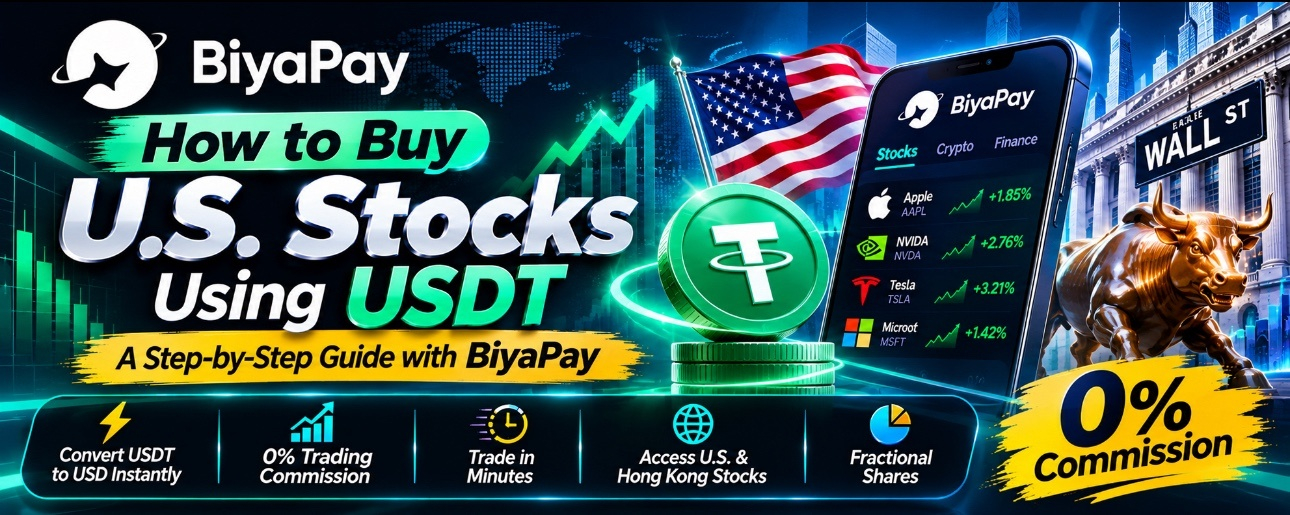
How to Buy U.S. Stocks Using USDT A Step-by-Step Guide with BiyaPayIf you hold stablecoins like USDT and want to buy shares of Apple, Nvidia, or an S&P 500 ETF, you have probably hit a frustrating wall. Moving capital from digital assets into traditional U.S. equities usually means cashing out to a local bank, losing money on steep foreign exchange spreads, paying international wire fees, and waiting days for a brokerage to clear your funds.
This brings up a practical question for modern retail investors: How can you buy U.S. stocks directly using USDT without losing money to endless conversion layers and banking delays?
Using BiyaPay as a unified multi-asset settlement bridge solves this bottleneck cleanly. Instead of routing cash through slow correspondent banks, you can convert stablecoins into U.S. dollars at a 1:1 rate and fund a stock trade in minutes. Here is how the process works in practice, what the actual fee structure looks like, and the key limitations to keep in mind before placing an order.
Why Traditional Cross-Border Stock Funding Is So Expensive
When investing in U.S. markets from outside the United States, your biggest hidden cost is rarely the stock trade itself, it is the capital routing.
Traditional international wire transfers typically carry flat fees ranging from $25 to $50 per transaction, plus intermediary bank deductions and unfavorable exchange rate markups of 1.5% to 3%. Even if a brokerage advertises zero-commission stock trades, losing 3% just to get your money onto the platform puts your portfolio at an immediate disadvantage.
How the USDT-to-Stock Workflow Operates
Rather than forcing you to bounce between a crypto exchange, a local bank, and an offshore brokerage, BiyaPay connects digital assets directly to U.S. and Hong Kong stock accounts inside one wallet.
You deposit stablecoins, swap them into USD at real-time market rates, and move the balance internally to your stock trading sub-account.
Step-by-Step Funding and Trading Process
Account Setup & Identity Verification: Create your account and complete standard KYC identity verification. Having a verified profile unlocks both fiat conversions and equity trading.Deposit USDT: Send USDT from your external wallet or exchange into your funding wallet. Always double-check the blockchain network (such as TRC20 or ERC20) and minimum deposit amounts so network gas fees do not leave your transfer short.Convert USDT to USD: Use the flash exchange feature to swap your USDT into U.S. dollars. In standard conditions, 1 USDT converts directly to 1 USD without hidden spread markups.Internal Transfer to Stock Account: Move your settled USD balance from your main wallet to your dedicated U.S. stock trading account.Execute Your Order: Search for your target U.S. ticker, check the live market depth, and place a market or limit order.
Comparing Traditional Bank Wires vs. USDT-to-Stock Routing
Understanding where you save and where costs still exist, is essential before moving capital. The table below compares a standard international bank wire to a traditional brokerage against routing USDT through BiyaPay.
Feature / Cost FactorTraditional International Bank WireBiyaPay (USDT-to-USD Route)Funding Speed2 to 5 business days (SWIFT network)Minutes for blockchain deposit + internal review bufferDeposit / Wire Fee$25 – $50 flat bank & intermediary fees$0 platform deposit fee (sender pays standard network gas)U.S. Stock Commission$0 – $10 per trade depending on broker$0 trading commissionPlatform & Regulatory FeesVaries by broker$0.005/share platform fee ($0.99 min, capped at 1% of trade value) + standard SEC/TAF/CAT regulatory feesFractional Shares (<1 share)Often unavailable to non-U.S. residentsSupported; 1% platform fee capped at $1
Key Findings and Practical Limitations to Keep in Mind
While routing USDT into U.S. stocks removes banking bottlenecks, there are four practical details every investor should plan around:
Zero Commission Does Not Mean Zero Cost: While trading commissions are $0, every standard U.S. stock order still carries a minimum platform fee of $0.99 (or $0.005 per share) alongside mandatory U.S. regulatory fees (SEC, TAF, and CAT fees) when selling. Making dozens of tiny $20 trades will trigger the $0.99 minimum repeatedly, eating into your returns.Weekend Deposits Are Not Instantly Tradable: Blockchain transfers run 24/7, but U.S. stock exchanges do not. If you deposit USDT on a Sunday night, your funds still need platform crediting, USD conversion, and internal account review before Monday's market open. Always leave a processing buffer.Strict Source-of-Funds Rules: You cannot have a friend or third party send USDT or fiat directly into your account to fund stock purchases. Deposits must come from wallets or accounts matching your verified identity to avoid compliance holds or returned funds.Market Risk Still Applies: Fast funding does not protect against stock market volatility, market holidays, or settlement rules. Always keep a cash buffer rather than putting your entire liquid balance into equities at once.
By planning your transfer frequency, batching smaller deposits to avoid repeated minimum fees, and tracking your conversion rates, bridging USDT into U.S. stocks is a straightforward and cost-effective way to diversify a global portfolio.
#Biyapay #USShares #CryptoToFiat #GlobalInvesting #PersonalFinance
How to Buy U.S. Stocks Using USDT A Step-by-Step Guide with BiyaPay
If you hold stablecoins like USDT and want to buy shares of Apple, Nvidia, or an S&P 500 ETF, you have probably hit a frustrating wall. Moving capital from digital assets into traditional U.S. equities usually means cashing out to a local bank, losing money on steep foreign exchange spreads, paying international wire fees, and waiting days for a brokerage to clear your funds.
This brings up a practical question for modern retail investors: How can you buy U.S. stocks directly using USDT without losing money to endless conversion layers and banking delays?
Using BiyaPay as a unified multi-asset settlement bridge solves this bottleneck cleanly. Instead of routing cash through slow correspondent banks, you can convert stablecoins into U.S. dollars at a 1:1 rate and fund a stock trade in minutes. Here is how the process works in practice, what the actual fee structure looks like, and the key limitations to keep in mind before placing an order.
Why Traditional Cross-Border Stock Funding Is So Expensive
When investing in U.S. markets from outside the United States, your biggest hidden cost is rarely the stock trade itself, it is the capital routing.
Traditional international wire transfers typically carry flat fees ranging from $25 to $50 per transaction, plus intermediary bank deductions and unfavorable exchange rate markups of 1.5% to 3%. Even if a brokerage advertises zero-commission stock trades, losing 3% just to get your money onto the platform puts your portfolio at an immediate disadvantage.
How the USDT-to-Stock Workflow Operates
Rather than forcing you to bounce between a crypto exchange, a local bank, and an offshore brokerage, BiyaPay connects digital assets directly to U.S. and Hong Kong stock accounts inside one wallet.
You deposit stablecoins, swap them into USD at real-time market rates, and move the balance internally to your stock trading sub-account.
Step-by-Step Funding and Trading Process
Account Setup & Identity Verification: Create your account and complete standard KYC identity verification. Having a verified profile unlocks both fiat conversions and equity trading.Deposit USDT: Send USDT from your external wallet or exchange into your funding wallet. Always double-check the blockchain network (such as TRC20 or ERC20) and minimum deposit amounts so network gas fees do not leave your transfer short.Convert USDT to USD: Use the flash exchange feature to swap your USDT into U.S. dollars. In standard conditions, 1 USDT converts directly to 1 USD without hidden spread markups.Internal Transfer to Stock Account: Move your settled USD balance from your main wallet to your dedicated U.S. stock trading account.Execute Your Order: Search for your target U.S. ticker, check the live market depth, and place a market or limit order.
Comparing Traditional Bank Wires vs. USDT-to-Stock Routing
Understanding where you save and where costs still exist, is essential before moving capital. The table below compares a standard international bank wire to a traditional brokerage against routing USDT through BiyaPay.
Feature / Cost FactorTraditional International Bank WireBiyaPay (USDT-to-USD Route)Funding Speed2 to 5 business days (SWIFT network)Minutes for blockchain deposit + internal review bufferDeposit / Wire Fee$25 – $50 flat bank & intermediary fees$0 platform deposit fee (sender pays standard network gas)U.S. Stock Commission$0 – $10 per trade depending on broker$0 trading commissionPlatform & Regulatory FeesVaries by broker$0.005/share platform fee ($0.99 min, capped at 1% of trade value) + standard SEC/TAF/CAT regulatory feesFractional Shares (<1 share)Often unavailable to non-U.S. residentsSupported; 1% platform fee capped at $1
Key Findings and Practical Limitations to Keep in Mind
While routing USDT into U.S. stocks removes banking bottlenecks, there are four practical details every investor should plan around:
Zero Commission Does Not Mean Zero Cost: While trading commissions are $0, every standard U.S. stock order still carries a minimum platform fee of $0.99 (or $0.005 per share) alongside mandatory U.S. regulatory fees (SEC, TAF, and CAT fees) when selling. Making dozens of tiny $20 trades will trigger the $0.99 minimum repeatedly, eating into your returns.Weekend Deposits Are Not Instantly Tradable: Blockchain transfers run 24/7, but U.S. stock exchanges do not. If you deposit USDT on a Sunday night, your funds still need platform crediting, USD conversion, and internal account review before Monday's market open. Always leave a processing buffer.Strict Source-of-Funds Rules: You cannot have a friend or third party send USDT or fiat directly into your account to fund stock purchases. Deposits must come from wallets or accounts matching your verified identity to avoid compliance holds or returned funds.Market Risk Still Applies: Fast funding does not protect against stock market volatility, market holidays, or settlement rules. Always keep a cash buffer rather than putting your entire liquid balance into equities at once.
By planning your transfer frequency, batching smaller deposits to avoid repeated minimum fees, and tracking your conversion rates, bridging USDT into U.S. stocks is a straightforward and cost-effective way to diversify a global portfolio.
#Biyapay #USShares #CryptoToFiat #GlobalInvesting #PersonalFinance
3
716

Article
Your Money Lives in Different Currencies. Does Your Financial Strategy Reflect That?Think about how money moves through an ordinary person's life.
You might earn in one currency, pay for subscriptions in another, support family in a different country, and invest in assets priced in U.S. dollars.
Your financial life can become international long before you consider yourself a global investor.
This creates an interesting challenge: managing money across different currencies while trying to keep your financial decisions organised.
And it's a challenge worth paying attention to.
The currency mismatch most people overlook
Imagine someone who earns in Nigerian naira but follows opportunities in the U.S. stock market.
Their everyday expenses are in naira. Their preferred digital assets may be held in USDT. Meanwhile, the stocks they want to research and potentially invest in are priced in dollars.
These are three different financial environments.
Moving between them involves more than simply changing numbers on a screen. Exchange rates, conversion costs, transaction fees and the availability of financial services all influence how much money eventually reaches its destination.
This is where people can lose sight of the bigger picture.
Someone may focus heavily on the price of an investment while paying very little attention to the cost of moving funds into the account. Another person may hold digital assets without having a clear plan for converting them when they need traditional currency.
Over time, these small decisions can affect how efficiently money is managed.
Money movement deserves as much attention as investment decisions
Most financial conversations focus on what to buy.
Should you hold Bitcoin? Are U.S. technology stocks worth researching? Is the Hong Kong market offering opportunities? Should you keep some funds in cash?
These questions matter, but there's another question worth asking:
How easily can you move your money between the different financial activities that matter to you?
Consider three situations.
1. Accessing traditional financial markets
Someone holding USDT may want exposure to eligible U.S. or Hong Kong stocks. That requires a financial service that connects digital asset funding with the relevant investment market.
2. Managing international payment.
A person supporting family abroad may need to convert digital assets into a supported fiat currency and transfer the funds through an available remittance route.
3. Following different asset markets
An investor interested in equities and cryptocurrencies may want to monitor both markets without treating them as completely unrelated parts of their financial life.
Each situation involves a different objective, but they share one thing: the need to manage funds across financial systems.
The case for a more connected financial setup
This is one reason platforms combining different financial services are becoming more relevant.
BiyaPay is built around this idea of connecting digital assets, traditional financial markets and cross-border money movement.
Its services cover U.S. and Hong Kong stock trading, cryptocurrency spot and contract trading, currency conversion, and international remittance. This gives users access to several financial activities within one platform rather than treating every activity as an entirely separate process.
For example, USDT can be converted into supported fiat currencies, including USD and HKD. Users can also access eligible U.S. and Hong Kong stock markets through the platform.
The interesting part is how these services relate to one another.
A person holding digital assets may also have international payment needs. Someone interested in global equities may already be managing funds in different currencies. Having these activities connected can make the overall financial setup easier to organise.
Of course, access to multiple services does not automatically make every financial decision a good one. Users still need to understand the products they're using, their costs, eligibility requirements and associated risks.
Convenience should never replace financial discipline
Having access to multiple markets can create more choices, but more choices also require better decision-making.
Before moving money, understand the exchange rate and the amount you'll receive after applicable charges.
Before investing, research the asset, understand its volatility and decide how much risk you're comfortable taking.
Before making an international transfer, check the supported destination, recipient details, limits and expected processing conditions.
And when using digital assets, pay attention to the network and wallet address. A mistake in an on-chain transfer can be difficult or impossible to reverse.
These checks matter regardless of which platform you use.
There's also a difference between having access to a market and having a reason to participate in it. Just because an asset is available doesn't mean it belongs in your portfolio.
A connected financial platform should make managing money more convenient. It should never become a reason to abandon a financial plan.
A better way to think about global finance
I think the next stage of personal finance will involve more people managing money across currencies and asset classes as part of their everyday lives.
Someone may use digital assets for one purpose, traditional currencies for another, and global investments for long-term financial goals.
The important thing is understanding how these pieces fit together.
BiyaPay is an example of a platform bringing several of these activities into one financial environment. Its combination of currency conversion, remittance, digital asset services and access to U.S. and Hong Kong markets reflects a growing demand for more connected financial tools.
For anyone managing money across borders, the real question is worth considering:
Is your financial setup keeping up with the way you actually earn, spend, transfer and invest money?
That may be a more useful place to start than simply looking for the next asset to buy.
Disclaimer: This article is for educational and informational purposes only. It is not financial or investment advice. Digital assets and financial markets involve risks, and product availability, fees and eligibility conditions may vary.
#BiyaPay #GlobalFinance #DigitalAssets #CrossBorderPayments #GlobalInvesting
Your Money Lives in Different Currencies. Does Your Financial Strategy Reflect That?
Think about how money moves through an ordinary person's life.
You might earn in one currency, pay for subscriptions in another, support family in a different country, and invest in assets priced in U.S. dollars.
Your financial life can become international long before you consider yourself a global investor.
This creates an interesting challenge: managing money across different currencies while trying to keep your financial decisions organised.
And it's a challenge worth paying attention to.
The currency mismatch most people overlook
Imagine someone who earns in Nigerian naira but follows opportunities in the U.S. stock market.
Their everyday expenses are in naira. Their preferred digital assets may be held in USDT. Meanwhile, the stocks they want to research and potentially invest in are priced in dollars.
These are three different financial environments.
Moving between them involves more than simply changing numbers on a screen. Exchange rates, conversion costs, transaction fees and the availability of financial services all influence how much money eventually reaches its destination.
This is where people can lose sight of the bigger picture.
Someone may focus heavily on the price of an investment while paying very little attention to the cost of moving funds into the account. Another person may hold digital assets without having a clear plan for converting them when they need traditional currency.
Over time, these small decisions can affect how efficiently money is managed.
Money movement deserves as much attention as investment decisions
Most financial conversations focus on what to buy.
Should you hold Bitcoin? Are U.S. technology stocks worth researching? Is the Hong Kong market offering opportunities? Should you keep some funds in cash?
These questions matter, but there's another question worth asking:
How easily can you move your money between the different financial activities that matter to you?
Consider three situations.
1. Accessing traditional financial markets
Someone holding USDT may want exposure to eligible U.S. or Hong Kong stocks. That requires a financial service that connects digital asset funding with the relevant investment market.
2. Managing international payment.
A person supporting family abroad may need to convert digital assets into a supported fiat currency and transfer the funds through an available remittance route.
3. Following different asset markets
An investor interested in equities and cryptocurrencies may want to monitor both markets without treating them as completely unrelated parts of their financial life.
Each situation involves a different objective, but they share one thing: the need to manage funds across financial systems.
The case for a more connected financial setup
This is one reason platforms combining different financial services are becoming more relevant.
BiyaPay is built around this idea of connecting digital assets, traditional financial markets and cross-border money movement.
Its services cover U.S. and Hong Kong stock trading, cryptocurrency spot and contract trading, currency conversion, and international remittance. This gives users access to several financial activities within one platform rather than treating every activity as an entirely separate process.
For example, USDT can be converted into supported fiat currencies, including USD and HKD. Users can also access eligible U.S. and Hong Kong stock markets through the platform.
The interesting part is how these services relate to one another.
A person holding digital assets may also have international payment needs. Someone interested in global equities may already be managing funds in different currencies. Having these activities connected can make the overall financial setup easier to organise.
Of course, access to multiple services does not automatically make every financial decision a good one. Users still need to understand the products they're using, their costs, eligibility requirements and associated risks.
Convenience should never replace financial discipline
Having access to multiple markets can create more choices, but more choices also require better decision-making.
Before moving money, understand the exchange rate and the amount you'll receive after applicable charges.
Before investing, research the asset, understand its volatility and decide how much risk you're comfortable taking.
Before making an international transfer, check the supported destination, recipient details, limits and expected processing conditions.
And when using digital assets, pay attention to the network and wallet address. A mistake in an on-chain transfer can be difficult or impossible to reverse.
These checks matter regardless of which platform you use.
There's also a difference between having access to a market and having a reason to participate in it. Just because an asset is available doesn't mean it belongs in your portfolio.
A connected financial platform should make managing money more convenient. It should never become a reason to abandon a financial plan.
A better way to think about global finance
I think the next stage of personal finance will involve more people managing money across currencies and asset classes as part of their everyday lives.
Someone may use digital assets for one purpose, traditional currencies for another, and global investments for long-term financial goals.
The important thing is understanding how these pieces fit together.
BiyaPay is an example of a platform bringing several of these activities into one financial environment. Its combination of currency conversion, remittance, digital asset services and access to U.S. and Hong Kong markets reflects a growing demand for more connected financial tools.
For anyone managing money across borders, the real question is worth considering:
Is your financial setup keeping up with the way you actually earn, spend, transfer and invest money?
That may be a more useful place to start than simply looking for the next asset to buy.
Disclaimer: This article is for educational and informational purposes only. It is not financial or investment advice. Digital assets and financial markets involve risks, and product availability, fees and eligibility conditions may vary.
#BiyaPay #GlobalFinance #DigitalAssets #CrossBorderPayments #GlobalInvesting
106

·
--
How to Send Money Globally with BiyaPay: A Simple Guide
Sending money internationally can be challeHow to Send Money Globally with BiyaPay: A Simple Guide
Sending money internationally can be challenging because of different currencies, transfer fees, and banking requirements. BiyaPay is a digital financial platform that helps eligible users manage international money transfers, exchange currencies, and access cryptocurrency services. It brings several financial tools together in one platform, making it useful for people who regularly handle international transactions.
What Is BiyaPay?
BiyaPay is a financial platform that provides services such as international remittances, currency exchange, cryptocurrency transactions, and access to selected financial markets.
Users can access its services through its website and mobile application, depending on their location and account eligibility.
Key Features of BiyaPay
1. International Money Transfers
BiyaPay supports international remittance services for eligible users. This can help individuals and businesses send money across supported countries and regions.
2. Multi-Currency Exchange
Users can exchange supported fiat currencies and digital assets. This is useful for people who regularly deal with different currencies.
3. Cryptocurrency Services
BiyaPay offers selected cryptocurrency services, including deposits, withdrawals, exchanges, and trading. Supported assets depend on availability and account requirements.
4. Financial Market Access
The platform also provides access to selected financial market services, including cryptocurrency and US and Hong Kong stock market products.
How to Get Started with BiyaPay
Getting started involves four basic steps:
Step 1: Create an Account
Visit the official BiyaPay platform or download its application. Follow the registration instructions.
Step 2: Verify Your Identity
Complete the required identity verification. Some services require additional documents or approval.
Step 3: Fund Your Account
Choose an available deposit method and follow the instructions. For cryptocurrency deposits, confirm the correct network and wallet address.
Step 4: Start Using BiyaPay
Explore the available transfer, exchange, withdrawal, and trading services.
Understanding BiyaPay Fees
Transaction fees depend on the service and amount involved. BiyaPay publishes different remittance withdrawal rates for different transaction amounts.
Other costs, including exchange rate differences, network charges, and third-party banking fees, may apply.
Always review the actual fee displayed before confirming a transaction.
Security Tips for Users
Protecting your financial information is important when using digital payment platforms.
- Use a strong and unique password.
- Never share your verification codes.
- Confirm recipient details before transferring money.
- Double-check cryptocurrency addresses.
- Avoid suspicious links and unofficial applications.
- Review transactions before confirming.
Remember that cryptocurrency prices can fluctuate and some transactions cannot be reversed.
Important Things to Know
Not every BiyaPay service is available in every country. Some features require identity verification, approved bank accounts, or additional eligibility checks. Processing times and fees may also vary depending on the transaction.
Users should review the platform's current terms, supported countries, and charges before using its services.
Final Thoughts
BiyaPay combines international money transfers, currency exchange, cryptocurrency services, and selected financial market products in one platform.
For people who regularly manage international payments and digital assets, these services may provide useful financial options. Understanding the fees, requirements, and risks can help users make better decisions.
#biyapay #Crypto #DigitalPayments #MoneyTransferb #FinTech
How to Send Money Globally with BiyaPay: A Simple Guide Sending money internationally can be challe
How to Send Money Globally with BiyaPay: A Simple Guide
Sending money internationally can be challenging because of different currencies, transfer fees, and banking requirements. BiyaPay is a digital financial platform that helps eligible users manage international money transfers, exchange currencies, and access cryptocurrency services. It brings several financial tools together in one platform, making it useful for people who regularly handle international transactions.
What Is BiyaPay?
BiyaPay is a financial platform that provides services such as international remittances, currency exchange, cryptocurrency transactions, and access to selected financial markets.
Users can access its services through its website and mobile application, depending on their location and account eligibility.
Key Features of BiyaPay
1. International Money Transfers
BiyaPay supports international remittance services for eligible users. This can help individuals and businesses send money across supported countries and regions.
2. Multi-Currency Exchange
Users can exchange supported fiat currencies and digital assets. This is useful for people who regularly deal with different currencies.
3. Cryptocurrency Services
BiyaPay offers selected cryptocurrency services, including deposits, withdrawals, exchanges, and trading. Supported assets depend on availability and account requirements.
4. Financial Market Access
The platform also provides access to selected financial market services, including cryptocurrency and US and Hong Kong stock market products.
How to Get Started with BiyaPay
Getting started involves four basic steps:
Step 1: Create an Account
Visit the official BiyaPay platform or download its application. Follow the registration instructions.
Step 2: Verify Your Identity
Complete the required identity verification. Some services require additional documents or approval.
Step 3: Fund Your Account
Choose an available deposit method and follow the instructions. For cryptocurrency deposits, confirm the correct network and wallet address.
Step 4: Start Using BiyaPay
Explore the available transfer, exchange, withdrawal, and trading services.
Understanding BiyaPay Fees
Transaction fees depend on the service and amount involved. BiyaPay publishes different remittance withdrawal rates for different transaction amounts.
Other costs, including exchange rate differences, network charges, and third-party banking fees, may apply.
Always review the actual fee displayed before confirming a transaction.
Security Tips for Users
Protecting your financial information is important when using digital payment platforms.
- Use a strong and unique password.
- Never share your verification codes.
- Confirm recipient details before transferring money.
- Double-check cryptocurrency addresses.
- Avoid suspicious links and unofficial applications.
- Review transactions before confirming.
Remember that cryptocurrency prices can fluctuate and some transactions cannot be reversed.
Important Things to Know
Not every BiyaPay service is available in every country. Some features require identity verification, approved bank accounts, or additional eligibility checks. Processing times and fees may also vary depending on the transaction.
Users should review the platform's current terms, supported countries, and charges before using its services.
Final Thoughts
BiyaPay combines international money transfers, currency exchange, cryptocurrency services, and selected financial market products in one platform.
For people who regularly manage international payments and digital assets, these services may provide useful financial options. Understanding the fees, requirements, and risks can help users make better decisions.
#biyapay #Crypto #DigitalPayments #MoneyTransferb #FinTech
139

Article
How Does BiyaPay Make Cross-Border Payments Easier?Sending money across countries can be frustrating. Different currencies, bank requirements, exchange rates and transfer fees can turn a simple payment into a complicated process.
Freelancers, families and businesses all face these challenges. Digital finance platforms are trying to make these transactions easier to manage.
BiyaPay brings together international remittance and currency conversion services. Depending on a user's location and eligibility, the platform offers ways to deposit supported funds, exchange currencies and withdraw money to eligible bank accounts. Here is how the process works and what to check first.
Why do international transfers need planning?
An international transfer may pass through several financial institutions. The sender may need to exchange one currency for another, while the receiving bank or an intermediary may apply additional charges.
For example, someone holding USDT who needs US dollars in a bank account may have to deposit the supported asset, convert it into USD and then use an available withdrawal route.
Before choosing a service, look beyond the advertised transfer fee. Check the exchange rate, the final amount the recipient should receive, the destination country, estimated processing time and any identity requirements. These details help you understand the real cost.
How does the transfer process work?
1. Create and verify your account. Register and complete the identity checks requested for the service. Some features may require additional information.
2. Check the destination. Confirm that the country, receiving currency and bank account are supported before depositing funds.
3. Deposit the asset. For the USDT route described in BiyaPay's guidance, follow the deposit instructions in your account. Check the wallet address and blockchain network carefully. Sending crypto to the wrong address or through an unsupported network can cause permanent loss.
4. Convert the funds. Once the deposit is credited, use the conversion feature to exchange USDT for USD if that option is available. Review the quoted rate and charges before confirming.
5. Submit and monitor the withdrawal. Select the eligible linked bank account, check the recipient details and submit the transaction. Keep the reference number and monitor its withdrawal
What about fees and exchange rates?
Fees should be checked before you commit. BiyaPay's Help Center explains that users can view the applicable remittance fee during the transfer setup process. The general web flow is to open Remittance, select or add the receiving bank account, choose the destination country, select the currency and payment method, then review the fee displayed.
The amount may vary according to the destination and transaction details. Receiving banks or intermediary institutions may also charge fees. A service with a lower transfer fee is not necessarily cheaper if its exchange rate is less favourable.
Requirements and limitations
Identity verification may be required, and some withdrawals may only be available to approved, linked bank accounts. Supported destinations and currencies can vary. Processing estimates are not guarantees because verification and external financial institutions can affect delivery.
Digital assets also carry risks. Cryptocurrency transfers are generally difficult to reverse, so check the address and network every time. Exchange rates can change, and digital asset prices can fluctuate. Local rules may affect which services are available in your country.
Check eligibility before using the transfer route.
Final thoughts
Cross-border payments involve more than pressing send. Currency conversion, fees, verification and receiving-bank requirements all matter.
BiyaPay brings remittance and currency conversion tools together, including a published USDT-to-USD-to-bank withdrawal route for eligible users. It may be worth exploring if that route suits your needs, but check availability, fees and conditions in your account before moving funds.
Review the details, verify recipient information and understand the risks. A careful check before confirming is better than trying to fix a mistake afterwards.
This article is for general information, not financial advice. Service availability, fees and requirements may change. Check BiyaPay's current in-app guidance before making a transaction.
#biyapay #CrossBorderPayments #CurrencyExchange #DigitalFinance
How Does BiyaPay Make Cross-Border Payments Easier?
Sending money across countries can be frustrating. Different currencies, bank requirements, exchange rates and transfer fees can turn a simple payment into a complicated process.
Freelancers, families and businesses all face these challenges. Digital finance platforms are trying to make these transactions easier to manage.
BiyaPay brings together international remittance and currency conversion services. Depending on a user's location and eligibility, the platform offers ways to deposit supported funds, exchange currencies and withdraw money to eligible bank accounts. Here is how the process works and what to check first.
Why do international transfers need planning?
An international transfer may pass through several financial institutions. The sender may need to exchange one currency for another, while the receiving bank or an intermediary may apply additional charges.
For example, someone holding USDT who needs US dollars in a bank account may have to deposit the supported asset, convert it into USD and then use an available withdrawal route.
Before choosing a service, look beyond the advertised transfer fee. Check the exchange rate, the final amount the recipient should receive, the destination country, estimated processing time and any identity requirements. These details help you understand the real cost.
How does the transfer process work?
1. Create and verify your account. Register and complete the identity checks requested for the service. Some features may require additional information.
2. Check the destination. Confirm that the country, receiving currency and bank account are supported before depositing funds.
3. Deposit the asset. For the USDT route described in BiyaPay's guidance, follow the deposit instructions in your account. Check the wallet address and blockchain network carefully. Sending crypto to the wrong address or through an unsupported network can cause permanent loss.
4. Convert the funds. Once the deposit is credited, use the conversion feature to exchange USDT for USD if that option is available. Review the quoted rate and charges before confirming.
5. Submit and monitor the withdrawal. Select the eligible linked bank account, check the recipient details and submit the transaction. Keep the reference number and monitor its withdrawal
What about fees and exchange rates?
Fees should be checked before you commit. BiyaPay's Help Center explains that users can view the applicable remittance fee during the transfer setup process. The general web flow is to open Remittance, select or add the receiving bank account, choose the destination country, select the currency and payment method, then review the fee displayed.
The amount may vary according to the destination and transaction details. Receiving banks or intermediary institutions may also charge fees. A service with a lower transfer fee is not necessarily cheaper if its exchange rate is less favourable.
Requirements and limitations
Identity verification may be required, and some withdrawals may only be available to approved, linked bank accounts. Supported destinations and currencies can vary. Processing estimates are not guarantees because verification and external financial institutions can affect delivery.
Digital assets also carry risks. Cryptocurrency transfers are generally difficult to reverse, so check the address and network every time. Exchange rates can change, and digital asset prices can fluctuate. Local rules may affect which services are available in your country.
Check eligibility before using the transfer route.
Final thoughts
Cross-border payments involve more than pressing send. Currency conversion, fees, verification and receiving-bank requirements all matter.
BiyaPay brings remittance and currency conversion tools together, including a published USDT-to-USD-to-bank withdrawal route for eligible users. It may be worth exploring if that route suits your needs, but check availability, fees and conditions in your account before moving funds.
Review the details, verify recipient information and understand the risks. A careful check before confirming is better than trying to fix a mistake afterwards.
This article is for general information, not financial advice. Service availability, fees and requirements may change. Check BiyaPay's current in-app guidance before making a transaction.
#biyapay #CrossBorderPayments #CurrencyExchange #DigitalFinance
118
Combining Stock Trading With Better Financial OrganizationFor currency conversion and international fund management, I also started exploring BiyaPay.
Its services include a digital wallet, multi-currency exchange, international transfers, and access to U.S. and Hong Kong stock trading services. It also supports USDT-related conversion functions, which may be relevant to users who already work with digital assets.
What I appreciate most about this approach is the flexibility to organize different financial activities according to their purposes.
Of course, convenience should never replace proper research. Before using any platform, I would always check its regulatory information, supported regions, transaction fees, and withdrawal requirements.
In the end, investing is not just about making individual trades. Building a sensible financial management routine is also part of the learning process.#biyapay
Combining Stock Trading With Better Financial Organization
For currency conversion and international fund management, I also started exploring BiyaPay.
Its services include a digital wallet, multi-currency exchange, international transfers, and access to U.S. and Hong Kong stock trading services. It also supports USDT-related conversion functions, which may be relevant to users who already work with digital assets.
What I appreciate most about this approach is the flexibility to organize different financial activities according to their purposes.
Of course, convenience should never replace proper research. Before using any platform, I would always check its regulatory information, supported regions, transaction fees, and withdrawal requirements.
In the end, investing is not just about making individual trades. Building a sensible financial management routine is also part of the learning process.#biyapay
77
Why Fund Management Matters in Stock TradingDifferent brokers may have different deposit methods, supported currencies, processing times, and withdrawal requirements. Even when the trading experience is smooth, the surrounding financial arrangements can become complicated.
I eventually discovered BiyaPay while looking for a more organized way to manage international funds. The platform supports multiple fiat currencies and digital assets, with features including currency exchange, transfers, and wallet management.
Another interesting aspect is its support for certain U.S. and Hong Kong stock trading services. This makes it worth exploring for people who want to understand how digital assets and traditional financial markets can work together.
Of course, using any financial service requires checking its eligibility requirements, applicable fees, and regulatory framework.
My biggest takeaway is simple: investment planning shouldn't stop at selecting stocks. Understanding how money moves between different platforms is also an important part of building a more structured investment routine.#biyapay
Why Fund Management Matters in Stock Trading
Different brokers may have different deposit methods, supported currencies, processing times, and withdrawal requirements. Even when the trading experience is smooth, the surrounding financial arrangements can become complicated.
I eventually discovered BiyaPay while looking for a more organized way to manage international funds. The platform supports multiple fiat currencies and digital assets, with features including currency exchange, transfers, and wallet management.
Another interesting aspect is its support for certain U.S. and Hong Kong stock trading services. This makes it worth exploring for people who want to understand how digital assets and traditional financial markets can work together.
Of course, using any financial service requires checking its eligibility requirements, applicable fees, and regulatory framework.
My biggest takeaway is simple: investment planning shouldn't stop at selecting stocks. Understanding how money moves between different platforms is also an important part of building a more structured investment routine.#biyapay
9
Brokers vs Futu vs Webull: My Personal ThoughtsThat's where I became interested in BiyaPay. It provides wallet services, currency conversion, international transfers, and access to certain investment-related services.
I find the idea of keeping fund management and stock trading organized particularly useful. Rather than expecting one application to handle everything, I prefer choosing tools based on their actual functions.
Ultimately, comparing platforms should involve more than promotional offers. Investors should carefully review account requirements, applicable fees, local regulations, and supported funding methods before making a decision.#biyapay
Brokers vs Futu vs Webull: My Personal Thoughts
That's where I became interested in BiyaPay. It provides wallet services, currency conversion, international transfers, and access to certain investment-related services.
I find the idea of keeping fund management and stock trading organized particularly useful. Rather than expecting one application to handle everything, I prefer choosing tools based on their actual functions.
Ultimately, comparing platforms should involve more than promotional offers. Investors should carefully review account requirements, applicable fees, local regulations, and supported funding methods before making a decision.#biyapay
61
I eventually came across BiyaPay, a multi-asset wallet that combines currency exchange, transfers, and other financial services. What caught my attention was the ability to view exchange rates and manage different currencies within one platform.
For people who regularly deal with international transactions, having a more organized way to manage funds can make everyday financial tasks easier.
I still believe that choosing a brokerage requires careful research. Trading fees, account eligibility, regulatory status, and available markets should all be considered. For me, the biggest lesson has been that a good investment routine involves more than simply buying and selling stocks. Having a clear and well-planned financial workflow matters just as much.#biyapay
84

·
--
Article
What Do You Actually Pay to Send USDT to a Bank Account?Disclosure: It is not financial advice
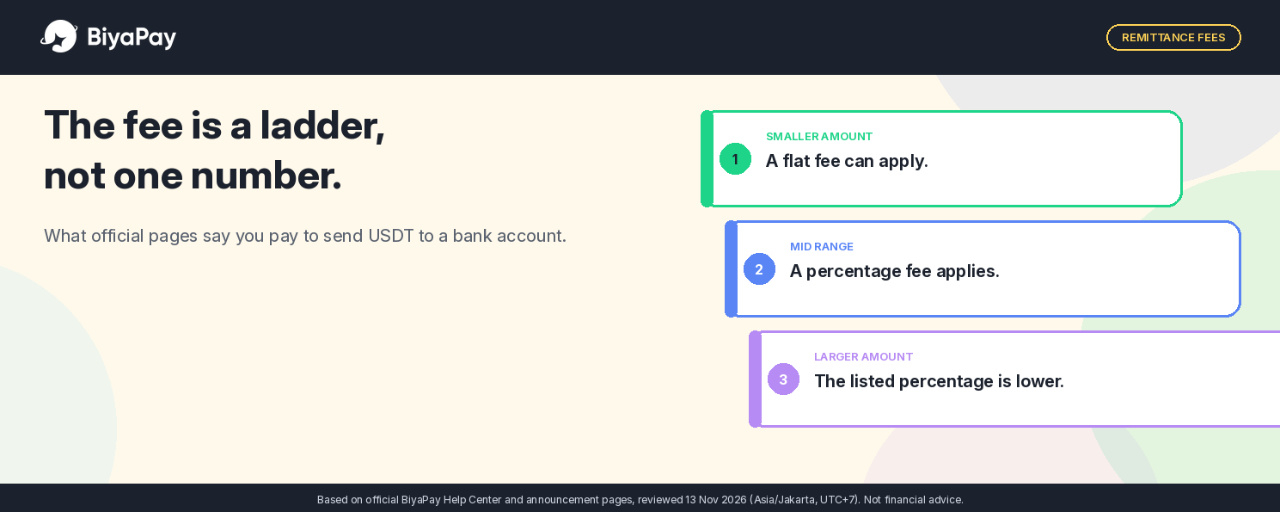
A short line about a remittance fee can make the cost sound like one number. On BiyaPay, the remittance fee is tiered, and it changes with the size of the transfer.
This is not a recommendation to send funds. It is a worked walk-through of that fee schedule, and of what I would look at before I send.
Two routes, and they pay out the same
There are two ways to withdraw fiat currency, and the arrival amounts of these two methods are the same. I am using a USD withdrawal as the example, from guidance dated 28 February 2026.
The first method is to open Flash Exchange on the app homepage, or open My Assets, then Funds, then Flash Exchange on the web, exchange USDT to USD, and then go to the Remittance page. There you select USD, choose the recipient account, and enter an email verification code or a Biya authenticator code.
The second method skips the separate exchange step. On the Remittance page, you select USDT for remittance, with the actual remittance in USD, then choose the recipient account and enter the same kind of verification code.
Some older screens used the word Convert for that step. The February 2026 guidance calls it Flash Exchange. I would follow the labels on the screen I am looking at.
Before those steps: verification and a recipient account
The process starts earlier than the Remittance button. Complete identity verification and link a bank account, then deposit USDT, then exchange, then withdraw to the linked account.
The recipient account is the one that receives fiat withdrawn from BiyaPay. You can add one from Personal Center, under Recipient Management, or from the Remittance page, under Remit to Self or Remit to Others. That binding guidance is dated 28 February 2026.
You can choose Self, Others, or Business. A Self account needs bank and personal information. An Others account also requires the recipient's ID card or passport. A Business account needs bank and enterprise information.
The fee is tiered, not a single headline rate
If you deposit USDT and withdraw USD, USDT is exchanged 1:1 with USD. That fee guidance was updated on 28 February 2026.
On the BiyaPay fee itself, the short summary is this. When the fiat withdrawal amount is between 200 USD and 2000 USD, the withdrawal fee is 20 USD. When the amount is greater than 2000 USD, the withdrawal fee is 1 percent, with a minimum fee of 0.5 percent available. Fees for other fiat currencies follow the equivalent amount in USD. A higher withdrawal amount has a lower fee percentage. Transferring fiat between BiyaPay wallets through a registered email has no handling fee.
A fuller table sits in a BiyaPay announcement titled Notice on the further reduction of the fee rate for BiyaPay remittance (fiat currency withdrawal), published on 28 November 2024. That table was still shown when I checked on 13 November 2026, after an update dated 15 October 2026.
Remittance still uses a tiered rate, taking a US dollar remittance as the example, with other fiat currencies calculated on the equivalent US dollar amount. The fee is deducted from the remittance amount. The published tiers, as a single remittance or withdrawal in US dollars, are:
200 up to but not including 2,000: a 20 US dollar fee, with no discount listed.
2,000 up to but not including 50,000: 1.00 percent, with no discount listed.
50,000 up to but not including 100,000: 0.90 percent, described as 10 percent off.
100,000 up to but not including 500,000: 0.80 percent, described as 20 percent off.
500,000 up to but not including 1 million: 0.70 percent, described as 30 percent off.
1 million up to but not including 2 million: 0.60 percent, described as 40 percent off.
2 million and above: 0.50 percent, described as 50 percent off.
I would treat that table as the published schedule for this article. The live figures I would use are the current Cost Center remittance table, and then the amount shown on the Remittance preview.
What the 0.1 percent headline does not replace
You may see a short line that remittance fees start from 0.1 percent. That is a headline floor. It is not what the published tier table above shows for ordinary sizes.
On that announcement table, the lowest listed rate is 0.50 percent, and only at 2 million US dollars and above. A 20 US dollar fee on a 200 US dollar transfer is 10 percent of the amount, not 0.1 percent. On a 2,000 US dollar transfer, the same 20 US dollar fee is 1 percent.
The useful question is which tier this amount falls into, and what the preview shows will be paid.
Other costs that are not on the BiyaPay fee line
The BiyaPay fee is not always the only deduction. A transfer in a home-country or local currency, such as US dollars to a US bank, Singapore dollars to a Singapore bank, or Hong Kong dollars to a Hong Kong bank, generally has no bank handling fee. That bank-charge guidance was last updated on 3 November 2024.
If the remittance is not in that local currency, the bank may charge a fee ranging from a few dollars to tens of dollars. Some banks charge even on a local-currency payment. A specific example is a US dollar transfer to US Wise, with a 10 US dollar fee per transaction. I would read the receiving bank's own fee, not only the BiyaPay tier.
Limits, cancellation, and what the transfer supports
A single remittance can be up to 5 million US dollars. To avoid bank scrutiny and a slower arrival, each remittance is better kept at or under 1 million US dollars, and an amount above that is best split into more than one transfer.
Fiat withdrawal currently supports over 30 currencies, including USD, HKD, and SGD. The currency selection page, when you bind a recipient on Remittance, shows the supported list. Remittances go to nearly 200 countries and regions, except countries or regions sanctioned by the United States or the international community. Only online bank transfers are supported, not cash.
Once funds have been remitted, they cannot be cancelled. There is a narrower exception: if the order status is under review, you can cancel that order yourself and then submit again.
Arrival time depends on more than the submit button
Funds will typically arrive within 1 to 3 business days, depending on the remittance country and currency, the payment method, working hours, and bank review. That arrival guidance was updated on 28 February 2026.
Local currencies are generally faster. USD to a US bank, SGD to a Singapore bank, and HKD to a Hong Kong bank generally arrive on the same working day. A cross-currency route, such as SGD to a US bank or USD to a Hong Kong bank, generally arrives on the same day or the next working day.
When you bind a bank account, the page also shows arrival times for the payment method. The examples are US SWIFT in 1 to 3 working days, and ABA or ACH in 0 to 1 working day.
If you submit before 5 PM Singapore time, the remittance is generally sent the same day. A later submission is likely sent on the next working day. Weekends and legal holidays in the destination country can extend arrival. If a bank review is extended, BiyaPay cannot confirm when the funds will arrive, because that depends on the recipient's bank. If a remittance has not arrived after more than 3 working days, contact BiyaPay so they can check the progress.
Flash Exchange itself is available 24 hours a day, and is completed in real time. That is the conversion step, not the bank arrival window.
A checklist I would use before I send
Finish identity verification and bind the correct recipient account, with the documents that account type requires.Decide the route: Flash Exchange into USD and then remit USD, or remit USDT as USD. The arrival amounts are the same.Read the current remittance fee table, not a headline rate I remember, and match the tier for this amount.Look at the preview of the amount to be received, including the BiyaPay fee that will be deducted.Check whether the receiving bank may add its own fee, especially if the currency is not local to that bank.Check the payment method's stated arrival window, and whether I am submitting before the 5 PM Singapore cutoff on a working day.Recheck the recipient details. After the funds have been remitted, the transfer cannot be cancelled.Complete the email or Biya authenticator verification only after those checks feel right.
Source: BiyaPay app and fee pages, and the remittance-fee announcement published on 28 November 2024, all checked on 13 November 2026 (Asia/Jakarta, UTC+7).
#BiyaPay #USDT #Remittance #BankTransfer
What Do You Actually Pay to Send USDT to a Bank Account?
Disclosure: It is not financial advice
A short line about a remittance fee can make the cost sound like one number. On BiyaPay, the remittance fee is tiered, and it changes with the size of the transfer.
This is not a recommendation to send funds. It is a worked walk-through of that fee schedule, and of what I would look at before I send.
Two routes, and they pay out the same
There are two ways to withdraw fiat currency, and the arrival amounts of these two methods are the same. I am using a USD withdrawal as the example, from guidance dated 28 February 2026.
The first method is to open Flash Exchange on the app homepage, or open My Assets, then Funds, then Flash Exchange on the web, exchange USDT to USD, and then go to the Remittance page. There you select USD, choose the recipient account, and enter an email verification code or a Biya authenticator code.
The second method skips the separate exchange step. On the Remittance page, you select USDT for remittance, with the actual remittance in USD, then choose the recipient account and enter the same kind of verification code.
Some older screens used the word Convert for that step. The February 2026 guidance calls it Flash Exchange. I would follow the labels on the screen I am looking at.
Before those steps: verification and a recipient account
The process starts earlier than the Remittance button. Complete identity verification and link a bank account, then deposit USDT, then exchange, then withdraw to the linked account.
The recipient account is the one that receives fiat withdrawn from BiyaPay. You can add one from Personal Center, under Recipient Management, or from the Remittance page, under Remit to Self or Remit to Others. That binding guidance is dated 28 February 2026.
You can choose Self, Others, or Business. A Self account needs bank and personal information. An Others account also requires the recipient's ID card or passport. A Business account needs bank and enterprise information.
The fee is tiered, not a single headline rate
If you deposit USDT and withdraw USD, USDT is exchanged 1:1 with USD. That fee guidance was updated on 28 February 2026.
On the BiyaPay fee itself, the short summary is this. When the fiat withdrawal amount is between 200 USD and 2000 USD, the withdrawal fee is 20 USD. When the amount is greater than 2000 USD, the withdrawal fee is 1 percent, with a minimum fee of 0.5 percent available. Fees for other fiat currencies follow the equivalent amount in USD. A higher withdrawal amount has a lower fee percentage. Transferring fiat between BiyaPay wallets through a registered email has no handling fee.
A fuller table sits in a BiyaPay announcement titled Notice on the further reduction of the fee rate for BiyaPay remittance (fiat currency withdrawal), published on 28 November 2024. That table was still shown when I checked on 13 November 2026, after an update dated 15 October 2026.
Remittance still uses a tiered rate, taking a US dollar remittance as the example, with other fiat currencies calculated on the equivalent US dollar amount. The fee is deducted from the remittance amount. The published tiers, as a single remittance or withdrawal in US dollars, are:
200 up to but not including 2,000: a 20 US dollar fee, with no discount listed.
2,000 up to but not including 50,000: 1.00 percent, with no discount listed.
50,000 up to but not including 100,000: 0.90 percent, described as 10 percent off.
100,000 up to but not including 500,000: 0.80 percent, described as 20 percent off.
500,000 up to but not including 1 million: 0.70 percent, described as 30 percent off.
1 million up to but not including 2 million: 0.60 percent, described as 40 percent off.
2 million and above: 0.50 percent, described as 50 percent off.
I would treat that table as the published schedule for this article. The live figures I would use are the current Cost Center remittance table, and then the amount shown on the Remittance preview.
What the 0.1 percent headline does not replace
You may see a short line that remittance fees start from 0.1 percent. That is a headline floor. It is not what the published tier table above shows for ordinary sizes.
On that announcement table, the lowest listed rate is 0.50 percent, and only at 2 million US dollars and above. A 20 US dollar fee on a 200 US dollar transfer is 10 percent of the amount, not 0.1 percent. On a 2,000 US dollar transfer, the same 20 US dollar fee is 1 percent.
The useful question is which tier this amount falls into, and what the preview shows will be paid.
Other costs that are not on the BiyaPay fee line
The BiyaPay fee is not always the only deduction. A transfer in a home-country or local currency, such as US dollars to a US bank, Singapore dollars to a Singapore bank, or Hong Kong dollars to a Hong Kong bank, generally has no bank handling fee. That bank-charge guidance was last updated on 3 November 2024.
If the remittance is not in that local currency, the bank may charge a fee ranging from a few dollars to tens of dollars. Some banks charge even on a local-currency payment. A specific example is a US dollar transfer to US Wise, with a 10 US dollar fee per transaction. I would read the receiving bank's own fee, not only the BiyaPay tier.
Limits, cancellation, and what the transfer supports
A single remittance can be up to 5 million US dollars. To avoid bank scrutiny and a slower arrival, each remittance is better kept at or under 1 million US dollars, and an amount above that is best split into more than one transfer.
Fiat withdrawal currently supports over 30 currencies, including USD, HKD, and SGD. The currency selection page, when you bind a recipient on Remittance, shows the supported list. Remittances go to nearly 200 countries and regions, except countries or regions sanctioned by the United States or the international community. Only online bank transfers are supported, not cash.
Once funds have been remitted, they cannot be cancelled. There is a narrower exception: if the order status is under review, you can cancel that order yourself and then submit again.
Arrival time depends on more than the submit button
Funds will typically arrive within 1 to 3 business days, depending on the remittance country and currency, the payment method, working hours, and bank review. That arrival guidance was updated on 28 February 2026.
Local currencies are generally faster. USD to a US bank, SGD to a Singapore bank, and HKD to a Hong Kong bank generally arrive on the same working day. A cross-currency route, such as SGD to a US bank or USD to a Hong Kong bank, generally arrives on the same day or the next working day.
When you bind a bank account, the page also shows arrival times for the payment method. The examples are US SWIFT in 1 to 3 working days, and ABA or ACH in 0 to 1 working day.
If you submit before 5 PM Singapore time, the remittance is generally sent the same day. A later submission is likely sent on the next working day. Weekends and legal holidays in the destination country can extend arrival. If a bank review is extended, BiyaPay cannot confirm when the funds will arrive, because that depends on the recipient's bank. If a remittance has not arrived after more than 3 working days, contact BiyaPay so they can check the progress.
Flash Exchange itself is available 24 hours a day, and is completed in real time. That is the conversion step, not the bank arrival window.
A checklist I would use before I send
Finish identity verification and bind the correct recipient account, with the documents that account type requires.Decide the route: Flash Exchange into USD and then remit USD, or remit USDT as USD. The arrival amounts are the same.Read the current remittance fee table, not a headline rate I remember, and match the tier for this amount.Look at the preview of the amount to be received, including the BiyaPay fee that will be deducted.Check whether the receiving bank may add its own fee, especially if the currency is not local to that bank.Check the payment method's stated arrival window, and whether I am submitting before the 5 PM Singapore cutoff on a working day.Recheck the recipient details. After the funds have been remitted, the transfer cannot be cancelled.Complete the email or Biya authenticator verification only after those checks feel right.
Source: BiyaPay app and fee pages, and the remittance-fee announcement published on 28 November 2024, all checked on 13 November 2026 (Asia/Jakarta, UTC+7).
#BiyaPay #USDT #Remittance #BankTransfer
337
·
--
Verified
Article
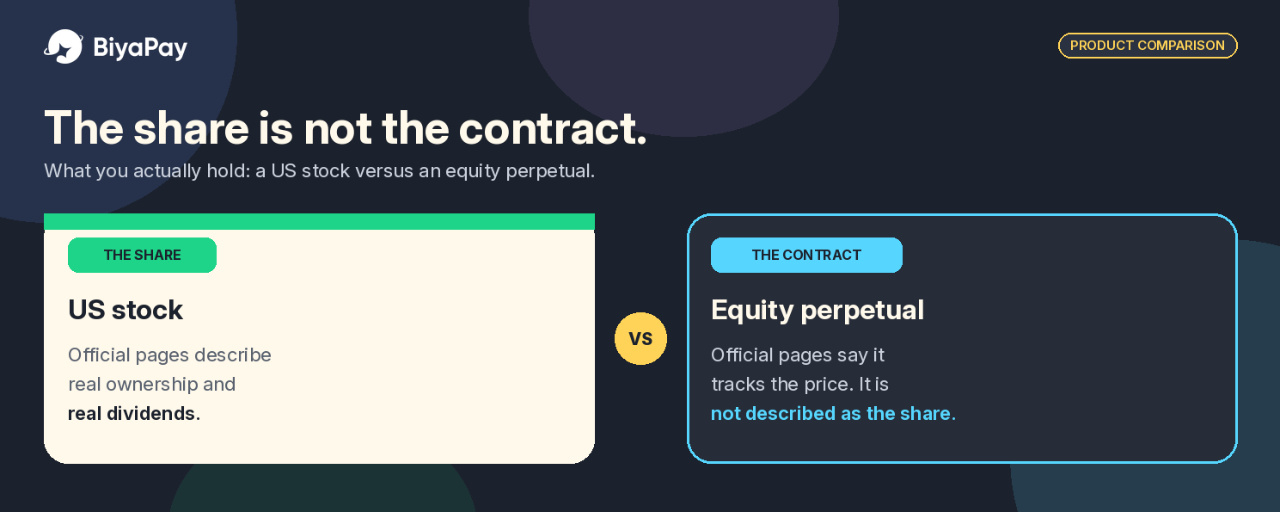
What Do You Actually Hold: the US Stock, or the Equity Perpetual?Disclosure: It is not financial advice
A familiar ticker can appear in more than one product. That does not mean you are holding the same thing.
On BiyaPay, you can buy a US stock, and you can also trade an equity perpetual contract that tracks that stock's price. The screen may look related. The holding is not.
I would separate those products before deciding which one matches the intention. This is not a recommendation to use either one. It is a comparison of what each product actually gives you, and what it does not.
What you hold when you buy the share
On BiyaPay, US and Hong Kong stock trading is real stocks, with real ownership and real dividends, plus 0 commission, instant settlement, and fast fills.
That description belongs to the stock product, not to every product that happens to show a similar name. A share is ownership of the equity. A contract that tracks the price is not.
On dividends, the terms are more specific. Purchased US and Hong Kong stocks may receive dividends. Whether a dividend is paid depends on whether the company pays one and whether you meet that company's conditions.
If you hold the stock on the ex-dividend date, dividends are usually paid within 1 to 30 working days after that date, with the timing and amount set by the company's policy and announcement.
The stock product comes with ownership and dividends. I will not invent a voting process on top of that.
BiyaPay can currently trade all US stocks, including ETFs. The smallest whole-number unit is 1 share, and some stocks support fractional share trading.
What you hold when you trade the equity perpetual
These contracts follow the same pattern: they track the price of the underlying common stock. NVDAUSDT tracks Nvidia (Nasdaq: NVDA). GOOGLUSDT tracks Alphabet (Nasdaq: GOOGL). METAUSDT tracks Meta Platforms (Nasdaq: META).
Later listings use the same wording for other US-listed names, including Netflix, Costco, and Adobe.
That is price tracking. It is not the same as the real ownership and real dividends that come with the stock product.
I would not treat a perpetual as if it paid the cash dividend of the underlying share, or as if it carried shareholder rights.
The risk language is blunt. Prices can be volatile, you may lose the amount you put in, and in contract trading, adverse moves can liquidate all of your margin balance.
The stock has defined sessions. The contract's hours are a separate check
US stock trading is not an always-open share market. BiyaPay currently supports night trading, pre-market, intraday, and after-hours sessions, with these windows in Eastern Time:
Night trading: 20:00 to 04:00Pre-market trading: 04:00 to 09:30Intraday trading: 09:30 to 16:00After-hours trading: 16:00 to 20:00
Those sessions are also mapped to Beijing time for daylight saving and standard time. Periods other than intraday trading are called extended trading hours. Around holidays or early closes, I would look at the session on the order ticket.
Cryptocurrency contracts can be traded 24 hours a day. That 24-hour window is for cryptocurrency contracts, not for TradFi equity pairs, so I would not copy it onto NVDAUSDT or GOOGLUSDT. The hours belong on the contract page itself.
Perpetual contracts have no expiration or delivery date. That is about tenor, not a substitute for a trading-hours schedule.
Fees: zero commission and zero trading fees are not the same thing
For US stocks, the commission item is US$0. That does not mean every cost is zero.
The platform fee is US$0.005 per share, with a minimum of US$0.99 per order and a maximum of 1 percent of the transaction value. External institution fees, trading activity fees, CAT fees, settlement-related fees, and sell-order charges may also apply.
Fractional orders of less than 1 whole share follow a separate rule: a 1 percent platform fee on transaction value, capped at US$1, with no commission or third-party fees. On a smaller ticket, the minimum fee is a larger share of the cost, so I would look at the fee line and the order preview before sending a stock order.
For TradFi perpetual contracts, BiyaPay has a 0 Trading Fee Program. During the campaign, maker and taker trading fees on all TradFi perpetual pairs are 0 percent.
The campaign is effective immediately and valid long-term, but it applies only to those trading fees. Funding fees and other applicable charges still follow the platform's existing rules, and BiyaPay reserves the right to modify, adjust, suspend, or terminate the campaign.
I would not treat 0 percent trading fees as zero cost. Funding is a separate charge. A funding rate is a fee periodically exchanged between long and short holders, used to keep a perpetual closer to the underlying price.
Funding still follows existing rules. I will not assume a single interval for pairs such as NVDAUSDT or GOOGLUSDT. The funding rate and settlement time sit on the contract page.
Leverage and liquidation belong with the contract
A cash purchase of the share and a leveraged contract are different risk shapes.
On the equity perpetual, an adverse move can liquidate all of your margin balance. That is the point I would not soften. Leverage can make a price swing larger in both directions.
Maximum leverage varies by contract. I will not invent a figure for TradFi equity pairs, or apply crypto examples such as 100x to these contracts.
There is also a separate stock-margin product that should not be mixed in by accident. A BiyaPay stock account can support underlying stocks and margin trading, and financing and short selling support up to 4x leverage.
Forced liquidation on the stock side applies to leveraged trading when remaining liquidity is 0, or 0 percent. A cash holding of the share is not the same as a margin stock position, and neither is the same as an equity perpetual.
How I would match the product to the intention
If the intention is to own the company, I would use the stock product and accept its sessions, settlement language, and the fee lines that still apply after 0 commission. That is the product with ownership and dividends.
If the intention is to trade the price, with no claim to the share itself, the equity perpetual is the product that tracks that price. I would then treat funding, leverage, and liquidation as part of the design, not as fine print to reread later.
I would not hold the contract as a stand-in for the share just because the ticker looks familiar.
A calmer way to choose
The useful split is simple. Real stocks, ownership, and dividends belong to the share. Tracking the price, trading fees, funding, and margin liquidation belong to the equity perpetual.
If those columns are kept apart, the choice gets clearer. If they are collapsed into one ticker, it is easy to expect shareholder treatment from a contract, or contract-style access from a share.
#BiyaPay #USStocks #Perpetuals #TradFi
What Do You Actually Hold: the US Stock, or the Equity Perpetual?
Disclosure: It is not financial advice
A familiar ticker can appear in more than one product. That does not mean you are holding the same thing.
On BiyaPay, you can buy a US stock, and you can also trade an equity perpetual contract that tracks that stock's price. The screen may look related. The holding is not.
I would separate those products before deciding which one matches the intention. This is not a recommendation to use either one. It is a comparison of what each product actually gives you, and what it does not.
What you hold when you buy the share
On BiyaPay, US and Hong Kong stock trading is real stocks, with real ownership and real dividends, plus 0 commission, instant settlement, and fast fills.
That description belongs to the stock product, not to every product that happens to show a similar name. A share is ownership of the equity. A contract that tracks the price is not.
On dividends, the terms are more specific. Purchased US and Hong Kong stocks may receive dividends. Whether a dividend is paid depends on whether the company pays one and whether you meet that company's conditions.
If you hold the stock on the ex-dividend date, dividends are usually paid within 1 to 30 working days after that date, with the timing and amount set by the company's policy and announcement.
The stock product comes with ownership and dividends. I will not invent a voting process on top of that.
BiyaPay can currently trade all US stocks, including ETFs. The smallest whole-number unit is 1 share, and some stocks support fractional share trading.
What you hold when you trade the equity perpetual
These contracts follow the same pattern: they track the price of the underlying common stock. NVDAUSDT tracks Nvidia (Nasdaq: NVDA). GOOGLUSDT tracks Alphabet (Nasdaq: GOOGL). METAUSDT tracks Meta Platforms (Nasdaq: META).
Later listings use the same wording for other US-listed names, including Netflix, Costco, and Adobe.
That is price tracking. It is not the same as the real ownership and real dividends that come with the stock product.
I would not treat a perpetual as if it paid the cash dividend of the underlying share, or as if it carried shareholder rights.
The risk language is blunt. Prices can be volatile, you may lose the amount you put in, and in contract trading, adverse moves can liquidate all of your margin balance.
The stock has defined sessions. The contract's hours are a separate check
US stock trading is not an always-open share market. BiyaPay currently supports night trading, pre-market, intraday, and after-hours sessions, with these windows in Eastern Time:
Night trading: 20:00 to 04:00Pre-market trading: 04:00 to 09:30Intraday trading: 09:30 to 16:00After-hours trading: 16:00 to 20:00
Those sessions are also mapped to Beijing time for daylight saving and standard time. Periods other than intraday trading are called extended trading hours. Around holidays or early closes, I would look at the session on the order ticket.
Cryptocurrency contracts can be traded 24 hours a day. That 24-hour window is for cryptocurrency contracts, not for TradFi equity pairs, so I would not copy it onto NVDAUSDT or GOOGLUSDT. The hours belong on the contract page itself.
Perpetual contracts have no expiration or delivery date. That is about tenor, not a substitute for a trading-hours schedule.
Fees: zero commission and zero trading fees are not the same thing
For US stocks, the commission item is US$0. That does not mean every cost is zero.
The platform fee is US$0.005 per share, with a minimum of US$0.99 per order and a maximum of 1 percent of the transaction value. External institution fees, trading activity fees, CAT fees, settlement-related fees, and sell-order charges may also apply.
Fractional orders of less than 1 whole share follow a separate rule: a 1 percent platform fee on transaction value, capped at US$1, with no commission or third-party fees. On a smaller ticket, the minimum fee is a larger share of the cost, so I would look at the fee line and the order preview before sending a stock order.
For TradFi perpetual contracts, BiyaPay has a 0 Trading Fee Program. During the campaign, maker and taker trading fees on all TradFi perpetual pairs are 0 percent.
The campaign is effective immediately and valid long-term, but it applies only to those trading fees. Funding fees and other applicable charges still follow the platform's existing rules, and BiyaPay reserves the right to modify, adjust, suspend, or terminate the campaign.
I would not treat 0 percent trading fees as zero cost. Funding is a separate charge. A funding rate is a fee periodically exchanged between long and short holders, used to keep a perpetual closer to the underlying price.
Funding still follows existing rules. I will not assume a single interval for pairs such as NVDAUSDT or GOOGLUSDT. The funding rate and settlement time sit on the contract page.
Leverage and liquidation belong with the contract
A cash purchase of the share and a leveraged contract are different risk shapes.
On the equity perpetual, an adverse move can liquidate all of your margin balance. That is the point I would not soften. Leverage can make a price swing larger in both directions.
Maximum leverage varies by contract. I will not invent a figure for TradFi equity pairs, or apply crypto examples such as 100x to these contracts.
There is also a separate stock-margin product that should not be mixed in by accident. A BiyaPay stock account can support underlying stocks and margin trading, and financing and short selling support up to 4x leverage.
Forced liquidation on the stock side applies to leveraged trading when remaining liquidity is 0, or 0 percent. A cash holding of the share is not the same as a margin stock position, and neither is the same as an equity perpetual.
How I would match the product to the intention
If the intention is to own the company, I would use the stock product and accept its sessions, settlement language, and the fee lines that still apply after 0 commission. That is the product with ownership and dividends.
If the intention is to trade the price, with no claim to the share itself, the equity perpetual is the product that tracks that price. I would then treat funding, leverage, and liquidation as part of the design, not as fine print to reread later.
I would not hold the contract as a stand-in for the share just because the ticker looks familiar.
A calmer way to choose
The useful split is simple. Real stocks, ownership, and dividends belong to the share. Tracking the price, trading fees, funding, and margin liquidation belong to the equity perpetual.
If those columns are kept apart, the choice gets clearer. If they are collapsed into one ticker, it is easy to expect shareholder treatment from a contract, or contract-style access from a share.
#BiyaPay #USStocks #Perpetuals #TradFi
1
1.3k
·
--
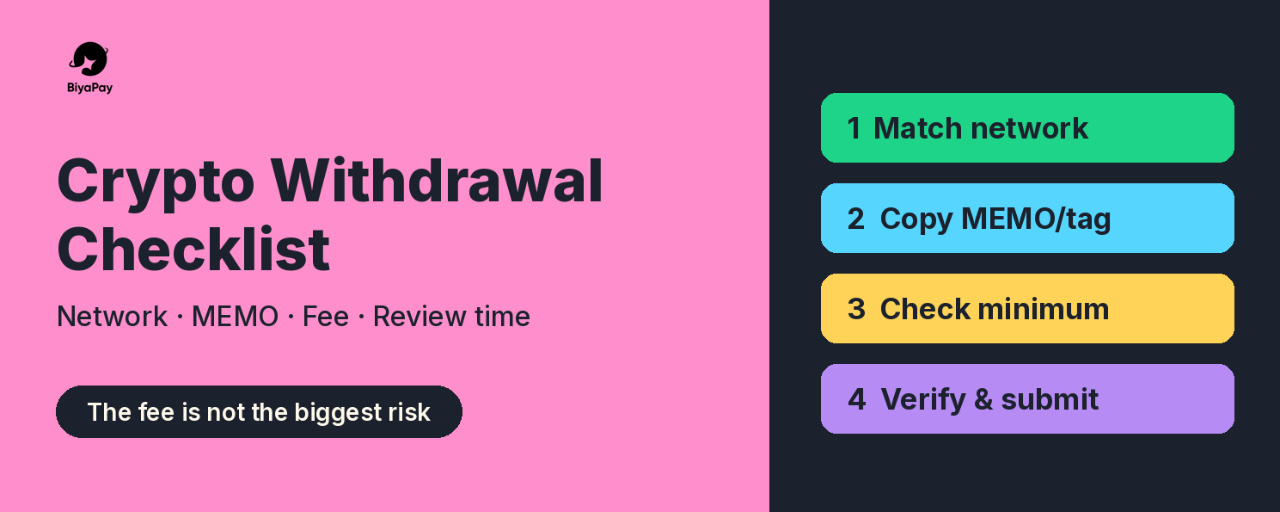
Article
Crypto Withdrawal Checklist on BiyaPay: Networks, MEMO Tags, Fees and Review TimeDisclosure: It is not financial advice
The 1 USDT versus 10 USDT withdrawal fee can look like the whole decision. In my view, it is not.
Official BiyaPay Help Center examples put the on-chain fee for USDT at 1 USDT on TRC20 and 10 USDT on ERC20. That is a 9 USDT gap, and it is easy to treat the cheaper figure as the default. The same Help Center also says that if the network does not match the receiving side, or if a required MEMO or tag is missing, the currency will be lost.
This is not a recommendation to withdraw. It is my reading of those official pages, and of which mistake actually costs more once you run the numbers.
The fee gap is real. The loss from a mismatch is larger.
Take the official examples first, and treat them as examples, because the Help Center notes that on-chain fees can change with network congestion.
On a 50 USDT withdrawal, a 1 USDT TRC20 fee is 2 percent of the amount. A 10 USDT ERC20 fee is 20 percent.
On 100 USDT, the same fees are 1 percent and 10 percent. On 1,000 USDT, they are 0.1 percent and 1 percent.
The 9 USDT difference does not grow with the size of the transfer, in these examples. The percentage shrinks as the amount gets larger, which makes the fee look cheaper, but a smaller percentage does not make the network choice safer.
If the receiving wallet or exchange only accepts USDT on ERC20, and the withdrawal is sent on TRC20 to "save" 9 USDT, the Help Center's wording is not that you pay a higher fee. It is that the currency will be lost. On a 1,000 USDT withdrawal, that is the entire 1,000, not the 9 you were trying to keep.
That is why, in my view, the most expensive withdrawal mistake is not paying the higher network fee. It is treating the cheaper network as a default before checking what the receiving side actually supports.
When paying the higher fee is the right call, and when it is not
If the receiving side supports both TRC20 and ERC20, I would pick the cheaper network it officially lists, after opening its deposit page and reading the network it shows. In the Help Center examples, that would be TRC20 at 1 USDT rather than ERC20 at 10 USDT.
If it only lists ERC20, I would pay the 10 USDT example fee, or I would not send, rather than choose TRC20 because it is cheaper. The 9 USDT "saving" is not a saving if the funds do not arrive.
The order matters. I would let the receiving side tell me the network first, for example TRC20 or ERC20, and only then choose the exact same network on BiyaPay's On-chain Withdrawal page. The Help Center's own example is USDT-TRC20 on both sides, and it says the two networks must be consistent.
A MEMO is not a fee problem. It is the same kind of total-loss problem.
The Help Center gives XRP and EOS as examples of coins that need more than an address. A label (MEMO) is shown above the withdrawal address, usually a string of numbers, and you must fill in both the address and the label, otherwise the currency will be lost.
There is no 1 USDT or 10 USDT figure attached to a missing MEMO. The official cost is the whole transfer. I would copy the MEMO, tag, or similar field at the same time as the address and treat both as one unit. If the receiving side shows a MEMO and I do not have it, I would not submit.
A cheaper route exists, but only for a different destination.
The Help Center lists three withdrawal methods: on-chain withdrawal, for sending cryptocurrency to an external wallet or exchange; fiat remittance, for sending fiat currency out to a bank account; and email account transfer, for moving funds to another BiyaPay account using its registered email.
If the person I am paying also uses BiyaPay and the transfer is fiat, an email account transfer may make more sense than going on-chain. The Help Center states there is no handling fee for transferring fiat currency between BiyaPay wallets through a registered email. Next to a 1 USDT or 10 USDT on-chain fee, that is a different cost entirely. It only applies to that route, and only to fiat between BiyaPay wallets. It is not a reason to skip the network check on an on-chain withdrawal to an outside wallet.
I would also check the minimum withdrawal amount on the day itself, on the On-chain Withdrawal page. Minimums differ by currency and by protocol, and they can change with the coin price or network congestion. A small withdrawal and a large one are not the same decision: 10 USDT is 20 percent of 50 USDT, and only 1 percent of 1,000 USDT. I would look at that percentage and at the live minimum together, and I would not assume the 1 USDT TRC20 example applies to a destination that does not support TRC20.
A second withdrawal, sent too early, can double the cost.
The official web flow asks you to check the address and amount again before Submit, then enter an email verification code or a Biya verification code. I would treat that code step as a last checkpoint, not a formality. If the network, the MEMO, or the amount feels off, that is the time to stop.
The Help Center says a crypto withdrawal goes through a review that takes from a few minutes to half an hour, and the arrival time after approval depends on the protocol and network congestion. If a withdrawal is pending for more than 30 minutes, it says you should contact support.
In my view, a withdrawal that has been pending for ten minutes is not a reason to submit a second one. On a 100 USDT send, a duplicate would not be a 1 USDT or 10 USDT question. It would be another 100 USDT, plus another fee, sitting in a window the Help Center describes as normal. Past 30 minutes, I would contact support through the official channels on the BiyaPay site, and I would not send a duplicate in the meantime.
Support for a coin or network can change, so I would treat the app screen on the day as the source of truth. BiyaPay says it supports withdrawal of over 200 cryptocurrencies including USDT, subject to what the app displays or what customer service announces.
What I would actually do
My takeaway is simple. I would rather pay the higher official fee on a network the receiver supports than try to keep 9 USDT on a network it does not. The fee in the Help Center examples is visible and bounded: 1 USDT or 10 USDT, subject to change with congestion. A mismatch or a missing MEMO is described as a loss of the currency itself.
A short list I would keep in front of me:
Decide the route first: on-chain, fiat remittance, or email transfer. Fiat between BiyaPay wallets via registered email has no handling fee.Let the receiving side tell you the network, then match it exactly. Only compare fees among networks that side supports.Copy any MEMO or tag together with the address. No MEMO, no submit.Check the current minimum and the live fee on the On-chain Withdrawal page, and look at the fee as a percentage of this amount, not only as a flat number.Re-check address and amount, then complete the verification code step.Expect review of a few minutes up to about 30 minutes. Contact support if it goes longer, and do not submit a second withdrawal while the first is still inside that window.
None of this is a recommendation to withdraw. Official fees, minimums, and supported networks can change. I would re-read the Help Center and the withdrawal page in the app before sending.
Source: BiyaPay Help Center, Withdrawal and Wallet sections, checked on November 9, 2026.
#BiyaPay #CryptoWithdrawal #USDT #CryptoSafety
Crypto Withdrawal Checklist on BiyaPay: Networks, MEMO Tags, Fees and Review Time
Disclosure: It is not financial advice
The 1 USDT versus 10 USDT withdrawal fee can look like the whole decision. In my view, it is not.
Official BiyaPay Help Center examples put the on-chain fee for USDT at 1 USDT on TRC20 and 10 USDT on ERC20. That is a 9 USDT gap, and it is easy to treat the cheaper figure as the default. The same Help Center also says that if the network does not match the receiving side, or if a required MEMO or tag is missing, the currency will be lost.
This is not a recommendation to withdraw. It is my reading of those official pages, and of which mistake actually costs more once you run the numbers.
The fee gap is real. The loss from a mismatch is larger.
Take the official examples first, and treat them as examples, because the Help Center notes that on-chain fees can change with network congestion.
On a 50 USDT withdrawal, a 1 USDT TRC20 fee is 2 percent of the amount. A 10 USDT ERC20 fee is 20 percent.
On 100 USDT, the same fees are 1 percent and 10 percent. On 1,000 USDT, they are 0.1 percent and 1 percent.
The 9 USDT difference does not grow with the size of the transfer, in these examples. The percentage shrinks as the amount gets larger, which makes the fee look cheaper, but a smaller percentage does not make the network choice safer.
If the receiving wallet or exchange only accepts USDT on ERC20, and the withdrawal is sent on TRC20 to "save" 9 USDT, the Help Center's wording is not that you pay a higher fee. It is that the currency will be lost. On a 1,000 USDT withdrawal, that is the entire 1,000, not the 9 you were trying to keep.
That is why, in my view, the most expensive withdrawal mistake is not paying the higher network fee. It is treating the cheaper network as a default before checking what the receiving side actually supports.
When paying the higher fee is the right call, and when it is not
If the receiving side supports both TRC20 and ERC20, I would pick the cheaper network it officially lists, after opening its deposit page and reading the network it shows. In the Help Center examples, that would be TRC20 at 1 USDT rather than ERC20 at 10 USDT.
If it only lists ERC20, I would pay the 10 USDT example fee, or I would not send, rather than choose TRC20 because it is cheaper. The 9 USDT "saving" is not a saving if the funds do not arrive.
The order matters. I would let the receiving side tell me the network first, for example TRC20 or ERC20, and only then choose the exact same network on BiyaPay's On-chain Withdrawal page. The Help Center's own example is USDT-TRC20 on both sides, and it says the two networks must be consistent.
A MEMO is not a fee problem. It is the same kind of total-loss problem.
The Help Center gives XRP and EOS as examples of coins that need more than an address. A label (MEMO) is shown above the withdrawal address, usually a string of numbers, and you must fill in both the address and the label, otherwise the currency will be lost.
There is no 1 USDT or 10 USDT figure attached to a missing MEMO. The official cost is the whole transfer. I would copy the MEMO, tag, or similar field at the same time as the address and treat both as one unit. If the receiving side shows a MEMO and I do not have it, I would not submit.
A cheaper route exists, but only for a different destination.
The Help Center lists three withdrawal methods: on-chain withdrawal, for sending cryptocurrency to an external wallet or exchange; fiat remittance, for sending fiat currency out to a bank account; and email account transfer, for moving funds to another BiyaPay account using its registered email.
If the person I am paying also uses BiyaPay and the transfer is fiat, an email account transfer may make more sense than going on-chain. The Help Center states there is no handling fee for transferring fiat currency between BiyaPay wallets through a registered email. Next to a 1 USDT or 10 USDT on-chain fee, that is a different cost entirely. It only applies to that route, and only to fiat between BiyaPay wallets. It is not a reason to skip the network check on an on-chain withdrawal to an outside wallet.
I would also check the minimum withdrawal amount on the day itself, on the On-chain Withdrawal page. Minimums differ by currency and by protocol, and they can change with the coin price or network congestion. A small withdrawal and a large one are not the same decision: 10 USDT is 20 percent of 50 USDT, and only 1 percent of 1,000 USDT. I would look at that percentage and at the live minimum together, and I would not assume the 1 USDT TRC20 example applies to a destination that does not support TRC20.
A second withdrawal, sent too early, can double the cost.
The official web flow asks you to check the address and amount again before Submit, then enter an email verification code or a Biya verification code. I would treat that code step as a last checkpoint, not a formality. If the network, the MEMO, or the amount feels off, that is the time to stop.
The Help Center says a crypto withdrawal goes through a review that takes from a few minutes to half an hour, and the arrival time after approval depends on the protocol and network congestion. If a withdrawal is pending for more than 30 minutes, it says you should contact support.
In my view, a withdrawal that has been pending for ten minutes is not a reason to submit a second one. On a 100 USDT send, a duplicate would not be a 1 USDT or 10 USDT question. It would be another 100 USDT, plus another fee, sitting in a window the Help Center describes as normal. Past 30 minutes, I would contact support through the official channels on the BiyaPay site, and I would not send a duplicate in the meantime.
Support for a coin or network can change, so I would treat the app screen on the day as the source of truth. BiyaPay says it supports withdrawal of over 200 cryptocurrencies including USDT, subject to what the app displays or what customer service announces.
What I would actually do
My takeaway is simple. I would rather pay the higher official fee on a network the receiver supports than try to keep 9 USDT on a network it does not. The fee in the Help Center examples is visible and bounded: 1 USDT or 10 USDT, subject to change with congestion. A mismatch or a missing MEMO is described as a loss of the currency itself.
A short list I would keep in front of me:
Decide the route first: on-chain, fiat remittance, or email transfer. Fiat between BiyaPay wallets via registered email has no handling fee.Let the receiving side tell you the network, then match it exactly. Only compare fees among networks that side supports.Copy any MEMO or tag together with the address. No MEMO, no submit.Check the current minimum and the live fee on the On-chain Withdrawal page, and look at the fee as a percentage of this amount, not only as a flat number.Re-check address and amount, then complete the verification code step.Expect review of a few minutes up to about 30 minutes. Contact support if it goes longer, and do not submit a second withdrawal while the first is still inside that window.
None of this is a recommendation to withdraw. Official fees, minimums, and supported networks can change. I would re-read the Help Center and the withdrawal page in the app before sending.
Source: BiyaPay Help Center, Withdrawal and Wallet sections, checked on November 9, 2026.
#BiyaPay #CryptoWithdrawal #USDT #CryptoSafety
354
·
--
Article
Before You Paste a USDT Address: My Network Checklist for BiyaPay DepositsDisclosure: It is not financial advice
The question everyone asks first
"Which network is cheapest for USDT?" In Indonesian crypto chats the answer is almost automatic: TRC20, because Ethereum is expensive.
I wanted to know if that answer still holds, so I looked at what a single USDT transfer actually cost on-chain in October and November 2026. The result surprised me, and it changed what I worry about before a deposit. The fee turned out to be the small problem. The network mismatch is the big one.
What one transfer actually cost this autumn
On TRON, a USDT transfer is a smart contract call, so it burns Energy. Energy has no free daily quota. You either stake TRX for it, rent it, or the network burns TRX from your balance at 100 sun per Energy.
An on-chain check by OrcaRail on 14 November 2026 put the cost at:
64,285 Energy (6.43 TRX, about $2.01) when the receiving address already holds USDT130,285 Energy (13.03 TRX, about $4.08) when the address has never held USDT
On Ethereum, the same check measured a USDT transfer at 64,031 gas to a new holder. At that day's base fee of 0.059 gwei, that is about 0.0000038 ETH, or under one US cent at ETH near $1,905.
A separate sample by TRXMAN on 27 October 2026 points the same way: a median of about $0.017 for 250 ERC20 USDT transfers, against a median of 6.77 TRX (about $2.22) for TRC20 transfers that had to burn TRX. TRC20 only becomes nearly free when the sender already has staked or rented Energy.
Here is what that means as a share of the amount, if you send from your own wallet without staked Energy:
20 USDT: TRC20 to a new address costs about 20.4%. ERC20 costs about 0.04%.100 USDT: TRC20 to a new address about 4.1%, to an existing holder about 2.0%. ERC20 under 0.01%.1,000 USDT: TRC20 about 0.41% or 0.20%. ERC20 is still a rounding error.
Two things follow. TRC20 is a flat fee in TRX, so it hurts small transfers most. And Ethereum's gas price moves with demand, so this snapshot can flip on a busy day. The fee is real, but it is measured in cents to a few dollars.
If you send from an exchange instead of your own wallet, the exchange charges its own flat withdrawal fee per network, and that number replaces the on-chain math above. Either way, the fee is something you can see before you press send.
Where deposits really go missing
The expensive mistake is choosing a different network on each side. Same token name, USDT, different blockchain. When the sending network and the receiving network do not match, the coins can be lost. That is a 100% loss, not a 4% fee.
Address formats explain why some mix-ups get caught and others do not. A TRON address starts with T and has 34 characters. An Ethereum address starts with 0x and has 42. Paste a TRON address into an Ethereum withdrawal field and the format check usually rejects it.
The dangerous case is between networks that share the 0x format. Several EVM chains use exactly the same address shape, so a withdrawal on the wrong one can look completely valid and go through. The wallet accepts it. The deposit never shows up where you expect it.
Memo coins are the second trap. For coins like XRP and EOS, the deposit needs both the address and a tag (MEMO), usually a string of numbers shown above the address. Skip the tag and the coins can be lost, even with a perfect address.
How I deposit USDT on BiyaPay
On BiyaPay, the deposit itself costs nothing. Crypto deposits are free on the receiving side; any fee comes from the sending wallet or exchange and the blockchain.
The path in the app is Deposit, then On-chain Deposit (Cryptocurrency), then pick USDT and the network, for example USDT-TRC20, and copy the address. On the web it starts from My Assets, then Funds, then Deposit, with the same network step.
The minimum depends on the network. USDT on TRC20 has a minimum of 1 USDT, and USDT on ERC20 has a minimum of 10 USDT. That matters for test transfers: a 5 USDT test on ERC20 sits below the minimum.
Each network also has its own confirmation requirement, shown on the network selection page. TRON blocks come about every 3 seconds, so TRC20 deposits usually confirm within minutes. Ethereum depends on congestion and the gas paid.
The deposit record icon in the upper right corner of the address page shows every deposit and its status. If a deposit is late, the transaction hash on a block explorer tells you whether it confirmed on-chain. If it confirmed and the balance has not updated, BiyaPay support needs the transaction hash, registered email, currency, deposit network, deposit address, transaction time, and a screenshot. Having those ready saves a lot of back and forth.
My checklist, in the order I use it
Pick the network on BiyaPay first, then select the exact same network on the sending side. Never the other way around.Read the first characters of the address: T for TRON, 0x for Ethereum. If it is 0x, double-check the chain name, not just the format.For memo coins, fill in both the address and the tag.Compare the total cost: the sender's withdrawal fee, or the on-chain cost from your own wallet. For small amounts from a wallet without staked Energy, ERC20 was the cheaper chain in this autumn's data.Stay above the network minimum: 1 USDT on TRC20, 10 USDT on ERC20.For a new route, send a small amount above the minimum first, then the rest.Keep the transaction hash until the balance shows up.
My take
The "TRC20 is always cheaper" rule is out of date for small transfers from a self-custody wallet. The October and November 2026 numbers show ERC20 costing a fraction of a cent while a TRC20 transfer burned $2 to $4 of TRX.
But I would not choose a network on fee alone. A few dollars of fee is a cost I can see in advance. A network mismatch is a full loss I cannot undo. So my order is fixed: match the network first, check the format and the memo, and only then compare fees.
Source: OrcaRail, "USDT TRC20 Fee vs ERC20 and Solana" (on-chain check, 14 Nov 2026); TRXMAN, "TRC20 vs ERC20: USDT fees measured on-chain" (updated 27 Oct 2026); TRON Developer Hub, "Bandwidth and Energy". Checked 21 Nov 2026.
#BiyaPay #USDT #CryptoDeposit #TRC20 #ERC20
Before You Paste a USDT Address: My Network Checklist for BiyaPay Deposits
Disclosure: It is not financial advice
The question everyone asks first
"Which network is cheapest for USDT?" In Indonesian crypto chats the answer is almost automatic: TRC20, because Ethereum is expensive.
I wanted to know if that answer still holds, so I looked at what a single USDT transfer actually cost on-chain in October and November 2026. The result surprised me, and it changed what I worry about before a deposit. The fee turned out to be the small problem. The network mismatch is the big one.
What one transfer actually cost this autumn
On TRON, a USDT transfer is a smart contract call, so it burns Energy. Energy has no free daily quota. You either stake TRX for it, rent it, or the network burns TRX from your balance at 100 sun per Energy.
An on-chain check by OrcaRail on 14 November 2026 put the cost at:
64,285 Energy (6.43 TRX, about $2.01) when the receiving address already holds USDT130,285 Energy (13.03 TRX, about $4.08) when the address has never held USDT
On Ethereum, the same check measured a USDT transfer at 64,031 gas to a new holder. At that day's base fee of 0.059 gwei, that is about 0.0000038 ETH, or under one US cent at ETH near $1,905.
A separate sample by TRXMAN on 27 October 2026 points the same way: a median of about $0.017 for 250 ERC20 USDT transfers, against a median of 6.77 TRX (about $2.22) for TRC20 transfers that had to burn TRX. TRC20 only becomes nearly free when the sender already has staked or rented Energy.
Here is what that means as a share of the amount, if you send from your own wallet without staked Energy:
20 USDT: TRC20 to a new address costs about 20.4%. ERC20 costs about 0.04%.100 USDT: TRC20 to a new address about 4.1%, to an existing holder about 2.0%. ERC20 under 0.01%.1,000 USDT: TRC20 about 0.41% or 0.20%. ERC20 is still a rounding error.
Two things follow. TRC20 is a flat fee in TRX, so it hurts small transfers most. And Ethereum's gas price moves with demand, so this snapshot can flip on a busy day. The fee is real, but it is measured in cents to a few dollars.
If you send from an exchange instead of your own wallet, the exchange charges its own flat withdrawal fee per network, and that number replaces the on-chain math above. Either way, the fee is something you can see before you press send.
Where deposits really go missing
The expensive mistake is choosing a different network on each side. Same token name, USDT, different blockchain. When the sending network and the receiving network do not match, the coins can be lost. That is a 100% loss, not a 4% fee.
Address formats explain why some mix-ups get caught and others do not. A TRON address starts with T and has 34 characters. An Ethereum address starts with 0x and has 42. Paste a TRON address into an Ethereum withdrawal field and the format check usually rejects it.
The dangerous case is between networks that share the 0x format. Several EVM chains use exactly the same address shape, so a withdrawal on the wrong one can look completely valid and go through. The wallet accepts it. The deposit never shows up where you expect it.
Memo coins are the second trap. For coins like XRP and EOS, the deposit needs both the address and a tag (MEMO), usually a string of numbers shown above the address. Skip the tag and the coins can be lost, even with a perfect address.
How I deposit USDT on BiyaPay
On BiyaPay, the deposit itself costs nothing. Crypto deposits are free on the receiving side; any fee comes from the sending wallet or exchange and the blockchain.
The path in the app is Deposit, then On-chain Deposit (Cryptocurrency), then pick USDT and the network, for example USDT-TRC20, and copy the address. On the web it starts from My Assets, then Funds, then Deposit, with the same network step.
The minimum depends on the network. USDT on TRC20 has a minimum of 1 USDT, and USDT on ERC20 has a minimum of 10 USDT. That matters for test transfers: a 5 USDT test on ERC20 sits below the minimum.
Each network also has its own confirmation requirement, shown on the network selection page. TRON blocks come about every 3 seconds, so TRC20 deposits usually confirm within minutes. Ethereum depends on congestion and the gas paid.
The deposit record icon in the upper right corner of the address page shows every deposit and its status. If a deposit is late, the transaction hash on a block explorer tells you whether it confirmed on-chain. If it confirmed and the balance has not updated, BiyaPay support needs the transaction hash, registered email, currency, deposit network, deposit address, transaction time, and a screenshot. Having those ready saves a lot of back and forth.
My checklist, in the order I use it
Pick the network on BiyaPay first, then select the exact same network on the sending side. Never the other way around.Read the first characters of the address: T for TRON, 0x for Ethereum. If it is 0x, double-check the chain name, not just the format.For memo coins, fill in both the address and the tag.Compare the total cost: the sender's withdrawal fee, or the on-chain cost from your own wallet. For small amounts from a wallet without staked Energy, ERC20 was the cheaper chain in this autumn's data.Stay above the network minimum: 1 USDT on TRC20, 10 USDT on ERC20.For a new route, send a small amount above the minimum first, then the rest.Keep the transaction hash until the balance shows up.
My take
The "TRC20 is always cheaper" rule is out of date for small transfers from a self-custody wallet. The October and November 2026 numbers show ERC20 costing a fraction of a cent while a TRC20 transfer burned $2 to $4 of TRX.
But I would not choose a network on fee alone. A few dollars of fee is a cost I can see in advance. A network mismatch is a full loss I cannot undo. So my order is fixed: match the network first, check the format and the memo, and only then compare fees.
Source: OrcaRail, "USDT TRC20 Fee vs ERC20 and Solana" (on-chain check, 14 Nov 2026); TRXMAN, "TRC20 vs ERC20: USDT fees measured on-chain" (updated 27 Oct 2026); TRON Developer Hub, "Bandwidth and Energy". Checked 21 Nov 2026.
#BiyaPay #USDT #CryptoDeposit #TRC20 #ERC20
132
·
--
Article
Hong Kong Stocks From a WIB Timezone: Hours, Lots and Limits I Would Read FirstDisclosure: It is not financial advice
What can Rp10 juta actually buy in Hong Kong?
For anyone in WIB, Hong Kong has the friendliest clock of the big stock markets. HKT is exactly one hour ahead all year, so the market runs 08:30–11:00 and 12:00–15:00 WIB, during our working day instead of at midnight.
That convenience makes it tempting to treat HK like US stocks with better hours. Open the app, pick a famous name, buy one share. That last step is where the plan breaks. In Hong Kong you do not buy one share. You buy one board lot.
So I asked a simple question: with Rp10 juta, which well-known Hong Kong stocks can I buy at all? I took the closing prices of 20 November 2026, the board lot sizes from the HKEX List of Securities, and converted everything at the JISDOR rate of Rp18.278 per US dollar and USD/HKD 7.8389. That puts one Hong Kong dollar at about Rp2.332, and Rp10 juta at about HKD 4,289.
The board lot is the real minimum
Here is what the smallest possible order cost for ten names that come up in every HK conversation:
Xiaomi (1810): HKD 27.64 × 200 shares = HKD 5,528, about Rp12,9 jutaMeituan (3690): HKD 66.50 × 100 = HKD 6,650, about Rp15,5 jutaAlibaba (9988): HKD 83.35 × 100 = HKD 8,335, about Rp19,4 jutaCCB (0939): HKD 10.48 × 1,000 = HKD 10,480, about Rp24,4 jutaTracker Fund of Hong Kong (2800): HKD 22.54 × 500 = HKD 11,270, about Rp26,3 jutaAIA (1299): HKD 74.20 × 200 = HKD 14,840, about Rp34,6 jutaPing An (2318): HKD 49.70 × 500 = HKD 24,850, about Rp57,9 jutaTencent (0700): HKD 344 × 100 = HKD 34,400, about Rp80,2 jutaHKEX (0388): HKD 357 × 100 = HKD 35,700, about Rp83,2 jutaHSBC (0005): HKD 129.20 × 400 = HKD 51,680, about Rp120,5 juta
The answer to my question: none of them. Rp10 juta does not cover a single lot of any of these ten. The cheapest entry ticket, Xiaomi, needs almost Rp13 juta, and HSBC needs more than Rp120 juta.
A cheap share is not a cheap ticket
The list has a trap in it. CCB is by far the cheapest share at HKD 10.48, eight times cheaper than Alibaba. But CCB trades in lots of 1,000, so one lot costs HKD 10,480. Alibaba trades in lots of 100, so one lot costs HKD 8,335. The "cheap" stock needs the bigger budget.
The lot also sets how finely you can size a position. With Tencent, every step up or down is HKD 34,400, around Rp80 juta. You cannot trim a quarter of a position if you only hold one lot. For a small portfolio, that lack of granularity matters as much as the entry price.
What the fees take from one lot
On BiyaPay, a Hong Kong stock order carries a commission of 0.03% with a minimum of HKD 7, and a platform fee of 0.03% with a minimum of HKD 8. On top of that come the market's own charges: stamp duty of 0.1% rounded up to the next dollar, plus small exchange, settlement, SFC and AFRC levies. ETFs on the HKEX list, such as the Tracker Fund, are not subject to stamp duty.
The two minimums decide everything at one-lot size. They only stop applying above roughly HKD 27,000 per order. Below that, a smaller lot pays a bigger percentage. Applied to one lot at the 20 November close:
Xiaomi, HKD 5,528: about HKD 21.70 to buy, 0.39%. Buy and sell at the same price: 0.79%.Meituan, HKD 6,650: about HKD 22.84, 0.34%. Round trip 0.69%.Alibaba, HKD 8,335: about HKD 25.06, 0.30%. Round trip 0.60%.Tracker Fund, HKD 11,270: about HKD 16.43, 0.15%. Round trip 0.29%, helped by the stamp duty exemption.Tencent, HKD 34,400: about HKD 60.01, 0.17%. Round trip 0.35%.HSBC, HKD 51,680: about HKD 89.57, 0.17%. Round trip 0.35%.
So the smallest lot costs more than twice as much in percentage terms as Tencent or HSBC. A Xiaomi lot has to rise about 0.8% just to cover the fees of getting in and out.
No daily limit, in real numbers
Hong Kong has no daily price limit. Tencent closed at HKD 372.80 on 18 November and HKD 348.40 on 19 November, a drop of 6.5% in one session. On one lot, that is HKD 2,440, about Rp5,7 juta, in a single day.
With US stocks you can soften that by buying a fraction or a few shares. In Hong Kong the lot fixes the minimum exposure, so the minimum daily swing in rupiah is fixed too. I think of the lot size as a risk number, not just a price number.
Hong Kong on BiyaPay: what you can do
Trade all Hong Kong stocks, including ETFs, in whole lots. One lot is the minimum order.Buy and sell on the same day, since HK trading on BiyaPay is T+0.Use margin and short selling on HK stocks. Warrants and callable bull/bear contracts (CBBCs) are not available.Fund the account with USDT or fiat and convert to HKD inside the app. Currency exchange runs 24 hours with no commission, at a live rate.Withdraw the funds after closing HK positions. With USDT, the money can arrive within minutes.
My routine before a first HK order:
Look up the lot size, then multiply by the price and convert to rupiah. That is the real minimum.Check whether the order is above or below about HKD 27,000, where the HKD 7 and HKD 8 minimums stop dominating.Add the stamp duty on both sides, unless it is an ETF.Ask how much one bad day on one lot would cost me in rupiah. If that number is uncomfortable, the position is too big, even at one lot.Keep margin and short selling out of a first order. One lot without a daily limit is enough risk to learn on.
My take
The hours are the easy part of Hong Kong for us in WIB. The lot is the hard part. It decides whether you can enter at all, how much the fees take, and how big your smallest possible daily loss is.
For a budget around Rp10–15 juta, I think the honest answer is that most famous HK names are out of reach at one lot, and the few that fit pay the highest fee percentage. In that range, I would rather wait and buy one full lot of something I understand than stretch for a stock because its share price looks cheap. And when the goal is broad exposure, an ETF lot like the Tracker Fund gives a whole index for about Rp26 juta, without stamp duty.
Source: HKEX List of Securities (board lots and stamp duty status, downloaded 21 Nov 2026); Yahoo Finance daily closes for 0700, 0005, 1810, 9988, 2800, 0939, 1299, 3690, 2318 and 0388 (18–20 Nov 2026); Bank Indonesia JISDOR, 20 Nov 2026 (Rp18.278/USD); Yahoo Finance USD/HKD, 20 Nov 2026 (7.8389).
#BiyaPay #HKStocks #HongKong #BoardLot #StockMarket
Hong Kong Stocks From a WIB Timezone: Hours, Lots and Limits I Would Read First
Disclosure: It is not financial advice
What can Rp10 juta actually buy in Hong Kong?
For anyone in WIB, Hong Kong has the friendliest clock of the big stock markets. HKT is exactly one hour ahead all year, so the market runs 08:30–11:00 and 12:00–15:00 WIB, during our working day instead of at midnight.
That convenience makes it tempting to treat HK like US stocks with better hours. Open the app, pick a famous name, buy one share. That last step is where the plan breaks. In Hong Kong you do not buy one share. You buy one board lot.
So I asked a simple question: with Rp10 juta, which well-known Hong Kong stocks can I buy at all? I took the closing prices of 20 November 2026, the board lot sizes from the HKEX List of Securities, and converted everything at the JISDOR rate of Rp18.278 per US dollar and USD/HKD 7.8389. That puts one Hong Kong dollar at about Rp2.332, and Rp10 juta at about HKD 4,289.
The board lot is the real minimum
Here is what the smallest possible order cost for ten names that come up in every HK conversation:
Xiaomi (1810): HKD 27.64 × 200 shares = HKD 5,528, about Rp12,9 jutaMeituan (3690): HKD 66.50 × 100 = HKD 6,650, about Rp15,5 jutaAlibaba (9988): HKD 83.35 × 100 = HKD 8,335, about Rp19,4 jutaCCB (0939): HKD 10.48 × 1,000 = HKD 10,480, about Rp24,4 jutaTracker Fund of Hong Kong (2800): HKD 22.54 × 500 = HKD 11,270, about Rp26,3 jutaAIA (1299): HKD 74.20 × 200 = HKD 14,840, about Rp34,6 jutaPing An (2318): HKD 49.70 × 500 = HKD 24,850, about Rp57,9 jutaTencent (0700): HKD 344 × 100 = HKD 34,400, about Rp80,2 jutaHKEX (0388): HKD 357 × 100 = HKD 35,700, about Rp83,2 jutaHSBC (0005): HKD 129.20 × 400 = HKD 51,680, about Rp120,5 juta
The answer to my question: none of them. Rp10 juta does not cover a single lot of any of these ten. The cheapest entry ticket, Xiaomi, needs almost Rp13 juta, and HSBC needs more than Rp120 juta.
A cheap share is not a cheap ticket
The list has a trap in it. CCB is by far the cheapest share at HKD 10.48, eight times cheaper than Alibaba. But CCB trades in lots of 1,000, so one lot costs HKD 10,480. Alibaba trades in lots of 100, so one lot costs HKD 8,335. The "cheap" stock needs the bigger budget.
The lot also sets how finely you can size a position. With Tencent, every step up or down is HKD 34,400, around Rp80 juta. You cannot trim a quarter of a position if you only hold one lot. For a small portfolio, that lack of granularity matters as much as the entry price.
What the fees take from one lot
On BiyaPay, a Hong Kong stock order carries a commission of 0.03% with a minimum of HKD 7, and a platform fee of 0.03% with a minimum of HKD 8. On top of that come the market's own charges: stamp duty of 0.1% rounded up to the next dollar, plus small exchange, settlement, SFC and AFRC levies. ETFs on the HKEX list, such as the Tracker Fund, are not subject to stamp duty.
The two minimums decide everything at one-lot size. They only stop applying above roughly HKD 27,000 per order. Below that, a smaller lot pays a bigger percentage. Applied to one lot at the 20 November close:
Xiaomi, HKD 5,528: about HKD 21.70 to buy, 0.39%. Buy and sell at the same price: 0.79%.Meituan, HKD 6,650: about HKD 22.84, 0.34%. Round trip 0.69%.Alibaba, HKD 8,335: about HKD 25.06, 0.30%. Round trip 0.60%.Tracker Fund, HKD 11,270: about HKD 16.43, 0.15%. Round trip 0.29%, helped by the stamp duty exemption.Tencent, HKD 34,400: about HKD 60.01, 0.17%. Round trip 0.35%.HSBC, HKD 51,680: about HKD 89.57, 0.17%. Round trip 0.35%.
So the smallest lot costs more than twice as much in percentage terms as Tencent or HSBC. A Xiaomi lot has to rise about 0.8% just to cover the fees of getting in and out.
No daily limit, in real numbers
Hong Kong has no daily price limit. Tencent closed at HKD 372.80 on 18 November and HKD 348.40 on 19 November, a drop of 6.5% in one session. On one lot, that is HKD 2,440, about Rp5,7 juta, in a single day.
With US stocks you can soften that by buying a fraction or a few shares. In Hong Kong the lot fixes the minimum exposure, so the minimum daily swing in rupiah is fixed too. I think of the lot size as a risk number, not just a price number.
Hong Kong on BiyaPay: what you can do
Trade all Hong Kong stocks, including ETFs, in whole lots. One lot is the minimum order.Buy and sell on the same day, since HK trading on BiyaPay is T+0.Use margin and short selling on HK stocks. Warrants and callable bull/bear contracts (CBBCs) are not available.Fund the account with USDT or fiat and convert to HKD inside the app. Currency exchange runs 24 hours with no commission, at a live rate.Withdraw the funds after closing HK positions. With USDT, the money can arrive within minutes.
My routine before a first HK order:
Look up the lot size, then multiply by the price and convert to rupiah. That is the real minimum.Check whether the order is above or below about HKD 27,000, where the HKD 7 and HKD 8 minimums stop dominating.Add the stamp duty on both sides, unless it is an ETF.Ask how much one bad day on one lot would cost me in rupiah. If that number is uncomfortable, the position is too big, even at one lot.Keep margin and short selling out of a first order. One lot without a daily limit is enough risk to learn on.
My take
The hours are the easy part of Hong Kong for us in WIB. The lot is the hard part. It decides whether you can enter at all, how much the fees take, and how big your smallest possible daily loss is.
For a budget around Rp10–15 juta, I think the honest answer is that most famous HK names are out of reach at one lot, and the few that fit pay the highest fee percentage. In that range, I would rather wait and buy one full lot of something I understand than stretch for a stock because its share price looks cheap. And when the goal is broad exposure, an ETF lot like the Tracker Fund gives a whole index for about Rp26 juta, without stamp duty.
Source: HKEX List of Securities (board lots and stamp duty status, downloaded 21 Nov 2026); Yahoo Finance daily closes for 0700, 0005, 1810, 9988, 2800, 0939, 1299, 3690, 2318 and 0388 (18–20 Nov 2026); Bank Indonesia JISDOR, 20 Nov 2026 (Rp18.278/USD); Yahoo Finance USD/HKD, 20 Nov 2026 (7.8389).
#BiyaPay #HKStocks #HongKong #BoardLot #StockMarket
1
156
·
--
Verified
Article
US Markets Just Shifted One Hour: A WIB Checklist for Sessions and Order TypesDisclosure: It is not financial advice
If you follow US stocks from Indonesia, November brings a calendar change worth checking before opening an order ticket. The United States is back on Standard Time. The regular session still opens at 09:30 and closes at 16:00 Eastern Time, but its WIB equivalent moves one hour later than during Daylight Saving Time.
After looking at trading fees, I think the next useful question is about timing: when does each session happen in Indonesia, and what kind of order makes sense for the conditions?
BiyaPay trading hours reminder and US stock Help Center provide a starting point. My focus here is translating those details into a practical WIB checklist, not recommending a stock or promising a particular trading result.
Why the clock feels different in WIB
Eastern Time is UTC-4 during Daylight Saving Time and UTC-5 during Standard Time. WIB stays at UTC+7, so the time difference changes.
During Daylight Saving Time, regular trading maps to 20:30–03:00 WIB. During Standard Time, the same session maps to 21:30–04:00 WIB.
BiyaPay announcement center reminded users that Standard Time began on November 1, 2026. Daylight Saving Time resumes on March 14, 2027. For now, the later WIB schedule is the one to check against.
For Indonesian readers, that affects more than the opening bell. It also changes when pre-market starts and when after-hours ends. An old reminder can be one hour out even though the US exchange has not changed its local opening time.
The three sessions in WIB
BiyaPay Help Center lists support for night, pre-market, intraday, and after-hours trading. The following card covers the three conventional US stock sessions during Standard Time; it is not a complete overnight-session timetable.
Pre-market
Eastern Time: 04:00–09:30WIB: 16:00–21:30Generally thinner liquidity and wider spreads than regular trading
Regular session
Eastern Time: 09:30–16:00WIB: 21:30–04:00 the following dayGenerally the most liquid session
After-hours
Eastern Time: 16:00–20:00WIB: 04:00–08:00 the following dayCan react to earnings announcements, but liquidity can still be thin
These are general market hours, not a guarantee that every security or order type is available in every session on BiyaPay. Before placing anything, I would check the symbol, eligible session, and available order options inside the app.
Holidays and early closes matter too. A schedule card is useful, but it cannot replace checking whether the US market is actually open that day.
Five order types listed by BiyaPay
The US Stock Trading FAQ lists five order types:
Limit OrderMarket OrderTake Profit / Stop LossBidirectional Take Profit / Stop LossTrailing Stop
Here is how I think about the differences.
Limit Order
A limit order sets the maximum price I am willing to pay when buying, or the minimum I am willing to accept when selling. That price control is useful when the spread looks wide. The trade-off is that the order might not fill.
Market Order
A market order prioritizes execution at available prices rather than a specific price. The last traded price is not a promise of the next fill. I would be especially cautious about assuming a market order is suitable outside a liquid regular session, and would first check whether it is supported.
Take Profit / Stop Loss
These orders help define an exit condition. But a trigger price is not necessarily the final execution price. Gaps and fast moves can produce a different result, so a stop should not be mistaken for guaranteed protection.
Bidirectional Take Profit / Stop Loss
This provides a way to define both a profit-taking condition and a loss-control condition. Before relying on it, I would read how the app handles the paired instructions, including their validity and session restrictions.
Trailing Stop
A trailing stop adjusts its trigger as the price moves favorably, according to the selected distance. It can help structure an exit, but it does not remove gap risk or guarantee that a position closes at the displayed stop level.
Why extended hours deserve a separate decision
More trading hours do not automatically mean better trading conditions.
Outside the regular session, fewer buyers and sellers can mean wider spreads and less depth. A quote may look attractive without enough volume available at that price. Earnings news can also move prices sharply while liquidity is limited.
For me, the useful distinction is between access and execution quality. Being able to submit an order is different from getting the result I expected.
My pre-order checklist
Before considering a US stock order from Indonesia, these are the checks I would make:
Confirm Standard Time or Daylight Saving Time. The current regular-session opening is 21:30 WIB.Confirm the trading calendar. Check for holidays, early closes, and any relevant market notices.Confirm the intended session. Check whether that session is available for the selected security in the app.Understand the order instruction. Know whether the priority is price control, execution, or an exit trigger.Read the order preview. Check quantity, buying power, estimated costs, validity, and session settings.Accept the possibility of a different outcome. A limit order might not fill. A stop might execute away from its trigger. A thin market can increase slippage.
Final thoughts
The one hour shift is easy to overlook because the US market's local schedule stays the same. What changes is the translation into our evening in Indonesia.
BiyaPay official reminders and order documentation are useful references, but the final check should still happen in the app before confirming an order.
My takeaway is simple: check the clock, check the session, and understand the order. None of those steps guarantees a good trade, but they help separate a market decision from an avoidable timing mistake.
#BiyaPay #USStocks #TradingHours #OrderTypes #StandardTime
US Markets Just Shifted One Hour: A WIB Checklist for Sessions and Order Types
Disclosure: It is not financial advice
If you follow US stocks from Indonesia, November brings a calendar change worth checking before opening an order ticket. The United States is back on Standard Time. The regular session still opens at 09:30 and closes at 16:00 Eastern Time, but its WIB equivalent moves one hour later than during Daylight Saving Time.
After looking at trading fees, I think the next useful question is about timing: when does each session happen in Indonesia, and what kind of order makes sense for the conditions?
BiyaPay trading hours reminder and US stock Help Center provide a starting point. My focus here is translating those details into a practical WIB checklist, not recommending a stock or promising a particular trading result.
Why the clock feels different in WIB
Eastern Time is UTC-4 during Daylight Saving Time and UTC-5 during Standard Time. WIB stays at UTC+7, so the time difference changes.
During Daylight Saving Time, regular trading maps to 20:30–03:00 WIB. During Standard Time, the same session maps to 21:30–04:00 WIB.
BiyaPay announcement center reminded users that Standard Time began on November 1, 2026. Daylight Saving Time resumes on March 14, 2027. For now, the later WIB schedule is the one to check against.
For Indonesian readers, that affects more than the opening bell. It also changes when pre-market starts and when after-hours ends. An old reminder can be one hour out even though the US exchange has not changed its local opening time.
The three sessions in WIB
BiyaPay Help Center lists support for night, pre-market, intraday, and after-hours trading. The following card covers the three conventional US stock sessions during Standard Time; it is not a complete overnight-session timetable.
Pre-market
Eastern Time: 04:00–09:30WIB: 16:00–21:30Generally thinner liquidity and wider spreads than regular trading
Regular session
Eastern Time: 09:30–16:00WIB: 21:30–04:00 the following dayGenerally the most liquid session
After-hours
Eastern Time: 16:00–20:00WIB: 04:00–08:00 the following dayCan react to earnings announcements, but liquidity can still be thin
These are general market hours, not a guarantee that every security or order type is available in every session on BiyaPay. Before placing anything, I would check the symbol, eligible session, and available order options inside the app.
Holidays and early closes matter too. A schedule card is useful, but it cannot replace checking whether the US market is actually open that day.
Five order types listed by BiyaPay
The US Stock Trading FAQ lists five order types:
Limit OrderMarket OrderTake Profit / Stop LossBidirectional Take Profit / Stop LossTrailing Stop
Here is how I think about the differences.
Limit Order
A limit order sets the maximum price I am willing to pay when buying, or the minimum I am willing to accept when selling. That price control is useful when the spread looks wide. The trade-off is that the order might not fill.
Market Order
A market order prioritizes execution at available prices rather than a specific price. The last traded price is not a promise of the next fill. I would be especially cautious about assuming a market order is suitable outside a liquid regular session, and would first check whether it is supported.
Take Profit / Stop Loss
These orders help define an exit condition. But a trigger price is not necessarily the final execution price. Gaps and fast moves can produce a different result, so a stop should not be mistaken for guaranteed protection.
Bidirectional Take Profit / Stop Loss
This provides a way to define both a profit-taking condition and a loss-control condition. Before relying on it, I would read how the app handles the paired instructions, including their validity and session restrictions.
Trailing Stop
A trailing stop adjusts its trigger as the price moves favorably, according to the selected distance. It can help structure an exit, but it does not remove gap risk or guarantee that a position closes at the displayed stop level.
Why extended hours deserve a separate decision
More trading hours do not automatically mean better trading conditions.
Outside the regular session, fewer buyers and sellers can mean wider spreads and less depth. A quote may look attractive without enough volume available at that price. Earnings news can also move prices sharply while liquidity is limited.
For me, the useful distinction is between access and execution quality. Being able to submit an order is different from getting the result I expected.
My pre-order checklist
Before considering a US stock order from Indonesia, these are the checks I would make:
Confirm Standard Time or Daylight Saving Time. The current regular-session opening is 21:30 WIB.Confirm the trading calendar. Check for holidays, early closes, and any relevant market notices.Confirm the intended session. Check whether that session is available for the selected security in the app.Understand the order instruction. Know whether the priority is price control, execution, or an exit trigger.Read the order preview. Check quantity, buying power, estimated costs, validity, and session settings.Accept the possibility of a different outcome. A limit order might not fill. A stop might execute away from its trigger. A thin market can increase slippage.
Final thoughts
The one hour shift is easy to overlook because the US market's local schedule stays the same. What changes is the translation into our evening in Indonesia.
BiyaPay official reminders and order documentation are useful references, but the final check should still happen in the app before confirming an order.
My takeaway is simple: check the clock, check the session, and understand the order. None of those steps guarantees a good trade, but they help separate a market decision from an avoidable timing mistake.
#BiyaPay #USStocks #TradingHours #OrderTypes #StandardTime
1
155
·
--
Verified
Article
"$0 Commission" Isn't $0: What I Actually Pay on a US Stock TradeDisclosure: It is not financial advice
A few days ago I wrote about moving part of my USDT into US stocks without converting through Rupiah first. After that post, a friend asked me a simple question: "If commission is $0, what are you actually paying?"
I realized I didn't have a precise answer. I had seen the "$0 commission" label and stopped reading there. So this time I opened the fee page, went line by line, and did the math on a few realistic orders. This is what I found.
Why "$0 commission" is only part of the story
In US markets, commission is just one layer of cost. A stock order can also include a platform fee charged by the app, plus small regulatory and clearing fees that get passed through. None of these are hidden on purpose, but most of us never read past the headline number.
As an Indonesian user, I also care about this because my orders are usually small. A fixed minimum fee hurts a $200 order much more than a $20,000 order.
The fee table, line by line
On BiyaPay's Cost Center, under Stock → US Stocks, the fee table currently lists:
Commission: $0 (every order)
Platform fee: $0.005 per share, min $0.99 per order, max 1% of trade value (every order)
SEC fee: 0.0000206 × trade value, min $0.01 (sell orders only)
Trading Activity Fee (TAF): $0.000195 per share, min $0.01, max $9.79 per execution (sell orders only)
CAT fee: $0.000003 per share (every order)
Settlement fee: $0.003 per share, capped at 7% of trade value (every order)
So the honest summary is: commission is $0, but the platform fee and settlement fee are the two items that actually matter for most trades. SEC, TAF, and CAT are tiny, and SEC and TAF only show up when you sell.
Running the numbers on real-looking orders
I used three example orders. These are my own estimates using the table above, rounded, and actual charges can differ slightly.
Example 1: Buy 10 shares at $180 (about $1,800)
Platform fee: 10 × $0.005 = $0.05, so the $0.99 minimum appliesSettlement fee: 10 × $0.003 = $0.03CAT fee: basically $0.00Estimated total: around $1.02, or roughly 0.06% of the order
Example 2: Sell the same 10 shares at $180
Platform fee: $0.99 minimumSettlement fee: $0.03SEC fee: $1,800 × 0.0000206 ≈ $0.04TAF: 10 × $0.000195 is below the minimum, so $0.01Estimated total: around $1.07
Example 3: Buy 300 shares at $20 (about $6,000)
Platform fee: 300 × $0.005 = $1.50 (above the minimum)Settlement fee: 300 × $0.003 = $0.90Estimated total: around $2.40, or roughly 0.04%
Two lessons jumped out. First, the $0.99 minimum is what you pay on most small orders. Second, because the platform and settlement fees are per share, buying many cheap shares costs more in fees than buying a few expensive shares of the same total value.
The fractional share rule
This was the part I didn't expect. According to the notes on the same page, for fractional orders of less than 1 whole share, BiyaPay charges a 1% platform fee on the transaction value, capped at $1, with no commission or third-party fees. For fractional orders above 1 whole share, the standard table applies.
What that means in practice:
A $30 fractional buy costs about $0.30A $100 fractional buy hits the $1 cap
For someone testing with small amounts, that is easier to understand than the per-share table. But at around $100 and up, the cost is close to the $0.99 minimum anyway, so it doesn't save much.
My personal checklist before placing an order
After doing this exercise, this is what I now check:
Order size vs. the $0.99 minimum. If my order is very small, the minimum is a big percentage. I'd rather make fewer, slightly larger orders.Share count, not just dollar value. Per-share fees add up with low-priced stocks.Buy and sell together. I estimate the round-trip cost, since SEC and TAF only appear on the sell side.Fractional or whole shares. Under 1 share, the 1% (max $1) rule applies.Re-check the fee page. Fees can change, so I look at the current table instead of relying on old screenshots, including my own.
Final thoughts
"$0 commission" is true, but it isn't the full price of a trade. What I liked about doing this on BiyaPay is that every line item is listed on one fee page, so I could do the math myself instead of guessing. For my habit of small, occasional US stock purchases funded from USDT, knowing about the $0.99 minimum and the fractional rule changes how I size my orders.
If you trade US stocks from crypto, try running your own last order through a table like this. The number you find might be different from what you assumed.
#BiyaPay #USStocks #TradingFees #USDT #CryptoInvesting
"$0 Commission" Isn't $0: What I Actually Pay on a US Stock Trade
Disclosure: It is not financial advice
A few days ago I wrote about moving part of my USDT into US stocks without converting through Rupiah first. After that post, a friend asked me a simple question: "If commission is $0, what are you actually paying?"
I realized I didn't have a precise answer. I had seen the "$0 commission" label and stopped reading there. So this time I opened the fee page, went line by line, and did the math on a few realistic orders. This is what I found.
Why "$0 commission" is only part of the story
In US markets, commission is just one layer of cost. A stock order can also include a platform fee charged by the app, plus small regulatory and clearing fees that get passed through. None of these are hidden on purpose, but most of us never read past the headline number.
As an Indonesian user, I also care about this because my orders are usually small. A fixed minimum fee hurts a $200 order much more than a $20,000 order.
The fee table, line by line
On BiyaPay's Cost Center, under Stock → US Stocks, the fee table currently lists:
Commission: $0 (every order)
Platform fee: $0.005 per share, min $0.99 per order, max 1% of trade value (every order)
SEC fee: 0.0000206 × trade value, min $0.01 (sell orders only)
Trading Activity Fee (TAF): $0.000195 per share, min $0.01, max $9.79 per execution (sell orders only)
CAT fee: $0.000003 per share (every order)
Settlement fee: $0.003 per share, capped at 7% of trade value (every order)
So the honest summary is: commission is $0, but the platform fee and settlement fee are the two items that actually matter for most trades. SEC, TAF, and CAT are tiny, and SEC and TAF only show up when you sell.
Running the numbers on real-looking orders
I used three example orders. These are my own estimates using the table above, rounded, and actual charges can differ slightly.
Example 1: Buy 10 shares at $180 (about $1,800)
Platform fee: 10 × $0.005 = $0.05, so the $0.99 minimum appliesSettlement fee: 10 × $0.003 = $0.03CAT fee: basically $0.00Estimated total: around $1.02, or roughly 0.06% of the order
Example 2: Sell the same 10 shares at $180
Platform fee: $0.99 minimumSettlement fee: $0.03SEC fee: $1,800 × 0.0000206 ≈ $0.04TAF: 10 × $0.000195 is below the minimum, so $0.01Estimated total: around $1.07
Example 3: Buy 300 shares at $20 (about $6,000)
Platform fee: 300 × $0.005 = $1.50 (above the minimum)Settlement fee: 300 × $0.003 = $0.90Estimated total: around $2.40, or roughly 0.04%
Two lessons jumped out. First, the $0.99 minimum is what you pay on most small orders. Second, because the platform and settlement fees are per share, buying many cheap shares costs more in fees than buying a few expensive shares of the same total value.
The fractional share rule
This was the part I didn't expect. According to the notes on the same page, for fractional orders of less than 1 whole share, BiyaPay charges a 1% platform fee on the transaction value, capped at $1, with no commission or third-party fees. For fractional orders above 1 whole share, the standard table applies.
What that means in practice:
A $30 fractional buy costs about $0.30A $100 fractional buy hits the $1 cap
For someone testing with small amounts, that is easier to understand than the per-share table. But at around $100 and up, the cost is close to the $0.99 minimum anyway, so it doesn't save much.
My personal checklist before placing an order
After doing this exercise, this is what I now check:
Order size vs. the $0.99 minimum. If my order is very small, the minimum is a big percentage. I'd rather make fewer, slightly larger orders.Share count, not just dollar value. Per-share fees add up with low-priced stocks.Buy and sell together. I estimate the round-trip cost, since SEC and TAF only appear on the sell side.Fractional or whole shares. Under 1 share, the 1% (max $1) rule applies.Re-check the fee page. Fees can change, so I look at the current table instead of relying on old screenshots, including my own.
Final thoughts
"$0 commission" is true, but it isn't the full price of a trade. What I liked about doing this on BiyaPay is that every line item is listed on one fee page, so I could do the math myself instead of guessing. For my habit of small, occasional US stock purchases funded from USDT, knowing about the $0.99 minimum and the fractional rule changes how I size my orders.
If you trade US stocks from crypto, try running your own last order through a table like this. The number you find might be different from what you assumed.
#BiyaPay #USStocks #TradingFees #USDT #CryptoInvesting
315
·
--
Article
No Credit Card for ChatGPT or Claude? How I Think About Paying AI Subscriptions With USDTDisclosure: It is not financial advice
A problem a lot of us quietly have
AI tools have become part of my daily routine. I use them for research, writing, and checking ideas before I post. But the moment I want a paid plan, I hit the same wall many people in Indonesia hit: the checkout asks for a credit card.
Not everyone has one. Some local debit cards get declined on foreign sites. Some people don't want to link their main bank card to a dozen recurring subscriptions. Meanwhile, a lot of crypto users like me already hold USDT, a dollar-pegged balance that's sitting right there but can't be typed into a checkout form.
Why this matters more now
AI subscriptions aren't a one-off purchase anymore. Many people pay for two or three tools at once, plus software like design apps, cloud storage, or VPNs. Most of these are billed in USD. So the real question becomes: what's a practical way to pay recurring USD bills when your money lives in USDT?
The usual workarounds
Before looking at other options, these were the routes I knew about:
Asking a friend with a credit card to pay, then paying them back. It works, but it's awkward and not sustainable.Selling USDT for rupiah, then hoping a local card gets accepted. That means extra conversion steps, and it still might fail.Buying gift cards or vouchers from resellers. That adds markup and trust risk.
None of these feel clean for something you pay every month.
One option I looked into: BiyaPay EasyCard
BiyaPay has a virtual card called EasyCard that can be funded with USDT and used for supported online payments, such as subscriptions. The idea is simple: your USDT becomes a card balance you can use at checkout, without needing a traditional credit card.
This is the EasyCard page from BiyaPay. It lists popular AI services like ChatGPT, Gemini, Claude, Midjourney, Cursor and Deepseek.
How the flow generally works
Sign in. Create a BiyaPay account.Apply for EasyCard. Choose a card BIN, fill in the details, and top up the card with USDT.Use the card. Once approved, the virtual card can be used right away, with no separate activation step.Keep enough balance for the next billing cycle, since subscriptions renew automatically.
The official EasyCard steps: sign in, apply and top up, then use it right away.
What to check before you rely on it
This is the part I think matters most, because no card works everywhere:
Supported merchants. "Supported online payments" means not every site will accept it. Test with one subscription first before moving everything over.Fees. Check top-up, conversion, and any card fees in the app before you start. They affect the real monthly cost.Renewal timing. If the card balance runs low on the billing date, the payment can fail and your plan may pause.Availability. Card services can differ by region, so confirm you're eligible where you live.Security habits. Never share full card details in screenshots, chats, or with "helpers" offering to pay for you.
Who this makes sense for
From my perspective, this is most useful if you:
Already hold USDT and pay for one or more USD subscriptions.Don't have a credit card, or don't want to use your main card for recurring payments.Want subscription spending separated from the rest of your money.
If you rarely pay online or already have a card that works fine everywhere, you may not need it.
My takeaway
Paying for AI tools shouldn't require jumping through hoops. A USDT-funded virtual card like EasyCard is a practical option to consider, especially for crypto users without a credit card. Start small, test one subscription, check the fees, and decide from there.
How do you pay for your AI subscriptions right now? Let me know in the comments.
#BiyaPay #USDT #AITools #EasyCard
No Credit Card for ChatGPT or Claude? How I Think About Paying AI Subscriptions With USDT
Disclosure: It is not financial advice
A problem a lot of us quietly have
AI tools have become part of my daily routine. I use them for research, writing, and checking ideas before I post. But the moment I want a paid plan, I hit the same wall many people in Indonesia hit: the checkout asks for a credit card.
Not everyone has one. Some local debit cards get declined on foreign sites. Some people don't want to link their main bank card to a dozen recurring subscriptions. Meanwhile, a lot of crypto users like me already hold USDT, a dollar-pegged balance that's sitting right there but can't be typed into a checkout form.
Why this matters more now
AI subscriptions aren't a one-off purchase anymore. Many people pay for two or three tools at once, plus software like design apps, cloud storage, or VPNs. Most of these are billed in USD. So the real question becomes: what's a practical way to pay recurring USD bills when your money lives in USDT?
The usual workarounds
Before looking at other options, these were the routes I knew about:
Asking a friend with a credit card to pay, then paying them back. It works, but it's awkward and not sustainable.Selling USDT for rupiah, then hoping a local card gets accepted. That means extra conversion steps, and it still might fail.Buying gift cards or vouchers from resellers. That adds markup and trust risk.
None of these feel clean for something you pay every month.
One option I looked into: BiyaPay EasyCard
BiyaPay has a virtual card called EasyCard that can be funded with USDT and used for supported online payments, such as subscriptions. The idea is simple: your USDT becomes a card balance you can use at checkout, without needing a traditional credit card.
This is the EasyCard page from BiyaPay. It lists popular AI services like ChatGPT, Gemini, Claude, Midjourney, Cursor and Deepseek.
How the flow generally works
Sign in. Create a BiyaPay account.Apply for EasyCard. Choose a card BIN, fill in the details, and top up the card with USDT.Use the card. Once approved, the virtual card can be used right away, with no separate activation step.Keep enough balance for the next billing cycle, since subscriptions renew automatically.
The official EasyCard steps: sign in, apply and top up, then use it right away.
What to check before you rely on it
This is the part I think matters most, because no card works everywhere:
Supported merchants. "Supported online payments" means not every site will accept it. Test with one subscription first before moving everything over.Fees. Check top-up, conversion, and any card fees in the app before you start. They affect the real monthly cost.Renewal timing. If the card balance runs low on the billing date, the payment can fail and your plan may pause.Availability. Card services can differ by region, so confirm you're eligible where you live.Security habits. Never share full card details in screenshots, chats, or with "helpers" offering to pay for you.
Who this makes sense for
From my perspective, this is most useful if you:
Already hold USDT and pay for one or more USD subscriptions.Don't have a credit card, or don't want to use your main card for recurring payments.Want subscription spending separated from the rest of your money.
If you rarely pay online or already have a card that works fine everywhere, you may not need it.
My takeaway
Paying for AI tools shouldn't require jumping through hoops. A USDT-funded virtual card like EasyCard is a practical option to consider, especially for crypto users without a credit card. Start small, test one subscription, check the fees, and decide from there.
How do you pay for your AI subscriptions right now? Let me know in the comments.
#BiyaPay #USDT #AITools #EasyCard
1
1.3k
·
--
Article
My Funds Were Sitting in USDT, So I Looked for a Way Into NVDA Without Going Through RupiahDisclosure: It is not financial advice
The problem I kept running into
As an Indonesian who's active in crypto, most of my idle funds sit in USDT. It's stable, it moves easily, and it's good for waiting on the right moment. But every time I watch stocks like NVIDIA or Apple move, I ask the same question: how do I get from USDT into real US stocks, not tokenized copies or CFDs?
The traditional route is long. I sell USDT for rupiah, withdraw the rupiah to my bank, open an account with a broker that offers US stocks, deposit again, and convert to dollars. Every step adds spreads, fees, and waiting time. When you want to invest small amounts on a regular schedule, that friction really adds up.
Why this question keeps coming up
A lot of crypto traders are now looking at traditional assets to diversify. US tech stocks, ETFs, and even gold come up often as a counterweight to a volatile crypto portfolio. The question isn't "should I?" anymore. It's "which route has the least hassle?"
One option I looked into: BiyaPay
One platform I looked into for this is BiyaPay. It's built as a one-stop platform: you can use USDT to invest in real US stocks through a licensed broker-dealer, without converting to rupiah first.
Here's what stood out to me, based on their official information:
US stock trading with 0 commission.Beyond stocks, access to ETFs, commodities, precious metals, and futures.0 maker fee on perpetual and spot trading.If you need fiat later, you can convert USDT to supported fiat currencies and send it to a bank account, at rates starting from 0.1%.
What the process looks like
This is the BiyaPay home screen on my phone, where stocks, crypto and transfers sit in one app.
Sign up and verify. Have your ID ready, since licensed investment platforms require KYC.Deposit USDT. Check which networks are supported (for example, TRC20 or ERC20) so your funds don't get lost.Allocate to your stock account. Your USDT balance funds purchases on the US market.Find the ticker and buy. For example, NVDA or AAPL, then choose an order type (market or limit).
Here's the NVDA page in the app, with the price chart and the buy option on the same screen.
Monitor and rebalance. If you need liquidity, you can sell the position and reuse the funds or convert them.
A quick comparison from my perspective
Fewer steps and fewer apps was the main difference for me. Fees and availability still depend on your region, so check them in the app.
What you still need to check
I don't want this to sound like everything is seamless. A few things you need to verify yourself:
Availability in your country. Services and features can differ by region, so make sure you're a supported user.Other fees. Zero commission doesn't mean zero cost. Check deposit, withdrawal, and conversion fees, plus spreads.US market hours. US exchanges open at night in Indonesia, so the biggest price moves often happen while we're asleep.Investment risk. Stocks can go down. No platform can guarantee returns.Taxes. Gains from foreign stocks still have tax implications, so learn the rules where you live.
My takeaway
If you hold USDT and want to diversify into US stocks without going back and forth through rupiah, a one stop platform like BiyaPay is worth looking into. What I appreciate is that the process gets shorter. But the final decision should still come from your own research, your risk tolerance, and the rules where you live.
If you hold USDT too, would you rather stay in crypto or start moving part of it into US stocks? Let me know in the comments.
#BiyaPay #USStocks #USDT #GlobalInvesting #NVDA
My Funds Were Sitting in USDT, So I Looked for a Way Into NVDA Without Going Through Rupiah
Disclosure: It is not financial advice
The problem I kept running into
As an Indonesian who's active in crypto, most of my idle funds sit in USDT. It's stable, it moves easily, and it's good for waiting on the right moment. But every time I watch stocks like NVIDIA or Apple move, I ask the same question: how do I get from USDT into real US stocks, not tokenized copies or CFDs?
The traditional route is long. I sell USDT for rupiah, withdraw the rupiah to my bank, open an account with a broker that offers US stocks, deposit again, and convert to dollars. Every step adds spreads, fees, and waiting time. When you want to invest small amounts on a regular schedule, that friction really adds up.
Why this question keeps coming up
A lot of crypto traders are now looking at traditional assets to diversify. US tech stocks, ETFs, and even gold come up often as a counterweight to a volatile crypto portfolio. The question isn't "should I?" anymore. It's "which route has the least hassle?"
One option I looked into: BiyaPay
One platform I looked into for this is BiyaPay. It's built as a one-stop platform: you can use USDT to invest in real US stocks through a licensed broker-dealer, without converting to rupiah first.
Here's what stood out to me, based on their official information:
US stock trading with 0 commission.Beyond stocks, access to ETFs, commodities, precious metals, and futures.0 maker fee on perpetual and spot trading.If you need fiat later, you can convert USDT to supported fiat currencies and send it to a bank account, at rates starting from 0.1%.
What the process looks like
This is the BiyaPay home screen on my phone, where stocks, crypto and transfers sit in one app.
Sign up and verify. Have your ID ready, since licensed investment platforms require KYC.Deposit USDT. Check which networks are supported (for example, TRC20 or ERC20) so your funds don't get lost.Allocate to your stock account. Your USDT balance funds purchases on the US market.Find the ticker and buy. For example, NVDA or AAPL, then choose an order type (market or limit).
Here's the NVDA page in the app, with the price chart and the buy option on the same screen.
Monitor and rebalance. If you need liquidity, you can sell the position and reuse the funds or convert them.
A quick comparison from my perspective
Fewer steps and fewer apps was the main difference for me. Fees and availability still depend on your region, so check them in the app.
What you still need to check
I don't want this to sound like everything is seamless. A few things you need to verify yourself:
Availability in your country. Services and features can differ by region, so make sure you're a supported user.Other fees. Zero commission doesn't mean zero cost. Check deposit, withdrawal, and conversion fees, plus spreads.US market hours. US exchanges open at night in Indonesia, so the biggest price moves often happen while we're asleep.Investment risk. Stocks can go down. No platform can guarantee returns.Taxes. Gains from foreign stocks still have tax implications, so learn the rules where you live.
My takeaway
If you hold USDT and want to diversify into US stocks without going back and forth through rupiah, a one stop platform like BiyaPay is worth looking into. What I appreciate is that the process gets shorter. But the final decision should still come from your own research, your risk tolerance, and the rules where you live.
If you hold USDT too, would you rather stay in crypto or start moving part of it into US stocks? Let me know in the comments.
#BiyaPay #USStocks #USDT #GlobalInvesting #NVDA
1
395
Log in to explore more content
Join global crypto users on Binance Square
⚡️ Get latest and useful information about crypto.
💬 Trusted by the world’s largest crypto exchange.
👍 Discover real insights from verified creators.
Email / Phone number
Trending Topics
1
#NVIDIAReinstatesJensenHuangasCEO
673 views
171 Discussing
2
#WillMarketsStageAThanksgivingReliefRally?
93,293 views
1,408 Discussing
3
#WillOctCorePCEShiftFedHikeExpectations?
31,282 views
537 Discussing
4
#BitcoinEndsRecord17DayStreakOfLowerHighs
19 views
42 Discussing
5
#TradersPriceOut50bpDecemberFedHike
481 views
47 Discussing
6
#EvolveAtBinanceBlockchainWeek
84,743 views
818 Discussing
7
#BlackRockETHNetOutflowsReach$1.75BSinceOct1
286 views
10 Discussing
8
#TrumpBackedAmericanBitcoinRaisesHoldingsToOver8500BTC
503 views
22 Discussing
9
#MuskWarnsOfAICashCrunch
47,300 views
617 Discussing
10
#SkyPSMUSDCLiquidityReboundsTo$1.77B
353 views
9 Discussing