
#kaira
kaira
21 views
2 Discussing
Hot
Latest
·
--
Article
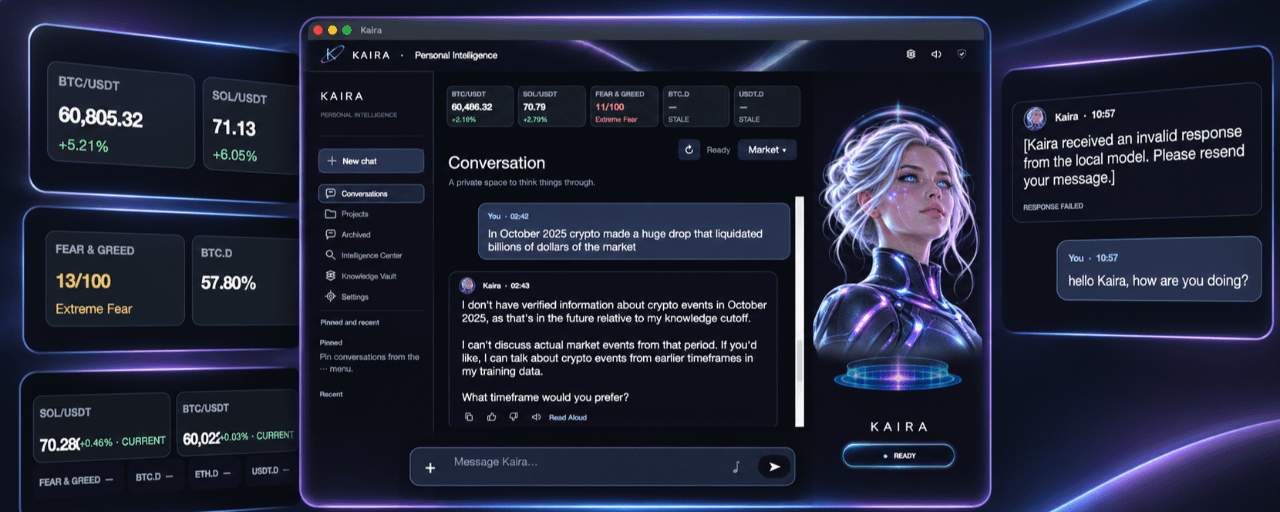
Building an AI Trader: What Happens When You Remove Human Emotions?For the past few weeks, I've been building Kaira, a locally operated AI with financial research, market analysis, strategy development and autonomous trading research capabilities.
The idea started with a question: What could an AI discover if given access to financial data, the freedom to investigate market behavior and the ability to learn from its own mistakes, without the emotional interference that often affects us as traders?
I'm not talking about another trading bot following RSI or moving average signals. I want something capable of questioning why a strategy works, under what conditions it stops working and what alternatives might perform better.
Teaching an AI how to think
I've been experimenting with a cognitive architecture I call ECA (Exploratory Cognitive Analysis), alongside ACC (Adaptive Cognitive Conditioning).
The idea is to encourage independent thinking, curiosity, meaningful associations between different subjects and, most importantly, the ability to recognize and correct mistakes.
Initially, we guide the reasoning process through questions, reinforce good analytical practices and gradually reduce that guidance to see whether those behaviors carry over into future investigations.
Sounds great in theory. In practice, it's been considerably more complicated. I've lost count of how many things we've had to fix, rethink or completely reverse.
From theory to actual market research
As of today, Kaira has 95 historical research candidates. We've independently reviewed 25 eligible hypotheses, of which 10 have advanced to testing.
She's now autonomously running exploratory experiments involving BTC, ETH and SOL, comparing strategies under different market conditions and accounting for modeled transaction costs.
One of our recent investigations looked at whether allocating capital to BTC following a broad market decline would outperform an equally weighted ETH/SOL basket.
Across 26 qualifying events, BTC returned −0.3167%, while the ETH/SOL basket returned −0.2962% after modeled costs.
Nothing particularly exciting from a profitability perspective, and the sample is too small to draw conclusions. But the results led to another question: Does the degree of dispersion between assets during a broad market decline influence their subsequent relative performance?
That question has now been registered as a new 30 day prospective hypothesis.
This is the kind of research cycle I want Kaira to eventually manage independently. Discover something, test it, study the results, question the outcome and develop another idea.
She's far from perfect
Kaira still makes mathematical mistakes, occasionally misinterprets statistics and sometimes reaches conclusions that aren't supported by the available evidence.
Interestingly, giving her more freedom to explore has produced more creative ideas, but it has also exposed weaknesses in her reasoning.
We've introduced deterministic mathematical verification and scientific validation to address some of these problems without restricting her ability to explore unconventional ideas.
I don't want an AI that simply agrees with me. I want one that can challenge my decisions, identify things I've overlooked and ideally discover opportunities I wouldn't have considered myself.
The best part?
Most of this is running locally on a MacBook Air M4 with just 16 GB of RAM, using a fine-tuned Qwen 3.5 4B model, historical market data and live feeds.
Special thanks to Binance and other platforms for making their market data accessible through free APIs.
Kaira can now continue collecting data, conducting research and running eligible experiments even when her desktop application is closed.
There's no proven trading edge yet on her autonomous strategies at this stage.
I genuinely don't know where this experiment will take me. But as someone who has spent years trading crypto, I'm fascinated by the possibility of developing a system that learns from market behavior without experiencing fear, greed, attachment or the temptation to chase losses.
Maybe the most valuable thing an AI trader can learn isn't when to enter a trade, but when there's simply no good reason to enter one.
I'll continue sharing our progress, including the failures.
#ArtificialInteligence #TradingTales #Binance #Quantitativetrading #Kaira
Building an AI Trader: What Happens When You Remove Human Emotions?
For the past few weeks, I've been building Kaira, a locally operated AI with financial research, market analysis, strategy development and autonomous trading research capabilities.
The idea started with a question: What could an AI discover if given access to financial data, the freedom to investigate market behavior and the ability to learn from its own mistakes, without the emotional interference that often affects us as traders?
I'm not talking about another trading bot following RSI or moving average signals. I want something capable of questioning why a strategy works, under what conditions it stops working and what alternatives might perform better.
Teaching an AI how to think
I've been experimenting with a cognitive architecture I call ECA (Exploratory Cognitive Analysis), alongside ACC (Adaptive Cognitive Conditioning).
The idea is to encourage independent thinking, curiosity, meaningful associations between different subjects and, most importantly, the ability to recognize and correct mistakes.
Initially, we guide the reasoning process through questions, reinforce good analytical practices and gradually reduce that guidance to see whether those behaviors carry over into future investigations.
Sounds great in theory. In practice, it's been considerably more complicated. I've lost count of how many things we've had to fix, rethink or completely reverse.
From theory to actual market research
As of today, Kaira has 95 historical research candidates. We've independently reviewed 25 eligible hypotheses, of which 10 have advanced to testing.
She's now autonomously running exploratory experiments involving BTC, ETH and SOL, comparing strategies under different market conditions and accounting for modeled transaction costs.
One of our recent investigations looked at whether allocating capital to BTC following a broad market decline would outperform an equally weighted ETH/SOL basket.
Across 26 qualifying events, BTC returned −0.3167%, while the ETH/SOL basket returned −0.2962% after modeled costs.
Nothing particularly exciting from a profitability perspective, and the sample is too small to draw conclusions. But the results led to another question: Does the degree of dispersion between assets during a broad market decline influence their subsequent relative performance?
That question has now been registered as a new 30 day prospective hypothesis.
This is the kind of research cycle I want Kaira to eventually manage independently. Discover something, test it, study the results, question the outcome and develop another idea.
She's far from perfect
Kaira still makes mathematical mistakes, occasionally misinterprets statistics and sometimes reaches conclusions that aren't supported by the available evidence.
Interestingly, giving her more freedom to explore has produced more creative ideas, but it has also exposed weaknesses in her reasoning.
We've introduced deterministic mathematical verification and scientific validation to address some of these problems without restricting her ability to explore unconventional ideas.
I don't want an AI that simply agrees with me. I want one that can challenge my decisions, identify things I've overlooked and ideally discover opportunities I wouldn't have considered myself.
The best part?
Most of this is running locally on a MacBook Air M4 with just 16 GB of RAM, using a fine-tuned Qwen 3.5 4B model, historical market data and live feeds.
Special thanks to Binance and other platforms for making their market data accessible through free APIs.
Kaira can now continue collecting data, conducting research and running eligible experiments even when her desktop application is closed.
There's no proven trading edge yet on her autonomous strategies at this stage.
I genuinely don't know where this experiment will take me. But as someone who has spent years trading crypto, I'm fascinated by the possibility of developing a system that learns from market behavior without experiencing fear, greed, attachment or the temptation to chase losses.
Maybe the most valuable thing an AI trader can learn isn't when to enter a trade, but when there's simply no good reason to enter one.
I'll continue sharing our progress, including the failures.
#ArtificialInteligence #TradingTales #Binance #Quantitativetrading #Kaira
108
Log in to explore more content
Join global crypto users on Binance Square
⚡️ Get latest and useful information about crypto.
💬 Trusted by the world’s largest crypto exchange.
👍 Discover real insights from verified creators.
Email / Phone number
Trending Topics
1
#EvolveAtBinanceBlockchainWeek
1.5M views
16,311 Discussing
2
#ChainflipVaultTheftHaltsProtocol
10,585 views
183 Discussing
3
#VitalikWantsWalletChipDesignsOpened
18,200 views
293 Discussing
4
#ColdcardFlawLeadsToTheftOfAtLeast1789BTC
4,721 views
47 Discussing
5
#MalaysiaFirstBitcoinETFToListOnDecember2
5,741 views
71 Discussing
6
#DowJonesAdds591.99Points
7,156 views
49 Discussing
7
#AnzaUrgesSolanaNodesUpgradeAgave
7,152 views
138 Discussing
8
#ClaudeAccusedOfDroppingUserPreferences
5,858 views
67 Discussing
9
#EthereumGlamsterdamKeepsStorageFeeChange
49,075 views
470 Discussing
10
#MoneroFalls13%OnDelistings
105,359 views
708 Discussing