
#informedtradingdecisions
informedtradingdecisions
20,000 views
58 Discussing
Hot
Latest

·
--
Bullish
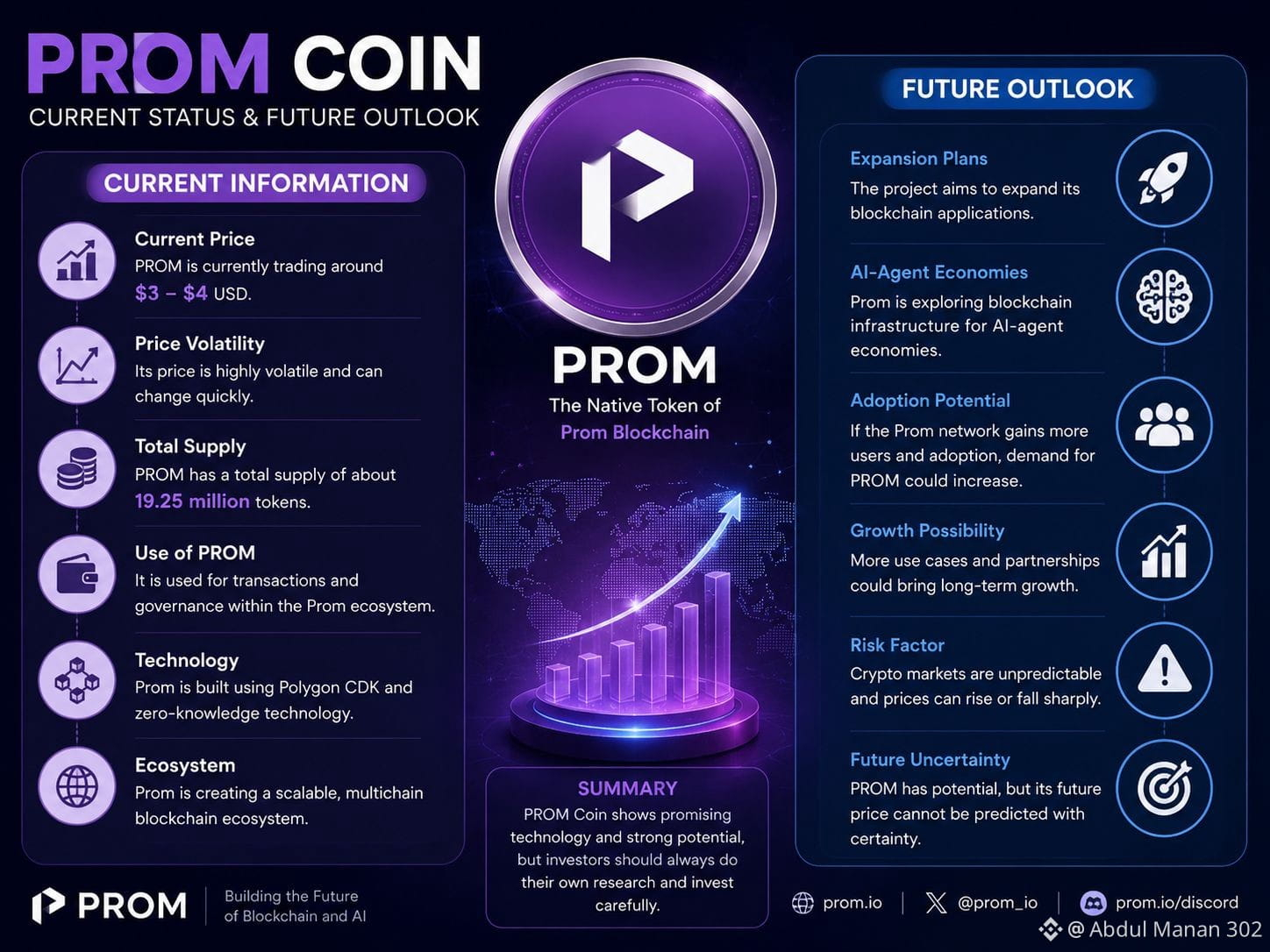
$PROM PROM Coin is the native token of the Prom blockchain ecosystem. Currently, it is trading around $3–$4, although its price can change quickly. PROM has a total supply of about 19.25 million tokens and is used for transactions and governance within the ecosystem. Prom is developing a scalable, multichain blockchain using Polygon CDK and zero-knowledge technology. In the future, the project aims to expand its blockchain applications and explore new areas such as AI-agent economies. If the Prom network gains more users and adoption, demand for PROM could increase. However, cryptocurrency prices are highly volatile and depend on market conditions and project development. Therefore, PROM may have future potential, but its future price cannot be predicted with certainty#Price-Prediction #InformedTradingDecisions
$PROM PROM Coin is the native token of the Prom blockchain ecosystem. Currently, it is trading around $3–$4, although its price can change quickly. PROM has a total supply of about 19.25 million tokens and is used for transactions and governance within the ecosystem. Prom is developing a scalable, multichain blockchain using Polygon CDK and zero-knowledge technology. In the future, the project aims to expand its blockchain applications and explore new areas such as AI-agent economies. If the Prom network gains more users and adoption, demand for PROM could increase. However, cryptocurrency prices are highly volatile and depend on market conditions and project development. Therefore, PROM may have future potential, but its future price cannot be predicted with certainty#Price-Prediction #InformedTradingDecisions
166

·
--
Article
More Chains, More Choices — But Where Should Your Capital Go?One crucial thing I’ve learned from watching multi-chain DeFi evolve is that more chains do not automatically mean more profit.
The real advantage comes from knowing where capital works best — and how to get there efficiently.
A pool showing 30% APY can look better than one offering 12%, but that headline number means little after accounting for gas, slippage, cross-chain fees, impermanent loss, liquidity depth and reward sustainability. $GRAM
The route matters as much as the destination
Moving capital across chains introduces another layer of risk.
A traditional bridge can involve locking an asset on one network and receiving a wrapped representation on another. That creates additional smart-contract and infrastructure dependencies before the actual DeFi strategy even begins.
An alternative approach is cross-chain execution through Omniston, STON.fi’s cross-chain execution layer.
Instead of simply transporting the same asset, Omniston can coordinate a swap into the native asset needed on the destination network through professional liquidity providers and HTLC-based settlement.
For a user, that difference is important:
You are not just asking, “How do I move my token?”
You are asking:
“What asset do I actually need when I arrive?”
That is a much more useful way to think about cross-chain capital.
Every chain has a different advantage
Ethereum → deeper liquidity and mature DeFi, but higher transaction costs can matter for smaller positions.
Base → lower-cost Ethereum-aligned execution, making frequent transactions easier to justify.
BNB Chain → broad retail activity, low fees and extensive token access.
TON → extremely low-cost native activity and access to TON-specific assets and liquidity through STONfi.
Solana → speed and low fees make it attractive for strategies requiring frequent adjustments.
TRON → particularly relevant for large stablecoin flows and USDT-focused activity.
None of these automatically wins.
The right chain depends on the position.
My simple rule before moving funds
I would ask five questions:
Is the expected net return actually higher?How much will the complete route cost?Is the destination liquidity deep enough for my position?What additional risks am I accepting?How long will it take to recover the cost of moving?
That last question is often overlooked.
If moving $1,000 costs $20 and only improves expected returns by $5 per month, the opportunity needs four months just to recover the migration cost.
And if the yield disappears after three weeks, the “better opportunity” was never really better.
$BTC $SOL #InformedTradingDecisions #Omniston #TrendingTopic #LiquidityAggregator #STONfi
More Chains, More Choices — But Where Should Your Capital Go?
One crucial thing I’ve learned from watching multi-chain DeFi evolve is that more chains do not automatically mean more profit.
The real advantage comes from knowing where capital works best — and how to get there efficiently.
A pool showing 30% APY can look better than one offering 12%, but that headline number means little after accounting for gas, slippage, cross-chain fees, impermanent loss, liquidity depth and reward sustainability. $GRAM
The route matters as much as the destination
Moving capital across chains introduces another layer of risk.
A traditional bridge can involve locking an asset on one network and receiving a wrapped representation on another. That creates additional smart-contract and infrastructure dependencies before the actual DeFi strategy even begins.
An alternative approach is cross-chain execution through Omniston, STON.fi’s cross-chain execution layer.
Instead of simply transporting the same asset, Omniston can coordinate a swap into the native asset needed on the destination network through professional liquidity providers and HTLC-based settlement.
For a user, that difference is important:
You are not just asking, “How do I move my token?”
You are asking:
“What asset do I actually need when I arrive?”
That is a much more useful way to think about cross-chain capital.
Every chain has a different advantage
Ethereum → deeper liquidity and mature DeFi, but higher transaction costs can matter for smaller positions.
Base → lower-cost Ethereum-aligned execution, making frequent transactions easier to justify.
BNB Chain → broad retail activity, low fees and extensive token access.
TON → extremely low-cost native activity and access to TON-specific assets and liquidity through STONfi.
Solana → speed and low fees make it attractive for strategies requiring frequent adjustments.
TRON → particularly relevant for large stablecoin flows and USDT-focused activity.
None of these automatically wins.
The right chain depends on the position.
My simple rule before moving funds
I would ask five questions:
Is the expected net return actually higher?How much will the complete route cost?Is the destination liquidity deep enough for my position?What additional risks am I accepting?How long will it take to recover the cost of moving?
That last question is often overlooked.
If moving $1,000 costs $20 and only improves expected returns by $5 per month, the opportunity needs four months just to recover the migration cost.
And if the yield disappears after three weeks, the “better opportunity” was never really better.
$BTC $SOL #InformedTradingDecisions #Omniston #TrendingTopic #LiquidityAggregator #STONfi
The real advantage comes from knowing where capital works best — and how to get there efficiently.
A pool showing 30% APY can look better than one offering 12%, but that headline number means little after accounting for gas, slippage, cross-chain fees, impermanent loss, liquidity depth and reward sustainability. $GRAM
The route matters as much as the destination
Moving capital across chains introduces another layer of risk.
A traditional bridge can involve locking an asset on one network and receiving a wrapped representation on another. That creates additional smart-contract and infrastructure dependencies before the actual DeFi strategy even begins.
An alternative approach is cross-chain execution through Omniston, STON.fi’s cross-chain execution layer.
Instead of simply transporting the same asset, Omniston can coordinate a swap into the native asset needed on the destination network through professional liquidity providers and HTLC-based settlement.
For a user, that difference is important:
You are not just asking, “How do I move my token?”
You are asking:
“What asset do I actually need when I arrive?”
That is a much more useful way to think about cross-chain capital.
Every chain has a different advantage
Ethereum → deeper liquidity and mature DeFi, but higher transaction costs can matter for smaller positions.
Base → lower-cost Ethereum-aligned execution, making frequent transactions easier to justify.
BNB Chain → broad retail activity, low fees and extensive token access.
TON → extremely low-cost native activity and access to TON-specific assets and liquidity through STONfi.
Solana → speed and low fees make it attractive for strategies requiring frequent adjustments.
TRON → particularly relevant for large stablecoin flows and USDT-focused activity.
None of these automatically wins.
The right chain depends on the position.
My simple rule before moving funds
I would ask five questions:
Is the expected net return actually higher?How much will the complete route cost?Is the destination liquidity deep enough for my position?What additional risks am I accepting?How long will it take to recover the cost of moving?
That last question is often overlooked.
If moving $1,000 costs $20 and only improves expected returns by $5 per month, the opportunity needs four months just to recover the migration cost.
And if the yield disappears after three weeks, the “better opportunity” was never really better.
$BTC $SOL #InformedTradingDecisions #Omniston #TrendingTopic #LiquidityAggregator #STONfi
1
166
Log in to explore more content
Join global crypto users on Binance Square
⚡️ Get latest and useful information about crypto.
💬 Trusted by the world’s largest crypto exchange.
👍 Discover real insights from verified creators.
Email / Phone number
Trending Topics
1
#WTICrudeBreaksAbove$85
490 views
39 Discussing
2
#BrentRisesAbove$90
5,871 views
98 Discussing
3
#KospiDrops3.6%AsSamsungSKHynixWeaken
3,427 views
202 Discussing
4
#GoldHits$4444.82InEarlyTrading
962 views
40 Discussing
5
#UKReleasesFirstCryptoGainsTaxStats
4,800 views
242 Discussing
6
#YenFallsDespite$97BJapanSupport
2,254 views
56 Discussing
7
#SheinCEOSkyXuWealthFalls$15B
603 views
37 Discussing
8
#YenBreaks160AgainstDollar
6,913 views
283 Discussing
9
#USStrikesIranianRocketLaunchers
7,103 views
287 Discussing
10
#About67MAmericansHoldCrypto
6,960 views
252 Discussing