

#bitgethackermoves83mstolenxrp
bitgethackermoves83mstolenxrp
6,960 views
14 Discussing
Hot
Latest


·
--
🚨 $XRP ALERT Hacker Moves $83M!
The Bitget hack is back in focus after the attacker moved roughly 54 million stolen $XRP, worth around $83M at current prices. #BitgetHackerMoves83MStolenXRP
The funds were originally part of approximately 103M $XRP stolen during the attack. Around $75M worth of XRP is reportedly still sitting in the hacker-linked wallets, meaning the story may not be over yet.
The biggest issue is what happens next. XRP itself cannot simply be frozen on-chain, but centralized exchanges can potentially block stolen funds if the attacker sends them to a platform.
So far, there is no confirmation that the moved XRP has been sold. For now, the transfers are being closely watched by the crypto community.
More movements could create additional selling pressure.
🚨 $XRP ALERT Hacker Moves $83M!
The Bitget hack is back in focus after the attacker moved roughly 54 million stolen $XRP , worth around $83M at current prices. #BitgetHackerMoves83MStolenXRP
The funds were originally part of approximately 103M $XRP stolen during the attack. Around $75M worth of XRP is reportedly still sitting in the hacker-linked wallets, meaning the story may not be over yet.
The biggest issue is what happens next. XRP itself cannot simply be frozen on-chain, but centralized exchanges can potentially block stolen funds if the attacker sends them to a platform.
So far, there is no confirmation that the moved XRP has been sold. For now, the transfers are being closely watched by the crypto community.
More movements could create additional selling pressure.
The Bitget hack is back in focus after the attacker moved roughly 54 million stolen $XRP , worth around $83M at current prices. #BitgetHackerMoves83MStolenXRP
The funds were originally part of approximately 103M $XRP stolen during the attack. Around $75M worth of XRP is reportedly still sitting in the hacker-linked wallets, meaning the story may not be over yet.
The biggest issue is what happens next. XRP itself cannot simply be frozen on-chain, but centralized exchanges can potentially block stolen funds if the attacker sends them to a platform.
So far, there is no confirmation that the moved XRP has been sold. For now, the transfers are being closely watched by the crypto community.
More movements could create additional selling pressure.

AcciolyCriptos:
Quando foi isso? E verdade @Binance_Customer_Support ?
3
12
14.9k
#BitgetHackerMoves83MStolenXRP
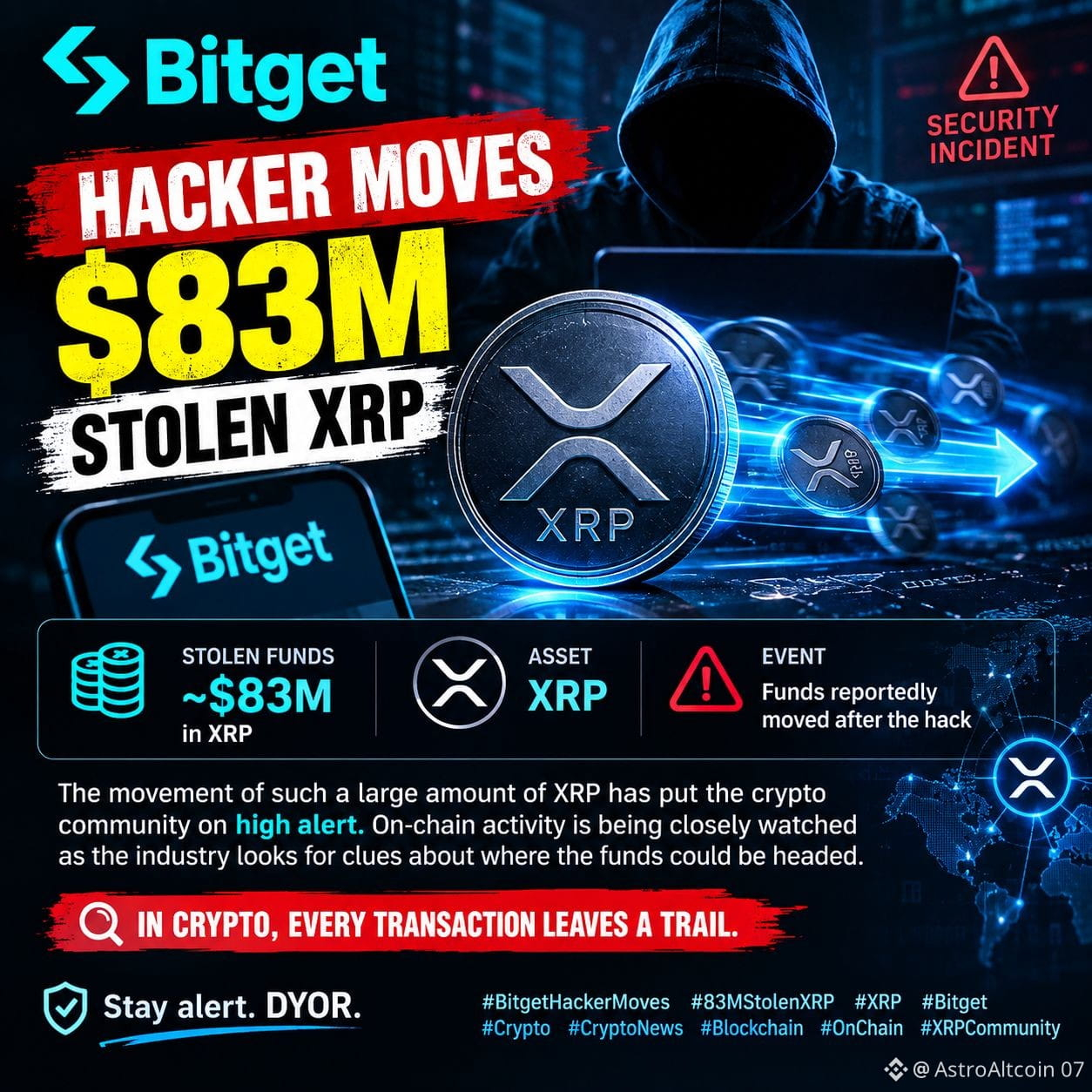
🚨 BREAKING: $83 MILLION IN XRP ON THE MOVE 🚨
A major crypto security incident is making waves as roughly $83M worth of XRP linked to the Bitget hack has reportedly been moved.
💰 Stolen funds: ~$83M in XRP
🔗 Asset: XRP
🚨 Event: Funds reportedly moved after the hack
The movement of such a large amount of XRP has put the crypto community on high alert. On-chain activity is being closely watched as the industry looks for clues about where the funds could be headed.
⚠️ In crypto, every transaction leaves a trail.
Stay alert. DYOR. 🔍
#BitgetHackerMoves #83MStolenXRP #XRP #Bitget #Crypto #CryptoNews #Blockchain #OnChain #XRPCommunity
#XRPHACKED #XRPRealityCheck 6
{future}(XRPUSDT)
#BitgetHackerMoves83MStolenXRP
🚨 BREAKING: $83 MILLION IN XRP ON THE MOVE 🚨
A major crypto security incident is making waves as roughly $83M worth of XRP linked to the Bitget hack has reportedly been moved.
💰 Stolen funds: ~$83M in XRP
🔗 Asset: XRP
🚨 Event: Funds reportedly moved after the hack
The movement of such a large amount of XRP has put the crypto community on high alert. On-chain activity is being closely watched as the industry looks for clues about where the funds could be headed.
⚠️ In crypto, every transaction leaves a trail.
Stay alert. DYOR. 🔍
#BitgetHackerMoves #83MStolenXRP #XRP #Bitget #Crypto #CryptoNews #Blockchain #OnChain #XRPCommunity
#XRPHACKED #XRPRealityCheck 6
🚨 BREAKING: $83 MILLION IN XRP ON THE MOVE 🚨
A major crypto security incident is making waves as roughly $83M worth of XRP linked to the Bitget hack has reportedly been moved.
💰 Stolen funds: ~$83M in XRP
🔗 Asset: XRP
🚨 Event: Funds reportedly moved after the hack
The movement of such a large amount of XRP has put the crypto community on high alert. On-chain activity is being closely watched as the industry looks for clues about where the funds could be headed.
⚠️ In crypto, every transaction leaves a trail.
Stay alert. DYOR. 🔍
#BitgetHackerMoves #83MStolenXRP #XRP #Bitget #Crypto #CryptoNews #Blockchain #OnChain #XRPCommunity
#XRPHACKED #XRPRealityCheck 6
128

·
--
Article
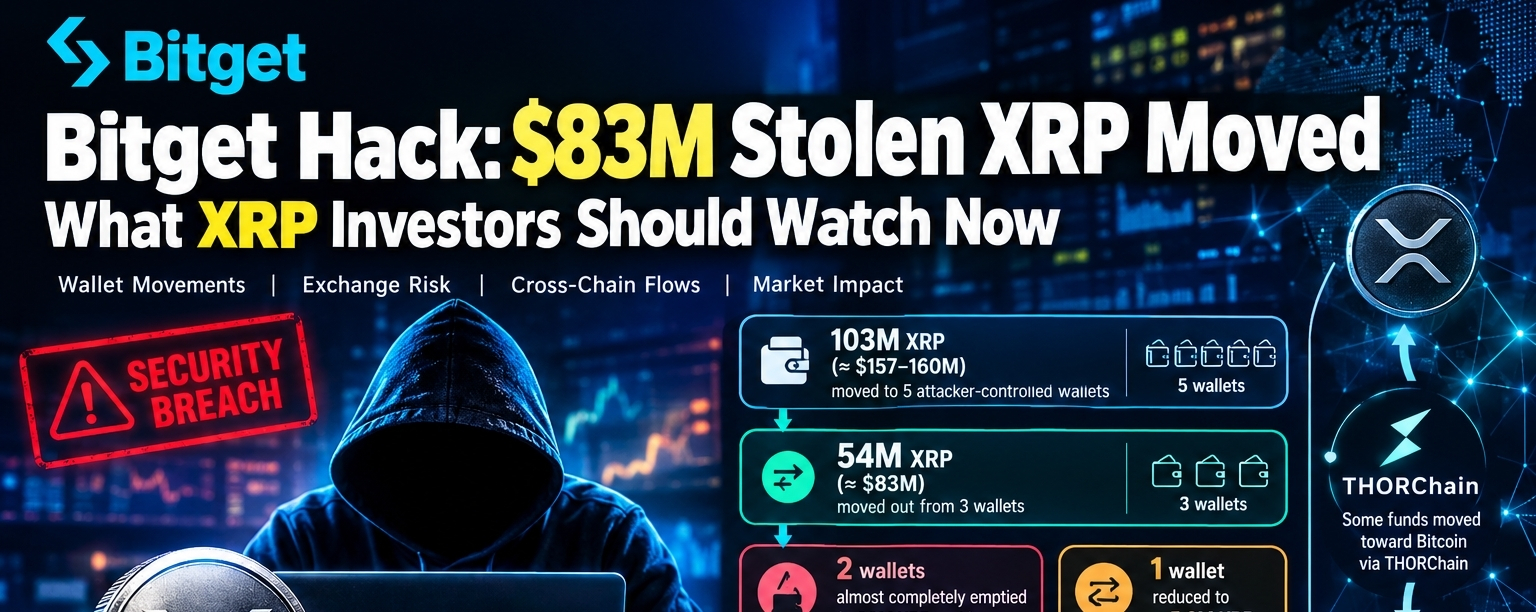
Bitget Hack: $83M Stolen XRP Moved — What XRP Investors Should Watch NowA major security breach at Bitget on September 24, 2026, has created a new risk factor for the crypto market.
Around $387.5 million in crypto assets were reportedly stolen, with $XRP representing one of the largest portions of the compromised funds.
Approximately 103 million XRP, worth roughly $157–160 million at the time, was moved into five wallets controlled by the attacker.
But the more important story is what happened afterward.
By September 26, around 54 million XRP, worth approximately $83 million, had already moved out of those original wallets.
Around 49 million XRP, valued at roughly $75 million at the time, remained in the original wallets.
So the story is far from over.
In fact, the most important part for XRP investors may be just beginning.
🔥 From 103M XRP to Around 49M XRP — Where Is the Remaining Money Going?
According to on-chain tracking, the stolen XRP was initially divided across five attacker-controlled wallets.
Two wallets that originally held around 20 million XRP each were almost completely emptied.
Another wallet was reduced to approximately 5.8 million XRP.
As a result, the combined XRP balance across the original five wallets fell significantly, leaving roughly 49 million XRP.
But there is one critical point investors need to understand:
An XRP transfer does not automatically mean XRP has been sold.
The funds could have been:
Moved to newly created attacker-controlled wallets
Split into smaller amounts
Converted through cross-chain infrastructure
Deposited to an exchange
Settled through OTC channels
Or moved as part of a broader laundering strategy
Therefore, it would be incorrect to assume that all 54 million $XRP has already been sold into the market.
That distinction matters.
📊 Why Is 103M XRP Important for the XRP Market?
At around $1.54 per XRP, 103 million XRP represented roughly $160 million in value.
According to CoinDesk's analysis, that amount represented roughly 4% of XRP's reported daily trading volume at the time.
That may not sound enormous relative to the entire XRP market.
But market liquidity matters.
If $160 million worth of XRP were suddenly market-sold into relatively thin liquidity, the price impact could be much larger than the headline percentage suggests.
On the other hand, if the funds are gradually moved between wallets or converted through OTC and cross-chain routes, the direct impact on the open market could be significantly smaller.
So the key question is not simply:
How much XRP was stolen?
The more important question is:
How is that XRP being moved?
⚠️ The Biggest Risk: “Stolen XRP = Immediate Sell Pressure” Is Not Necessarily True
Some investors may immediately think:
103M XRP was stolen, so XRP is about to dump.
The reality is more complicated.
If the attacker simply moves XRP from one wallet to another, there is no new XRP supply entering circulation and no direct market sell order is created.
But if stolen XRP reaches a centralized exchange, OTC desk, or liquid swap infrastructure and is converted into another asset, the situation changes.
That is when potential selling pressure can emerge.
This is why XRP investors should focus not only on how much XRP is moving, but also on:
Where is the XRP going?
🧩 An Important Point About the XRP Ledger
There is another important aspect of this incident for XRP investors.
Native XRP does not have an issuer-level freeze mechanism comparable to certain centralized stablecoins.
That means there is no central issuer that can simply freeze native XRP sitting in a specific wallet.
CoinDesk reported that Circle and Tether froze roughly $320,000 worth of related stablecoins, while native XRP does not have the same issuer-based freezing mechanism.
This highlights two characteristics of blockchain infrastructure at the same time:
Transparency and decentralization.
Transactions on the XRP Ledger can be publicly tracked.
But being publicly visible is not the same as having the ability to freeze funds.
As a result, centralized exchanges and custodial gateways can become important checkpoints in attempts to identify and restrict the movement of stolen assets.
🌐 Why Cross-Chain Movement Through THORChain Matters
Another development that deserves attention is the reported movement of some stolen assets through cross-chain infrastructure.
Some reports have indicated that portions of the funds may have been moved through THORChain toward Bitcoin.
Bitget's CEO has also called on relevant service providers not to facilitate transactions involving the attacker-linked funds.
But there is another important distinction:
Cross-chain movement does not automatically mean confirmed cash-out.
However, it can make fund tracing more complicated.
When an asset remains on the same blockchain, tracking its movement is relatively straightforward.
But if the path becomes something like:
XRP → another asset → BTC
the fund flow becomes increasingly fragmented.
For that reason, XRP investors should watch not only the XRP Ledger but also cross-chain activity.
💰 The Real Investor Question: Can XRP Absorb This Pressure?
There is one point I would keep in mind.
The stolen XRP does not represent newly created supply.
Those XRP were already part of the circulating supply.
Therefore, this incident does not fundamentally increase XRP's total supply.
The real issue is liquidity and selling pressure.
The key question is:
How quickly—and through which channels—will the stolen XRP be liquidated, if at all?
If the funds remain distributed across wallets for an extended period, direct selling pressure could remain limited.
But if large amounts reach exchanges or liquid markets and are aggressively sold, short-term volatility could increase significantly.
That is why XRP investors should watch wallet activity alongside price action.
📈 One Important Market Signal
Despite the security incident, XRP did not completely collapse.
According to market data cited by CoinDesk, XRP was trading around $1.54 on September 26, while still maintaining roughly a 9% seven-day gain, although it was down around 4% over the previous 24 hours.
This highlights an important characteristic of markets:
A major security event does not automatically change an asset's broader trend.
If broader demand, liquidity and buyer participation remain strong, the impact of an isolated wallet event may be limited.
On the other hand, if stolen funds begin entering liquid markets and aggressive selling follows, the short-term trend could come under pressure.
So for XRP, the most important thing to watch now is:
Not just the news—but the market's reaction to it.
🐋 What Data Points Should XRP Investors Watch?
Over the next several days, I would pay particular attention to several indicators.
1️⃣ The Remaining 49M XRP
How quickly are the remaining approximately 49 million XRP moving?
This is one of the most direct indicators.
2️⃣ Exchange Deposits
Are the stolen XRP entering deposit infrastructure associated with major centralized exchanges?
This is potentially more important than simple wallet-to-wallet transfers because it could indicate possible liquidation.
3️⃣ XRP Trading Volume
Is volume increasing alongside a decline in price?
A sharp decline accompanied by unusually high volume could indicate stronger market pressure.
4️⃣ Order-Book Liquidity
Trading volume alone does not tell the whole story.
Investors should also consider how much bid liquidity exists below the current market price.
5️⃣ Cross-Chain Movement
Are the XRP being converted into other assets?
And if so, where are those assets going?
That could become an important part of the investigation.
🔎 The Biggest Mistake Would Be Panic Selling or Blind Buying
Events like this often create two emotional reactions.
One group says:
“The hacker will dump XRP, so sell immediately.”
Another says:
“XRP survived the hack news, so buy immediately.”
Both reactions can be incomplete.
The market data is still evolving.
A more disciplined approach is to ask:
What is price doing?
What is volume showing?
What are the large wallets doing?
Are stolen XRP entering exchanges?
Are key support levels holding?
Looking at these factors together provides a much clearer picture.
🚨 Another Important Lesson for XRP Holders
This incident is not only about XRP's price.
It once again highlights that holding assets on an exchange and holding assets in self-custody involve different types of risk.
Bitget stated that the breach affected part of its hot/warm wallet infrastructure while its cold wallets remained secure. The exchange later revised the estimated affected assets to approximately $387.5 million and said its User Protection Fund exceeded $464 million. Bitget also stated that it would cover the relevant losses.
For investors, this creates another important question beyond:
“Which coin should I buy?”
The next questions should be:
Where should I hold it?
How much exchange exposure should I take?
How much should remain in self-custody?
How much dependence should I place on a single platform?
In crypto, custody risk is part of portfolio risk.
🧠 My Market Take
The Bitget incident does not, by itself, establish that XRP's long-term fundamental thesis has changed.
However, it has created a meaningful short-term volatility and sentiment risk.
The initial theft involved approximately 103 million XRP.
Around 54 million XRP had already moved out of the original holding wallets.
And roughly 49 million XRP remained in those original wallets according to the latest reports available at the time.
That means on-chain monitoring and liquidity analysis could remain extremely important for XRP over the coming days.
The most important point is:
We still cannot assume that all moved XRP has been sold.
Treating every transfer as a “dump” could therefore lead to incorrect analysis.
🔥 Bottom Line
The Bitget hack's XRP story is not over.
103M XRP stolen
⬇️
~54M XRP moved from the original wallets
⬇️
~49M XRP remaining
⬇️
Cross-chain activity under observation
⬇️
Potential exchange and liquidity pressure
For XRP investors, the most important thing now is not a sensational headline.
It is:
Follow the wallets.
Watch the liquidity.
Track exchange deposits.
Do not confuse movement with selling.
If the remaining XRP gradually moves between wallets without significant exchange deposits, direct market pressure could remain limited.
But if large amounts enter exchanges or liquid swap routes while volume-driven selling begins, short-term volatility could increase substantially.
That is why the most useful approach right now is data-driven monitoring rather than emotional decision-making.
The Bitget hack is a risk event for $XRP —but it is also a real-world example of how blockchain transparency, fund tracing and crypto custody infrastructure work together.
The next major XRP move may not be written only on the price chart.
It could also be visible on the blockchain.
DYOR | Risk Management First | Never Risk More Than You Can Afford to Lose
#BitgetHackerMoves83MStolenXRP #BitgetHackerMoves$83MStolenXRP #xrp #Bitget #crypto
{spot}(XRPUSDT)
Bitget Hack: $83M Stolen XRP Moved — What XRP Investors Should Watch Now
A major security breach at Bitget on September 24, 2026, has created a new risk factor for the crypto market.
Around $387.5 million in crypto assets were reportedly stolen, with $XRP representing one of the largest portions of the compromised funds.
Approximately 103 million XRP, worth roughly $157–160 million at the time, was moved into five wallets controlled by the attacker.
But the more important story is what happened afterward.
By September 26, around 54 million XRP, worth approximately $83 million, had already moved out of those original wallets.
Around 49 million XRP, valued at roughly $75 million at the time, remained in the original wallets.
So the story is far from over.
In fact, the most important part for XRP investors may be just beginning.
🔥 From 103M XRP to Around 49M XRP — Where Is the Remaining Money Going?
According to on-chain tracking, the stolen XRP was initially divided across five attacker-controlled wallets.
Two wallets that originally held around 20 million XRP each were almost completely emptied.
Another wallet was reduced to approximately 5.8 million XRP.
As a result, the combined XRP balance across the original five wallets fell significantly, leaving roughly 49 million XRP.
But there is one critical point investors need to understand:
An XRP transfer does not automatically mean XRP has been sold.
The funds could have been:
Moved to newly created attacker-controlled wallets
Split into smaller amounts
Converted through cross-chain infrastructure
Deposited to an exchange
Settled through OTC channels
Or moved as part of a broader laundering strategy
Therefore, it would be incorrect to assume that all 54 million $XRP has already been sold into the market.
That distinction matters.
📊 Why Is 103M XRP Important for the XRP Market?
At around $1.54 per XRP, 103 million XRP represented roughly $160 million in value.
According to CoinDesk's analysis, that amount represented roughly 4% of XRP's reported daily trading volume at the time.
That may not sound enormous relative to the entire XRP market.
But market liquidity matters.
If $160 million worth of XRP were suddenly market-sold into relatively thin liquidity, the price impact could be much larger than the headline percentage suggests.
On the other hand, if the funds are gradually moved between wallets or converted through OTC and cross-chain routes, the direct impact on the open market could be significantly smaller.
So the key question is not simply:
How much XRP was stolen?
The more important question is:
How is that XRP being moved?
⚠️ The Biggest Risk: “Stolen XRP = Immediate Sell Pressure” Is Not Necessarily True
Some investors may immediately think:
103M XRP was stolen, so XRP is about to dump.
The reality is more complicated.
If the attacker simply moves XRP from one wallet to another, there is no new XRP supply entering circulation and no direct market sell order is created.
But if stolen XRP reaches a centralized exchange, OTC desk, or liquid swap infrastructure and is converted into another asset, the situation changes.
That is when potential selling pressure can emerge.
This is why XRP investors should focus not only on how much XRP is moving, but also on:
Where is the XRP going?
🧩 An Important Point About the XRP Ledger
There is another important aspect of this incident for XRP investors.
Native XRP does not have an issuer-level freeze mechanism comparable to certain centralized stablecoins.
That means there is no central issuer that can simply freeze native XRP sitting in a specific wallet.
CoinDesk reported that Circle and Tether froze roughly $320,000 worth of related stablecoins, while native XRP does not have the same issuer-based freezing mechanism.
This highlights two characteristics of blockchain infrastructure at the same time:
Transparency and decentralization.
Transactions on the XRP Ledger can be publicly tracked.
But being publicly visible is not the same as having the ability to freeze funds.
As a result, centralized exchanges and custodial gateways can become important checkpoints in attempts to identify and restrict the movement of stolen assets.
🌐 Why Cross-Chain Movement Through THORChain Matters
Another development that deserves attention is the reported movement of some stolen assets through cross-chain infrastructure.
Some reports have indicated that portions of the funds may have been moved through THORChain toward Bitcoin.
Bitget's CEO has also called on relevant service providers not to facilitate transactions involving the attacker-linked funds.
But there is another important distinction:
Cross-chain movement does not automatically mean confirmed cash-out.
However, it can make fund tracing more complicated.
When an asset remains on the same blockchain, tracking its movement is relatively straightforward.
But if the path becomes something like:
XRP → another asset → BTC
the fund flow becomes increasingly fragmented.
For that reason, XRP investors should watch not only the XRP Ledger but also cross-chain activity.
💰 The Real Investor Question: Can XRP Absorb This Pressure?
There is one point I would keep in mind.
The stolen XRP does not represent newly created supply.
Those XRP were already part of the circulating supply.
Therefore, this incident does not fundamentally increase XRP's total supply.
The real issue is liquidity and selling pressure.
The key question is:
How quickly—and through which channels—will the stolen XRP be liquidated, if at all?
If the funds remain distributed across wallets for an extended period, direct selling pressure could remain limited.
But if large amounts reach exchanges or liquid markets and are aggressively sold, short-term volatility could increase significantly.
That is why XRP investors should watch wallet activity alongside price action.
📈 One Important Market Signal
Despite the security incident, XRP did not completely collapse.
According to market data cited by CoinDesk, XRP was trading around $1.54 on September 26, while still maintaining roughly a 9% seven-day gain, although it was down around 4% over the previous 24 hours.
This highlights an important characteristic of markets:
A major security event does not automatically change an asset's broader trend.
If broader demand, liquidity and buyer participation remain strong, the impact of an isolated wallet event may be limited.
On the other hand, if stolen funds begin entering liquid markets and aggressive selling follows, the short-term trend could come under pressure.
So for XRP, the most important thing to watch now is:
Not just the news—but the market's reaction to it.
🐋 What Data Points Should XRP Investors Watch?
Over the next several days, I would pay particular attention to several indicators.
1️⃣ The Remaining 49M XRP
How quickly are the remaining approximately 49 million XRP moving?
This is one of the most direct indicators.
2️⃣ Exchange Deposits
Are the stolen XRP entering deposit infrastructure associated with major centralized exchanges?
This is potentially more important than simple wallet-to-wallet transfers because it could indicate possible liquidation.
3️⃣ XRP Trading Volume
Is volume increasing alongside a decline in price?
A sharp decline accompanied by unusually high volume could indicate stronger market pressure.
4️⃣ Order-Book Liquidity
Trading volume alone does not tell the whole story.
Investors should also consider how much bid liquidity exists below the current market price.
5️⃣ Cross-Chain Movement
Are the XRP being converted into other assets?
And if so, where are those assets going?
That could become an important part of the investigation.
🔎 The Biggest Mistake Would Be Panic Selling or Blind Buying
Events like this often create two emotional reactions.
One group says:
“The hacker will dump XRP, so sell immediately.”
Another says:
“XRP survived the hack news, so buy immediately.”
Both reactions can be incomplete.
The market data is still evolving.
A more disciplined approach is to ask:
What is price doing?
What is volume showing?
What are the large wallets doing?
Are stolen XRP entering exchanges?
Are key support levels holding?
Looking at these factors together provides a much clearer picture.
🚨 Another Important Lesson for XRP Holders
This incident is not only about XRP's price.
It once again highlights that holding assets on an exchange and holding assets in self-custody involve different types of risk.
Bitget stated that the breach affected part of its hot/warm wallet infrastructure while its cold wallets remained secure. The exchange later revised the estimated affected assets to approximately $387.5 million and said its User Protection Fund exceeded $464 million. Bitget also stated that it would cover the relevant losses.
For investors, this creates another important question beyond:
“Which coin should I buy?”
The next questions should be:
Where should I hold it?
How much exchange exposure should I take?
How much should remain in self-custody?
How much dependence should I place on a single platform?
In crypto, custody risk is part of portfolio risk.
🧠 My Market Take
The Bitget incident does not, by itself, establish that XRP's long-term fundamental thesis has changed.
However, it has created a meaningful short-term volatility and sentiment risk.
The initial theft involved approximately 103 million XRP.
Around 54 million XRP had already moved out of the original holding wallets.
And roughly 49 million XRP remained in those original wallets according to the latest reports available at the time.
That means on-chain monitoring and liquidity analysis could remain extremely important for XRP over the coming days.
The most important point is:
We still cannot assume that all moved XRP has been sold.
Treating every transfer as a “dump” could therefore lead to incorrect analysis.
🔥 Bottom Line
The Bitget hack's XRP story is not over.
103M XRP stolen
⬇️
~54M XRP moved from the original wallets
⬇️
~49M XRP remaining
⬇️
Cross-chain activity under observation
⬇️
Potential exchange and liquidity pressure
For XRP investors, the most important thing now is not a sensational headline.
It is:
Follow the wallets.
Watch the liquidity.
Track exchange deposits.
Do not confuse movement with selling.
If the remaining XRP gradually moves between wallets without significant exchange deposits, direct market pressure could remain limited.
But if large amounts enter exchanges or liquid swap routes while volume-driven selling begins, short-term volatility could increase substantially.
That is why the most useful approach right now is data-driven monitoring rather than emotional decision-making.
The Bitget hack is a risk event for $XRP —but it is also a real-world example of how blockchain transparency, fund tracing and crypto custody infrastructure work together.
The next major XRP move may not be written only on the price chart.
It could also be visible on the blockchain.
DYOR | Risk Management First | Never Risk More Than You Can Afford to Lose
#BitgetHackerMoves83MStolenXRP #BitgetHackerMoves$83MStolenXRP #xrp #Bitget #crypto
Around $387.5 million in crypto assets were reportedly stolen, with $XRP representing one of the largest portions of the compromised funds.
Approximately 103 million XRP, worth roughly $157–160 million at the time, was moved into five wallets controlled by the attacker.
But the more important story is what happened afterward.
By September 26, around 54 million XRP, worth approximately $83 million, had already moved out of those original wallets.
Around 49 million XRP, valued at roughly $75 million at the time, remained in the original wallets.
So the story is far from over.
In fact, the most important part for XRP investors may be just beginning.
🔥 From 103M XRP to Around 49M XRP — Where Is the Remaining Money Going?
According to on-chain tracking, the stolen XRP was initially divided across five attacker-controlled wallets.
Two wallets that originally held around 20 million XRP each were almost completely emptied.
Another wallet was reduced to approximately 5.8 million XRP.
As a result, the combined XRP balance across the original five wallets fell significantly, leaving roughly 49 million XRP.
But there is one critical point investors need to understand:
An XRP transfer does not automatically mean XRP has been sold.
The funds could have been:
Moved to newly created attacker-controlled wallets
Split into smaller amounts
Converted through cross-chain infrastructure
Deposited to an exchange
Settled through OTC channels
Or moved as part of a broader laundering strategy
Therefore, it would be incorrect to assume that all 54 million $XRP has already been sold into the market.
That distinction matters.
📊 Why Is 103M XRP Important for the XRP Market?
At around $1.54 per XRP, 103 million XRP represented roughly $160 million in value.
According to CoinDesk's analysis, that amount represented roughly 4% of XRP's reported daily trading volume at the time.
That may not sound enormous relative to the entire XRP market.
But market liquidity matters.
If $160 million worth of XRP were suddenly market-sold into relatively thin liquidity, the price impact could be much larger than the headline percentage suggests.
On the other hand, if the funds are gradually moved between wallets or converted through OTC and cross-chain routes, the direct impact on the open market could be significantly smaller.
So the key question is not simply:
How much XRP was stolen?
The more important question is:
How is that XRP being moved?
⚠️ The Biggest Risk: “Stolen XRP = Immediate Sell Pressure” Is Not Necessarily True
Some investors may immediately think:
103M XRP was stolen, so XRP is about to dump.
The reality is more complicated.
If the attacker simply moves XRP from one wallet to another, there is no new XRP supply entering circulation and no direct market sell order is created.
But if stolen XRP reaches a centralized exchange, OTC desk, or liquid swap infrastructure and is converted into another asset, the situation changes.
That is when potential selling pressure can emerge.
This is why XRP investors should focus not only on how much XRP is moving, but also on:
Where is the XRP going?
🧩 An Important Point About the XRP Ledger
There is another important aspect of this incident for XRP investors.
Native XRP does not have an issuer-level freeze mechanism comparable to certain centralized stablecoins.
That means there is no central issuer that can simply freeze native XRP sitting in a specific wallet.
CoinDesk reported that Circle and Tether froze roughly $320,000 worth of related stablecoins, while native XRP does not have the same issuer-based freezing mechanism.
This highlights two characteristics of blockchain infrastructure at the same time:
Transparency and decentralization.
Transactions on the XRP Ledger can be publicly tracked.
But being publicly visible is not the same as having the ability to freeze funds.
As a result, centralized exchanges and custodial gateways can become important checkpoints in attempts to identify and restrict the movement of stolen assets.
🌐 Why Cross-Chain Movement Through THORChain Matters
Another development that deserves attention is the reported movement of some stolen assets through cross-chain infrastructure.
Some reports have indicated that portions of the funds may have been moved through THORChain toward Bitcoin.
Bitget's CEO has also called on relevant service providers not to facilitate transactions involving the attacker-linked funds.
But there is another important distinction:
Cross-chain movement does not automatically mean confirmed cash-out.
However, it can make fund tracing more complicated.
When an asset remains on the same blockchain, tracking its movement is relatively straightforward.
But if the path becomes something like:
XRP → another asset → BTC
the fund flow becomes increasingly fragmented.
For that reason, XRP investors should watch not only the XRP Ledger but also cross-chain activity.
💰 The Real Investor Question: Can XRP Absorb This Pressure?
There is one point I would keep in mind.
The stolen XRP does not represent newly created supply.
Those XRP were already part of the circulating supply.
Therefore, this incident does not fundamentally increase XRP's total supply.
The real issue is liquidity and selling pressure.
The key question is:
How quickly—and through which channels—will the stolen XRP be liquidated, if at all?
If the funds remain distributed across wallets for an extended period, direct selling pressure could remain limited.
But if large amounts reach exchanges or liquid markets and are aggressively sold, short-term volatility could increase significantly.
That is why XRP investors should watch wallet activity alongside price action.
📈 One Important Market Signal
Despite the security incident, XRP did not completely collapse.
According to market data cited by CoinDesk, XRP was trading around $1.54 on September 26, while still maintaining roughly a 9% seven-day gain, although it was down around 4% over the previous 24 hours.
This highlights an important characteristic of markets:
A major security event does not automatically change an asset's broader trend.
If broader demand, liquidity and buyer participation remain strong, the impact of an isolated wallet event may be limited.
On the other hand, if stolen funds begin entering liquid markets and aggressive selling follows, the short-term trend could come under pressure.
So for XRP, the most important thing to watch now is:
Not just the news—but the market's reaction to it.
🐋 What Data Points Should XRP Investors Watch?
Over the next several days, I would pay particular attention to several indicators.
1️⃣ The Remaining 49M XRP
How quickly are the remaining approximately 49 million XRP moving?
This is one of the most direct indicators.
2️⃣ Exchange Deposits
Are the stolen XRP entering deposit infrastructure associated with major centralized exchanges?
This is potentially more important than simple wallet-to-wallet transfers because it could indicate possible liquidation.
3️⃣ XRP Trading Volume
Is volume increasing alongside a decline in price?
A sharp decline accompanied by unusually high volume could indicate stronger market pressure.
4️⃣ Order-Book Liquidity
Trading volume alone does not tell the whole story.
Investors should also consider how much bid liquidity exists below the current market price.
5️⃣ Cross-Chain Movement
Are the XRP being converted into other assets?
And if so, where are those assets going?
That could become an important part of the investigation.
🔎 The Biggest Mistake Would Be Panic Selling or Blind Buying
Events like this often create two emotional reactions.
One group says:
“The hacker will dump XRP, so sell immediately.”
Another says:
“XRP survived the hack news, so buy immediately.”
Both reactions can be incomplete.
The market data is still evolving.
A more disciplined approach is to ask:
What is price doing?
What is volume showing?
What are the large wallets doing?
Are stolen XRP entering exchanges?
Are key support levels holding?
Looking at these factors together provides a much clearer picture.
🚨 Another Important Lesson for XRP Holders
This incident is not only about XRP's price.
It once again highlights that holding assets on an exchange and holding assets in self-custody involve different types of risk.
Bitget stated that the breach affected part of its hot/warm wallet infrastructure while its cold wallets remained secure. The exchange later revised the estimated affected assets to approximately $387.5 million and said its User Protection Fund exceeded $464 million. Bitget also stated that it would cover the relevant losses.
For investors, this creates another important question beyond:
“Which coin should I buy?”
The next questions should be:
Where should I hold it?
How much exchange exposure should I take?
How much should remain in self-custody?
How much dependence should I place on a single platform?
In crypto, custody risk is part of portfolio risk.
🧠 My Market Take
The Bitget incident does not, by itself, establish that XRP's long-term fundamental thesis has changed.
However, it has created a meaningful short-term volatility and sentiment risk.
The initial theft involved approximately 103 million XRP.
Around 54 million XRP had already moved out of the original holding wallets.
And roughly 49 million XRP remained in those original wallets according to the latest reports available at the time.
That means on-chain monitoring and liquidity analysis could remain extremely important for XRP over the coming days.
The most important point is:
We still cannot assume that all moved XRP has been sold.
Treating every transfer as a “dump” could therefore lead to incorrect analysis.
🔥 Bottom Line
The Bitget hack's XRP story is not over.
103M XRP stolen
⬇️
~54M XRP moved from the original wallets
⬇️
~49M XRP remaining
⬇️
Cross-chain activity under observation
⬇️
Potential exchange and liquidity pressure
For XRP investors, the most important thing now is not a sensational headline.
It is:
Follow the wallets.
Watch the liquidity.
Track exchange deposits.
Do not confuse movement with selling.
If the remaining XRP gradually moves between wallets without significant exchange deposits, direct market pressure could remain limited.
But if large amounts enter exchanges or liquid swap routes while volume-driven selling begins, short-term volatility could increase substantially.
That is why the most useful approach right now is data-driven monitoring rather than emotional decision-making.
The Bitget hack is a risk event for $XRP —but it is also a real-world example of how blockchain transparency, fund tracing and crypto custody infrastructure work together.
The next major XRP move may not be written only on the price chart.
It could also be visible on the blockchain.
DYOR | Risk Management First | Never Risk More Than You Can Afford to Lose
#BitgetHackerMoves83MStolenXRP #BitgetHackerMoves$83MStolenXRP #xrp #Bitget #crypto
1
87

·
--
Bearish
#BitgetHackerMoves83MStolenXRP
🚨 $83 MILLION ON THE MOVE: THE BITGET HACK & THE FATAL FLAW OF DECENTRALIZATION 🚨
The fallout from the massive $387.5 million Bitget security breach has taken a critical and dangerous turn. On-chain data confirms that the attacker has begun actively moving the stolen funds, redistributing approximately $83 million worth of XRP (about 54 million tokens) across multiple decentralized wallets. This sophisticated shuffling is a classic tactic to obscure the trail before attempting to cash out, and it highlights a massive underlying issue for asset recovery in Web3.
The core problem causing panic among recovery teams is the architecture of the XRP Ledger itself. While centralized stablecoins like USDT and USDC were quickly frozen by Tether and Circle, native XRP cannot be frozen at the protocol level. The very feature that makes crypto beautifully decentralized and censorship-resistant is now preventing authorities from stopping the hacker. Ripple has no administrative backdoor to simply lock the attacker's wallets.
This creates a ticking time bomb for XRP price action. The hacker originally stole around 103 million XRP. While moving funds between wallets doesn't automatically equate to selling, the threat of millions of dollars in unexpected market orders hitting decentralized liquidity pools is a massive dark cloud over the asset. The only real defense now is for centralized exchanges to globally blacklist the hacker's deposit addresses, hoping to trap the funds when the attacker inevitably tries to off-ramp to fiat.
For traders, extreme caution is required. An unexpected dump of $83M into the spot market could trigger heavy localized liquidations. How are you playing this security crisis?
{spot}(XRPUSDT)
#CryptoSecurity #Bitget #XRPledger #BinanceSquare
#BitgetHackerMoves83MStolenXRP
🚨 $83 MILLION ON THE MOVE: THE BITGET HACK & THE FATAL FLAW OF DECENTRALIZATION 🚨
The fallout from the massive $387.5 million Bitget security breach has taken a critical and dangerous turn. On-chain data confirms that the attacker has begun actively moving the stolen funds, redistributing approximately $83 million worth of XRP (about 54 million tokens) across multiple decentralized wallets. This sophisticated shuffling is a classic tactic to obscure the trail before attempting to cash out, and it highlights a massive underlying issue for asset recovery in Web3.
The core problem causing panic among recovery teams is the architecture of the XRP Ledger itself. While centralized stablecoins like USDT and USDC were quickly frozen by Tether and Circle, native XRP cannot be frozen at the protocol level. The very feature that makes crypto beautifully decentralized and censorship-resistant is now preventing authorities from stopping the hacker. Ripple has no administrative backdoor to simply lock the attacker's wallets.
This creates a ticking time bomb for XRP price action. The hacker originally stole around 103 million XRP. While moving funds between wallets doesn't automatically equate to selling, the threat of millions of dollars in unexpected market orders hitting decentralized liquidity pools is a massive dark cloud over the asset. The only real defense now is for centralized exchanges to globally blacklist the hacker's deposit addresses, hoping to trap the funds when the attacker inevitably tries to off-ramp to fiat.
For traders, extreme caution is required. An unexpected dump of $83M into the spot market could trigger heavy localized liquidations. How are you playing this security crisis?
#CryptoSecurity #Bitget #XRPledger #BinanceSquare
🚨 $83 MILLION ON THE MOVE: THE BITGET HACK & THE FATAL FLAW OF DECENTRALIZATION 🚨
The fallout from the massive $387.5 million Bitget security breach has taken a critical and dangerous turn. On-chain data confirms that the attacker has begun actively moving the stolen funds, redistributing approximately $83 million worth of XRP (about 54 million tokens) across multiple decentralized wallets. This sophisticated shuffling is a classic tactic to obscure the trail before attempting to cash out, and it highlights a massive underlying issue for asset recovery in Web3.
The core problem causing panic among recovery teams is the architecture of the XRP Ledger itself. While centralized stablecoins like USDT and USDC were quickly frozen by Tether and Circle, native XRP cannot be frozen at the protocol level. The very feature that makes crypto beautifully decentralized and censorship-resistant is now preventing authorities from stopping the hacker. Ripple has no administrative backdoor to simply lock the attacker's wallets.
This creates a ticking time bomb for XRP price action. The hacker originally stole around 103 million XRP. While moving funds between wallets doesn't automatically equate to selling, the threat of millions of dollars in unexpected market orders hitting decentralized liquidity pools is a massive dark cloud over the asset. The only real defense now is for centralized exchanges to globally blacklist the hacker's deposit addresses, hoping to trap the funds when the attacker inevitably tries to off-ramp to fiat.
For traders, extreme caution is required. An unexpected dump of $83M into the spot market could trigger heavy localized liquidations. How are you playing this security crisis?
#CryptoSecurity #Bitget #XRPledger #BinanceSquare
76

🚨 BITGET HACKER MOVES $83M IN STOLEN XRP 💰⚠️
A major update has emerged following the Bitget security breach.
🔴 About $83M worth of stolen XRP has reportedly been moved from three wallets linked to the attacker.
📌 Around 103M XRP was initially stolen and split across five wallets.
📌 Roughly $75M reportedly remains across the original wallets.
📌 XRP itself cannot be frozen by Ripple because it is the native asset of the XRP Ledger.
📌 Exchanges can still restrict accounts if stolen XRP reaches their platforms.
Bitget says the affected assets are covered by its protection fund and that customer balances remain unaffected.
👀 The crypto community is now watching where the remaining XRP moves next.
⚠️ Security incidents highlight the importance of using reputable platforms, enabling strong account security, and managing crypto risk carefully.
#Bitget #xrp #CryptoSecurity #BitgetHackerMoves83MStolenXRP $XRP
{future}(XRPUSDT)
🚨 BITGET HACKER MOVES $83M IN STOLEN XRP 💰⚠️
A major update has emerged following the Bitget security breach.
🔴 About $83M worth of stolen XRP has reportedly been moved from three wallets linked to the attacker.
📌 Around 103M XRP was initially stolen and split across five wallets.
📌 Roughly $75M reportedly remains across the original wallets.
📌 XRP itself cannot be frozen by Ripple because it is the native asset of the XRP Ledger.
📌 Exchanges can still restrict accounts if stolen XRP reaches their platforms.
Bitget says the affected assets are covered by its protection fund and that customer balances remain unaffected.
👀 The crypto community is now watching where the remaining XRP moves next.
⚠️ Security incidents highlight the importance of using reputable platforms, enabling strong account security, and managing crypto risk carefully.
#Bitget #xrp #CryptoSecurity #BitgetHackerMoves83MStolenXRP $XRP
A major update has emerged following the Bitget security breach.
🔴 About $83M worth of stolen XRP has reportedly been moved from three wallets linked to the attacker.
📌 Around 103M XRP was initially stolen and split across five wallets.
📌 Roughly $75M reportedly remains across the original wallets.
📌 XRP itself cannot be frozen by Ripple because it is the native asset of the XRP Ledger.
📌 Exchanges can still restrict accounts if stolen XRP reaches their platforms.
Bitget says the affected assets are covered by its protection fund and that customer balances remain unaffected.
👀 The crypto community is now watching where the remaining XRP moves next.
⚠️ Security incidents highlight the importance of using reputable platforms, enabling strong account security, and managing crypto risk carefully.
#Bitget #xrp #CryptoSecurity #BitgetHackerMoves83MStolenXRP $XRP
47

·
--
#BitgetHackerMoves83MStolenXRP
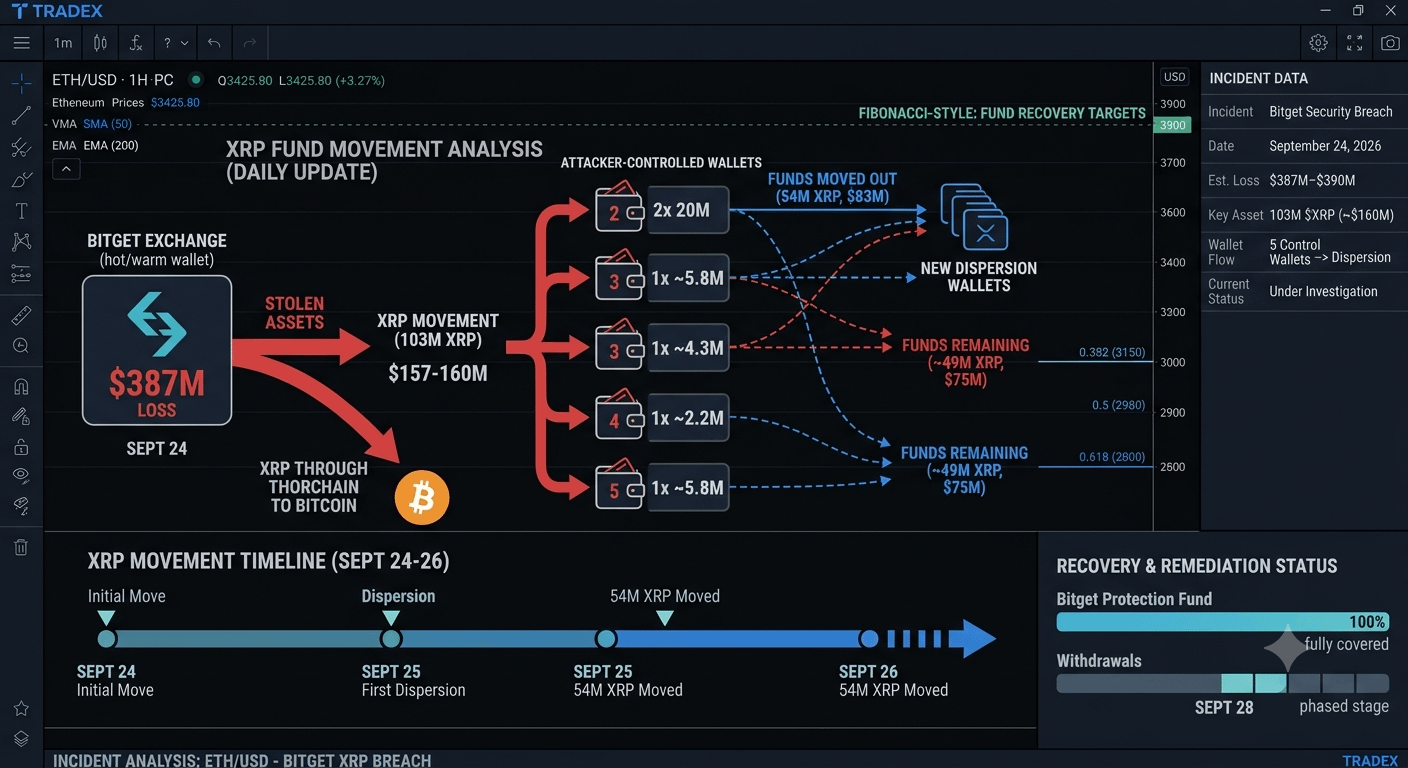
On September 24, 2026, cryptocurrency exchange Bitget experienced a major security incident involving unauthorized access to its hot and warm wallets, resulting in total estimated losses of approximately $387.5 million.
A significant portion of the stolen funds comprised $XRP P, with attackers transferring around 103 million $XRP P (valued at $157M–$160M at the time) into five attacker-controlled holding wallets. By September 26, approximately 54 million$XRP (~$83 million) were moved out of three of those initial wallets, leaving two wallets nearly emptied and reducing another to around 5.8 million XRP.
Roughly 49 million to 70 million XRP remained in the original receiving addresses. The attacker dispersed these funds into smaller addresses overnight and routed portions through cross-chain protocols like THORChain into Bitcoin. Because XRP is the native token of the XRP Ledger, Ripple lacks a protocol-level mechanism to freeze these assets directly in private wallets.
Key updates regarding the incident:
Protection Fund Coverage: Bitget confirmed that all losses will be fully covered by its User Protection Fund (holding over $460 million in BTC), meaning customer account balances remain unaffected.
Withdrawals: Withdrawals are scheduled to resume in phased stages starting September 28, 2026.
Attribution: Bitget CEO Gracy Chen indicated that security investigators suspect a North Korea-linked cybercrime organization was behind the breach.
#BitgetHackerMoves83MStolenXRP
On September 24, 2026, cryptocurrency exchange Bitget experienced a major security incident involving unauthorized access to its hot and warm wallets, resulting in total estimated losses of approximately $387.5 million.
A significant portion of the stolen funds comprised $XRP P, with attackers transferring around 103 million $XRP P (valued at $157M–$160M at the time) into five attacker-controlled holding wallets. By September 26, approximately 54 million$XRP (~$83 million) were moved out of three of those initial wallets, leaving two wallets nearly emptied and reducing another to around 5.8 million XRP.
Roughly 49 million to 70 million XRP remained in the original receiving addresses. The attacker dispersed these funds into smaller addresses overnight and routed portions through cross-chain protocols like THORChain into Bitcoin. Because XRP is the native token of the XRP Ledger, Ripple lacks a protocol-level mechanism to freeze these assets directly in private wallets.
Key updates regarding the incident:
Protection Fund Coverage: Bitget confirmed that all losses will be fully covered by its User Protection Fund (holding over $460 million in BTC), meaning customer account balances remain unaffected.
Withdrawals: Withdrawals are scheduled to resume in phased stages starting September 28, 2026.
Attribution: Bitget CEO Gracy Chen indicated that security investigators suspect a North Korea-linked cybercrime organization was behind the breach.
On September 24, 2026, cryptocurrency exchange Bitget experienced a major security incident involving unauthorized access to its hot and warm wallets, resulting in total estimated losses of approximately $387.5 million.
A significant portion of the stolen funds comprised $XRP P, with attackers transferring around 103 million $XRP P (valued at $157M–$160M at the time) into five attacker-controlled holding wallets. By September 26, approximately 54 million$XRP (~$83 million) were moved out of three of those initial wallets, leaving two wallets nearly emptied and reducing another to around 5.8 million XRP.
Roughly 49 million to 70 million XRP remained in the original receiving addresses. The attacker dispersed these funds into smaller addresses overnight and routed portions through cross-chain protocols like THORChain into Bitcoin. Because XRP is the native token of the XRP Ledger, Ripple lacks a protocol-level mechanism to freeze these assets directly in private wallets.
Key updates regarding the incident:
Protection Fund Coverage: Bitget confirmed that all losses will be fully covered by its User Protection Fund (holding over $460 million in BTC), meaning customer account balances remain unaffected.
Withdrawals: Withdrawals are scheduled to resume in phased stages starting September 28, 2026.
Attribution: Bitget CEO Gracy Chen indicated that security investigators suspect a North Korea-linked cybercrime organization was behind the breach.
32

·
--
On September 24, 2026, #Bitget suffered a major security breach, with approximately $387M–$390M in assets allegedly stolen.
A large portion of the stolen funds was $XRP .
Around 103M $XRP , with an approximate value of $157M–$160M at the time, were transferred to five wallets controlled by the attacker.
By September 26, approximately 54M XRP ($83M) had already been moved out of three of those wallets.
Two wallets, each containing around 20M XRP, were almost completely emptied, while another was reduced to about 5.8M XRP.
That left around 49M XRP, valued at approximately $75M at the time, still in the original wallets.
The transfers also intensified overnight, with funds distributed into new wallets. Some reports indicate that part of the XRP was later moved via THORChain to Bitcoin.
This is definitely a situation I keep under watch while the funds continue to move.
#BitgetHackerMoves83MStolenXRP
On September 24, 2026, #Bitget suffered a major security breach, with approximately $387M–$390M in assets allegedly stolen.
A large portion of the stolen funds was $XRP .
Around 103M $XRP , with an approximate value of $157M–$160M at the time, were transferred to five wallets controlled by the attacker.
By September 26, approximately 54M XRP ($83M) had already been moved out of three of those wallets.
Two wallets, each containing around 20M XRP, were almost completely emptied, while another was reduced to about 5.8M XRP.
That left around 49M XRP, valued at approximately $75M at the time, still in the original wallets.
The transfers also intensified overnight, with funds distributed into new wallets. Some reports indicate that part of the XRP was later moved via THORChain to Bitcoin.
This is definitely a situation I keep under watch while the funds continue to move.
#BitgetHackerMoves83MStolenXRP
A large portion of the stolen funds was $XRP .
Around 103M $XRP , with an approximate value of $157M–$160M at the time, were transferred to five wallets controlled by the attacker.
By September 26, approximately 54M XRP ($83M) had already been moved out of three of those wallets.
Two wallets, each containing around 20M XRP, were almost completely emptied, while another was reduced to about 5.8M XRP.
That left around 49M XRP, valued at approximately $75M at the time, still in the original wallets.
The transfers also intensified overnight, with funds distributed into new wallets. Some reports indicate that part of the XRP was later moved via THORChain to Bitcoin.
This is definitely a situation I keep under watch while the funds continue to move.
#BitgetHackerMoves83MStolenXRP


432
Institutional funds surge in a frenzy, propelling the crypto market into a historic moment
In the last week of September 2026, the global crypto market is undergoing an unprecedented wave of institutional capital. Bitcoin spot ETFs saw net inflows of as much as $2.39 billion in a single week, setting the highest record since October 2025, with cumulative net inflows returning to positive at roughly $930 million. Meanwhile, Solana spot ETFs also recorded a historic weekly inflow high of $188 million, second only to the $199 million logged in their first week after listing. Both ETFs expanded in tandem, signaling that traditional financial institutions’ enthusiasm for allocating to crypto assets is rapidly heating up.
1. Bitcoin ETF flows keep pouring in, yet the price trades sideways
Since September 17, Bitcoin spot ETFs have recorded net inflows for seven consecutive trading days, pulling in about $3.0 billion in total. Yet, in stark contrast to the fervor of capital flows, BTC’s price has remained locked in a tight range of around $84,000, unable to break out effectively. JPMorgan analysts noted that if short sellers’ positions continue to unwind, Bitcoin could outperform gold. The core contradiction in the market right now is that massive capital is entering, but there is a lack of short-term price catalysts; investors are waiting for the next directional signal. In the Plaza Community, BTC discussions have reached 5,040 mentions. Bullish sentiment clearly leads, with 286 bullish posts compared to only 37 bearish ones—reflecting retail traders’ confidence in the mid-term outlook.
2. Solana’s ecosystem erupts across the board—ETF and fundamentals drive together
Solana’s performance this week has been especially impressive. The SOL spot ETF logged a weekly inflow of $188 million, indicating strong institutional demand. In terms of price, SOL rose by about 3% to $123.92, backed by multiple positive tailwinds: the injection of $500 million USDC into the ecosystem to provide liquidity support, and the Alpenglow testnet migration to ultimately shorten confirmation time to 100 to 150 milliseconds, pushing technical performance to a new level. However, it’s worth noting that the RSI has broken above 81 into overbought territory, and with whales transferring $60 million worth of SOL to exchanges, the risk of a near-term pullback should not be ignored. Plaza data shows SOL mentions of 3,712 times, with 148 bullish posts and only 5 bearish ones—sentiment is extremely optimistic.
3. Tokenized US stocks and deep integration with traditional finance
One of the most striking developments this week is that Quant Network was selected by The Clearing House, an entity under the U.S. Clearing Association, to be included in its on-chain money initiative project. This enabled the UK’s seven largest banks to complete real tokenized GBP deposit transactions. After the news was released, the QNT token surged more than 54% within 24 hours, jumping from $105.68 to $163.30. At one point, RSI touched an extreme level of 96. As of the time of writing, QNT perpetual contracts are quoted at $166.09, with a 24-hour swing of as much as $103 to $195, and trading volume exceeding $1.06 billion. At the same time, Ethena and Binance Equities reached a cooperation agreement to bring tokenized stock receipts into the USDe collateral framework. ENA surged 277% from its July low to $0.28, with an additional $90 million in collateral added. Tokenized assets are moving from concept toward large-scale real-world applications.
4. The Federal Reserve steps in—stablecoin regulation framework accelerates
This week, the Federal Reserve proposed two stablecoin regulatory initiatives under the GENIUS Act, requiring regulated stablecoin issuers to fully back their tokens using short-term U.S. Treasury bills and high-quality liquid assets. This framework means stablecoins will face formal regulatory oversight at the U.S. federal level, which could accelerate the market share expansion of compliant stablecoins such as USDC. Meanwhile, the Trump administration is exploring promoting dollar-pegged stablecoins overseas through joint ventures between the government and the private sector. As the bridge connecting traditional finance and the crypto world, the clearer regulation of stablecoins is poised to have far-reaching impact across the entire industry.
5. The security alarm keeps ringing—Bitget’s hack incident continues to unfold
As the industry grows rapidly, security incidents once again serve as a warning. The $387.5 million hack suffered by Bitget has been confirmed to be linked to a North Korean hacker organization. The attackers exploited a vulnerability in the trust chain of transaction signatures to siphon off $185 million within roughly one minute. The stolen funds were laundered through THORChain, Wasabi CoinJoin, and cross-chain swaps. Circle and Tether have frozen the relevant stablecoins. Notably, the hacker also moved $83 million worth of XRP, exposing the structural limitations of Ripple’s inability to freeze native XRP. THORChain refused Bitget’s request to block the attackers’ addresses based on decentralization principles, triggering intense community debate over the balance between decentralization and compliance.
Overall, the market this week is driven by three main themes: institutional capital accelerating into the space, tokenized assets exploding, and regulatory frameworks taking shape. Persistent ETF inflows provide strong underlying support for the market’s foundation, but overbought technical conditions in the short term and the continued occurrence of security incidents remind investors to stay rational. In the context of acceleration into the institutional era, compliance, security, and infrastructure will be key variables determining the industry’s next stage.
#SOLSpotETFWeeklyInflow188M #BitgetHackerMoves83MStolenXRP #ENA surges 277%
Institutional funds surge in a frenzy, propelling the crypto market into a historic moment
In the last week of September 2026, the global crypto market is undergoing an unprecedented wave of institutional capital. Bitcoin spot ETFs saw net inflows of as much as $2.39 billion in a single week, setting the highest record since October 2025, with cumulative net inflows returning to positive at roughly $930 million. Meanwhile, Solana spot ETFs also recorded a historic weekly inflow high of $188 million, second only to the $199 million logged in their first week after listing. Both ETFs expanded in tandem, signaling that traditional financial institutions’ enthusiasm for allocating to crypto assets is rapidly heating up.
1. Bitcoin ETF flows keep pouring in, yet the price trades sideways
Since September 17, Bitcoin spot ETFs have recorded net inflows for seven consecutive trading days, pulling in about $3.0 billion in total. Yet, in stark contrast to the fervor of capital flows, BTC’s price has remained locked in a tight range of around $84,000, unable to break out effectively. JPMorgan analysts noted that if short sellers’ positions continue to unwind, Bitcoin could outperform gold. The core contradiction in the market right now is that massive capital is entering, but there is a lack of short-term price catalysts; investors are waiting for the next directional signal. In the Plaza Community, BTC discussions have reached 5,040 mentions. Bullish sentiment clearly leads, with 286 bullish posts compared to only 37 bearish ones—reflecting retail traders’ confidence in the mid-term outlook.
2. Solana’s ecosystem erupts across the board—ETF and fundamentals drive together
Solana’s performance this week has been especially impressive. The SOL spot ETF logged a weekly inflow of $188 million, indicating strong institutional demand. In terms of price, SOL rose by about 3% to $123.92, backed by multiple positive tailwinds: the injection of $500 million USDC into the ecosystem to provide liquidity support, and the Alpenglow testnet migration to ultimately shorten confirmation time to 100 to 150 milliseconds, pushing technical performance to a new level. However, it’s worth noting that the RSI has broken above 81 into overbought territory, and with whales transferring $60 million worth of SOL to exchanges, the risk of a near-term pullback should not be ignored. Plaza data shows SOL mentions of 3,712 times, with 148 bullish posts and only 5 bearish ones—sentiment is extremely optimistic.
3. Tokenized US stocks and deep integration with traditional finance
One of the most striking developments this week is that Quant Network was selected by The Clearing House, an entity under the U.S. Clearing Association, to be included in its on-chain money initiative project. This enabled the UK’s seven largest banks to complete real tokenized GBP deposit transactions. After the news was released, the QNT token surged more than 54% within 24 hours, jumping from $105.68 to $163.30. At one point, RSI touched an extreme level of 96. As of the time of writing, QNT perpetual contracts are quoted at $166.09, with a 24-hour swing of as much as $103 to $195, and trading volume exceeding $1.06 billion. At the same time, Ethena and Binance Equities reached a cooperation agreement to bring tokenized stock receipts into the USDe collateral framework. ENA surged 277% from its July low to $0.28, with an additional $90 million in collateral added. Tokenized assets are moving from concept toward large-scale real-world applications.
4. The Federal Reserve steps in—stablecoin regulation framework accelerates
This week, the Federal Reserve proposed two stablecoin regulatory initiatives under the GENIUS Act, requiring regulated stablecoin issuers to fully back their tokens using short-term U.S. Treasury bills and high-quality liquid assets. This framework means stablecoins will face formal regulatory oversight at the U.S. federal level, which could accelerate the market share expansion of compliant stablecoins such as USDC. Meanwhile, the Trump administration is exploring promoting dollar-pegged stablecoins overseas through joint ventures between the government and the private sector. As the bridge connecting traditional finance and the crypto world, the clearer regulation of stablecoins is poised to have far-reaching impact across the entire industry.
5. The security alarm keeps ringing—Bitget’s hack incident continues to unfold
As the industry grows rapidly, security incidents once again serve as a warning. The $387.5 million hack suffered by Bitget has been confirmed to be linked to a North Korean hacker organization. The attackers exploited a vulnerability in the trust chain of transaction signatures to siphon off $185 million within roughly one minute. The stolen funds were laundered through THORChain, Wasabi CoinJoin, and cross-chain swaps. Circle and Tether have frozen the relevant stablecoins. Notably, the hacker also moved $83 million worth of XRP, exposing the structural limitations of Ripple’s inability to freeze native XRP. THORChain refused Bitget’s request to block the attackers’ addresses based on decentralization principles, triggering intense community debate over the balance between decentralization and compliance.
Overall, the market this week is driven by three main themes: institutional capital accelerating into the space, tokenized assets exploding, and regulatory frameworks taking shape. Persistent ETF inflows provide strong underlying support for the market’s foundation, but overbought technical conditions in the short term and the continued occurrence of security incidents remind investors to stay rational. In the context of acceleration into the institutional era, compliance, security, and infrastructure will be key variables determining the industry’s next stage.
#SOLSpotETFWeeklyInflow188M #BitgetHackerMoves83MStolenXRP #ENA surges 277%
In the last week of September 2026, the global crypto market is undergoing an unprecedented wave of institutional capital. Bitcoin spot ETFs saw net inflows of as much as $2.39 billion in a single week, setting the highest record since October 2025, with cumulative net inflows returning to positive at roughly $930 million. Meanwhile, Solana spot ETFs also recorded a historic weekly inflow high of $188 million, second only to the $199 million logged in their first week after listing. Both ETFs expanded in tandem, signaling that traditional financial institutions’ enthusiasm for allocating to crypto assets is rapidly heating up.
1. Bitcoin ETF flows keep pouring in, yet the price trades sideways
Since September 17, Bitcoin spot ETFs have recorded net inflows for seven consecutive trading days, pulling in about $3.0 billion in total. Yet, in stark contrast to the fervor of capital flows, BTC’s price has remained locked in a tight range of around $84,000, unable to break out effectively. JPMorgan analysts noted that if short sellers’ positions continue to unwind, Bitcoin could outperform gold. The core contradiction in the market right now is that massive capital is entering, but there is a lack of short-term price catalysts; investors are waiting for the next directional signal. In the Plaza Community, BTC discussions have reached 5,040 mentions. Bullish sentiment clearly leads, with 286 bullish posts compared to only 37 bearish ones—reflecting retail traders’ confidence in the mid-term outlook.
2. Solana’s ecosystem erupts across the board—ETF and fundamentals drive together
Solana’s performance this week has been especially impressive. The SOL spot ETF logged a weekly inflow of $188 million, indicating strong institutional demand. In terms of price, SOL rose by about 3% to $123.92, backed by multiple positive tailwinds: the injection of $500 million USDC into the ecosystem to provide liquidity support, and the Alpenglow testnet migration to ultimately shorten confirmation time to 100 to 150 milliseconds, pushing technical performance to a new level. However, it’s worth noting that the RSI has broken above 81 into overbought territory, and with whales transferring $60 million worth of SOL to exchanges, the risk of a near-term pullback should not be ignored. Plaza data shows SOL mentions of 3,712 times, with 148 bullish posts and only 5 bearish ones—sentiment is extremely optimistic.
3. Tokenized US stocks and deep integration with traditional finance
One of the most striking developments this week is that Quant Network was selected by The Clearing House, an entity under the U.S. Clearing Association, to be included in its on-chain money initiative project. This enabled the UK’s seven largest banks to complete real tokenized GBP deposit transactions. After the news was released, the QNT token surged more than 54% within 24 hours, jumping from $105.68 to $163.30. At one point, RSI touched an extreme level of 96. As of the time of writing, QNT perpetual contracts are quoted at $166.09, with a 24-hour swing of as much as $103 to $195, and trading volume exceeding $1.06 billion. At the same time, Ethena and Binance Equities reached a cooperation agreement to bring tokenized stock receipts into the USDe collateral framework. ENA surged 277% from its July low to $0.28, with an additional $90 million in collateral added. Tokenized assets are moving from concept toward large-scale real-world applications.
4. The Federal Reserve steps in—stablecoin regulation framework accelerates
This week, the Federal Reserve proposed two stablecoin regulatory initiatives under the GENIUS Act, requiring regulated stablecoin issuers to fully back their tokens using short-term U.S. Treasury bills and high-quality liquid assets. This framework means stablecoins will face formal regulatory oversight at the U.S. federal level, which could accelerate the market share expansion of compliant stablecoins such as USDC. Meanwhile, the Trump administration is exploring promoting dollar-pegged stablecoins overseas through joint ventures between the government and the private sector. As the bridge connecting traditional finance and the crypto world, the clearer regulation of stablecoins is poised to have far-reaching impact across the entire industry.
5. The security alarm keeps ringing—Bitget’s hack incident continues to unfold
As the industry grows rapidly, security incidents once again serve as a warning. The $387.5 million hack suffered by Bitget has been confirmed to be linked to a North Korean hacker organization. The attackers exploited a vulnerability in the trust chain of transaction signatures to siphon off $185 million within roughly one minute. The stolen funds were laundered through THORChain, Wasabi CoinJoin, and cross-chain swaps. Circle and Tether have frozen the relevant stablecoins. Notably, the hacker also moved $83 million worth of XRP, exposing the structural limitations of Ripple’s inability to freeze native XRP. THORChain refused Bitget’s request to block the attackers’ addresses based on decentralization principles, triggering intense community debate over the balance between decentralization and compliance.
Overall, the market this week is driven by three main themes: institutional capital accelerating into the space, tokenized assets exploding, and regulatory frameworks taking shape. Persistent ETF inflows provide strong underlying support for the market’s foundation, but overbought technical conditions in the short term and the continued occurrence of security incidents remind investors to stay rational. In the context of acceleration into the institutional era, compliance, security, and infrastructure will be key variables determining the industry’s next stage.
#SOLSpotETFWeeklyInflow188M #BitgetHackerMoves83MStolenXRP #ENA surges 277%
6

Article
Bitget Hacker just moved `$83M in stolen XRP and Ripple CAN'T FREEZE IT 😱#BitgetHackerMoves$83MStolenXRP
ALERT: Bitget Hacker Moves `$83M in Stolen XRP — And Ripple Can't Do Anything To Stop It
The nightmare from the $388M Bitget hack just got worse.
The hacker has officially started laundering the stolen funds, moving $83 Million worth of XRP out of the original holding wallets — and exposing a terrifying truth about XRP itself.
Ripple is powerless.
What Just Happened?
On Thursday, hackers drained nearly 103 Million XRP from Bitget and split it into 5 wallets to avoid detection.
By Saturday 12:41 UTC, on-chain data shows:
• Wallet 1: 20M XRP -> 23 XRP left (emptied)
• Wallet 2: 20M XRP -> 55 XRP left (emptied)
• Wallet 3: Down to 5.8M XRP and still draining
• Total moved so far: 54 Million XRP (∼$`83M)
• Total still sitting: ∼`$75M in 5 original wallets
The transfers accelerated overnight. At 04:32 UTC, 70M XRP remained. Just 8 hours later, only 49M remained. The funds are being scattered into dozens of smaller wallets.
Why Ripple Can't Freeze It
This is the shocking part most people don't know.
The XRP Ledger DOES have a freeze function, but it only works for tokens issued by companies on the ledger.
XRP itself is the NATIVE asset. It has no issuer. No kill switch. No blacklist button.
Ripple CEO can watch, but he cannot stop, block, or reverse a single transaction.
Contrast this:
• USDT / USDC: Circle & Tether already froze ∼$`320,000 of the stolen stablecoins in hours.
• ETH: 68,465 ETH (∼`$183M) is sitting in attacker wallets. No one can freeze ETH either.
• XRP: $`83M is now in motion. The only hope is if it hits a centralized exchange that can block the account.
If the hacker keeps it in private wallets, it's untouchable.
Bitget's Response
Bitget has raised the total loss estimate from $351M to *$387.5 Million*, now including stolen Zcash and TRON transfers.
They claim:
• Protection Fund will cover all losses
• User balances are NOT affected
• Withdrawals will resume in stages: BTC on Sept 28, ETH on Sept 29, USDT on Sept 30, others by Oct 2.
But trust is shaken.
What Happens Next? Sell Pressure Incoming?
`$83M in XRP moving means one thing: The hacker will try to sell.
$XRP is trading at ∼$`1.54 right now. A slow-motion dump of 54M XRP across exchanges could trigger massive volatility.
Whales are watching. Exchanges are on high alert.
The dollars have been frozen. The $XRP has not.
This is now a race: Can exchanges blacklist the hacker faster than he can cash out?
• 103M XRP stolen, split in 5 wallets
• 2 wallets already EMPTIED
• $`75M still sitting, ready to dump
• Circle froze USDC in hours, but XRP? NO FREEZE BUTTON EXISTS
If this `$83M hits exchanges, $XRP will bleed.
Are you holding XRP? 👇
#BitgetHackerMoves83MStolenXRP #Xrp🔥🔥 #bitgethack #Ripple
Bitget Hacker just moved `$83M in stolen XRP and Ripple CAN'T FREEZE IT 😱
#BitgetHackerMoves$83MStolenXRP
ALERT: Bitget Hacker Moves `$83M in Stolen XRP — And Ripple Can't Do Anything To Stop It
The nightmare from the $388M Bitget hack just got worse.
The hacker has officially started laundering the stolen funds, moving $83 Million worth of XRP out of the original holding wallets — and exposing a terrifying truth about XRP itself.
Ripple is powerless.
What Just Happened?
On Thursday, hackers drained nearly 103 Million XRP from Bitget and split it into 5 wallets to avoid detection.
By Saturday 12:41 UTC, on-chain data shows:
• Wallet 1: 20M XRP -> 23 XRP left (emptied)
• Wallet 2: 20M XRP -> 55 XRP left (emptied)
• Wallet 3: Down to 5.8M XRP and still draining
• Total moved so far: 54 Million XRP (∼$`83M)
• Total still sitting: ∼`$75M in 5 original wallets
The transfers accelerated overnight. At 04:32 UTC, 70M XRP remained. Just 8 hours later, only 49M remained. The funds are being scattered into dozens of smaller wallets.
Why Ripple Can't Freeze It
This is the shocking part most people don't know.
The XRP Ledger DOES have a freeze function, but it only works for tokens issued by companies on the ledger.
XRP itself is the NATIVE asset. It has no issuer. No kill switch. No blacklist button.
Ripple CEO can watch, but he cannot stop, block, or reverse a single transaction.
Contrast this:
• USDT / USDC: Circle & Tether already froze ∼$`320,000 of the stolen stablecoins in hours.
• ETH: 68,465 ETH (∼`$183M) is sitting in attacker wallets. No one can freeze ETH either.
• XRP: $`83M is now in motion. The only hope is if it hits a centralized exchange that can block the account.
If the hacker keeps it in private wallets, it's untouchable.
Bitget's Response
Bitget has raised the total loss estimate from $351M to *$387.5 Million*, now including stolen Zcash and TRON transfers.
They claim:
• Protection Fund will cover all losses
• User balances are NOT affected
• Withdrawals will resume in stages: BTC on Sept 28, ETH on Sept 29, USDT on Sept 30, others by Oct 2.
But trust is shaken.
What Happens Next? Sell Pressure Incoming?
`$83M in XRP moving means one thing: The hacker will try to sell.
$XRP is trading at ∼$`1.54 right now. A slow-motion dump of 54M XRP across exchanges could trigger massive volatility.
Whales are watching. Exchanges are on high alert.
The dollars have been frozen. The $XRP has not.
This is now a race: Can exchanges blacklist the hacker faster than he can cash out?
• 103M XRP stolen, split in 5 wallets
• 2 wallets already EMPTIED
• $`75M still sitting, ready to dump
• Circle froze USDC in hours, but XRP? NO FREEZE BUTTON EXISTS
If this `$83M hits exchanges, $XRP will bleed.
Are you holding XRP? 👇
#BitgetHackerMoves83MStolenXRP #Xrp🔥🔥 #bitgethack #Ripple
ALERT: Bitget Hacker Moves `$83M in Stolen XRP — And Ripple Can't Do Anything To Stop It
The nightmare from the $388M Bitget hack just got worse.
The hacker has officially started laundering the stolen funds, moving $83 Million worth of XRP out of the original holding wallets — and exposing a terrifying truth about XRP itself.
Ripple is powerless.
What Just Happened?
On Thursday, hackers drained nearly 103 Million XRP from Bitget and split it into 5 wallets to avoid detection.
By Saturday 12:41 UTC, on-chain data shows:
• Wallet 1: 20M XRP -> 23 XRP left (emptied)
• Wallet 2: 20M XRP -> 55 XRP left (emptied)
• Wallet 3: Down to 5.8M XRP and still draining
• Total moved so far: 54 Million XRP (∼$`83M)
• Total still sitting: ∼`$75M in 5 original wallets
The transfers accelerated overnight. At 04:32 UTC, 70M XRP remained. Just 8 hours later, only 49M remained. The funds are being scattered into dozens of smaller wallets.
Why Ripple Can't Freeze It
This is the shocking part most people don't know.
The XRP Ledger DOES have a freeze function, but it only works for tokens issued by companies on the ledger.
XRP itself is the NATIVE asset. It has no issuer. No kill switch. No blacklist button.
Ripple CEO can watch, but he cannot stop, block, or reverse a single transaction.
Contrast this:
• USDT / USDC: Circle & Tether already froze ∼$`320,000 of the stolen stablecoins in hours.
• ETH: 68,465 ETH (∼`$183M) is sitting in attacker wallets. No one can freeze ETH either.
• XRP: $`83M is now in motion. The only hope is if it hits a centralized exchange that can block the account.
If the hacker keeps it in private wallets, it's untouchable.
Bitget's Response
Bitget has raised the total loss estimate from $351M to *$387.5 Million*, now including stolen Zcash and TRON transfers.
They claim:
• Protection Fund will cover all losses
• User balances are NOT affected
• Withdrawals will resume in stages: BTC on Sept 28, ETH on Sept 29, USDT on Sept 30, others by Oct 2.
But trust is shaken.
What Happens Next? Sell Pressure Incoming?
`$83M in XRP moving means one thing: The hacker will try to sell.
$XRP is trading at ∼$`1.54 right now. A slow-motion dump of 54M XRP across exchanges could trigger massive volatility.
Whales are watching. Exchanges are on high alert.
The dollars have been frozen. The $XRP has not.
This is now a race: Can exchanges blacklist the hacker faster than he can cash out?
• 103M XRP stolen, split in 5 wallets
• 2 wallets already EMPTIED
• $`75M still sitting, ready to dump
• Circle froze USDC in hours, but XRP? NO FREEZE BUTTON EXISTS
If this `$83M hits exchanges, $XRP will bleed.
Are you holding XRP? 👇
#BitgetHackerMoves83MStolenXRP #Xrp🔥🔥 #bitgethack #Ripple
128
·
--
#BitgetHackerMoves83MStolenXRP
👽👽👽👽👽👽👽👽👽👽👽👽👽👽
🚨 $XRP Alert: Has $83 million been transferred by an attacker from Bitget? 👀
Bitget has reportedly returned to the spotlight again, with claims that around 54M from $XRP , worth roughly $83 million, was transferred from wallets associated with the attacker.
Initially, a theft of 103M $XRP was reported, while a large portion of the funds may still be present in linked wallets.
⚠️ Key point:
There is no confirmed evidence that the transferred XRP was sold.
If these funds were sent to centralized exchanges, platforms may flag or restrict them.
At the moment, the crypto community is closely monitoring the wallets. Any further movement could increase pressure on the market.
#XRP
#Bitget
#CryptoSecurity
#CryptoNews
#BitgetHackerMoves83MStolenXRP
👽👽👽👽👽👽👽👽👽👽👽👽👽👽
🚨 $XRP Alert: Has $83 million been transferred by an attacker from Bitget? 👀
Bitget has reportedly returned to the spotlight again, with claims that around 54M from $XRP , worth roughly $83 million, was transferred from wallets associated with the attacker.
Initially, a theft of 103M $XRP was reported, while a large portion of the funds may still be present in linked wallets.
⚠️ Key point:
There is no confirmed evidence that the transferred XRP was sold.
If these funds were sent to centralized exchanges, platforms may flag or restrict them.
At the moment, the crypto community is closely monitoring the wallets. Any further movement could increase pressure on the market.
#XRP
#Bitget
#CryptoSecurity
#CryptoNews
👽👽👽👽👽👽👽👽👽👽👽👽👽👽
🚨 $XRP Alert: Has $83 million been transferred by an attacker from Bitget? 👀
Bitget has reportedly returned to the spotlight again, with claims that around 54M from $XRP , worth roughly $83 million, was transferred from wallets associated with the attacker.
Initially, a theft of 103M $XRP was reported, while a large portion of the funds may still be present in linked wallets.
⚠️ Key point:
There is no confirmed evidence that the transferred XRP was sold.
If these funds were sent to centralized exchanges, platforms may flag or restrict them.
At the moment, the crypto community is closely monitoring the wallets. Any further movement could increase pressure on the market.
#XRP
#Bitget
#CryptoSecurity
#CryptoNews
152
Log in to explore more content
Join global crypto users on Binance Square
⚡️ Get latest and useful information about crypto.
💬 Trusted by the world’s largest crypto exchange.
👍 Discover real insights from verified creators.
Email / Phone number
Trending Topics
1
#BTCFallsBelow$83000
1,353 views
47 Discussing
2
#FedProposesPaymentStablecoinRules
11,122 views
262 Discussing
3
#ChinaMayLetAlibabaByteDanceBuyNvidiaChips
12,737 views
317 Discussing
4
#USChinaRelease$30BTariffCutProductLists
2,150 views
38 Discussing
5
#SKoreaFSCConsidersVirtualAssetMarketMaker
10,561 views
263 Discussing
6
#ChinaIndustrialProfitGrowthSlowsFourthMonth
11,005 views
267 Discussing
7
#BitwiseFilesFinalNEARSpotETFProspectus
126,840 views
1,833 Discussing
8
#BitgetHackerMoves$83MStolenXRP
41,317 views
179 Discussing
9
#SOLSpotETFWeeklyInflow$188M
25,840 views
142 Discussing
10
#DogecoinETFsPostBiggestWeekSinceLaunch
71,672 views
1,155 Discussing