
#695
695
79 views
14 Discussing
Hot
Latest

·
--
Gensyn slept at $0.014 all day yesterday. Then 1am UTC hit and it woke up angry.
$AIGENSYN is $0.0174 now, up 28% on the day, and the live hour just printed $0.0175 — the highest this coin has seen in five days. The ignition bar at 01:00 UTC did seven times the usual hourly volume. $1.45M through Binance so far.
Here's the bit that should slow anyone down before chasing it: there's no news. Nothing verified at all — even CoinMarketCap's own read on it is "no confirmed catalyst." And the push isn't spot buyers. Perps are doing the lifting: $10.9M of futures volume against $1.3M of spot, funding negative, shorts paying longs. Leverage, not conviction.
The coin itself is tiny — rank ~#695, $21.5M market cap, only 13% of its 10B supply actually circulating, still 84% below its April high of $0.1073. And this exact shape already played out once this week: it burst to $0.0146 on Friday morning and handed back 10% by Saturday.
The 06:00 UTC close is the verdict. A close up here and the leg is real. A close back under $0.01525 and tonight was a wick with a story attached. Which one are you betting on?
1
117
·
--
$ONE broke the fresh low last night — then took the line back in three closes.
The Nov 6–7 run took it $0.0011 to $0.0025. Then the give-back: 20:00 UTC closed $0.001681 under the $0.001692 fresh-low line, 21:00 closed $0.001647 — a second close under, fresh 24h low $0.001606 on the same hour.
And then buyers stepped back in. 22:00 closed $0.001726. 23:00 closed $0.001713. 00:00 closed $0.001739. Three straight closes back above the line that just broke.
Live $0.001722, -16.4% in 24 hours, $23.1M on Binance. The chart reads RSI 43, still under EMA20 $0.001829 and EMA50 $0.001823, window -15.1%. CoinGecko: rank #695, $25.6M, global volume $53.1M — about twice the whole market cap in a day — 7d +49.8%, -99.5% off the $0.37902 all-time high.
No fresh headline behind any of this — quote pages and prediction spam only. The run, the break, and the reclaim are all tape. The backdrop is old: the October 14 exploit analysis and the September L1-sunset proposal.
The other side: three closes is a reclaim, not a reversal. Price is still under both EMAs, and the 24 hours is still -16%. One hourly close back below $0.001692 unwrites the chapter, and $0.001606 is right underneath.
Not a call, either way. The 02:00 UTC close decides it — does ONE hold $0.001692 a fourth hour, or does the give-back resume toward $0.001606?
49
·
--
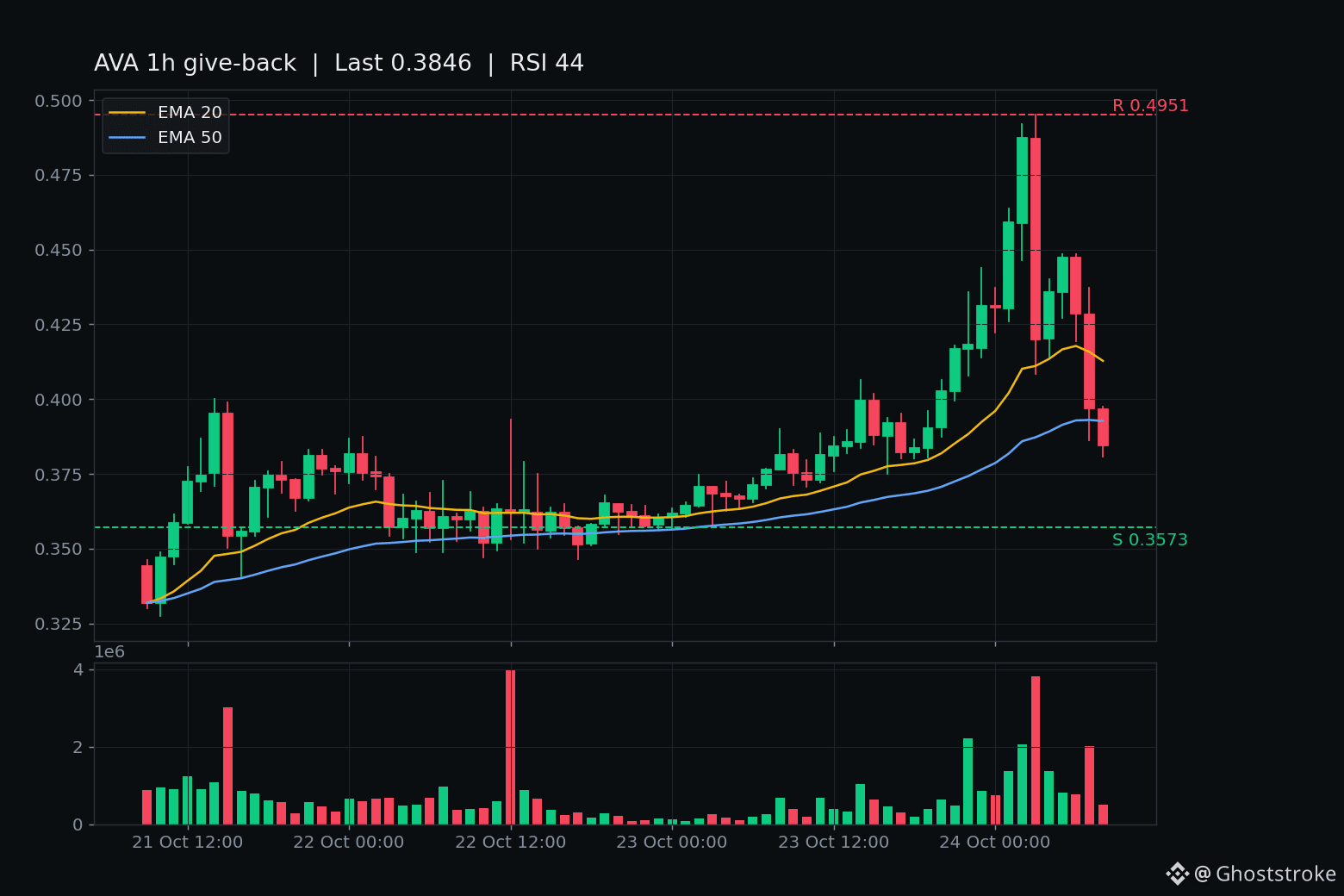
$AVA just gave back the leg — $0.3848, down 22% from last night's $0.4951 spike.
The tape since my leg-2 post: AVA stabilized $0.42–$0.44 into the morning, then both lines I flagged gave way on closed candles. 06:00 UTC closed $0.4285 — back under the old $0.4359 ceiling, the leg unwinding. 07:00 UTC did the real damage: $0.4283 down to a $0.3864 low, closed $0.3968 on $817k — decisively under the $0.4085 flush low. That's the give-back having legs, not a wobble. The forming hour is $0.3846, still sliding. Live $0.3848, -12.7% from the leg-2 post, $9.8M Binance volume.
The numbers: rank #695, $27.1M market cap, global volume $35.5M today — 1.3x the entire market cap changing hands in a day. 70.2M of 100M circulating, -94% off the $6.45 all-time high. The 7-day gain is down to +28.8% — it was +52.7% at the leg-2 post. The give-back already ate nearly half the week's run. Chart: RSI cooled to 44, price under its 1h EMA20 $0.4128 and EMA50 $0.3927.
No new headline here — checked twice. The Oct 22 buyback multiplier is still the story, and it's two days old. Buyback announcements buy a day, not a trend, and this one bought two legs before the tape took it back.
Levels: ceiling $0.4951. Overhead now $0.4359, then the $0.4085 flush low — reclaiming either reopens the leg. Below, the shelf is $0.351, the pre-move base — a full round-trip, about 9% under here.
Not a call. These small caps wreck accounts on exactly this moment — the pump's reason is still real, and the price is falling anyway. Does $0.351 hold as the floor, or is the buyback pump fully unwound first?
9

·
--
WAL surged 6.7% in five minutes! What happened? Key levels here10:01 (just now): WAL surged 6.7% within five minutes (5-minute window 09:56→10:01). As of 10:02:54, the current price is 0.06377, up 54.3% over 24h. AVA and IDOL also saw unusual moves around the same time.
📅 Data as of 10:02:54 (event trigger times are noted in each item; prices are real-time snapshots at the time of writing)
📌 In a nutshell: Short-term momentum is concentrated, and pullbacks can come fast—placing orders in batches is steadier than chasing a rally.
Market overview: BTC 81,535.00(-2.22%) · ETH 2,409.23(-3.97%); 24h market-wide: 39 gainers / 454 decliners; top 24h gainer: WAL +54.26%, top decliner: Lobster -29.03%.
WAL surged 6.7% in five minutes! What happened? Key levels here
10:01 (just now): WAL surged 6.7% within five minutes (5-minute window 09:56→10:01). As of 10:02:54, the current price is 0.06377, up 54.3% over 24h. AVA and IDOL also saw unusual moves around the same time.
📅 Data as of 10:02:54 (event trigger times are noted in each item; prices are real-time snapshots at the time of writing)
📌 In a nutshell: Short-term momentum is concentrated, and pullbacks can come fast—placing orders in batches is steadier than chasing a rally.
Market overview: BTC 81,535.00(-2.22%) · ETH 2,409.23(-3.97%); 24h market-wide: 39 gainers / 454 decliners; top 24h gainer: WAL +54.26%, top decliner: Lobster -29.03%.

·
--
Solana passkey capabilities are still in draft|SOL around $102|Watch how the cost rules take shape first
My stance is neutral to cautious. I would not present the technical direction of “supporting Passkeys” as if it had already translated into user growth. The original Solana Foundation SIMD-0565 is still a Draft. It proposes adding secp256r1—the commonly used P-256 curve operations—to the low-level interfaces callable by on-chain programs. This is relevant to the cryptographic standards used by ecosystems such as Apple Secure Enclave, Android Keystore, WebAuthn, and passkeys. Its long-term significance is that it could make hardware-backed account verification and related application designs easier to implement. But “easier to build” does not mean wallets have already migrated at scale, much less that demand for SOL will immediately increase.
The specific progress I’ve seen this time is SIMD document PR #695, submitted on October 14. It proposes compute-unit costs for P-256 point verification, decompression, addition and subtraction, scalar multiplication, and multiscalar multiplication. The author calibrated the costs using an Agave fork on a private test cluster under heavily loaded blocks, proposing 9,000 CU for scalar multiplication and 20 CU for point verification. These are proposal figures, and the test hardware, account contention, and block conditions are quite specific. The PR is still Open; the workflow bot requires approval from at least one relevant member each from Anza and Firedancer before it can be merged. The related Agave code PR can be viewed as a cross-check on the implementation path, but that does not mean the feature is live on mainnet. What matters most to me is whether future pricing will adequately cover validators’ computational burden without making real-world application costs prohibitively high.
Why does this matter for trading? If the costs are set too low, popular apps could strain nodes during congestion. If they are set too high, hardware-key products may struggle to gain users. Value would have to flow through gradually via usability, wallet development, real users, and on-chain fees; a single documentation PR is not enough to push up the token price. At the time of writing, SOL/USD on Kraken is around $102.01, with a daily open of $103.34 and a rolling 24-hour range of $101.00–$104.65. The price is below the daily open, and for now I see no independent premium from the market for this proposal. The current trending topics on the plaza do not include a direct SOL rally narrative, so I’m discussing only genuinely relevant project developments, rather than borrowing tags from other coins.
If I were trading this myself, I would stay out for now. The only direction I would consider is a small spot long position; I would not chase the move with high leverage. Only if SOL gets back above $103.35 and holds on a retest would I use at most 2.5% of my total capital to build a trial position in stages. I would first target $104.65 and sell half, then look toward around $106 and exit most of the rest. I would set the initial stop-loss below $100.90 and close the position if that level breaks. If the price breaks through $103.35 but quickly falls back below it, I would reduce the position and exit early. If the trigger conditions are not met, I will remain flat. The conditions that would invalidate my view are clear: a decisive break above $104.65 followed by sustained support would make me more constructive; a break below $101 would put me on the defensive. No matter how promising the project draft is, it does not replace discipline.
Sources: Original Solana Foundation SIMD-0565, SIMD documentation PR #695, related Agave implementation PR, live Kraken SOL/USD market data. #SOL
The above reflects only my personal market observations and does not constitute investment advice.

4
·
--
UAI suddenly plunges 1.4% at a key time! Panic or opportunity? Support levels at a glanceAt 07:54 (5 minutes ago), UAI fell 1.4% at a key time (5-minute window: 07:49→07:54). As of 07:59:59, the current price is 0.2955, down 0.5% over 24h. DIA also moved sharply during the same period.
📅 Data as of 07:59:59 (event trigger times are noted in each item; prices are live snapshots at the time of writing)
📌 In a nutshell: Sharp moves during key periods (candlestick closes / U.S. market open and close) often involve institutional investors, making the signals more reliable
Market overview: BTC 85,731.00 (-0.85%) · ETH 2,709.14 (-0.61%); across the market, 262 gainers / 225 decliners over 24h; top gainer over 24h: RLC +99.42%; top loser: US -21.43%.
UAI suddenly plunges 1.4% at a key time! Panic or opportunity? Support levels at a glance
At 07:54 (5 minutes ago), UAI fell 1.4% at a key time (5-minute window: 07:49→07:54). As of 07:59:59, the current price is 0.2955, down 0.5% over 24h. DIA also moved sharply during the same period.
📅 Data as of 07:59:59 (event trigger times are noted in each item; prices are live snapshots at the time of writing)
📌 In a nutshell: Sharp moves during key periods (candlestick closes / U.S. market open and close) often involve institutional investors, making the signals more reliable
Market overview: BTC 85,731.00 (-0.85%) · ETH 2,709.14 (-0.61%); across the market, 262 gainers / 225 decliners over 24h; top gainer over 24h: RLC +99.42%; top loser: US -21.43%.
101
Log in to explore more content
Join global crypto users on Binance Square
⚡️ Get latest and useful information about crypto.
💬 Trusted by the world’s largest crypto exchange.
👍 Discover real insights from verified creators.
Email / Phone number
Trending Topics
1
#BTCReboundsAbove$60KAmidWhaleDipBuying
47,464 views
257 Discussing
2
#SolanaSets2027RoadmapToDoubleComputeCapacity
29,227 views
638 Discussing
3
#CaliforniaNvidiaProbeExaminesPotentialCriminalViolations
8,137 views
94 Discussing
4
#BlackRockLaunchesHKDollarDigitalLiquidityFund
26,043 views
511 Discussing
5
#NvidiaLoses$2.7TrillionInMonthAndAHalf
67,330 views
280 Discussing
6
#GlobalStocksFaceLongestLosingStreakSince2023
519,777 views
3,231 Discussing
7
#BlackRockIBITPostsRecord$541MSingleDayOutflow
84,491 views
173 Discussing
8
#AnthropicPlungesTowardIPOPriceonDay2
280,173 views
2,152 Discussing
9
#TwentyOneCapitalAdds172.25BTC
146,577 views
1,483 Discussing
10
#HKBillWouldExcludeTokenizedDepositsFromVirtualAssets
17,081 views
97 Discussing