
#36029
36029
3 views
3 Discussing
Hot
Latest

·
--
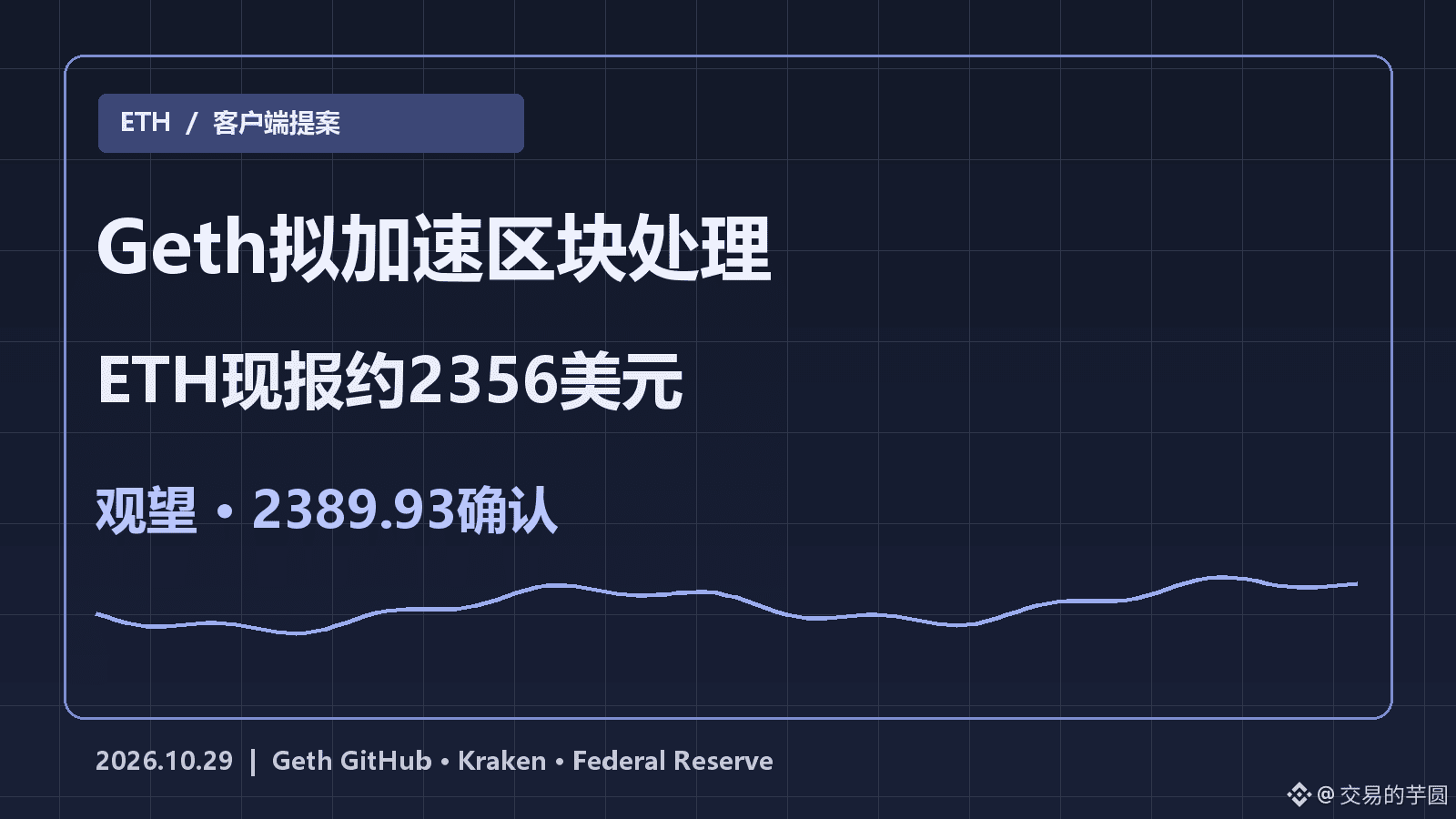
Geth proposes faster block processing | ETH at around $2,356, still below the daily high | A proposal is not a deployed upgrade
My stance is neutral to cautious; first, I want to see whether spot prices confirm strength. On October 27, the official GitHub repository for Ethereum execution client Geth saw proposal #36029 , which aims to shorten the preparation work performed before engine_newPayload executes a block. Developers propose processing transaction senders in parallel with root-hash calculations, avoiding redundant hashing of transactions and withdrawal roots, and decoding transactions in parallel when there are enough of them. At the time of checking, its status was still Open, meaning the design is under review. It has neither been merged nor become an upgrade completed on Ethereum mainnet. The proposal improves the client’s processing workflow; it cannot be directly translated into higher on-chain throughput, lower fees, or spot buying of ETH.
This is worth watching because, after an execution client receives a new block, it has to validate, process, and propagate it. If the preparation stage involves less redundant work, nodes may be able to begin execution sooner during busy periods, potentially improving operational efficiency over the long term. But performance gains need to be verified through benchmarks and testing across different node environments. Even if the proposal is merged in the future, the network would still need to release a version and node operators would need to upgrade before any observable system-wide effect could emerge. Describing a code proposal as “Glamsterdam has started” conflates two different things: the Ethereum Foundation previously said that activation of Glamsterdam on the Hoodi testnet had been postponed, and there is no new date yet.
The market currently seems to be digesting macroeconomic factors and divergent flows rather than pricing in this PR. Kraken’s ETH/USD quote showed trading at around $2,355.55, above the daily open of $2,347.12 but below the daily high of $2,389.93; the daily low was $2,319.54. At the same time, BTC/USD was around $81,126. ETH moving above its daily open is worth noting, but it is still some way from breaking the daily high. Farside reported net outflows of $60.2 million from U.S. spot ETH funds on October 27; the row for October 28 was still blank, so that should not be misread as either zero outflows or new inflows. On October 28, the Federal Reserve held rates at 3.75% to 4% by a 10–2 vote, with two members supporting a 25-basis-point hike; FOMC was still being discussed among the trending topics on Binance Square. Differences over interest rates can affect risk appetite, but they cannot, on their own, explain ETH’s price movements over this hour.
My key levels are $2,347.12, $2,389.93, and $2,319.54. If ETH falls back below the daily open and the rebound is weak, my view of short-term improvement is invalidated; a break below $2,319.54 would mean intraday support has failed. Only a high-volume move above $2,389.93 followed by a successful retest would lead me to upgrade the structure to a clearer breakout. At the project level, if the PR is closed or its scope is significantly reduced, I would also withdraw the expectation of improved efficiency.
If I were trading this myself, I would not add a position now; I would stay directionally neutral, with 0% allocated to new positions. Only if ETH holds above $2,389.93 and BTC does not fall back below $80,000 would I consider a spot long using 2% of total capital. The first target would be $2,420, where I would reduce the position by half; I would hold the rest for $2,460. After entry, I would set a stop-loss if ETH falls back to $2,368. If ETH breaks below $2,319.54, or a macro shock drives BTC below $80,000, I would close the position immediately. If none of these conditions are triggered, I would wait—without using high leverage or describing the plan as an executed trade.
Sources: Geth official GitHub proposal #36029, Ethereum Foundation blog, Kraken ETH/USD and BTC/USD, Farside ETH fund table, Federal Reserve statement of October 28, Binance Square trending topics. #FOMCMeeting
The above is solely my personal market observation and does not constitute investment advice.
7
·
--
Geth proposes optimizing new-block processing|Still under review, not yet live|ETH falls back below its daily high; wait for now
My stance is to keep watching ETH and not chase the rally for now. The trending topics on Binance Square and the most-searched terms over the past six hours have no new rising tag directly related to ETH. I also checked Binance News, Research and OTC, as well as the Fed, SEC, ETF flows, Strategy, exchange announcements and the Ethereum Foundation. Rather than force a connection to other coins’ trending topics, what’s more worth noting is PR #36029, newly opened in the official Geth code repository on October 27. The proposal aims to reduce duplicated work by execution clients before processing new-block payloads. This includes starting transaction senders earlier, calculating the transaction and withdrawal root hashes just once, and decoding in parallel when there are enough transactions. Its current GitHub status is still Open and it has not been merged; this is an engineering improvement under code review, absolutely not a sign that “the mainnet has already been upgraded” or that “Ethereum throughput will immediately increase.”
Why pay attention to details like this? More efficient execution clients may reduce the resource burden on validators and nodes when processing new blocks, potentially helping the network’s operational resilience over the long term. But this code mainly addresses local computational overhead on nodes; it will not directly change block capacity under the protocol, ETH supply or today’s gas fees. Its effects can only be assessed after code review, performance testing, a release and actual adoption. I won’t price in developers’ expected benefits ahead of time, much less present this as evidence that ETF funds have already returned.
The market reaction needs to be considered separately. At the time of writing, ETH/USD on Kraken was around $2,359.66, with a daily open of $2,347.12, a high of $2,383.77 and a low of $2,338.06. The price is slightly above the daily open but remains below the daily high; this does not prove that the PR drove the market. Farside’s data previously showed net outflows of about $60.2 million from spot ETH funds on October 27, and the price and fund-flow data do not offer strong confirmation at the same time. Even if the FOMC topic is still trending on Binance Square, the Fed’s policy statement for its October 27–28 meeting has yet to be released, so an unknown outcome cannot be counted as positive news. The levels I’m watching are the daily high near $2,384 and the daily low near $2,338. If ETH breaks below $2,338 and fails to recover it, the basis for a short-term move higher is invalidated.
If I were trading myself, I’d stay out for now and only plan a small spot long position. I’d enter with 2% of my total capital only if ETH makes a sustained break above $2,384, holds near $2,384 on a retest, and there is no official policy announcement that is more hawkish than expected. My first target is $2,420, where I’d reduce the position by half; my second target is $2,460, with a trailing stop on the remainder. I’d set the initial stop-loss at $2,350. If the price falls back below $2,384 on a retest and cannot promptly reclaim it, I’d exit early. If the PR is closed or testing disproves its effectiveness, I’d only adjust my long-term technical view; I would not treat an unmerged proposal as a signal to sell today. If the conditions aren’t met, I’ll stay flat and won’t invent a trade.
#ETH
This is solely my personal market observation and does not constitute investment advice.

1
Log in to explore more content
Join global crypto users on Binance Square
⚡️ Get latest and useful information about crypto.
💬 Trusted by the world’s largest crypto exchange.
👍 Discover real insights from verified creators.
Email / Phone number
Trending Topics
1
#Binance98PercentReplenished
107 views
90 Discussing
2
#USMidterms-WhatAreMarketsExpecting?
190,690 views
1,498 Discussing
3
#USOctoberNFP-AreRateCutsStillPossible
308,026 views
2,428 Discussing
4
#AMDBeatsExpectations-AINarrativeContinues
50,265 views
559 Discussing
5
#CircleQ3Revenue865M
7,600 views
256 Discussing
6
#BinanceIncidentReport
363,488 views
1,808 Discussing
7
#USStocksOpenHigherAsDowGains1.9%
76 views
23 Discussing
8
#ADPUSPrivateEmployersAdd86000JobsInOctober
33 views
10 Discussing
9
#FrenchAssemblyPassesSelfCustodiedCryptoReportingAmendment
231 views
12 Discussing
10
#AnthropicIPOPricedDownasInvestorsEye$1.5T
26,869 views
122 Discussing