

#16223
16223
2 views
3 Discussing
Hot
Latest


·
--
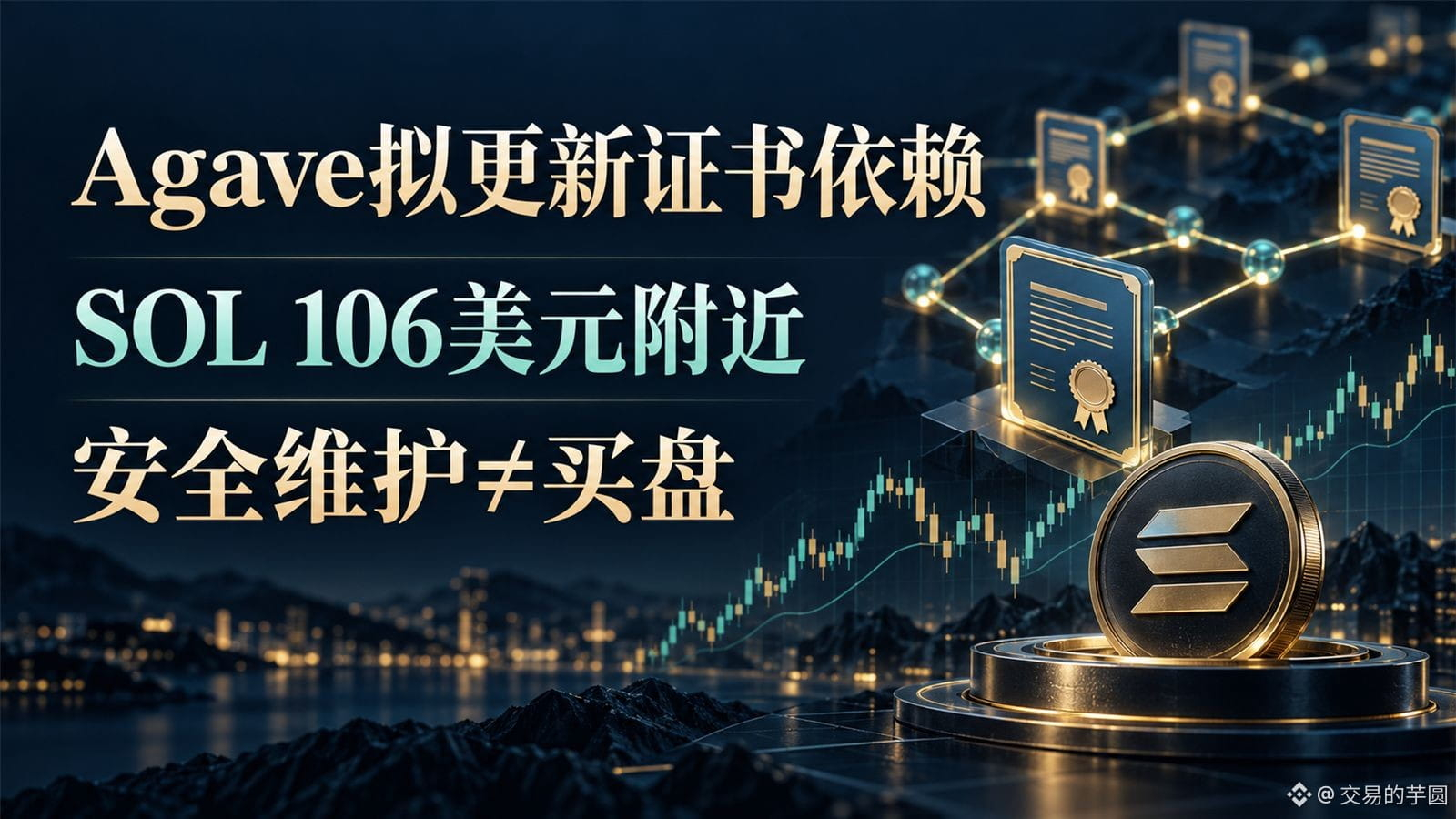
SOL Watch | Agave proposes updating certificate root dependencies | I’m keeping risk boundaries around $106
My position is to pay attention to security maintenance, but not to frame a dependency update as proof that something has already gone wrong on Solana. On October 20, the Agave official repository opened PR #16223, proposing an upgrade to `rustls-webpki` and certificate-root-related dependencies in response to the RustSec security advisory RUSTSEC-2026-0381. The RustSec advisory says that affected versions of `webpki-roots` still include an emSign root certificate path that should no longer be trusted, and that certain certificate chains may pass through an intermediate certificate that is no longer trusted; the patched version removes this root starting with 1.0.10. This concerns the trust boundary when software establishes TLS connections. It is not evidence of “SOL private keys being leaked” or “on-chain transactions being tampered with.”
When I checked, the Agave PR had received review approval but was still open, and the page clearly showed that it had not been deployed. Solana’s official status page showed the mainnet cluster and RPC as operational, with no incidents reported from October 20 to 21. Taken together, these two primary sources support only the conclusion that “developers are addressing a general dependency risk.” They do not show that nodes have already been widely exploited, nor that the patch has made it into validator versions currently in use. A more detailed discussion of the dependency tree also points out that an older version number may simply be a compatibility layer that re-exports a patched version. So an alert from a scan does not mean that all nodes and all connections are equally exposed.
Why should traders still pay attention? The reliability of a public blockchain depends not only on its consensus algorithm, but also on the software supply chain behind nodes, installers, and external connections. If the patch is merged and released smoothly, it will reduce potential operational risk; it will not automatically create new demand for SOL, nor guarantee a corresponding increase in fund inflows or trading volume. Conversely, the risk should be reassessed only if a later audit confirms that the affected path is broader, or the official status page reports an actual service disruption. At the time of writing, SOL/USD on Kraken is around $106.3, with a rolling 24-hour open of $106.43, low of $103.65, and high of $108.13. The current price is slightly below the open; this move should not be attributed solely to a PR that has not yet been merged.
I’m using $108.13 as a short-term breakout level to watch, looking to see whether price can reclaim around $106.43, with $103.65 as the lower end of the range. If price cannot hold above $108.13 and quickly falls back below $106.43, the bullish scenario is invalidated; if $103.65 is decisively broken, I’ll prioritize defense over adding to the position. If I were trading this myself, I would stay out for now and consider only a small, trend-following spot position: I’d consider a long using 2% of my total capital only after an hourly close above $108.13, followed by a successful retest and hold near $108, with the official status remaining normal. I’d take half off at $110 and close the rest at $113. After entry, I’d stop out if price falls below $106.4, or close the entire position if the loss on the trade reaches 0.3% of total capital. If these conditions aren’t met, I’d keep my cash, avoid high leverage, and not portray a security patch as a guarantee of a price rally.
Sources: Agave PR #16223, RustSec RUSTSEC-2026-0381, Solana status page, Kraken SOL/USD. #SOL
The above is solely my personal market observation and does not constitute investment advice.
3
Log in to explore more content
Join global crypto users on Binance Square
⚡️ Get latest and useful information about crypto.
💬 Trusted by the world’s largest crypto exchange.
👍 Discover real insights from verified creators.
Email / Phone number
Trending Topics
1
#BinancePick
2.5M views
138,337 Discussing
2
#EarningsSeason
4.9M views
23,956 Discussing
3
#ElectrumWalletBugLetRogueServersStealFunds
2,757 views
151 Discussing
4
#ArgentineCourtDismissesLIBRACaseAgainstMilei
10,691 views
234 Discussing
5
#SKHynixReportedlyPlansSpecialDividendFromKioxiaStakeSale
2,313 views
37 Discussing
6
#KeystoneWebsiteBreachExposesBuyersShippingAddresses
1,303 views
29 Discussing
7
#USQ3GDPAndSeptemberPCEDueNextWeek
84,599 views
1,043 Discussing
8
#SouthKoreaDelaysCryptoIncomeTax
154,722 views
1,087 Discussing
9
#ElectrumFixesHighRiskExploitInVersionsBefore4.8.3
67,773 views
779 Discussing
10
#SouthKoreaPlansToRegulateStablecoinsUnderFXLaw
65,957 views
693 Discussing