

#162
162
2,857 views
11 Discussing
Hot
Latest

·
--
STRK suddenly plunges 2.2% at a key time! Panic or opportunity? Key support levels at a glance15:51 (4 minutes ago): STRK dropped 2.2% at a key time (5-minute window 15:46→15:51). As of 15:55:41, the current price is 0.07447, down 8.9% in 24h. WAL and BTW also made notable moves around the same time.
📅 Data as of 15:55:41 (event trigger times are noted for each item; prices are real-time snapshots at the time of writing)
📌 In a nutshell: Notable moves at key times (candle closes / U.S. market opens and closes) often involve institutional activity, making these signals more reliable
Market overview: BTC 81,435.80 (-2.42%) · ETH 2,376.90 (-5.14%); across the market, 25 assets rose and 466 fell in 24h; top 24h gainer: ZEREBRO +51.93%; biggest loser: Lobster -33.04%.
STRK suddenly plunges 2.2% at a key time! Panic or opportunity? Key support levels at a glance
15:51 (4 minutes ago): STRK dropped 2.2% at a key time (5-minute window 15:46→15:51). As of 15:55:41, the current price is 0.07447, down 8.9% in 24h. WAL and BTW also made notable moves around the same time.
📅 Data as of 15:55:41 (event trigger times are noted for each item; prices are real-time snapshots at the time of writing)
📌 In a nutshell: Notable moves at key times (candle closes / U.S. market opens and closes) often involve institutional activity, making these signals more reliable
Market overview: BTC 81,435.80 (-2.42%) · ETH 2,376.90 (-5.14%); across the market, 25 assets rose and 466 fell in 24h; top 24h gainer: ZEREBRO +51.93%; biggest loser: Lobster -33.04%.
·
--
RSR surges 11% in 15 minutes! What happened? Key levels to watch20:06 (just now): RSR surged 11% in 15 minutes (15-minute window: 19:51→20:06). As of 20:07:33, the current price is 0.002505, up 56.8% in 24h. CTK and BAT also saw unusual moves around the same time.
📅 Data as of 20:07:33 (event trigger times are noted in each item; prices are real-time snapshots taken when this was written)
📌 In a nutshell: The 15-minute trend has intensified. Before following it, decide where to place your stop-loss.
Market overview: BTC 83,301.00 (+0.14%) · ETH 2,542.21 (+1.38%); across the market, 225 assets rose and 266 fell in 24h; top 24h gainer: RSR +56.76%; top loser: LUMIA -26.54%.
RSR surges 11% in 15 minutes! What happened? Key levels to watch
20:06 (just now): RSR surged 11% in 15 minutes (15-minute window: 19:51→20:06). As of 20:07:33, the current price is 0.002505, up 56.8% in 24h. CTK and BAT also saw unusual moves around the same time.
📅 Data as of 20:07:33 (event trigger times are noted in each item; prices are real-time snapshots taken when this was written)
📌 In a nutshell: The 15-minute trend has intensified. Before following it, decide where to place your stop-loss.
Market overview: BTC 83,301.00 (+0.14%) · ETH 2,542.21 (+1.38%); across the market, 225 assets rose and 266 fell in 24h; top 24h gainer: RSR +56.76%; top loser: LUMIA -26.54%.
2

·
--
$0.9710 hangs there like a nail. $PONS has fallen from its peak to $0.412, down 57.55%. The point after being cut in half is where you’re most likely to get itchy fingers—that’s the anchor trap: you’re focused not on what it’s worth now, but on what it used to be worth.
What really made me stop was the trading volume. Daily volume was still $231M on September 7; now it’s down to just $37.5M, a drop of more than 80%. The price slid from $0.845 to $0.41—not like a panic sell-off, but more like liquidity being slowly drained away, until the market couldn’t be bothered to price it anymore. Today’s +6.96% looks nice, but the 24-hour high of $0.412851 is almost exactly the current price—the rebound barely touched the intraday high before buying dried up.
My read: $PONS is now in a state where it’s not falling much further, but nobody’s in a hurry to buy either. Its $280M market cap and #162 ranking show it still has some heft, and the narrative isn’t dead, but a 30-day drop of 54% means there’s overhead supply at every level. The confirmation signal isn’t a single green candle; it’s whether volume can climb back above $80M and stay there for a few days.
The opposite case holds too: if this is another leg down in a liquidity retreat, the intraday low of $0.36 is just the next step down. A slow bleed on low volume is the most gruelling kind—it gives you no clear reason to stop out.
That’s the dilemma: wait for volume to confirm before entering, or bet that this is the sentiment bottom and get in early, knowing you may have to stomach a drawdown? I lean toward the former, but plenty of people are already going with the latter.
45
·
--
Breaking! 2Z sharply drops 9.7% within 15 minutes—before buying the dip, check this batch of support00:41 (12 minutes ago) 2Z saw a 9.7% drop within 15 minutes (15-minute window 00:26→00:41); as of 00:53:52, the current price is 0.04719, with -14.5% over the past 24h. Other movers in the same batch include GTC and MAGMA.
📅 Data as of 00:53:52 (event-trigger times are indicated in each item; prices are real-time snapshots at the time of writing)
📌 One-sentence takeaway: the 15-minute trend is amplified—decide where to place your stop-loss before you follow the trend.
Market Overview: BTC 85,133.80 (+1.10%) · ETH 2,688.78 (+0.30%); across the whole market, 360 up / 133 down over the past 24h; top gainer over the past 24h: MAGMA +64.75%, top decliner: Lobster -57.32%.
Breaking! 2Z sharply drops 9.7% within 15 minutes—before buying the dip, check this batch of support
00:41 (12 minutes ago) 2Z saw a 9.7% drop within 15 minutes (15-minute window 00:26→00:41); as of 00:53:52, the current price is 0.04719, with -14.5% over the past 24h. Other movers in the same batch include GTC and MAGMA.
📅 Data as of 00:53:52 (event-trigger times are indicated in each item; prices are real-time snapshots at the time of writing)
📌 One-sentence takeaway: the 15-minute trend is amplified—decide where to place your stop-loss before you follow the trend.
Market Overview: BTC 85,133.80 (+1.10%) · ETH 2,688.78 (+0.30%); across the whole market, 360 up / 133 down over the past 24h; top gainer over the past 24h: MAGMA +64.75%, top decliner: Lobster -57.32%.
151

·
--
XMR tail emission pays miners丨All-node incentives still under open discussion丨Around 545 I’ll wait to confirm
My stance is to separate “network security” from “price increases.” After scanning Binance Square’s trending topics today and searches from the last six hours, I haven’t found any verifiable new hotspot directly pointing to XMR. I’m not trying to force XMR into other coins’ security incidents. What’s more worth revisiting is the open questions in Monero’s official materials and the Research Lab repository about node incentives: this is a mechanism discussion that still needs research, not a protocol upgrade that has just been approved.
Verified baseline facts: According to Monero’s official encyclopedia, since tail emission began in 2022, each block reward is about 0.6 XMR; if the block-size penalty takes effect, it can be lower. The goal is to provide ongoing economic incentives to maintain miners’ compute power. With an average of one block every two minutes, that works out roughly to about 432 XMR per day based on the stated value. This is an estimate of the emission mechanism—not today’s on-chain measured output, and not subsidies given to all full nodes.
A question in the Monero Research Lab repository that was still open on August 24 is very direct: non-mining full nodes bear storage, bandwidth, and maintenance costs, yet they don’t receive the same protocol rewards. Has the model of relying on personal usage demand to keep nodes running been thoroughly validated? The questioner also specifically points out that paying directly based on the number of nodes could be exploited by one person fabricating multiple nodes. These are questions raised by community members and cannot be written as if the development team has announced node dividends.
This matters for XMR’s long-term value, because privacy coins need not only block-production security but also a sufficient number of independently verifiable nodes. If ordinary users shift to a small number of remote nodes due to cost or operational difficulty, the cryptographic privacy of on-chain transactions does not equal the assumption that network-connection information is completely invisible. Monero’s official FAQ explicitly reminds that remote nodes may see users’ IP addresses and the source of transaction broadcasts, and in extreme cases privacy could be reduced. On the other hand, adding node subsidies thoughtlessly could also expand abuse and dilute incentives pressure. You can’t simply turn “the more nodes, the better” into a buy-coin slogan. What’s truly worth tracking is the distribution of independent nodes, how remote nodes are used, progress on software reducing operating costs, and whether a formal design, audit, and upgrade schedule appears. The open questions themselves do not equal those conditions being fulfilled.
How has the market reacted? I checked Kraken’s XMR/USD at about $544.99; over the past 24 hours it’s been high $553.29 and low $536.22, with the current price near the middle of the range. This volatility can’t be attributed to the research questions from August; it only tells me that the money didn’t form a clear one-way confirmation from this old discussion. Short-term, watch whether 536 holds, whether 548 can be reclaimed, and whether 553 can be broken. If it falls below 536 and the pullback lacks strength, lean toward a bullish observation with a withdrawal. If it breaks above 553 and holds, and the project also provides a verifiable node-economic solution, only then cautiously consider an upward adjustment.
If I were trading myself, I wouldn’t participate right now and I wouldn’t take high-leverage reverse bets on news. Only if XMR/USD closes the one-hour chart above 548, then pulls back and doesn’t break 546 to 548, would I use at most 0.3% of total funds to open an unleveraged spot long. I’d cut the position in half around 551; flat the remaining position in the 553 to 556 range; and hard stop at 542. After entry, I’d close early if the next two hour candles re-close below 546. If it breaks 536 first, the plan is to cancel outright. When there’s no confirmed timeline for research progress, I’d rather miss the first leg than treat a discussion post as good news already realized.
Sources: Monero tail emission encyclopedia and FAQ, Monero Research Lab issue #162, Kraken XMR/USD market data. #XMR
The above is only personal market observation and does not constitute investment advice.

9

·
--
$USELESS Grabs the Spotlight: Huge Volume Despite Pullback
$USELESS is making serious noise today, claiming the #7 spot on the trending list. Despite a minor -4.78% dip over the last 24 hours, the token is showing massive market presence with a staggering $836M in 24-hour trading volume. When a lower-cap asset pulls in that kind of liquidity, traders take notice. The market is actively trading the volatility, turning this into a high-momentum playground. With its market cap ranked at #162, the intense volume-to-market-cap ratio suggests a highly active community and heavy speculative interest. Keep an eye on the volume trends here—this level of activity usually precedes a major directional expansion.
Follow for more crypto setups.
#HahaProfit #UselessCoin

131

·
--
$USELESS Grabs the Spotlight: Massive Volume Defies the Dip
$USELESS is making serious noise today, claiming the #7 spot on the trending list. Despite a minor -4.78% pullback over the last 24 hours bringing the price to $0.23339, the real story is the absolute monster of trading volume behind it.
We are looking at over $836 million in 24-hour volume 📊. For a project sitting at #162 in market cap, that level of liquidity and trading activity is highly unusual and suggests massive retail interest and high-stakes positioning. When a coin pulls back slightly on massive volume, it usually means a major tug-of-war is happening between buyers and sellers. Keep an eye on this one; the volatility is just getting started ⚡.
Follow for daily crypto updates.
#DeGenYuv #UselessCoin

138

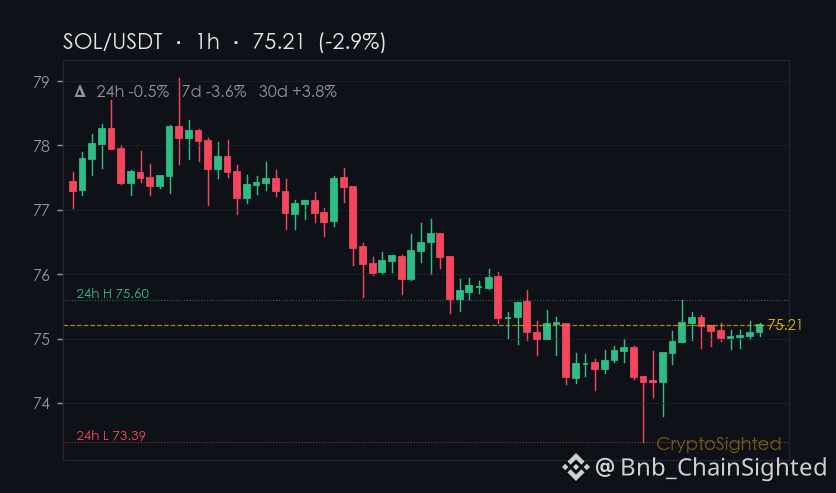
↓0.5%. Solana’s 24-hour dip hides a broader liquidity shift
Solana is sitting at $75.14, down 0.5% on the day, trading between $73.39 and $75.60 with 1.3 million $SOL changing hands.
The price dip might look like a routine move, but the broader picture tells a different story - a major liquidity shift is unfolding, possibly linked to traditional markets.
Japan’s stock rout, highlighted on Binance Square, could be part of that shift.
—
Not financial advice. DYOR.
📌 Hotspot Watch · #162 · #CryptoTrends #CryptoSighted $SOL
178
Log in to explore more content
Join global crypto users on Binance Square
⚡️ Get latest and useful information about crypto.
💬 Trusted by the world’s largest crypto exchange.
👍 Discover real insights from verified creators.
Email / Phone number
Trending Topics
1
#CanMicrosoftDeliverOnAI
221,659 views
1,872 Discussing
2
#CanGoogleDefindItsCore
125,057 views
1,371 Discussing
3
#EarningsSeason
5.8M views
27,837 Discussing
4
#BitcoinSurpasses$81K
31 views
22 Discussing
5
#KOSPISurges6.63%BackAbove6000
1 views
24 Discussing
6
#DatavaultAICantWithdrawBitcoinFromBiconomy
735 views
41 Discussing
7
#FOMCWatch
9.2M views
29,056 Discussing
8
#HKPlacesTokenizedFundSecondaryTradingUnderETFLikeFramework
516 views
27 Discussing
9
#USGovSellsFTXLinkedAnthropicSharesFor$627M
783 views
29 Discussing
10
#MoodysAssignsRLUSDA2LongTermDepositRating
5,939 views
200 Discussing