
#11779
11779
2 views
3 Discussing
Hot
Latest

·
--
XMR Wallet Recovery Date Proposal|An Invalid Date Could Miss Part of the Scan Range|I’m Sticking to My $500 Discipline
My approach is to watch cautiously and not chase a rally based on a single code-fix proposal. On November 22, a PR titled “Reject impossible wallet restore dates” appeared in Monero’s official code repository as PR #11779. The example given by the contributor is straightforward: entering “2026-02-31” in the command line may currently pass the initial checks, after which the date function automatically rolls it forward to March 3. The wallet then uses that date to look up the recovery block height. The two-day buffer originally reserved for the height lookup may not cover an offset of several days, so a mistyped date could cause the scan to start too late. The proposal would add calendar validation both before creating a wallet via the command line and at the underlying date-query step. The page shows that one maintainer has approved it, but its status is still Open and pending review. It is not a merged patch, nor does it mean a new client version has been released.
This matters to XMR in terms of user safety and usability, not token supply: scanning too few historical blocks during recovery could make someone think their balance is too low, potentially leading to secondary risks such as importing the wallet repeatedly, asking strangers for help, or revealing their seed phrase. If date validation eventually makes it into an official release, it could reduce user errors. For now, however, the more reliable approach is to back up wallet files and recovery information, check the recovery height against the official documentation, and check the scan range first if the balance looks wrong. Never give your private keys or seed phrase to anyone claiming they can “fix your balance.” A code proposal does not prove that new XMR buying has emerged today, nor does it justify inferring that a large-scale network failure has occurred.
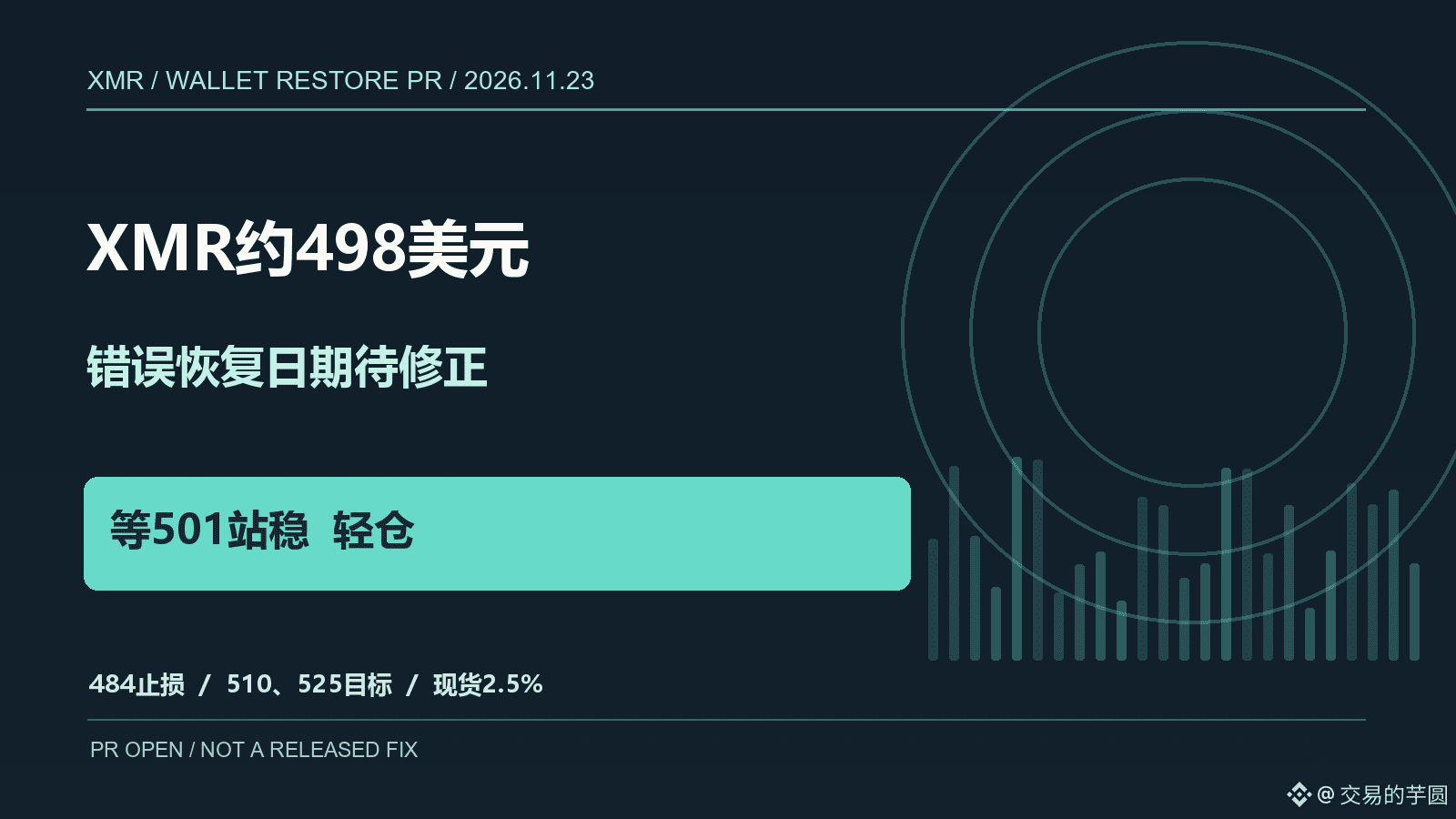
How has the market reacted? I just checked XMR/USD on Kraken: the latest trade was around $498.14, with a 24-hour low of $475.50 and a high of $500.00. The current price is near the upper end of the range, indicating strength, but there is no evidence that this rise was caused by the wallet PR. $500 is the key level to watch for now; whether the price can hold above it matters more than merely touching the round number. Around $490 is the short-term pullback zone to watch, and a break below $484 would invalidate my bullish trade idea. If claims such as “the fix is live” appear on social media, I’ll rely only on the merge status in the Monero repository and the official download page.
If I were trading this myself: I would sit out for now. The only direction I’d consider is a leveraged-free spot long, with a planned position size of 2.5% of my account. I’d enter in two tranches only if XMR moves convincingly above $501 and then holds around $500 on a retest. My first target would be $510 and my second $525. At $510, I’d sell half and move the stop on the rest up to protect my principal. I’d set the initial stop at $484 and close the entire position if it is hit. If the price breaks straight below $490, I’d cancel the entry and wait to reassess. If none of the conditions are met, this remains only a plan—I will not describe it as a trade already executed or as a profit.
#XMR
The above is solely my personal market observation and does not constitute investment advice.
2
Log in to explore more content
Join global crypto users on Binance Square
⚡️ Get latest and useful information about crypto.
💬 Trusted by the world’s largest crypto exchange.
👍 Discover real insights from verified creators.
Email / Phone number
Trending Topics
1
#NVIDIAReinstatesJensenHuangasCEO
23,654 views
540 Discussing
2
#WillMarketsStageAThanksgivingReliefRally?
125,748 views
1,656 Discussing
3
#WillOctCorePCEShiftFedHikeExpectations?
47,471 views
687 Discussing
4
#BitcoinEndsRecord17DayStreakOfLowerHighs
5,068 views
177 Discussing
5
#TradersPriceOut50bpDecemberFedHike
3,942 views
115 Discussing
6
#EvolveAtBinanceBlockchainWeek
104,138 views
949 Discussing
7
#TrumpBackedAmericanBitcoinRaisesHoldingsToOver8500BTC
810 views
28 Discussing
8
#MuskWarnsOfAICashCrunch
57,321 views
677 Discussing
9
#TradFiForBeginners
1.1M views
5,966 Discussing
10
#SkyPSMUSDCLiquidityReboundsTo$1.77B
454 views
9 Discussing