
Investing in cryptocurrencies requires serious research if you are going to make a good return on your investments. You can follow what an influencer on Twitter said and make some gains, or watch a YouTube video, take a trade and make some money. But how often does that happen?
A combination of factors has to be considered before making any crypto investment. It is true that most projects will provide information about the project. Such as tokenomics, roadmap, a whitepaper and team information in cases where the team is not anon. But these are barely sufficient to make financial decisions.
A good knowledge of crypto fundamentals will help you determine if a crypto asset is worth buying or not. In this article, you will learn:
What fundamental analysis in crypto is.
How to conduct fundamental analysis.
What metrics to use for fundamental analysis.
Some tools to use for fundamental analysis.
Why you should take fundamental analysis very seriously.
First, lets see what fundamental analysis really is, and why you should take it seriously.
What is fundamental analysis?
Fundamental analysis (FA) is a crucial tool for any investor looking to make informed decisions in the crypto market. By evaluating a range of economic, financial, and social factors, FA provides a comprehensive method for determining the intrinsic value of a crypto asset.
Unlike traditional finance services which provide regular financial reports, the crypto market is entirely transparent thanks to the blockchain. This means that financial analysts have access to all the information they need to evaluate a project's tokenomics, roadmap, whitepaper, and team information. In essence, FA allows you to become an auditor of sorts, enabling you to make informed investment decisions based on the most up-to-date information available.
Whether you're a seasoned investor or just starting out in the crypto market, understanding the basics of FA is essential for making smart investment choices.
Lets see how you can conduct fundamental analysis
How to conduct fundamental analysis?
There are four factors to consider for fundamental analysis. These are:
Blockchain Metrics
Financial Metrics
Social Metrics
Project Metrics
Blockchain metrics:
As we know, transparency is a cornerstone of the crypto market, thanks to the open nature of the blockchain. However, the sheer size and complexity of the blockchain can make it difficult to determine which metrics are most important for evaluating a project.
If you're considering investing in a project built on top of an existing blockchain, there are a few key metrics you should be aware of. These metrics can provide valuable insights into the project's performance and potential for success.
One important factor to consider is the project's activity level, including the number of active addresses and transactions taking place on the blockchain. Additionally, you'll want to keep an eye on the fees associated with these transactions, as high fees can indicate a potential issue with scalability.
For projects utilizing L1 or L2 blockchain services like Solana or Polygon, other important metrics include hash rate, number of validators, and transaction values. These metrics can provide a clear picture of the project's overall health and potential for growth.
By understanding and analyzing these key blockchain metrics, you'll be better equipped to make informed investment decisions in the fast-moving and ever-evolving world of crypto.
Let’s consider some of the things you can look out for on-chain
1: Top holders of the token: You will have to copy the project contract address and paste on the chain explorer to find this information. If the project is built on the Binance Smart Chain, then you use bscscan.com. If it is built on Ethereum, then you use etherscan.io. You just need to look for the explorer link of the blockchain the project is on, and the you make the search.
First, you want to check the percentage of tokens held by the top 10 holders. More often than not, the first wallet usually hold locked tokens that are yet in circulation. You will see a small icon of a note just before the contract address. If this is so, then the percentage of tokens in that address is locked. However, you still have to find out for how long these tokens are locked for
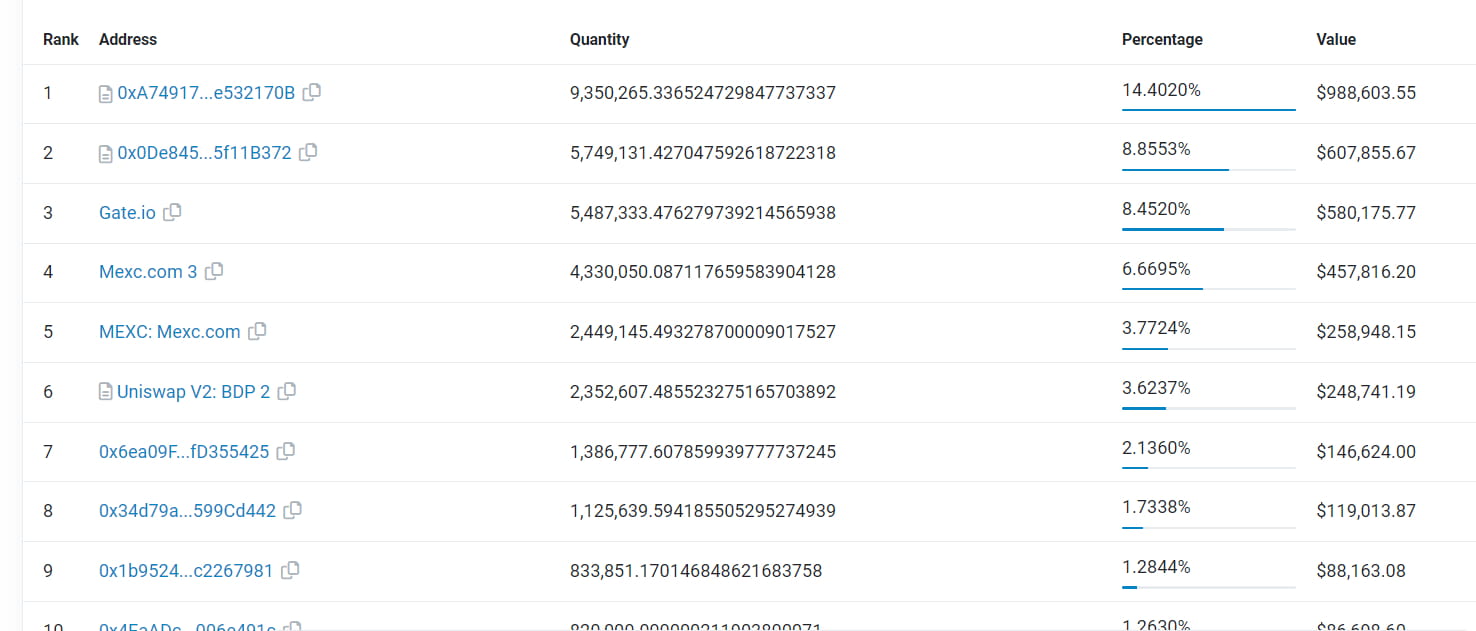
You also want to see the number of unlocked addresses holding large percentages of tokens. If the top 10 unlocked wallet holds more than 20% of the total supply, this is a concerning sign. When these wallets decide to sell, it can affect prices of the token greatly. If the top 100 addresses holds more than 50% of the supply, then you should be worried also. Have such large percentage of token supply concentrated in the hands of such little number of persons is not a good sign
2: Number of holders/addresses: The larger the number of addresses holding a particular coin/token the more “legit” it can be said to be. Simply put, it means a large amount of persons are holding the tokens. Why they are holding is another thing to worry about however.
If the amount of addresses is low. Say 1,000-5,000, you may consider yourself to be “early”. If that is the case, then you may make more gains on your investment as users increase. Imagine you were one of the first 5,000 holders of $Shib and you held till there was over 1 million users… But being “early” also means taking on higher risk. Low users may mean the project may not be very useful, and could soon be abandoned. Or worse, you may suffer a rug pull
3: Inflation: This refers to the rate at which new tokens are created. Inflation can have a major impact on the value of the token.
If the inflation rate is too high, the token could lose its value over time. This is why it's important to have a reasonable inflation rate that maintains the value of the token while also allowing for growth.
A well-distributed token with a reasonable inflation rate can help ensure the stability and growth of a cryptocurrency project, which benefits everyone involved.
However, if the inflation is too high, holders will get diluted real quick and bad that they end up holding worth less tokens.
So, beware of tokens that has less than 5% or sometimes as low as 1% of total supply in circulation, when all supply is expected to be in circulation in 2 - 4 years.
Staking won’t save your portfolio in such cases.
4: Ecosystem treasury: This is a portion of the token dedicated to growing the project, and for rewards to contributors. Not all projects have an ecosystem fund though
If the project you are analyzing has one, find out the following:
To total number of token supply allocated for this purpose
Vesting schedule
How tokens are given out
How many tokens are left from this fund
Who controls the wallet containing the tokens
Is the wallet under a time lock?
Preferably, it should also be controlled by a multi-sig and under timelock of at least 24 hours
Financial Metrics:
These are metrics that helps to asses things such as liquidity of a crypto asset and market responses. Lets look at some of these Financial metrics.
1: Market Cap (MC): The market capitalization represents the total value of circulating supply of a project’s token. The higher the market cap, the more credible the project seems. The lower the market cap, the more risks it pose. However, lower market cap means more upside. The value of a token doesn’t matter. That a token price is $0.1 does not necessarily mean it is a better investment to a token valued at $10. What you should look for is the market cap. Market cap is calculated by Circulating supply X token unit price.
2: Fully Diluted Valuation (FDV): It is extremely important to pay attention to the FDV of any token/coin. Some argue that FDV is more important than MC. And for good reason. Fully diluted supply is the value of total supply (circulating supply + locked tokens) X token price.
Let’s look at an example. Project X releases their token called $ABC. ABC has a total supply of 1,000,000,000. Upon launch, there was 10,000,000 circulating $ABC tokens.
Trading at $2 per token, we have a market ca of 10,000,000 ABC tokens X $2 = $20,000,000
Since FDV = TS x Token price, FDV of $ABC = 1,000,000,000 X $2. = $2,000,000,000
Why is this of concern? You need to ask yourself some questions:
What is the token unlock schedule?
How long before total supply is I circulation?
Is the project worth the FDV?
By the time total tokens will be in circulation, what will be the realistic price of each token?
These questions will help you determine if you should invest in that particular project, and how long you want to invest.
Projects that usually have less than 5% of total supply released on launch, with a max unlock schedule within some 2 years are a ticking time bomb. You will seriously get diluted as more tokens are released.
In the example given above about project X, at 10,000,000 circulating $ABC tokens valued at $2 each, we saw that the MC is $20,000,000.
If there are 100,000,000 tokens in circulation, which is just 10% of TS, the market cap will need to be at $200,000,000 for each token to be worth $2.
If the project has some staking plan where you stake your token to earn more tokens, then you will want to make your own calculations as to whether the APR for staking outweighs the inflation you will suffer.
3: Liquidity and trading volume: Liquidity basically means the ease of buying or selling a crypto asset without suffering high price impact. If a large number of persons can easily buy and sell a coin/token, then that is good. The number of buyers and sellers as well as the volume per transaction constitutes trading volume.
If trading volume is low, then there is low momentum. If volume is high, momentum is high. If you are doing research on a token and you find out that there is just about 3% of total supply in circulation, and the trading volume is low, then it looks like a coin you do not want to have any business with.
4: Total Value Locked (TVL): The TVL is refers to the value of all the tokens locked in the protocol. This includes tokens in liquidity pools, bridges and staked tokens. The primary reason why people lock their tokens or keep tokens in these protocols is to earn yield.
And if you have large sum of money, you only want to put it in a protocol you feel safe with, and where you have a potential to earn good returns.
So, that being said, the higher the TVL of a protocol, the higher the investor confidence in that project. Projects with large and growing TVL often experience increase in the price of its token. This applies to both protocols and blockchains.
If the market cap of a token or coin is very high, and the TVL is small, then its likely the price of that token will drop soon. Imagine a case where the coin of a chain is over 500 million dollars in market cap, and the TVL is less than 10 million. The chances are that the price of that coin will drop soon.
Such low TVL suggest only a handful are interested in using the chain
Social metrics:
This covers all that is happening on the social side of a crypto project. It includes the team and their background, the community, and information you can gather from other tools and websites about the crypto project you want to invest in.
Let’s take a look at some of the social metrics to consider.
1: Community: The community behind a project determines to a large extent, how successful it will become. If the community is active and hyped about the project, then that is a good sign. It the community is mostly silent or quiet, then that is not good.
As we can see from the rise of meme coins with no real use case, the community, usually referred to as “army” can take a coin/token price to a level beyond imagination. At some point, there was two meme coins in the top 10 of cryptocurrencies with the largest market cap. That is the perfect example of the saying “there is strength in numbers”
2: Social channels: How active is the project on social channels like Twitter and Telegram? Who are the other types categories of people tweeting about the project or retweeting their tweets? How many followers do they have on Twitter? Considering the number of followers, how does engagement per tweet looks like? What is the sentiment on the project’s Telegram group? How does the team or mods respond to questions asked? These are some of the questions you want to find answers to understand the how well a project is doing on social media. If you conclude that they are doing great, then it means positive. If you conclude they are doing bad, that is negative, and you may want to give further thoughts on the investment you are about to make.
Project Metrics:
This covers all the information you can find about the project itself. What about the project itself do you need to look at include in your fundamental analysis?
1: The whitepaper: Whitepaper, greenpaper or whatever paper they call it. You need to take a look at it. Some even add a pitch deck. When you look at the whitepaper, here are some things to look out for:
The problem the project is solving
The proposed solution
Utility of the project’s currency
Information about the team, if they are not anon
The tokenomics. How it is distributed
Future upgrades and developments
While you spend time reading the whitepaper, be very objective about what you read. See if it makes sense to you and then draw your own conclusion
2: Roadmap: After looking at the whitepaper, you want to check out their roadmap.
A roadmap outlines planned developments along with timelines on when to achieve them. For a project with some serious use case, you will see each upgrade or new feature to be added and when they want to implement them.
A roadmap that includes stuffs like “Pancakeswap listing”, “Coingecko listing”, “Coinmarketcap listing”, or something more ridiculous like expected market cap within a particular timeframe is exactly what you should be staying away from.
If a project spend more time focusing on token price, then it is no different from a meme.
3: Competition analysis: A team may seem good, and have nice stuffs on the whitepaper and roadmap. But you must pay attention to what others are doing. Especially if it is the same thing or similar.
Most projects today are a copy or previous ones. Maybe a little addition, if they are nice. Very few offer something really good or innovative. It is more of “Did you miss Project X? Don’t worry, we made Project Y”
So, compare what they are doing with others. If it is the same or similar to a number of others, ask yourself:
What are the chances that they will do this “same thing” better?
What is different about this project?
The project with the first mover advantage usually has the highest adoption. Maybe another one with a strong community and large marketing budget could get some good adoption and followership. But this is usually rare.
That is all for the metrics to consider before making any financial investment in any crypto project.
Tools to use for fundamental analysis:
There are many tools available today that can help with fundamental analysis. We will only look at two categories. They are:
Analytical tools
Charting tools
Analytical tools:
These are tools that helps with analysis. Two of such tools are Coingecko and Coinmarketcap. You can refer to these two as crypto encyclopedias, as they contain most of the information you need about a project listed on both platforms.
You can find information such as; total supply, circulating supply, all time high and date, as well as all time low and date. You will also find a brief overview of the project you are making a research on, as well as links to their website and social media channels.
Both Coingecko and Coinmarketcap are available for download on Google Play Store and Apple Store.
Another analytical tool, and one that is widely used is Defi Llama. It is a dashboard that contains all of the important metrics you are looking for, and you can use it for much more than just fundamental analysis.
Head over to their website defillama.com
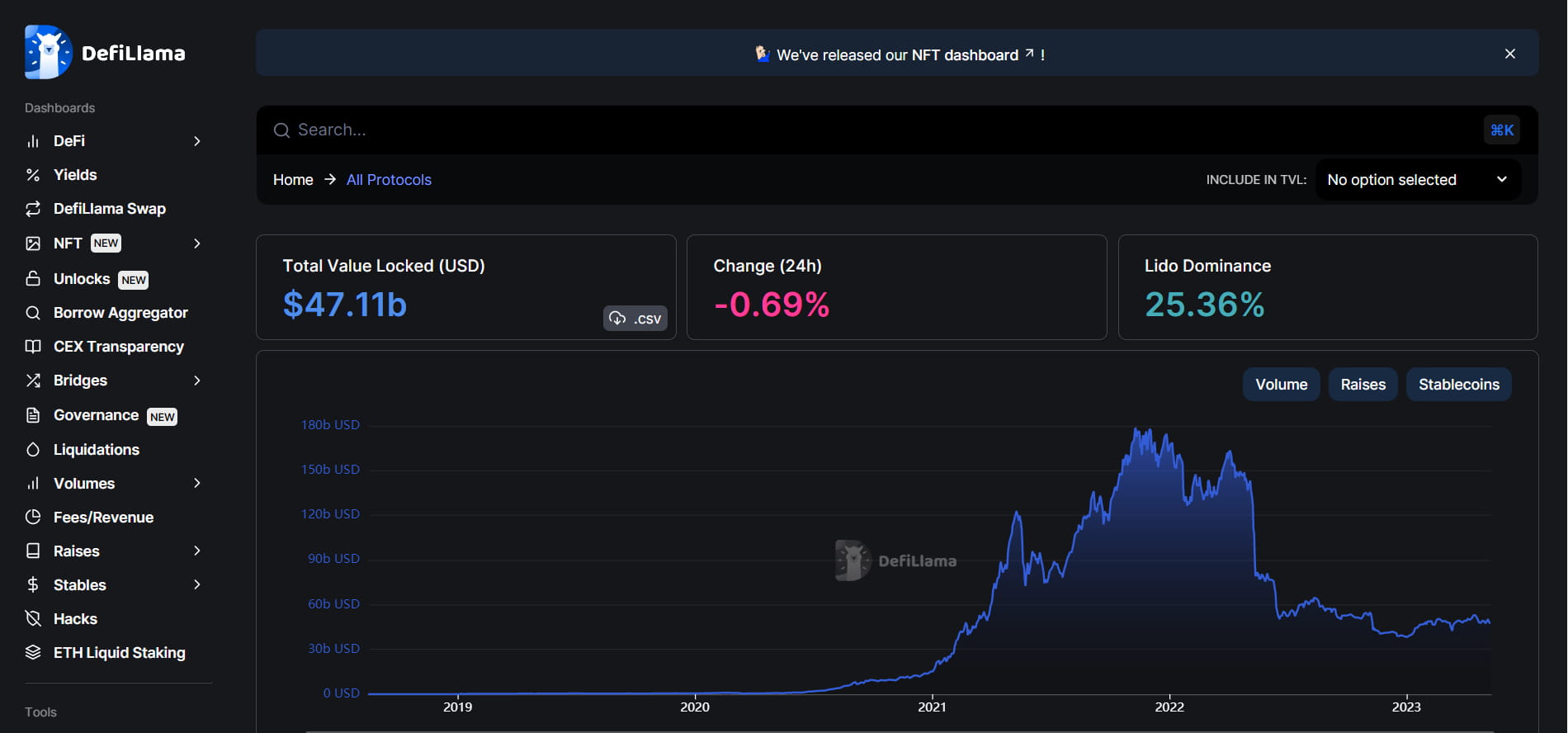
You will be greeted with the dashboard where you will see the total value locked for all DeFi protocols. On the left side, you have the menu to access all they have in store
Under the DeFi section, you can see chains and recent protocols. You can also monitor stable coin inflows to new and existing chains. Since stable coin inflows likely mean chain adoption, this is a good alpha to pay attention to.
DeFi Llama has a ton of features that can be of great advantage to you and your research, so feel free to play around with the dashboard.
Charting tools:
These are tools that help you see what the chart is saying about the historical price action of a coin/token. Trading View is the number one charting app or website to use. At least, it is the most used.
As a fundamental analyst, you can use all your research work to determine the direction of the price of a token. Charting tools like Trading View will help you look for a good entry. You can find charts of major tokens there.
For majority of other tokens, including newly listed ones, you can find their charts on Poocoin, Dex Screener, DexGuru and Dextools. There are other, but these three are the most used at the moment, and they are crosschain.
You will need to copy the contract address and paste in the search bar to see the charts for the specific token. You will also see a link to the block explorer to find more on-chain information about that contract address.
Conclusion
I hope that you found this article informative and helpful in your quest for financial success. Through this article, you have learned about the power of fundamental analysis in evaluating cryptocurrencies based on their intrinsic value.
By conducting thorough research and using key metrics such as the project, on-chain, financial and social metrics, you now have the tools to make informed investment decisions in the dynamic and exciting world of crypto.
Remember, investing in cryptocurrencies carries inherent risks, and it is essential to always do your own research and remain objective in your analysis. By combining your newfound knowledge with a disciplined approach to investing, you can navigate the market with confidence and potentially reap the rewards.
I will like to emphasize that this article is educational material and is not intended as financial advice. The investment decisions you make are ultimately your own, and it is important to always consider your own personal circumstances and risk tolerance before making any investment decisions.
If you found the information here helpful, please share with other crypto bros around you. And be sure to give us a follow, if you have not done so already.