

background:
Bitcoin ushered in the era of decentralized trust, but its application-specific nature limits the development of new decentralized applications.
Through the concept of comprehensive programming and modular blockchain, Ethereum allows DApps to be built without permission on its trust network, decoupling innovation and trust, and promoting the development of the pseudo-anonymous economy. Then, when Ethereum moved to a rollup-centric development path, the number of applications that could be built on top of it without permission increased significantly. By outsourcing execution to a single node or a small group of nodes, but being able to absorb Ethereum's trust by proving computations to Ethereum, permissionless innovation is further driven, spawning a boom in various proof technologies.
However, any module that cannot be deployed or proven on top of the EVM cannot absorb Ethereum’s collective trust. Such modules involve processing input from outside Ethereum, so their processing cannot be verified within the Ethereum internal protocol. Examples of such modules include sidechains based on new consensus protocols, data availability layers, new virtual machines, keeper networks, oracle networks, bridging, threshold encryption schemes, and trusted execution environments.
Typically, such modules require active verification services that have their own distributed verification semantics for verification. Typically, these Active Validation Services (“AVS”) are either secured by their own native tokens or are permissioned in nature.
The organization of the AVS ecosystem has four basic shortcomings:
New AVS startup problem
Innovators looking to develop new AVS must initiate a new network of trust to gain security.
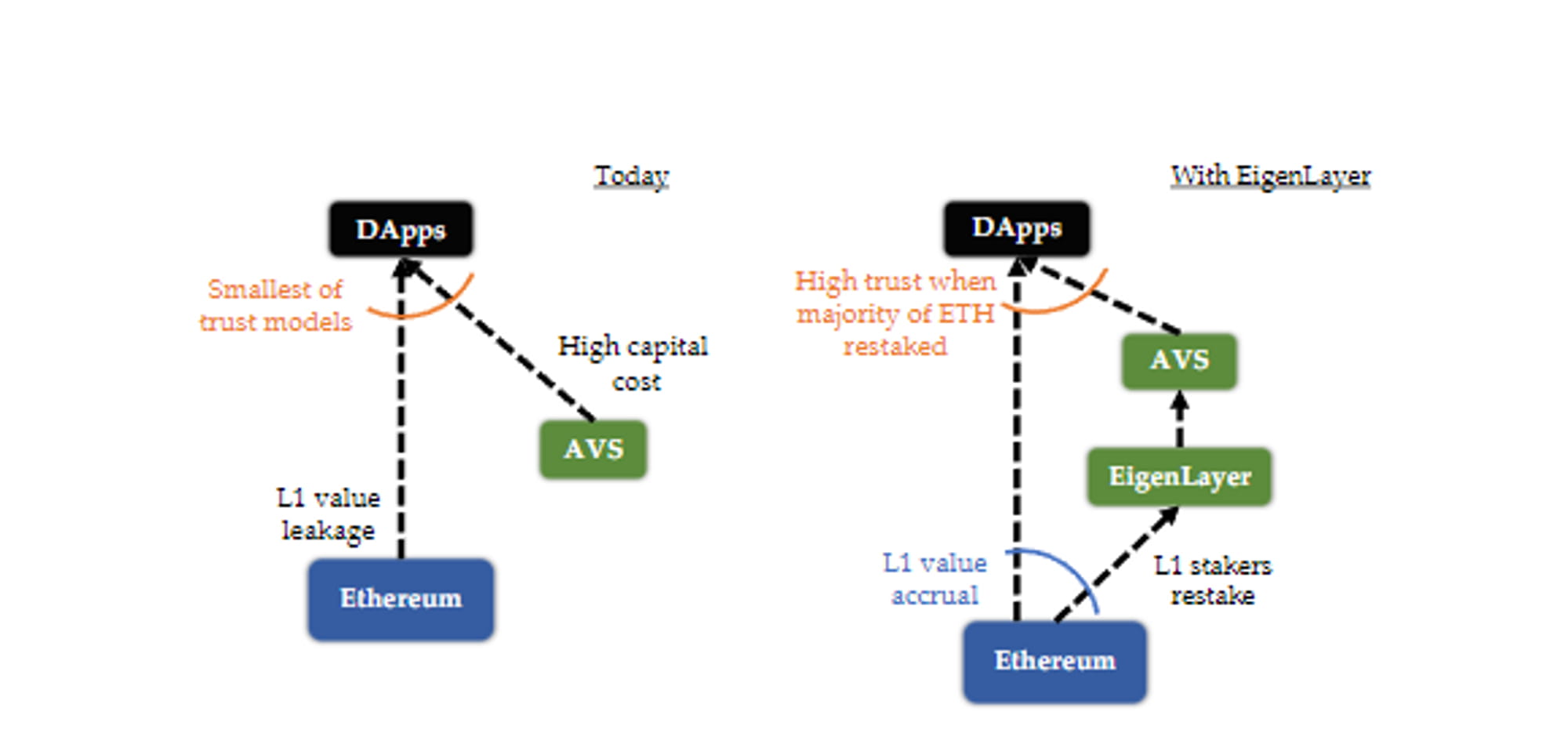
value leakage
Since each AVS develops its own trust pool, users not only pay fees to these pools, but also pay Ethereum transaction fees. This shift in fee flow leads to value leakage in Ethereum.
capital cost burden
Validators who stake to secure the new AVS must bear a capital cost, which is equivalent to the opportunity cost and price risk of staking in the new system. Therefore, AVS must provide a high enough staking return to cover this cost. For most AVS in operation today, the capital cost of staking is much higher than any operating costs. For example, consider a data availability tier with $10 billion in staking protection, assuming the stakers’ expected annualized rate of return (APR) is 5%. This AVS needs to return at least $500 million to pledgers every year to compensate for capital costs. This is much greater than the operational costs associated with data storage or network costs.
Lower trust model for DApps
The current AVS ecosystem creates a highly undesirable security dynamic: generally speaking, any middleware dependency of a DApp may become a target of attack. Therefore, the cost of corruption of a DApp must generally be considered to be at least no more than the minimum cost of corrupting its dependencies.
Project Description
What is EigenLayer:
In official terms, EigenLayer is an Ethereum re-pledge collection, a set of smart contracts on Ethereum that allows consensus layer Ethereum (ETH) stakers to choose to verify new software built on top of the Ethereum ecosystem. module.
Stakeholders extend the security of the crypto-economy by opting in by authorizing the EigenLayer smart contract to impose additional penalty conditions on their staked ETH (those who commit dishonest actions risk having their staked ETH penalized when participating in verification). .
Stakeholders who choose to join EigenLayer can verify many types of modules, including consensus protocols, data availability layers, virtual machines, keeper networks, oracle networks, cross-chain bridges, threshold encryption schemes, and trusted execution environments.
EigenLayer provides a new permissionless innovation platform. Innovators do not need to build their own trust network to implement new distributed verification modules, but can rely on the security and decentralization provided by EigenLayer through ETH re-stakers, thereby Save costs while enjoying the security of Ethereum.
In summary, EigenLayer allows re-pledgers to participate in the verification of different networks and services through a set of smart contracts, saving costs for third-party protocols while enjoying the security of Ethereum, and providing multiple benefits and flexibility for re-pledgers.
Object-oriented:
Re-stakeholders: can earn rewards by helping operate and secure various networks and services built on Ethereum, such as data availability layers, decentralized sequencers, and bridges.
Active verification service providers: including third parties such as consensus protocols, data availability layers, virtual machines, keeper networks, oracle networks, cross-chain bridges, threshold encryption schemes and trusted execution environments, such as Chainlink.
Risks faced:
Many operators may collude to attack a group of AVS
In an ideal world where all operators transfer their stake to all AVS, the cost of corrupting any one AVS on EigenLayer is now proportional to the total amount of stake in EigenLayer. This is the best one can hope for in terms of maximizing the costs of corruption. However, in a realistic scenario where only a subset of operators choose to participate in a given AVS, sophisticated attacks exist where some operators may collude to steal funds from a group of AVS. In particular, if only a small number of stakers participate in re-staking across multiple services, the system may become cryptoeconomically insecure.
One solution is to limit the PfC (Potential Financial Cost) of any specific AVS. For example, (1) the bridge can limit the flow of value during the cut period, (2) the oracle can bound the total value during the transaction period, etc. Another solution is that EigenLayer can actively increase the CoC (Cost of Corruption) of corrupt AVS.
AVS built on EigenLayer may have unexpected slashing vulnerability
This is the risk of honest nodes being cut. For example, an AVS was created with an unintentional slashing vulnerability (e.g., programming error), which was triggered and resulted in the loss of funds for honest users. Here, the team presents lines of defense: (1) security audits; (2) the ability to veto reduction events.
Eigenlayer’s own smart contract risks
Example:
EigenLayer supports many use cases, including MEV management, Data Availability Layer (DA), decentralized sequencers, light node bridging and fast mode bridging, etc.
Staking options provided by the testnet:
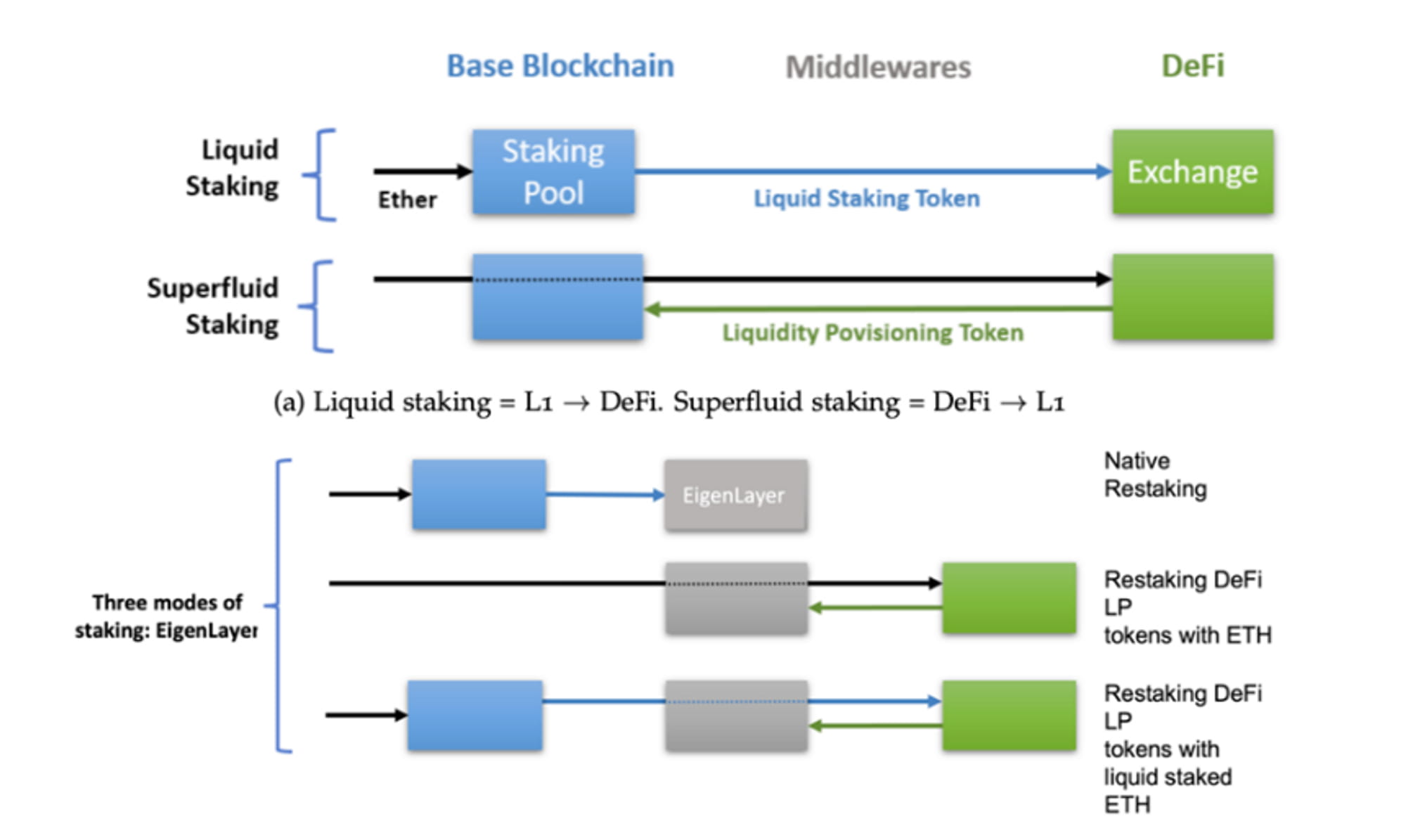
Liquidity Re-staking: Liquidity staking is a service that allows users to deposit their ETH into a staking pool and receive a liquid staking token in return (as offered by Lido and RocketPool). Stakeholders can deposit liquid staking tokens into EigenLayer. There are different options here such as ETH LP re-staking.
Native Re-staking: This option is suitable for independent stakers/family stakers who want to natively re-stake their same staked ETH. When they stake within the Ethereum protocol, they need to specify a withdrawal certificate, which is the account that has the authority to withdraw the collateral. To participate in EigenLayer, you need to assign this credential to the EigenLayer smart contract. (L1 → EigenLayer)
team:
The team is primarily located in Seattle, Washington. Founder Sreeram Kannan is a professor at the University of Washington and the director of the University of Washington Blockchain Lab. The first members of the team came from the laboratory.

Financing status:
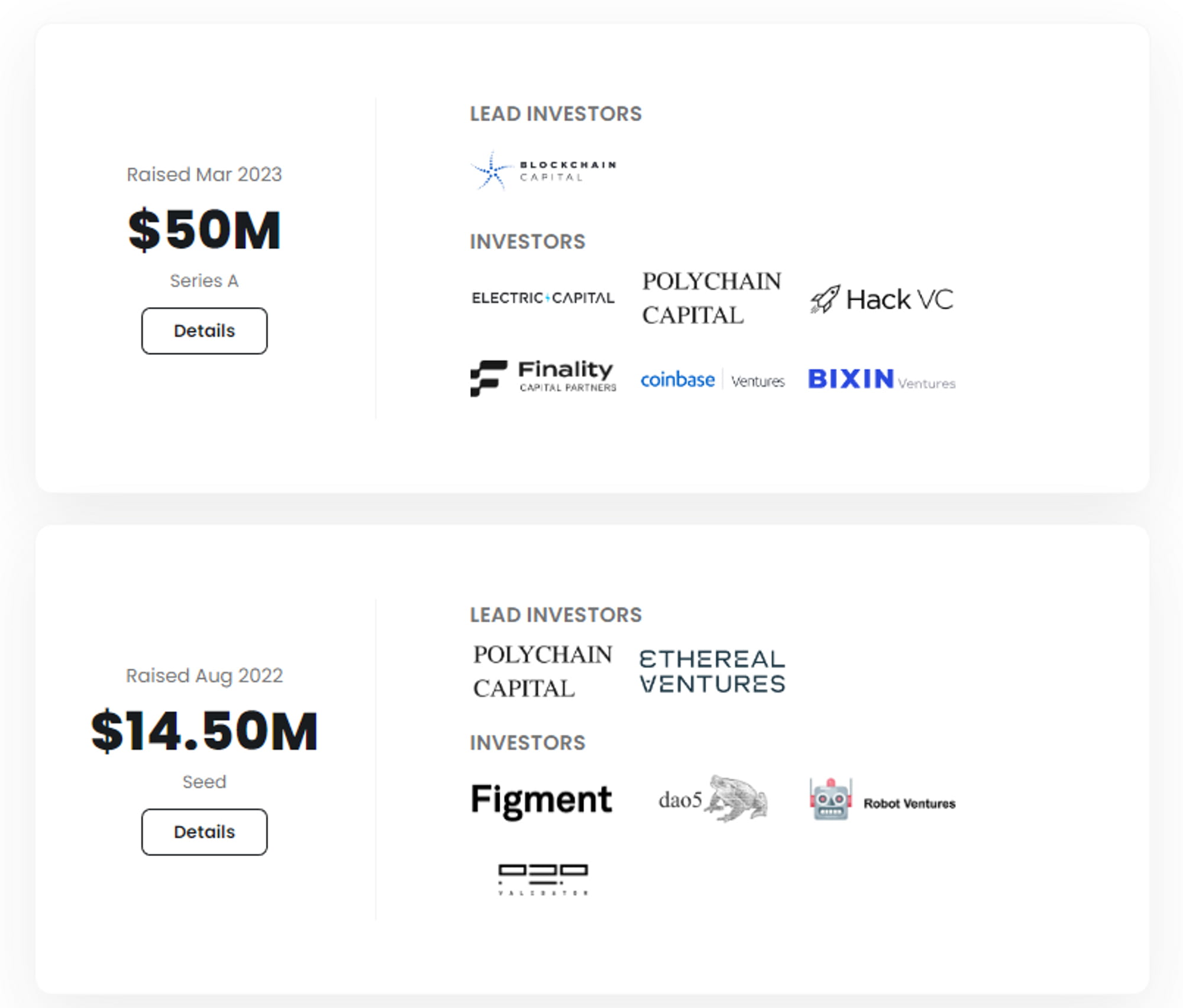
A total of two rounds of financing, raising a total of US$64.5 million
The seed round announced in August 2022 that it had raised US$14.5 million in seed round financing led by polychain+etherealvc, with participation from FigmentCapital, daofive, robotventures, P2Pvalidator, etc.
The Series A round of financing was announced in March 2023 and raised US$50 million led by blockchaincap, with participation from ElectricCapital, polychaincap, hack_vc, FinalityCap, cbventures and others.
Project Process:
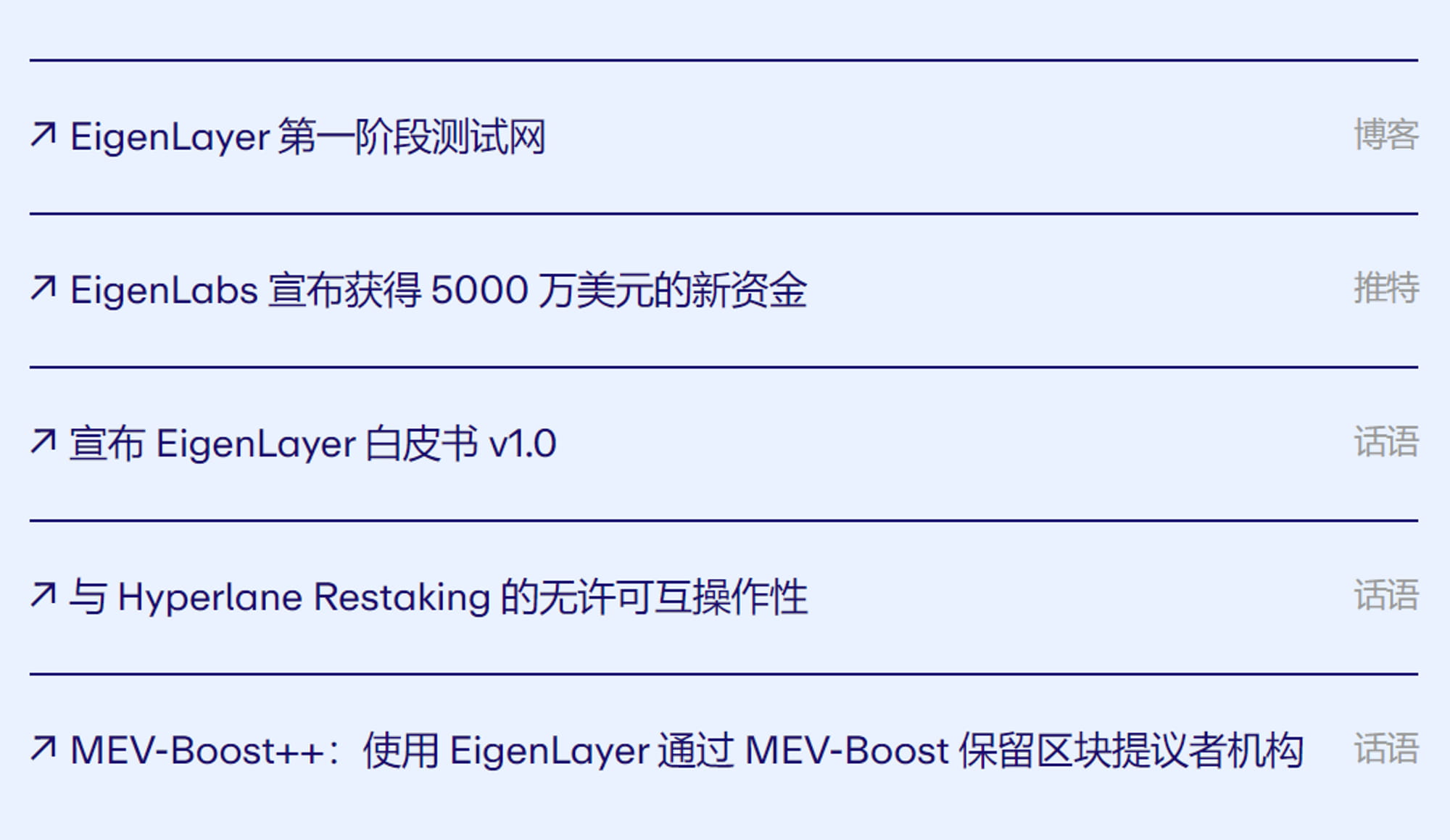
The project is currently in the first phase of the test network, and the launch of the first phase of the test network was announced on April 6, 2023. (The article writes about whether it is an incentivized test network, so you can judge by yourself)
The protocol will launch in three phases: stakers, operators, and services. The first phase is currently for stakers. Stakeholders can participate in liquidity re-staking and local re-staking. Pledgers will later be able to entrust their re-pledges to operators for operation without having to verify them themselves, similar to delegated voting.
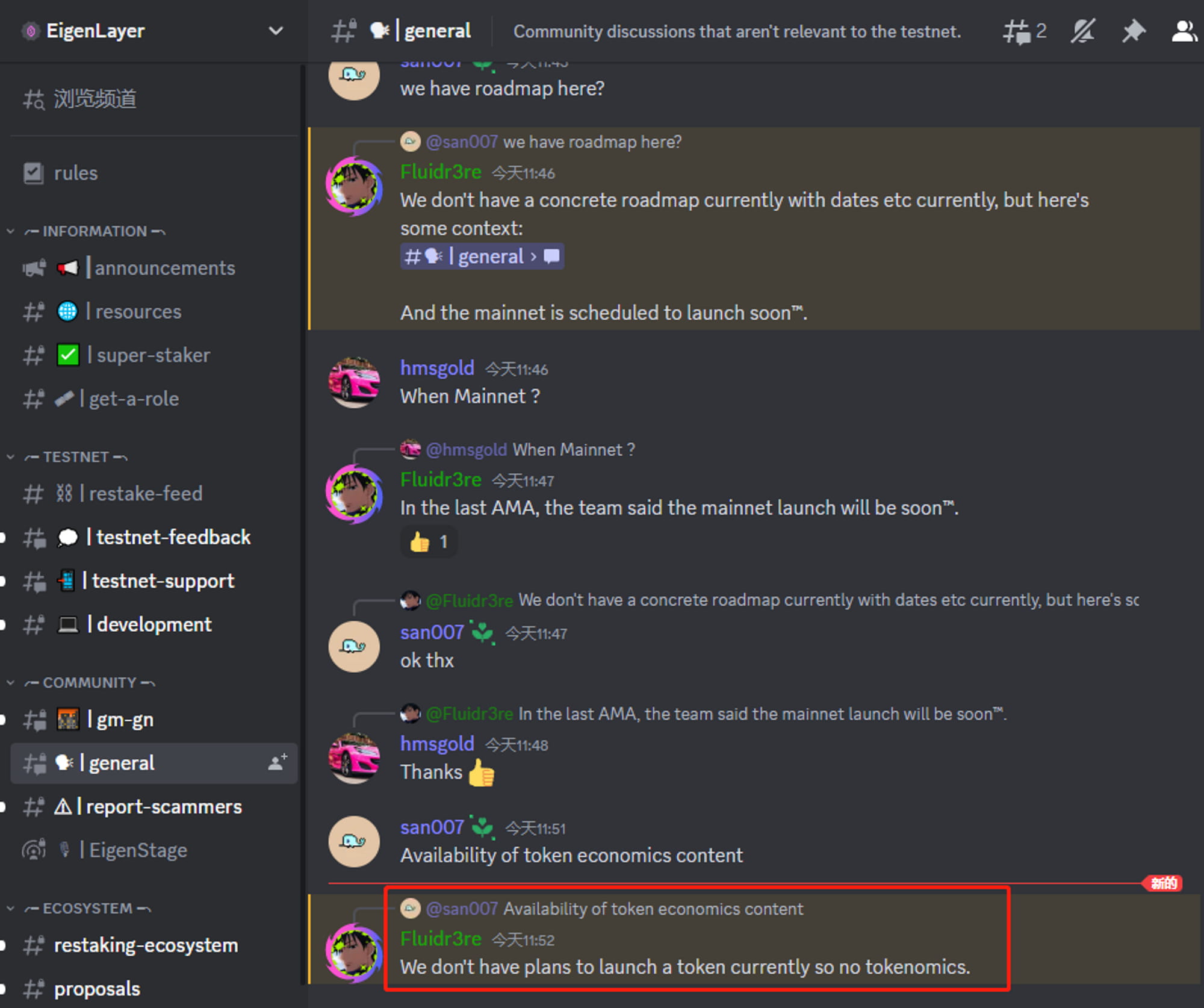
According to the latest community AMA meeting, the mainnet will be launched soon. According to the Discord Mod reply, there are currently no plans for tokens, so there are no token economics. (As a re-pledge agreement, raising tens of millions, if you only rely on the value capture of the agreement itself to obtain income, there are currently not many projects that can achieve this)
Summarize:
As the pledge rate of Ethereum increases, the demand for re-pledge protocols gradually increases. The new re-pledge solution proposed by Eigenlayer has a very good vision, providing multiple benefits for re-pledgers and releasing higher benefits for protocol innovators. In terms of security and cost saving, judging from the current testnet stage, only the stakers can operate it.
The first project on Eigenlayer will also be EigenDA built by the team itself, a super large data availability layer. Espresso Systems is developing Espresso Sequencer. They plan to use EigenLayer for re-pledge. Mantle plans to use EigenLayer's data availability (DA) layer. When these innovators come to deploy on Eigenlayer, they need to pay the verifier service fee and the security they enjoy is also affected by the number of nodes participating in the verification. Therefore, it is difficult to attract more protocol innovators or middleware in the future. Go ahead, the narrative is pretty good anyway, it’s a bit like a matryoshka doll but not entirely a matryoshka doll. Anyway, stay tuned for the follow-up.