


Introduction:
The emergence of Bitcoin has promised to bring freedom to the finance industry, but is it the ultimate solution? What about Ethereum? What if combining both could offer an even better solution? Introducing CORE, the revolutionary blockchain platform leading the way in the era of Web3.
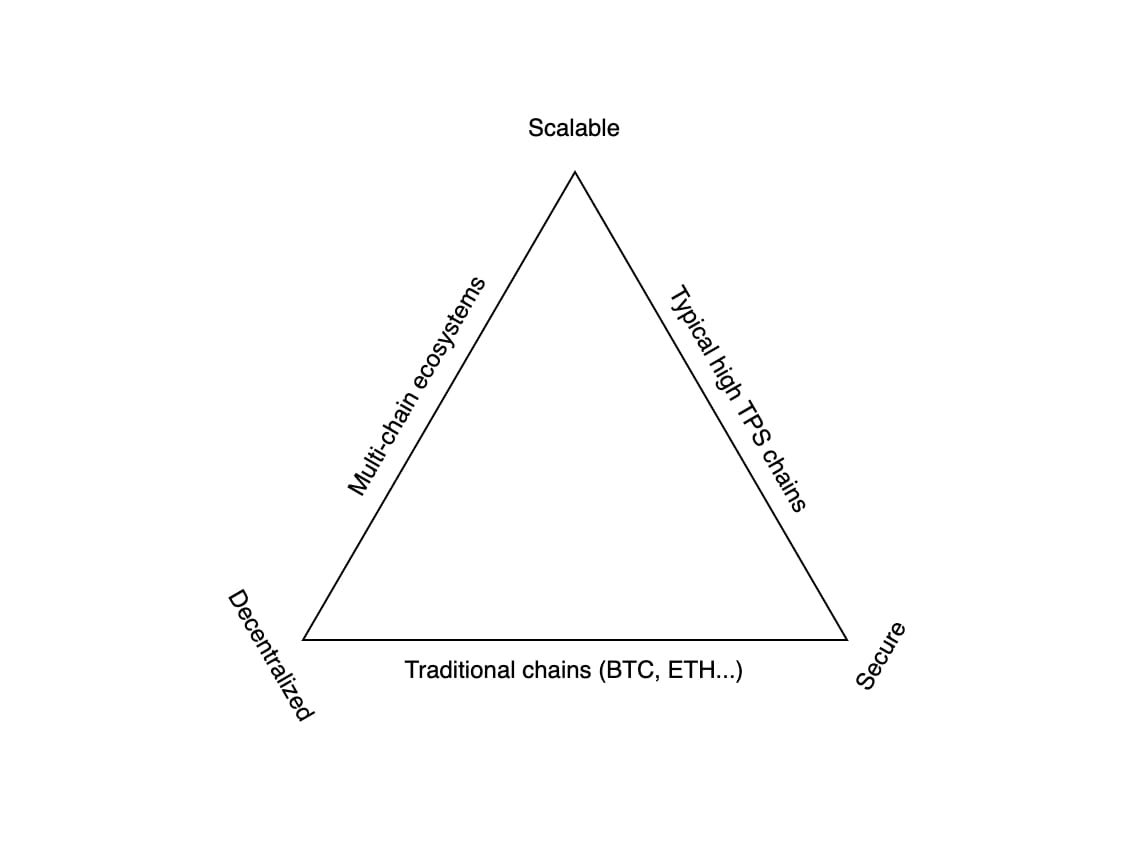
CORE leverages the Satoshi Plus Consensus algorithm, combining the mining hashrate of Bitcoin with the Ethereum Virtual Machine (EVM). This powerful combination offers a protocol-driven validator election mechanism that maximizes security, scalability, and decentralization, successfully solving the Blockchain Trilemma.
CORE's ability to be decentralized, secure, and scalable at the same time sets it apart from other crypto giants like Bitcoin and Ethereum. While Bitcoin is decentralized and secure, it lacks scalability, and Ethereum's shift away from PoW for scalability leaves it without a decentralisation solution. CORE, on the other hand, successfully tackles all three aspects of the Trilemma, making it the ideal blockchain platform.
As the cryptocurrency revolution continues to evolve, CORE's innovative approach to finance and blockchain technology puts the future of finance at our fingertips, offering limitless possibilities for the Web3 world.
Comparison:
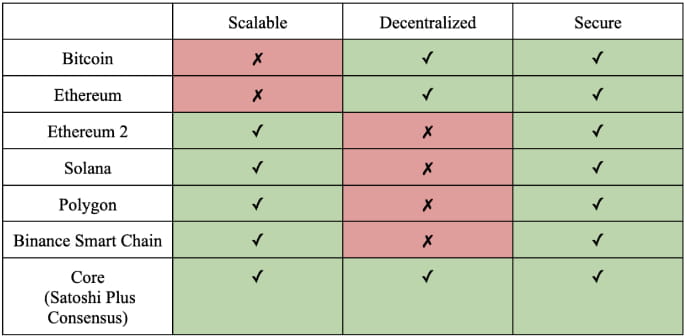
The Table depicted above unequivocally demonstrates that CORE stands out as the preeminent Blockchain technology, boasting unparalleled levels of security, scalability, and decentralization. Without compromising on any of these critical attributes, CORE has firmly established itself as the leader in the Blockchain space.
Satoshi Plus Consensus:
Satoshi Plus is the ingenious consensus mechanism that forms the backbone of the Core network's security. It utilizes the combined power of hash mining on the Bitcoin blockchain and a Decentralized Proof of Stake mechanism to achieve an optimal balance of decentralization and scalability. By harnessing the strengths of these two consensus mechanisms, Satoshi Plus has positioned Core as a pioneer in the blockchain trilemma.
To better understand this groundbreaking system, let's take a closer look at its key components:
Validators: Responsible for producing blocks and validating transactions on the Core network. Becoming a validator requires registration with the network and locking up a refundable CORE deposit to be included into the validator set per the rules of the validator election. Anyone can deposit and become a validator on Core.
Relayers: Responsible for relaying BTC block headers to the Core network. In order to relay, a potential relayer must register with the network and lockup a refundable CORE deposit. Anyone can deposit and become a relayer on Core.
BTC Miners: The miners responsible for securing the Bitcoin network via PoW. In order to have their hash power factor into Satoshi Plus consensus, miners must delegate their hash power to a validator that either they or a third party run. Delegation is a non-destructive act, meaning that by delegating on Core they’re re-purposing their existing work vs choosing between securing Bitcoin and securing Core.
CORE Holders: Holders of the CORE currency, the base currency of the CORE chain. All holders of CORE are able to participate in staking by delegating their holdings to a validator.
Verifiers: Responsible for reporting malicious behaviors on the network. Anyone can act as a verifier in the Core network. Successful verification flags may result in slashing (rewards or stake) or jailing misbehaving validators.
Validator Election: The mechanism in which the top 21 validators are selected for inclusion in the validator set. Validators are elected in relation to their hybrid score each round. To ensure a more stable TPS, the “live” validators are updated every 200 blocks during the round so that other validators do not need to wait for “jailed” validators for the entirety of the round.
Hybrid Scord: The output of the protocol function used in validator election calculations. The inputs to the function are the BTC hash power and CORE delegated to the validator.
Round: Cycle time for Core to update validator quorum and distribute rewards, which is currently set to 1 day. Each day, 21 validators with the highest hybrid scores are elected to the validator set, thereby becoming responsible for producing blocks on the Core network for the entirety of the round. At the last block of each round, the accumulated rewards for the round will be calculated and distributed and the validator quorum for the next round will also be determined.
Slot: Each round is divided into slots and all validators in the quorum take turns producing blocks repeatedly in a round robin manner until the end of the round. Currently, the slot length is set to 3 seconds. In each slot, an honest validator either produces a block or fails to do so.
Epoch: The cycle length for the system to check each validator’s status to exclude jailed validators from the quorum to prevent them from participating in the consensus to keep TPS more or less constant in a given round. Currently, epoch is set to 200 slots, which is 600 seconds or 10 minutes.
PoW:
Now that we have a basic understanding of the participants and processes involved in Satoshi Plus, let's delve deeper into each consensus mechanism. First up is the widely-used Proof of Work.
In the Core network, BTC miners have the option to either delegate their hash power to a Core validator or operate their own validator by synchronizing their identity across both the BTC and Core blockchains using their public and private keys. When transactions are submitted, the blocks mined by BTC miners are seamlessly synced with the Core network via relayers. The network precisely calculates the BTC hash power of each validator in each round by monitoring the number of blocks produced by each miner on the BTC network over the previous week on the same day.
An intriguing aspect of Core's use of BTC hash power is that miners only delegate their power, meaning that contributing to the security of the Core network doesn't detract from the security of the Bitcoin network. This ingenious design enables network security to be achieved without miners having to expend any additional computing power.
DPoS:
Like other blockchains, such as Tron, Core utilizes a unique system called Delegated Proof of Stake in conjunction with the Bitcoin Proof-of-work system and its hash power. As previously mentioned, the DPoS system works by electing a rotating group of 21 validators that are voted on by token holders who delegate their holdings. This innovative approach aims to address the high barrier-to-entry issue faced by smaller token holders who lack the requisite amount of $CORE to run a validator. This barrier is further exacerbated by the 32 ETH required to run an Ethereum validator, which highlights the prohibitive nature of some Proof of Stake networks.
But how are validators selected? This is determined by the 'hybrid scores,' which take into account a validator's hash power and staked $CORE. These scores are calculated using a function, with the highest hybrid scores being chosen and ranked from 1 to 21. This limited validator design is deliberate and allows for higher TPS and better scalability, while the PoW component provides the network with its much-needed decentralization. Additionally, $CORE holders can participate by delegating their tokens to validators, further increasing the network's fault tolerance and resistance to possible attacks.
Community:
Having a strong and engaged community is undoubtedly an important aspect for the success of any cryptocurrency, and CORE seems to have that. With 1.7 million followers on Twitter, 245K Discord members, 30 million transactions, and 4 million on-chain addresses, CORE boasts one of the largest communities in the crypto space. This active community has been demonstrated by the success of CORE's Airdrop in partnership with Satoshi App in February, which saw over 1.2 million people participate and is considered one of the biggest Airdrops in the crypto space. Such a large and active community can help increase adoption and awareness of CORE, which could contribute to its long-term success in the cryptocurrency market.
Tokenomics:
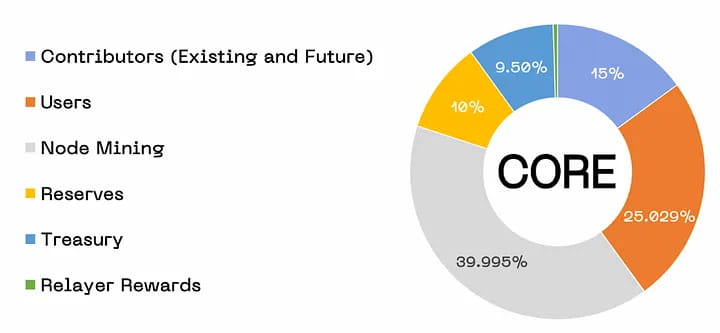
Distribution Breakdown of the 2.1 billion total CORE tokens:
Node Mining (839,900,000 CORE tokens; 39.995% of the total supply):
To get Core off the ground, both miners and stakers who are securing the network must be compensated for their services. Node rewards will be distributed over an extended period of time (~81 years) to ensure long-term incentive alignment. Nodes can also receive rewards in the form of transaction fees.
Users (525,600,000 CORE tokens; 25.029%):
From the start, Core users should know that this chain is built for them. Airdropped CORE tokens will be allocated to a decentralized base of millions of users.
Contributors (Existing and Future) (315,000,000 CORE tokens; 15%):
Compensation will incentivize past, present, and future Core contributors.
Reserves (210,000,000 CORE tokens; 10%):
This reserve may be used over time in order to capitalize the foundation without centralizing the token supply.
Treasury (199,500,000 CORE tokens; 9.5%):
The Treasury will give the DAO the funds necessary to build out the ecosystem.
Relayer Rewards (10,000,000 CORE tokens; 0.476%):
Like nodes, relayers must be compensated for the services they provide to the chain’s security. Relayers also receive rewards in the form of transaction fees.
Mission:
The Core community has set an ambitious goal of having 100% of Bitcoin's hash power delegated to the Satoshi Plus consensus mechanism. This would not only help secure the Core network, but also fulfill the symbiotic relationship between Bitcoin and Core. By leveraging the hash power generated by Bitcoin miners, Core will be able to achieve a high level of decentralization without requiring additional computing power.
Disclaimer: Do your Own Research. I'm not a Financial Advisor