

Binance News
396.6k Posts

Binance News
 Binance Officially Verified Account
Report
Follow Binance News to stay on top of industry trends & news
9 Following
2.3M+ Followers
2.8M+ Liked
Top
Replies
Videos
·
--
Circle and Tether Freeze Hacker Wallet After Bitget's $352 Million HeistCircle and Tether have frozen stablecoins in a wallet linked to Thursday's $351.6 million Bitget hack, though the amount is a small fraction of the total, according to CoinDesk. On-chain data shows Circle blacklisted the address — labeled "Bitget Exploiter 8" on Etherscan — at 05:00 UTC Friday. The wallet holds about 170.47 ETH, 218,023 USDT and 99,990 USDC, and blockchain security firm MistTrack said Tether has since banned it too. That leaves roughly $318,000 in stablecoins stuck, while MistTrack's tracker shows other exploiter addresses still holding more than 63,000 ETH, which no issuer can freeze.
Bitget CEO Gracy Chen said attackers compromised a backend system in the exchange's wallet infrastructure, spoofed transaction data and triggered its authorization process to move funds out, ruling out a private-key compromise. She said Bitget's user protection fund, which holds over $464 million, covers the loss. Circle's quick action contrasts with its response to April's $285 million Drift hack, when the attacker moved about $232 million in USDC from Solana to Ethereum using Circle's own cross-chain transfer protocol; critics including ZachXBT said Circle could have acted faster to blacklist wallets and freeze funds, and Circle said it freezes assets when legally required.
Circle and Tether Freeze Hacker Wallet After Bitget's $352 Million Heist
Circle and Tether have frozen stablecoins in a wallet linked to Thursday's $351.6 million Bitget hack, though the amount is a small fraction of the total, according to CoinDesk. On-chain data shows Circle blacklisted the address — labeled "Bitget Exploiter 8" on Etherscan — at 05:00 UTC Friday. The wallet holds about 170.47 ETH, 218,023 USDT and 99,990 USDC, and blockchain security firm MistTrack said Tether has since banned it too. That leaves roughly $318,000 in stablecoins stuck, while MistTrack's tracker shows other exploiter addresses still holding more than 63,000 ETH, which no issuer can freeze.
Bitget CEO Gracy Chen said attackers compromised a backend system in the exchange's wallet infrastructure, spoofed transaction data and triggered its authorization process to move funds out, ruling out a private-key compromise. She said Bitget's user protection fund, which holds over $464 million, covers the loss. Circle's quick action contrasts with its response to April's $285 million Drift hack, when the attacker moved about $232 million in USDC from Solana to Ethereum using Circle's own cross-chain transfer protocol; critics including ZachXBT said Circle could have acted faster to blacklist wallets and freeze funds, and Circle said it freezes assets when legally required.
Bitget CEO Gracy Chen said attackers compromised a backend system in the exchange's wallet infrastructure, spoofed transaction data and triggered its authorization process to move funds out, ruling out a private-key compromise. She said Bitget's user protection fund, which holds over $464 million, covers the loss. Circle's quick action contrasts with its response to April's $285 million Drift hack, when the attacker moved about $232 million in USDC from Solana to Ethereum using Circle's own cross-chain transfer protocol; critics including ZachXBT said Circle could have acted faster to blacklist wallets and freeze funds, and Circle said it freezes assets when legally required.
13
11
55
37.1k
·
--
Hyperliquid Assistance Fund Buys and Burns Over 47.51 Million HYPEHyperliquid’s assistance fund has cumulatively bought back and burned more than 47.5058 million HYPE tokens, with total purchase costs of about $1.321 billion. According to Odaily, the holdings are currently worth about $4.366 billion.
Hyperliquid Assistance Fund Buys and Burns Over 47.51 Million HYPE
Hyperliquid’s assistance fund has cumulatively bought back and burned more than 47.5058 million HYPE tokens, with total purchase costs of about $1.321 billion. According to Odaily, the holdings are currently worth about $4.366 billion.
2
2
5
4.4k
·
--
Bitget to Restore Withdrawals in Stages After Security IncidentBitget said it will restore withdrawals in stages after a security incident on September 24. According to PANews, BTC withdrawals will reopen at 8:00 UTC on September 28, ETH withdrawals on September 29 across Ethereum, BSC, Arbitrum, Base and Optimism, USDT withdrawals on September 30 across Ethereum, BSC, Solana and Tron, and other tokens, fiat and P2P on October 2. The company said user assets and balances were not affected.
Bitget to Restore Withdrawals in Stages After Security Incident
Bitget said it will restore withdrawals in stages after a security incident on September 24. According to PANews, BTC withdrawals will reopen at 8:00 UTC on September 28, ETH withdrawals on September 29 across Ethereum, BSC, Arbitrum, Base and Optimism, USDT withdrawals on September 30 across Ethereum, BSC, Solana and Tron, and other tokens, fiat and P2P on October 2. The company said user assets and balances were not affected.
3
2
14
12.9k
·
--
Block Integrates Bitcoin Lightning Network Into x402 Payment StandardBlock announced on September 24 that it has integrated the Bitcoin Lightning Network into the x402 payment standard. According to Odaily, the x402 protocol can verify payment requests after a server returns an HTTP 402 response and unlock data through Lightning invoices and payment preimages.
Steve Lee, head of Block's open-source Bitcoin development unit Spiral, said the integration is aimed at instant, low-cost micropayments. Block has not disclosed a timeline for bringing the standard to Cash App, Square, or Bitkey, and the Python implementation still needs testing on a real node.
Block Integrates Bitcoin Lightning Network Into x402 Payment Standard
Block announced on September 24 that it has integrated the Bitcoin Lightning Network into the x402 payment standard. According to Odaily, the x402 protocol can verify payment requests after a server returns an HTTP 402 response and unlock data through Lightning invoices and payment preimages.
Steve Lee, head of Block's open-source Bitcoin development unit Spiral, said the integration is aimed at instant, low-cost micropayments. Block has not disclosed a timeline for bringing the standard to Cash App, Square, or Bitkey, and the Python implementation still needs testing on a real node.
Steve Lee, head of Block's open-source Bitcoin development unit Spiral, said the integration is aimed at instant, low-cost micropayments. Block has not disclosed a timeline for bringing the standard to Cash App, Square, or Bitkey, and the Python implementation still needs testing on a real node.
4
2.2k
·
--
Trader on Aster Opens 15x Long on 2.15 Million ENA, Gains 786.54%A trader address starting with 0xc8F opened a 15x leveraged long position on 2.15 million ENA on Aster and has gained about $310,700, according to Lookonchain monitoring. According to Foresight News, the position has returned 786.54%.
Trader on Aster Opens 15x Long on 2.15 Million ENA, Gains 786.54%
A trader address starting with 0xc8F opened a 15x leveraged long position on 2.15 million ENA on Aster and has gained about $310,700, according to Lookonchain monitoring. According to Foresight News, the position has returned 786.54%.
1
11
26.4k
·
--

Article
SEC Crypto FAQ Addresses Token Buybacks, Network Upgrades and Promises of ProfitThe US Securities and Exchange Commission said Friday that token buybacks, network upgrades and marketing claims do not automatically turn a crypto asset into a security, according to The Block. In an updated Frequently Asked Questions release, the Division of Corporation Finance said announcing a buyback program for an already-functioning crypto network would not, by itself, make the associated token subject to an investment contract — though that would not necessarily hold for a network that is not yet functional where issuers pitch the buyback as a source of returns for holders.
The FAQ also addressed projects that keep developing after launch. "Once a crypto system is functional, services to secure, maintain, improve, or enhance such a system or its functionality, or to facilitate network effects" would not count as the kind of managerial effort under the Howey test, it stated. Marketing a network's existing uses generally would not create an expectation of profit either, nor would statements about future features, so long as they don't promote the potential for profit, though the answer still depends heavily on each case's specifics. The update builds on the SEC's March "Interpretive Release" on how securities laws apply to crypto, and comes weeks after the Clarity Act failed to advance in the Senate, leaving regulators to work under existing laws.
Separately, the CFTC updated its own crypto FAQ on Thursday, saying futures firms and clearinghouses may invest customer funds in tokenized versions of previously permitted assets as long as they meet investment and custody requirements. CFTC staff also said regulated firms can use blockchains for recordkeeping but must be able to produce the records even if a blockchain or its block explorer is not functioning.
SEC Crypto FAQ Addresses Token Buybacks, Network Upgrades and Promises of Profit
The US Securities and Exchange Commission said Friday that token buybacks, network upgrades and marketing claims do not automatically turn a crypto asset into a security, according to The Block. In an updated Frequently Asked Questions release, the Division of Corporation Finance said announcing a buyback program for an already-functioning crypto network would not, by itself, make the associated token subject to an investment contract — though that would not necessarily hold for a network that is not yet functional where issuers pitch the buyback as a source of returns for holders.
The FAQ also addressed projects that keep developing after launch. "Once a crypto system is functional, services to secure, maintain, improve, or enhance such a system or its functionality, or to facilitate network effects" would not count as the kind of managerial effort under the Howey test, it stated. Marketing a network's existing uses generally would not create an expectation of profit either, nor would statements about future features, so long as they don't promote the potential for profit, though the answer still depends heavily on each case's specifics. The update builds on the SEC's March "Interpretive Release" on how securities laws apply to crypto, and comes weeks after the Clarity Act failed to advance in the Senate, leaving regulators to work under existing laws.
Separately, the CFTC updated its own crypto FAQ on Thursday, saying futures firms and clearinghouses may invest customer funds in tokenized versions of previously permitted assets as long as they meet investment and custody requirements. CFTC staff also said regulated firms can use blockchains for recordkeeping but must be able to produce the records even if a blockchain or its block explorer is not functioning.
The FAQ also addressed projects that keep developing after launch. "Once a crypto system is functional, services to secure, maintain, improve, or enhance such a system or its functionality, or to facilitate network effects" would not count as the kind of managerial effort under the Howey test, it stated. Marketing a network's existing uses generally would not create an expectation of profit either, nor would statements about future features, so long as they don't promote the potential for profit, though the answer still depends heavily on each case's specifics. The update builds on the SEC's March "Interpretive Release" on how securities laws apply to crypto, and comes weeks after the Clarity Act failed to advance in the Senate, leaving regulators to work under existing laws.
Separately, the CFTC updated its own crypto FAQ on Thursday, saying futures firms and clearinghouses may invest customer funds in tokenized versions of previously permitted assets as long as they meet investment and custody requirements. CFTC staff also said regulated firms can use blockchains for recordkeeping but must be able to produce the records even if a blockchain or its block explorer is not functioning.
8
7
45
50.9k
·
--
Sui DeFi Protocol AlphaFi Announces Orderly Shutdown and Enters Maintenance ModeAlphaFi, a DeFi protocol in the Sui ecosystem, has announced an orderly shutdown and is now in maintenance mode. According to Odaily, withdrawals remain open, but the protocol is no longer accepting new deposits or loans.
AlphaFi said some borrowing positions in AlphaLend backed by ALPHA were undercollateralized, which led to bad debt. The Sui Foundation security team identified the issue and worked with the project team to address it, and AlphaFi said the bad debt has been fully covered and the protocol remains solvent.
As part of the shutdown process, users are being asked to close positions and withdraw assets. Slush Strategies users can now withdraw funds directly from Slush Wallet, the WAL vault lockup period has been removed, and the SUI, WAL, DEEP, and USDC strategies can be withdrawn immediately. The ALPHA vault has also stopped operating and its lockup period has been canceled.
Sui DeFi Protocol AlphaFi Announces Orderly Shutdown and Enters Maintenance Mode
AlphaFi, a DeFi protocol in the Sui ecosystem, has announced an orderly shutdown and is now in maintenance mode. According to Odaily, withdrawals remain open, but the protocol is no longer accepting new deposits or loans.
AlphaFi said some borrowing positions in AlphaLend backed by ALPHA were undercollateralized, which led to bad debt. The Sui Foundation security team identified the issue and worked with the project team to address it, and AlphaFi said the bad debt has been fully covered and the protocol remains solvent.
As part of the shutdown process, users are being asked to close positions and withdraw assets. Slush Strategies users can now withdraw funds directly from Slush Wallet, the WAL vault lockup period has been removed, and the SUI, WAL, DEEP, and USDC strategies can be withdrawn immediately. The ALPHA vault has also stopped operating and its lockup period has been canceled.
AlphaFi said some borrowing positions in AlphaLend backed by ALPHA were undercollateralized, which led to bad debt. The Sui Foundation security team identified the issue and worked with the project team to address it, and AlphaFi said the bad debt has been fully covered and the protocol remains solvent.
As part of the shutdown process, users are being asked to close positions and withdraw assets. Slush Strategies users can now withdraw funds directly from Slush Wallet, the WAL vault lockup period has been removed, and the SUI, WAL, DEEP, and USDC strategies can be withdrawn immediately. The ALPHA vault has also stopped operating and its lockup period has been canceled.
1
7
11.8k
·
--

Article
SEC Commissioner Hester Peirce to Leave on October 2U.S. Securities and Exchange Commission Commissioner Hester Peirce said she will leave the agency on October 2. She announced the date in a resignation letter posted on X on Friday.
Peirce, known in the industry as "Crypto Mom," has long pushed for clearer rules for the crypto sector. According to ChainCatcher, she continued advocating for regulation even as the SEC took a tougher enforcement approach to crypto under former chairs Jay Clayton and Gary Gensler, and later led work at the agency's newly created crypto task force.
Her crypto-related work covered policy statements and guidance on mining, staking, and meme coins, as well as efforts to define different types of crypto assets and clarify their regulatory status. The SEC has recently begun proposing formal rules, including "Regulation Crypto Assets," which would create a framework for issuing crypto assets without triggering strict securities oversight. The agency has also opened a path for securities tokenization through an "innovation exemption" with a five-year limited term.
Peirce will become an associate professor at Regent University School of Law. After her departure, the SEC will have only two commissioners left, Atkins and Mark Uyeda, though the rules allow two members to form a quorum.
On the same day, the SEC released a crypto assets FAQ document addressing how to avoid triggering a "necessary managerial efforts" finding when marketing tokens, as well as questions involving staking receipt tokens and when secondary markets may be viewed as promoters of an investment contract.
SEC Commissioner Hester Peirce to Leave on October 2
U.S. Securities and Exchange Commission Commissioner Hester Peirce said she will leave the agency on October 2. She announced the date in a resignation letter posted on X on Friday.
Peirce, known in the industry as "Crypto Mom," has long pushed for clearer rules for the crypto sector. According to ChainCatcher, she continued advocating for regulation even as the SEC took a tougher enforcement approach to crypto under former chairs Jay Clayton and Gary Gensler, and later led work at the agency's newly created crypto task force.
Her crypto-related work covered policy statements and guidance on mining, staking, and meme coins, as well as efforts to define different types of crypto assets and clarify their regulatory status. The SEC has recently begun proposing formal rules, including "Regulation Crypto Assets," which would create a framework for issuing crypto assets without triggering strict securities oversight. The agency has also opened a path for securities tokenization through an "innovation exemption" with a five-year limited term.
Peirce will become an associate professor at Regent University School of Law. After her departure, the SEC will have only two commissioners left, Atkins and Mark Uyeda, though the rules allow two members to form a quorum.
On the same day, the SEC released a crypto assets FAQ document addressing how to avoid triggering a "necessary managerial efforts" finding when marketing tokens, as well as questions involving staking receipt tokens and when secondary markets may be viewed as promoters of an investment contract.
Peirce, known in the industry as "Crypto Mom," has long pushed for clearer rules for the crypto sector. According to ChainCatcher, she continued advocating for regulation even as the SEC took a tougher enforcement approach to crypto under former chairs Jay Clayton and Gary Gensler, and later led work at the agency's newly created crypto task force.
Her crypto-related work covered policy statements and guidance on mining, staking, and meme coins, as well as efforts to define different types of crypto assets and clarify their regulatory status. The SEC has recently begun proposing formal rules, including "Regulation Crypto Assets," which would create a framework for issuing crypto assets without triggering strict securities oversight. The agency has also opened a path for securities tokenization through an "innovation exemption" with a five-year limited term.
Peirce will become an associate professor at Regent University School of Law. After her departure, the SEC will have only two commissioners left, Atkins and Mark Uyeda, though the rules allow two members to form a quorum.
On the same day, the SEC released a crypto assets FAQ document addressing how to avoid triggering a "necessary managerial efforts" finding when marketing tokens, as well as questions involving staking receipt tokens and when secondary markets may be viewed as promoters of an investment contract.
2
18
32.8k
·
--

Article
CoinMarketCap Completes Acquisition of CoinglassCoinMarketCap has completed its acquisition of derivatives data platform Coinglass. According to Foresight News, Coinglass will continue to operate as an independent brand, and its website, app, free tools, API, and pricing will remain unchanged.
CoinMarketCap Completes Acquisition of Coinglass
CoinMarketCap has completed its acquisition of derivatives data platform Coinglass. According to Foresight News, Coinglass will continue to operate as an independent brand, and its website, app, free tools, API, and pricing will remain unchanged.
1
2
5
4.2k
·
--
Article
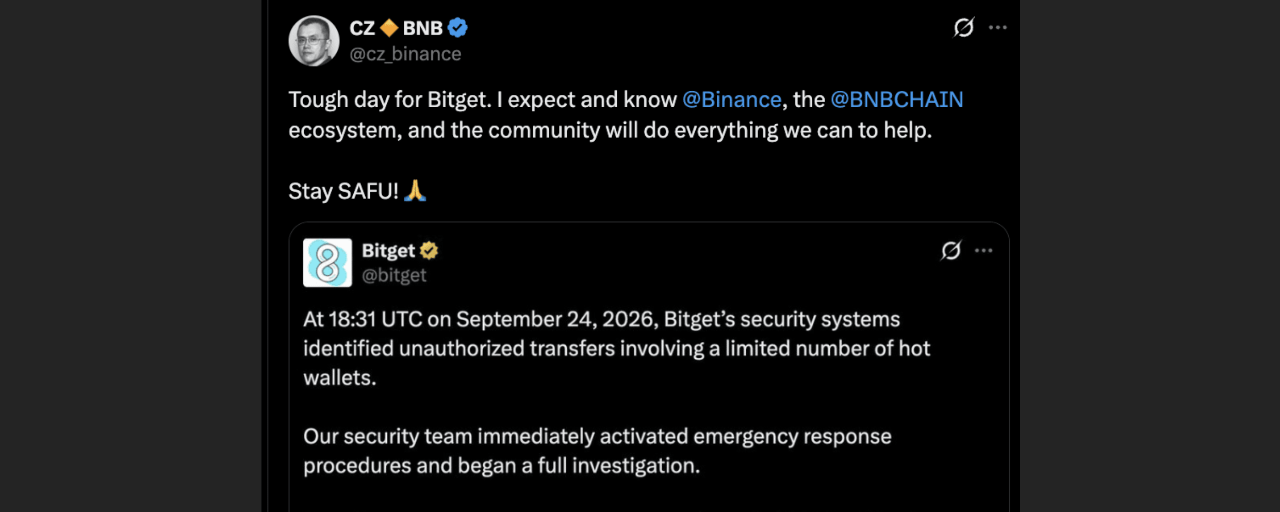
CZ Responds to Bitget Hack: Binance and BNB Chain to Offer SupportOn September 25, CZ posted on X regarding the roughly $350 million hack of Bitget: "Tough day for Bitget. I expect and know @Binance, the @BNBCHAIN ecosystem, and the community will do everything we can to help. Stay SAFU!" Binance Co-CEO Richard Teng said Binance's security team had been working closely with Bitget since the breach was detected, sharing threat intelligence, tracking the stolen funds, and supporting asset recovery efforts.
CZ Responds to Bitget Hack: Binance and BNB Chain to Offer Support
On September 25, CZ posted on X regarding the roughly $350 million hack of Bitget: "Tough day for Bitget. I expect and know @Binance, the @BNBCHAIN ecosystem, and the community will do everything we can to help. Stay SAFU!" Binance Co-CEO Richard Teng said Binance's security team had been working closely with Bitget since the breach was detected, sharing threat intelligence, tracking the stolen funds, and supporting asset recovery efforts.
4
6
47
63.7k
·
--
BlackRock Develops Three Tokenized Portfolio Strategies for Ondo as ONDO Rises 30%BlackRock developed three portfolio strategies for Ondo that each trade as a single token. According to NS3.AI, the tokens carry full asset allocations that can rebalance and move between wallets.
The products are available to eligible investors outside the United States. ONDO rose about 30% on the news.
BlackRock Develops Three Tokenized Portfolio Strategies for Ondo as ONDO Rises 30%
BlackRock developed three portfolio strategies for Ondo that each trade as a single token. According to NS3.AI, the tokens carry full asset allocations that can rebalance and move between wallets.
The products are available to eligible investors outside the United States. ONDO rose about 30% on the news.
The products are available to eligible investors outside the United States. ONDO rose about 30% on the news.
9
21k
·
--
Crypto News | Trump Rejects Iran's Ceasefire, Morgan Stanley Sees Dollar at 104 by Mid-2027 — Bitcoin Holds $84K as Bond Volatility Spikes 30% and 81% of Supply Sits UnmovedTrump rejected Iran's seven-day ceasefire proposal and told aides he expects to resume bombing after November's midterms — removing the Hormuz resolution that had been Bitcoin's primary macro tailwind this week. Morgan Stanley abandoned its bearish dollar view, now forecasting DXY at 104 by mid-2027 with two more Fed hikes (December and March) — stretching this week's dollar headwind from a trade into a multi-quarter regime. Treasury volatility (MOVE) jumped 30% to its highest since March while Bitcoin implied volatility (BVIV) sits near yearly lows at 37 — a divergence that reads as either resilience or complacency. CryptoQuant's MVRV signal marked August 20 as Bitcoin's early bull market entry at $71,255. 81% of circulating Bitcoin hasn't moved in six months.Morgan Stanley's Dollar U-Turn Extends the Squeeze on Risk Assets Into 2027Morgan Stanley abandoned its bearish dollar view, now forecasting DXY rising from ~101 to 104 by mid-2027 and EUR/USD falling from ~$1.14 to $1.10. The bank's revised Fed path calls for hikes in December 2026 and March 2027 — more tightening than the dot plot's one remaining 2026 move, but on a slower clock than futures pricing 53%+ October odds. The distinction matters: if MS is right, October disappoints the hawks and offers a tactical reprieve while the destination ends up higher than the dot plot implies. European political risk adds a second engine — France's spring 2027 presidential election plus German and Italian election risks stack a euro risk premium on top of the US rate advantage. For crypto, a dollar march to 104 extends the two pressure channels — foreign purchasing power erosion and elevated opportunity cost — for several more quarters. The counterweights holding so far: $2.84B in six-day ETF inflows, slowing LTH distribution, and BVIV near yearly lows even as bond volatility spikes. October 2 jobs and October 14 CPI arbitrate the MS-versus-futures timing dispute.The Bond Market Is Screaming and Bitcoin Is Not Listening — YetThe MOVE index jumped ~30% from around 80 Tuesday to 104 Thursday — its highest since March — while BVIV sits at ~37 near its yearly floor of 35 and the VIX hovers near 14. The 20-day BVIV-MOVE correlation has turned decisively negative at -0.37: as bond volatility rose, Bitcoin's expected volatility fell. Bitcoin held ~$84,300 through the 10-year's push past 5.2%, supported by $2.84B in six-day ETF inflows. The bullish precedent: in March when MOVE last reached these levels, the S&P 500 stood near 6,350 and has since risen ~21%. The caution: BVIV at 37 means Bitcoin options are pricing very little turbulence just after a $14B Deribit expiry removed the $85,000 pin — low implied volatility is exactly what makes markets vulnerable to violent repricing if the bond warning proves right. Watch whether MOVE keeps climbing toward its March extreme of 199, whether BVIV liftsBitcoin Enters Early Bull Market Phase After MVRV Signal, CryptoQuant Analyst SaysCryptoQuant's Axel Adler Jr. identified August 20 as the date Bitcoin entered an early bull market phase, based on the adjusted MVRV 30-day MA to 365-day MA ratio crossing above its 365-day moving average at a price of $71,255. The phase lasted 31 days, during which Bitcoin rose 13%. The signal is consistent with other structural reads this week: Glassnode's four-year cycle breakdown note, LTH distribution slowing 80% in three weeks, and $2.84B in six-day ETF inflows. MVRV-based signals have historically marked the transition from recovery to sustained appreciation rather than predicting a specific price target — the metric measures whether the average holder is profitable relative to historical norms, which at $71,255 entry suggested undervaluation relative to realized value.81% of Circulating Bitcoin Has Not Moved for More Than Six Months, River Data ShowsRiver data shows 81% of circulating Bitcoin has not been transferred in over six months — the highest illiquidity reading consistent with structural accumulation rather than active trading. The figure complements this week's LTH data: 30-day long-term holder distribution slowed from -105,900 BTC on August 30 to -21,700 BTC by September 20, with most recent sales at a loss. A market where 81% of supply is dormant and the remaining 19% is actively priced means the effective float is thin — mechanically amplifying price moves in both directions. The same dynamic that powered Monday's ~$300M/hour short liquidation squeeze also means a reversal finds less liquidity to absorb it. Bitcoin's low BVIV at 37 against this backdrop is the tension the bond market's MOVE spike is flagging.U.S. President Donald Trump Rejects Iran's Seven-Day Ceasefire Proposal, WSJ ReportsTrump rejected Iran's proposed seven-day ceasefire and told aides he expects to resume bombing after November's midterm elections — removing the Hormuz resolution narrative that had sent WTI from $106 to $89 and supported risk assets through the week. With the ceasefire off the table until after November 3 at the earliest, the physical supply constraint returns as the base case: Saudi output at 6.238M bpd (its lowest since 1990), tanker rates above $1M/day, the East-West pipeline closed, and Bab El-Mandeb under threat. BofA's raised Brent second-half average of $95 now looks conservative against this backdrop. For Bitcoin, the oil-inflation-yields chain that capped price from February through August is back as the dominant macro regime heading into October's jobs report, CPI, and Fed decision.
Crypto News | Trump Rejects Iran's Ceasefire, Morgan Stanley Sees Dollar at 104 by Mid-2027 — Bitcoin Holds $84K as Bond Volatility Spikes 30% and 81% of Supply Sits Unmoved
Trump rejected Iran's seven-day ceasefire proposal and told aides he expects to resume bombing after November's midterms — removing the Hormuz resolution that had been Bitcoin's primary macro tailwind this week. Morgan Stanley abandoned its bearish dollar view, now forecasting DXY at 104 by mid-2027 with two more Fed hikes (December and March) — stretching this week's dollar headwind from a trade into a multi-quarter regime. Treasury volatility (MOVE) jumped 30% to its highest since March while Bitcoin implied volatility (BVIV) sits near yearly lows at 37 — a divergence that reads as either resilience or complacency. CryptoQuant's MVRV signal marked August 20 as Bitcoin's early bull market entry at $71,255. 81% of circulating Bitcoin hasn't moved in six months.Morgan Stanley's Dollar U-Turn Extends the Squeeze on Risk Assets Into 2027Morgan Stanley abandoned its bearish dollar view, now forecasting DXY rising from ~101 to 104 by mid-2027 and EUR/USD falling from ~$1.14 to $1.10. The bank's revised Fed path calls for hikes in December 2026 and March 2027 — more tightening than the dot plot's one remaining 2026 move, but on a slower clock than futures pricing 53%+ October odds. The distinction matters: if MS is right, October disappoints the hawks and offers a tactical reprieve while the destination ends up higher than the dot plot implies. European political risk adds a second engine — France's spring 2027 presidential election plus German and Italian election risks stack a euro risk premium on top of the US rate advantage. For crypto, a dollar march to 104 extends the two pressure channels — foreign purchasing power erosion and elevated opportunity cost — for several more quarters. The counterweights holding so far: $2.84B in six-day ETF inflows, slowing LTH distribution, and BVIV near yearly lows even as bond volatility spikes. October 2 jobs and October 14 CPI arbitrate the MS-versus-futures timing dispute.The Bond Market Is Screaming and Bitcoin Is Not Listening — YetThe MOVE index jumped ~30% from around 80 Tuesday to 104 Thursday — its highest since March — while BVIV sits at ~37 near its yearly floor of 35 and the VIX hovers near 14. The 20-day BVIV-MOVE correlation has turned decisively negative at -0.37: as bond volatility rose, Bitcoin's expected volatility fell. Bitcoin held ~$84,300 through the 10-year's push past 5.2%, supported by $2.84B in six-day ETF inflows. The bullish precedent: in March when MOVE last reached these levels, the S&P 500 stood near 6,350 and has since risen ~21%. The caution: BVIV at 37 means Bitcoin options are pricing very little turbulence just after a $14B Deribit expiry removed the $85,000 pin — low implied volatility is exactly what makes markets vulnerable to violent repricing if the bond warning proves right. Watch whether MOVE keeps climbing toward its March extreme of 199, whether BVIV liftsBitcoin Enters Early Bull Market Phase After MVRV Signal, CryptoQuant Analyst SaysCryptoQuant's Axel Adler Jr. identified August 20 as the date Bitcoin entered an early bull market phase, based on the adjusted MVRV 30-day MA to 365-day MA ratio crossing above its 365-day moving average at a price of $71,255. The phase lasted 31 days, during which Bitcoin rose 13%. The signal is consistent with other structural reads this week: Glassnode's four-year cycle breakdown note, LTH distribution slowing 80% in three weeks, and $2.84B in six-day ETF inflows. MVRV-based signals have historically marked the transition from recovery to sustained appreciation rather than predicting a specific price target — the metric measures whether the average holder is profitable relative to historical norms, which at $71,255 entry suggested undervaluation relative to realized value.81% of Circulating Bitcoin Has Not Moved for More Than Six Months, River Data ShowsRiver data shows 81% of circulating Bitcoin has not been transferred in over six months — the highest illiquidity reading consistent with structural accumulation rather than active trading. The figure complements this week's LTH data: 30-day long-term holder distribution slowed from -105,900 BTC on August 30 to -21,700 BTC by September 20, with most recent sales at a loss. A market where 81% of supply is dormant and the remaining 19% is actively priced means the effective float is thin — mechanically amplifying price moves in both directions. The same dynamic that powered Monday's ~$300M/hour short liquidation squeeze also means a reversal finds less liquidity to absorb it. Bitcoin's low BVIV at 37 against this backdrop is the tension the bond market's MOVE spike is flagging.U.S. President Donald Trump Rejects Iran's Seven-Day Ceasefire Proposal, WSJ ReportsTrump rejected Iran's proposed seven-day ceasefire and told aides he expects to resume bombing after November's midterm elections — removing the Hormuz resolution narrative that had sent WTI from $106 to $89 and supported risk assets through the week. With the ceasefire off the table until after November 3 at the earliest, the physical supply constraint returns as the base case: Saudi output at 6.238M bpd (its lowest since 1990), tanker rates above $1M/day, the East-West pipeline closed, and Bab El-Mandeb under threat. BofA's raised Brent second-half average of $95 now looks conservative against this backdrop. For Bitcoin, the oil-inflation-yields chain that capped price from February through August is back as the dominant macro regime heading into October's jobs report, CPI, and Fed decision.
32
5
110
7.8k
·
--
Polymarket Wagers on Bank Failures Trigger FDIC ConcernsPolymarket bets on the likelihood that some of the biggest names in banking — including Wells Fargo, JPMorgan Chase and Bank of America — will fail are drawing scrutiny from officials in Washington, people familiar with the matter told Bloomberg. The little-noticed contracts remain a tiny piece of the prediction market's offshore platform, which says it bans Americans from trading, but they have raised concerns among bank regulators and lawmakers, some worried the contracts could grow and eventually help fuel a real-world bank run. Wagers on individual failures often total just a few hundred dollars, though volume runs into the thousands for firms like Deutsche Bank and Wells Fargo; recent trades on banks failing by year-end drew $76,000 in volume, while an earlier set focused on failures by July saw $591,000.
Despite the market's modest size, officials inside the Federal Deposit Insurance Corp. expressed concern in recent weeks after the contracts were highlighted to senior staff at an internal meeting, the people said. The agency, which supervises thousands of mostly small banks, insures deposits and takes over failing lenders, questioned whether the contracts had any legitimate commercial benefit and whether its internal ethics rules were strong enough to bar insiders from trading — the FDIC keeps a confidential list of "problem banks" — though officials ultimately judged existing rules sufficient. FDIC Chairman Travis Hill said in March that while prediction markets could be a useful monitoring tool, he worried about people speculating on the timing of bank failures. The FDIC declined to comment.
Unlike shorting stocks or using credit-default swaps, the bets let customers take a direct binary position on a bank's collapse. The CFTC, which views prediction markets as derivatives exchanges and claims exclusive jurisdiction over US platforms, declined to comment; Polymarket's CFTC-regulated US exchange does not offer bank-failure wagers, but its offshore international platform does, alongside markets on a "major US bank bailout." Chief Legal Officer Neal Kumar said such markets aggregate information once available only to sophisticated institutions "in a format everyone can access," while rival Kalshi — which offers no such contracts — called them "in poor taste."
Former FDIC head Sheila Bair warned the failure-focused contracts introduce dangerous incentives, encouraging bad actors to weaponize social media, stoke rumors and deliberately trigger panic. "I don't see any socially beneficial value with those kinds of contracts to offset the financial stability threats and the risks that they pose," she said. Senator Elizabeth Warren, the top Democrat on the Senate Banking Committee, called the contracts reckless, saying "prediction markets under Trump's industry-captured regulators are the wild west, full of insider manipulation." The bets are a tiny slice of a multibillion-dollar industry; in April the Justice Department accused US soldier Gannon Ken Van Dyke of using classified information to make more than $400,000 on Polymarket's international platform via a VPN — he has pleaded not guilty — and both Kalshi and Polymarket say they oppose insider trading and police their markets.
Polymarket Wagers on Bank Failures Trigger FDIC Concerns
Polymarket bets on the likelihood that some of the biggest names in banking — including Wells Fargo, JPMorgan Chase and Bank of America — will fail are drawing scrutiny from officials in Washington, people familiar with the matter told Bloomberg. The little-noticed contracts remain a tiny piece of the prediction market's offshore platform, which says it bans Americans from trading, but they have raised concerns among bank regulators and lawmakers, some worried the contracts could grow and eventually help fuel a real-world bank run. Wagers on individual failures often total just a few hundred dollars, though volume runs into the thousands for firms like Deutsche Bank and Wells Fargo; recent trades on banks failing by year-end drew $76,000 in volume, while an earlier set focused on failures by July saw $591,000.
Despite the market's modest size, officials inside the Federal Deposit Insurance Corp. expressed concern in recent weeks after the contracts were highlighted to senior staff at an internal meeting, the people said. The agency, which supervises thousands of mostly small banks, insures deposits and takes over failing lenders, questioned whether the contracts had any legitimate commercial benefit and whether its internal ethics rules were strong enough to bar insiders from trading — the FDIC keeps a confidential list of "problem banks" — though officials ultimately judged existing rules sufficient. FDIC Chairman Travis Hill said in March that while prediction markets could be a useful monitoring tool, he worried about people speculating on the timing of bank failures. The FDIC declined to comment.
Unlike shorting stocks or using credit-default swaps, the bets let customers take a direct binary position on a bank's collapse. The CFTC, which views prediction markets as derivatives exchanges and claims exclusive jurisdiction over US platforms, declined to comment; Polymarket's CFTC-regulated US exchange does not offer bank-failure wagers, but its offshore international platform does, alongside markets on a "major US bank bailout." Chief Legal Officer Neal Kumar said such markets aggregate information once available only to sophisticated institutions "in a format everyone can access," while rival Kalshi — which offers no such contracts — called them "in poor taste."
Former FDIC head Sheila Bair warned the failure-focused contracts introduce dangerous incentives, encouraging bad actors to weaponize social media, stoke rumors and deliberately trigger panic. "I don't see any socially beneficial value with those kinds of contracts to offset the financial stability threats and the risks that they pose," she said. Senator Elizabeth Warren, the top Democrat on the Senate Banking Committee, called the contracts reckless, saying "prediction markets under Trump's industry-captured regulators are the wild west, full of insider manipulation." The bets are a tiny slice of a multibillion-dollar industry; in April the Justice Department accused US soldier Gannon Ken Van Dyke of using classified information to make more than $400,000 on Polymarket's international platform via a VPN — he has pleaded not guilty — and both Kalshi and Polymarket say they oppose insider trading and police their markets.
Despite the market's modest size, officials inside the Federal Deposit Insurance Corp. expressed concern in recent weeks after the contracts were highlighted to senior staff at an internal meeting, the people said. The agency, which supervises thousands of mostly small banks, insures deposits and takes over failing lenders, questioned whether the contracts had any legitimate commercial benefit and whether its internal ethics rules were strong enough to bar insiders from trading — the FDIC keeps a confidential list of "problem banks" — though officials ultimately judged existing rules sufficient. FDIC Chairman Travis Hill said in March that while prediction markets could be a useful monitoring tool, he worried about people speculating on the timing of bank failures. The FDIC declined to comment.
Unlike shorting stocks or using credit-default swaps, the bets let customers take a direct binary position on a bank's collapse. The CFTC, which views prediction markets as derivatives exchanges and claims exclusive jurisdiction over US platforms, declined to comment; Polymarket's CFTC-regulated US exchange does not offer bank-failure wagers, but its offshore international platform does, alongside markets on a "major US bank bailout." Chief Legal Officer Neal Kumar said such markets aggregate information once available only to sophisticated institutions "in a format everyone can access," while rival Kalshi — which offers no such contracts — called them "in poor taste."
Former FDIC head Sheila Bair warned the failure-focused contracts introduce dangerous incentives, encouraging bad actors to weaponize social media, stoke rumors and deliberately trigger panic. "I don't see any socially beneficial value with those kinds of contracts to offset the financial stability threats and the risks that they pose," she said. Senator Elizabeth Warren, the top Democrat on the Senate Banking Committee, called the contracts reckless, saying "prediction markets under Trump's industry-captured regulators are the wild west, full of insider manipulation." The bets are a tiny slice of a multibillion-dollar industry; in April the Justice Department accused US soldier Gannon Ken Van Dyke of using classified information to make more than $400,000 on Polymarket's international platform via a VPN — he has pleaded not guilty — and both Kalshi and Polymarket say they oppose insider trading and police their markets.
1
1
2.9k
·
--
Ethereum Co-Founder Vitalik Buterin Says PeerDAS Has Run Stable for Nearly a YearEthereum co-founder Vitalik Buterin said on X that PeerDAS has run stably for nearly a year with almost no issues. According to Odaily, Buterin described it as an underrated achievement by Ethereum client developers and said it is a complex task. He added that PeerDAS is the first large-scale blockchain system to reach consensus on data availability without any single node downloading a full block, enabling decentralized consensus without full data replication.
Ethereum Co-Founder Vitalik Buterin Says PeerDAS Has Run Stable for Nearly a Year
Ethereum co-founder Vitalik Buterin said on X that PeerDAS has run stably for nearly a year with almost no issues. According to Odaily, Buterin described it as an underrated achievement by Ethereum client developers and said it is a complex task. He added that PeerDAS is the first large-scale blockchain system to reach consensus on data availability without any single node downloading a full block, enabling decentralized consensus without full data replication.
2
3.2k
·
--
Circle Mints 500 Million USDC on Solana in Two TransactionsCircle’s USDC Treasury minted 250 million USDC on the Solana network at 5:42 and 11:04 today, for a total of 500 million USDC. According to Odaily, the two transactions were recorded on Solana.
Circle Mints 500 Million USDC on Solana in Two Transactions
Circle’s USDC Treasury minted 250 million USDC on the Solana network at 5:42 and 11:04 today, for a total of 500 million USDC. According to Odaily, the two transactions were recorded on Solana.
2
2
6
9.9k
·
--
Sui Says SlushWallet Supports Strategies, SuiNS Names, and Gas-Free Stablecoin TransfersSui said on X that SlushWallet is designed for Sui and supports strategies, replacing addresses with SuiNS names, and gas-free stablecoin transfers that settle in 1 second. According to Odaily, the wallet was developed by Mysten Labs.
Sui Says SlushWallet Supports Strategies, SuiNS Names, and Gas-Free Stablecoin Transfers
Sui said on X that SlushWallet is designed for Sui and supports strategies, replacing addresses with SuiNS names, and gas-free stablecoin transfers that settle in 1 second. According to Odaily, the wallet was developed by Mysten Labs.
12
16.3k
·
--
Trader Turns $870 Into More Than $313,000 After Buying 16.7 Million e/acc TokensA trader spent $870 to buy 16.7 million e/acc tokens, which are now worth about $313,000. According to BlockBeats On-chain Detection, the address recorded a profit of more than $312,000 within five hours, representing a 350-fold return.
Trader Turns $870 Into More Than $313,000 After Buying 16.7 Million e/acc Tokens
A trader spent $870 to buy 16.7 million e/acc tokens, which are now worth about $313,000. According to BlockBeats On-chain Detection, the address recorded a profit of more than $312,000 within five hours, representing a 350-fold return.
9
14.7k
·
--
Bitcoin(BTC) Drops Below 84,000 USDT with a 0.76% Decrease in 24 HoursOn Sep 26, 2026, 09:14 AM(UTC). According to Binance Market Data, Bitcoin has dropped below 84,000 USDT and is now trading at 83,975.796875 USDT, with a narrowed 0.76% decrease in 24 hours.
Bitcoin(BTC) Drops Below 84,000 USDT with a 0.76% Decrease in 24 Hours
On Sep 26, 2026, 09:14 AM(UTC). According to Binance Market Data, Bitcoin has dropped below 84,000 USDT and is now trading at 83,975.796875 USDT, with a narrowed 0.76% decrease in 24 hours.
5
4.4k
·
--
China Says It Agreed With U.S. on $30 Billion Tariff Reduction, AI TalksAccording to CNBC, China said it reached an eight-point consensus with the United States that includes a $30 billion reciprocal tariff-reduction arrangement and the launch of a dialogue on artificial intelligence during President Xi Jinping's visit to Washington. The Chinese Foreign Ministry said the two sides also agreed to set up a trade council and extend the results of earlier talks in Kuala Lumpur. U.S. Treasury Secretary Scott Bessent said on Wednesday that the world's two largest economies had already extended a trade truce by two months, giving them more time to work on a potentially larger trade deal. The three-day summit between Xi and President Donald Trump ended on Friday, and Xi has since landed in Beijing, Xinhua reported on Saturday. The ministry said the two sides will hold the next AI discussions in November and create a communication channel for AI-related incidents. It also said both countries agreed to support each other in hosting the Asia-Pacific Economic Cooperation leaders' meeting and the Group of 20 summit, and that they agreed Iran should not develop nuclear weapons and that no country or entity should impose transit tolls on international waterways.
China Says It Agreed With U.S. on $30 Billion Tariff Reduction, AI Talks
According to CNBC, China said it reached an eight-point consensus with the United States that includes a $30 billion reciprocal tariff-reduction arrangement and the launch of a dialogue on artificial intelligence during President Xi Jinping's visit to Washington. The Chinese Foreign Ministry said the two sides also agreed to set up a trade council and extend the results of earlier talks in Kuala Lumpur. U.S. Treasury Secretary Scott Bessent said on Wednesday that the world's two largest economies had already extended a trade truce by two months, giving them more time to work on a potentially larger trade deal. The three-day summit between Xi and President Donald Trump ended on Friday, and Xi has since landed in Beijing, Xinhua reported on Saturday. The ministry said the two sides will hold the next AI discussions in November and create a communication channel for AI-related incidents. It also said both countries agreed to support each other in hosting the Asia-Pacific Economic Cooperation leaders' meeting and the Group of 20 summit, and that they agreed Iran should not develop nuclear weapons and that no country or entity should impose transit tolls on international waterways.
12
16.7k
·
--
New Wallet Withdraws 428,640 HYPE From Multiple CEXs in 8 HoursBlockBeats reported on September 26 that a newly created wallet, 0xbe51, withdrew 428,640 HYPE from multiple centralized exchanges over the past 8 hours. According to BlockBeats On-chain Detection, the tokens were worth about $39.23 million.
New Wallet Withdraws 428,640 HYPE From Multiple CEXs in 8 Hours
BlockBeats reported on September 26 that a newly created wallet, 0xbe51, withdrew 428,640 HYPE from multiple centralized exchanges over the past 8 hours. According to BlockBeats On-chain Detection, the tokens were worth about $39.23 million.
1
1
2
11.9k
·
--

Article
Ethereum Node Sync Time Falls to Half a Day, Vitalik SaysVitalik said on X that syncing an Ethereum node now takes as little as half a day, and disk usage can be reduced to below 0.5 TB under aggressive settings. According to Odaily, he said EIP-4444 and client teams’ optimizations for snapshot sync have significantly improved the process. He added that Glamsterdam will further improve node synchronization, including a new sync protocol for Nimbus that will use related upgrades.
Ethereum Node Sync Time Falls to Half a Day, Vitalik Says
Vitalik said on X that syncing an Ethereum node now takes as little as half a day, and disk usage can be reduced to below 0.5 TB under aggressive settings. According to Odaily, he said EIP-4444 and client teams’ optimizations for snapshot sync have significantly improved the process. He added that Glamsterdam will further improve node synchronization, including a new sync protocol for Nimbus that will use related upgrades.
7
14.2k
·
--
LayerZero to End Off-Chain Support for 13 Low-Activity BlockchainsLayerZero said it is gradually ending off-chain support for some low-activity blockchains, affecting 13 networks including Aurora, Taiko, Japan Open Chain, LightLink, Viction, Animechain, XPLA, Merlin, Gnosis, Zora, Otherworld Space, XAI and opBNB. According to Foresight News, the affected networks will no longer be able to use LayerZero's DVN and Executor services.
The move will also cause Stargate Hydra to stop supporting some of the affected chains. LayerZero advised users to redeem Hydra assets on the relevant chains, including USDC.e, wETH and Hydra USDT, and said the specific affected networks and effective dates will be subject to official announcements.
LayerZero to End Off-Chain Support for 13 Low-Activity Blockchains
LayerZero said it is gradually ending off-chain support for some low-activity blockchains, affecting 13 networks including Aurora, Taiko, Japan Open Chain, LightLink, Viction, Animechain, XPLA, Merlin, Gnosis, Zora, Otherworld Space, XAI and opBNB. According to Foresight News, the affected networks will no longer be able to use LayerZero's DVN and Executor services.
The move will also cause Stargate Hydra to stop supporting some of the affected chains. LayerZero advised users to redeem Hydra assets on the relevant chains, including USDC.e, wETH and Hydra USDT, and said the specific affected networks and effective dates will be subject to official announcements.
The move will also cause Stargate Hydra to stop supporting some of the affected chains. LayerZero advised users to redeem Hydra assets on the relevant chains, including USDC.e, wETH and Hydra USDT, and said the specific affected networks and effective dates will be subject to official announcements.
1
1.9k
·
--
Trader Closes Solana Long Position After Nearly a Month of HoldingOn September 26, TradingBeats monitoring showed that address 0x13da…08be closed about 282,700 SOL long positions this morning, with a liquidation value of about $34.03 million and a profit of about $4.41 million. According to BlockBeats On-chain Detection, the address now holds no SOL futures positions.
The position was built in batches from August 30 to August 31 at an average entry price of about $104.79. It was held for nearly a month before being fully closed today at an average price of about $120.39, as SOL rose about 14.9% from the entry level.
Trader Closes Solana Long Position After Nearly a Month of Holding
On September 26, TradingBeats monitoring showed that address 0x13da…08be closed about 282,700 SOL long positions this morning, with a liquidation value of about $34.03 million and a profit of about $4.41 million. According to BlockBeats On-chain Detection, the address now holds no SOL futures positions.
The position was built in batches from August 30 to August 31 at an average entry price of about $104.79. It was held for nearly a month before being fully closed today at an average price of about $120.39, as SOL rose about 14.9% from the entry level.
The position was built in batches from August 30 to August 31 at an average entry price of about $104.79. It was held for nearly a month before being fully closed today at an average price of about $120.39, as SOL rose about 14.9% from the entry level.
3
4
11.1k
·
--
Entropy Buys Pearl Code for 500 HYPE as Perpetual Contract Launch LoomsEntropy, a HIP-3 market deployer, spent 500 HYPE to acquire the Pearl code, suggesting a possible upcoming launch of its perpetual contract. According to ChainCatcher, Pearl (PRL) is an independent blockchain scheduled to go live in April 2026 and describes itself as an "AI version of Bitcoin." Its miners use GPUs for large-model matrix computing, and block production also generates verifiable AI computation. The project’s total supply is about 2.1 billion tokens.
Entropy Buys Pearl Code for 500 HYPE as Perpetual Contract Launch Looms
Entropy, a HIP-3 market deployer, spent 500 HYPE to acquire the Pearl code, suggesting a possible upcoming launch of its perpetual contract. According to ChainCatcher, Pearl (PRL) is an independent blockchain scheduled to go live in April 2026 and describes itself as an "AI version of Bitcoin." Its miners use GPUs for large-model matrix computing, and block production also generates verifiable AI computation. The project’s total supply is about 2.1 billion tokens.
3
11.8k
·
--
Uniswap Founder Hayden Says SEC FAQ Clarifies Token Buybacks Do Not Make Commodity Tokens SecuritiesUniswap founder Hayden said in a post on X that the U.S. Securities and Exchange Commission’s crypto asset FAQ issued the same day makes clear that token buybacks do not cause commodity tokens to become securities. According to Odaily, Hayden also said liquidity staking tokens for commodity tokens are not securities.
Uniswap Founder Hayden Says SEC FAQ Clarifies Token Buybacks Do Not Make Commodity Tokens Securities
Uniswap founder Hayden said in a post on X that the U.S. Securities and Exchange Commission’s crypto asset FAQ issued the same day makes clear that token buybacks do not cause commodity tokens to become securities. According to Odaily, Hayden also said liquidity staking tokens for commodity tokens are not securities.
3
2
14.5k
·
--
Replying to
Cointelegraph and 1 more
📰 Ex-CFTC Commissioner Summer Mersinger to exit Blockchain Association
• Mersinger will step down as CEO on Oct. 16, leaving the organization by year-end
• Former CEO Kristin Smith returns as interim CEO to lead the group
• Departure follows the failed cloture vote on the Digital Asset Market Clarity Act (CLARITY Act)
• The bill lacked bipartisan support and may now be stalled until 2027
• BA credited Mersinger for advancing the GENIUS Act and regulatory clarity at the SEC & CFTC
• Mersinger will step down as CEO on Oct. 16, leaving the organization by year-end
• Former CEO Kristin Smith returns as interim CEO to lead the group
• Departure follows the failed cloture vote on the Digital Asset Market Clarity Act (CLARITY Act)
• The bill lacked bipartisan support and may now be stalled until 2027
• BA credited Mersinger for advancing the GENIUS Act and regulatory clarity at the SEC & CFTC

1
2
557
·
--
AERO Rises 25.5% and Velodrome Gains 22.1% Ahead of October 21 Merger Into AeroAERO was trading at $0.89, up 25.5% over the past 24 hours, while Velodrome was at $0.038, up 22.1%. According to Odaily, Aerodrome and Velodrome are set to merge on October 21 into a unified cross-chain DEX called Aero.
The merged platform will cover Base, Ethereum mainnet, OP, Arc, and Ink, and will add Robinhood Chain and Arbitrum. AERO and VELO tokens will be combined into a single AERO token, and the community and trading platform will also migrate to Aero.
AERO Rises 25.5% and Velodrome Gains 22.1% Ahead of October 21 Merger Into Aero
AERO was trading at $0.89, up 25.5% over the past 24 hours, while Velodrome was at $0.038, up 22.1%. According to Odaily, Aerodrome and Velodrome are set to merge on October 21 into a unified cross-chain DEX called Aero.
The merged platform will cover Base, Ethereum mainnet, OP, Arc, and Ink, and will add Robinhood Chain and Arbitrum. AERO and VELO tokens will be combined into a single AERO token, and the community and trading platform will also migrate to Aero.
The merged platform will cover Base, Ethereum mainnet, OP, Arc, and Ink, and will add Robinhood Chain and Arbitrum. AERO and VELO tokens will be combined into a single AERO token, and the community and trading platform will also migrate to Aero.
1
5
21k
·
--
XRP Ledger Releases xrpld 3.4.1 to Fix Batch Function Issue and Improve StabilityXRP Ledger has released xrpld 3.4.1 to fix a batch function issue and include broader stability improvements. According to Odaily, the project urged validators and node operators to upgrade as soon as possible, and developers said the issue did not affect mainnet or cause any fund losses.
The new version introduces the fixBatchV1_2 amendment, which is currently set to vote in favor by default and has a consensus rate of 94.29%. The amendment and the batch function are both in the activation period, after some validators changed their votes from yes to no to reset the Batch amendment voting timer.
XRP Ledger Releases xrpld 3.4.1 to Fix Batch Function Issue and Improve Stability
XRP Ledger has released xrpld 3.4.1 to fix a batch function issue and include broader stability improvements. According to Odaily, the project urged validators and node operators to upgrade as soon as possible, and developers said the issue did not affect mainnet or cause any fund losses.
The new version introduces the fixBatchV1_2 amendment, which is currently set to vote in favor by default and has a consensus rate of 94.29%. The amendment and the batch function are both in the activation period, after some validators changed their votes from yes to no to reset the Batch amendment voting timer.
The new version introduces the fixBatchV1_2 amendment, which is currently set to vote in favor by default and has a consensus rate of 94.29%. The amendment and the batch function are both in the activation period, after some validators changed their votes from yes to no to reset the Batch amendment voting timer.
6
6.2k
·
--
Bitwise Solana Staking ETF Records More Than $110 Million in Net Inflows This WeekBitwise CEO said on X that the Bitwise Solana Staking ETF recorded more than $110 million in net inflows this week. According to Odaily, many people appear to think Solana is performing well.
Bitwise Solana Staking ETF Records More Than $110 Million in Net Inflows This Week
Bitwise CEO said on X that the Bitwise Solana Staking ETF recorded more than $110 million in net inflows this week. According to Odaily, many people appear to think Solana is performing well.
1
10
13.1k
·
--
Immutable X to Unlock 9.62 Million IMX Tokens on October 3Immutable X (IMX) is scheduled to unlock about 9.62 million tokens at 8:00 AM on October 3, according to Web3 asset data platform RootData's token unlock data. According to ChainCatcher, the unlocked tokens are valued at about $1.54 million.
Immutable X to Unlock 9.62 Million IMX Tokens on October 3
Immutable X (IMX) is scheduled to unlock about 9.62 million tokens at 8:00 AM on October 3, according to Web3 asset data platform RootData's token unlock data. According to ChainCatcher, the unlocked tokens are valued at about $1.54 million.
1
5.3k
·
--
PRECIOUS METALS | Gold, silver, and copper fall for the week as platinum and palladium rise FridayAccording to Wallstreetcn, spot gold rose 0.25% to $4,285.81 an ounce on Friday's New York close, but fell 2.11% for the week; COMEX gold futures fell 2.35% to $4,321.40 an ounce, spot silver rose 0.79% to $64.3172 an ounce but fell 2.93% for the week, COMEX silver futures fell 3.60% to $64.730 an ounce, COMEX copper futures fell 0.18% to $6.7775 per pound but rose 1.29% for the week, spot platinum rose 1.43% to $1,781.56 an ounce, spot palladium rose 0.22% to $1,270.83 an ounce, the Philadelphia Gold and Silver Index fell 2.79% to 383.48, the NYSE Arca Gold Miners Index fell 3.06% to 2,657.73, the S&P Materials Index fell 0.53%, the Metals and Mining Index fell 1.26%, and the State Street Metals and Mining ETF rose 0.34% to $108.33 but fell 0.26% for the week, its fifth straight weekly decline.
PRECIOUS METALS | Gold, silver, and copper fall for the week as platinum and palladium rise Friday
According to Wallstreetcn, spot gold rose 0.25% to $4,285.81 an ounce on Friday's New York close, but fell 2.11% for the week; COMEX gold futures fell 2.35% to $4,321.40 an ounce, spot silver rose 0.79% to $64.3172 an ounce but fell 2.93% for the week, COMEX silver futures fell 3.60% to $64.730 an ounce, COMEX copper futures fell 0.18% to $6.7775 per pound but rose 1.29% for the week, spot platinum rose 1.43% to $1,781.56 an ounce, spot palladium rose 0.22% to $1,270.83 an ounce, the Philadelphia Gold and Silver Index fell 2.79% to 383.48, the NYSE Arca Gold Miners Index fell 3.06% to 2,657.73, the S&P Materials Index fell 0.53%, the Metals and Mining Index fell 1.26%, and the State Street Metals and Mining ETF rose 0.34% to $108.33 but fell 0.26% for the week, its fifth straight weekly decline.
2
2
4
6.6k
·
--
Federal Reserve Seeks Public Comment on GENIUS Act Stablecoin RulesThe US Federal Reserve Board has requested public comment on two proposals to create a regulatory framework for supervised payment stablecoin issuers under the GENIUS Act. According to Cointelegraph, the first proposal would require issuers to fully back stablecoins with reserve assets, including short-term Treasury bills and other high-quality, liquid assets. It would also standardize capital requirements to address credit and operational risks and set risk-management standards. The second proposal would establish an application process for banks seeking to issue payment stablecoins, requiring them to submit business plans and financial information. It would also create a process for appeals, hearings and final determinations for applications. The comment period will close 60 days after publication in the Federal Register.
Cointelegraph reported in July that US regulatory agencies had missed a rule-making deadline under the GENIUS Act, a year after the law was signed. While several regulatory agencies published proposed rules and collected public feedback during the preceding year, no final regulations were issued before the deadline. The GENIUS Act established the first comprehensive federal regulatory framework for stablecoins in the US. The act was signed into law by U.S. President Donald Trump on July 18, 2025.
Federal Reserve Seeks Public Comment on GENIUS Act Stablecoin Rules
The US Federal Reserve Board has requested public comment on two proposals to create a regulatory framework for supervised payment stablecoin issuers under the GENIUS Act. According to Cointelegraph, the first proposal would require issuers to fully back stablecoins with reserve assets, including short-term Treasury bills and other high-quality, liquid assets. It would also standardize capital requirements to address credit and operational risks and set risk-management standards. The second proposal would establish an application process for banks seeking to issue payment stablecoins, requiring them to submit business plans and financial information. It would also create a process for appeals, hearings and final determinations for applications. The comment period will close 60 days after publication in the Federal Register.
Cointelegraph reported in July that US regulatory agencies had missed a rule-making deadline under the GENIUS Act, a year after the law was signed. While several regulatory agencies published proposed rules and collected public feedback during the preceding year, no final regulations were issued before the deadline. The GENIUS Act established the first comprehensive federal regulatory framework for stablecoins in the US. The act was signed into law by U.S. President Donald Trump on July 18, 2025.
Cointelegraph reported in July that US regulatory agencies had missed a rule-making deadline under the GENIUS Act, a year after the law was signed. While several regulatory agencies published proposed rules and collected public feedback during the preceding year, no final regulations were issued before the deadline. The GENIUS Act established the first comprehensive federal regulatory framework for stablecoins in the US. The act was signed into law by U.S. President Donald Trump on July 18, 2025.
6
3.4k
·
--
ARK Invest and Securitize Announce Tokenized Interests in ARK Venture Fund on EthereumARK Invest and Securitize announced on Sept. 24 that eligible investors will be able to hold tokenized interests in the ARK Venture Fund on Ethereum. According to NS3.AI, the shares will remain unlisted and no secondary market is expected.
The fund also offers to buy back up to 5% of its outstanding shares at net asset value each quarter.
ARK Invest and Securitize Announce Tokenized Interests in ARK Venture Fund on Ethereum
ARK Invest and Securitize announced on Sept. 24 that eligible investors will be able to hold tokenized interests in the ARK Venture Fund on Ethereum. According to NS3.AI, the shares will remain unlisted and no secondary market is expected.
The fund also offers to buy back up to 5% of its outstanding shares at net asset value each quarter.
The fund also offers to buy back up to 5% of its outstanding shares at net asset value each quarter.
6
5.8k
·
--
X Warns Users About Links Under Paid Official AccountX is warning users who click links under Paid’s official account and are redirected to the project’s website. According to Odaily, the warning says Paid’s official link has been flagged by X or its partners under X’s URL policy as possible spam or unsafe mail.
Paid is a tool that automatically splits creator fees for token creators. Project teams can route creator fees from Meme coins into Paid, with 80% converted into U.S. dollars and paid through X Money to designated X users.
X Warns Users About Links Under Paid Official Account
X is warning users who click links under Paid’s official account and are redirected to the project’s website. According to Odaily, the warning says Paid’s official link has been flagged by X or its partners under X’s URL policy as possible spam or unsafe mail.
Paid is a tool that automatically splits creator fees for token creators. Project teams can route creator fees from Meme coins into Paid, with 80% converted into U.S. dollars and paid through X Money to designated X users.
Paid is a tool that automatically splits creator fees for token creators. Project teams can route creator fees from Meme coins into Paid, with 80% converted into U.S. dollars and paid through X Money to designated X users.
1
13
11.6k
·
--
XRP Whales Buy 470 Million Tokens As Spot ETF Inflows ContinueLarge XRP holders accumulated more than 470 million tokens worth about $724 million in five days, while U.S. spot XRP ETFs extended their inflow streak, according to BeInCrypto, with the products taking in $75.59 million in the week ending September 25. Whale balances rose from about 12.37 billion to 12.80 billion XRP as the token traded near $1.55 and tested resistance around $1.60.
XRP Whales Buy 470 Million Tokens As Spot ETF Inflows Continue
Large XRP holders accumulated more than 470 million tokens worth about $724 million in five days, while U.S. spot XRP ETFs extended their inflow streak, according to BeInCrypto, with the products taking in $75.59 million in the week ending September 25. Whale balances rose from about 12.37 billion to 12.80 billion XRP as the token traded near $1.55 and tested resistance around $1.60.
3
5.5k
·
--
Robinhood Chain DeFi TVL Rises to $1.027 Billion as DEX Volume Reaches $1.397 BillionRobinhood Chain’s DeFi total value locked has reached $1.027 billion, up 60.47% over the past month and the fastest growth among major blockchains. According to ChainCatcher, the network also recorded $1.397 billion in DEX trading volume over the past 24 hours, ranking second across all chains behind Solana.
Robinhood Chain launched in early July and has become a major blockchain by TVL and trading activity in less than three months.
Robinhood Chain DeFi TVL Rises to $1.027 Billion as DEX Volume Reaches $1.397 Billion
Robinhood Chain’s DeFi total value locked has reached $1.027 billion, up 60.47% over the past month and the fastest growth among major blockchains. According to ChainCatcher, the network also recorded $1.397 billion in DEX trading volume over the past 24 hours, ranking second across all chains behind Solana.
Robinhood Chain launched in early July and has become a major blockchain by TVL and trading activity in less than three months.
Robinhood Chain launched in early July and has become a major blockchain by TVL and trading activity in less than three months.
1
8
1.7k
·
--
Ethena Says USDe-Related Token Incentives Will Fall to Zero by Month-EndEthena said token incentives tied to USDe growth have fallen about 85% since the first airdrop in 2024. According to Foresight News, the USDe-related token incentives and inflation will drop to zero by the end of this month, after which no further distributions will be made.
Ethena Says USDe-Related Token Incentives Will Fall to Zero by Month-End
Ethena said token incentives tied to USDe growth have fallen about 85% since the first airdrop in 2024. According to Foresight News, the USDe-related token incentives and inflation will drop to zero by the end of this month, after which no further distributions will be made.
3
3k
·
--
Trader MK4 Holds $43.63 Million in Open Positions With $12.95 Million in Unrealized GainsOn September 26, Onchain Lens reported that trader MK4 (@mk4_lul) currently holds open positions worth $43.63 million, with unrealized gains of about $12.95 million. According to BlockBeats On-chain Detection, the trader's largest position is a long on NEAR.
The position includes 5.84 million NEAR, valued at about $28.48 million, with an average entry price of $2.35. The NEAR trade is showing unrealized gains of about $14.74 million, while MK4's cumulative historical profit stands at about $57.04 million across spot and perpetual contracts.
Trader MK4 Holds $43.63 Million in Open Positions With $12.95 Million in Unrealized Gains
On September 26, Onchain Lens reported that trader MK4 (@mk4_lul) currently holds open positions worth $43.63 million, with unrealized gains of about $12.95 million. According to BlockBeats On-chain Detection, the trader's largest position is a long on NEAR.
The position includes 5.84 million NEAR, valued at about $28.48 million, with an average entry price of $2.35. The NEAR trade is showing unrealized gains of about $14.74 million, while MK4's cumulative historical profit stands at about $57.04 million across spot and perpetual contracts.
The position includes 5.84 million NEAR, valued at about $28.48 million, with an average entry price of $2.35. The NEAR trade is showing unrealized gains of about $14.74 million, while MK4's cumulative historical profit stands at about $57.04 million across spot and perpetual contracts.
6
10.4k
·
--
U.S. President Donald Trump Rejects Iran's Proposal to Reopen Strait of HormuzU.S. President Donald Trump said he rejected Iran's proposal to reopen the Strait of Hormuz. According to ChainCatcher, Trump said the U.S. has complete control of the strait and that large volumes of oil are flowing through it.
U.S. President Donald Trump Rejects Iran's Proposal to Reopen Strait of Hormuz
U.S. President Donald Trump said he rejected Iran's proposal to reopen the Strait of Hormuz. According to ChainCatcher, Trump said the U.S. has complete control of the strait and that large volumes of oil are flowing through it.
2
1
4k
·
--
Ethereum Faces $692 Million Long Liquidation Risk Below $2,563Ethereum could trigger $692 million in cumulative long liquidations across major centralized exchanges if it falls below $2,563, according to Coinglass data. According to ChainCatcher, if ETH rises above $2,807, cumulative short liquidation pressure on major CEXs would reach $685 million.
Ethereum Faces $692 Million Long Liquidation Risk Below $2,563
Ethereum could trigger $692 million in cumulative long liquidations across major centralized exchanges if it falls below $2,563, according to Coinglass data. According to ChainCatcher, if ETH rises above $2,807, cumulative short liquidation pressure on major CEXs would reach $685 million.
4
5.3k
Join global crypto users on Binance Square
⚡️ Get latest and useful information about crypto.
💬 Trusted by the world’s largest crypto exchange.
👍 Discover real insights from verified creators.
Email / Phone number
Trending Topics
CircleMints500MUSDCOnSolana
71,480 views
1,680 Discussing
#circlemints500musdconsolana
🚨 $500M USDC MINTED ON SOLANA! 💵🔥
Circle Treasury just minted 500M USDC on Solana, pushing total global supply to $75.2B! 📈✨
💡 Quick Reality Check:
🔹 Minting = Fresh Inventory Creation (Not instant buying power!🛒
🔹 Real Trigger = Capital Deployment into DeFi, Exchanges & Pools! 🌐🚀
🎯 Coins to Watch:
⚡ $SOL — Network activity is booming, and fresh liquidity continues to drive ecosystem growth!
💎 $RARE — A high-volatility altcoin that reacts fast to fresh market liquidity and sentiment!🪐
💥 Are you accumulating now or waiting for full capital deployment? Drop your thoughts below! 👇✨
#CircleMints500MUSDCOnSolana
#PolymarketBankFailureBetsDrawFDICConcern
#BlackRockBuildsTokenizedPortfoliosForOndo
#BitwiseFilesToListNEARETFOnNYSEArca
Hifza Rubab
·4 Likes
·4.3k views
PolymarketBankFailureBetsDrawFDICConcern
80,192 views
1,606 Discussing
BlackRockBuildsTokenizedPortfoliosForOndo
68,939 views
1,139 Discussing