
Every bull season will have a major trend that shapes the game, we have experienced the ICO DeFi Summer GameFi Season. So what will be the next trend to lead the cryptocurrency market?

Preamble
The cryptocurrency market has always been an attractive space for investors because of its crazy growth. Market capitalization increases hundreds of times after each cycle, coins increase hundreds to thousands of times every season. But with huge profits comes risk, not every project achieves the expected growth. The crypto community has long known that investing must follow the trend to minimize risks and reduce risks. increase profit opportunities.
I have another article overviewing all the trends that have the potential to become the main trend next season. If you haven't seen it yet, you can read it again here.
Each bull season will have one big trend and many small trends that help shape the game that season. We went through ICO, DeFi summer, GameFi season. So the question is, what will be the next big trend in the cryptocurrency market?
For a story to become a major trend capable of leading the market, it first needs to be novel and relevant enough to attract investors. Second and most importantly, the trend must help investors make a lot of money in a short time.
For society in general and the investment market in particular, earning money is the prerequisite to attract participants. The most influential communication strategy is "positivist communication". Through those who participate and make money from the market, a large group will "follow the example".
It must also be noted that the sufficient factor for a trend to run is that the social cash flow must be strong enough, meaning the trend needs to run in accordance with macroeconomic conditions to ensure that "those who are about to participate" have money. . If viewed from a broader socio-economic perspective, this is the activity of collecting money after pumping, and when the cash flow in society has been squeezed, it is not the time to collect money anymore but the beginning of the process. The process of driving down prices to collect cheap assets.
Since the market entered winter from the end of 2021 until now, we have observed many new pieces, the most prominent of which include: LSDfi, Layer 2, SocialFi, RWA. In this series of articles, the author will lead us through each outstanding story of the market to find the perfect puzzle piece to trigger the next bull season.
See more: Experience in hitting the Meme wave
Through this series of articles, I hope you will not only gain assessments of potential trends for the upcoming cycle, but also the comprehensive knowledge of each piece of the puzzle. From there, you can quickly keep up with the market once a trend appears.
LSDfi - The economy revolves around liquid staking tokens
As you know, previously when staking tokens into a protocol, that portion of the token would be locked and unable to be exchanged or moved, also known as illiquidity. And LSD (liquid staking derivatives) protocols were born to solve this problem.
When staking tokens into the LSD protocols, you will receive back a representative token at a 1:1 ratio (called liquid staking token). When you don't want it, you can exchange this representative token for the staked asset.
And the economy surrounding LST (liquid staking token) starts here. You can use LST to participate in all activities at supported protocols: Trade, Lending/Borrowing, add LP,...
Not only does it help unlock liquidity and secure the protocol, LSDfi also gives users the opportunity to mine profits.
Potential of LSDfi
LSDfi started to emerge in early 2023 due to the effect of the Ethereum Shanghai (Shapella) update. This update allows users to stake and unstake flexibly, which is expected to promote the growth of stake rate leading to the LSDfi trend.
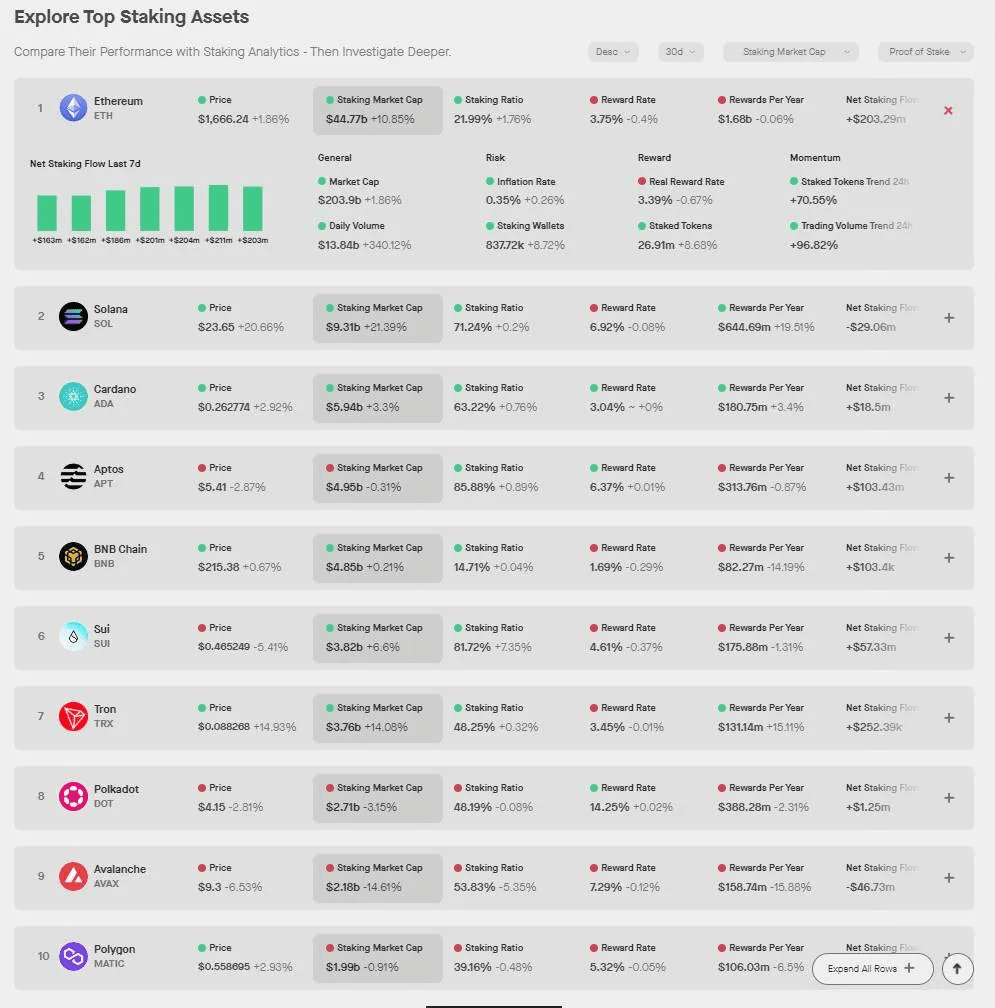
Currently, the ratio of staking ETH compared to the total new supply is about 21.99%, still very small compared to other networks (Solana 71%, Cardano 63%, Aptos 86%, Sui 81%,...). In the future, when the stake rate increases, projects in the LSDfi ecosystem will benefit.
Not to mention, currently the LSD segment is only developing strongly on Ethereum. Later, when expanding to other chains, LSDfi promises to explode even more.
But here is the story of LSDfi, reStaking protocols are emerging. These protocols allow users to continue to re-stake the liquid staking tokens that were staked the first time, and then the retake tokens are continued to be traded in the LSDfi ecosystem.
Capital flows are multiplying again, will we have reStake of reStake in the future?
This story reminds the author of the CDO (Collateralized Debt Obligation) product during the 2008 financial crisis. Creators packaged subprime debt into Synthetic CDOs for sale, then continued. Pack the Synthetic CDO again and we have CDO of CDO. It didn't stop there, in the end they even packaged it again to create a 3rd layer CDO. In 2007, the CDO market value reached 62 trillion USD, to imagine how big it is. Compare that to 2007 world GDP of 58.35 trillion USD. It was CDO that contributed to one of the largest financial crises in history - The 2008 subprime crisis.
Puzzle pieces in the LSDfi ecosystem
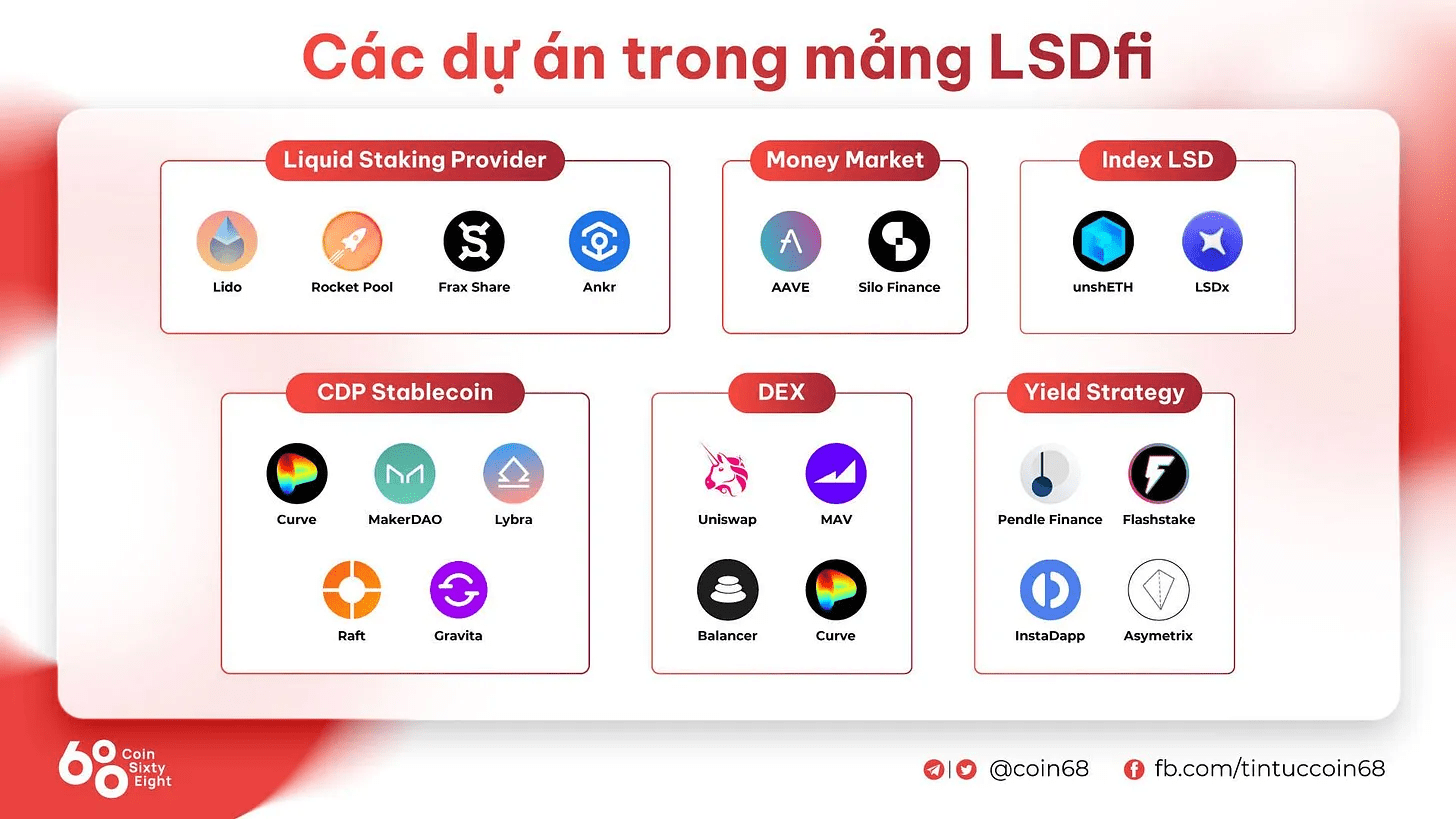
Back to the topic LSDfi - Liquid Staking Derivatives Finance, let's take a look at the pieces inside:
- Liquid Staking Provider: Protocols that provide staking services, including decentralized protocols such as Lido, Rocket Pool,... and centralized services such as Coinbase, Binance.
- CDP Stablecoin: CDP stands for Collateral Debt Position, which means collateralized debt positions. CDP protocols allow users to use LSD tokens as collateral to mint stablecoins.
- DEX: Protocols that help users trade LST.
- Money Market: Protocols that allow LST collateral to borrow assets.
- Index LSD: Products that allow users to receive a “basket” of LSD tokens according to the project's allocation ratio. This helps reduce risks during the investment process. Instead of holding just one type of Liquid Staking Token, the project helps users allocate capital to a variety of Liquid Staking Tokens to minimize risks.
- Yield Strategy: Products aimed at maximizing profits for the LSTs they are holding through strategies of providing liquidity, borrowing-collateralization, staking,...
Outstanding projects
Next, let's learn about some outstanding projects in the LSDfi ecosystem updated until September 2023.
Pendle Finance
Pendle Finance is a project belonging to the Yield Strategy segment in the LSDfi ecosystem. Pendle's goal is to help users manage and maximize yields from profitable tokens.
Appearing since mid-2021, it was not until the model shift focusing on LSDfi that Pendle really exploded, especially after being invested by Binance Labs.
Operational model
Yield Trading is a new segment in the DeFi market, where users can create strategies to earn profits from their future profits.
To do this, Pendle uses a technique of separating the base and future profits of the yielding token, then builds tools that allow users to trade these two parts independently. Below we will learn more.
Pendle includes 3 main parts:
Yield Tokenization: Encapsulation technique to remove origin and yield.
Pendle AMM: A specialized AMM dedicated to the native token and yield.
vePENDLE: Pendle's veToken model.
Yield Tokenization
This is the most unique part of Pendle. First you need to know the term yield-bearing tokens which are tokens that are capable of generating profits. For example, ETH is a non-profitable token, but when you stake ETH at Lido and receive stETH, stETH is a profitable token, because holding stETH gives you a future profit paid by the protocol.
When users deposit yield-bearing tokens into Pendle, the system will package it into a new token called SY (standardized yield tokens) according to the EIP-5115 standard released by the project itself. Then mint issued 2 tokens:
PT (principal token): Original token, representing the principal amount you deposit. After maturity, PT can exchange the original asset at a 1:1 ratio.
YT (yield token): Yield token, representing the amount of profit you receive at maturity.
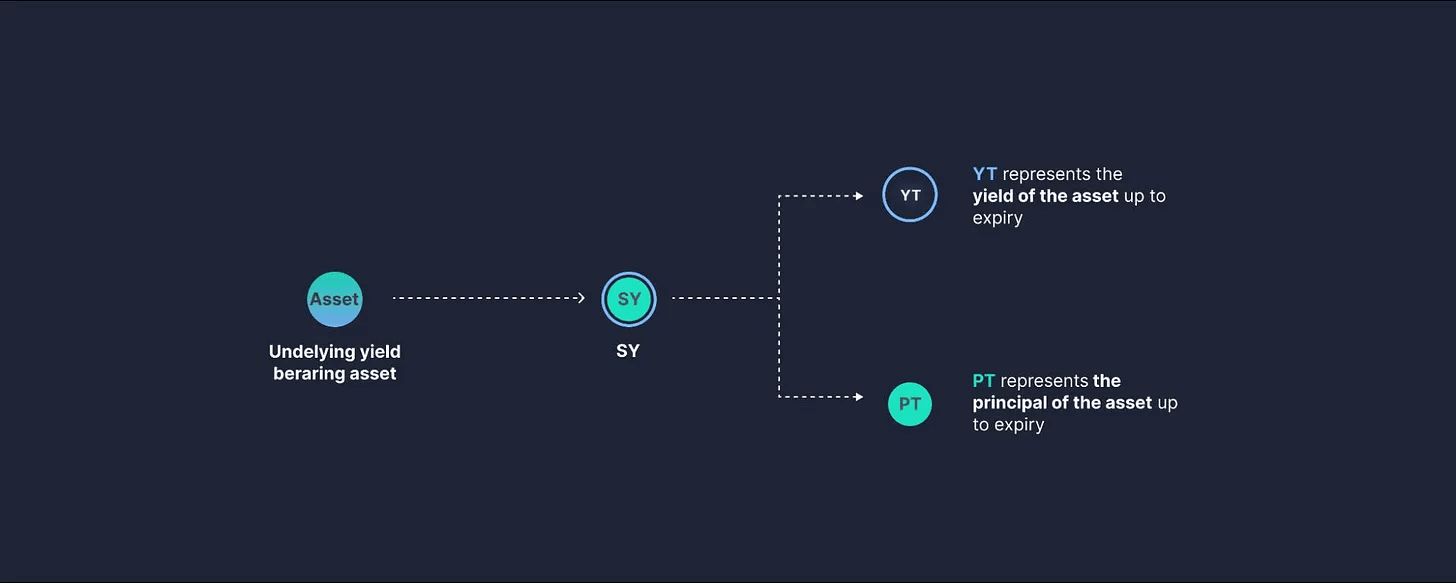
PT and YT tokens are the two main objects in Pendle's yield-trading model, they are traded through a special AMM, which is also the second most important component of Pendle.
Pendle AMM
This is where the trading activities of PY and YT take place. According to documents from Pendle, their AMM curve is customizable to respond to yield fluctuations. Yield fluctuations are narrower and more predictable than their prices, so Pendle concentrates liquidity in that area, increasing liquidity depth to minimize slippage when AMM operates.
vePENDLE
Pendle applies the veToken model to its native token, PENDLE. Users can choose to lock PENDLE for a period of time, the longest being 2 years to receive vePENDLE, the longer the lock time, the more number of vePENDLE will be received.
Benefits of holding vePENDLE:
- First, vePENDLE holders enjoy accumulated profits from YT. Currently, Pendle is distributing all of these profits to vePENDLE holders without retaining any part (Pendle collects 3% and distributes all 3% to vePENDLE holders).
- Second, a part of the profits from the PTs that have matured but have not been converted will also be distributed to vePENDLE holders according to the holding ratio.
- Third, if you are holding vePENDLE and provide liquidity to Pools, the incentive rewards from all those pools will be increased, up to a maximum of 250% based on the number of vePENDEL held.
- Fourth, vePENDLE holders who participate in voting activities at pools will receive 80% of transaction fees from those pools.
- Finally, vePENDLE holders have the right to participate in protocol governance by voting on liquidity incentives.
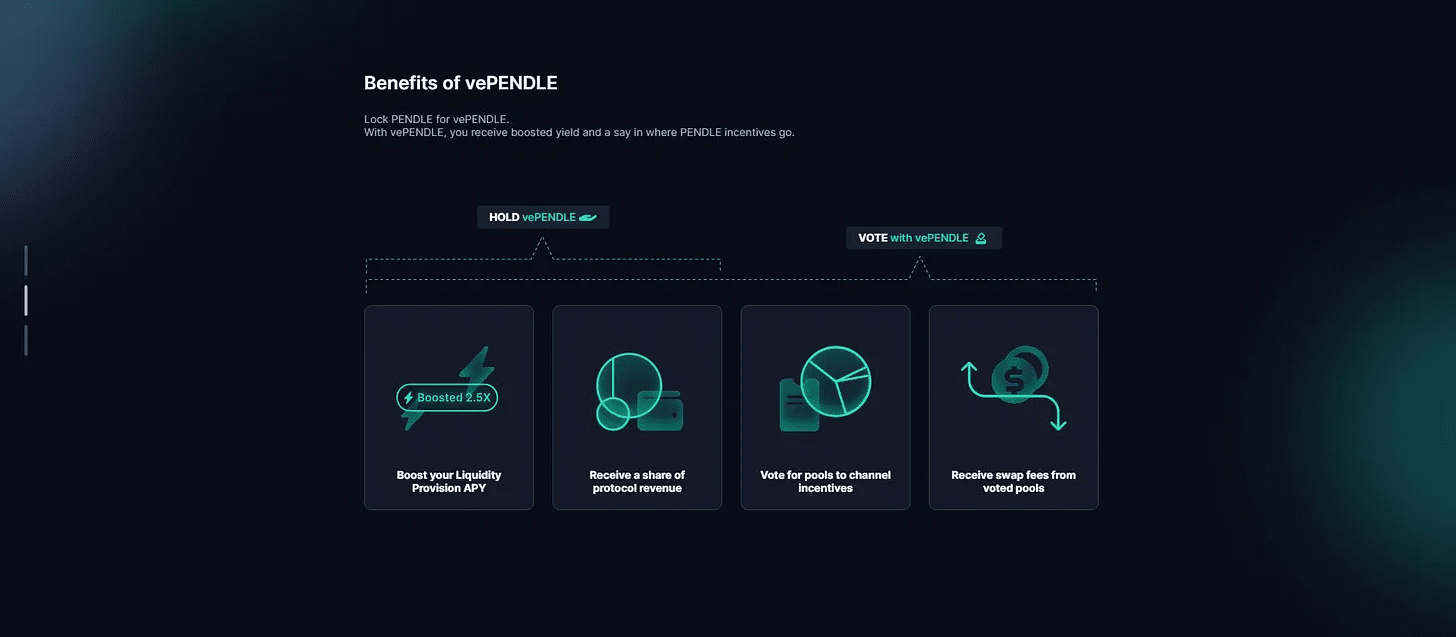
From the fourth and fifth points in the list of benefits for vePENDLE holders, it can be seen that Pendle is encouraging users to participate in their governance. The more vePENDLE a person holds, the more power they have to direct incentive programs according to their wishes. This does not have much impact on retail investors, but is extremely meaningful to whales and organizations, thereby promoting a battle for vePENDLE market share - Pendle Wars.
Strategies for finding profits with Pendle Finance
Before talking about strategies to generate profits with Pendle, we will go back to how SY token extracts principal and profits.
Suppose you deposit 1 stETH into Pendle maturing December 26, 2024 with an interest rate of 4.1%. At the present time you will receive:
1 PT-stETH is worth 0.959 ETH
1 YT-stETH is worth 0.041 ETH
The reason the amount of PT-stETH is only worth 0.959 ETH is because the system has cut out 0.0041 ETH of future profit from the original portion you deposited into the system to pay you in advance. If you want to take profits immediately, you can bring YT-stETH to the pool to collect ETH to use for other purposes. Regarding the principal, on the maturity date, 1 PY-stETH will be exchanged for 1 ETH.
What you need to spend is the waiting time. If you don't want to wait, you can immediately sell PT-stETH at a profit-discounted value through Pendle's AMM.
From here, profit mining strategies on Pendle are born for all users.
Fixed-Yield Strategy
Is the act of buying PT-token at a certain discount rate. Because when 1 PT-token matures, it can be converted to 1 original token, so you can buy PT-tokens from those who want to sell early at a discount.
As the above example is 4.1% for stETH, you only need to spend 0.959 ETH to buy 1 PT-stETH - which will convert back to 1 ETH upon maturity.
This strategy is suitable if you believe the price of the asset will increase in the future and want to hold it for a long time, then you will benefit from both the fixed yield and the increase in the original asset price.
Long-Yield Strategy
Is the act of buying YT-token. When you expect the yield of yield-bearing tokens to increase, you can buy.
Provide liquidity
Another strategy favored by whales is providing liquidity. By providing liquidity to the pool, users will receive trading fees, PENDLE incentive tokens, PT fixed yield and other rewards from the underlying yield assets. Additionally as mentioned in the vePENDLE section, if the liquidity provider holds vePENDLE it can increase the reward received by up to 250%.
Development potential
Pendle's vision is to be the protocol that powers all things interest related. Currently, Liquid Staking is just one of the areas that Pendle exploits. In the future, Pendle can continue to expand into many other areas, as long as profitability is related. It can be seen that Pendle's scalability is very large.
Another notable product recently supported by Pendle that shows the foresight of the project is RWA.
In addition, multi-chain is also a direction being implemented by the Pendle team. Pendle currently supports Ethereum, Arbitrum, Optimism and BNBChain, and will continue to expand to many more chains in the future.
Pendle's TVL at the time of writing is 159 million USD, growing 10 times compared to the beginning of 2023. This is an impressive growth milestone while during this period most other platforms have had a sharp decline. about TVL.
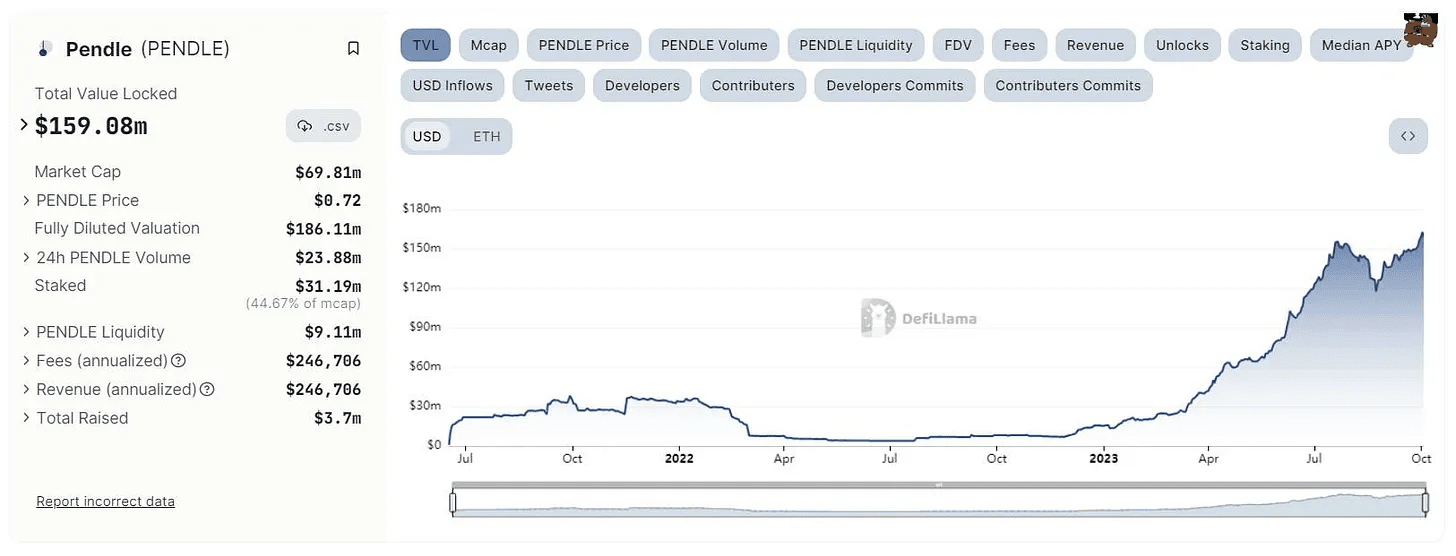
To summarize, it can be seen that yield-trading is a new segment in DeFi, following the trend, Pendle Finance has a leading advantage, the product operates stably, along with support from many names. big like Binance Labs, HashKey, CMS Holdings.
The difficulty of the project is to convey so that users understand and use its products, while continuing to accelerate and maintain its pioneering position. Pendle is a project that promises to have a strong breakthrough in the future.
OwnLayer
EigenLayer is a pioneering project in the reStaking model, whereby users can use staked tokens to continue to stake again to earn more profits while enhancing network security.
One of the challenges facing the blockchain system is decentralization, especially on the Ethereum network. Middleware applications and applications that are not compatible with EVM (non-EVM applications) when built on the Ethereum network will have to create a separate trust network. However, building and operating such a security system is resource-intensive. As more applications are built, security will become increasingly decentralized.
Realizing this, EigenLayer has introduced the reStaking model to enhance network security by centralizing and directing large amounts of LST (Liquid Staking Token) of users.
EigenLayer's operating model consists of two parts:
Pooled Security: is a place where resources from many different sources are gathered to be ready for security operations under the direction of the validator.
Free-market Governance: allows validators to choose security for specific applications and protocols. They can decide on the rules, values and conditions of security provision, which creates a free and competitive governance model.
You can understand that EigenLayer is building a security layer for the network by gathering resources into a single Pool. Protocols that want to use privacy can then bid for validators to direct the pool to their dApp. From there, the economic model for EigenLayer was formed.
Currently, EigenLayer has deployed phase 1 mainnet and let users reStake LST (currently only accepting rETH, stETH and cbETH). The total value of stakes in EigenLayer at the time of writing is 230 million USD.
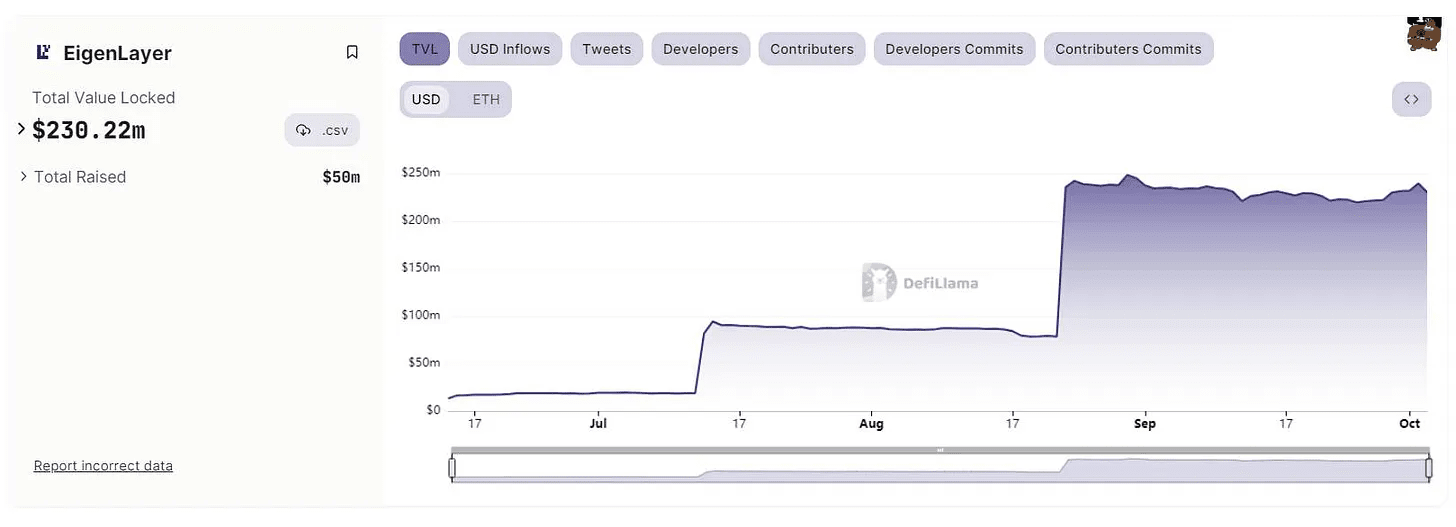
The project has received an investment worth 64.5 million USD from many large investment funds such as Coinbase Ventures, Blockchain Capital, Polychain Capital.
Leveraging LST to secure the network is a new direction for DeFi, along with the development of the LSDfi EigenLayer array that promises to create a remarkable security market.
Lybra Finance
Lybra Finance is a project in the CDP segment that allows users to use collateral assets, Liquid Staking Token, to mint stablecoin eUSD. The special thing about eUSD is that it has the ability to make a profit, the reason for this is because the original assets you mortgage in Lybra (ETH or staked ETH) are profitable assets, so the eUSD you mint will also be returned the interest by Lybra. That is, as long as you hold eUSD. Not to mention you can use eUSD to participate in other DeFi activities to seek more profits.
In addition to eUSD, since version Lybra v2, the Omnichain stablecoin peUSD product has been provided. If eUSD is a profitable stablecoin, then peUSD is an unprofitable stablecoin, peUSD is pegged 1:1 with eUSD.
Lybra's mechanism of action is divided into 3 important parts:
Minting
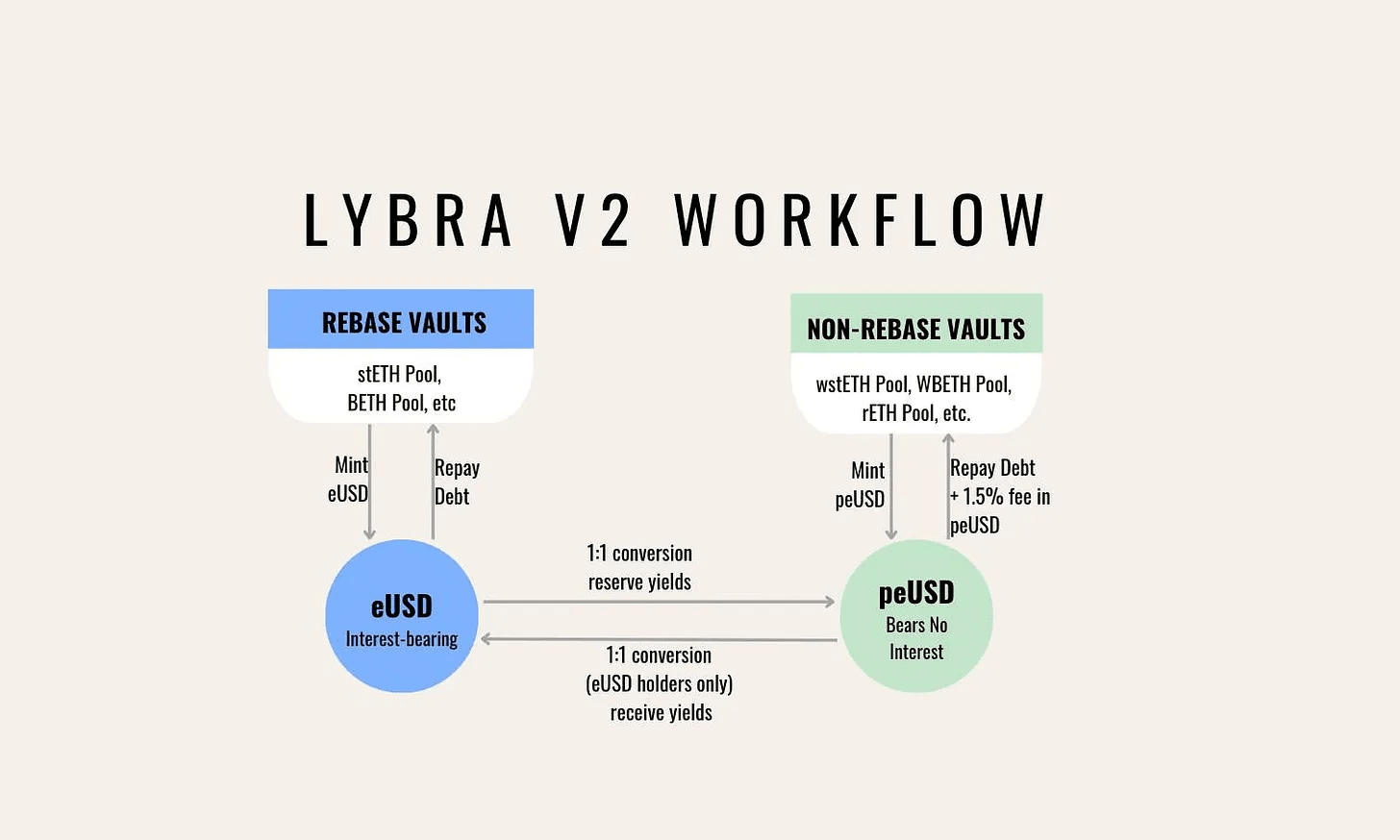
eUSD and peUSD are minted through 2 vaults:
Rebase Vault: Use rebase LST (tokens are recalculated every cycle) to mint eUSD.
Non-Rebase vault: Use non-rebase LST to mint peUSD. Additionally, you can convert eUSD to peUSD at a 1:1 ratio.
To securely peg eUSD to USD, Lybra requires collateral exceeding the 150% threshold. That means to mint 100 eUSD or peUSD you need to mortgage an amount of LST worth at least 150 USD.
The creation of additional peUSD tokens is a strategic step in Lybra's v2 version, it helps users be more confident in using minted stablecoins for DeFi activities without worrying about the yield coming from LST. .
Rigid Redemption
Is the activity of exchanging eUSD/peUSD to get back the original asset. You can redeem ETH at any time, Lybra charges a 0.5% redemption fee (may be modified by Lybra Community DAO).
Liquidation
When the mortgage ratio drops below 150%, the mortgaged assets will automatically be liquidated. Lybra encourages users to keep their mortgage ratio above 200%.
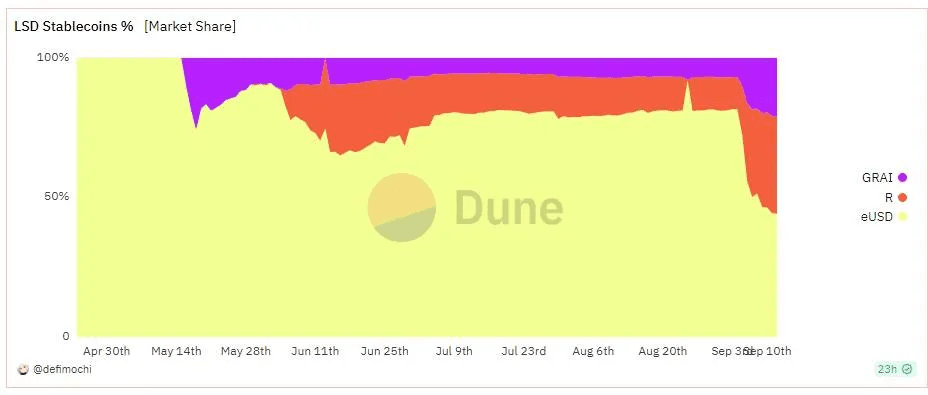
The characteristic of the stablecoin segment is the need to increase its popularity and create many use cases for it. In the past, there was a time when the eUSD market share was more than 80%, although there has been a recent decline due to competition from many other CDP protocols, Lybra is still taking the lead and market share. We will continue to monitor the project's progress.
Above are new projects that the author considers outstanding in the LSDfi segment updated until September 2023. In addition, in each piece of LSDfi there are many quality projects in operation.
Conclusion
LSDfi is an area that I really like and believe will explode strongly in the coming period because of its extremely strong scalability despite its somewhat ponzi orientation.
Right from staking ETH and receiving stETH is once "printing tokens from thin air" to put into the market. Next, the operation of using stETH to mortgage mint to LSD stablecoin is similar to mortgaging air to mint more air. After that, stablecoins continued to be put into circulation in DeFi, not to mention staking protocols. The entire LSDfi economy is being run by yield from ETH staking and native token inflation of the protocols.
Although it seems unsustainable, it promotes the ecosystem to develop very quickly and strongly. In the transition phase, projects with sustainable models can still control inflation and enter a stable development phase. determined.
Although it has been around since 2021, LSDfi has really been shaped and entered the development phase since early 2023. The battle between staking protocols has shaped the leaders but other pieces in the ecosystem. is still just in the development stage, we have a long way to go with LSDfi ahead.
If the article is valuable, don't forget to Follow and Share!