

Binance News
422.3k Posts

Binance News
 Binance Officially Verified Account
Report
Follow Binance News to stay on top of industry trends & news
9 Following
2.3M+ Followers
2.8M+ Liked
Top
Replies
Videos
·
--
BeInCrypto: Crypto Still Has Little Political Power in Latin American ElectionsCrypto has little political influence in Latin America despite adoption, while U.S. groups use campaign spending to shape policy. The region lacks organized voter advocacy, according to BeInCrypto; after the CLARITY Act failed to advance in a 49-50 Senate vote, Fairshake announced a $30 million spend against Sherrod Brown. Argentina had the region’s highest monthly crypto-app usage in 2025, at 12.4%, yet lawmakers focused on LIBRA, the token President Javier Milei shared that collapsed within hours. Brazil’s October 25 runoff, won by Luiz Inácio Lula da Silva with 51.8% of valid votes to Flávio Bolsonaro’s 48.2%, highlighted crypto users’ failure to mobilize as a voting bloc.
BeInCrypto: Crypto Still Has Little Political Power in Latin American Elections
Crypto has little political influence in Latin America despite adoption, while U.S. groups use campaign spending to shape policy. The region lacks organized voter advocacy, according to BeInCrypto; after the CLARITY Act failed to advance in a 49-50 Senate vote, Fairshake announced a $30 million spend against Sherrod Brown. Argentina had the region’s highest monthly crypto-app usage in 2025, at 12.4%, yet lawmakers focused on LIBRA, the token President Javier Milei shared that collapsed within hours. Brazil’s October 25 runoff, won by Luiz Inácio Lula da Silva with 51.8% of valid votes to Flávio Bolsonaro’s 48.2%, highlighted crypto users’ failure to mobilize as a voting bloc.
1
3
3.1k
·
--
Michael Saylor: Anyone Can Issue Crypto, but That Does Not Undermine Bitcoin's ValueStrategy founder Michael Saylor said that the fact anyone can issue a cryptocurrency does not mean Bitcoin has no value. According to ChainCatcher, he compared that reasoning to claiming there is no reason to learn English because anyone can invent a language.
Michael Saylor: Anyone Can Issue Crypto, but That Does Not Undermine Bitcoin's Value
Strategy founder Michael Saylor said that the fact anyone can issue a cryptocurrency does not mean Bitcoin has no value. According to ChainCatcher, he compared that reasoning to claiming there is no reason to learn English because anyone can invent a language.
6
7
19
27.9k
·
--
Solflare Validator Stops Generating Staking Rewards After Provider Security Incident; User Funds UnaffectedA security incident at a Solflare staking service provider affected the keys held for its validator, which has stopped generating staking rewards. According to ChainCatcher, Solflare said user funds remain unaffected: delegated SOL stays in users’ own staking accounts and remains under their control. Solflare plans to use an app update to guide users to migrate to a new validator. Rewards will resume after staking is activated, and Solflare plans to compensate users who migrate.
Solflare Validator Stops Generating Staking Rewards After Provider Security Incident; User Funds Unaffected
A security incident at a Solflare staking service provider affected the keys held for its validator, which has stopped generating staking rewards. According to ChainCatcher, Solflare said user funds remain unaffected: delegated SOL stays in users’ own staking accounts and remains under their control. Solflare plans to use an app update to guide users to migrate to a new validator. Rewards will resume after staking is activated, and Solflare plans to compensate users who migrate.
400
·
--
Bitwise's BHYP ETF Wallet Receives 47,390 HYPE Worth $3.71 Million After UnstakingBitwise's BHYP ETF wallet received 47,390 HYPE from Hyperliquid after unstaking tokens, valued at $3.71 million. According to Odaily, Onchain Lens monitored the transaction, and the wallet address was 0x618...4318.
Bitwise's BHYP ETF Wallet Receives 47,390 HYPE Worth $3.71 Million After Unstaking
Bitwise's BHYP ETF wallet received 47,390 HYPE from Hyperliquid after unstaking tokens, valued at $3.71 million. According to Odaily, Onchain Lens monitored the transaction, and the wallet address was 0x618...4318.
3
1
9
13.1k
·
--
MANTRA Opens Eighth OM Upgrade Claim Batch, Sets December 2 Claim DeadlineMANTRA has opened the eighth claim batch for the OM upgrade, with token vesting continuing through December 2. According to Odaily, users who have not claimed since June 3 must complete at least one claim by December 2 to continue receiving future distributions.
MANTRA Opens Eighth OM Upgrade Claim Batch, Sets December 2 Claim Deadline
MANTRA has opened the eighth claim batch for the OM upgrade, with token vesting continuing through December 2. According to Odaily, users who have not claimed since June 3 must complete at least one claim by December 2 to continue receiving future distributions.
3
3
13.5k
·
--
Binance Sets DYOR Feedback Campaign With 500 USDC in RewardsAccording to the announcement from Binance, the exchange is inviting users to share feedback on the latest upgrade to Binance DYOR in a campaign running from 2026-10-27 12:00 (UTC) to 2026-11-01 23:59 (UTC). Binance will select 25 users based on the depth and quality of their feedback, with each selected participant receiving a 20 USDC token voucher, for a total reward pool of 500 USDC. DYOR is Binance’s research hub for Binance Alpha tokens, bringing together information on Top Holders, DEX Liquidity, CEX Wallet Sweep Movements, project fundamentals, and Binance Open Interest and Funding Rate. The campaign seeks users’ experiences with the research hub and feedback on its interface and future development. To take part, users must have a verified Binance account, follow the Binance Angels X account, repost the campaign’s main X post with an answer to “I used DYOR for…,” and complete the feedback survey during the activity period. Binance DYOR can be accessed from the Spot Trading page of a supported Alpha token in the Binance App, using the DYOR tab. Rewards will be distributed by 2026-11-30 through Binance Rewards Hub.
Binance Sets DYOR Feedback Campaign With 500 USDC in Rewards
According to the announcement from Binance, the exchange is inviting users to share feedback on the latest upgrade to Binance DYOR in a campaign running from 2026-10-27 12:00 (UTC) to 2026-11-01 23:59 (UTC). Binance will select 25 users based on the depth and quality of their feedback, with each selected participant receiving a 20 USDC token voucher, for a total reward pool of 500 USDC. DYOR is Binance’s research hub for Binance Alpha tokens, bringing together information on Top Holders, DEX Liquidity, CEX Wallet Sweep Movements, project fundamentals, and Binance Open Interest and Funding Rate. The campaign seeks users’ experiences with the research hub and feedback on its interface and future development. To take part, users must have a verified Binance account, follow the Binance Angels X account, repost the campaign’s main X post with an answer to “I used DYOR for…,” and complete the feedback survey during the activity period. Binance DYOR can be accessed from the Spot Trading page of a supported Alpha token in the Binance App, using the DYOR tab. Rewards will be distributed by 2026-11-30 through Binance Rewards Hub.
7
7
24
11.6k
·
--
Ripple’s New Bank Charter May Leave XRP Holders Last in LineRipple won final approval from the OCC to open a national trust bank. According to BeInCrypto, the charter covers reserves backing its $2.5 billion RLUSD stablecoin but gives XRP no direct role. Ripple National Trust Bank will manage RLUSD reserves and may provide digital-asset custody to enterprises. XRP traded at $1.31, about 64% below its $3.65 peak from July 2025.
Ripple’s New Bank Charter May Leave XRP Holders Last in Line
Ripple won final approval from the OCC to open a national trust bank. According to BeInCrypto, the charter covers reserves backing its $2.5 billion RLUSD stablecoin but gives XRP no direct role. Ripple National Trust Bank will manage RLUSD reserves and may provide digital-asset custody to enterprises. XRP traded at $1.31, about 64% below its $3.65 peak from July 2025.
1
17
22.1k
·
--
Article
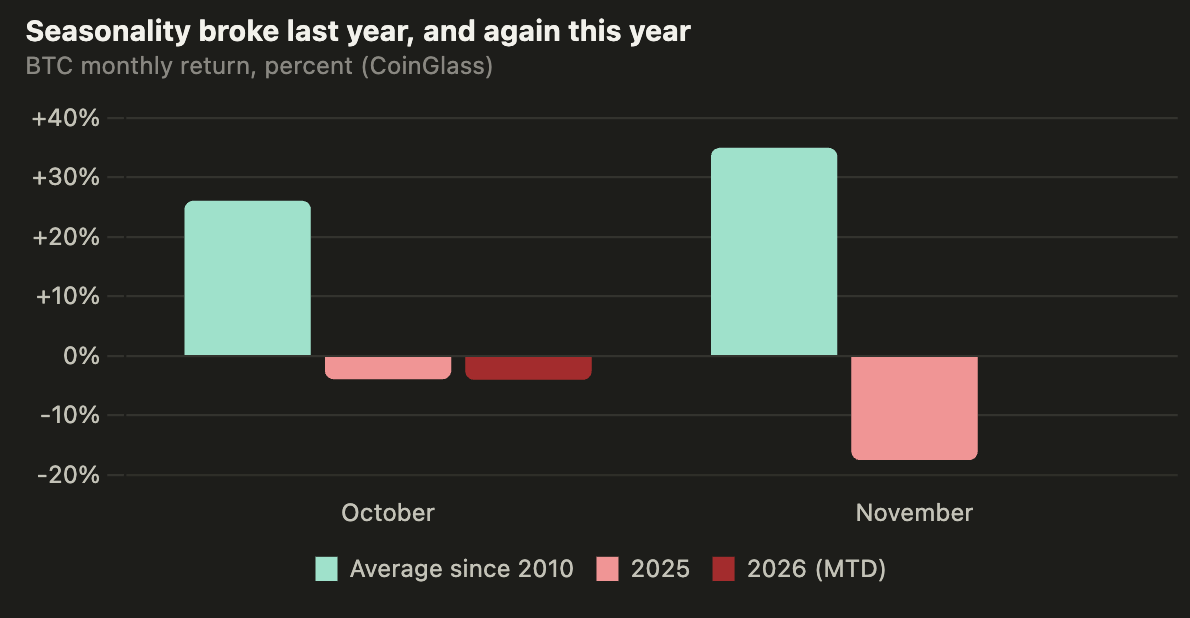
Bitcoin News | Bitcoin Fights for $80,000 Into the Fed and Big Tech Earnings as “Uptober” Heads for a 4% LossBitcoin starts the last week of October struggling to hold $80,000 ahead of the Federal Reserve’s decision on Wednesday, key US inflation data and earnings from the largest tech companies. The cryptocurrency is on track to end October down about 4%, matching its 2025 performance and bucking the month’s historical tendency to rally.Fed Hold Expected, December in FocusMarkets widely expect the Fed to hold its target range at 3.75%–4.00% on Wednesday, with CME FedWatch data favoring a 25 basis point hike in December. Traders will parse Chair Kevin Warsh’s press conference for signals.Economist Robin Brooks said markets price only 12% odds of a hike this week, calling it “a temporary reprieve for Warsh” after contentious meetings earlier in 2026. Brooks argued that even a rise in Brent to $125 would not force the Fed’s hand, because tightening financial conditions would make a hike the last thing policymakers want. Brent crude hit $117 a barrel on Friday before easing to about $110 on Monday.On Thursday, the US releases September PCE inflation, the Fed’s preferred gauge, after a lower-than-expected 3.4% year-on-year reading last month, along with third-quarter GDP.Tech Earnings Test the AI TradeSouth Korea’s KOSPI fell 1.5% on Monday to 5,469, after touching 5,308 on Friday amid foreign selling of tech stocks. The Nasdaq Composite closed Friday at 25,955, its lowest close since August 3.“We’re not rewarding capex anymore; what we are rewarding is return on capital,” said Raisah Rasid of JPMorgan Asset Management. Microsoft and Alphabet report after the close on Wednesday, followed by Amazon and Intel on Thursday.Uptober Turns NegativeOctober has averaged gains of 26.1% for bitcoin since 2010, according to CoinGlass, but both this year and last have bucked the trend. In 2025, bitcoin fell 3.9% in October and another 17.5% in November, against a November average of 35%.Nearly $150 million of long positions were liquidated in two hours on Saturday as bitcoin fell to $79,145. CoinGlass order-book data shows about $73 million of bids holding price above $79,300, with asks clustered around $81,000. Into the Cryptoverse founder Benjamin Cowen called bitcoin’s trips to $87,000 in late September and early October a “fakeout” and expects weakness through year-end, citing patterns in US midterm election years. The $87,000 area remains key resistance, with the 2026 yearly open at $87,490 and the 20-month moving average at $87,165.
Bitcoin News | Bitcoin Fights for $80,000 Into the Fed and Big Tech Earnings as “Uptober” Heads for a 4% Loss
Bitcoin starts the last week of October struggling to hold $80,000 ahead of the Federal Reserve’s decision on Wednesday, key US inflation data and earnings from the largest tech companies. The cryptocurrency is on track to end October down about 4%, matching its 2025 performance and bucking the month’s historical tendency to rally.Fed Hold Expected, December in FocusMarkets widely expect the Fed to hold its target range at 3.75%–4.00% on Wednesday, with CME FedWatch data favoring a 25 basis point hike in December. Traders will parse Chair Kevin Warsh’s press conference for signals.Economist Robin Brooks said markets price only 12% odds of a hike this week, calling it “a temporary reprieve for Warsh” after contentious meetings earlier in 2026. Brooks argued that even a rise in Brent to $125 would not force the Fed’s hand, because tightening financial conditions would make a hike the last thing policymakers want. Brent crude hit $117 a barrel on Friday before easing to about $110 on Monday.On Thursday, the US releases September PCE inflation, the Fed’s preferred gauge, after a lower-than-expected 3.4% year-on-year reading last month, along with third-quarter GDP.Tech Earnings Test the AI TradeSouth Korea’s KOSPI fell 1.5% on Monday to 5,469, after touching 5,308 on Friday amid foreign selling of tech stocks. The Nasdaq Composite closed Friday at 25,955, its lowest close since August 3.“We’re not rewarding capex anymore; what we are rewarding is return on capital,” said Raisah Rasid of JPMorgan Asset Management. Microsoft and Alphabet report after the close on Wednesday, followed by Amazon and Intel on Thursday.Uptober Turns NegativeOctober has averaged gains of 26.1% for bitcoin since 2010, according to CoinGlass, but both this year and last have bucked the trend. In 2025, bitcoin fell 3.9% in October and another 17.5% in November, against a November average of 35%.Nearly $150 million of long positions were liquidated in two hours on Saturday as bitcoin fell to $79,145. CoinGlass order-book data shows about $73 million of bids holding price above $79,300, with asks clustered around $81,000. Into the Cryptoverse founder Benjamin Cowen called bitcoin’s trips to $87,000 in late September and early October a “fakeout” and expects weakness through year-end, citing patterns in US midterm election years. The $87,000 area remains key resistance, with the 2026 yearly open at $87,490 and the 20-month moving average at $87,165.
Voting
Will BTC hold $80k through Fed and earnings?
I trust Uptober vibes, rebound after Fed
I think $80k breaks, watching resistance at $87k
I'm numb, 4% down and nothing feels real
I'm staying flat, let data decide direction
46 votes • Voting
3
2
14
14.5k
·
--
Galaxy Research Head Alex Thorn: Some Long-Term Funds Added Bitcoin ETFs in Q3, SIGFIG Clients Added $73 MillionSome long-term funds increased their Bitcoin ETF holdings in the third quarter, while SIGFIG Wealth Management clients added about $73 million in holdings, Galaxy research head Alex Thorn said.
According to Odaily, 13F filings for Bitcoin ETFs remain at an early stage, and most large asset managers and registered investment advisers typically submit filings by the November 16 deadline.
SIGFIG Wealth Management made its first related filing. A substantial share of its managed assets comes from retail client accounts at Wells Fargo, Citizens, Santander and UBS.
Galaxy Research Head Alex Thorn: Some Long-Term Funds Added Bitcoin ETFs in Q3, SIGFIG Clients Added $73 Million
Some long-term funds increased their Bitcoin ETF holdings in the third quarter, while SIGFIG Wealth Management clients added about $73 million in holdings, Galaxy research head Alex Thorn said.
According to Odaily, 13F filings for Bitcoin ETFs remain at an early stage, and most large asset managers and registered investment advisers typically submit filings by the November 16 deadline.
SIGFIG Wealth Management made its first related filing. A substantial share of its managed assets comes from retail client accounts at Wells Fargo, Citizens, Santander and UBS.
According to Odaily, 13F filings for Bitcoin ETFs remain at an early stage, and most large asset managers and registered investment advisers typically submit filings by the November 16 deadline.
SIGFIG Wealth Management made its first related filing. A substantial share of its managed assets comes from retail client accounts at Wells Fargo, Citizens, Santander and UBS.
2
3
5.9k
·
--
Solana Bug Reports Now Cost 1 SOL as AI Floods Security Teams With SpamFiredancer will require researchers to burn 1 SOL, worth about $100, for each bug report to curb AI-assisted spam; the fee is nonrefundable, and unburned submissions are ineligible for rewards. A $1 million audit competition held between April 9 and May 9 drew 809 reports but produced 127 unique findings, with nearly half of valid submissions duplicating earlier reports, according to CoinDesk. Jump Crypto is increasing rewards through Nov. 20, with critical bugs specific to Solana’s Alpenglow voting system eligible for up to $300,000.
Solana Bug Reports Now Cost 1 SOL as AI Floods Security Teams With Spam
Firedancer will require researchers to burn 1 SOL, worth about $100, for each bug report to curb AI-assisted spam; the fee is nonrefundable, and unburned submissions are ineligible for rewards. A $1 million audit competition held between April 9 and May 9 drew 809 reports but produced 127 unique findings, with nearly half of valid submissions duplicating earlier reports, according to CoinDesk. Jump Crypto is increasing rewards through Nov. 20, with critical bugs specific to Solana’s Alpenglow voting system eligible for up to $300,000.
1
1
20
17.7k
·
--
Data: ETH Falling Below $2,205 Could Trigger $919M in Long Liquidations on Major CEXsIf ETH falls below $2,205, cumulative long liquidation intensity on major centralized exchanges could reach $919 million. According to ChainCatcher, Coinglass data also shows that if ETH rises above $2,434, cumulative short liquidation intensity on these exchanges could reach $785 million.
Data: ETH Falling Below $2,205 Could Trigger $919M in Long Liquidations on Major CEXs
If ETH falls below $2,205, cumulative long liquidation intensity on major centralized exchanges could reach $919 million. According to ChainCatcher, Coinglass data also shows that if ETH rises above $2,434, cumulative short liquidation intensity on these exchanges could reach $785 million.
2
1
4
10.1k
·
--
Article
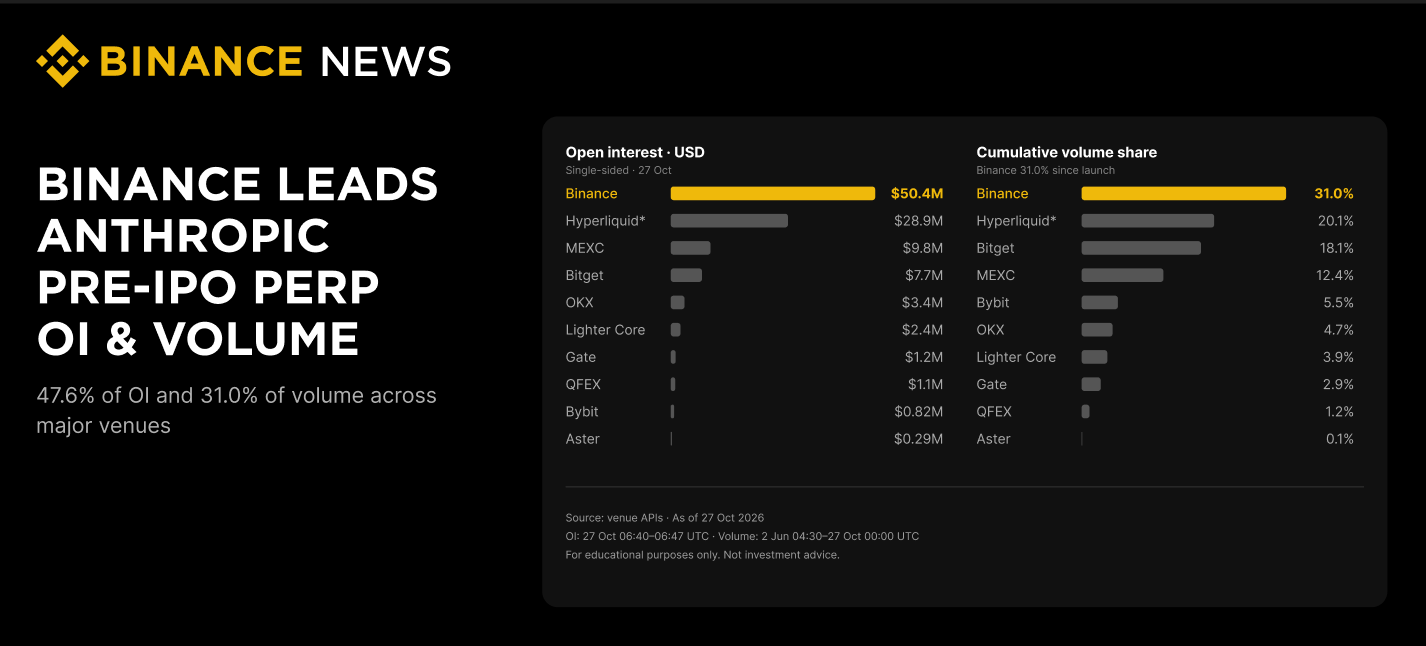
Binance News | Binance Leads Anthropic Pre-IPO Perpetual Futures With 47.6% of Open Interest and 31% of Trading Volume, Binance Research Data ShowsBinance is the largest venue for Anthropic pre-IPO perpetual futures by both open interest and trading volume, according to data from Binance Research. As of October 27, Binance held $50.4 million of single-sided open interest, 47.6% of the total across 10 major venues, and had captured 31.0% of cumulative trading volume since the contracts launched on June 2.Binance Holds Nearly Half of Open InterestBinance’s $50.4 million in open interest is about 1.7 times that of Hyperliquid, the second-largest venue at $28.9 million, and more than the next three venues combined. MEXC followed with $9.8 million and Bitget with $7.7 million, while OKX held $3.4 million and Lighter Core $2.4 million. Gate, QFEX, Bybit and Aster each held less than $1.5 million. Across the 10 venues, open interest totaled about $106 million, measured between 06:40 and 06:47 UTC on October 27.31% of Volume Since LaunchBinance accounted for 31.0% of cumulative Anthropic pre-IPO perpetual volume from June 2 to October 27, ahead of Hyperliquid at 20.1%, Bitget at 18.1% and MEXC at 12.4%. Bybit took 5.5%, OKX 4.7% and Lighter Core 3.9%, with Gate, QFEX and Aster making up the rest.
Binance News | Binance Leads Anthropic Pre-IPO Perpetual Futures With 47.6% of Open Interest and 31% of Trading Volume, Binance Research Data Shows
Binance is the largest venue for Anthropic pre-IPO perpetual futures by both open interest and trading volume, according to data from Binance Research. As of October 27, Binance held $50.4 million of single-sided open interest, 47.6% of the total across 10 major venues, and had captured 31.0% of cumulative trading volume since the contracts launched on June 2.Binance Holds Nearly Half of Open InterestBinance’s $50.4 million in open interest is about 1.7 times that of Hyperliquid, the second-largest venue at $28.9 million, and more than the next three venues combined. MEXC followed with $9.8 million and Bitget with $7.7 million, while OKX held $3.4 million and Lighter Core $2.4 million. Gate, QFEX, Bybit and Aster each held less than $1.5 million. Across the 10 venues, open interest totaled about $106 million, measured between 06:40 and 06:47 UTC on October 27.31% of Volume Since LaunchBinance accounted for 31.0% of cumulative Anthropic pre-IPO perpetual volume from June 2 to October 27, ahead of Hyperliquid at 20.1%, Bitget at 18.1% and MEXC at 12.4%. Bybit took 5.5%, OKX 4.7% and Lighter Core 3.9%, with Gate, QFEX and Aster making up the rest.
16
4
28
22k
·
--
Ripple, BNY Explore XRP Ledger Financing for Approved InvoicesRipple and BNY are exploring tokenized trade finance on the XRP Ledger, using approved invoices to provide supplier financing. The initiative, with working-capital provider C2FO, could let suppliers receive funds in seconds while invoice terms and due dates stay unchanged, according to The Block. BNY is adding XRP and RLUSD to its institutional custody platform and intends to let clients mint and redeem RLUSD through the bank. Ripple also partnered with Robinhood on stablecoins, treasury and institutional markets; Robinhood will use RLUSD for settlement on the XRP Ledger. RLUSD has a market capitalization of about $2.5 billion.
Ripple, BNY Explore XRP Ledger Financing for Approved Invoices
Ripple and BNY are exploring tokenized trade finance on the XRP Ledger, using approved invoices to provide supplier financing. The initiative, with working-capital provider C2FO, could let suppliers receive funds in seconds while invoice terms and due dates stay unchanged, according to The Block. BNY is adding XRP and RLUSD to its institutional custody platform and intends to let clients mint and redeem RLUSD through the bank. Ripple also partnered with Robinhood on stablecoins, treasury and institutional markets; Robinhood will use RLUSD for settlement on the XRP Ledger. RLUSD has a market capitalization of about $2.5 billion.
1
5
12.9k
·
--
Lavrov: Russia-Ukraine Conflict Set to Escalate; U.S.-Russia Diesel Deal Involves No Political ConcessionsRussian Foreign Minister Sergey Lavrov said the Russia-Ukraine conflict would continue and escalate. According to Sina Finance, Lavrov said Finland’s president and Norway’s prime minister raised nothing new about Ukraine in calls with Russian President Vladimir Putin. He also said European countries were seeking to join the Ukraine negotiations, while the Trump administration continued to support Ukraine but remained open to dialogue with Russia. Lavrov described the Russian-U.S. diesel supply agreement as a commercial transaction unrelated to political concessions on other issues.
Lavrov: Russia-Ukraine Conflict Set to Escalate; U.S.-Russia Diesel Deal Involves No Political Concessions
Russian Foreign Minister Sergey Lavrov said the Russia-Ukraine conflict would continue and escalate. According to Sina Finance, Lavrov said Finland’s president and Norway’s prime minister raised nothing new about Ukraine in calls with Russian President Vladimir Putin. He also said European countries were seeking to join the Ukraine negotiations, while the Trump administration continued to support Ukraine but remained open to dialogue with Russia. Lavrov described the Russian-U.S. diesel supply agreement as a commercial transaction unrelated to political concessions on other issues.
3
1
4
13.3k
·
--
Article
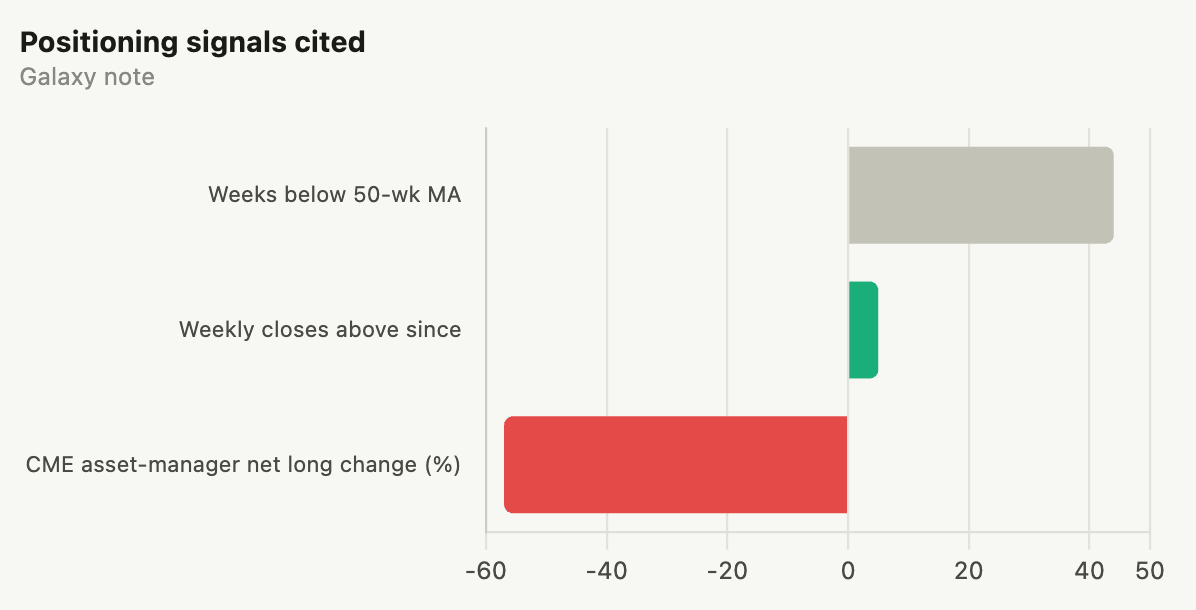
Bitcoin News | Galaxy’s Alex Thorn Says Bitcoin’s Bear Market Ended in June Near $58,000 and It’s Time to Accumulate, With $76,540 as the LineBitcoin’s bear market likely ended in June below $58,000, and the cryptocurrency is now in the accumulation phase that has preceded every prior advance, according to Alex Thorn, head of firmwide research at Galaxy. In a note titled “Why now is the time to add and hold BTC,” Thorn said improving technical signals, reduced selling pressure and rising US fiscal risks make bitcoin attractive to accumulate. His view comes as bitcoin’s rally has stalled near $80,000, prompting some traders to warn of a renewed crash.Up 38% From the Low, 36% Below the HighBitcoin is up about 38% from its June low but remains about 36.5% below its record high above $126,000. A return to that peak would require a gain of roughly 58% from current levels.“We think the bear market ended in June and that bitcoin is in the accumulation phase that has preceded every prior advance,” Thorn said.Technical and Positioning SignalsThorn pointed to bitcoin’s recovery above its 50-week moving average after 44 weeks below it. Five consecutive weekly closes above that level have strengthened his view that the market has bottomed.Positioning also supports the case, he argued. Asset managers’ net long exposure in CME bitcoin futures has fallen 57% from the week of the record high, and several major trading firms have cut their ETF holdings substantially. Meanwhile, spot bitcoin ETFs have added 87,000 BTC since the June low, which Galaxy reads as renewed directional demand as arbitrage activity has declined.“The fast money has left, the base stayed, and everything else is priced for perfection,” Thorn said.Fiscal Risk and SentimentGalaxy expects rising US debt, persistent deficits and higher interest costs to strengthen bitcoin’s appeal as a fixed-supply asset. Thorn also said institutional enthusiasm for stablecoins and tokenization, alongside fading interest in bitcoin itself, resembles sentiment near previous market lows.Risks and the $76,540 LineGalaxy acknowledged risks from broader market declines, AI-related disruption and quantum computing. It said a weekly close below $76,540, followed by a failure to recover within a month, would challenge its technical thesis.
Bitcoin News | Galaxy’s Alex Thorn Says Bitcoin’s Bear Market Ended in June Near $58,000 and It’s Time to Accumulate, With $76,540 as the Line
Bitcoin’s bear market likely ended in June below $58,000, and the cryptocurrency is now in the accumulation phase that has preceded every prior advance, according to Alex Thorn, head of firmwide research at Galaxy. In a note titled “Why now is the time to add and hold BTC,” Thorn said improving technical signals, reduced selling pressure and rising US fiscal risks make bitcoin attractive to accumulate. His view comes as bitcoin’s rally has stalled near $80,000, prompting some traders to warn of a renewed crash.Up 38% From the Low, 36% Below the HighBitcoin is up about 38% from its June low but remains about 36.5% below its record high above $126,000. A return to that peak would require a gain of roughly 58% from current levels.“We think the bear market ended in June and that bitcoin is in the accumulation phase that has preceded every prior advance,” Thorn said.Technical and Positioning SignalsThorn pointed to bitcoin’s recovery above its 50-week moving average after 44 weeks below it. Five consecutive weekly closes above that level have strengthened his view that the market has bottomed.Positioning also supports the case, he argued. Asset managers’ net long exposure in CME bitcoin futures has fallen 57% from the week of the record high, and several major trading firms have cut their ETF holdings substantially. Meanwhile, spot bitcoin ETFs have added 87,000 BTC since the June low, which Galaxy reads as renewed directional demand as arbitrage activity has declined.“The fast money has left, the base stayed, and everything else is priced for perfection,” Thorn said.Fiscal Risk and SentimentGalaxy expects rising US debt, persistent deficits and higher interest costs to strengthen bitcoin’s appeal as a fixed-supply asset. Thorn also said institutional enthusiasm for stablecoins and tokenization, alongside fading interest in bitcoin itself, resembles sentiment near previous market lows.Risks and the $76,540 LineGalaxy acknowledged risks from broader market declines, AI-related disruption and quantum computing. It said a weekly close below $76,540, followed by a failure to recover within a month, would challenge its technical thesis.
5
1
20
38.9k
·
--
Three Wallets Transfer 482,200 SOL Worth $49.17 Million Over Three Days, Prepare to SellThree wallets that may belong to the same large holder transferred 482,200 SOL, worth $49.17 million, over three days and appeared to be preparing to sell. According to Odaily, the wallets have deposited 171,400 SOL, worth $17.3 million, to exchanges.
Three Wallets Transfer 482,200 SOL Worth $49.17 Million Over Three Days, Prepare to Sell
Three wallets that may belong to the same large holder transferred 482,200 SOL, worth $49.17 million, over three days and appeared to be preparing to sell. According to Odaily, the wallets have deposited 171,400 SOL, worth $17.3 million, to exchanges.
4
22
51.1k
·
--
Predict.fun Suspected of BNB Chain Attack With More Than $20,000 StolenPredict.fun appears to have been attacked on BNB Chain. According to Foresight News, Onchain Lens tracked funds moving from multiple Kernel contracts through intermediary wallets, then across chains via Relay and on to Tornado Cash. At least 24,660 USDT was stolen.
Predict.fun Suspected of BNB Chain Attack With More Than $20,000 Stolen
Predict.fun appears to have been attacked on BNB Chain. According to Foresight News, Onchain Lens tracked funds moving from multiple Kernel contracts through intermediary wallets, then across chains via Relay and on to Tornado Cash. At least 24,660 USDT was stolen.
2
7
8.5k
·
--
EU SEC-Lite Plan Depends on Governance, Outgoing Watchdog Chief SaysThe outgoing chair of the European Union’s securities watchdog said the bloc is unlikely to match the scope of its U.S. counterpart in her lifetime, according to Bloomberg. She said efforts to improve market oversight will depend on governance that allows the regulator to act swiftly.
EU SEC-Lite Plan Depends on Governance, Outgoing Watchdog Chief Says
The outgoing chair of the European Union’s securities watchdog said the bloc is unlikely to match the scope of its U.S. counterpart in her lifetime, according to Bloomberg. She said efforts to improve market oversight will depend on governance that allows the regulator to act swiftly.
2
1.3k
·
--
OSMO Plans to Burn 100 Million Tokens From Community PoolOSMO plans to burn 100 million tokens from its community pool, equal to about 12.6% of its circulating supply. According to Odaily, the plan was reported in market news.
OSMO Plans to Burn 100 Million Tokens From Community Pool
OSMO plans to burn 100 million tokens from its community pool, equal to about 12.6% of its circulating supply. According to Odaily, the plan was reported in market news.
4
7
8.6k
·
--
BNY Mellon Supports XRP and RLUSD Custody, Explores Tokenized Trade Finance With RippleBNY Mellon has added XRP and RLUSD support to its digital asset custody platform for eligible institutional clients, who can custody, hold and transfer the assets. According to Odaily, BNY and Ripple are expanding their digital asset cooperation, building on existing arrangements for RLUSD reserve custody and Ripple Prime custody.
BNY plans to extend support for tokenized assets and investment products on the XRP Ledger (XRPL), and is working with Ripple to enable clients to mint and redeem RLUSD directly through BNY in the future. The two companies are also working with working capital platform C2FO to explore an XRPL-based supply chain financing solution that would tokenize trade finance assets, including receivables, and expand investor access.
BNY Mellon Supports XRP and RLUSD Custody, Explores Tokenized Trade Finance With Ripple
BNY Mellon has added XRP and RLUSD support to its digital asset custody platform for eligible institutional clients, who can custody, hold and transfer the assets. According to Odaily, BNY and Ripple are expanding their digital asset cooperation, building on existing arrangements for RLUSD reserve custody and Ripple Prime custody.
BNY plans to extend support for tokenized assets and investment products on the XRP Ledger (XRPL), and is working with Ripple to enable clients to mint and redeem RLUSD directly through BNY in the future. The two companies are also working with working capital platform C2FO to explore an XRPL-based supply chain financing solution that would tokenize trade finance assets, including receivables, and expand investor access.
BNY plans to extend support for tokenized assets and investment products on the XRP Ledger (XRPL), and is working with Ripple to enable clients to mint and redeem RLUSD directly through BNY in the future. The two companies are also working with working capital platform C2FO to explore an XRPL-based supply chain financing solution that would tokenize trade finance assets, including receivables, and expand investor access.
5
3.5k
·
--
Binance Makrket Update | Fed Expected to Hold Today — Warsh Must Keep December Alive Without Looking Political, Six Days Before MidtermsThe Fed is widely expected to hold at 3.75%-4.00% Wednesday, with October hike odds at ~12% after Williams, Jefferson, and Waller signaled patience in late September. Warsh’s task: explain the hold despite persistent inflation, reaffirm the fight, and keep December alive — without appearing politically motivated six days before November 3 midterms, after Trump criticized September’s hike. Galaxy’s Alex Thorn says Bitcoin’s bear market ended in June near $58,000, with $76,540 as the line that challenges the thesis. Binance leads Anthropic pre-IPO perpetual futures with 47.6% of open interest ($50.4M) and 31% of cumulative volume since launch. SK Hynix reports Q3 Wednesday with a shareholder-return plan. S&P 500 futures +0.3% ahead of the decision.Binance Leads Anthropic Pre-IPO Perpetual Futures With 47.6% of Open Interest and 31% of Trading Volume, Binance Research Data ShowsBinance Research data as of October 27: Binance holds $50.4M in single-sided open interest — 47.6% of $106M total across 10 major venues — and 31.0% of cumulative trading volume since June 2. Hyperliquid second at $28.9M OI (20.1% of volume), Bitget $7.7M (18.1% volume), MEXC $9.8M OI (12.4% volume). Bybit 5.5%, OKX 4.7%, Lighter Core 3.9%. NYC Comptroller Mark Levine wrote to Anthropic CEO Dario Amodei in October urging a pause of the planned IPO to address AI safety concerns — the pre-IPO perpetual market continues regardless. $106M in total open interest across 10 venues is a meaningful signal of institutional demand for pre-IPO AI company exposure through crypto-native instruments.Galaxy’s Alex Thorn Says Bitcoin’s Bear Market Ended in June Near $58,000 and It’s Time to Accumulate, With $76,540 as the LineAlex Thorn, Galaxy head of firmwide research: Bitcoin is in the accumulation phase that has preceded every prior advance, with the bear market likely ending in June below $58,000. Current price: up ~38% from the June low, still ~36.5% below the $126,080 record (a 58% gain needed to recover the high). Technical signals: recovery above the 50-week MA after 44 weeks below it, with five consecutive weekly closes above it. Positioning: asset managers’ net CME futures long exposure down 57% from the record-high week; several major firms cut ETF holdings substantially; spot ETFs added 87,000 BTC since June — Galaxy reads this as directional demand rather than arbitrage. Fiscal thesis: rising US debt, persistent deficits, and higher interest costs strengthen Bitcoin’s fixed-supply appeal. Risk line: a weekly close below $76,540 followed by failure to recover within a month challenges the technical thesis. “The fast money has left, the base stayed, and everything else is priced for perfection.”SK Hynix Reports Q3 With a New Shareholder-Return Plan as Investors Test the AI Memory SupercycleSK Hynix reports after US market close Tuesday (Wednesday morning Seoul). Key disclosures: Q3 results plus a new shareholder-return plan simultaneously. Already announced: ₩40T in treasury share repurchase and cancellation, 50%+ free cash flow return to shareholders over 2025-2027. Dong-A Ilbo reported SK Hynix is weighing a ₩16T special dividend — the company says no decision has been made. KB Securities: more than 70% of Samsung and SK Hynix’s planned output next year is already covered by five-year supply agreements with major tech companies — long-term contracts underpin the demand thesis. The read-through matters beyond Korea: SK Hynix’s HBM guidance is the clearest available signal on whether the AI memory supercycle can sustain the valuation multiple that drove KOSPI to its June record (now 39.3% below it). Samsung, Kioxia and other memory makers report shortly after.S&P 500 Futures Extend Gains to an Intraday High, Up 0.3% Ahead of Wednesday’s Fed DecisionS&P 500 futures reached an intraday high Tuesday at +0.3% ahead of the 2:00pm ET decision. The Nasdaq 100 is down more than 7% since its October 6 record high; the 10-year yield held above 5% for several weeks before recent easing. Markets have largely priced the hold — the risk is in the press conference framing, not the decision itself.Warsh Must Explain Why the Fed Is Holding This Week While Keeping a December Hike AliveOctober hike odds: ~12%, down from 70%+ post-September hike, after Williams, Jefferson, and Waller each signaled patience. The hold is priced; the communication is the event. Warsh’s three tasks: explain why not acting in October despite persistent inflation; reaffirm price stability commitment; keep December alive (December odds remain near 90%). Santander’s Stephen Stanley: Warsh needs to explain “why not act in October, and why December is still under consideration.” Political sensitivity: the decision falls six days before the November 3 midterms; Trump criticized September’s hike; any impression of political motivation would undermine the Fed’s credibility at a moment when 1-year consumer inflation expectations have risen to 4.7% and are described as at risk of becoming entrenched. Warsh has offered little forward guidance since May — his July hold press conference unsettled markets; September’s hawkish pivot and dot plot restored stability. The pattern suggests markets are sensitive to what he declines to say as much as what he does.
Binance Makrket Update | Fed Expected to Hold Today — Warsh Must Keep December Alive Without Looking Political, Six Days Before Midterms
The Fed is widely expected to hold at 3.75%-4.00% Wednesday, with October hike odds at ~12% after Williams, Jefferson, and Waller signaled patience in late September. Warsh’s task: explain the hold despite persistent inflation, reaffirm the fight, and keep December alive — without appearing politically motivated six days before November 3 midterms, after Trump criticized September’s hike. Galaxy’s Alex Thorn says Bitcoin’s bear market ended in June near $58,000, with $76,540 as the line that challenges the thesis. Binance leads Anthropic pre-IPO perpetual futures with 47.6% of open interest ($50.4M) and 31% of cumulative volume since launch. SK Hynix reports Q3 Wednesday with a shareholder-return plan. S&P 500 futures +0.3% ahead of the decision.Binance Leads Anthropic Pre-IPO Perpetual Futures With 47.6% of Open Interest and 31% of Trading Volume, Binance Research Data ShowsBinance Research data as of October 27: Binance holds $50.4M in single-sided open interest — 47.6% of $106M total across 10 major venues — and 31.0% of cumulative trading volume since June 2. Hyperliquid second at $28.9M OI (20.1% of volume), Bitget $7.7M (18.1% volume), MEXC $9.8M OI (12.4% volume). Bybit 5.5%, OKX 4.7%, Lighter Core 3.9%. NYC Comptroller Mark Levine wrote to Anthropic CEO Dario Amodei in October urging a pause of the planned IPO to address AI safety concerns — the pre-IPO perpetual market continues regardless. $106M in total open interest across 10 venues is a meaningful signal of institutional demand for pre-IPO AI company exposure through crypto-native instruments.Galaxy’s Alex Thorn Says Bitcoin’s Bear Market Ended in June Near $58,000 and It’s Time to Accumulate, With $76,540 as the LineAlex Thorn, Galaxy head of firmwide research: Bitcoin is in the accumulation phase that has preceded every prior advance, with the bear market likely ending in June below $58,000. Current price: up ~38% from the June low, still ~36.5% below the $126,080 record (a 58% gain needed to recover the high). Technical signals: recovery above the 50-week MA after 44 weeks below it, with five consecutive weekly closes above it. Positioning: asset managers’ net CME futures long exposure down 57% from the record-high week; several major firms cut ETF holdings substantially; spot ETFs added 87,000 BTC since June — Galaxy reads this as directional demand rather than arbitrage. Fiscal thesis: rising US debt, persistent deficits, and higher interest costs strengthen Bitcoin’s fixed-supply appeal. Risk line: a weekly close below $76,540 followed by failure to recover within a month challenges the technical thesis. “The fast money has left, the base stayed, and everything else is priced for perfection.”SK Hynix Reports Q3 With a New Shareholder-Return Plan as Investors Test the AI Memory SupercycleSK Hynix reports after US market close Tuesday (Wednesday morning Seoul). Key disclosures: Q3 results plus a new shareholder-return plan simultaneously. Already announced: ₩40T in treasury share repurchase and cancellation, 50%+ free cash flow return to shareholders over 2025-2027. Dong-A Ilbo reported SK Hynix is weighing a ₩16T special dividend — the company says no decision has been made. KB Securities: more than 70% of Samsung and SK Hynix’s planned output next year is already covered by five-year supply agreements with major tech companies — long-term contracts underpin the demand thesis. The read-through matters beyond Korea: SK Hynix’s HBM guidance is the clearest available signal on whether the AI memory supercycle can sustain the valuation multiple that drove KOSPI to its June record (now 39.3% below it). Samsung, Kioxia and other memory makers report shortly after.S&P 500 Futures Extend Gains to an Intraday High, Up 0.3% Ahead of Wednesday’s Fed DecisionS&P 500 futures reached an intraday high Tuesday at +0.3% ahead of the 2:00pm ET decision. The Nasdaq 100 is down more than 7% since its October 6 record high; the 10-year yield held above 5% for several weeks before recent easing. Markets have largely priced the hold — the risk is in the press conference framing, not the decision itself.Warsh Must Explain Why the Fed Is Holding This Week While Keeping a December Hike AliveOctober hike odds: ~12%, down from 70%+ post-September hike, after Williams, Jefferson, and Waller each signaled patience. The hold is priced; the communication is the event. Warsh’s three tasks: explain why not acting in October despite persistent inflation; reaffirm price stability commitment; keep December alive (December odds remain near 90%). Santander’s Stephen Stanley: Warsh needs to explain “why not act in October, and why December is still under consideration.” Political sensitivity: the decision falls six days before the November 3 midterms; Trump criticized September’s hike; any impression of political motivation would undermine the Fed’s credibility at a moment when 1-year consumer inflation expectations have risen to 4.7% and are described as at risk of becoming entrenched. Warsh has offered little forward guidance since May — his July hold press conference unsettled markets; September’s hawkish pivot and dot plot restored stability. The pattern suggests markets are sensitive to what he declines to say as much as what he does.
26
10
115
16.6k
·
--
An Address Opens 25x Leveraged ETH Short Worth About $22.46 Million, Down $48,000An unidentified address opened a 25x leveraged short position of 9,700 ETH, with an unrealized loss of $48,000. According to Odaily, the position was opened at $2,311.92 per ETH, with a take-profit price of $2,058.20 and a partial stop-loss price of $2,750.10.
An Address Opens 25x Leveraged ETH Short Worth About $22.46 Million, Down $48,000
An unidentified address opened a 25x leveraged short position of 9,700 ETH, with an unrealized loss of $48,000. According to Odaily, the position was opened at $2,311.92 per ETH, with a take-profit price of $2,058.20 and a partial stop-loss price of $2,750.10.
3
5
17.3k
·
--
Thailand Launches WORPT Stablecoin-to-QR Payment AppThailand has introduced WORPT, a digital wallet that lets foreign visitors convert USDT, USDC and other stablecoins into baht and pay local merchants through the QR PromptPay network. According to ChainCatcher, Waan Exchange and Wipay developed the app under the Securities and Exchange Commission’s Tourist Digipay regulatory sandbox. Merchants receive payment in baht through standard payment systems and do not directly accept cryptocurrency. WORPT also plans to offer physical and virtual Visa prepaid cards that would use the same baht balance as QR payments. The project plans to hold an official launch event in November 2026 and must comply with the sandbox’s identity verification, transaction monitoring and anti-money laundering requirements.
Thailand Launches WORPT Stablecoin-to-QR Payment App
Thailand has introduced WORPT, a digital wallet that lets foreign visitors convert USDT, USDC and other stablecoins into baht and pay local merchants through the QR PromptPay network. According to ChainCatcher, Waan Exchange and Wipay developed the app under the Securities and Exchange Commission’s Tourist Digipay regulatory sandbox. Merchants receive payment in baht through standard payment systems and do not directly accept cryptocurrency. WORPT also plans to offer physical and virtual Visa prepaid cards that would use the same baht balance as QR payments. The project plans to hold an official launch event in November 2026 and must comply with the sandbox’s identity verification, transaction monitoring and anti-money laundering requirements.
1
3
2.2k
·
--
Trump Says U.S. Will Receive First 1 Million Barrels of Venezuelan Crude OilU.S. President Donald Trump said the United States will receive an initial 1 million barrels of Venezuelan crude oil, with subsequent supplies expected to reach billions of barrels. According to ChainCatcher, Trump said the United States could obtain the oil without taxpayer funding through rebuilding relations with Venezuela, and predicted gasoline and diesel prices would fall significantly.
Trump Says U.S. Will Receive First 1 Million Barrels of Venezuelan Crude Oil
U.S. President Donald Trump said the United States will receive an initial 1 million barrels of Venezuelan crude oil, with subsequent supplies expected to reach billions of barrels. According to ChainCatcher, Trump said the United States could obtain the oil without taxpayer funding through rebuilding relations with Venezuela, and predicted gasoline and diesel prices would fall significantly.
1
5
6.6k
·
--
Initia Drafts Vulnerability Fix, Plans L1 and Rollup Network Restart After AuditInitia has drafted a security fix for a vulnerability identified on October 23 and is having it audited by security partners. According to Odaily, after the audit, Initia will announce a plan to restore support for affected assets and restart its L1 and Rollup networks in an orderly manner. The process is expected to be completed within the next few days.
Initia Drafts Vulnerability Fix, Plans L1 and Rollup Network Restart After Audit
Initia has drafted a security fix for a vulnerability identified on October 23 and is having it audited by security partners. According to Odaily, after the audit, Initia will announce a plan to restore support for affected assets and restart its L1 and Rollup networks in an orderly manner. The process is expected to be completed within the next few days.
1
4
4k
·
--
Bonk Guy Says On-Chain Meme Market Is Far From Bottom, Historic Opportunity May ReturnBonk Guy said views that on-chain trading and the meme coin market are in their worst-ever period misread current conditions. According to Odaily, he said about six new tokens reached market capitalizations of $100 million to more than $300 million over the past four months. PONS started from zero and reached a fully diluted valuation (FDV) of $960 million, while ANSEM, CASHCAT, AI and STONK each exceeded $300 million in FDV. Dozens of other new tokens surpassed $10 million in market capitalization, and some have posted sharp gains despite a weaker market structure.
Bonk Guy compared current conditions with earlier slow periods. Before Robinhood Chain appeared, the market went a long time with few notable rallies. After the TRUMP token launched last year and before BonkFun initially gained traction, about six months passed with almost no tokens reaching market capitalizations of $2 million to $5 million.
He said trading opportunities have not disappeared, though the market is weaker than it was during the broad gains of several months ago. He expects a recovery could come soon and faster than many anticipate, and suggested watching tokens that outperformed in the previous cycle and looking for opportunities during market pullbacks. He also said some formerly strong tokens may regain or exceed their previous highs in a new rally, and that opportunities often emerge before mainstream investors change their views.
Bonk Guy Says On-Chain Meme Market Is Far From Bottom, Historic Opportunity May Return
Bonk Guy said views that on-chain trading and the meme coin market are in their worst-ever period misread current conditions. According to Odaily, he said about six new tokens reached market capitalizations of $100 million to more than $300 million over the past four months. PONS started from zero and reached a fully diluted valuation (FDV) of $960 million, while ANSEM, CASHCAT, AI and STONK each exceeded $300 million in FDV. Dozens of other new tokens surpassed $10 million in market capitalization, and some have posted sharp gains despite a weaker market structure.
Bonk Guy compared current conditions with earlier slow periods. Before Robinhood Chain appeared, the market went a long time with few notable rallies. After the TRUMP token launched last year and before BonkFun initially gained traction, about six months passed with almost no tokens reaching market capitalizations of $2 million to $5 million.
He said trading opportunities have not disappeared, though the market is weaker than it was during the broad gains of several months ago. He expects a recovery could come soon and faster than many anticipate, and suggested watching tokens that outperformed in the previous cycle and looking for opportunities during market pullbacks. He also said some formerly strong tokens may regain or exceed their previous highs in a new rally, and that opportunities often emerge before mainstream investors change their views.
Bonk Guy compared current conditions with earlier slow periods. Before Robinhood Chain appeared, the market went a long time with few notable rallies. After the TRUMP token launched last year and before BonkFun initially gained traction, about six months passed with almost no tokens reaching market capitalizations of $2 million to $5 million.
He said trading opportunities have not disappeared, though the market is weaker than it was during the broad gains of several months ago. He expects a recovery could come soon and faster than many anticipate, and suggested watching tokens that outperformed in the previous cycle and looking for opportunities during market pullbacks. He also said some formerly strong tokens may regain or exceed their previous highs in a new rally, and that opportunities often emerge before mainstream investors change their views.
3
5.7k
·
--
Bitcoin Shows Signs of Weakness as Ripple's Bank Approval Fails to Lift XRPBitcoin traded below $80,000 and its 50-day average, while XRP fell 0.5% since midnight UTC despite Ripple receiving U.S. regulatory approval to operate a national trust bank. A break below BTC's $80,000 support zone could expose $75,000 and then $73,000, while options pricing implied a roughly 3% move in either direction by Friday's expiry, according to CoinDesk. Ripple's bank charter does not require purchases of XRP, which was trading near $1.25, a support level since mid-September.
Bitcoin Shows Signs of Weakness as Ripple's Bank Approval Fails to Lift XRP
Bitcoin traded below $80,000 and its 50-day average, while XRP fell 0.5% since midnight UTC despite Ripple receiving U.S. regulatory approval to operate a national trust bank. A break below BTC's $80,000 support zone could expose $75,000 and then $73,000, while options pricing implied a roughly 3% move in either direction by Friday's expiry, according to CoinDesk. Ripple's bank charter does not require purchases of XRP, which was trading near $1.25, a support level since mid-September.
6
13.3k
·
--
Gold Price Crashed 25%, but Investors Still BuyGold has lost nearly a quarter of its value since the US-Iran war began, briefly falling to $3,975 an ounce on Friday before recovering to around $4,020 on Monday. Investors continued buying gold ETFs through much of the decline, according to BeInCrypto; the World Gold Council said funds attracted a record $31 billion in the third quarter, with holdings rising 67 tonnes in September. Overall ETF holdings reached nearly 102 million troy ounces, their highest level since mid-2022. Higher oil prices and rate-hike expectations have pressured gold, while global ETF holdings fell 6.8 tonnes in the week of October 19 and GLD lost $2.3 billion over five days. The $4,000 level, Wednesday’s Fed decision and Thursday’s US inflation report are near-term tests.
Gold Price Crashed 25%, but Investors Still Buy
Gold has lost nearly a quarter of its value since the US-Iran war began, briefly falling to $3,975 an ounce on Friday before recovering to around $4,020 on Monday. Investors continued buying gold ETFs through much of the decline, according to BeInCrypto; the World Gold Council said funds attracted a record $31 billion in the third quarter, with holdings rising 67 tonnes in September. Overall ETF holdings reached nearly 102 million troy ounces, their highest level since mid-2022. Higher oil prices and rate-hike expectations have pressured gold, while global ETF holdings fell 6.8 tonnes in the week of October 19 and GLD lost $2.3 billion over five days. The $4,000 level, Wednesday’s Fed decision and Thursday’s US inflation report are near-term tests.
XAU+1.29%
GLDETF+1.34%
1
10
8.5k
·
--
Ethereum (ETH) Drops Below 2,300 USDT with a 1.39% Decrease in 24 HoursAccording to Binance Market Data, Ethereum has dropped below 2,300 USDT and is now trading at 2,299.139893 USDT, with 1.39% decrease in 24 hours.
Ethereum (ETH) Drops Below 2,300 USDT with a 1.39% Decrease in 24 Hours
According to Binance Market Data, Ethereum has dropped below 2,300 USDT and is now trading at 2,299.139893 USDT, with 1.39% decrease in 24 hours.
1
5
6.1k
·
--
U.S. President Donald Trump to Announce Easing of Oil Company Methane Leak RulesU.S. President Donald Trump is set to announce a relaxation of regulations governing methane leaks by oil companies, The Washington Post reported. According to ChainCatcher, the announcement concerns rules on methane leaks.
U.S. President Donald Trump to Announce Easing of Oil Company Methane Leak Rules
U.S. President Donald Trump is set to announce a relaxation of regulations governing methane leaks by oil companies, The Washington Post reported. According to ChainCatcher, the announcement concerns rules on methane leaks.
4.3k
·
--
GMX Staking on Arbitrum and Avalanche to Move to New Contracts; Unstaking Requires Application and 180-Day WaitGMX staking on Arbitrum and Avalanche will migrate to new contracts on October 28. According to Odaily, unstaking requires an application, and tokens can be withdrawn after 180 days; applicants must meet an 80% staking-weight threshold. Staked GMX and esGMX will remain unchanged, and holders do not need to take any action.
GMX Staking on Arbitrum and Avalanche to Move to New Contracts; Unstaking Requires Application and 180-Day Wait
GMX staking on Arbitrum and Avalanche will migrate to new contracts on October 28. According to Odaily, unstaking requires an application, and tokens can be withdrawn after 180 days; applicants must meet an 80% staking-weight threshold. Staked GMX and esGMX will remain unchanged, and holders do not need to take any action.
1
1
2.6k
·
--
Uniswap Says StablePair Hook Supports 1:1 Assets From Stablecoins to Tokenized StocksUniswap said the StablePair Hook can be used for any two assets intended to trade at a 1:1 ratio, from stablecoins to tokenized stocks. According to Odaily, Uniswap shared the statement on X.
Uniswap Says StablePair Hook Supports 1:1 Assets From Stablecoins to Tokenized Stocks
Uniswap said the StablePair Hook can be used for any two assets intended to trade at a 1:1 ratio, from stablecoins to tokenized stocks. According to Odaily, Uniswap shared the statement on X.
3
2.4k
·
--
Liquid's Reserve Shortfall Narrows to 600 BTC After Test TransferLiquid's reserve shortfall narrowed to about 600 BTC after a test transfer was completed. According to ChainCatcher, Liquid Federation member Samson Mow said the remaining funds are expected to arrive in the coming days, but direct redemptions will not resume until reserves are fully backed.
The shortfall followed a security incident in which attackers exploited a vulnerability in Elements' rangeproof verification cache to mint about 4,000 L-BTC without sufficient Bitcoin backing, then moved about 4,000 BTC through the redemption channel of SideSwap, a Federation member. The attackers have returned 3,400 BTC, while about 602 BTC remains under recovery efforts.
Blockstream paused the Liquid bridge node and asked exchanges to suspend L-BTC deposits and withdrawals. It later deployed an emergency patch and released Elements v23.3.4 to fix the vulnerability. Liquid transactions have resumed, but direct redemptions remain paused, with reserve coverage at about 85.8%.
Liquid's Reserve Shortfall Narrows to 600 BTC After Test Transfer
Liquid's reserve shortfall narrowed to about 600 BTC after a test transfer was completed. According to ChainCatcher, Liquid Federation member Samson Mow said the remaining funds are expected to arrive in the coming days, but direct redemptions will not resume until reserves are fully backed.
The shortfall followed a security incident in which attackers exploited a vulnerability in Elements' rangeproof verification cache to mint about 4,000 L-BTC without sufficient Bitcoin backing, then moved about 4,000 BTC through the redemption channel of SideSwap, a Federation member. The attackers have returned 3,400 BTC, while about 602 BTC remains under recovery efforts.
Blockstream paused the Liquid bridge node and asked exchanges to suspend L-BTC deposits and withdrawals. It later deployed an emergency patch and released Elements v23.3.4 to fix the vulnerability. Liquid transactions have resumed, but direct redemptions remain paused, with reserve coverage at about 85.8%.
The shortfall followed a security incident in which attackers exploited a vulnerability in Elements' rangeproof verification cache to mint about 4,000 L-BTC without sufficient Bitcoin backing, then moved about 4,000 BTC through the redemption channel of SideSwap, a Federation member. The attackers have returned 3,400 BTC, while about 602 BTC remains under recovery efforts.
Blockstream paused the Liquid bridge node and asked exchanges to suspend L-BTC deposits and withdrawals. It later deployed an emergency patch and released Elements v23.3.4 to fix the vulnerability. Liquid transactions have resumed, but direct redemptions remain paused, with reserve coverage at about 85.8%.
1
2
2.7k
·
--
Spicenet Raises $5 Million in Series A Led by dao5Spicenet has raised $5 million in a Series A round led by dao5. According to Odaily, Babylon and Astrarizon also participated. The company previously raised $3 million in a seed round co-led by Hack VC and Magnus Capital, bringing its total funding to $8 million. The new funding will support the launch of Spice Edge, a cross-venue margin product, and the SPICE token, as well as provide initial liquidity for products on the network. Spicenet said trading volume on the beta version of its cross-chain product, Spice Flow, has exceeded $160,000. Spice Edge is expected to launch in beta, with Derive as its first partner.
Spicenet Raises $5 Million in Series A Led by dao5
Spicenet has raised $5 million in a Series A round led by dao5. According to Odaily, Babylon and Astrarizon also participated. The company previously raised $3 million in a seed round co-led by Hack VC and Magnus Capital, bringing its total funding to $8 million. The new funding will support the launch of Spice Edge, a cross-venue margin product, and the SPICE token, as well as provide initial liquidity for products on the network. Spicenet said trading volume on the beta version of its cross-chain product, Spice Flow, has exceeded $160,000. Spice Edge is expected to launch in beta, with Derive as its first partner.
1
3
3.1k
·
--
Binance Will Launch South Asia SpaceX Button Game With $10,000 SPCXB PrizeAccording to the announcement from Binance, the exchange will launch a button game for the South Asia community, offering a $10,000 prize in SPCXB token vouchers to the first participant who gets the countdown to reach 00:00 without interruption. The activity is scheduled to begin 2026-10-27 14:00 (UTC) and will end when the timer reaches 00:00 or 30 days after the game starts, whichever comes first. Eligible participants must complete identity verification and take part through the activity page.
If no participant reaches 00:00 by the end of the activity period, the $10,000 grand prize will not be awarded. Instead, the 10 users whose countdowns come closest to 00:00 will share a $4,275 pool of SPCXB token vouchers. A best time of at least 10 seconds is required to qualify for a leaderboard reward, and users with the same best time will split the applicable reward equally. The grand prize and leaderboard pool are mutually exclusive: if a participant succeeds in reaching 00:00, the activity ends immediately and no leaderboard rewards will be distributed. Rewards are denominated in U.S. dollar value and converted into SPCXB using a reference price of $148.25 as of 2026-10-27.
Binance Will Launch South Asia SpaceX Button Game With $10,000 SPCXB Prize
According to the announcement from Binance, the exchange will launch a button game for the South Asia community, offering a $10,000 prize in SPCXB token vouchers to the first participant who gets the countdown to reach 00:00 without interruption. The activity is scheduled to begin 2026-10-27 14:00 (UTC) and will end when the timer reaches 00:00 or 30 days after the game starts, whichever comes first. Eligible participants must complete identity verification and take part through the activity page.
If no participant reaches 00:00 by the end of the activity period, the $10,000 grand prize will not be awarded. Instead, the 10 users whose countdowns come closest to 00:00 will share a $4,275 pool of SPCXB token vouchers. A best time of at least 10 seconds is required to qualify for a leaderboard reward, and users with the same best time will split the applicable reward equally. The grand prize and leaderboard pool are mutually exclusive: if a participant succeeds in reaching 00:00, the activity ends immediately and no leaderboard rewards will be distributed. Rewards are denominated in U.S. dollar value and converted into SPCXB using a reference price of $148.25 as of 2026-10-27.
If no participant reaches 00:00 by the end of the activity period, the $10,000 grand prize will not be awarded. Instead, the 10 users whose countdowns come closest to 00:00 will share a $4,275 pool of SPCXB token vouchers. A best time of at least 10 seconds is required to qualify for a leaderboard reward, and users with the same best time will split the applicable reward equally. The grand prize and leaderboard pool are mutually exclusive: if a participant succeeds in reaching 00:00, the activity ends immediately and no leaderboard rewards will be distributed. Rewards are denominated in U.S. dollar value and converted into SPCXB using a reference price of $148.25 as of 2026-10-27.
4
2.7k
·
--
U.S. President Donald Trump: The United States Did Not Start the War With IranAccording to Jin10, U.S. President Donald Trump said the United States did not start the war with Iran and that Iran has been waging war against the United States since 1979.
U.S. President Donald Trump: The United States Did Not Start the War With Iran
According to Jin10, U.S. President Donald Trump said the United States did not start the war with Iran and that Iran has been waging war against the United States since 1979.
6
3k
·
--
South Korea's Ruling Party to Gather More Views on Virtual Asset Tax DelaySouth Korea's ruling Democratic Party of Korea will gather further internal views on whether to delay virtual asset taxation and decide its position as soon as possible. According to Odaily, party floor spokesperson Jeon Eun-su said no party position had been set that day. Policy Committee Chair Kwon Chil-seung relayed a range of views, including support for a delay, while lawmaker Ahn Do-geol argued that taxation should be implemented alongside passage of the Digital Asset Basic Act. If it is not postponed again, virtual asset taxation will take effect in January next year, applying a combined 22% rate for other income tax and local income tax to annual income from transferring or renting virtual assets after a basic deduction of 2.5 million won.
South Korea's Ruling Party to Gather More Views on Virtual Asset Tax Delay
South Korea's ruling Democratic Party of Korea will gather further internal views on whether to delay virtual asset taxation and decide its position as soon as possible. According to Odaily, party floor spokesperson Jeon Eun-su said no party position had been set that day. Policy Committee Chair Kwon Chil-seung relayed a range of views, including support for a delay, while lawmaker Ahn Do-geol argued that taxation should be implemented alongside passage of the Digital Asset Basic Act. If it is not postponed again, virtual asset taxation will take effect in January next year, applying a combined 22% rate for other income tax and local income tax to annual income from transferring or renting virtual assets after a basic deduction of 2.5 million won.
1
1.1k
·
--
Treasury's Bessent Sees Crypto as a Tool to Keep the U.S. Dollar on TopTreasury Secretary Scott Bessent said digital assets could help preserve the U.S. dollar’s global dominance as technological leadership grows in importance to economic influence. According to CoinDesk, Bessent said Tuesday at Ripple’s Swell conference with CEO Brad Garlinghouse that the U.S. would win in digital assets and further fortify the dollar. He said the GENIUS Act’s stablecoin framework could expand global access to dollars and demand for U.S. government securities; more than 90% of stablecoins are backed by dollars, and issuers often hold Treasury securities as reserves. After Congress failed to pass the Clarity Act, Bessent said Treasury could work with the SEC and CFTC on oversight and establish safeguards against banks cutting off crypto firms.
Treasury's Bessent Sees Crypto as a Tool to Keep the U.S. Dollar on Top
Treasury Secretary Scott Bessent said digital assets could help preserve the U.S. dollar’s global dominance as technological leadership grows in importance to economic influence. According to CoinDesk, Bessent said Tuesday at Ripple’s Swell conference with CEO Brad Garlinghouse that the U.S. would win in digital assets and further fortify the dollar. He said the GENIUS Act’s stablecoin framework could expand global access to dollars and demand for U.S. government securities; more than 90% of stablecoins are backed by dollars, and issuers often hold Treasury securities as reserves. After Congress failed to pass the Clarity Act, Bessent said Treasury could work with the SEC and CFTC on oversight and establish safeguards against banks cutting off crypto firms.
1
6
8.5k
·
--
Electrum 4.8.3 Fixes Vulnerability That Could Trick Users Into Signing Bitcoin-Theft TransactionsElectrum released version 4.8.3 on October 24, 2026, fixing a security vulnerability that had been used in real attacks. According to Odaily, a malicious server could display fake transactions and, when a user tried to speed up a transaction using replace-by-fee (RBF), trick them into signing a payment to an attacker’s address without obtaining their private key. Electrum said it had received two related reports, including one in which a user lost bitcoin after increasing a transaction fee, and recommended that users update to version 4.8.3.
Electrum 4.8.3 Fixes Vulnerability That Could Trick Users Into Signing Bitcoin-Theft Transactions
Electrum released version 4.8.3 on October 24, 2026, fixing a security vulnerability that had been used in real attacks. According to Odaily, a malicious server could display fake transactions and, when a user tried to speed up a transaction using replace-by-fee (RBF), trick them into signing a payment to an attacker’s address without obtaining their private key. Electrum said it had received two related reports, including one in which a user lost bitcoin after increasing a transaction fee, and recommended that users update to version 4.8.3.
2
2
5.7k
·
--
ENSv2 Launches on Ethereum MainnetENSv2 has officially launched on the Ethereum mainnet. According to Foresight News, the update introduces hierarchical registries and a more granular permissions model, allowing each domain to function as a separate on-chain registry. Communities and organizations can set custom rules for issuing subdomains and manage access by permission group. The update also changes domain resolution and supports sharing record links. ENS has released a new app for general users and ENS Explorer for developers.
ENS says its ecosystem supports more than 36 million domains across over 600 applications. Existing .eth domains will continue to work without re-registration, and users can choose to upgrade through the ENS App starting today. After upgrading all eligible domains, users can claim an ENSv2 commemorative NFT designed by artist Polyhop. Each wallet can claim one, with Ethereum network gas fees required. 1inch, MetaMask, Safe, Uniswap, PayPal, Venmo, and OpenSea are among the applications adapting to ENSv2.
ENSv2 Launches on Ethereum Mainnet
ENSv2 has officially launched on the Ethereum mainnet. According to Foresight News, the update introduces hierarchical registries and a more granular permissions model, allowing each domain to function as a separate on-chain registry. Communities and organizations can set custom rules for issuing subdomains and manage access by permission group. The update also changes domain resolution and supports sharing record links. ENS has released a new app for general users and ENS Explorer for developers.
ENS says its ecosystem supports more than 36 million domains across over 600 applications. Existing .eth domains will continue to work without re-registration, and users can choose to upgrade through the ENS App starting today. After upgrading all eligible domains, users can claim an ENSv2 commemorative NFT designed by artist Polyhop. Each wallet can claim one, with Ethereum network gas fees required. 1inch, MetaMask, Safe, Uniswap, PayPal, Venmo, and OpenSea are among the applications adapting to ENSv2.
ENS says its ecosystem supports more than 36 million domains across over 600 applications. Existing .eth domains will continue to work without re-registration, and users can choose to upgrade through the ENS App starting today. After upgrading all eligible domains, users can claim an ENSv2 commemorative NFT designed by artist Polyhop. Each wallet can claim one, with Ethereum network gas fees required. 1inch, MetaMask, Safe, Uniswap, PayPal, Venmo, and OpenSea are among the applications adapting to ENSv2.
1
1
1.9k
Join global crypto users on Binance Square
⚡️ Get latest and useful information about crypto.
💬 Trusted by the world’s largest crypto exchange.
👍 Discover real insights from verified creators.
Email / Phone number