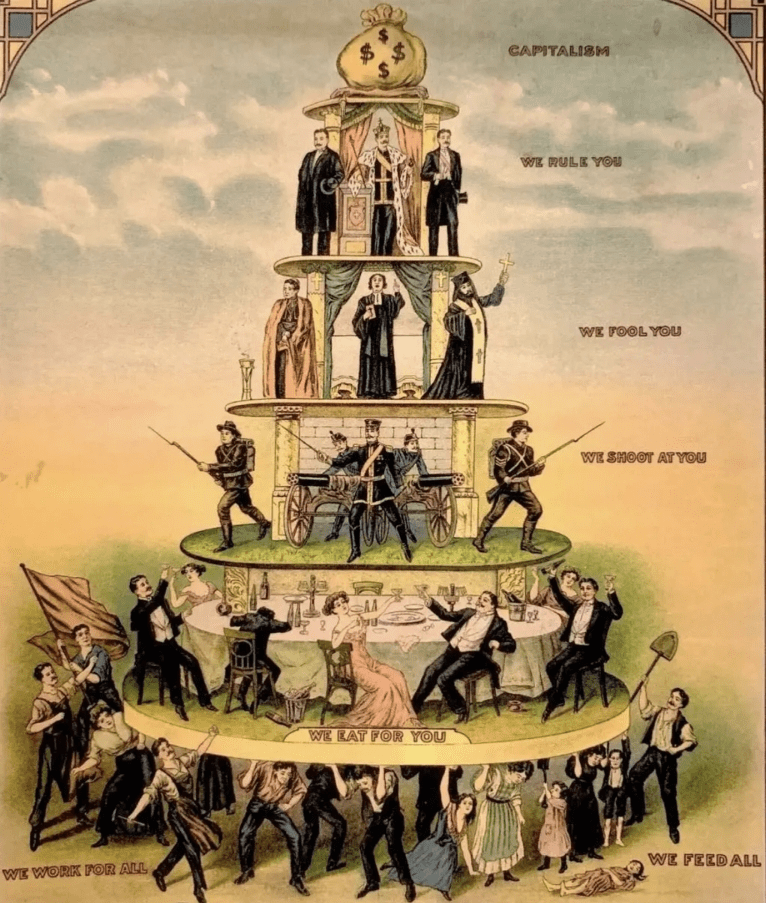
A person who has always been at the bottom of society is mainly affected by the following four factors: the most difficult thing for the poor to break through is their parents, the shackles of consumption, the terrible homogeneous stratification, and learned helplessness.
1. The most difficult thing for poor people to overcome is their parents.
Parents are everyone’s starting point and the ceiling for most people.
In recent generations, most people in China have done better than their parents because their parents were delayed. In the next few generations, everyone will be able to see the power of this sentence.
In the mature societies of the United States, the United Kingdom, and Germany, this is very obvious. The vast majority of children cannot surpass their parents.
I often see parents who have accomplished nothing themselves, and they educate their children in a sound and logical way, but the children seem to deliberately go against them. No matter what the parents say, the children just don't listen.
This is a phenomenon worthy of reflection by many parents: most parents do not realize that their children are imitating themselves, and they will do what you do.
Of course, when he grows up, he will also educate his children in this way, and he will speak clearly and clearly, but the children will still act as if they can't hear, and then do whatever they are supposed to do.
In other words, excluding low-probability genetic mutations, children inherit two sets of genes from their parents:
One set is a physiological gene. Your child looks like you and has the same pupil color and earlobe shape as you. These are physiological genes. The other set is a sociological gene. Your child also behaves in a similar way. You, think a lot like you too. If there is no compulsory education, your child will most likely be a copy of you. This is called social genes.
Compulsory education has changed the social genes of many families. After all, they can learn some basic knowledge from Newton and understand society and human nature from Lu Xun. It is no longer limited to all knowledge coming from parents, but the influence of parents on their children is almost decisive.
In other words, rich people will pass on some of their experiences to their children, and poor people will pass on many of their methods and ideas to the next generation. Although they know that many things are wrong, they pass them on unknowingly. The result is often that whatever the parents are, the children will be the same, which is very pessimistic and disturbing.
For most people, they don’t learn many useful survival skills from their parents. Because people of the parents’ generation don’t quite understand how to strengthen their own survival skills, let alone how to pass them on to the next generation, and this state will always be passed down through “social genes”.
This was especially obvious in the agricultural era, because at that time reading was a luxury and knowledge could not be learned casually like now. Most families don't think about studying at all, and most of their experience comes from their parents.
Only in landlord families like Zeng Guofan, the eldest son would work hard at home and farm the land, and the remaining children would be smart enough to study. If this generation is a scholar, the next generation can be a Jinshi. When one of them becomes successful, he will take the other brothers out of the family. For example, when Zeng Guofan became prosperous later, he brought his two brothers, Zeng Guohua and Zeng Guoquan, to fight with him outside and perform meritorious service. Later, Zeng Guohua was killed in Sanhe Town, and his other brother Zeng Guoquan became prosperous.
What ancient times followed as a whole was an "evolutionary algorithm." Step by step, the best of each generation are selected and nurtured. If one person becomes prosperous, everyone will prosper together.
Compared with ancient times, one of the biggest breakthroughs in modern society is compulsory education. Compulsory education first originated in Germany and was considered to be a trump card for Germany and the United States to quickly catch up with the United Kingdom.
After the first industrial revolution in the UK, the focus of the government's work was on coal mining and textiles, which did not have high technical content. The UK treated workers like livestock and replaced them with new ones after they were used up. There was no human resources at all.
Germany was the first to universalize compulsory education. The electric age requires a large number of skilled workers, who must have relevant knowledge. The British "animal education" model is outdated because illiterate people cannot operate electrical equipment.
Later, Germany and the United States, which focused on education and had high-quality citizens, caught up. This move later became a trump card for Japan, China and other late-developing countries.
Compulsory education forces children to go to school. On the one hand, it can provide patriotic education. In a melting pot country like the United States, children must recite the oath every morning, which is known to everyone as "Indivisible under God." Over time, , national consciousness emerged.
Another advantage of compulsory education is to break the "social gene".
Parents only know so much, so it is naturally difficult for children to learn knowledge from their parents. Schools have compulsory education, and children are sent to schools to forcibly indoctrinate them into things like the Big Bang, the theory of evolution, and molecular biology.
In China, compulsory education has created many miracles over the years. Dozens of college students were born in a poor village, which changed their destiny and broke through the ceiling of their parents. It must be said that compulsory education has countless merits.
However, those who can get into the ideal university are only a minority phenomenon. All over the world, there is a situation where people of all levels gather together. Birds of a feather flock together, people flock together, and good people gather together. This is not because they are deliberately exclusive, but a "homogeneous stratification" mechanism that can be mathematically proven.
This phenomenon spans species, spans civilizations, and exists everywhere.
In other words, if you are a poor person and you leave your family and try not to be affected by your family, your social class determines that the people around you are generally not particularly outstanding people, and you cannot learn much from them. Things, if you want to become great, you have to break through this circle.
2. The shackles of consumption
There is a passage in "Rich Dad, Poor Dad": Both poor and rich people buy luxury goods. The poor often buy them with their hard-earned money every month, which is wealth that should be invested or left to their children.
The rich buy with the capital they generate.
Poor people's purchases of luxury goods did make them look wealthy, but they immediately entered a debt crisis. The monthly salary is used to repay the debt and continue to take out loans, and they enter a vicious cycle.
Ordinary people spend their wages, but some people with the vision of a wealthy person will save their money and buy things that can bring in money.
Things that can bring in cash flow are called assets, and then the money brought by the assets is spent, because that income is considered passive income.
Moreover, there is a huge gap between the consumption of the poor and the consumption of the rich. A top real estate developer in Germany made a very interesting statement before. He said that after wealth is accumulated to a certain point, the money cannot be spent. You buy a luxury car, and the value of the car appreciates; you buy a watch, and the value of the watch appreciates; and you buy gold, and the value of gold appreciates. You can't eliminate money through consumption, which may be the boring part of rich people's lives.
But there is a problem here. This type of asset consumption is easy to say, but very difficult to do. The most basic point is that a few years ago, everyone realized how comfortable it would be if they bought a few houses and then worked as renters. Everyone understands the reason, but how to do it?
The first and most difficult thing about this problem is that it requires a large amount of start-up capital. If you save money slowly, you will probably have to save until the end of time to save the down payment for a house, because you won’t make enough money.
For most poor people, the most difficult thing is not having enough money to spend. How to save money to buy assets?
Some people say that you can borrow money, but when the turnover is low, borrowing money with large leverage is almost a recipe for death. What is even more depressing is that poor people have poor credit and cannot borrow money, or the cost of borrowing money is too high.
The credit mentioned here is not the credit mentioned in life, but the bank's credit rating for you. The poor have a low rating, and the bank will either not lend you money or the interest rate will be very high.
This incident is a very good inspiration for those who have the conditions but have problematic consumption concepts. But for the truly poor, there is almost no solution. They know that the current lifestyle is getting narrower and narrower, but they can still only go this way. This may be the most depressing thing in the world.
Of course, some people "understand all the principles but cannot operate due to objective conditions", but there are still many people who are really missing a chord in their minds.
A friend of mine became a village cadre after graduating from graduate school. He said that the state allocated funds to poor households, but many poor households did not make good use of this money, and many people spent it randomly after receiving it.
He lamented that some people are poor because they lack opportunities, and some people are really lacking in knowledge and have problematic concepts, making it difficult to support them.
3. The terrible homogenization stratification
Generally speaking, societies are all equal in the early stages, a bit like water and oil mixed together for a period of time by shaking them vigorously. But if you let it sit for a while, it will slowly return to the state of separation of water and oil, and clear boundaries will be formed between each class.
Don't think it's unreasonable, it's the same all over the world, both in ancient and modern times.
A few years ago, some people from small cities went to big cities and found that the dress of people in big cities was not much different from theirs, and it could not be said to be fashionable. At that time, my parents visited the workplace dormitories that my parents’ friends in the city lived in and felt they were not as comfortable as living in a small bungalow in a small county town.
I think around 2008 was a watershed. Urban and rural areas were rapidly divided. Young people in big cities became more and more fashionable and looked different from those in rural areas.
For example, a former college classmate taught at the university. He once lamented to me a few years ago, saying that when he stood on the podium, he could tell at a glance which of the students came from a big city and which one came from a village like him.
And he discovered that one thing has become more and more obvious in recent years. There are fewer and fewer rural students in universities. When he went to university, the whole school was full of "local cannons".
In fact, if you look at Europe and the United States, you will find that Europe and the United States have been developing peacefully for hundreds of years, while China has developed from poverty to the present. Compared with them, it has not developed very long. Now everyone is talking about the middle class. The middle class can spend hundreds of thousands or hundreds of thousands a year on their children, and education has turned into an arms race.
In the future, this state will only become more and more serious, and it will become "circular", with various circles living and cooperating together.
In some circles, people only need to maintain the status quo and not fall down, while in other circles, they need to constantly make breakthroughs upward.
It's a bit like some people living on high floors, as long as they can't fall down, some people need to pant and climb up.
The problem is that people at higher levels maintain a high advantage in the competition. The lower the level, the worse the resources and conditions of people, and the harder it is to climb up. This phenomenon exists all over the world, and the more mature societies are, the more so.
In Germany, 5% of the population owns nearly half of the country’s houses, with the rest mostly renting. Only 5% of people in Leipzig own a house, and the rest rent these people's houses.
There was a saying on the Internet that Germans are not in a hurry to buy houses, so house prices are not high.
I remember once asking a friend who came back from Germany, do Germans really have such an open-minded view on real estate consumption? He said that only fools don’t like housing. Most Germans cannot save money and generally cannot afford to buy a house.
In European and American countries, wealthy families buy houses in high-quality school districts from the beginning, and then advance to high-quality junior high schools through high-quality primary schools, then to key middle schools and key universities, and follow this path.
Of course, this does not mean that if you enter a high-quality primary school, you will definitely be able to go to a prestigious school. Top private schools in Europe and the United States do not have this effect, but the probability will increase a lot.
In contrast, the probability of ordinary people going to prestigious schools will be much reduced, and the right to education will gradually move up.
During the Ming and Qing Dynasties, the imperial court discovered a phenomenon: the south was much better than the north in imperial examinations.
Of course, there are many reasons for this phenomenon. For example, the South has suffered less from wars and scourges, and many wealthy and educated families have good foundations. These families often have tens of thousands of books and even have libraries. People in the past dynasties have served as officials in the imperial court and are familiar with imperial examinations. Routine, tutoring the children at home will naturally have bonuses.
More importantly, starting from the Song Dynasty, the southern economy began to surpass that of the north. The south could invest more resources in raising children. Both the proportion and the number of children studying in the south far exceeded those in the north.
The two provinces of Fujian and Zhejiang combined have more academies than the whole country. The advantages of economic power flow back to all levels, including education.
Since the Ming Dynasty, China's admission model has been somewhat similar to the current admissions model. Each province will take care of it, rather than simply admitting students across the country. However, within each province, there are still some places that occupy the vast majority of the province's quotas.
As the economy continues to develop and society evolves over the next few years, everywhere will evolve into circles. If you cannot enter this circle, you will not be able to do certain things.
For example, if a child cannot enter certain good schools, he or she will not be able to pass the "211" and "985" exams, or it will be difficult to pass them. If you can't go to this kind of university, you won't be able to enter a better company in the future.
I say this not to prepare to sell anxiety, but as an objective reality that is coming, or has already arrived.
4. Learned helplessness
There is a passage from Barry Schwartz's "Paradox of Choice":
If a person is in a state of lack of choice for a long time, the subconscious mind will gradually think that nothing can be done to change the status quo and change one's own destiny, so it will enter a state called learned helplessness and become More negative.
Even if the situation changes and there is an opportunity, do not take action.
When this situation is severe, it can lead to decreased immunity and even depression.
When there are many choices, the sense of self-mastery is very powerful, so that people can maintain a proactive attitude for a long time, which is very good for physical and mental health.
Of course, there are three problems when there are too many choices: decision-making requires more energy; the possibility of making mistakes after making a choice is greater; and the psychological frustration caused by making mistakes is stronger.
If you don't make a choice for a long time, your brain will become very negative.
Many people say that they feel like they are about to suffer from depression. In fact, you can reflect on whether it is because there are almost nothing you need to choose on your own. Is it because life is forcing you to move forward? In this state, as time goes by, it will indeed produce an increasingly serious negative state.
This is also the biggest difference between the strong and the poor that I have witnessed over the years. Most normal people seem to have a sense of resignation about life, thinking that this is it, and they can just make do with it, but it is not impossible to live.
Of course, the more powerful people can do more things, and the poorer people can do less things. If they have no resources, their mobility will naturally be poor, and nothing they do will go smoothly, which will have a huge impact on their confidence.
I think young people can run something of their own, which can be Weibo, Twitter, or even edit some simple short videos every day. Of course, it can also be more complex projects.
A fan of mine sent me a private message two months ago and found that he has no particularly obvious strengths. He usually only surfs Twitter and is a mediocre person, and he has always been a leek when it comes to cryptocurrency investment. My advice to him was to try being a Twitter blogger. After he accepted the suggestion, I gave him step-by-step guidance. At present, the number of fans of this blogger has begun to take shape and continues to grow steadily.
He finally knows what to do in his spare time, and this will most likely become the second curve of his life!
This is what I must emphasize. A person must change from a consumer to a producer in order to change the predicament. Because it is the big brother who produces and the poor who consume.
If a person keeps being a consumer, playing other people's games, and eating other people's food, instead of switching to the production side, he will always be in a pit, and he will never get over.
You have to let other people consume your stuff.
The consumption mentioned here does not necessarily mean spending money. Spending time now is also consumption.
If you spend a lot of time on other people's products, such as a certain game or an APP that gives you short-term happiness but wastes time, you have contributed value to others.
A decision now may be of little use to a poor person with little resources and hands-on ability, but this decision may completely change your life five years later.
If you have done something but failed, there are many reasons. Maybe you are not the right person or you are unlucky. But if you don’t do anything and feel that you can’t do it well, this may really be a psychological problem.
5. Start with small decisions
After analyzing it for a long time, I suddenly found that if a particularly poor person reads this content, it may not be of much use, but will make him more depressed.
Society is not kind to the poor, and it goes far beyond flaws in the way we think. More importantly, the lower the hierarchy, the fewer resources are available and the higher the cost of trial and error.
Everything in this world requires trial and error, and trial and error costs money.
Especially in the eyes of the whole world, it is even more embarrassing. From the current point of view, the best way is still ours: let the people from the village go to the city first, integrate into the social division of labor, and give those who are enterprising and flexible a chance. Maybe they can find a way to put their own Take the fellow out.
This is not nonsense. After a village in Jiangxi received poverty alleviation funds, under the leadership of a very powerful farmer, the whole village became rural Internet celebrities. The local flavor short videos became popular all over the country. Now that village is rich. .
Of course, this is a macro-level operation. For everyone, we need to think more and act more, and try more things that are low-cost trial and error and have long-term dividends.
所以,大家如果有时间的话就做点什么,不一定要非常盈利、非常独特、一夜翻身。先认真做起来,说不定三五年后,你会感慨当初的小决定,竟然真的改变了自己的一生。