News


·
--
Bitcoin Whale Moves 20.43 BTC After 15.4 Years, Onchain Lens SaysA Bitcoin whale address that accumulated coins when Bitcoin traded at $3 to $4 transferred 20.43 BTC after holding for 15.4 years, according to Onchain Lens. According to ChainCatcher, the wallet is estimated to have realized about $1.72 million in profit, with a return of more than 2,000,000%.
The address can be traced back 15 years, and historical records show it previously interacted with Mt. Gox and Silk Road.
Bitcoin Whale Moves 20.43 BTC After 15.4 Years, Onchain Lens Says
A Bitcoin whale address that accumulated coins when Bitcoin traded at $3 to $4 transferred 20.43 BTC after holding for 15.4 years, according to Onchain Lens. According to ChainCatcher, the wallet is estimated to have realized about $1.72 million in profit, with a return of more than 2,000,000%.
The address can be traced back 15 years, and historical records show it previously interacted with Mt. Gox and Silk Road.
The address can be traced back 15 years, and historical records show it previously interacted with Mt. Gox and Silk Road.
7
3
13
49.3k
·
--
Decrypt Announces The Information Exchange on Solana, Powered by Myriad and MYRDecrypt has announced The Information Exchange, an information and financial network powered by Myriad and the MYR token and deployed on Solana. According to Odaily, the platform will combine news, data, market prices, probability information, and direct participation features.
Myriad will offer prediction markets, spot markets, perpetual contracts, and structured event products, while also connecting with third-party protocols and exchange products. MYR can be used to stake network functions and access API and market data resources, and the products will roll out in stages over the next few weeks before launching ahead of Solana Breakpoint.
Decrypt Announces The Information Exchange on Solana, Powered by Myriad and MYR
Decrypt has announced The Information Exchange, an information and financial network powered by Myriad and the MYR token and deployed on Solana. According to Odaily, the platform will combine news, data, market prices, probability information, and direct participation features.
Myriad will offer prediction markets, spot markets, perpetual contracts, and structured event products, while also connecting with third-party protocols and exchange products. MYR can be used to stake network functions and access API and market data resources, and the products will roll out in stages over the next few weeks before launching ahead of Solana Breakpoint.
Myriad will offer prediction markets, spot markets, perpetual contracts, and structured event products, while also connecting with third-party protocols and exchange products. MYR can be used to stake network functions and access API and market data resources, and the products will roll out in stages over the next few weeks before launching ahead of Solana Breakpoint.
3
2
619
·
--
Market News | Bitcoin Clears $85,200 and Gold Breaks $4,200 After Core PCE Comes in CoolerBitcoin surged past $85,000 following the US PCE release and traded above $85,200.Spot gold rose $14 to $4,205 an ounce and spot silver gained $0.36 to $61.36. The dollar index fell 15 basis points to 101.05.August core PCE rose 3% year over year against expectations of 3.3%, a six-month low, with the July figure revised down from 3.30% to 3%.Gold Cleared the Level Named YesterdayThe $4,205 print puts gold above the line XS.com identified as decisive.Simon-Peter Massabni, head of business development at the firm, said Tuesday that $4,200 was where buyers betting on the broader uptrend meet sellers expecting a deeper pullback. He wanted a daily or four-hour close above it before calling a new leg higher.He also flagged the specific risk: a higher-than-expected PCE reading "could trigger another wave of short-term selling pressure." The print came in lower, and gold moved the other way.The close is what matters on his framing, not the intraday level. Gold fell to $4,144 on September 28 and remains roughly 25% below January's $5,600 record.Both Assets Rose, Which Has Not Been TypicalBitcoin and gold moving together is a change from most of September.The two assets' correlation collapsed to 0.28 from 0.69 over 30 days, and they repeatedly diverged — Bitcoin holding above $83,000 on September 28 while gold fell to $4,144.Gold carries roughly twice Bitcoin's sensitivity to the 10-year Treasury yield, at −0.41 against −0.17, which is why rate-driven sessions separate them.A session where both rise on a softer inflation print is one where the rate channel is moving in the direction that helps both. It does not indicate the correlation has been restored.The Dollar Move Is Small Against Its LevelThe dollar index fell 15 basis points to 101.05.That is a modest move, and the level is the more informative number. The index traded in the 98 and 99 handles through mid-September, so 101.05 represents meaningful dollar strength accumulated since.A stronger dollar makes dollar-priced commodities more expensive for holders of other currencies, which has been part of the pressure on gold through the month. A 15 basis point decline does not reverse that.
Market News | Bitcoin Clears $85,200 and Gold Breaks $4,200 After Core PCE Comes in Cooler
Bitcoin surged past $85,000 following the US PCE release and traded above $85,200.Spot gold rose $14 to $4,205 an ounce and spot silver gained $0.36 to $61.36. The dollar index fell 15 basis points to 101.05.August core PCE rose 3% year over year against expectations of 3.3%, a six-month low, with the July figure revised down from 3.30% to 3%.Gold Cleared the Level Named YesterdayThe $4,205 print puts gold above the line XS.com identified as decisive.Simon-Peter Massabni, head of business development at the firm, said Tuesday that $4,200 was where buyers betting on the broader uptrend meet sellers expecting a deeper pullback. He wanted a daily or four-hour close above it before calling a new leg higher.He also flagged the specific risk: a higher-than-expected PCE reading "could trigger another wave of short-term selling pressure." The print came in lower, and gold moved the other way.The close is what matters on his framing, not the intraday level. Gold fell to $4,144 on September 28 and remains roughly 25% below January's $5,600 record.Both Assets Rose, Which Has Not Been TypicalBitcoin and gold moving together is a change from most of September.The two assets' correlation collapsed to 0.28 from 0.69 over 30 days, and they repeatedly diverged — Bitcoin holding above $83,000 on September 28 while gold fell to $4,144.Gold carries roughly twice Bitcoin's sensitivity to the 10-year Treasury yield, at −0.41 against −0.17, which is why rate-driven sessions separate them.A session where both rise on a softer inflation print is one where the rate channel is moving in the direction that helps both. It does not indicate the correlation has been restored.The Dollar Move Is Small Against Its LevelThe dollar index fell 15 basis points to 101.05.That is a modest move, and the level is the more informative number. The index traded in the 98 and 99 handles through mid-September, so 101.05 represents meaningful dollar strength accumulated since.A stronger dollar makes dollar-priced commodities more expensive for holders of other currencies, which has been part of the pressure on gold through the month. A 15 basis point decline does not reverse that.
14
2
27
11.6k
·
--
Article
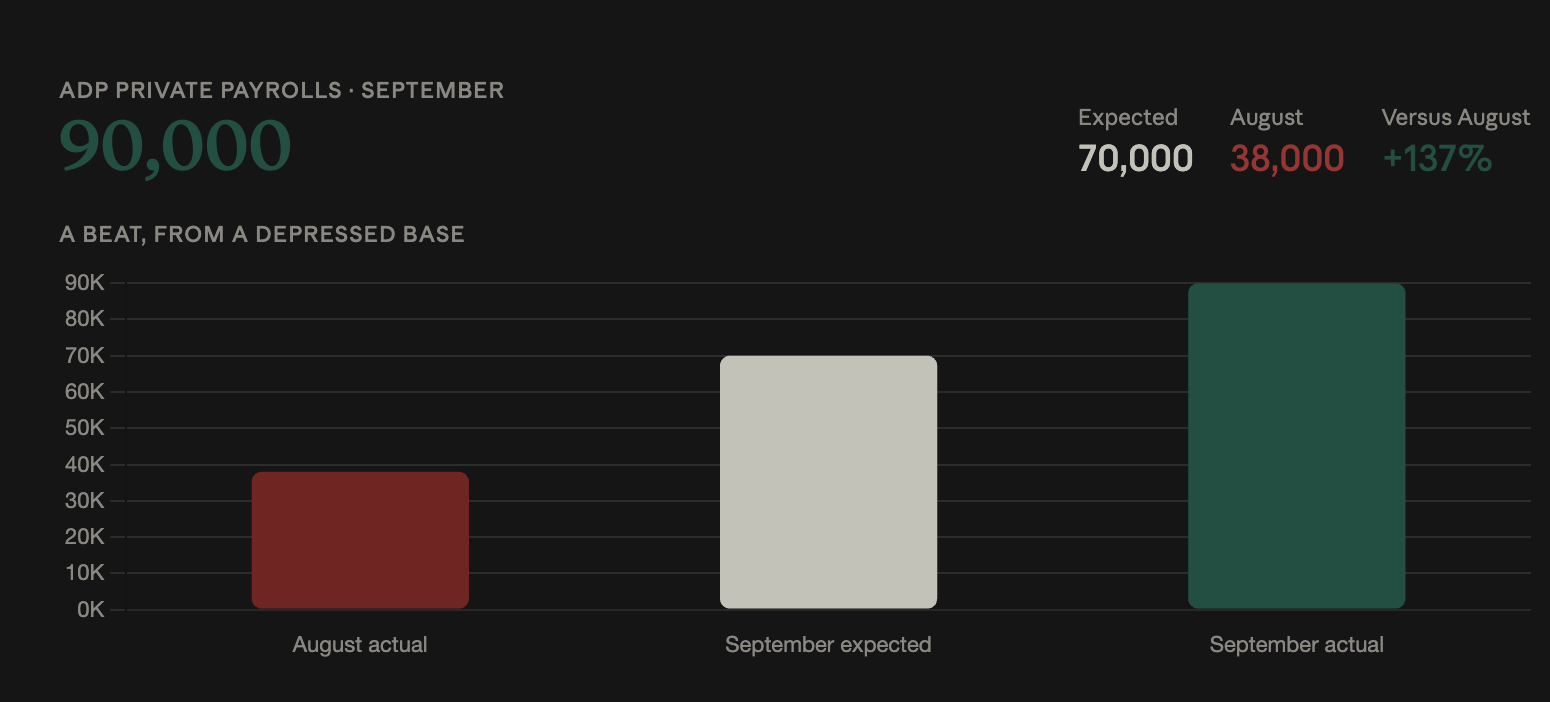
Market News | ADP Shows 90,000 Jobs in September, Beating Forecasts and More Than Doubling AugustUS private employers added 90,000 jobs in September, above expectations of 70,000 and more than double August's 38,000, according to ADP."It was a strong report, with job growth rebounding and wage growth remaining robust after three months of slowdown," said ADP chief economist Nela Richardson.The August Base Is What Makes the Rebound Look LargeAugust's 38,000 was the weakest ADP print since January.A move from 38,000 to 90,000 is a recovery from a depressed base rather than evidence of an accelerating labour market. The figure sits closer to a normal monthly pace than to a strong one.Richardson's reference to wage growth holding firm after three months of slowdown is the second element. Wages that stop decelerating while hiring recovers is a different signal from either alone, and it is the part that bears on inflation.It Lands in the Middle of the Payrolls DisagreementThe print arrives with prediction markets and bank economists split on Friday's non-farm payrolls.Kalshi data put the probability of the official figure exceeding 90,000 at nearly 60%, with about 50% odds of topping 100,000. Goldman Sachs forecast 80,000 and Bank of America just 60,000.ADP at 90,000 sits at the Kalshi threshold and above both bank estimates.The relationship between the two series is loose. ADP covers private payrolls only and uses a different methodology from the Bureau of Labor Statistics, and the monthly correlation between them has been weak in recent years. A strong ADP print raises the odds of a strong official figure without determining it.The Rate Implication Runs Against WilliamsThe timing complicates the Fed pricing.October hike odds fell from about 71% to 50% on Tuesday after New York Fed President John Williams downplayed the urgency of raising rates.A labour market print that beats expectations pushes in the other direction. Firm hiring alongside robust wage growth is the combination that supports further tightening, and it sits awkwardly against Williams's message two days earlier.The Fed raised rates 25 basis points to 3.75%-4.00% on September 16, its first increase since July 2023, with a dot plot median pointing to one more move in 2026.The Bond Market Has Been Pricing Something ElseLong yields have been setting extremes independently of the policy path.The 30-year Treasury yield crossed 5.6% on Tuesday, its highest since June 2002, and the 10-year reached a fresh 2007 high near 5.3%. 10x Research's Markus Thielen forecasts the 10-year reaching 6%, attributing the rise to fiscal concerns and term premium rather than Fed expectations.A strong labour print adds a growth argument to a move that had been driven by deficit and inflation concerns. Whether the long end responds tells you which factor currently dominates.PCE inflation data arrives before the Wall Street open, and Micron reports after the close.
Market News | ADP Shows 90,000 Jobs in September, Beating Forecasts and More Than Doubling August
US private employers added 90,000 jobs in September, above expectations of 70,000 and more than double August's 38,000, according to ADP."It was a strong report, with job growth rebounding and wage growth remaining robust after three months of slowdown," said ADP chief economist Nela Richardson.The August Base Is What Makes the Rebound Look LargeAugust's 38,000 was the weakest ADP print since January.A move from 38,000 to 90,000 is a recovery from a depressed base rather than evidence of an accelerating labour market. The figure sits closer to a normal monthly pace than to a strong one.Richardson's reference to wage growth holding firm after three months of slowdown is the second element. Wages that stop decelerating while hiring recovers is a different signal from either alone, and it is the part that bears on inflation.It Lands in the Middle of the Payrolls DisagreementThe print arrives with prediction markets and bank economists split on Friday's non-farm payrolls.Kalshi data put the probability of the official figure exceeding 90,000 at nearly 60%, with about 50% odds of topping 100,000. Goldman Sachs forecast 80,000 and Bank of America just 60,000.ADP at 90,000 sits at the Kalshi threshold and above both bank estimates.The relationship between the two series is loose. ADP covers private payrolls only and uses a different methodology from the Bureau of Labor Statistics, and the monthly correlation between them has been weak in recent years. A strong ADP print raises the odds of a strong official figure without determining it.The Rate Implication Runs Against WilliamsThe timing complicates the Fed pricing.October hike odds fell from about 71% to 50% on Tuesday after New York Fed President John Williams downplayed the urgency of raising rates.A labour market print that beats expectations pushes in the other direction. Firm hiring alongside robust wage growth is the combination that supports further tightening, and it sits awkwardly against Williams's message two days earlier.The Fed raised rates 25 basis points to 3.75%-4.00% on September 16, its first increase since July 2023, with a dot plot median pointing to one more move in 2026.The Bond Market Has Been Pricing Something ElseLong yields have been setting extremes independently of the policy path.The 30-year Treasury yield crossed 5.6% on Tuesday, its highest since June 2002, and the 10-year reached a fresh 2007 high near 5.3%. 10x Research's Markus Thielen forecasts the 10-year reaching 6%, attributing the rise to fiscal concerns and term premium rather than Fed expectations.A strong labour print adds a growth argument to a move that had been driven by deficit and inflation concerns. Whether the long end responds tells you which factor currently dominates.PCE inflation data arrives before the Wall Street open, and Micron reports after the close.
Voting
ADP beats forecasts — does the Fed hike again in October?
Yes — firm jobs and wages force another hike
No — Williams signaled patience for a reason
One ADP print won't decide it, payrolls will
Fed watching is a full-time job at this point 😮💨
16 votes • Voting
2
12
4.1k
·
--
Article
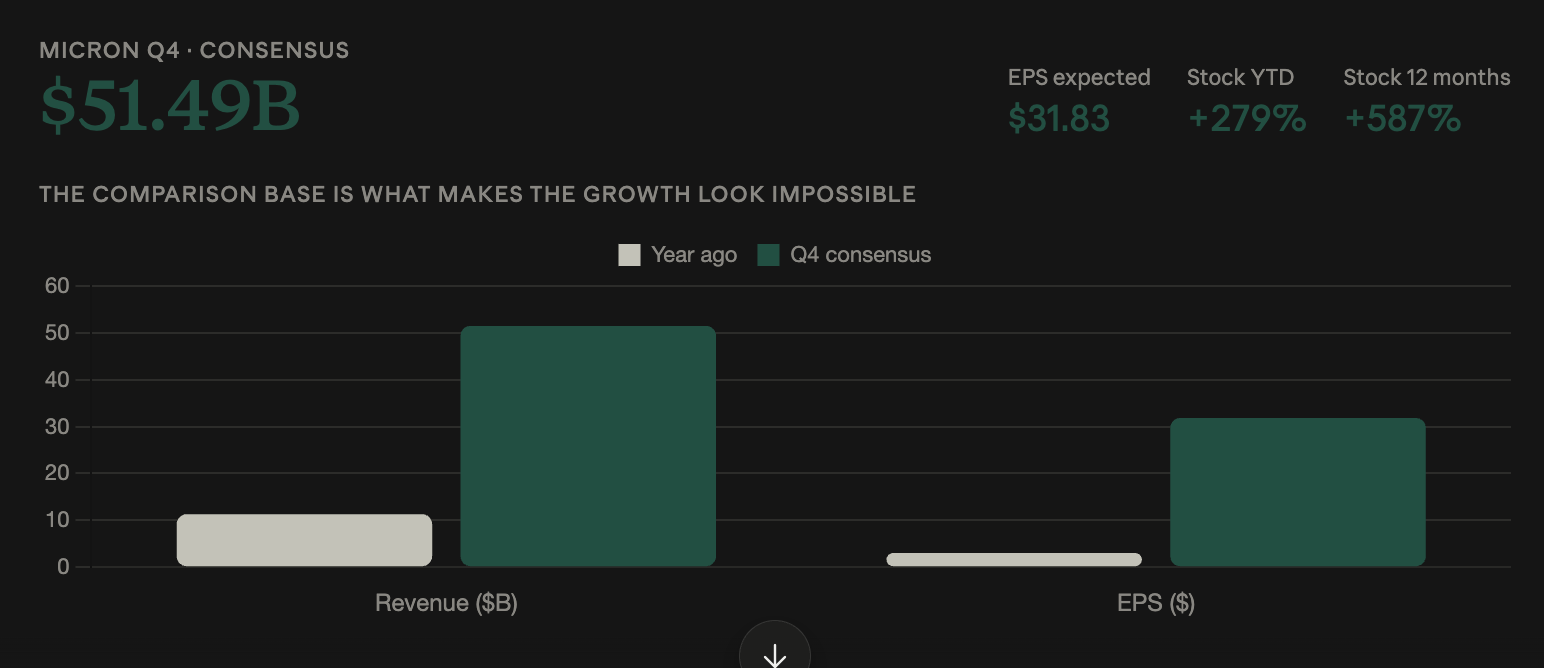
Market News | What Micron's Q4 Print Needs to Deliver After a 279% Year-to-Date RunMicron reports fourth quarter earnings after the bell on Wednesday, with Wall Street expecting earnings per share of $31.83 and revenue of $51.49 billion.Those compare against $3.03 and $11.31 billion a year ago — increases of 950% and 355%.The stock has risen 279% year to date and 587% over the past 12 months, which sets a high bar for what counts as good news.The Headline Beat Is Not the VariableConsensus at 950% EPS growth means a beat is largely expected. The stock has already moved on the assumption.What the print actually decides is whether the memory cycle has further to run.Memory is severely operationally leveraged. Fabs carry high fixed costs, so when pricing turns, margin expands far faster than revenue — which is how Micron went from $3.03 per share to a consensus of $31.83 in four quarters.The same mechanism works in reverse. A cycle that turns produces margin compression faster than revenue decline, and the year-ago comparisons that flatter the current quarter become punishing within two.So the question for Wednesday is not the quarter. It is what management says about DRAM contract pricing into 2027.What a Bullish Outcome Looks LikeThree things would extend the trade.DRAM pricing holding or rising into the first half of 2027 would be the strongest signal, because it means supply has not caught demand. DRAM is expected to deliver $38.22 billion of the quarter's revenue, roughly 76% of the total, and it is the line tied directly to AI infrastructure.Capacity commentary matters second. Memory cycles end when suppliers add enough capacity to break pricing, so any indication that Micron and its competitors are holding discipline supports the cycle continuing.Customer concentration and order visibility is the third. Hyperscaler purchase commitments extending further out reduce the risk that demand is being pulled forward.Micron's August announcement of up to $10 billion over ten years for a research institution in Boise, Idaho signals the company expects a long cycle. Confirmation in the guidance would matter more than the spending plan itself.What a Bearish Outcome Looks LikeThe warning signs are narrower but clearer.Any softening in DRAM pricing guidance would hit hardest, because that is the line the valuation rests on. A beat on the quarter paired with cautious pricing commentary would likely still sell off.NAND is the second area to watch. At $12.29 billion expected, it serves consumer devices rather than data centres, and it is where the pricing pressure hitting phones and laptops shows up first. Weakness there is a demand signal even if DRAM holds.Consumer electronics makers have been absorbing memory costs by raising prices — Apple lifted the iPhone 18 Pro line by $100 against the iPhone 17 Pro. Those increases have cut unit sales while protecting margins, and that arrangement has a limit. Commentary suggesting device makers are resisting further cost pass-through would indicate the cycle is closer to its end than its middle.Korea Sent a Different Signal Three Days AgoThe timing complicates the read.South Korea's Kospi fell 2.7% on Monday with Samsung Electronics and SK Hynix both down more than 5%. Both are memory manufacturers and both function as the region's AI proxy.That may reflect positioning ahead of Micron rather than a view on memory — traders reducing exposure before a print that will reprice the whole complex. Or it may be the market pricing something the US session has not yet.Memory has swung hard in both directions all month. Micron and SanDisk each fell more than 7% on September 14 against Nvidia's 4% after Anthropic CEO Dario Amodei called for slowing frontier AI development. By September 22 the Philadelphia Semiconductor Index had risen five straight sessions after Meta's Muse agent topped the App Store and AMD briefly cleared $1 trillion.Memory carries higher beta than logic within the AI trade, which is why Micron's guidance moves more than its results.The Macro Backdrop Is Working Against ItThe print lands into a difficult tape regardless of content.The 30-year Treasury yield crossed 5.6% on Tuesday, its highest since June 2002, and the 10-year reached a fresh 2007 high near 5.3%.Rising discount rates weigh most heavily on equities with cash flows weighted years forward, which describes the entire AI infrastructure complex. A strong print into rising yields may be received less well than the same print into falling ones.PCE inflation data arrives before the Wall Street open on the same day, so sentiment will already have been set by the time Micron reports.The Crypto Read-ThroughThe connection runs through the miners that pivoted to AI compute.IREN, Hut 8, HIVE, Core Scientific and TeraWulf lagged Bitcoin badly through September, with the top-10 mining median gaining 1.8% against Bitcoin's 22%. The pivot removed their leverage to Bitcoin while adding full exposure to AI sentiment.Strong DRAM guidance supports the demand case those companies built their capital spending around. Weak guidance undermines it — and they carry the AI beta without the memory pricing upside.JPMorgan's counterpoint from last week still stands: neocloud contract pricing has moved to $15-$20 per megawatt from $10-$15, which suggests compute demand remains firm regardless of what memory pricing does.
Market News | What Micron's Q4 Print Needs to Deliver After a 279% Year-to-Date Run
Micron reports fourth quarter earnings after the bell on Wednesday, with Wall Street expecting earnings per share of $31.83 and revenue of $51.49 billion.Those compare against $3.03 and $11.31 billion a year ago — increases of 950% and 355%.The stock has risen 279% year to date and 587% over the past 12 months, which sets a high bar for what counts as good news.The Headline Beat Is Not the VariableConsensus at 950% EPS growth means a beat is largely expected. The stock has already moved on the assumption.What the print actually decides is whether the memory cycle has further to run.Memory is severely operationally leveraged. Fabs carry high fixed costs, so when pricing turns, margin expands far faster than revenue — which is how Micron went from $3.03 per share to a consensus of $31.83 in four quarters.The same mechanism works in reverse. A cycle that turns produces margin compression faster than revenue decline, and the year-ago comparisons that flatter the current quarter become punishing within two.So the question for Wednesday is not the quarter. It is what management says about DRAM contract pricing into 2027.What a Bullish Outcome Looks LikeThree things would extend the trade.DRAM pricing holding or rising into the first half of 2027 would be the strongest signal, because it means supply has not caught demand. DRAM is expected to deliver $38.22 billion of the quarter's revenue, roughly 76% of the total, and it is the line tied directly to AI infrastructure.Capacity commentary matters second. Memory cycles end when suppliers add enough capacity to break pricing, so any indication that Micron and its competitors are holding discipline supports the cycle continuing.Customer concentration and order visibility is the third. Hyperscaler purchase commitments extending further out reduce the risk that demand is being pulled forward.Micron's August announcement of up to $10 billion over ten years for a research institution in Boise, Idaho signals the company expects a long cycle. Confirmation in the guidance would matter more than the spending plan itself.What a Bearish Outcome Looks LikeThe warning signs are narrower but clearer.Any softening in DRAM pricing guidance would hit hardest, because that is the line the valuation rests on. A beat on the quarter paired with cautious pricing commentary would likely still sell off.NAND is the second area to watch. At $12.29 billion expected, it serves consumer devices rather than data centres, and it is where the pricing pressure hitting phones and laptops shows up first. Weakness there is a demand signal even if DRAM holds.Consumer electronics makers have been absorbing memory costs by raising prices — Apple lifted the iPhone 18 Pro line by $100 against the iPhone 17 Pro. Those increases have cut unit sales while protecting margins, and that arrangement has a limit. Commentary suggesting device makers are resisting further cost pass-through would indicate the cycle is closer to its end than its middle.Korea Sent a Different Signal Three Days AgoThe timing complicates the read.South Korea's Kospi fell 2.7% on Monday with Samsung Electronics and SK Hynix both down more than 5%. Both are memory manufacturers and both function as the region's AI proxy.That may reflect positioning ahead of Micron rather than a view on memory — traders reducing exposure before a print that will reprice the whole complex. Or it may be the market pricing something the US session has not yet.Memory has swung hard in both directions all month. Micron and SanDisk each fell more than 7% on September 14 against Nvidia's 4% after Anthropic CEO Dario Amodei called for slowing frontier AI development. By September 22 the Philadelphia Semiconductor Index had risen five straight sessions after Meta's Muse agent topped the App Store and AMD briefly cleared $1 trillion.Memory carries higher beta than logic within the AI trade, which is why Micron's guidance moves more than its results.The Macro Backdrop Is Working Against ItThe print lands into a difficult tape regardless of content.The 30-year Treasury yield crossed 5.6% on Tuesday, its highest since June 2002, and the 10-year reached a fresh 2007 high near 5.3%.Rising discount rates weigh most heavily on equities with cash flows weighted years forward, which describes the entire AI infrastructure complex. A strong print into rising yields may be received less well than the same print into falling ones.PCE inflation data arrives before the Wall Street open on the same day, so sentiment will already have been set by the time Micron reports.The Crypto Read-ThroughThe connection runs through the miners that pivoted to AI compute.IREN, Hut 8, HIVE, Core Scientific and TeraWulf lagged Bitcoin badly through September, with the top-10 mining median gaining 1.8% against Bitcoin's 22%. The pivot removed their leverage to Bitcoin while adding full exposure to AI sentiment.Strong DRAM guidance supports the demand case those companies built their capital spending around. Weak guidance undermines it — and they carry the AI beta without the memory pricing upside.JPMorgan's counterpoint from last week still stands: neocloud contract pricing has moved to $15-$20 per megawatt from $10-$15, which suggests compute demand remains firm regardless of what memory pricing does.
2
2
6
5.3k
·
--
Article
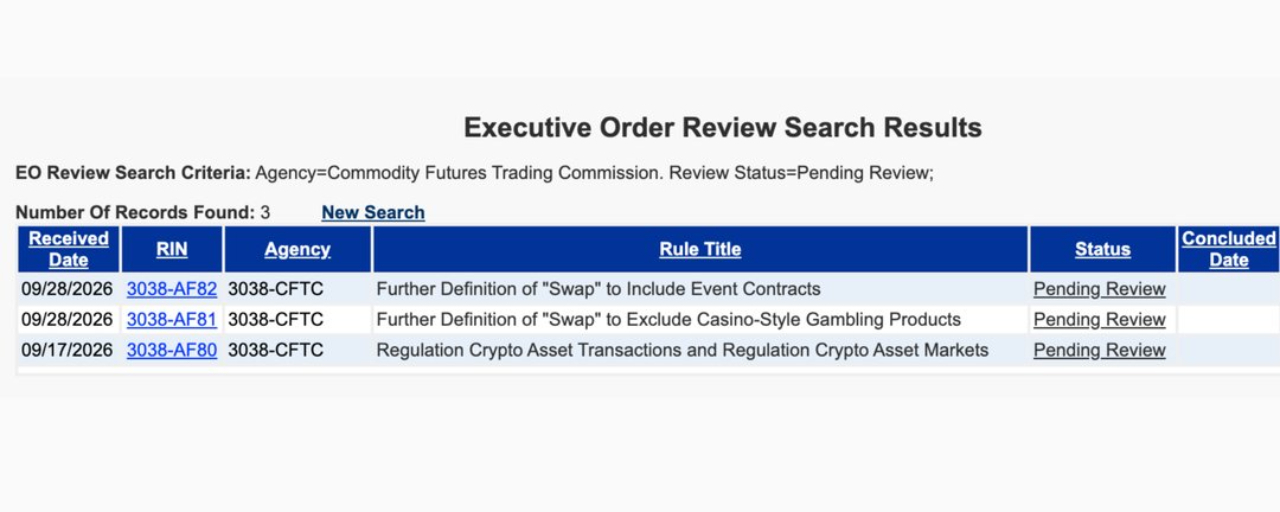
CFTC Submits Two Rule Proposals on Event Contracts to White HouseThe U.S. Commodity Futures Trading Commission has submitted two rulemaking proposals on event contracts to the White House Office of Information and Regulatory Affairs. According to Odaily, one proposal would exclude casino-style gambling products from the definition of swaps, while the other would include event contracts in the swap definition.
CFTC Submits Two Rule Proposals on Event Contracts to White House
The U.S. Commodity Futures Trading Commission has submitted two rulemaking proposals on event contracts to the White House Office of Information and Regulatory Affairs. According to Odaily, one proposal would exclude casino-style gambling products from the definition of swaps, while the other would include event contracts in the swap definition.
2
647
·
--
Binance Launches October Affiliate Dual-Star Program With 500,000 USDC Prize PoolAccording to the announcement from Binance, the exchange is launching the October Affiliate Dual-Star Program for eligible Binance Affiliates, with two reward tracks and a total prize pool worth 500,000 USDC. The program is designed to reward affiliates who drive new trader growth and trading activity through Referral Pro Mode. Promotion A runs from 2026-10-01 00:00 (UTC) to 2026-10-31 23:59 (UTC), while Promotion B runs from 2026-09-01 00:00 (UTC) to 2026-11-30 23:59 (UTC). Under Promotion A, affiliates who meet both the trading volume and first-time trader requirements for any tier can earn up to 2,000 USDC in token vouchers and unlock one bonus spin. The bonus spin offers a chance to win an iPhone 18 series device or a Binance Blockchain Week ticket. Promotion B ranks eligible affiliates on two global leaderboards, one for new trader performance and one for trading volume, with rewards of up to 10,000 USDC in token vouchers based on final rankings. Binance said the program is limited to eligible affiliates in certain regions and that rewards are subject to prize pool availability.
Promotion A rewards are tied to tiered performance thresholds based on qualifying Spot, Margin, and Futures trading volume generated by new and existing regular to VIP 2 referrals, along with the number of first-time Spot, Margin, and Futures referrals. The exchange said eligible participants can receive only the highest-tier reward they qualify for under Promotion A. Those who reach at least Tier 5 during the promotion period will receive one bonus spin, which can be used from 2026-11-07 to 2026-11-21. Promotion B will distribute rewards according to final leaderboard rankings across the two global leaderboards, with 5,000 USDC for first place, 3,500 USDC for second, 2,500 USDC for third, and smaller rewards for lower ranked positions through 30th place. Binance said leaderboard data will be updated with a maximum delay of 2 days, and final results will be confirmed by 2026-11-02. Promotion A rewards will be distributed in token vouchers by 2026-11-26, while Promotion B rewards will be distributed in token vouchers by 2026-12-26.
Binance Launches October Affiliate Dual-Star Program With 500,000 USDC Prize Pool
According to the announcement from Binance, the exchange is launching the October Affiliate Dual-Star Program for eligible Binance Affiliates, with two reward tracks and a total prize pool worth 500,000 USDC. The program is designed to reward affiliates who drive new trader growth and trading activity through Referral Pro Mode. Promotion A runs from 2026-10-01 00:00 (UTC) to 2026-10-31 23:59 (UTC), while Promotion B runs from 2026-09-01 00:00 (UTC) to 2026-11-30 23:59 (UTC). Under Promotion A, affiliates who meet both the trading volume and first-time trader requirements for any tier can earn up to 2,000 USDC in token vouchers and unlock one bonus spin. The bonus spin offers a chance to win an iPhone 18 series device or a Binance Blockchain Week ticket. Promotion B ranks eligible affiliates on two global leaderboards, one for new trader performance and one for trading volume, with rewards of up to 10,000 USDC in token vouchers based on final rankings. Binance said the program is limited to eligible affiliates in certain regions and that rewards are subject to prize pool availability.
Promotion A rewards are tied to tiered performance thresholds based on qualifying Spot, Margin, and Futures trading volume generated by new and existing regular to VIP 2 referrals, along with the number of first-time Spot, Margin, and Futures referrals. The exchange said eligible participants can receive only the highest-tier reward they qualify for under Promotion A. Those who reach at least Tier 5 during the promotion period will receive one bonus spin, which can be used from 2026-11-07 to 2026-11-21. Promotion B will distribute rewards according to final leaderboard rankings across the two global leaderboards, with 5,000 USDC for first place, 3,500 USDC for second, 2,500 USDC for third, and smaller rewards for lower ranked positions through 30th place. Binance said leaderboard data will be updated with a maximum delay of 2 days, and final results will be confirmed by 2026-11-02. Promotion A rewards will be distributed in token vouchers by 2026-11-26, while Promotion B rewards will be distributed in token vouchers by 2026-12-26.
Promotion A rewards are tied to tiered performance thresholds based on qualifying Spot, Margin, and Futures trading volume generated by new and existing regular to VIP 2 referrals, along with the number of first-time Spot, Margin, and Futures referrals. The exchange said eligible participants can receive only the highest-tier reward they qualify for under Promotion A. Those who reach at least Tier 5 during the promotion period will receive one bonus spin, which can be used from 2026-11-07 to 2026-11-21. Promotion B will distribute rewards according to final leaderboard rankings across the two global leaderboards, with 5,000 USDC for first place, 3,500 USDC for second, 2,500 USDC for third, and smaller rewards for lower ranked positions through 30th place. Binance said leaderboard data will be updated with a maximum delay of 2 days, and final results will be confirmed by 2026-11-02. Promotion A rewards will be distributed in token vouchers by 2026-11-26, while Promotion B rewards will be distributed in token vouchers by 2026-12-26.
1
634
·
--
Article
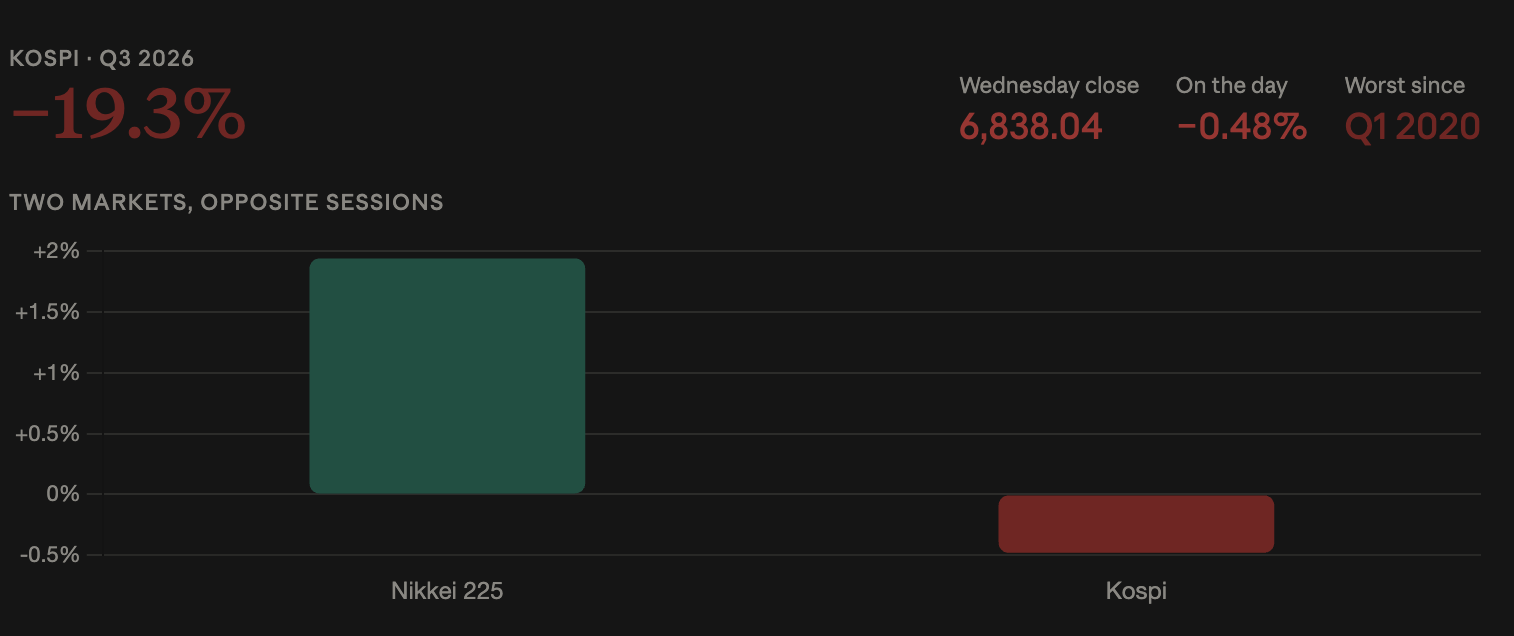
Market News | Kospi Posts Its Worst Quarter Since Early 2020 as the Nikkei Gains 1.94%South Korea's Kospi closed down 32.77 points, or 0.48%, at 6,838.04 on Wednesday, per Bitget data.The index fell 19.3% across the third quarter, its steepest quarterly decline since the first quarter of 2020.Japan's Nikkei 225 moved the opposite way on the same session, closing up 1,272.45 points, or 1.94%, at 66,753.72.The 2020 Comparison Sets the ScaleQ1 2020 was the pandemic crash, when global equity markets fell in weeks rather than months.A quarterly decline matching that period without a comparable systemic event points to something specific to Korea's market composition rather than to a broad risk-off move.That composition is the explanation. The Kospi carries concentrated exposure to memory manufacturing through Samsung Electronics and SK Hynix, both of which function as the region's AI proxy.The Quarter Was Defined by Two SelloffsKorea's market fell hard twice in the period.A 22% selloff in July followed doubts about returns on AI investment — the same concern that reached US markets months later. The index has struggled to hold above 7,000 since.September brought a second leg. The Kospi fell 3% on September 14 after Anthropic CEO Dario Amodei called for slowing frontier AI development, with SK Hynix down 6%. It then fell 2.7% on September 28 with both Samsung and SK Hynix down more than 5%.Between those, the index rose 2% on September 22 as the same names led an Asian rally after Meta's Muse agent overtook ChatGPT as the top free app on Apple's US App Store.Participation Fell Alongside PriceTurnover has been declining independently of the index.Kospi average daily turnover fell to 20.6 trillion won, about $15 billion, in September — the lowest of 2026 and less than half the May and June peak.A market that falls on thinning volume has less depth to absorb further shocks. The retail buying that drove Korean stocks to records earlier in the year was itself a volume story, and it has not returned.The Nikkei Divergence Is the Session's Other SignalJapanese equities rising 1.94% while Korea fell separates the two markets on a day they would normally move together.Japan's index is more diversified across industrials, financials and consumer names, so it carries less direct exposure to the memory cycle driving Korea.The Bank of Japan also raised its benchmark to a 31-year high in September, and the yen has been weak at around 157.8 per dollar — a level that supports Japanese exporters by making their goods cheaper abroad.Micron Reports After the US CloseThe timing places both markets ahead of a print that will reprice the memory complex.Micron reports fourth quarter results after Wednesday's US close, with consensus at $31.83 earnings per share against $3.03 a year ago and revenue of $51.49 billion against $11.31 billion.DRAM is expected to account for $38.22 billion of that, roughly 76% of revenue, and it is the line tied to AI infrastructure demand.Guidance on DRAM contract pricing into 2027 matters more for Samsung and SK Hynix than the quarter itself, since all three compete in the same market. Monday's Korean selloff may reflect positioning ahead of it.PCE inflation data arrives before the US open on the same day.
Market News | Kospi Posts Its Worst Quarter Since Early 2020 as the Nikkei Gains 1.94%
South Korea's Kospi closed down 32.77 points, or 0.48%, at 6,838.04 on Wednesday, per Bitget data.The index fell 19.3% across the third quarter, its steepest quarterly decline since the first quarter of 2020.Japan's Nikkei 225 moved the opposite way on the same session, closing up 1,272.45 points, or 1.94%, at 66,753.72.The 2020 Comparison Sets the ScaleQ1 2020 was the pandemic crash, when global equity markets fell in weeks rather than months.A quarterly decline matching that period without a comparable systemic event points to something specific to Korea's market composition rather than to a broad risk-off move.That composition is the explanation. The Kospi carries concentrated exposure to memory manufacturing through Samsung Electronics and SK Hynix, both of which function as the region's AI proxy.The Quarter Was Defined by Two SelloffsKorea's market fell hard twice in the period.A 22% selloff in July followed doubts about returns on AI investment — the same concern that reached US markets months later. The index has struggled to hold above 7,000 since.September brought a second leg. The Kospi fell 3% on September 14 after Anthropic CEO Dario Amodei called for slowing frontier AI development, with SK Hynix down 6%. It then fell 2.7% on September 28 with both Samsung and SK Hynix down more than 5%.Between those, the index rose 2% on September 22 as the same names led an Asian rally after Meta's Muse agent overtook ChatGPT as the top free app on Apple's US App Store.Participation Fell Alongside PriceTurnover has been declining independently of the index.Kospi average daily turnover fell to 20.6 trillion won, about $15 billion, in September — the lowest of 2026 and less than half the May and June peak.A market that falls on thinning volume has less depth to absorb further shocks. The retail buying that drove Korean stocks to records earlier in the year was itself a volume story, and it has not returned.The Nikkei Divergence Is the Session's Other SignalJapanese equities rising 1.94% while Korea fell separates the two markets on a day they would normally move together.Japan's index is more diversified across industrials, financials and consumer names, so it carries less direct exposure to the memory cycle driving Korea.The Bank of Japan also raised its benchmark to a 31-year high in September, and the yen has been weak at around 157.8 per dollar — a level that supports Japanese exporters by making their goods cheaper abroad.Micron Reports After the US CloseThe timing places both markets ahead of a print that will reprice the memory complex.Micron reports fourth quarter results after Wednesday's US close, with consensus at $31.83 earnings per share against $3.03 a year ago and revenue of $51.49 billion against $11.31 billion.DRAM is expected to account for $38.22 billion of that, roughly 76% of revenue, and it is the line tied to AI infrastructure demand.Guidance on DRAM contract pricing into 2027 matters more for Samsung and SK Hynix than the quarter itself, since all three compete in the same market. Monday's Korean selloff may reflect positioning ahead of it.PCE inflation data arrives before the US open on the same day.
1
2
2.4k
·
--
Article
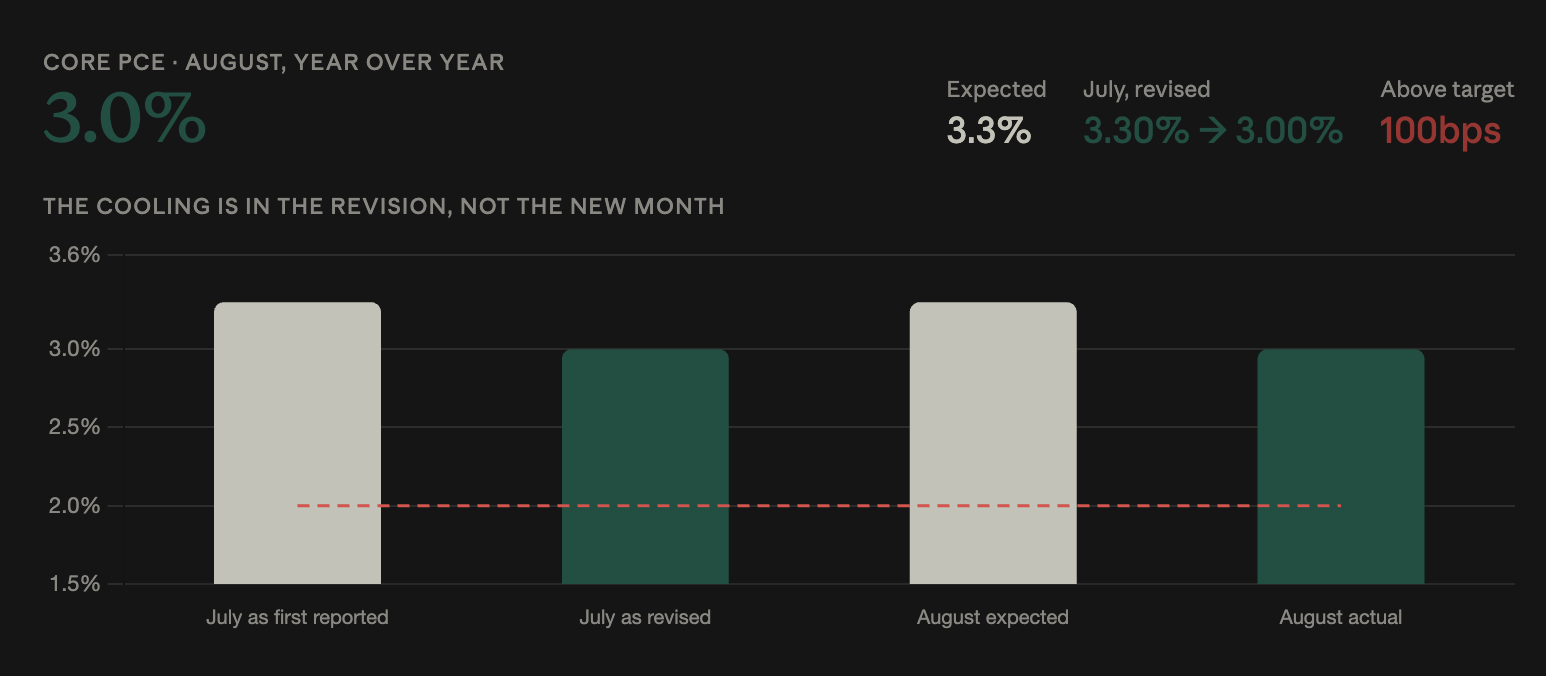
Market News | Core PCE Holds at 3% in August as July Is Revised Down From 3.3%The US core personal consumption expenditures price index rose 3% year over year in August, below expectations of 3.3% and a six-month low.The July figure was revised down from 3.30% to 3%.That revision changes how the print reads. August is flat against a restated July rather than a decline from 3.3%, so the cooling shows up in the historical data rather than in the new month.The Revision Is the Larger EventA 30 basis point downward revision to the prior month is substantial for a series that moves in tenths.It means inflation was running cooler in July than the data showed at the time — including on September 16, when the Fed raised rates 25 basis points to 3.75%-4.00% partly on the strength of price pressures.Chair Kevin Warsh built his Jackson Hole case around PCE rather than CPI, citing a 12-month rate of 3.7% against a hotter six-month reading and arguing the recent trend was the operative measure. A downward revision to that recent trend weakens the specific argument he made.It Cuts Against Wednesday's Labour DataThe print arrives hours after ADP showed private payrolls rising 90,000 in September, above the 70,000 expected and more than double August's 38,000.ADP chief economist Nela Richardson described wage growth as remaining robust after three months of slowdown.The two releases point in opposite directions for policy. Firm hiring with solid wages supports further tightening; cooler inflation than expected does not.That combination is the one the Fed finds hardest to read, because it separates the labour market from the price data the tightening was meant to address.October Odds Were Already at a Coin FlipRate pricing was finely balanced going in.Federal funds futures showed October hike odds falling from about 71% to 50% on Tuesday after New York Fed President John Williams downplayed the urgency of raising rates.A softer inflation print supports Williams's position. The ADP beat runs against it. Which dominates depends on whether the market treats the PCE revision as evidence that price pressures were overstated or as a single data point in a series that remains well above the 2% target.At 3%, core PCE is still 100 basis points above target.The Long End Has Been Pricing Something ElseTreasury yields have set extremes independently of inflation expectations.The 30-year crossed 5.6% on Tuesday, its highest since June 2002, and the 10-year reached a fresh 2007 high near 5.3%. 10x Research's Markus Thielen forecasts the 10-year reaching 6%, attributing the move to fiscal concerns and term premium rather than the policy path.If that framing is correct, a softer inflation print does less for long yields than it would in a conventional cycle. The test is whether the 30-year responds at all.For Crypto, the Driver Matters More Than the LevelThielen's distinction bears directly on how Bitcoin reads this."When yields rise because the Fed is tightening, bitcoin suffers. When yields rise on fiscal and term-premium concerns, the picture flips," he said Tuesday.A cooler inflation print reduces the probability of the first scenario. It does nothing about the second.Bitcoin traded around $83,700 on Wednesday, consolidating since the failed breakout at $87,300 on September 21, with 30-day implied volatility contained all week.Gold, which carries roughly twice Bitcoin's sensitivity to the 10-year at −0.41 against −0.17, has more riding on the yield reaction. It fell to $4,144 on September 28 before recovering toward $4,200, the level XS.com identified as the line separating a recovery from a deeper pullback.Friday's non-farm payrolls report is the next release, with Kalshi pricing nearly 60% odds of a figure above 90,000 against Goldman Sachs at 80,000 and Bank of America at 60,000.
Market News | Core PCE Holds at 3% in August as July Is Revised Down From 3.3%
The US core personal consumption expenditures price index rose 3% year over year in August, below expectations of 3.3% and a six-month low.The July figure was revised down from 3.30% to 3%.That revision changes how the print reads. August is flat against a restated July rather than a decline from 3.3%, so the cooling shows up in the historical data rather than in the new month.The Revision Is the Larger EventA 30 basis point downward revision to the prior month is substantial for a series that moves in tenths.It means inflation was running cooler in July than the data showed at the time — including on September 16, when the Fed raised rates 25 basis points to 3.75%-4.00% partly on the strength of price pressures.Chair Kevin Warsh built his Jackson Hole case around PCE rather than CPI, citing a 12-month rate of 3.7% against a hotter six-month reading and arguing the recent trend was the operative measure. A downward revision to that recent trend weakens the specific argument he made.It Cuts Against Wednesday's Labour DataThe print arrives hours after ADP showed private payrolls rising 90,000 in September, above the 70,000 expected and more than double August's 38,000.ADP chief economist Nela Richardson described wage growth as remaining robust after three months of slowdown.The two releases point in opposite directions for policy. Firm hiring with solid wages supports further tightening; cooler inflation than expected does not.That combination is the one the Fed finds hardest to read, because it separates the labour market from the price data the tightening was meant to address.October Odds Were Already at a Coin FlipRate pricing was finely balanced going in.Federal funds futures showed October hike odds falling from about 71% to 50% on Tuesday after New York Fed President John Williams downplayed the urgency of raising rates.A softer inflation print supports Williams's position. The ADP beat runs against it. Which dominates depends on whether the market treats the PCE revision as evidence that price pressures were overstated or as a single data point in a series that remains well above the 2% target.At 3%, core PCE is still 100 basis points above target.The Long End Has Been Pricing Something ElseTreasury yields have set extremes independently of inflation expectations.The 30-year crossed 5.6% on Tuesday, its highest since June 2002, and the 10-year reached a fresh 2007 high near 5.3%. 10x Research's Markus Thielen forecasts the 10-year reaching 6%, attributing the move to fiscal concerns and term premium rather than the policy path.If that framing is correct, a softer inflation print does less for long yields than it would in a conventional cycle. The test is whether the 30-year responds at all.For Crypto, the Driver Matters More Than the LevelThielen's distinction bears directly on how Bitcoin reads this."When yields rise because the Fed is tightening, bitcoin suffers. When yields rise on fiscal and term-premium concerns, the picture flips," he said Tuesday.A cooler inflation print reduces the probability of the first scenario. It does nothing about the second.Bitcoin traded around $83,700 on Wednesday, consolidating since the failed breakout at $87,300 on September 21, with 30-day implied volatility contained all week.Gold, which carries roughly twice Bitcoin's sensitivity to the 10-year at −0.41 against −0.17, has more riding on the yield reaction. It fell to $4,144 on September 28 before recovering toward $4,200, the level XS.com identified as the line separating a recovery from a deeper pullback.Friday's non-farm payrolls report is the next release, with Kalshi pricing nearly 60% odds of a figure above 90,000 against Goldman Sachs at 80,000 and Bank of America at 60,000.
1
1
3
6.9k
·
--
Market News | Bank of Korea to Buy One Ton of Domestic Gold in December, Its First Purchase in 13 YearsThe Bank of Korea will purchase approximately one ton of domestically produced gold in December, worth 200 billion won, according to a report submitted to ruling party lawmakers on September 30.It marks the central bank's first physical gold purchase in 13 years. The first transaction is scheduled for December 14, after the bank establishes the system needed for domestic gold trading.The Quantity Is Small Against Existing HoldingsThe Bank of Korea held 104.4 tons of physical gold as of the end of August, valued at $14.88 billion and representing 3.4% of foreign exchange reserves.One ton adds under 1% to that position.What makes the purchase notable is the resumption itself. A central bank that has not bought physical gold since 2013 building the infrastructure to do so signals an intent to continue, and the report describes establishing a system rather than executing a one-off trade.The Won-Denominated Structure Is the MechanismThe purchase is expected to cover gold that domestic producers had originally planned to export.That allows the central bank to pay in Korean won without drawing on foreign exchange reserves.The distinction matters for how the transaction affects Korea's external position. A conventional gold purchase converts foreign currency into bullion, changing the composition of reserves without altering their total. Buying domestic production with won adds to reserves without spending any.It also keeps gold inside Korea that would otherwise have left, which has a marginal effect on the country's trade flows.Indirect Exposure Came FirstThe Bank of Korea began indirect gold investment in the second quarter of this year, purchasing $250 million worth of gold ETFs.That sequence is informative. ETF exposure gives price participation without custody, storage or the operational work of handling physical metal. Moving from ETFs to bullion after two quarters suggests the earlier position was a preliminary step rather than the intended endpoint.Korea Is a Long Way Behind Regional PeersAt 3.4% of reserves, the Bank of Korea's gold allocation is low by international standards.China's central bank has been the more visible buyer, adding 650,000 ounces in a recent month — its largest since 2023 — across 22 consecutive months of purchases.Central bank gold demand has been a persistent bid through a period when the metal has fallen sharply on rate expectations. Gold traded near $4,144 on September 28, roughly 25% below January's record of $5,600, and posted three consecutive weekly declines through mid-September.That divergence is the thing to watch. Official sector buying has continued while investor flows moved the other way, and a central bank starting a programme at these levels is buying into weakness rather than strength.Fiscal Concerns Are the Stated Driver ElsewhereThe broader argument for central bank gold accumulation has shifted toward sovereign risk.Chicago-based Strategic Analytics put it directly: "Since 2022, gold has increasingly tracked fiscal-risk perceptions – term premium, deficits, debt sustainability – rather than the Fed's policy path."That framing sits alongside a bond market setting extremes. The 30-year Treasury yield crossed 5.6% on Tuesday, its highest since June 2002, and the 10-year reached a fresh 2007 high near 5.3%, with analysts including 10x Research's Markus Thielen forecasting 6%.The Bank of Korea's report does not state a rationale, so the connection is contextual rather than attributed.
Market News | Bank of Korea to Buy One Ton of Domestic Gold in December, Its First Purchase in 13 Years
The Bank of Korea will purchase approximately one ton of domestically produced gold in December, worth 200 billion won, according to a report submitted to ruling party lawmakers on September 30.It marks the central bank's first physical gold purchase in 13 years. The first transaction is scheduled for December 14, after the bank establishes the system needed for domestic gold trading.The Quantity Is Small Against Existing HoldingsThe Bank of Korea held 104.4 tons of physical gold as of the end of August, valued at $14.88 billion and representing 3.4% of foreign exchange reserves.One ton adds under 1% to that position.What makes the purchase notable is the resumption itself. A central bank that has not bought physical gold since 2013 building the infrastructure to do so signals an intent to continue, and the report describes establishing a system rather than executing a one-off trade.The Won-Denominated Structure Is the MechanismThe purchase is expected to cover gold that domestic producers had originally planned to export.That allows the central bank to pay in Korean won without drawing on foreign exchange reserves.The distinction matters for how the transaction affects Korea's external position. A conventional gold purchase converts foreign currency into bullion, changing the composition of reserves without altering their total. Buying domestic production with won adds to reserves without spending any.It also keeps gold inside Korea that would otherwise have left, which has a marginal effect on the country's trade flows.Indirect Exposure Came FirstThe Bank of Korea began indirect gold investment in the second quarter of this year, purchasing $250 million worth of gold ETFs.That sequence is informative. ETF exposure gives price participation without custody, storage or the operational work of handling physical metal. Moving from ETFs to bullion after two quarters suggests the earlier position was a preliminary step rather than the intended endpoint.Korea Is a Long Way Behind Regional PeersAt 3.4% of reserves, the Bank of Korea's gold allocation is low by international standards.China's central bank has been the more visible buyer, adding 650,000 ounces in a recent month — its largest since 2023 — across 22 consecutive months of purchases.Central bank gold demand has been a persistent bid through a period when the metal has fallen sharply on rate expectations. Gold traded near $4,144 on September 28, roughly 25% below January's record of $5,600, and posted three consecutive weekly declines through mid-September.That divergence is the thing to watch. Official sector buying has continued while investor flows moved the other way, and a central bank starting a programme at these levels is buying into weakness rather than strength.Fiscal Concerns Are the Stated Driver ElsewhereThe broader argument for central bank gold accumulation has shifted toward sovereign risk.Chicago-based Strategic Analytics put it directly: "Since 2022, gold has increasingly tracked fiscal-risk perceptions – term premium, deficits, debt sustainability – rather than the Fed's policy path."That framing sits alongside a bond market setting extremes. The 30-year Treasury yield crossed 5.6% on Tuesday, its highest since June 2002, and the 10-year reached a fresh 2007 high near 5.3%, with analysts including 10x Research's Markus Thielen forecasting 6%.The Bank of Korea's report does not state a rationale, so the connection is contextual rather than attributed.
5.5k
·
--
Article
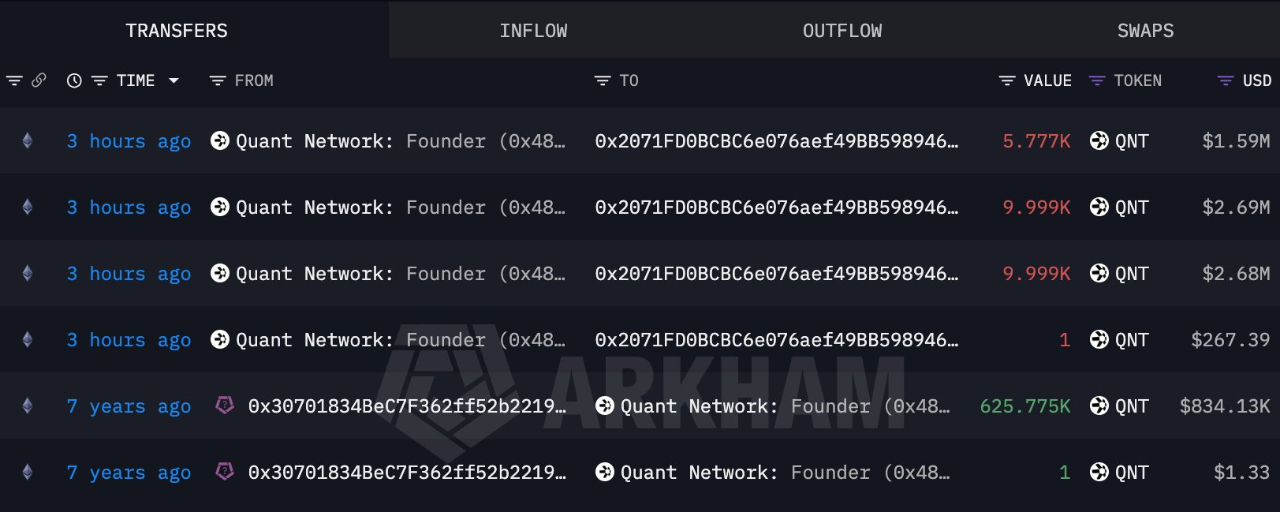
Quant Network Founder-Linked Wallet Moves 25,776 QNT After Seven Years of InactivityA wallet linked to the Quant Network founder transferred 25,776 QNT to several newly created wallets after remaining inactive for seven years. According to BlockBeats On-chain Detection, the wallet 0x48E9 still holds 600,000 QNT.
Quant Network Founder-Linked Wallet Moves 25,776 QNT After Seven Years of Inactivity
A wallet linked to the Quant Network founder transferred 25,776 QNT to several newly created wallets after remaining inactive for seven years. According to BlockBeats On-chain Detection, the wallet 0x48E9 still holds 600,000 QNT.
2
18
42k
·
--
Article
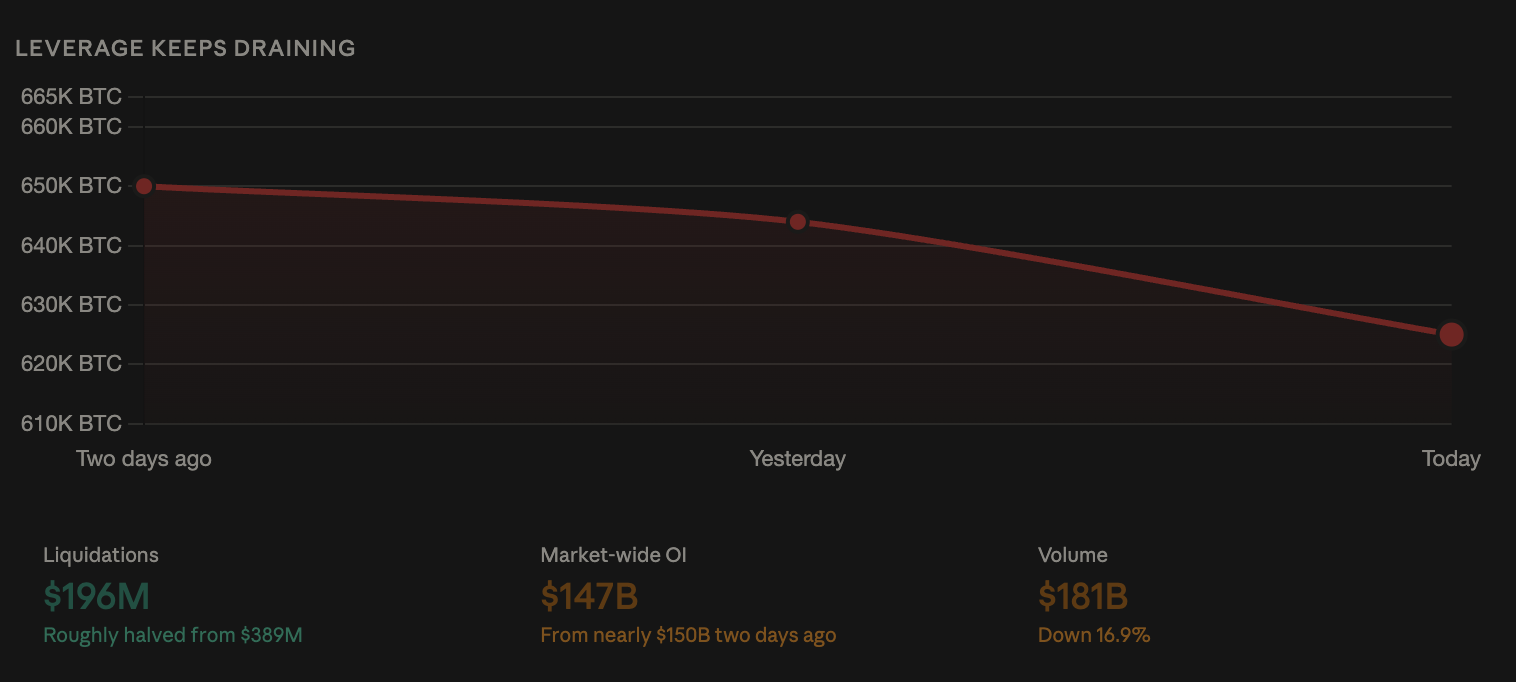
Crypto News | Bitcoin Stalls Near $83,000 as Altcoin Season Index Holds Above 60 for Five DaysBitcoin traded at $83,164 in the European morning, down 0.57% since midnight UTC, with the CoinDesk 100 split evenly at 50 constituents higher and 50 lower.It lost around 1% over 24 hours from a peak of $84,400 during Tuesday's US session, and has been consolidating since the failed breakout attempt at $87,300 on September 21.CoinMarketCap's altcoin season index sits at 61/100, firmly in bullish territory and above 60 for a fifth consecutive day — a level not reached in more than three months.Sustained Breadth Is the SignalA single day above 60 is noise. Five is a pattern.The index measures how many of the top 100 tokens are outperforming Bitcoin over a rolling window, so it captures breadth rather than any one token's move. Holding the level while Bitcoin consolidates points to rotation rather than a general market lift. That has been building for over a week. Bitcoin's share of total market value slipped to roughly 57% on September 22 from 59.2% earlier in the month.Leverage Is Still DrainingThe derivatives picture continues to thin.Liquidations roughly halved to $196 million from $389 million. Open interest slipped to $147 billion from nearly $150 billion two days ago, and volume fell 16.9% to $181 billion, per CoinGlass. The taker long/short volume ratio is balanced for a second day.Bitcoin futures open interest dropped to 625,000 BTC, the lowest since January 1, from 644,000 yesterday and 650,000 the day before.That decline began in June, while price climbed from $57,000 to over $80,000 — read as evidence the rally was spot-driven rather than leveraged.The reading needs a caveat. CryptoQuant estimates Bitcoin's spot demand shrank by about 170,000 BTC over the past 30 days, and that measure deteriorated while price rose. Falling futures open interest shows leverage was not the driver; it does not by itself establish net spot accumulation.Ether futures open interest slid to about 13.08 million ETH, the lowest since early March. Solana and XRP futures show little activity.Two Tokens Show Opposite Leverage PatternsPUMP jumped nearly 16% over 24 hours, the best performer in the top 100, with futures open interest rising alongside it.Fresh money chasing a token with leverage has tended to mark short-term tops when the pattern repeats across speculative names.HBAR ran the reverse. It fell 16% over 24 hours while futures open interest climbed to new highs, with funding rates turning negative from just above zero two days ago. Its 24-hour open-interest-adjusted CVD is the most negative among majors.Traders may be hedging long spot holdings against a deeper drop rather than positioning outright short, though funding and CVD data cannot separate the two.POL and CAKE both carry deeply negative funding, meaning shorts are paying to hold their positions.QNT Recovered 14% After Monday's CollapseInteroperability tokens led the gainers. Quant rose 7.5% since midnight for a 14% 24-hour advance, the biggest in the CoinDesk 100.That follows Monday, when QNT fell more than 40% from its high and briefly broke below 200 USDT after a morning surge that had doubled the token.LayerZero rose 13% over the same window. Bonk added 5.9% and dogwifhat 3.4% as memecoins outperformed, while PUMP slipped 2.7% since midnight but held a 14% 24-hour gain.DeFi Split After the Aave Burn SpeculationThe CoinDesk DeFi index fell 2.3%, the worst performance in the index family.Aave retreated 4.4% after leading Tuesday's gains with an 11% jump on speculation about a token burn. Uniswap and Ondo posted smaller losses.Curve rose 3.6%, and liquid staking token Lido and Ethena each gained 1.8%.A sector that rallies on one name's catalyst and splits the next day is trading the story rather than the sector.Yields Keep Setting Extremes as Crude RetreatsTraditional markets were firmer despite the bond move, with S&P 500 futures up 0.27% and the Stoxx 600 up 0.74%.The 30-year Treasury yield crossed 5.6% on Tuesday, its highest since June 2002, and the 10-year reached a fresh 2007 high near 5.3%.Brent traded at $96.43 after falling Tuesday, well below the $100 level that accompanied Monday's crypto selloff. That matters for the inflation argument — crude has given back the move that drove this month's rate-hike bets, even as long yields keep setting new extremes.Volatility remains contained. Bitcoin and ether 30-day implied volatility indices stayed calm all week, with traders pricing orderly markets despite rising yields, a stronger dollar and weaker gold.PCE arrives before the Wall Street open, with Micron earnings after the close
Crypto News | Bitcoin Stalls Near $83,000 as Altcoin Season Index Holds Above 60 for Five Days
Bitcoin traded at $83,164 in the European morning, down 0.57% since midnight UTC, with the CoinDesk 100 split evenly at 50 constituents higher and 50 lower.It lost around 1% over 24 hours from a peak of $84,400 during Tuesday's US session, and has been consolidating since the failed breakout attempt at $87,300 on September 21.CoinMarketCap's altcoin season index sits at 61/100, firmly in bullish territory and above 60 for a fifth consecutive day — a level not reached in more than three months.Sustained Breadth Is the SignalA single day above 60 is noise. Five is a pattern.The index measures how many of the top 100 tokens are outperforming Bitcoin over a rolling window, so it captures breadth rather than any one token's move. Holding the level while Bitcoin consolidates points to rotation rather than a general market lift. That has been building for over a week. Bitcoin's share of total market value slipped to roughly 57% on September 22 from 59.2% earlier in the month.Leverage Is Still DrainingThe derivatives picture continues to thin.Liquidations roughly halved to $196 million from $389 million. Open interest slipped to $147 billion from nearly $150 billion two days ago, and volume fell 16.9% to $181 billion, per CoinGlass. The taker long/short volume ratio is balanced for a second day.Bitcoin futures open interest dropped to 625,000 BTC, the lowest since January 1, from 644,000 yesterday and 650,000 the day before.That decline began in June, while price climbed from $57,000 to over $80,000 — read as evidence the rally was spot-driven rather than leveraged.The reading needs a caveat. CryptoQuant estimates Bitcoin's spot demand shrank by about 170,000 BTC over the past 30 days, and that measure deteriorated while price rose. Falling futures open interest shows leverage was not the driver; it does not by itself establish net spot accumulation.Ether futures open interest slid to about 13.08 million ETH, the lowest since early March. Solana and XRP futures show little activity.Two Tokens Show Opposite Leverage PatternsPUMP jumped nearly 16% over 24 hours, the best performer in the top 100, with futures open interest rising alongside it.Fresh money chasing a token with leverage has tended to mark short-term tops when the pattern repeats across speculative names.HBAR ran the reverse. It fell 16% over 24 hours while futures open interest climbed to new highs, with funding rates turning negative from just above zero two days ago. Its 24-hour open-interest-adjusted CVD is the most negative among majors.Traders may be hedging long spot holdings against a deeper drop rather than positioning outright short, though funding and CVD data cannot separate the two.POL and CAKE both carry deeply negative funding, meaning shorts are paying to hold their positions.QNT Recovered 14% After Monday's CollapseInteroperability tokens led the gainers. Quant rose 7.5% since midnight for a 14% 24-hour advance, the biggest in the CoinDesk 100.That follows Monday, when QNT fell more than 40% from its high and briefly broke below 200 USDT after a morning surge that had doubled the token.LayerZero rose 13% over the same window. Bonk added 5.9% and dogwifhat 3.4% as memecoins outperformed, while PUMP slipped 2.7% since midnight but held a 14% 24-hour gain.DeFi Split After the Aave Burn SpeculationThe CoinDesk DeFi index fell 2.3%, the worst performance in the index family.Aave retreated 4.4% after leading Tuesday's gains with an 11% jump on speculation about a token burn. Uniswap and Ondo posted smaller losses.Curve rose 3.6%, and liquid staking token Lido and Ethena each gained 1.8%.A sector that rallies on one name's catalyst and splits the next day is trading the story rather than the sector.Yields Keep Setting Extremes as Crude RetreatsTraditional markets were firmer despite the bond move, with S&P 500 futures up 0.27% and the Stoxx 600 up 0.74%.The 30-year Treasury yield crossed 5.6% on Tuesday, its highest since June 2002, and the 10-year reached a fresh 2007 high near 5.3%.Brent traded at $96.43 after falling Tuesday, well below the $100 level that accompanied Monday's crypto selloff. That matters for the inflation argument — crude has given back the move that drove this month's rate-hike bets, even as long yields keep setting new extremes.Volatility remains contained. Bitcoin and ether 30-day implied volatility indices stayed calm all week, with traders pricing orderly markets despite rising yields, a stronger dollar and weaker gold.PCE arrives before the Wall Street open, with Micron earnings after the close
1
1
6
9.1k
·
--
Article
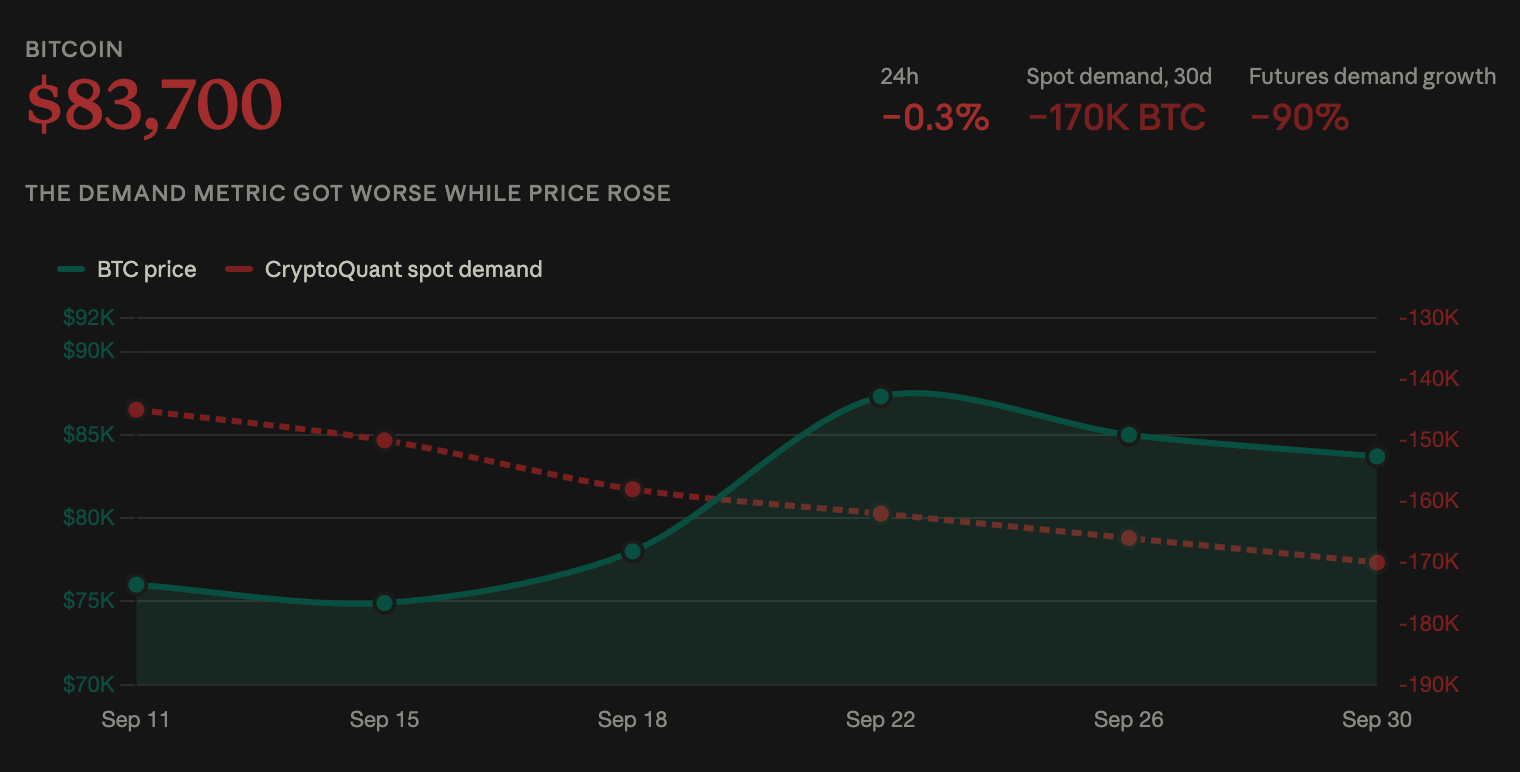
Bitcoin News | Bitcoin Slips Below $84,000 as Spot Demand Falls 170,000 BTC Before PCEBitcoin slipped 0.3% to about $83,700 early Wednesday as traders waited on the personal consumption expenditures price index, the Federal Reserve's preferred inflation gauge, expected to show inflation quickened in August.Ether fell 0.7% to about $2,690. HYPE dropped nearly 2%, the worst among the majors, while XRP and TRX each added under 1%.The Demand Metric Got Worse While Price RoseCryptoQuant estimates Bitcoin's spot demand has shrunk by about 170,000 BTC over the past 30 days. Growth in futures demand has dropped 90% since September 14.That is the figure worth sitting with. On September 11 the same metric read −145,000 BTC. Bitcoin then rallied from roughly $76,000 to $87,300, and the measure deteriorated by a further 25,000 BTC.A rally that leaves spot demand weaker than it started describes a move built on something other than accumulation. Short liquidations supplied much of it — $844 million in a single day on September 22, with hourly liquidations collapsing from over $300 million to under $11 million once the forced buying ran out.The September 14 date on the futures figure is precise enough to be useful. That was the session before the Clarity Act failed its Senate cloture vote, and the point at which leveraged positioning stopped expanding.Spot Bitcoin ETFs did draw nearly $1 billion on September 21, the largest single day since October 2025. That arrived after the period CryptoQuant measures began, and one day has not reversed a 30-day trend.Brent Is Rising as Supply ReturnsThe oil situation contains a contradiction the market has not resolved.Brent rose above $103 and is up about 14% in September — even though Middle East crude flows are returning to pre-war levels.Supply normalising while price climbs points away from the physical shortage that drove the earlier move. Saudi output had fallen to 6.238 million barrels per day, the lowest since 1990, with the East-West pipeline to Yanbu shut and Hormuz disrupted.If those barrels are moving again and Brent is still rising, the driver is something else: demand, positioning, or a risk premium that has not adjusted to improved logistics.It matters because the inflation impulse behind this month's rate-hike bets rested on the supply story. A crude rally without the shortage is harder to read as a durable price shock.The Bond Market Is Where the Damage SitsThirty-year Treasury yields hit their highest since 2002 before steadying Wednesday. The dollar held near its strongest since July.That 2002 reference marks a fresh extreme. The same maturity reached a June 2007 high of 5.40% on September 15, so the long end has pushed through another two decades of history in a fortnight.The Fed raised rates 25 basis points to 3.75%-4.00% on September 16 with a dot plot median pointing to one more move in 2026 — below what markets had priced. The long end has continued selling off regardless, which is consistent with the move reflecting fiscal and inflation concerns rather than the policy path.Gold Needs $4,200 to ConfirmGold is back near $4,200 an ounce, the level Simon-Peter Massabni, head of business development at XS.com, identifies as where buyers betting on the broader uptrend meet sellers expecting a deeper pullback.He wants a daily or four-hour close above $4,200 before calling a new leg higher."Gold pays no interest, so when markets expect rates to stay high, holding it gets more expensive compared with bonds and cash," making Wednesday's PCE the next test. A higher-than-expected reading "could trigger another wave of short-term selling pressure," he said.Gold fell to $4,144 on September 28, so a return to $4,200 is a recovery rather than a breakdown. It remains roughly 25% below January's $5,600 record.After PCE, attention turns to the monthly jobs report. A weaker-than-expected number would ease bets on further hikes.Micron Tests the Trade Holding Up EquitiesMicron Technology reports after the US close, and its results are a test for the AI-linked stocks that kept the S&P 500's losses contained through the bond selloff.The timing is awkward. South Korea's Kospi fell 2.7% on Monday with Samsung Electronics and SK Hynix both down more than 5% — the same memory complex, moving against the trade Micron is meant to validate.Memory has been the most volatile corner of the AI rally in both directions. Micron fell more than 7% on September 14 against Nvidia's 4%, then participated in the five-session semiconductor rally that followed.For Bitcoin, the connection runs through the miners that pivoted to AI compute. IREN, Hut 8, HIVE, Core Scientific and TeraWulf lagged Bitcoin badly through September, with the top-10 mining median gaining 1.8% against Bitcoin's 22%.
Bitcoin News | Bitcoin Slips Below $84,000 as Spot Demand Falls 170,000 BTC Before PCE
Bitcoin slipped 0.3% to about $83,700 early Wednesday as traders waited on the personal consumption expenditures price index, the Federal Reserve's preferred inflation gauge, expected to show inflation quickened in August.Ether fell 0.7% to about $2,690. HYPE dropped nearly 2%, the worst among the majors, while XRP and TRX each added under 1%.The Demand Metric Got Worse While Price RoseCryptoQuant estimates Bitcoin's spot demand has shrunk by about 170,000 BTC over the past 30 days. Growth in futures demand has dropped 90% since September 14.That is the figure worth sitting with. On September 11 the same metric read −145,000 BTC. Bitcoin then rallied from roughly $76,000 to $87,300, and the measure deteriorated by a further 25,000 BTC.A rally that leaves spot demand weaker than it started describes a move built on something other than accumulation. Short liquidations supplied much of it — $844 million in a single day on September 22, with hourly liquidations collapsing from over $300 million to under $11 million once the forced buying ran out.The September 14 date on the futures figure is precise enough to be useful. That was the session before the Clarity Act failed its Senate cloture vote, and the point at which leveraged positioning stopped expanding.Spot Bitcoin ETFs did draw nearly $1 billion on September 21, the largest single day since October 2025. That arrived after the period CryptoQuant measures began, and one day has not reversed a 30-day trend.Brent Is Rising as Supply ReturnsThe oil situation contains a contradiction the market has not resolved.Brent rose above $103 and is up about 14% in September — even though Middle East crude flows are returning to pre-war levels.Supply normalising while price climbs points away from the physical shortage that drove the earlier move. Saudi output had fallen to 6.238 million barrels per day, the lowest since 1990, with the East-West pipeline to Yanbu shut and Hormuz disrupted.If those barrels are moving again and Brent is still rising, the driver is something else: demand, positioning, or a risk premium that has not adjusted to improved logistics.It matters because the inflation impulse behind this month's rate-hike bets rested on the supply story. A crude rally without the shortage is harder to read as a durable price shock.The Bond Market Is Where the Damage SitsThirty-year Treasury yields hit their highest since 2002 before steadying Wednesday. The dollar held near its strongest since July.That 2002 reference marks a fresh extreme. The same maturity reached a June 2007 high of 5.40% on September 15, so the long end has pushed through another two decades of history in a fortnight.The Fed raised rates 25 basis points to 3.75%-4.00% on September 16 with a dot plot median pointing to one more move in 2026 — below what markets had priced. The long end has continued selling off regardless, which is consistent with the move reflecting fiscal and inflation concerns rather than the policy path.Gold Needs $4,200 to ConfirmGold is back near $4,200 an ounce, the level Simon-Peter Massabni, head of business development at XS.com, identifies as where buyers betting on the broader uptrend meet sellers expecting a deeper pullback.He wants a daily or four-hour close above $4,200 before calling a new leg higher."Gold pays no interest, so when markets expect rates to stay high, holding it gets more expensive compared with bonds and cash," making Wednesday's PCE the next test. A higher-than-expected reading "could trigger another wave of short-term selling pressure," he said.Gold fell to $4,144 on September 28, so a return to $4,200 is a recovery rather than a breakdown. It remains roughly 25% below January's $5,600 record.After PCE, attention turns to the monthly jobs report. A weaker-than-expected number would ease bets on further hikes.Micron Tests the Trade Holding Up EquitiesMicron Technology reports after the US close, and its results are a test for the AI-linked stocks that kept the S&P 500's losses contained through the bond selloff.The timing is awkward. South Korea's Kospi fell 2.7% on Monday with Samsung Electronics and SK Hynix both down more than 5% — the same memory complex, moving against the trade Micron is meant to validate.Memory has been the most volatile corner of the AI rally in both directions. Micron fell more than 7% on September 14 against Nvidia's 4%, then participated in the five-session semiconductor rally that followed.For Bitcoin, the connection runs through the miners that pivoted to AI compute. IREN, Hut 8, HIVE, Core Scientific and TeraWulf lagged Bitcoin badly through September, with the top-10 mining median gaining 1.8% against Bitcoin's 22%.
9
15.3k
·
--
Bitget Hot Wallet Attack Linked to Third-Party Security System Breach, Reports SayOdaily reported that SlowMist and Google Cloud’s Mandiant released interim investigation reports on the theft from Bitget’s hot wallet. According to Odaily, both reports said the attacker first compromised systems related to a third-party security product and then moved laterally into Bitget’s wallet business environment.
SlowMist said one node of a third-party security product had a zero-day vulnerability, with related malicious activity traceable to August 31. On September 25, the attacker also used an internal employee identity to access the management platform of another third-party security product and interacted with the wallet system’s withdrawal logic using a highly customized withdrawal tool. Mandiant said the attacker gained persistent access through a third-party security device, then moved to production wallet task servers and deployed malicious programs.
Mandiant said it had found no evidence that Bitget private keys were leaked and that cold wallets were not affected. The two security teams are still investigating the attacker’s specific intrusion path between the related systems.
Bitget Hot Wallet Attack Linked to Third-Party Security System Breach, Reports Say
Odaily reported that SlowMist and Google Cloud’s Mandiant released interim investigation reports on the theft from Bitget’s hot wallet. According to Odaily, both reports said the attacker first compromised systems related to a third-party security product and then moved laterally into Bitget’s wallet business environment.
SlowMist said one node of a third-party security product had a zero-day vulnerability, with related malicious activity traceable to August 31. On September 25, the attacker also used an internal employee identity to access the management platform of another third-party security product and interacted with the wallet system’s withdrawal logic using a highly customized withdrawal tool. Mandiant said the attacker gained persistent access through a third-party security device, then moved to production wallet task servers and deployed malicious programs.
Mandiant said it had found no evidence that Bitget private keys were leaked and that cold wallets were not affected. The two security teams are still investigating the attacker’s specific intrusion path between the related systems.
SlowMist said one node of a third-party security product had a zero-day vulnerability, with related malicious activity traceable to August 31. On September 25, the attacker also used an internal employee identity to access the management platform of another third-party security product and interacted with the wallet system’s withdrawal logic using a highly customized withdrawal tool. Mandiant said the attacker gained persistent access through a third-party security device, then moved to production wallet task servers and deployed malicious programs.
Mandiant said it had found no evidence that Bitget private keys were leaked and that cold wallets were not affected. The two security teams are still investigating the attacker’s specific intrusion path between the related systems.
3
1
9
7k
·
--
Bitcoin News | Bitcoin Rebounds 14% From Its September Low to Clear $85,200Bitcoin surged past $85,000 following the US PCE release and traded above $85,200.August core PCE rose 3% year over year against expectations of 3.3%, a six-month low, with July revised down from 3.30% to 3%.
Bitcoin News | Bitcoin Rebounds 14% From Its September Low to Clear $85,200
Bitcoin surged past $85,000 following the US PCE release and traded above $85,200.August core PCE rose 3% year over year against expectations of 3.3%, a six-month low, with July revised down from 3.30% to 3%.
6
6
15
9.3k
·
--
Crypto News | Core PCE Misses at 3% With July Revised Down — Bitcoin Clears $85,200, Gold Breaks $4,200, KOSPI Posts Worst Quarter Since 2020August core PCE came in at 3% year-over-year — below the 3.3% forecast and a six-month low, with July revised down from 3.3% to 3%. The revision matters more than the print: inflation was running cooler than the Fed knew when it hiked on September 16. Bitcoin surged past $85,200, gold cleared $4,205, the dollar slipped 15bps. ADP then complicated the picture: 90,000 September private payrolls, beating 70,000 forecast and doubling August's 38,000 — firm hiring against cooling inflation is the combination the Fed finds hardest to read. October hike odds sit at a coin flip. KOSPI posted its worst quarter since Q1 2020, down 19.3%, with Micron reporting after tonight's US close as the next AI memory catalyst.Bitcoin Clears $85,200 and Gold Breaks $4,200 After Core PCE Comes in CoolerAugust core PCE rose 3% year-over-year — below the 3.3% consensus, a six-month low, with July revised down from 3.3% to 3%. Bitcoin surged above $85,200. Gold cleared $4,205 — above the $4,200 level XS.com's Simon-Peter Massabni identified as where uptrend buyers meet pullback sellers, having called for a daily close above it before confirming a new leg. The dollar fell 15bps to 101.05, a modest move against a level that accumulated from the 98-99 range through mid-September. Bitcoin and gold rising together on the same print is a change from most of September, when they repeatedly diverged — gold falling to $4,144 on September 28 while Bitcoin held above $83,000. Gold carries roughly twice Bitcoin's yield sensitivity (-0.41 vs -0.17), so a session where the rate channel moves in both assets' favor produces co-movement without restoring the structural correlation, which collapsed to 0.28 from 0.69 over 30 days.ADP Shows 90,000 Jobs in September, Beating Forecasts and More Than Doubling AugustUS private employers added 90,000 jobs in September against a 70,000 forecast, more than doubling August's depressed 38,000 — the weakest ADP print since January. ADP chief economist Nela Richardson: job growth rebounded and wage growth remained robust after three months of slowdown — wages holding firm while hiring recovers is the combination that supports further tightening. The print lands at the Kalshi threshold where prediction markets placed 60% odds for the official NFP, above Goldman's 80,000 and well above BofA's 60,000 — though ADP and BLS use different methodologies with weak monthly correlation, so a beat here raises rather than determines Friday's odds. October hike odds had fallen from 71% to 50% after Williams downplayed urgency Tuesday; 90,000 private payrolls with firm wages pushes back against that repricing. The long end's response is the tell: if the 30-year holds near 5.6% on growth data rather than just fiscal concerns, it changes which of Thielen's frameworks applies.Bank of Korea to Buy One Ton of Domestic Gold in December, Its First Purchase in 13 YearsThe Bank of Korea will purchase ~1 ton of domestically produced gold in December for 200B won — its first physical gold purchase since 2013 — establishing a domestic gold trading system for ongoing purchases rather than a one-off transaction. The Bank holds 104.4 tons ($14.88B, 3.4% of FX reserves), so one ton adds under 1% — the significance is the resumption and the infrastructure being built. The won-denominated structure adds to reserves without spending foreign currency, keeping gold inside Korea that would otherwise have been exported. Korea began indirect exposure via $250M in gold ETFs in Q2 — moving to physical after two quarters suggests the ETF position was preliminary. The broader context: PBOC bought 650,000 oz in a single month across 22 consecutive months; central banks are buying into gold's 25% decline from January's $5,600 record. Strategic Analytics framed it: since 2022, gold increasingly tracks fiscal risk — term premium, deficits, debt sustainability — rather than the Fed's policy path.Kospi Posts Its Worst Quarter Since Early 2020 as the Nikkei Gains 1.94%The KOSPI fell 19.3% in Q3 — its steepest quarterly decline since the pandemic crash of Q1 2020 — on two AI-driven selloffs: a 22% July drop on AI ROI doubts and a September leg down after Amodei's development slowdown call sent SK Hynix -6% and Samsung -5%+. Average daily turnover fell to 20.6T won ($15B) in September — the lowest of 2026 and less than half the May-June peak — a market falling on thinning volume with less depth to absorb further shocks. Japan's Nikkei rose 1.94% on the same session, diverging on lower memory cycle exposure and yen weakness near 157.8 supporting exporters. Micron reports after tonight's US close — guidance on DRAM contract pricing into 2027 matters more for Samsung and SK Hynix than Micron's own quarter, since all three compete in the same market.Core PCE Holds at 3% in August as July Is Revised Down From 3.3%August core PCE rose 3% year-over-year against a 3.3% forecast — a six-month low — with July revised down 30bps from 3.3% to 3%. The revision is the larger event: inflation was running cooler than the Fed knew on September 16 when it hiked to 3.75%-4.00%. Warsh built his Jackson Hole hawkish case specifically on PCE's six-month trend running hotter than the annual figure — a downward revision to that recent trend weakens the specific argument he made. At 3%, core PCE remains 100bps above the 2% target. The long end's response is the tell: the 30-year crossed 5.6% Tuesday on fiscal rather than inflation concerns — if it barely moves on a softer print, Thielen's framework (fiscal driver dominates, not the policy path) is confirmed.
Crypto News | Core PCE Misses at 3% With July Revised Down — Bitcoin Clears $85,200, Gold Breaks $4,200, KOSPI Posts Worst Quarter Since 2020
August core PCE came in at 3% year-over-year — below the 3.3% forecast and a six-month low, with July revised down from 3.3% to 3%. The revision matters more than the print: inflation was running cooler than the Fed knew when it hiked on September 16. Bitcoin surged past $85,200, gold cleared $4,205, the dollar slipped 15bps. ADP then complicated the picture: 90,000 September private payrolls, beating 70,000 forecast and doubling August's 38,000 — firm hiring against cooling inflation is the combination the Fed finds hardest to read. October hike odds sit at a coin flip. KOSPI posted its worst quarter since Q1 2020, down 19.3%, with Micron reporting after tonight's US close as the next AI memory catalyst.Bitcoin Clears $85,200 and Gold Breaks $4,200 After Core PCE Comes in CoolerAugust core PCE rose 3% year-over-year — below the 3.3% consensus, a six-month low, with July revised down from 3.3% to 3%. Bitcoin surged above $85,200. Gold cleared $4,205 — above the $4,200 level XS.com's Simon-Peter Massabni identified as where uptrend buyers meet pullback sellers, having called for a daily close above it before confirming a new leg. The dollar fell 15bps to 101.05, a modest move against a level that accumulated from the 98-99 range through mid-September. Bitcoin and gold rising together on the same print is a change from most of September, when they repeatedly diverged — gold falling to $4,144 on September 28 while Bitcoin held above $83,000. Gold carries roughly twice Bitcoin's yield sensitivity (-0.41 vs -0.17), so a session where the rate channel moves in both assets' favor produces co-movement without restoring the structural correlation, which collapsed to 0.28 from 0.69 over 30 days.ADP Shows 90,000 Jobs in September, Beating Forecasts and More Than Doubling AugustUS private employers added 90,000 jobs in September against a 70,000 forecast, more than doubling August's depressed 38,000 — the weakest ADP print since January. ADP chief economist Nela Richardson: job growth rebounded and wage growth remained robust after three months of slowdown — wages holding firm while hiring recovers is the combination that supports further tightening. The print lands at the Kalshi threshold where prediction markets placed 60% odds for the official NFP, above Goldman's 80,000 and well above BofA's 60,000 — though ADP and BLS use different methodologies with weak monthly correlation, so a beat here raises rather than determines Friday's odds. October hike odds had fallen from 71% to 50% after Williams downplayed urgency Tuesday; 90,000 private payrolls with firm wages pushes back against that repricing. The long end's response is the tell: if the 30-year holds near 5.6% on growth data rather than just fiscal concerns, it changes which of Thielen's frameworks applies.Bank of Korea to Buy One Ton of Domestic Gold in December, Its First Purchase in 13 YearsThe Bank of Korea will purchase ~1 ton of domestically produced gold in December for 200B won — its first physical gold purchase since 2013 — establishing a domestic gold trading system for ongoing purchases rather than a one-off transaction. The Bank holds 104.4 tons ($14.88B, 3.4% of FX reserves), so one ton adds under 1% — the significance is the resumption and the infrastructure being built. The won-denominated structure adds to reserves without spending foreign currency, keeping gold inside Korea that would otherwise have been exported. Korea began indirect exposure via $250M in gold ETFs in Q2 — moving to physical after two quarters suggests the ETF position was preliminary. The broader context: PBOC bought 650,000 oz in a single month across 22 consecutive months; central banks are buying into gold's 25% decline from January's $5,600 record. Strategic Analytics framed it: since 2022, gold increasingly tracks fiscal risk — term premium, deficits, debt sustainability — rather than the Fed's policy path.Kospi Posts Its Worst Quarter Since Early 2020 as the Nikkei Gains 1.94%The KOSPI fell 19.3% in Q3 — its steepest quarterly decline since the pandemic crash of Q1 2020 — on two AI-driven selloffs: a 22% July drop on AI ROI doubts and a September leg down after Amodei's development slowdown call sent SK Hynix -6% and Samsung -5%+. Average daily turnover fell to 20.6T won ($15B) in September — the lowest of 2026 and less than half the May-June peak — a market falling on thinning volume with less depth to absorb further shocks. Japan's Nikkei rose 1.94% on the same session, diverging on lower memory cycle exposure and yen weakness near 157.8 supporting exporters. Micron reports after tonight's US close — guidance on DRAM contract pricing into 2027 matters more for Samsung and SK Hynix than Micron's own quarter, since all three compete in the same market.Core PCE Holds at 3% in August as July Is Revised Down From 3.3%August core PCE rose 3% year-over-year against a 3.3% forecast — a six-month low — with July revised down 30bps from 3.3% to 3%. The revision is the larger event: inflation was running cooler than the Fed knew on September 16 when it hiked to 3.75%-4.00%. Warsh built his Jackson Hole hawkish case specifically on PCE's six-month trend running hotter than the annual figure — a downward revision to that recent trend weakens the specific argument he made. At 3%, core PCE remains 100bps above the 2% target. The long end's response is the tell: the 30-year crossed 5.6% Tuesday on fiscal rather than inflation concerns — if it barely moves on a softer print, Thielen's framework (fiscal driver dominates, not the policy path) is confirmed.
84
10
141
5.5k
·
--
Bitget CEO 'Not Very Optimistic' on Recovering Funds From $388 Million BreachBitget Chief Executive Officer Gracy Chen is unsure the exchange can fully freeze or recover all the assets compromised in a security breach last week that cost about $388 million in crypto, according to Cointelegraph. Speaking on Cointelegraph's Chain Reaction released Tuesday, Chen said she viewed the February 2025 hack of Bybit — in which attackers stole about $1.5 billion in Ether and the company reported freezing and recovering a combined $80 million — as a "good reference point" for Thursday's breach. "I'm actually not very optimistic because after a year or so of Bybit's hack, they've only [been able to freeze] about 3.5% of the total stolen funds," Chen said. "That's only the freezing. It's not about recovery yet."
Bitget launched a bounty program offering 5% of funds frozen and 5% of those recovered, and some firms have already stepped in to help mitigate user losses. The team behind NEAR Intents said Monday it had blocked more than $50 million in assets tied to the attack and froze about $500,000, while Chen confirmed that stablecoin issuers Tether and Circle blacklisted a linked wallet, freezing $318,013 in USDT and USDC. The breach is one of the largest to hit crypto in 2026, following a $320 million exploit of the Liquid Network in September, and ranks among major attacks including Bybit's in 2025, the $615 million Ronin Bridge hack in 2022 and the $611 million Poly Network hack in 2021. Bitget initially reported $352 million lost before Chen revised the figure to about $388 million to reflect a more complete accounting of transfers.
On responsibility, Chen said she had pointed immediately after the attack to possible North Korean involvement, citing IP addresses matching the VPN choices of a certain DPRK-linked group, though she said Bitget had not entirely ruled out an inside job, describing the matter as complex and requiring thorough investigation based on preliminary results. Bitget began resuming withdrawals in stages, starting with Bitcoin transactions on Monday and continuing with Ether on Tuesday.
Bitget CEO 'Not Very Optimistic' on Recovering Funds From $388 Million Breach
Bitget Chief Executive Officer Gracy Chen is unsure the exchange can fully freeze or recover all the assets compromised in a security breach last week that cost about $388 million in crypto, according to Cointelegraph. Speaking on Cointelegraph's Chain Reaction released Tuesday, Chen said she viewed the February 2025 hack of Bybit — in which attackers stole about $1.5 billion in Ether and the company reported freezing and recovering a combined $80 million — as a "good reference point" for Thursday's breach. "I'm actually not very optimistic because after a year or so of Bybit's hack, they've only [been able to freeze] about 3.5% of the total stolen funds," Chen said. "That's only the freezing. It's not about recovery yet."
Bitget launched a bounty program offering 5% of funds frozen and 5% of those recovered, and some firms have already stepped in to help mitigate user losses. The team behind NEAR Intents said Monday it had blocked more than $50 million in assets tied to the attack and froze about $500,000, while Chen confirmed that stablecoin issuers Tether and Circle blacklisted a linked wallet, freezing $318,013 in USDT and USDC. The breach is one of the largest to hit crypto in 2026, following a $320 million exploit of the Liquid Network in September, and ranks among major attacks including Bybit's in 2025, the $615 million Ronin Bridge hack in 2022 and the $611 million Poly Network hack in 2021. Bitget initially reported $352 million lost before Chen revised the figure to about $388 million to reflect a more complete accounting of transfers.
On responsibility, Chen said she had pointed immediately after the attack to possible North Korean involvement, citing IP addresses matching the VPN choices of a certain DPRK-linked group, though she said Bitget had not entirely ruled out an inside job, describing the matter as complex and requiring thorough investigation based on preliminary results. Bitget began resuming withdrawals in stages, starting with Bitcoin transactions on Monday and continuing with Ether on Tuesday.
Bitget launched a bounty program offering 5% of funds frozen and 5% of those recovered, and some firms have already stepped in to help mitigate user losses. The team behind NEAR Intents said Monday it had blocked more than $50 million in assets tied to the attack and froze about $500,000, while Chen confirmed that stablecoin issuers Tether and Circle blacklisted a linked wallet, freezing $318,013 in USDT and USDC. The breach is one of the largest to hit crypto in 2026, following a $320 million exploit of the Liquid Network in September, and ranks among major attacks including Bybit's in 2025, the $615 million Ronin Bridge hack in 2022 and the $611 million Poly Network hack in 2021. Bitget initially reported $352 million lost before Chen revised the figure to about $388 million to reflect a more complete accounting of transfers.
On responsibility, Chen said she had pointed immediately after the attack to possible North Korean involvement, citing IP addresses matching the VPN choices of a certain DPRK-linked group, though she said Bitget had not entirely ruled out an inside job, describing the matter as complex and requiring thorough investigation based on preliminary results. Bitget began resuming withdrawals in stages, starting with Bitcoin transactions on Monday and continuing with Ether on Tuesday.
8
5
24
30.1k
·
--
Article
SEC Chair Paul Atkins Says Agency Will Clarify On-Chain Fundraising Rules Within Legal AuthoritySEC Chair Paul Atkins said the agency will clarify on-chain fundraising rules within its legal authority, even though the CLARITY Act did not pass Congress. According to Odaily, the U.S. Senate failed on September 15 to advance the bill by a 49-50 vote, falling short of the 60 votes needed.Atkins did not say whether the guidance would take the form of exemptions, a registration path, or staff guidance. The SEC previously cleared the way for tokenized stocks on September 17 and issued nine frequently asked questions on September 25 explaining how issuer commitments affect securities determinations. Commissioner Hester Peirce is set to leave on October 2, leaving Atkins and Mark Uyeda as the SEC's only sitting commissioners.
SEC Chair Paul Atkins Says Agency Will Clarify On-Chain Fundraising Rules Within Legal Authority
SEC Chair Paul Atkins said the agency will clarify on-chain fundraising rules within its legal authority, even though the CLARITY Act did not pass Congress. According to Odaily, the U.S. Senate failed on September 15 to advance the bill by a 49-50 vote, falling short of the 60 votes needed.Atkins did not say whether the guidance would take the form of exemptions, a registration path, or staff guidance. The SEC previously cleared the way for tokenized stocks on September 17 and issued nine frequently asked questions on September 25 explaining how issuer commitments affect securities determinations. Commissioner Hester Peirce is set to leave on October 2, leaving Atkins and Mark Uyeda as the SEC's only sitting commissioners.
7
5.3k
·
--

Article
UK FCA Opens Authorization Applications for Crypto FirmsThe U.K. Financial Conduct Authority said it is now accepting authorization applications from crypto firms. According to Foresight News, firms that plan to continue operating in the U.K. must submit applications by February 28, 2027, and the new regulatory regime will take effect on October 25, 2027.The FCA said applications will not be approved automatically. Firms must show they meet requirements on consumer protection, custody of client assets, market integrity, and financial resilience. Companies that do not meet the standards will not be able to continue providing regulated crypto asset services in the U.K. Existing firms that apply during the application period may continue offering services while their applications are under review if no decision has been made before the new regime takes effect.
UK FCA Opens Authorization Applications for Crypto Firms
The U.K. Financial Conduct Authority said it is now accepting authorization applications from crypto firms. According to Foresight News, firms that plan to continue operating in the U.K. must submit applications by February 28, 2027, and the new regulatory regime will take effect on October 25, 2027.The FCA said applications will not be approved automatically. Firms must show they meet requirements on consumer protection, custody of client assets, market integrity, and financial resilience. Companies that do not meet the standards will not be able to continue providing regulated crypto asset services in the U.K. Existing firms that apply during the application period may continue offering services while their applications are under review if no decision has been made before the new regime takes effect.
1
1
1
2.3k
·
--

Article
Binance App Adds PayPay QR Code Scanning for Crypto Payments in JapanBinance announced on X that the Binance App now supports scanning PayPay QR codes in Japan, allowing users to pay directly with digital assets. The update is designed to let users make purchases without exchanging currency or using cash, according to the announcement. Binance also said the service includes a 10% discount. The announcement did not provide additional details on supported assets, transaction limits, or rollout timing beyond the availability of the feature in the Binance App.
The company framed the update as a payment option for users shopping in Japan, where PayPay QR codes can now be scanned through the app. Binance said the feature enables digital currency payments at the point of sale and removes the need for cash handling or foreign exchange. No further operational details were included in the post, and the announcement did not mention any changes to other Binance services or products. The message focused on the new payment function and the stated discount, while keeping the update limited to the Japan use case and the app-based QR code scanning feature.
Binance App Adds PayPay QR Code Scanning for Crypto Payments in Japan
Binance announced on X that the Binance App now supports scanning PayPay QR codes in Japan, allowing users to pay directly with digital assets. The update is designed to let users make purchases without exchanging currency or using cash, according to the announcement. Binance also said the service includes a 10% discount. The announcement did not provide additional details on supported assets, transaction limits, or rollout timing beyond the availability of the feature in the Binance App.
The company framed the update as a payment option for users shopping in Japan, where PayPay QR codes can now be scanned through the app. Binance said the feature enables digital currency payments at the point of sale and removes the need for cash handling or foreign exchange. No further operational details were included in the post, and the announcement did not mention any changes to other Binance services or products. The message focused on the new payment function and the stated discount, while keeping the update limited to the Japan use case and the app-based QR code scanning feature.
The company framed the update as a payment option for users shopping in Japan, where PayPay QR codes can now be scanned through the app. Binance said the feature enables digital currency payments at the point of sale and removes the need for cash handling or foreign exchange. No further operational details were included in the post, and the announcement did not mention any changes to other Binance services or products. The message focused on the new payment function and the stated discount, while keeping the update limited to the Japan use case and the app-based QR code scanning feature.
11
15
43
21.9k
·
--
MOVR Migration Period Ends on September 30, 2026 as Token Rises 51.73%Moonriver said its migration period will officially end on September 30, 2026. Valid applications submitted during the migration window will be processed as soon as possible, and users who do not apply by September 30 will lose access to MOVR. Moonriver previously said MOVR will migrate to the Base platform together with GLMR.
According to Foresight News, MOVR briefly touched 1.489 USDT and was trading at 1.465 USDT, up 51.73% over the past 24 hours.
MOVR Migration Period Ends on September 30, 2026 as Token Rises 51.73%
Moonriver said its migration period will officially end on September 30, 2026. Valid applications submitted during the migration window will be processed as soon as possible, and users who do not apply by September 30 will lose access to MOVR. Moonriver previously said MOVR will migrate to the Base platform together with GLMR.
According to Foresight News, MOVR briefly touched 1.489 USDT and was trading at 1.465 USDT, up 51.73% over the past 24 hours.
According to Foresight News, MOVR briefly touched 1.489 USDT and was trading at 1.465 USDT, up 51.73% over the past 24 hours.
3
8
19.7k
·
--
U.S. Core PCE Inflation Slows to 3% in August, Lowest Since FebruaryAccording to Jin10, U.S. August core PCE price index annual inflation came in at 3%, down slightly from the previous month and the lowest since February, below the market forecast of 3.3%.
U.S. Core PCE Inflation Slows to 3% in August, Lowest Since February
According to Jin10, U.S. August core PCE price index annual inflation came in at 3%, down slightly from the previous month and the lowest since February, below the market forecast of 3.3%.
3
8.8k
·
--
Crypto Liquidations Reach $261 Million in 24 Hours, Coinglass Data ShowsCoinglass data shows that crypto liquidations across the market totaled $261 million in the past 24 hours, with $127 million in long positions and $134 million in short positions. According to ChainCatcher, Bitcoin long liquidations reached $24.003 million, while Bitcoin short liquidations totaled $58.6383 million.
Ethereum long liquidations came to $28.8816 million, and Ethereum short liquidations reached $25.5469 million. Over the same period, 74,249 traders were liquidated globally, and the largest single liquidation order occurred on HTX's BTC-USDT pair, valued at $6.9154 million.
Crypto Liquidations Reach $261 Million in 24 Hours, Coinglass Data Shows
Coinglass data shows that crypto liquidations across the market totaled $261 million in the past 24 hours, with $127 million in long positions and $134 million in short positions. According to ChainCatcher, Bitcoin long liquidations reached $24.003 million, while Bitcoin short liquidations totaled $58.6383 million.
Ethereum long liquidations came to $28.8816 million, and Ethereum short liquidations reached $25.5469 million. Over the same period, 74,249 traders were liquidated globally, and the largest single liquidation order occurred on HTX's BTC-USDT pair, valued at $6.9154 million.
Ethereum long liquidations came to $28.8816 million, and Ethereum short liquidations reached $25.5469 million. Over the same period, 74,249 traders were liquidated globally, and the largest single liquidation order occurred on HTX's BTC-USDT pair, valued at $6.9154 million.
3
1
5
4.8k
·
--
Suspected North Korea-Linked Attacker Moves 2,700 ZEC Into Zcash Shielded Pool After Bitget TheftOn September 30, on-chain investigator ZachXBT said a suspected North Korea-linked attacker in the Bitget theft case had begun moving about 2,700 ZEC into Zcash's Ironwood shielded pool. According to BlockBeats On-chain Detection, Bitget's hot wallet was previously drained of about 18,900 ZEC.
Suspected North Korea-Linked Attacker Moves 2,700 ZEC Into Zcash Shielded Pool After Bitget Theft
On September 30, on-chain investigator ZachXBT said a suspected North Korea-linked attacker in the Bitget theft case had begun moving about 2,700 ZEC into Zcash's Ironwood shielded pool. According to BlockBeats On-chain Detection, Bitget's hot wallet was previously drained of about 18,900 ZEC.
6
11.7k
·
--
ASIA MARKET CLOSE | Tokyo's Nikkei Rises 1.9%, Hong Kong Edges Up as Pharma Leads; Seoul SlipsAccording to RTHK, HKET and UDN Money, Tokyo stocks led Asian equities higher on the final trading day of September. The Nikkei 225 closed up 1,272 points, or 1.94%, at 66,753, ending the third quarter down about 4.7% but up roughly 33% year to date.
Seoul's KOSPI eased 32.77 points, or 0.48%, to close at 6,838.04, finishing lower on the session.
Hong Kong stocks reversed early losses to close firmer ahead of the National Day holiday. The Hang Seng Index ended up 89 points, or 0.36%, at 24,613, after falling as much as 190 points in the morning to a low of 24,332. The Hang Seng Tech Index added 0.1% to 4,253. Pharmaceutical shares led the blue chips: CSPC Pharmaceutical rose more than 6% and WuXi Biologics gained over 4%. Zhipu rebounded 4% and MINIMAX advanced more than 3%. Property developers were mixed, with China Overseas Land and Longfor both falling.
Taiwan's TAIEX closed up 308.17 points, or 0.65%, at 47,940.13, gaining about 4% in both September and the third quarter. TSMC ended up NT$5, or 0.2%, at NT$2,480.
In mainland China, the Shanghai Composite closed up 0.31%, while the Shenzhen Component slipped 0.11% and the ChiNext Index fell 0.23%. Pharmaceutical, bank, coal, steel and liquor stocks strengthened, with more than 2,500 stocks advancing marketwide on turnover exceeding 1.45 trillion yuan.
ASIA MARKET CLOSE | Tokyo's Nikkei Rises 1.9%, Hong Kong Edges Up as Pharma Leads; Seoul Slips
According to RTHK, HKET and UDN Money, Tokyo stocks led Asian equities higher on the final trading day of September. The Nikkei 225 closed up 1,272 points, or 1.94%, at 66,753, ending the third quarter down about 4.7% but up roughly 33% year to date.
Seoul's KOSPI eased 32.77 points, or 0.48%, to close at 6,838.04, finishing lower on the session.
Hong Kong stocks reversed early losses to close firmer ahead of the National Day holiday. The Hang Seng Index ended up 89 points, or 0.36%, at 24,613, after falling as much as 190 points in the morning to a low of 24,332. The Hang Seng Tech Index added 0.1% to 4,253. Pharmaceutical shares led the blue chips: CSPC Pharmaceutical rose more than 6% and WuXi Biologics gained over 4%. Zhipu rebounded 4% and MINIMAX advanced more than 3%. Property developers were mixed, with China Overseas Land and Longfor both falling.
Taiwan's TAIEX closed up 308.17 points, or 0.65%, at 47,940.13, gaining about 4% in both September and the third quarter. TSMC ended up NT$5, or 0.2%, at NT$2,480.
In mainland China, the Shanghai Composite closed up 0.31%, while the Shenzhen Component slipped 0.11% and the ChiNext Index fell 0.23%. Pharmaceutical, bank, coal, steel and liquor stocks strengthened, with more than 2,500 stocks advancing marketwide on turnover exceeding 1.45 trillion yuan.
Seoul's KOSPI eased 32.77 points, or 0.48%, to close at 6,838.04, finishing lower on the session.
Hong Kong stocks reversed early losses to close firmer ahead of the National Day holiday. The Hang Seng Index ended up 89 points, or 0.36%, at 24,613, after falling as much as 190 points in the morning to a low of 24,332. The Hang Seng Tech Index added 0.1% to 4,253. Pharmaceutical shares led the blue chips: CSPC Pharmaceutical rose more than 6% and WuXi Biologics gained over 4%. Zhipu rebounded 4% and MINIMAX advanced more than 3%. Property developers were mixed, with China Overseas Land and Longfor both falling.
Taiwan's TAIEX closed up 308.17 points, or 0.65%, at 47,940.13, gaining about 4% in both September and the third quarter. TSMC ended up NT$5, or 0.2%, at NT$2,480.
In mainland China, the Shanghai Composite closed up 0.31%, while the Shenzhen Component slipped 0.11% and the ChiNext Index fell 0.23%. Pharmaceutical, bank, coal, steel and liquor stocks strengthened, with more than 2,500 stocks advancing marketwide on turnover exceeding 1.45 trillion yuan.
1.2k
·
--
Sui Says Traders Can Lose Money Despite Correct Calls as CME Micro SUI Futures Equal One-Tenth of Standard ContractSui said on X that traders can still lose money even when their market view is correct if their position size is too large. According to Odaily, CME Group’s micro SUI futures contract is one-tenth the size of the standard contract.
Sui Says Traders Can Lose Money Despite Correct Calls as CME Micro SUI Futures Equal One-Tenth of Standard Contract
Sui said on X that traders can still lose money even when their market view is correct if their position size is too large. According to Odaily, CME Group’s micro SUI futures contract is one-tenth the size of the standard contract.
12
26.8k
·
--
BNB Surpasses 770 USDT with a 0.80% Increase in 24 HoursOn Sep 30, 2026, 10:54 AM(UTC). According to Binance Market Data, BNB has crossed the 770 USDT benchmark and is now trading at 770.049988 USDT, with a narrowed 0.80% increase in 24 hours.
BNB Surpasses 770 USDT with a 0.80% Increase in 24 Hours
On Sep 30, 2026, 10:54 AM(UTC). According to Binance Market Data, BNB has crossed the 770 USDT benchmark and is now trading at 770.049988 USDT, with a narrowed 0.80% increase in 24 hours.
2
972
·
--
HSBC Names Upcoming Stablecoin RedCoin and Plans Phased LaunchHSBC has officially named its upcoming stablecoin RedCoin. According to Odaily, the bank said it will roll out the product in phases, starting with person-to-person and person-to-merchant payments before expanding to commercial banking and corporate use.
Hong Kong’s Monetary Authority granted the first batch of Hong Kong dollar stablecoin issuer licenses to HSBC and Standard Chartered’s Anchorpoint Financial in April. HSBC previously said it planned to formally launch its Hong Kong dollar stablecoin in the second half of this year.
HSBC Names Upcoming Stablecoin RedCoin and Plans Phased Launch
HSBC has officially named its upcoming stablecoin RedCoin. According to Odaily, the bank said it will roll out the product in phases, starting with person-to-person and person-to-merchant payments before expanding to commercial banking and corporate use.
Hong Kong’s Monetary Authority granted the first batch of Hong Kong dollar stablecoin issuer licenses to HSBC and Standard Chartered’s Anchorpoint Financial in April. HSBC previously said it planned to formally launch its Hong Kong dollar stablecoin in the second half of this year.
Hong Kong’s Monetary Authority granted the first batch of Hong Kong dollar stablecoin issuer licenses to HSBC and Standard Chartered’s Anchorpoint Financial in April. HSBC previously said it planned to formally launch its Hong Kong dollar stablecoin in the second half of this year.
1
893
·
--
Bitcoin and XRP Give Back Gains as Cooler Inflation Meets Rising Oil PricesBitcoin and XRP gave back Wednesday's early gains after a cooler-than-expected inflation reading was offset by rising oil prices. According to NS3.AI, core PCE prices rose 0.2% in August, below the 0.3% forecast, while Brent crude climbed 3% on the day.
Stronger-than-forecast economic growth and consumer spending also complicated the outlook for interest rates. Bitcoin settled near $84,000, and XRP traded near $1.50 after their initial gains faded.
Bitcoin and XRP Give Back Gains as Cooler Inflation Meets Rising Oil Prices
Bitcoin and XRP gave back Wednesday's early gains after a cooler-than-expected inflation reading was offset by rising oil prices. According to NS3.AI, core PCE prices rose 0.2% in August, below the 0.3% forecast, while Brent crude climbed 3% on the day.
Stronger-than-forecast economic growth and consumer spending also complicated the outlook for interest rates. Bitcoin settled near $84,000, and XRP traded near $1.50 after their initial gains faded.
Stronger-than-forecast economic growth and consumer spending also complicated the outlook for interest rates. Bitcoin settled near $84,000, and XRP traded near $1.50 after their initial gains faded.
2
2k
·
--
ETH Breaks Above $2,700 as 24-Hour Decline Narrows to 1.33%ETH rose above 2,700 USDT and was last reported at 2,700.9 USDT. According to Odaily, its 24-hour decline narrowed to 1.33%.
ETH Breaks Above $2,700 as 24-Hour Decline Narrows to 1.33%
ETH rose above 2,700 USDT and was last reported at 2,700.9 USDT. According to Odaily, its 24-hour decline narrowed to 1.33%.
1
2.4k
·
--
Zcash Approves $1.5 Million Bounty Proposals for Orchard Bug Finder Taylor HornbyZcash token holders approved two bounty proposals for Orchard fake coin vulnerability researcher Taylor Hornby in the third-quarter retrospective grant vote, totaling $1.5 million. According to Foresight News, the approved awards include Hornby’s requested $750,000 bug bounty and an additional $750,000 bonus nominated by a community member.
The funded recipient still needs to complete KYC and the disbursement process.
Zcash Approves $1.5 Million Bounty Proposals for Orchard Bug Finder Taylor Hornby
Zcash token holders approved two bounty proposals for Orchard fake coin vulnerability researcher Taylor Hornby in the third-quarter retrospective grant vote, totaling $1.5 million. According to Foresight News, the approved awards include Hornby’s requested $750,000 bug bounty and an additional $750,000 bonus nominated by a community member.
The funded recipient still needs to complete KYC and the disbursement process.
The funded recipient still needs to complete KYC and the disbursement process.
1
1
4
9.7k
·
--
Binance Academy Launches Free Stocks Course as Platform Expands Into EquitiesBinance Blog published a new article, revealing details about Binance’s expansion into stocks and the launch of a free educational course designed to help users understand traditional equity markets. The platform now offers direct equities, TradFi perpetuals, and bStocks, bringing stocks alongside the crypto pairs already available to traders. The article explains that while users no longer need a separate account or app for stocks, the asset class still comes with its own mechanics and vocabulary. To address that gap, Binance Academy will release Understanding Stocks: From Shares to Markets on September 30. The course is intended to explain what a share represents, where stocks trade, what shareholders own, what influences prices, and how risk is managed. It is presented as a step-by-step introduction for users who may be familiar with crypto trading but have not studied equity markets.
The course is structured for beginners and does not require prior investing or finance experience. According to the article, the material is written in plain language and focuses on core ideas rather than the rules of any single country or platform. It is divided into three sections and six modules, with each module lasting about four to five minutes and the full course taking around 25 to 30 minutes. The lessons cover what a stock really is, including the meaning of ownership, possible benefits such as capital gains and dividends, and the rights that may come with shares. The course also explains why companies issue shares, how debt and equity financing differ, and what happens during an initial public offering. Additional modules cover exchanges, brokers, and order types such as market, limit, and stop orders, along with practical topics like commissions, the bid-ask spread, dividends, stock splits, buybacks, settlement, and market hours. The final sections focus on reading stock quotes, understanding price drivers, and approaching investing with risk management in mind through diversification, index funds, ETFs, and longer time horizons.
Binance Academy Launches Free Stocks Course as Platform Expands Into Equities
Binance Blog published a new article, revealing details about Binance’s expansion into stocks and the launch of a free educational course designed to help users understand traditional equity markets. The platform now offers direct equities, TradFi perpetuals, and bStocks, bringing stocks alongside the crypto pairs already available to traders. The article explains that while users no longer need a separate account or app for stocks, the asset class still comes with its own mechanics and vocabulary. To address that gap, Binance Academy will release Understanding Stocks: From Shares to Markets on September 30. The course is intended to explain what a share represents, where stocks trade, what shareholders own, what influences prices, and how risk is managed. It is presented as a step-by-step introduction for users who may be familiar with crypto trading but have not studied equity markets.
The course is structured for beginners and does not require prior investing or finance experience. According to the article, the material is written in plain language and focuses on core ideas rather than the rules of any single country or platform. It is divided into three sections and six modules, with each module lasting about four to five minutes and the full course taking around 25 to 30 minutes. The lessons cover what a stock really is, including the meaning of ownership, possible benefits such as capital gains and dividends, and the rights that may come with shares. The course also explains why companies issue shares, how debt and equity financing differ, and what happens during an initial public offering. Additional modules cover exchanges, brokers, and order types such as market, limit, and stop orders, along with practical topics like commissions, the bid-ask spread, dividends, stock splits, buybacks, settlement, and market hours. The final sections focus on reading stock quotes, understanding price drivers, and approaching investing with risk management in mind through diversification, index funds, ETFs, and longer time horizons.
The course is structured for beginners and does not require prior investing or finance experience. According to the article, the material is written in plain language and focuses on core ideas rather than the rules of any single country or platform. It is divided into three sections and six modules, with each module lasting about four to five minutes and the full course taking around 25 to 30 minutes. The lessons cover what a stock really is, including the meaning of ownership, possible benefits such as capital gains and dividends, and the rights that may come with shares. The course also explains why companies issue shares, how debt and equity financing differ, and what happens during an initial public offering. Additional modules cover exchanges, brokers, and order types such as market, limit, and stop orders, along with practical topics like commissions, the bid-ask spread, dividends, stock splits, buybacks, settlement, and market hours. The final sections focus on reading stock quotes, understanding price drivers, and approaching investing with risk management in mind through diversification, index funds, ETFs, and longer time horizons.
4
1.3k
·
--
Standard Chartered Sees Ethena Token ENA at $2 by End-2028Standard Chartered has initiated coverage of Ethena token ENA and expects the token to reach $2 by the end of 2028. According to Odaily, the bank said Ethena sits at the intersection of perpetual contracts, tokenization, and stablecoins, and that ENA may benefit from growth in those areas and a newly launched buyback plan.
The bank said Ethena is currently the fourth-largest stablecoin issuer after Tether, Circle, and Sky, and the second-largest interest-bearing stablecoin issuer after Sky. It also said USDe is the fastest stablecoin to reach a market value of $10 billion.
Standard Chartered Sees Ethena Token ENA at $2 by End-2028
Standard Chartered has initiated coverage of Ethena token ENA and expects the token to reach $2 by the end of 2028. According to Odaily, the bank said Ethena sits at the intersection of perpetual contracts, tokenization, and stablecoins, and that ENA may benefit from growth in those areas and a newly launched buyback plan.
The bank said Ethena is currently the fourth-largest stablecoin issuer after Tether, Circle, and Sky, and the second-largest interest-bearing stablecoin issuer after Sky. It also said USDe is the fastest stablecoin to reach a market value of $10 billion.
The bank said Ethena is currently the fourth-largest stablecoin issuer after Tether, Circle, and Sky, and the second-largest interest-bearing stablecoin issuer after Sky. It also said USDe is the fastest stablecoin to reach a market value of $10 billion.
8
10.2k
·
--
Polymarket T1 Academy Game 4 Winner Odds Jump to 90%Polymarket odds for the "Game 4 Winner" submarket in the "LoL: T1 Academy vs. Galions World Star Challenger Invitational Playoffs" event rose sharply, with the T1 Academy option climbing from 59.5% one hour earlier to 90%, a 30.5 percentage-point increase. According to ChainCatcher, the move reflects a sudden swing in the prediction market tied to related breaking news.
Polymarket T1 Academy Game 4 Winner Odds Jump to 90%
Polymarket odds for the "Game 4 Winner" submarket in the "LoL: T1 Academy vs. Galions World Star Challenger Invitational Playoffs" event rose sharply, with the T1 Academy option climbing from 59.5% one hour earlier to 90%, a 30.5 percentage-point increase. According to ChainCatcher, the move reflects a sudden swing in the prediction market tied to related breaking news.
4
6
41.7k
·
--
Bitcoin Nears $87,400 as Weakening Demand Raises Pullback RiskBitcoin climbed near $87,400 last week, but weakening demand and profit-taking have increased the risk of a retreat. According to NS3.AI, CryptoQuant estimates that apparent spot demand contracted by about 170,000 BTC over the past 30 days.
Alphractal said the rally cleared the largest clusters of short positions accumulated over 365 days, leaving the largest unliquidated clusters on the long side. CryptoQuant added that Bitcoin's 365-day moving average near $80,000 is the first major test of the new bull phase.
Bitcoin Nears $87,400 as Weakening Demand Raises Pullback Risk
Bitcoin climbed near $87,400 last week, but weakening demand and profit-taking have increased the risk of a retreat. According to NS3.AI, CryptoQuant estimates that apparent spot demand contracted by about 170,000 BTC over the past 30 days.
Alphractal said the rally cleared the largest clusters of short positions accumulated over 365 days, leaving the largest unliquidated clusters on the long side. CryptoQuant added that Bitcoin's 365-day moving average near $80,000 is the first major test of the new bull phase.
Alphractal said the rally cleared the largest clusters of short positions accumulated over 365 days, leaving the largest unliquidated clusters on the long side. CryptoQuant added that Bitcoin's 365-day moving average near $80,000 is the first major test of the new bull phase.
1
2
4.4k
·
--
PRECIOUS METALS | Gold Extends Rebound as Markets Watch U.S.-Iran Talks and Fed SignalsAccording to Jin10, gold extended its rebound as expectations grew that U.S.-Iran talks would make progress; the two sides are still negotiating Iran's proposal to restart the Strait of Hormuz under conditions within 7 days, with the main disagreement centered on the sequence of steps rather than the plan's details. New York Fed President John C. Williams also supported gold prices, saying he was not in a hurry to take further action after the September rate hike, but could raise rates once more if the economy performs as expected. His remarks prompted markets to reassess the policy stance as more dovish, and the probability of an October rate hike fell from 70% to 45%. Market attention will remain on U.S.-Iran talks, Fed policy signals, and U.S. economic data this week, including ADP employment and the PCE price index today, the ISM manufacturing PMI and initial jobless claims on Thursday, and the nonfarm payrolls report on Friday.
PRECIOUS METALS | Gold Extends Rebound as Markets Watch U.S.-Iran Talks and Fed Signals
According to Jin10, gold extended its rebound as expectations grew that U.S.-Iran talks would make progress; the two sides are still negotiating Iran's proposal to restart the Strait of Hormuz under conditions within 7 days, with the main disagreement centered on the sequence of steps rather than the plan's details. New York Fed President John C. Williams also supported gold prices, saying he was not in a hurry to take further action after the September rate hike, but could raise rates once more if the economy performs as expected. His remarks prompted markets to reassess the policy stance as more dovish, and the probability of an October rate hike fell from 70% to 45%. Market attention will remain on U.S.-Iran talks, Fed policy signals, and U.S. economic data this week, including ADP employment and the PCE price index today, the ISM manufacturing PMI and initial jobless claims on Thursday, and the nonfarm payrolls report on Friday.
1
1
3
3.8k
·
--
Binance Earn Adds New Yield Arena Offers Across USDe, USDT, Dual Investment, and Staking ProductsAccording to the announcement from Binance, Binance Earn has added new offers to Yield Arena this week, expanding the range of products available through Simple Earn, ETH Staking, SOL Staking, Dual Investment, and related earning programs. The update includes limited-time offers for USDe, new Simple Earn opportunities for USDT Flexible Products, and a Dual Investment monthly leaderboard campaign. The announcement also outlines several flexible and locked product offerings across multiple assets, including BNB, SOL, BTC, BABY, 0G, SSV, GRAM, ETH, and KGST, with APRs and subscription limits varying by product type. For USDe, eligible users holding at least 0.01 USDe for 24 hours can receive 5% APR rewards from 2026-09-25 00:00 (UTC) to 2026-10-01 23:59 (UTC). For Simple Earn, users subscribing to USDT Flexible Products from 2026-09-25 00:00:00 (UTC) to 2026-10-08 23:59:59 (UTC) may receive up to 7% APR, including an exclusive Bonus Tiered APR. The Dual Investment October Monthly Leaderboard is scheduled from 2026-09-29 02:00 (UTC) to 2026-10-30 23:59 (UTC), with rewards of up to 5,888 USDC.
The announcement also details product terms for several Binance Earn offerings. Flexible Products include USDT, USDC, ETH, SOL, and KGST, each with real-time APRs and bonus tiered APR structures where applicable. Locked Products include BNB, SOL, SOL for VIP users, BTC for VIP users, BABY, 0G, SSV, and GRAM, with terms ranging from 60 days to 90 days and APRs that differ by asset and user category. ETH Staking and SOL Staking are also included, with flexible dynamic APRs of up to 2.2% for ETH and up to 4.49% for SOL. Dual Investment products for BTC and ETH are listed with multiple settlement dates and APRs of 15% or more. Binance also noted that users holding BNB Flexible Products or BNB Locked Products may receive rewards from ongoing Launchpools, may qualify for Megadrop rewards through active BNB Locked Products positions, and may receive airdropped tokens through HODLer Airdrops when subscribing to BNB Simple Earn products. The announcement further described Simple Earn, Dual Investment, BTC Yield, and VIP Earn as part of its broader earning product lineup.
Binance Earn Adds New Yield Arena Offers Across USDe, USDT, Dual Investment, and Staking Products
According to the announcement from Binance, Binance Earn has added new offers to Yield Arena this week, expanding the range of products available through Simple Earn, ETH Staking, SOL Staking, Dual Investment, and related earning programs. The update includes limited-time offers for USDe, new Simple Earn opportunities for USDT Flexible Products, and a Dual Investment monthly leaderboard campaign. The announcement also outlines several flexible and locked product offerings across multiple assets, including BNB, SOL, BTC, BABY, 0G, SSV, GRAM, ETH, and KGST, with APRs and subscription limits varying by product type. For USDe, eligible users holding at least 0.01 USDe for 24 hours can receive 5% APR rewards from 2026-09-25 00:00 (UTC) to 2026-10-01 23:59 (UTC). For Simple Earn, users subscribing to USDT Flexible Products from 2026-09-25 00:00:00 (UTC) to 2026-10-08 23:59:59 (UTC) may receive up to 7% APR, including an exclusive Bonus Tiered APR. The Dual Investment October Monthly Leaderboard is scheduled from 2026-09-29 02:00 (UTC) to 2026-10-30 23:59 (UTC), with rewards of up to 5,888 USDC.
The announcement also details product terms for several Binance Earn offerings. Flexible Products include USDT, USDC, ETH, SOL, and KGST, each with real-time APRs and bonus tiered APR structures where applicable. Locked Products include BNB, SOL, SOL for VIP users, BTC for VIP users, BABY, 0G, SSV, and GRAM, with terms ranging from 60 days to 90 days and APRs that differ by asset and user category. ETH Staking and SOL Staking are also included, with flexible dynamic APRs of up to 2.2% for ETH and up to 4.49% for SOL. Dual Investment products for BTC and ETH are listed with multiple settlement dates and APRs of 15% or more. Binance also noted that users holding BNB Flexible Products or BNB Locked Products may receive rewards from ongoing Launchpools, may qualify for Megadrop rewards through active BNB Locked Products positions, and may receive airdropped tokens through HODLer Airdrops when subscribing to BNB Simple Earn products. The announcement further described Simple Earn, Dual Investment, BTC Yield, and VIP Earn as part of its broader earning product lineup.
The announcement also details product terms for several Binance Earn offerings. Flexible Products include USDT, USDC, ETH, SOL, and KGST, each with real-time APRs and bonus tiered APR structures where applicable. Locked Products include BNB, SOL, SOL for VIP users, BTC for VIP users, BABY, 0G, SSV, and GRAM, with terms ranging from 60 days to 90 days and APRs that differ by asset and user category. ETH Staking and SOL Staking are also included, with flexible dynamic APRs of up to 2.2% for ETH and up to 4.49% for SOL. Dual Investment products for BTC and ETH are listed with multiple settlement dates and APRs of 15% or more. Binance also noted that users holding BNB Flexible Products or BNB Locked Products may receive rewards from ongoing Launchpools, may qualify for Megadrop rewards through active BNB Locked Products positions, and may receive airdropped tokens through HODLer Airdrops when subscribing to BNB Simple Earn products. The announcement further described Simple Earn, Dual Investment, BTC Yield, and VIP Earn as part of its broader earning product lineup.
1
9
3.5k
·
--
Binance to Suspend Ronin Network Deposits and Withdrawals for Upgrade and Hard ForkAccording to the announcement from Binance, deposits and withdrawals of token(s) on the Ronin (RONIN) network will be suspended starting at approximately 2026-10-07 15:00 (UTC) to support a network upgrade and hard fork. The upgrade and hard fork are scheduled to take place at approximately 2026-10-07 16:00 (UTC). Binance said trading of token(s) on the Ronin network will not be impacted during the process. The exchange added that it will handle all technical requirements involved for users and that deposits and withdrawals will reopen once the upgraded network is deemed stable. No further announcement will be posted. The notice applies as a general announcement, and Binance noted that products and services mentioned may not be available in all regions.
The announcement also stated that the suspension is intended to support the network upgrade and hard fork while maintaining user experience. Binance did not specify any changes to trading activity, and it reiterated that only deposits and withdrawals on the Ronin network will be affected. Once the network is considered stable after the upgrade, access to deposits and withdrawals will resume without additional notice. The announcement did not include further operational details beyond the timing of the suspension and the planned upgrade window.
Binance to Suspend Ronin Network Deposits and Withdrawals for Upgrade and Hard Fork
According to the announcement from Binance, deposits and withdrawals of token(s) on the Ronin (RONIN) network will be suspended starting at approximately 2026-10-07 15:00 (UTC) to support a network upgrade and hard fork. The upgrade and hard fork are scheduled to take place at approximately 2026-10-07 16:00 (UTC). Binance said trading of token(s) on the Ronin network will not be impacted during the process. The exchange added that it will handle all technical requirements involved for users and that deposits and withdrawals will reopen once the upgraded network is deemed stable. No further announcement will be posted. The notice applies as a general announcement, and Binance noted that products and services mentioned may not be available in all regions.
The announcement also stated that the suspension is intended to support the network upgrade and hard fork while maintaining user experience. Binance did not specify any changes to trading activity, and it reiterated that only deposits and withdrawals on the Ronin network will be affected. Once the network is considered stable after the upgrade, access to deposits and withdrawals will resume without additional notice. The announcement did not include further operational details beyond the timing of the suspension and the planned upgrade window.
The announcement also stated that the suspension is intended to support the network upgrade and hard fork while maintaining user experience. Binance did not specify any changes to trading activity, and it reiterated that only deposits and withdrawals on the Ronin network will be affected. Once the network is considered stable after the upgrade, access to deposits and withdrawals will resume without additional notice. The announcement did not include further operational details beyond the timing of the suspension and the planned upgrade window.
1
6
4.3k
·
--
Ripple, Cardano Strike Brazil Partnerships In Finance And EnergyRipple and Cardano struck major partnerships in Brazil, expanding blockchain use in the country’s regulated financial and energy sectors. According to BeInCrypto, CSD BR began testing XRP Ledger as a parallel record-keeping system for investment funds, while Cardano Foundation unveiled two applications with Petrobras for sustainable aviation fuel and renewable diesel tracking. Ripple said the pilot mirrors BTG Pactual fund shares onchain, and Cardano said the projects support emissions reporting. ADA traded near $0.2549, up 0.9% in 24 hours.
Ripple, Cardano Strike Brazil Partnerships In Finance And Energy
Ripple and Cardano struck major partnerships in Brazil, expanding blockchain use in the country’s regulated financial and energy sectors. According to BeInCrypto, CSD BR began testing XRP Ledger as a parallel record-keeping system for investment funds, while Cardano Foundation unveiled two applications with Petrobras for sustainable aviation fuel and renewable diesel tracking. Ripple said the pilot mirrors BTG Pactual fund shares onchain, and Cardano said the projects support emissions reporting. ADA traded near $0.2549, up 0.9% in 24 hours.
2
2.3k
·
--
Aave V4 Active Loans Exceed $400 MillionAave V4's active loan amount has surpassed $400 million. According to Foresight News, the milestone reflects continued borrowing activity on the protocol.
Aave V4 Active Loans Exceed $400 Million
Aave V4's active loan amount has surpassed $400 million. According to Foresight News, the milestone reflects continued borrowing activity on the protocol.
5
5.7k
Filter
Most Searched (6H)
USDT