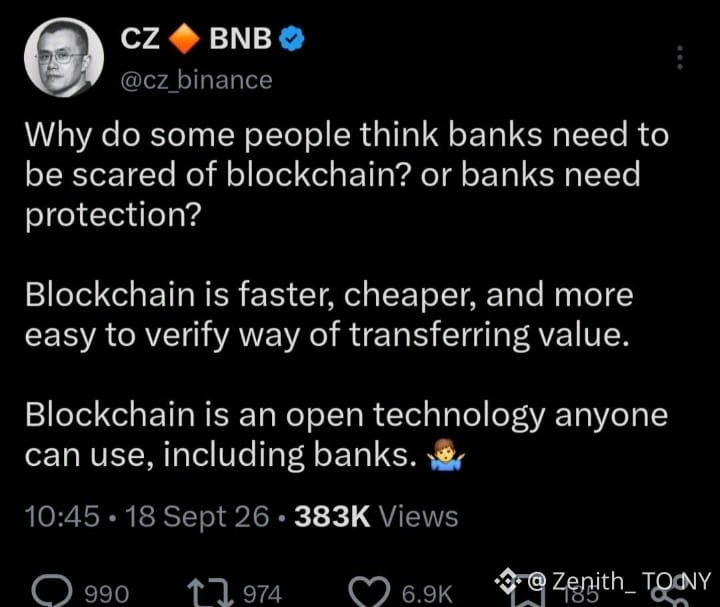
Blockchain is the technology underneath many cryptocurrencies. @Bitcoin, @Ethereum, and @BNB are three major examples of crypto assets that operate within established blockchain ecosystems.
1. What is Blockchain?
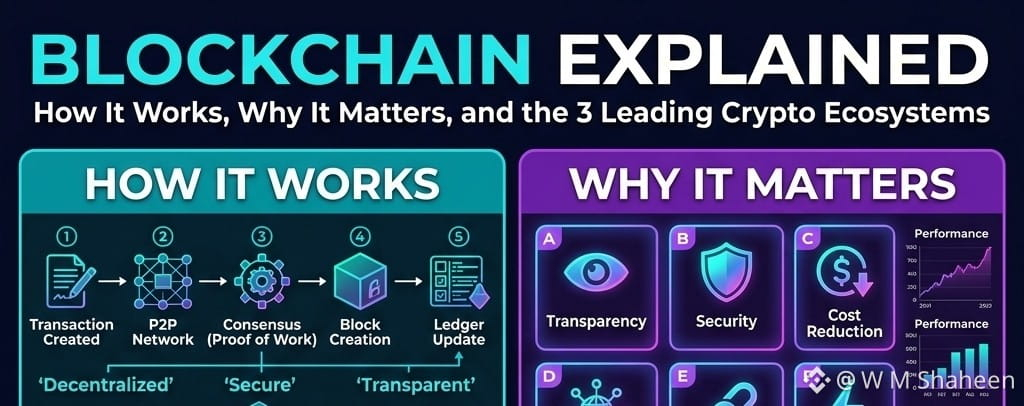
A blockchain is a shared digital database that records transactions or other information across a network of computers.
The important difference from a traditional database is how the information gets maintained.
Instead of one central organization keeping the only authoritative copy, a blockchain distributes the ledger across many participating computers, called nodes. The network uses cryptography and a consensus mechanism to agree on the state of the ledger.
The word blockchain has two parts:
Block: A collection of transactions or other data.
Chain: Each block contains a cryptographic reference to the previous block, linking the blocks together.
A simplified structure looks like this:
Block 1 → Block 2 → Block 3 → Block 4 → Block 5
Each new block builds on the previous history.
2. A simple example
Imagine that five people maintain identical accounting books.
Ali sends 1 BTC to Ahmed.
The transaction gets broadcast to the network.
The network checks whether:
Ali has sufficient
$BTC . Ali authorized the transaction. The transaction follows the network's rules.
After the network reaches consensus, the transaction becomes part of a block.
That block becomes part of the blockchain.
The participating computers can then update their records.
Bitcoin describes its blockchain as a shared public ledger containing confirmed transactions.
3. Why does blockchain need cryptography?
Cryptography provides several important functions.
Digital signatures help prove that the person initiating a transaction has the authority to spend the relevant assets.
Hash functions help link blocks together.
A hash is essentially a cryptographic fingerprint of data.
If someone changes important data inside an earlier block, its resulting hash changes. That breaks the chain of subsequent cryptographic references, making unauthorized alteration detectable.
This is one reason blockchain records are difficult to alter retrospectively.
4. What is a node?
A node is a computer running blockchain software and participating in the network.
Depending on the blockchain, nodes can:
Store blockchain data. Verify transactions. Verify blocks. Relay information. Participate in consensus.
Ethereum describes its nodes as computers that maintain the state of the Ethereum network and participate in processing and verifying changes to that state.
5. What is consensus?
If thousands of computers maintain a shared database, they need a mechanism for agreeing on what gets added.
That mechanism is called consensus.
Different blockchains use different consensus mechanisms.
Bitcoin uses Proof of Work.
Ethereum uses Proof of Stake.
$BNB Smart Chain uses a validator-based Proof of Staked Authority system.
This is a fundamental point:
Blockchain does not mean Proof of Work.
Proof of Work is only one type of blockchain consensus mechanism.
6. Proof of Work, Bitcoin
Bitcoin uses miners.
Miners compete to produce valid blocks by performing computational work.
This requires substantial computing resources and electricity.
The economic cost of mining helps protect the Bitcoin network from attacks.
Bitcoin therefore combines:
Cryptography Mining Economic incentives Network consensus A fixed monetary issuance model
7. Proof of Stake, Ethereum
Ethereum moved from Proof of Work to Proof of Stake.
Validators stake
$ETH as economic collateral.
They participate in proposing and checking blocks. Dishonest behavior can result in penalties, including loss of staked ETH.
So the basic distinction is:
Bitcoin: Computational resources secure the network.
Ethereum: Staked economic value and validators secure the network.
8. Smart contracts
This is where blockchain becomes much more interesting.
A smart contract is a program deployed on a blockchain.
Instead of simply recording:
"Ali sent Ahmed 1 ETH."
A blockchain such as Ethereum can execute programmed rules.
For example:
IF certain conditions are satisfied, THEN perform a specified transaction or change the blockchain state.
Ethereum describes itself as a blockchain with an embedded computer, the Ethereum Virtual Machine, or EVM.
This enables decentralized applications, commonly called dApps.
9. What can blockchain be used for?
Blockchain technology can support:
Cryptocurrency payments Digital asset ownership Stablecoins Decentralized finance, DeFi Tokenized real-world assets NFTs Decentralized applications Digital identity systems Supply-chain records Gaming assets Decentralized organizations Data and storage systems
Ethereum, for example, supports applications involving payments, gaming, prediction markets, AI agents, decentralized identity, and other use cases.
BNB Chain also supports DeFi, NFTs, gaming, dApps, decentralized storage, and other applications.
10. Blockchain versus cryptocurrency
This distinction is extremely important.
Blockchain is the technology.
Cryptocurrency is one application of that technology.
For example:
Bitcoin is a cryptocurrency and Bitcoin is also the name of its blockchain network.
ETH is the native cryptocurrency of Ethereum.
BNB is the native token of the BNB Chain ecosystem.
Ethereum explicitly describes ETH as the native cryptocurrency used on the Ethereum network, including for transaction fees.
So:
Blockchain ≠ cryptocurrency.
Cryptocurrency can operate as an economic asset within a blockchain ecosystem.
11. What is a blockchain transaction?
A simplified transaction process looks like this:
You create a transaction.
↓
Your wallet signs it using your private key.
↓
The transaction enters the network.
↓
Network participants verify it.
↓
A validator or miner includes it in a block.
↓
The network reaches the required consensus.
↓
The block becomes part of the blockchain.
↓
Your transaction becomes part of the network's recorded history.
The exact process differs between blockchains.
12. What is a crypto wallet?
A wallet does not simply "store coins" in the way a physical wallet stores cash.
The blockchain records ownership or control of assets.
Your wallet primarily manages the cryptographic keys that allow you to authorize transactions.
A private key is extremely important because control of the relevant key can provide control over the associated blockchain assets.
This is why private-key security is fundamental to cryptocurrency.
13. Public key and private key
Think of them conceptually as:
Public address: Something you can share so others can send assets to you.
Private key: Secret information used to authorize transactions.
Never treat a private key or seed phrase as ordinary login information.
If someone obtains it, they may be able to control the associated assets.
14. Why blockchain is considered decentralized
Traditional banking generally depends on centralized institutions.
For example:
You → Bank → Bank database
A public blockchain can instead work approximately like:
You → Blockchain network → Distributed nodes
There is no single database that represents the entire system.
However, decentralization exists on a spectrum.
This is important.
Not every blockchain is equally decentralized.
The number and distribution of validators, node operators, developers, token ownership, governance structures, and other factors can affect how decentralized a network actually is.
15. Blockchain's major advantages
Transparency
Public blockchains can allow anyone to inspect transactions and network activity.
Global accessibility
A blockchain network can operate across national borders.
Programmability
Smart-contract blockchains can execute predefined logic.
Auditability
Blockchain records can provide a persistent transaction history.
Resistance to unilateral alteration
Changing established blockchain history can be technically and economically difficult, depending on the network.
Reduced dependence on intermediaries
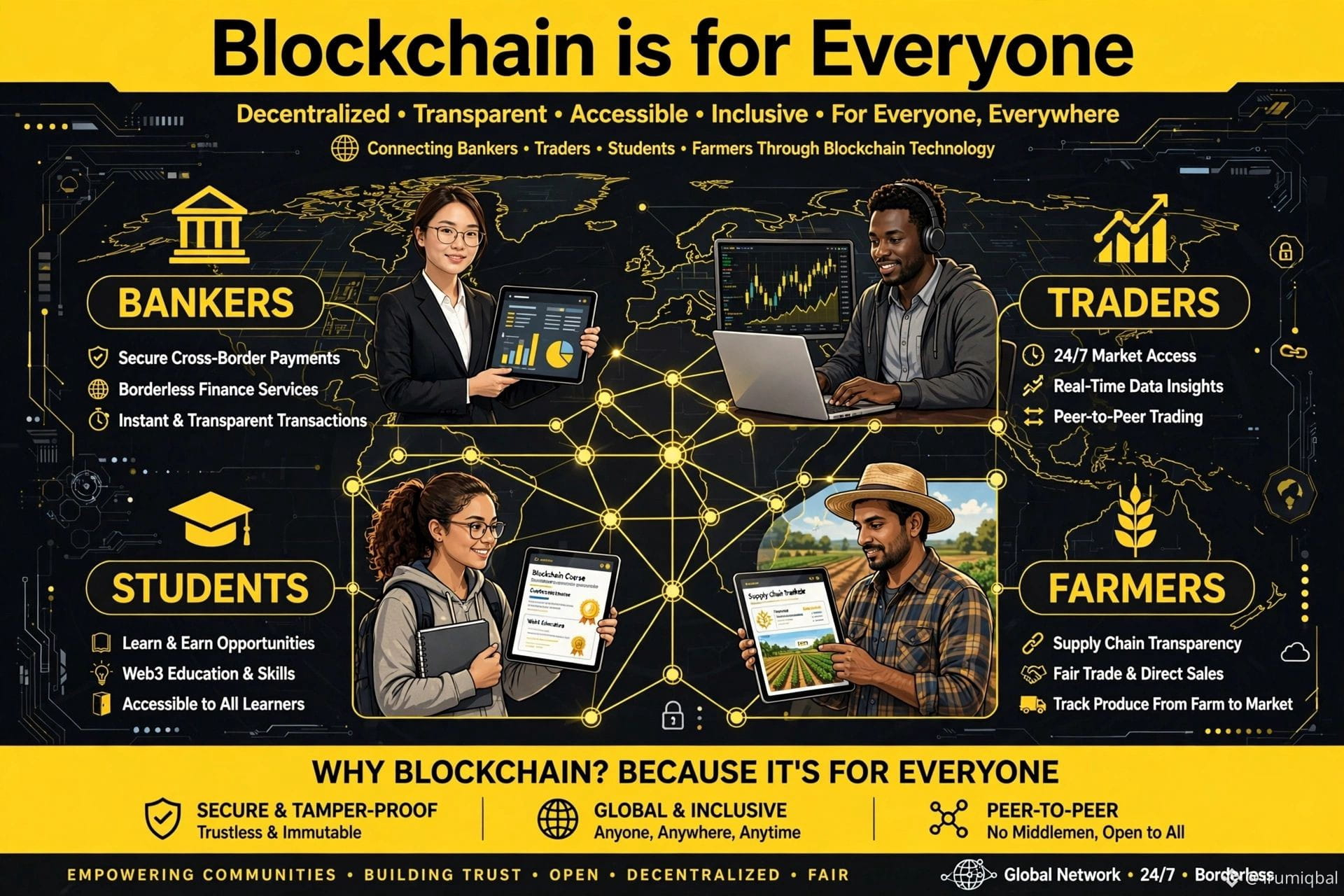
Some blockchain applications can perform functions traditionally handled by financial or technological intermediaries.
16. Blockchain's major limitations
Blockchain is not automatically better than a conventional database.
Important limitations include:
Scalability
A network may struggle when transaction demand becomes extremely high.
Fees
High demand can increase transaction costs on some networks.
Complexity
Smart contracts introduce technical risks.
Security
A blockchain can be secure while an application built on it contains vulnerabilities.
Privacy
Public blockchains can make transaction histories highly visible.
Governance
Blockchain networks still require decisions about upgrades and rules.
Centralization risks
Some networks rely on relatively concentrated validator structures.
Energy consumption
Proof of Work networks such as Bitcoin require substantial computational energy.
17. The Blockchain Trilemma
A common concept in blockchain engineering is the "blockchain trilemma."
It describes the tension between:
Decentralization Security Scalability
Improving one dimension can create tradeoffs elsewhere.
Bitcoin strongly emphasizes decentralization and security.
Ethereum attempts to maintain decentralization and security while scaling through additional layers and technologies.
BNB Smart Chain emphasizes high performance and low-cost transactions while using a comparatively limited validator structure. Its official documentation describes its Proof of Staked Authority model and validator architecture.
18. Three established crypto assets to understand first
If your goal is to learn the blockchain industry, these three are particularly useful starting points:
1. Bitcoin, BTC
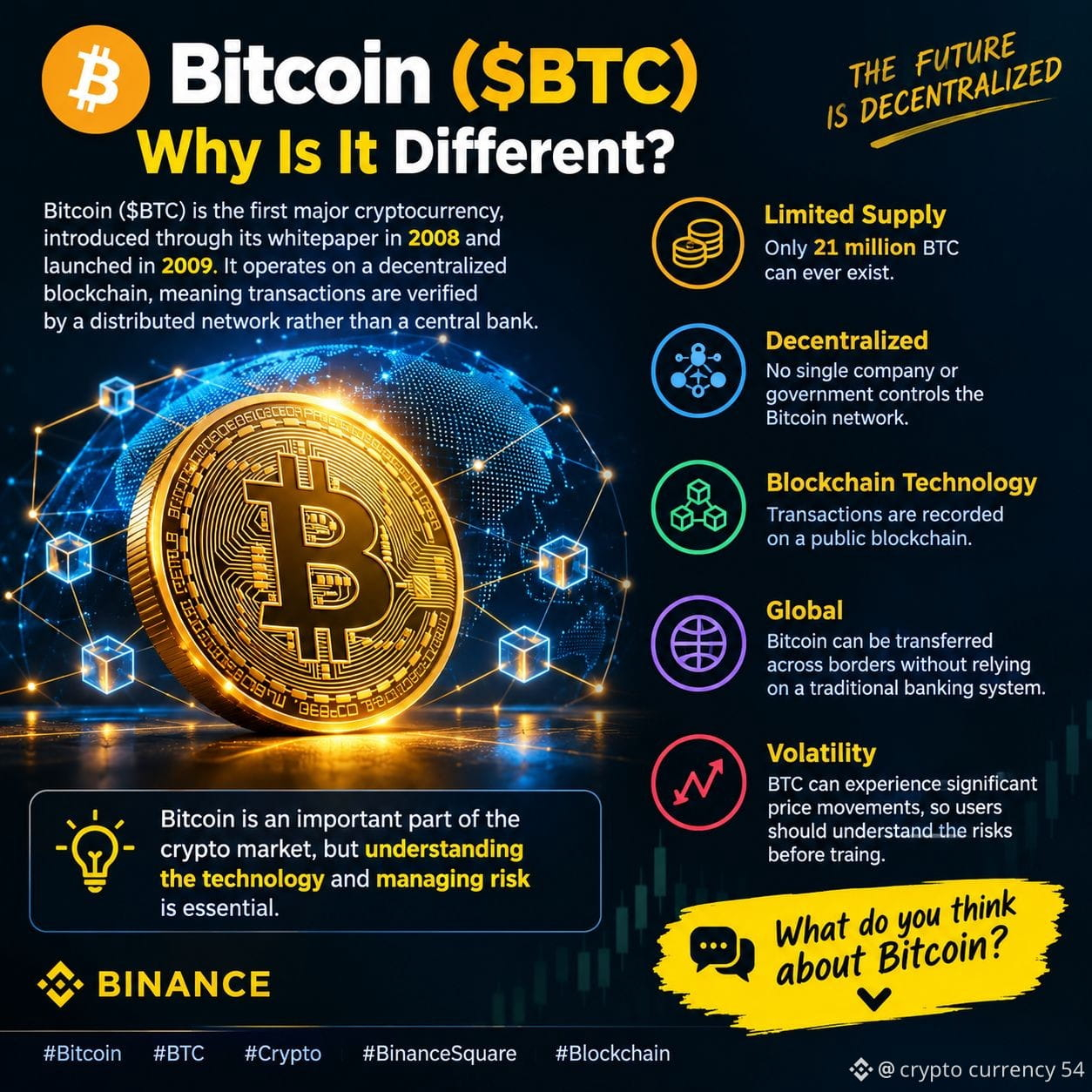
Bitcoin is the original major cryptocurrency and operates on the Bitcoin blockchain.
Primary concept: Decentralized digital money.
Consensus: Proof of Work.
Key characteristic: 21 million maximum supply.
Its blockchain functions primarily as a secure public ledger for Bitcoin transactions.
Bitcoin is important for understanding:
Mining Proof of Work Digital scarcity Cryptographic signatures UTXO transactions Decentralized monetary systems
2. Ethereum, ETH
Ethereum is a programmable blockchain.
ETH is its native cryptocurrency.
Primary concept: A decentralized platform for executing smart contracts and applications.
Consensus: Proof of Stake.
Key characteristic: Smart contracts and the Ethereum Virtual Machine.
ETH is also used to pay transaction fees and is involved in Ethereum's Proof of Stake security mechanism.
Ethereum is important for understanding:
Smart contracts DeFi dApps Proof of Stake Gas fees Tokenization Layer 2 scaling
3. BNB
BNB is the native token of the BNB Chain ecosystem.
BNB Smart Chain is designed for decentralized applications and supports EVM-compatible smart contracts. BNB is used for transaction fees and staking within the ecosystem.
BNB is important for understanding:
EVM-compatible blockchains Low-cost transactions DeFi Smart contracts Validator-based consensus Blockchain ecosystem economics
19. BTC vs ETH vs BNB
BTC:
Blockchain purpose: Digital monetary system.
Native asset: BTC.
Consensus: Proof of Work.
Smart contracts: Limited compared with Ethereum.
Main economic idea: Scarcity and decentralized monetary settlement.
ETH:
Blockchain purpose: Programmable decentralized computing platform.
Native asset: ETH.
Consensus: Proof of Stake.
Smart contracts: Core functionality.
Main economic idea: Demand for blockchain computation, applications, settlement, and network security.
BNB:
Blockchain ecosystem purpose: High-performance infrastructure for applications and Web3 services.
Native asset: BNB.
Consensus: Proof of Staked Authority on BNB Smart Chain.
Smart contracts: Yes, EVM compatible.
Main economic idea: Utility and activity within the BNB Chain ecosystem.
BNB Smart Chain currently describes itself as an EVM-compatible high-performance blockchain designed particularly for decentralized applications and DeFi.
20. The easiest way to remember them
BTC = digital monetary network.
ETH = programmable blockchain.
BNB = blockchain ecosystem utility token.
And remember this distinction:
Bitcoin is primarily about transferring and securing value.
Ethereum is about programmable value and decentralized computation.
BNB Chain is about scalable blockchain applications and ecosystem activity.
If you want to study crypto seriously, understanding these three systems gives you a strong foundation before moving into stablecoins, DeFi, Layer 2 networks, tokenomics, RWA, and smaller altcoins.
#Binance #Crypto #BlockChain