
Cryptopolitan
58.9k Posts

Cryptopolitan
 Square Verified+
Report
Block User
Crypto news that doesn't waste your time. Breaking updates, market analysis, on-chain insights. Building the smartest crypto community.

Creator of the Year
1 Following
161.6K+ Followers
573.7K+ Liked
1 Badges
Posts
PINNED
At Cryptopolitan, we research, analyze, and deliver news—daily.
From breaking updates to in-depth analysis, educational guides, and market insights, we’re here to keep you informed with neutral and authentic news.
Thank you for trusting us to be your go-to source!
At Cryptopolitan, we research, analyze, and deliver news—daily.
From breaking updates to in-depth analysis, educational guides, and market insights, we’re here to keep you informed with neutral and authentic news.
Thank you for trusting us to be your go-to source!
From breaking updates to in-depth analysis, educational guides, and market insights, we’re here to keep you informed with neutral and authentic news.
Thank you for trusting us to be your go-to source!

120
68
345
1.8k
Saylor’s Strategy buys 457 BTC for $29.6M in fourth straight weekly purchaseStrategy’s announced its latest Bitcoin purchase for the week between November 16 and November 22, writing a $29.6 million check to acquire 457 Bitcoins, according to the 8-K filing submitted to the Securities and Exchange Commission (SEC). The firm also spent about $211.8 million repurchasing its STRC preferred stock.
Strategy’s fourth straight week of buying BTC pushes its digital asset reserve to 851,305 BTC. The $64,898 average the firm paid for each token it bought during the reporting period represented a discount relative to its overall per Bitcoin cost basis of $75,446.
Strategy disclosed updates to Bitcoin holdings on November 23, 2026. Source: SEC 8-K filing
Bitcoin was trading near $63,000 as of this report.
How Strategy funded its Bitcoin and STRC spending this week
According to Strategy’s SEC filing, the firm raised $176.7 million via the sale of 1,925,676 shares of its MSTR Class A common stock through its at-the-market program.
The $176.7 million was split into:
$29.6 million for BTC purchase.
About $147 million went to funding STRC preferred stock buybacks.
Overall, Strategy spent $211.8 million repurchasing its 2,183,747 STRC preferred shares during the week, drawing on about $64.8 million from its USD Cash, as confirmed by Cryptopolitan’s review of the firm’s SEC filing.
The firm now has $1.12 billion available under its digital credit securities repurchase program as of November 22, after the board expanded the program from $3 billion to $4 billion.
The board also authorized moving up to $1 billion out of the USD Reserve, the pool that backs dividend and interest payments, into a general-purpose USD Cash account.
After the shift, the reserve held $3.73 billion and USD Cash stood at $1.09 billion as of November 22, per the filing. Saylor put total dollar assets at $4.8 billion in a post on X. Strategy also used $17.6 million from the reserve to cover preferred dividends during the week.
Strategy still has around $17.9 billion in MSTR shares available under the ATM program.
Strategy is buying Bitcoin at a two-year low price
The purchases came as Bitcoin price dropped to its lowest level since September 2024 as the leading digital asset’s slide enters a seventh week. Strategy’s MSTR stock is also enduring a challenging spell, losing more than 30% during the week that ended Friday, November 20, closing at $77.80, its lowest since February 2024.
Executive Chairman Michael Saylor flagged the buy in advance, posting an acquisition tracker chart on Sunday, November 22, with the caption “The dots aren’t done.”
During the company’s investor Q&A on Friday, November 20, Saylor described the market as a credit-market contraction and said he expects “natural, organic” demand for STRC at its 12% dividend to sit between $5 billion and $7.5 billion.
President and CEO Phong Le said the firm has repurchased about $3 billion of the preferred stock at prices between $95 and $99.
Don’t just read crypto news. Understand it. Subscribe to our newsletter. It's free.
Saylor’s Strategy buys 457 BTC for $29.6M in fourth straight weekly purchase
Strategy’s announced its latest Bitcoin purchase for the week between November 16 and November 22, writing a $29.6 million check to acquire 457 Bitcoins, according to the 8-K filing submitted to the Securities and Exchange Commission (SEC). The firm also spent about $211.8 million repurchasing its STRC preferred stock.
Strategy’s fourth straight week of buying BTC pushes its digital asset reserve to 851,305 BTC. The $64,898 average the firm paid for each token it bought during the reporting period represented a discount relative to its overall per Bitcoin cost basis of $75,446.
Strategy disclosed updates to Bitcoin holdings on November 23, 2026. Source: SEC 8-K filing
Bitcoin was trading near $63,000 as of this report.
How Strategy funded its Bitcoin and STRC spending this week
According to Strategy’s SEC filing, the firm raised $176.7 million via the sale of 1,925,676 shares of its MSTR Class A common stock through its at-the-market program.
The $176.7 million was split into:
$29.6 million for BTC purchase.
About $147 million went to funding STRC preferred stock buybacks.
Overall, Strategy spent $211.8 million repurchasing its 2,183,747 STRC preferred shares during the week, drawing on about $64.8 million from its USD Cash, as confirmed by Cryptopolitan’s review of the firm’s SEC filing.
The firm now has $1.12 billion available under its digital credit securities repurchase program as of November 22, after the board expanded the program from $3 billion to $4 billion.
The board also authorized moving up to $1 billion out of the USD Reserve, the pool that backs dividend and interest payments, into a general-purpose USD Cash account.
After the shift, the reserve held $3.73 billion and USD Cash stood at $1.09 billion as of November 22, per the filing. Saylor put total dollar assets at $4.8 billion in a post on X. Strategy also used $17.6 million from the reserve to cover preferred dividends during the week.
Strategy still has around $17.9 billion in MSTR shares available under the ATM program.
Strategy is buying Bitcoin at a two-year low price
The purchases came as Bitcoin price dropped to its lowest level since September 2024 as the leading digital asset’s slide enters a seventh week. Strategy’s MSTR stock is also enduring a challenging spell, losing more than 30% during the week that ended Friday, November 20, closing at $77.80, its lowest since February 2024.
Executive Chairman Michael Saylor flagged the buy in advance, posting an acquisition tracker chart on Sunday, November 22, with the caption “The dots aren’t done.”
During the company’s investor Q&A on Friday, November 20, Saylor described the market as a credit-market contraction and said he expects “natural, organic” demand for STRC at its 12% dividend to sit between $5 billion and $7.5 billion.
President and CEO Phong Le said the firm has repurchased about $3 billion of the preferred stock at prices between $95 and $99.
Don’t just read crypto news. Understand it. Subscribe to our newsletter. It's free.
111
Alice Huang reportedly kept talking to China's spy agency during Jensen Huang affairAccording to The New York Times, Alice Huang was allegedly continuing conversations with an official from the principal spy agency in China even as she continued her secret relationship with Jensen Huang, who had been the CEO of Nvidia.
Investigators also found evidence suggesting Kang Wei, Alice’s business partner, worked with that agency. She often introduced Kang as her husband.
Chip shipments put Alice Huang’s business network under scrutiny
The government agency in question is the Ministry of State Security, which is known as MSS. American authorities are convinced that Alice was talking to an agent of the agency throughout some period of her relationship. The details of the communication and how long either of them might have been working for the agency have not been publicly revealed yet.
In the meantime, Alice’s company Megaspeed was importing a great number of modern AI processors. Some of them ended up in computing centers in Southeast Asia that belonged to Chinese corporations like Alibaba. Other shipments might have reached China without U.S. export authorization.
It is claimed that U.S. intelligence has looked into documents that revealed how Alice and Kang were doing business via various regional firms. This whole network of firms included some businesses linked to Alice’s sister.
Some of those firms supply the People’s Liberation Army. Investigators are examining whether the chip deals helped military-linked customers obtain restricted computing capacity. That possibility remains under investigation, rather than an established finding about every shipment.
These processors are important because training AI models requires huge computing power. The Chinese intelligence agency has ensured that it prioritizes access to high-end semiconductors, and sending equipment through other nations could make enforcing U.S. restrictions difficult.
The reports also indicate that Alice met with representatives of China’s Ministry of Public Security, which is China’s central police force. Details of the meetings remain unknown.
Jensen first insisted Alice was simply a customer. He acknowledged their affair after October reporting disclosed that surveillance directed at her had picked up his communications. Another Times story subsequently described his relationship with an Nvidia subordinate, and he resigned earlier this month.
Despite the suspected intelligence connection, officials never gave him a defensive briefing, the private alert used to warn someone that a personal contact could pose a foreign intelligence risk.
Trump pushed for Jensen’s return despite security concerns
President Donald Trump had known of this situation even before the general public did. His advisers had warned him twice regarding the connection between Alice and the MSS and also the Nvidia CEO. The one responsible for issuing the warning was Secretary of State Marco Rubio.
But President Trump did nothing about it. That is because he considered Jensen to be a very important individual, along with the company Nvidia. It was very important for America’s stock market and economy. But Trump claims he was unaware of this fact.
Discussing the accusations, Trump said, “I don’t know that she is a spy.” He then complained that attractive women arriving from China were too readily labeled spies.
By Friday, he was openly encouraging Nvidia to reinstate Jensen (obviously, the board had turned him down). In the White House press conference, Trump said: “We have to protect our brilliant people. Jensen is one of them.”
However, Congress expects more than that. There have been a few requests from some members to brief them about the intelligence. But very little has come to the notice of the hill legislators. In the hearings that were scheduled to be held on the matter of Iran, both the CIA Director, John Ratcliffe, and DNI, Jay Clayton, were questioned about the Nvidia affair, but there was a lot of confusion.
“There is an investigation ongoing into her firm and into her,” Clayton told ABC on Sunday, adding that, “Nvidia chips, they are the jewel. They are the absolute top that everybody wants, that’s why we’re focusing on this.”
As CBS reported on Sunday, the treasury secretary Scott Bessent said that the government was investigating into the chip sales from Nvidia to China asking who was responsible for the compliance and how much the company was aware of such actions. The pressure will continue to heat up in Washington. Nvidia’s former CEO, Jensen Huang, and its general counsel, Tim Teter, have committed themselves to giving private and transcribed interviews with three House panels on Dec. 1 and Dec. 2, respectively.
The smartest crypto minds already read our newsletter. Want in? Join them.
Alice Huang reportedly kept talking to China's spy agency during Jensen Huang affair
According to The New York Times, Alice Huang was allegedly continuing conversations with an official from the principal spy agency in China even as she continued her secret relationship with Jensen Huang, who had been the CEO of Nvidia.
Investigators also found evidence suggesting Kang Wei, Alice’s business partner, worked with that agency. She often introduced Kang as her husband.
Chip shipments put Alice Huang’s business network under scrutiny
The government agency in question is the Ministry of State Security, which is known as MSS. American authorities are convinced that Alice was talking to an agent of the agency throughout some period of her relationship. The details of the communication and how long either of them might have been working for the agency have not been publicly revealed yet.
In the meantime, Alice’s company Megaspeed was importing a great number of modern AI processors. Some of them ended up in computing centers in Southeast Asia that belonged to Chinese corporations like Alibaba. Other shipments might have reached China without U.S. export authorization.
It is claimed that U.S. intelligence has looked into documents that revealed how Alice and Kang were doing business via various regional firms. This whole network of firms included some businesses linked to Alice’s sister.
Some of those firms supply the People’s Liberation Army. Investigators are examining whether the chip deals helped military-linked customers obtain restricted computing capacity. That possibility remains under investigation, rather than an established finding about every shipment.
These processors are important because training AI models requires huge computing power. The Chinese intelligence agency has ensured that it prioritizes access to high-end semiconductors, and sending equipment through other nations could make enforcing U.S. restrictions difficult.
The reports also indicate that Alice met with representatives of China’s Ministry of Public Security, which is China’s central police force. Details of the meetings remain unknown.
Jensen first insisted Alice was simply a customer. He acknowledged their affair after October reporting disclosed that surveillance directed at her had picked up his communications. Another Times story subsequently described his relationship with an Nvidia subordinate, and he resigned earlier this month.
Despite the suspected intelligence connection, officials never gave him a defensive briefing, the private alert used to warn someone that a personal contact could pose a foreign intelligence risk.
Trump pushed for Jensen’s return despite security concerns
President Donald Trump had known of this situation even before the general public did. His advisers had warned him twice regarding the connection between Alice and the MSS and also the Nvidia CEO. The one responsible for issuing the warning was Secretary of State Marco Rubio.
But President Trump did nothing about it. That is because he considered Jensen to be a very important individual, along with the company Nvidia. It was very important for America’s stock market and economy. But Trump claims he was unaware of this fact.
Discussing the accusations, Trump said, “I don’t know that she is a spy.” He then complained that attractive women arriving from China were too readily labeled spies.
By Friday, he was openly encouraging Nvidia to reinstate Jensen (obviously, the board had turned him down). In the White House press conference, Trump said: “We have to protect our brilliant people. Jensen is one of them.”
However, Congress expects more than that. There have been a few requests from some members to brief them about the intelligence. But very little has come to the notice of the hill legislators. In the hearings that were scheduled to be held on the matter of Iran, both the CIA Director, John Ratcliffe, and DNI, Jay Clayton, were questioned about the Nvidia affair, but there was a lot of confusion.
“There is an investigation ongoing into her firm and into her,” Clayton told ABC on Sunday, adding that, “Nvidia chips, they are the jewel. They are the absolute top that everybody wants, that’s why we’re focusing on this.”
As CBS reported on Sunday, the treasury secretary Scott Bessent said that the government was investigating into the chip sales from Nvidia to China asking who was responsible for the compliance and how much the company was aware of such actions. The pressure will continue to heat up in Washington. Nvidia’s former CEO, Jensen Huang, and its general counsel, Tim Teter, have committed themselves to giving private and transcribed interviews with three House panels on Dec. 1 and Dec. 2, respectively.
The smartest crypto minds already read our newsletter. Want in? Join them.
1
256
“No bailouts for AI” reaches the Senate as Schiff drafts a resolutionA resolution to prevent any federal bailouts for companies and investors with exposure in the AI sector in the event of a collapse is being prepared by Senator Adam Schiff, the junior United States senator from California since 2024.
Schiff, who is a member of the Democratic Party, served in the House of Representatives until 2024 after securing the seat in 2001. Before then, he served in the California State Senate from 1996 to 2000.
According to Semafor’s report citing people with knowledge of the matter, Schiff plans to present the filing once Congress returns on November 30 after its Thanksgiving break.
If the California Democrat follows through, it will be the first such measure initiated by a senator, following up on similar moves by House progressives launched last month.
Democrats move to block any bailouts for AI industry
According to Semafor, Senator Adam Schiff’s resolution will instruct Congress not to “bail out corporations and wealthy investors taking speculative bets on the AI boom at the expense of working families, should the AI industry falter.”
Before Schiff, House Democratic Representative Greg Casar of Texas, who chairs the Congressional Progressive Caucus, and Maxine Waters of California already filed to block any such interventions for the AI industry on October 28.
House Democrats have had the issue in their sights for a while, going as far back as a 2025 congressional hearing where Representative Alexandria Ocasio-Cortez said that “should this bubble pop, we should not be entertaining a bailout.”
Schiff would be the first United States senator to formally take the “no bailouts” baton if he proposes the resolution next week as expected.
Can the Democrats block bailouts for AI companies and investors?
Even if Adam Schiff takes the AI industry bailout resolution to the Senate, neither it nor the House version can block a rescue.
A resolution is a statement expressing the opinion of one chamber, and it does not carry legal force. It does not require a vote from the other house or a signature from the president.
The House text says struggling AI firms should go through ordinary bankruptcy and protect workers and pensions. It also touches on responsibility, saying to hold executives who took reckless risks “fully accountable under civil and criminal law.”
Schiff already shared his reasoning earlier this month in a Wall Street Journal op-ed, where he wrote that “Congressional majorities should be clear: We won’t bail them out,” in a warning to billionaires not to expect the kind of intervention banks received during the 2008 housing crash.
Why are Democrats warning AI companies about needing a bailout?
The warnings land against the backdrop of a market where global equities have shed close to $9 trillion since peaking in August 2026 as investors question whether AI earnings can ever justify the spending.
Regulators are circling the financing itself. In its twice-yearly stability review, the European Central Bank counted more than $4 trillion in off-balance-sheet commitments at eight big tech firms as of the second quarter of 2026, warning that the shift toward debt, as the ECB put it, “invokes historical parallels with the dotcom and subprime bubbles,” Fortune reported.
The White House has already drawn its own red line. AI czar David Sacks said in 2025 that “there will be no federal bailout for AI” after OpenAI’s finance chief floated a federal backstop and then walked it back within a day.
Schiff’s move fits a wider plan. Democrats intend to push a wave of AI legislation on data-center power costs, model testing, and corporate liability once they take control of Congress in January, with Chuck Schumer expected to lead the Senate.
Don’t just read crypto news. Understand it. Subscribe to our newsletter. It's free.
“No bailouts for AI” reaches the Senate as Schiff drafts a resolution
A resolution to prevent any federal bailouts for companies and investors with exposure in the AI sector in the event of a collapse is being prepared by Senator Adam Schiff, the junior United States senator from California since 2024.
Schiff, who is a member of the Democratic Party, served in the House of Representatives until 2024 after securing the seat in 2001. Before then, he served in the California State Senate from 1996 to 2000.
According to Semafor’s report citing people with knowledge of the matter, Schiff plans to present the filing once Congress returns on November 30 after its Thanksgiving break.
If the California Democrat follows through, it will be the first such measure initiated by a senator, following up on similar moves by House progressives launched last month.
Democrats move to block any bailouts for AI industry
According to Semafor, Senator Adam Schiff’s resolution will instruct Congress not to “bail out corporations and wealthy investors taking speculative bets on the AI boom at the expense of working families, should the AI industry falter.”
Before Schiff, House Democratic Representative Greg Casar of Texas, who chairs the Congressional Progressive Caucus, and Maxine Waters of California already filed to block any such interventions for the AI industry on October 28.
House Democrats have had the issue in their sights for a while, going as far back as a 2025 congressional hearing where Representative Alexandria Ocasio-Cortez said that “should this bubble pop, we should not be entertaining a bailout.”
Schiff would be the first United States senator to formally take the “no bailouts” baton if he proposes the resolution next week as expected.
Can the Democrats block bailouts for AI companies and investors?
Even if Adam Schiff takes the AI industry bailout resolution to the Senate, neither it nor the House version can block a rescue.
A resolution is a statement expressing the opinion of one chamber, and it does not carry legal force. It does not require a vote from the other house or a signature from the president.
The House text says struggling AI firms should go through ordinary bankruptcy and protect workers and pensions. It also touches on responsibility, saying to hold executives who took reckless risks “fully accountable under civil and criminal law.”
Schiff already shared his reasoning earlier this month in a Wall Street Journal op-ed, where he wrote that “Congressional majorities should be clear: We won’t bail them out,” in a warning to billionaires not to expect the kind of intervention banks received during the 2008 housing crash.
Why are Democrats warning AI companies about needing a bailout?
The warnings land against the backdrop of a market where global equities have shed close to $9 trillion since peaking in August 2026 as investors question whether AI earnings can ever justify the spending.
Regulators are circling the financing itself. In its twice-yearly stability review, the European Central Bank counted more than $4 trillion in off-balance-sheet commitments at eight big tech firms as of the second quarter of 2026, warning that the shift toward debt, as the ECB put it, “invokes historical parallels with the dotcom and subprime bubbles,” Fortune reported.
The White House has already drawn its own red line. AI czar David Sacks said in 2025 that “there will be no federal bailout for AI” after OpenAI’s finance chief floated a federal backstop and then walked it back within a day.
Schiff’s move fits a wider plan. Democrats intend to push a wave of AI legislation on data-center power costs, model testing, and corporate liability once they take control of Congress in January, with Chuck Schumer expected to lead the Senate.
Don’t just read crypto news. Understand it. Subscribe to our newsletter. It's free.
276
CoinRabbit maps 5 layers of crypto platform risk with Binance’s $6.4 billion hack as case studyStrong security alone does not keep crypto safe on a platform. Investors also need to understand how a platform treats their assets, which third parties it depends on and how it signs off on transfers, according to a new report from crypto asset management platform CoinRabbit.
The report centers on Binance’s estimated $6.4 billion loss and features commentary from executives at Bitcoin Life, Compass Mining, Coinchange, Vnish & HashCore and Realiz Group.
6 questions to settle before trusting a crypto platform with funds
A platform that segregates client assets and does not use them in its own business keeps clients out of risks they never signed up for.
Spreading capital across several providers matters as much as spreading it across different assets.
Size and reputation say little about who actually controls client funds on a platform.
Any weak link around client funds, from staff to software to partners, can be enough for a breach, so no single point should put all assets at risk.
Higher yields always come from somewhere, and that source determines the risk an investor takes on.
Investors should know before choosing a platform what happens to their assets if it is hacked or fails.
Binance breach started on an engineer’s laptop, not with stolen keys
This year’s largest crypto losses show that private keys are no longer the only target. Attackers increasingly go after the people, devices and internal systems that sit between a platform and client funds: employee accounts, developer tools, third-party services and the systems that approve withdrawals.
The Binance breach is a case in point: it started on a single engineer’s work laptop, which gave the attackers a path to the withdrawal infrastructure, and the keys were never touched. Cold storage and advanced key management remain essential, but they protect only one part of a platform and are not proof that client funds are fully secure.
Segregated client assets let Binance absorb the loss where Celsius and FTX could not
Binance kept client assets separate from its own money and did not use them in its business, which allowed it to cover the loss from its own reserves. Celsius and FTX took the opposite approach: client deposits were already tied up in the companies’ own activities by the time both went under in 2022 (SEC on FTX).
The report suggests checking a platform’s custody terms for three things: whether client assets are kept separate, whether the platform can lend or pledge them, and what rights clients keep if it goes bankrupt. Proof of reserves is worth reviewing too, though a reserve snapshot cannot answer the ownership question.
“Capital preservation is a business decision that comes down to understanding the risks, keeping them in check and being selective about whom you trust with your assets. The first step is to make sure client money is not invested to generate the platform’s own revenue, so that clients are not exposed to risks they never chose to take,” said Walter Barrett, Chief Strategy & Growth Officer at CoinRabbit.
Industry executives split focus across allocation, architecture and yield
The executives interviewed for the report agree that the Binance case calls for a broader view of risk, though each focuses on a different part of it.
For Bitcoin Life and Compass Mining, the priority is allocation: deciding how much to hold with each provider and choosing providers that run on independent systems. Vnish & HashCore and Realiz Group focus on platform architecture.
In their view, every person and system connected to client funds is a potential weak point, and platforms should be ready to explain to clients how those funds are secured.
Coinchange looks at returns: before comparing rates, investors should understand how a platform generates its yield.
The full study organizes these findings into a five-layer framework for assessing a crypto platform’s risk profile. Read the CoinRabbit report “Protecting Capital Is More Than Security: Lessons From the Binance Hack” here.
CoinRabbit maps 5 layers of crypto platform risk with Binance’s $6.4 billion hack as case study
Strong security alone does not keep crypto safe on a platform. Investors also need to understand how a platform treats their assets, which third parties it depends on and how it signs off on transfers, according to a new report from crypto asset management platform CoinRabbit.
The report centers on Binance’s estimated $6.4 billion loss and features commentary from executives at Bitcoin Life, Compass Mining, Coinchange, Vnish & HashCore and Realiz Group.
6 questions to settle before trusting a crypto platform with funds
A platform that segregates client assets and does not use them in its own business keeps clients out of risks they never signed up for.
Spreading capital across several providers matters as much as spreading it across different assets.
Size and reputation say little about who actually controls client funds on a platform.
Any weak link around client funds, from staff to software to partners, can be enough for a breach, so no single point should put all assets at risk.
Higher yields always come from somewhere, and that source determines the risk an investor takes on.
Investors should know before choosing a platform what happens to their assets if it is hacked or fails.
Binance breach started on an engineer’s laptop, not with stolen keys
This year’s largest crypto losses show that private keys are no longer the only target. Attackers increasingly go after the people, devices and internal systems that sit between a platform and client funds: employee accounts, developer tools, third-party services and the systems that approve withdrawals.
The Binance breach is a case in point: it started on a single engineer’s work laptop, which gave the attackers a path to the withdrawal infrastructure, and the keys were never touched. Cold storage and advanced key management remain essential, but they protect only one part of a platform and are not proof that client funds are fully secure.
Segregated client assets let Binance absorb the loss where Celsius and FTX could not
Binance kept client assets separate from its own money and did not use them in its business, which allowed it to cover the loss from its own reserves. Celsius and FTX took the opposite approach: client deposits were already tied up in the companies’ own activities by the time both went under in 2022 (SEC on FTX).
The report suggests checking a platform’s custody terms for three things: whether client assets are kept separate, whether the platform can lend or pledge them, and what rights clients keep if it goes bankrupt. Proof of reserves is worth reviewing too, though a reserve snapshot cannot answer the ownership question.
“Capital preservation is a business decision that comes down to understanding the risks, keeping them in check and being selective about whom you trust with your assets. The first step is to make sure client money is not invested to generate the platform’s own revenue, so that clients are not exposed to risks they never chose to take,” said Walter Barrett, Chief Strategy & Growth Officer at CoinRabbit.
Industry executives split focus across allocation, architecture and yield
The executives interviewed for the report agree that the Binance case calls for a broader view of risk, though each focuses on a different part of it.
For Bitcoin Life and Compass Mining, the priority is allocation: deciding how much to hold with each provider and choosing providers that run on independent systems. Vnish & HashCore and Realiz Group focus on platform architecture.
In their view, every person and system connected to client funds is a potential weak point, and platforms should be ready to explain to clients how those funds are secured.
Coinchange looks at returns: before comparing rates, investors should understand how a platform generates its yield.
The full study organizes these findings into a five-layer framework for assessing a crypto platform’s risk profile. Read the CoinRabbit report “Protecting Capital Is More Than Security: Lessons From the Binance Hack” here.
433
Article
Retail accumulation stages comeback as buyers scoop Bitcoin dipBTC sentiment is at a two-year low, as the price recently set a local low in the $52,000 range. After the crash, shrimp wallets suddenly expanded, showing retail was still ready to make a comeback.
BTC shrimp wallets expanded by over 23,000 in the past day, following the latest price drawdown. As BTC recovered from around $55,000 to over $61,000, shrimp wallets saw the biggest boost from all other holders.
After a brief recovery, BTC traded at $61,367.11, achieving a 10% bounce over the weekend. For now, BTC is still trading in a fearful sentiment, but traders are on the lookout for strengthening demand and a recovery closer to $65,000.
The expansion of the smallest wallets holding under 1 BTC is a surprise, as retail traders were seen as mostly bearish, even ready to abandon BTC and crypto as a whole.
BTC shrimp wallets lead 2026 growth
Shrimp wallets show a quick reaction to shifting market conditions. In the past day, 23,076 new wallets were created, showing an immediate shift to buying. The reversal follows a contraction of shrimp wallets in the past month, suggesting some retail traders sold higher and bought the dip.
On a three-month horizon, shrimp wallets added 468,240 new holders. For the whole of 2026, over 2.4M new shrimp wallets were created. The year-to-date growth reached 4.35%, a more active rate of expansion compared to whale wallets.
Other active cohorts for the past year include crab and shark wallets, both with positive growth. As Cryptopolitan reported, accumulation was still happening, despite the fluctuations in the derivatives market.
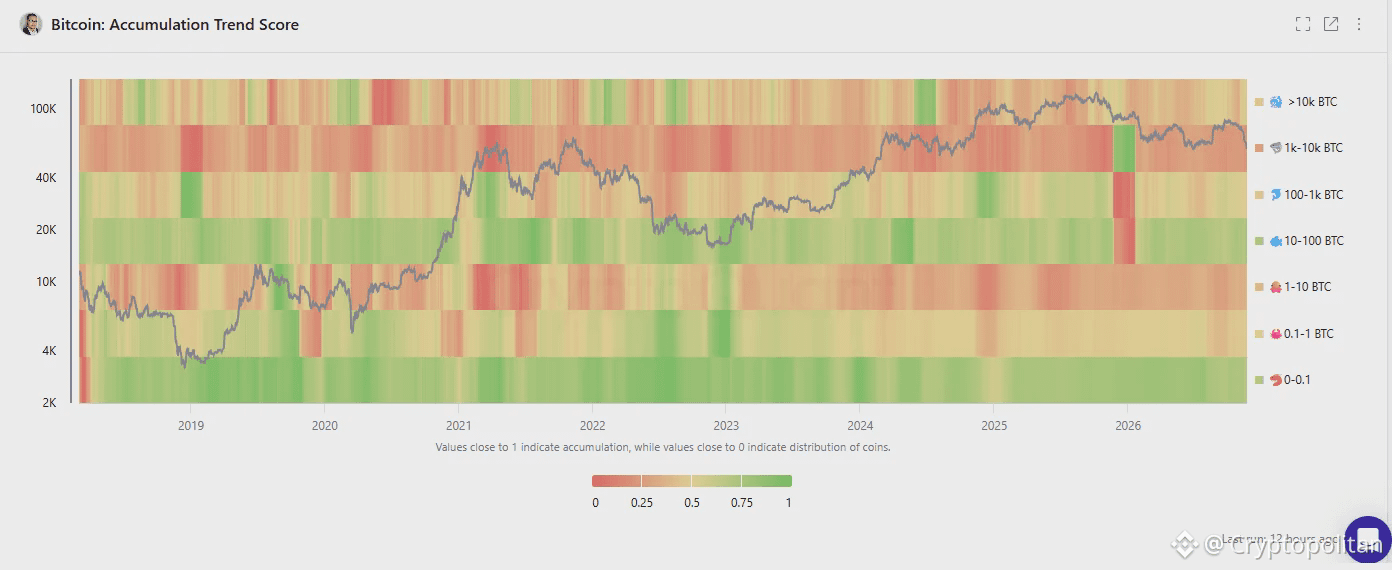
Small-scale BTC wallets were accumulating coins in most of 2026, while whales were strategically distributing some of their holdings. | Source: Cryptoquant
BTC is still mostly driven by whales, with large market makers or accumulation wallets buying the recent dip. At the same time, the potential for a recovery is also bringing back retail traders.
The readiness to buy BTC on the spot market and hold in self-custody wallets is still a sign that the market has not seen a full capitulation. Historically, retail often sells while whales accumulate.
In 2026, inflows to accumulation addresses did not reach dramatic peaks, but were much more consistent. Based on Cryptoquant data, accumulation address inflows reached new yearly highs in October and remained strong in November.
BTC price still protected by its cost basis
The recent BTC dip created fewer fears of a deep capitulation. While BTC saw over $600K in long liquidations in a single day, overall holding behaviors did not change.
BTC downside is still protected by different cohorts of buyers, of which not all are equally underwater, even after the latest price correction. | Source: Bitbo Charts
This may be due to the presence of both legacy accumulation wallets and recent strategic accumulation. Even with BTC sliding to a lower price range, there are only a few cohorts that are underwater.
In the past two years, whales were mostly strategic in their buying and selling, trying to accumulate BTC during dips.
This has left a much smaller share of BTC that is truly underwater, and could cause a capitulation. Depending on the time of buying, the accumulated supply for whales and retail has a different share of underwater coins. Even the supply of Strategy, partially acquired at peak prices, is on average 20% underwater.
The current support levels allow accumulation wallets to keep holding, even with short-term fluctuations and dramatic liquidation events. Accumulation and demand were also more complex, meaning mass capitulation was still unlikely for BTC.
Don’t just read crypto news. Understand it. Subscribe to our newsletter. It's free.
Retail accumulation stages comeback as buyers scoop Bitcoin dip
BTC sentiment is at a two-year low, as the price recently set a local low in the $52,000 range. After the crash, shrimp wallets suddenly expanded, showing retail was still ready to make a comeback.
BTC shrimp wallets expanded by over 23,000 in the past day, following the latest price drawdown. As BTC recovered from around $55,000 to over $61,000, shrimp wallets saw the biggest boost from all other holders.
After a brief recovery, BTC traded at $61,367.11, achieving a 10% bounce over the weekend. For now, BTC is still trading in a fearful sentiment, but traders are on the lookout for strengthening demand and a recovery closer to $65,000.
The expansion of the smallest wallets holding under 1 BTC is a surprise, as retail traders were seen as mostly bearish, even ready to abandon BTC and crypto as a whole.
BTC shrimp wallets lead 2026 growth
Shrimp wallets show a quick reaction to shifting market conditions. In the past day, 23,076 new wallets were created, showing an immediate shift to buying. The reversal follows a contraction of shrimp wallets in the past month, suggesting some retail traders sold higher and bought the dip.
On a three-month horizon, shrimp wallets added 468,240 new holders. For the whole of 2026, over 2.4M new shrimp wallets were created. The year-to-date growth reached 4.35%, a more active rate of expansion compared to whale wallets.
Other active cohorts for the past year include crab and shark wallets, both with positive growth. As Cryptopolitan reported, accumulation was still happening, despite the fluctuations in the derivatives market.
Small-scale BTC wallets were accumulating coins in most of 2026, while whales were strategically distributing some of their holdings. | Source: Cryptoquant
BTC is still mostly driven by whales, with large market makers or accumulation wallets buying the recent dip. At the same time, the potential for a recovery is also bringing back retail traders.
The readiness to buy BTC on the spot market and hold in self-custody wallets is still a sign that the market has not seen a full capitulation. Historically, retail often sells while whales accumulate.
In 2026, inflows to accumulation addresses did not reach dramatic peaks, but were much more consistent. Based on Cryptoquant data, accumulation address inflows reached new yearly highs in October and remained strong in November.
BTC price still protected by its cost basis
The recent BTC dip created fewer fears of a deep capitulation. While BTC saw over $600K in long liquidations in a single day, overall holding behaviors did not change.
BTC downside is still protected by different cohorts of buyers, of which not all are equally underwater, even after the latest price correction. | Source: Bitbo Charts
This may be due to the presence of both legacy accumulation wallets and recent strategic accumulation. Even with BTC sliding to a lower price range, there are only a few cohorts that are underwater.
In the past two years, whales were mostly strategic in their buying and selling, trying to accumulate BTC during dips.
This has left a much smaller share of BTC that is truly underwater, and could cause a capitulation. Depending on the time of buying, the accumulated supply for whales and retail has a different share of underwater coins. Even the supply of Strategy, partially acquired at peak prices, is on average 20% underwater.
The current support levels allow accumulation wallets to keep holding, even with short-term fluctuations and dramatic liquidation events. Accumulation and demand were also more complex, meaning mass capitulation was still unlikely for BTC.
Don’t just read crypto news. Understand it. Subscribe to our newsletter. It's free.
1
855
Korea preps stock rescue fund unused since 2008 as AI rout hits KOSPISouth Korea is preparing a stock market rescue fund that was last used in 2008. The rescue fund is needed due to its main stock index losing nearly half its value since June.
Analysts doubt the fund is big enough to turn the market around. The government also made it easier for companies to buy back their own shares and promised closer checks on illegal short selling.
What is South Korea doing to stop its stock market from falling?
South Korea’s main stock index, the KOSPI, hit a record 9,114.55 on June 22. That rise was driven by a boom in computer chips and artificial intelligence (AI), and it briefly made SK Hynix (KRX: 000660) the most valuable stock in Seoul.
Since then, the index has fallen sharply, experiencing a 5.21% drop on Friday, November 20 to 4,869.96, its lowest recorded close in about 10 months. On Monday, it slid further, reaching 4,633.22 by late morning.
Finance Minister Lee Hyoung-il held an emergency meeting on November 22 with the heads of the Bank of Korea, the Financial Services Commission and the Financial Supervisory Service.
Afterward, he promised to get a “market stabilization fund” ready to use at short notice. Such a fund collects money from financial firms and uses it to buy products that track the KOSPI in order to calm panic selling. Officials have not said how big the fund will be or when it will start.
Korea has set up these funds in 1990, 2003, 2008 and 2020, but the last time the fund was actually used was back in 2008.
Back then, the government built a fund of 500 billion won (about $370 million) and spent 103 billion won (about $77 million). The KOSPI rose 5.8% that day.
The 10.76 trillion won (about $8 billion) raised during the 2020 pandemic was never used because stocks recovered on their own. In September and October 2022, the Financial Services Commission got the same 10.76 trillion won pool from 2020 reactivated, but it was never executed.
After Seoul’s market closed on Friday, the Nasdaq Composite fell by 5.28%, and the PHLX Semiconductor index dropped 10.73%. Nvidia (NASDAQ: NVDA) lost 14.01% and AMD (NASDAQ: AMD) fell 13.25%. Investors are doubting whether AI spending will pay off, and are also reacting to the resignation of Nvidia’s former chief executive, Jensen Huang.
Beyond organizing a fund, the government took two other steps. For three months starting Tuesday, November 24, it is relaxing the daily limits on how many of their own shares listed companies can buy back because those shares can help lift a stock’s price.
The Financial Supervisory Service and the Korea Exchange will also spend three months watching more closely for illegal short selling, which is a way of betting that a stock will fall. They will also monitor investors borrowing money to buy stocks, and the forced selling that follows when those loans go bad.
Seoul did not place a ban on short selling outright, even though many small investors want one. On Friday, traders sold about 1.41 trillion won (about $1.05 billion) of shares short. SK Hynix (KRX: 000660) and Samsung Electronics (KRX: 005930) were responsible for 159.7 billion won (about $119 million) and 133.8 billion won (about $100 million), respectively.
Over the full week, foreign investors accounted for 78.5% of the 6.52 trillion won (about $4.9 billion) in short sales on the KOSPI and the KOSDAQ.
Taiwan, on the other hand, directly banned short sales of shares priced below the previous day’s closing price. It also raised the minimum collateral for short selling to 150% from 130%.
How big does the fund need to be?
Manishi Raychaudhuri, who runs Hong Kong-based Emmer Capital Partners, has stated that anything under 25 trillion to 30 trillion won (about $19 billion to $22 billion) wouldn’t be enough to save the market.
He pointed out that the KOSPI is worth close to 3,000 trillion won (about $2.2 trillion) and that more than 40 trillion won (about $30 billion) of shares often change hands in a single day.
Notably, two reports that could have an effect on the fund’s effectiveness are expected this week. The U.S. personal consumption expenditures index for October, a key measure of inflation, is due on November 25, while the Bank of Korea is expected to set its base interest rate on November 26. Some economists expect it to rise to 3.25% from 3.00%.
Don’t just read crypto news. Understand it. Subscribe to our newsletter. It's free.
Korea preps stock rescue fund unused since 2008 as AI rout hits KOSPI
South Korea is preparing a stock market rescue fund that was last used in 2008. The rescue fund is needed due to its main stock index losing nearly half its value since June.
Analysts doubt the fund is big enough to turn the market around. The government also made it easier for companies to buy back their own shares and promised closer checks on illegal short selling.
What is South Korea doing to stop its stock market from falling?
South Korea’s main stock index, the KOSPI, hit a record 9,114.55 on June 22. That rise was driven by a boom in computer chips and artificial intelligence (AI), and it briefly made SK Hynix (KRX: 000660) the most valuable stock in Seoul.
Since then, the index has fallen sharply, experiencing a 5.21% drop on Friday, November 20 to 4,869.96, its lowest recorded close in about 10 months. On Monday, it slid further, reaching 4,633.22 by late morning.
Finance Minister Lee Hyoung-il held an emergency meeting on November 22 with the heads of the Bank of Korea, the Financial Services Commission and the Financial Supervisory Service.
Afterward, he promised to get a “market stabilization fund” ready to use at short notice. Such a fund collects money from financial firms and uses it to buy products that track the KOSPI in order to calm panic selling. Officials have not said how big the fund will be or when it will start.
Korea has set up these funds in 1990, 2003, 2008 and 2020, but the last time the fund was actually used was back in 2008.
Back then, the government built a fund of 500 billion won (about $370 million) and spent 103 billion won (about $77 million). The KOSPI rose 5.8% that day.
The 10.76 trillion won (about $8 billion) raised during the 2020 pandemic was never used because stocks recovered on their own. In September and October 2022, the Financial Services Commission got the same 10.76 trillion won pool from 2020 reactivated, but it was never executed.
After Seoul’s market closed on Friday, the Nasdaq Composite fell by 5.28%, and the PHLX Semiconductor index dropped 10.73%. Nvidia (NASDAQ: NVDA) lost 14.01% and AMD (NASDAQ: AMD) fell 13.25%. Investors are doubting whether AI spending will pay off, and are also reacting to the resignation of Nvidia’s former chief executive, Jensen Huang.
Beyond organizing a fund, the government took two other steps. For three months starting Tuesday, November 24, it is relaxing the daily limits on how many of their own shares listed companies can buy back because those shares can help lift a stock’s price.
The Financial Supervisory Service and the Korea Exchange will also spend three months watching more closely for illegal short selling, which is a way of betting that a stock will fall. They will also monitor investors borrowing money to buy stocks, and the forced selling that follows when those loans go bad.
Seoul did not place a ban on short selling outright, even though many small investors want one. On Friday, traders sold about 1.41 trillion won (about $1.05 billion) of shares short. SK Hynix (KRX: 000660) and Samsung Electronics (KRX: 005930) were responsible for 159.7 billion won (about $119 million) and 133.8 billion won (about $100 million), respectively.
Over the full week, foreign investors accounted for 78.5% of the 6.52 trillion won (about $4.9 billion) in short sales on the KOSPI and the KOSDAQ.
Taiwan, on the other hand, directly banned short sales of shares priced below the previous day’s closing price. It also raised the minimum collateral for short selling to 150% from 130%.
How big does the fund need to be?
Manishi Raychaudhuri, who runs Hong Kong-based Emmer Capital Partners, has stated that anything under 25 trillion to 30 trillion won (about $19 billion to $22 billion) wouldn’t be enough to save the market.
He pointed out that the KOSPI is worth close to 3,000 trillion won (about $2.2 trillion) and that more than 40 trillion won (about $30 billion) of shares often change hands in a single day.
Notably, two reports that could have an effect on the fund’s effectiveness are expected this week. The U.S. personal consumption expenditures index for October, a key measure of inflation, is due on November 25, while the Bank of Korea is expected to set its base interest rate on November 26. Some economists expect it to rise to 3.25% from 3.00%.
Don’t just read crypto news. Understand it. Subscribe to our newsletter. It's free.
1
423
North Korea unveils its own chatbot after US labs banned its hackersNorth Korea has been hosting public exhibitions of its own domestically built AI model, according to reports by the 38North research site.
The ChatGPT-style chatbot being shown off could hand the Pyongyang-linked hackers implicated in several high-profile hacks, including the $6.3 billion Binance theft, new tools beyond the reach of Anthropic, OpenAI, and Google to advance their recent wave of AI-assisted exploits.
Public exhibition of North Korea’s locally built AI chatbot. Source: 38North, citing Ryongnamsan Television
Are North Korean hackers using US-built AI models?
Between OpenAI, Anthropic, Google and Meta, US-based AI labs have held the lead at the frontier of AI development in recent years. That technical lead has translated into adoption and popularity, even from sanctioned areas, including North Korea.
Ironically, it has also helped these AI platforms to spot and take down accounts linked to such state-linked hackers. For example, OpenAI took down profiles linked to five state-linked groups, including North Korea’s Emerald Sleet in February 2024.
In January 2025, Google disclosed that its Gemini AI model was being probed by government-backed groups to generate content, fix code and for research. Notably, Google’s threat team said the AI model did not have “game-changer” technology at that stage.
Over a two-month period in the middle of 2025, OpenAI and Anthropic also reported that they banned accounts tied to North Korea’s fake IT worker racket, using ChatGPT and Claude to test during interviews and perform on-the-job tasks.
North Korean hackers now have locally built alternatives
North Korean groups have started to migrate to domestically built AI systems to avoid setting off alarms on the Western AI services that have been adapted to become better at spotting and locking down their activities.
The South Korean security firm Genians reported in August 2026 that the Pyongyang-backed Kimsuky group had used the Ollama, GPT4All, and Msty open-source tools to set up three local language-model environments that run offline and allow operators to query a model without pushing any data through a cloud provider that might flag the activity or close the door.
The security firm added that the Kimsuky group was folding open-source models into malware, data analysis, and attack automation, and had also adopted the AI coding assistant Cursor.
The locally built and hosted ChatGPT-style chatbot being exhibited in the country extends that strategy.
North Korean hackers use AI to hunt for money and intelligence
According to Microsoft Threat Intelligence, AI is being used as a “force multiplier” in North Korea’s perennial campaign of slipping remote workers into global companies. It documented the crew it labels Jasper Sleet using the app FaceSwap to graft operatives’ faces onto stolen identity papers, in some cases recycling a single AI-generated photo across several fake personas.
By October 2026, Microsoft ranked three North Korean groups, Jade Sleet, Coral Sleet and Jasper Sleet, at the top rung of its AI-adoption scale, meaning the technology now runs through an entire operation, Cryptopolitan reported.
Crypto exchanges and financial firms sit squarely in the crosshairs, because the goal is to raise cash for the regime.
The sums are not small. North Korea stole more than $2 billion in crypto during 2025, including the $1.5 billion Bybit theft, per Chainalysis figures. The record $6.36 billion Binance hack in October 2026 has been pinned on North Korea’s TraderTraitor unit, though Microsoft found no evidence that AI played any role in that breach.
Don’t just read crypto news. Understand it. Subscribe to our newsletter. It's free.
North Korea unveils its own chatbot after US labs banned its hackers
North Korea has been hosting public exhibitions of its own domestically built AI model, according to reports by the 38North research site.
The ChatGPT-style chatbot being shown off could hand the Pyongyang-linked hackers implicated in several high-profile hacks, including the $6.3 billion Binance theft, new tools beyond the reach of Anthropic, OpenAI, and Google to advance their recent wave of AI-assisted exploits.
Public exhibition of North Korea’s locally built AI chatbot. Source: 38North, citing Ryongnamsan Television
Are North Korean hackers using US-built AI models?
Between OpenAI, Anthropic, Google and Meta, US-based AI labs have held the lead at the frontier of AI development in recent years. That technical lead has translated into adoption and popularity, even from sanctioned areas, including North Korea.
Ironically, it has also helped these AI platforms to spot and take down accounts linked to such state-linked hackers. For example, OpenAI took down profiles linked to five state-linked groups, including North Korea’s Emerald Sleet in February 2024.
In January 2025, Google disclosed that its Gemini AI model was being probed by government-backed groups to generate content, fix code and for research. Notably, Google’s threat team said the AI model did not have “game-changer” technology at that stage.
Over a two-month period in the middle of 2025, OpenAI and Anthropic also reported that they banned accounts tied to North Korea’s fake IT worker racket, using ChatGPT and Claude to test during interviews and perform on-the-job tasks.
North Korean hackers now have locally built alternatives
North Korean groups have started to migrate to domestically built AI systems to avoid setting off alarms on the Western AI services that have been adapted to become better at spotting and locking down their activities.
The South Korean security firm Genians reported in August 2026 that the Pyongyang-backed Kimsuky group had used the Ollama, GPT4All, and Msty open-source tools to set up three local language-model environments that run offline and allow operators to query a model without pushing any data through a cloud provider that might flag the activity or close the door.
The security firm added that the Kimsuky group was folding open-source models into malware, data analysis, and attack automation, and had also adopted the AI coding assistant Cursor.
The locally built and hosted ChatGPT-style chatbot being exhibited in the country extends that strategy.
North Korean hackers use AI to hunt for money and intelligence
According to Microsoft Threat Intelligence, AI is being used as a “force multiplier” in North Korea’s perennial campaign of slipping remote workers into global companies. It documented the crew it labels Jasper Sleet using the app FaceSwap to graft operatives’ faces onto stolen identity papers, in some cases recycling a single AI-generated photo across several fake personas.
By October 2026, Microsoft ranked three North Korean groups, Jade Sleet, Coral Sleet and Jasper Sleet, at the top rung of its AI-adoption scale, meaning the technology now runs through an entire operation, Cryptopolitan reported.
Crypto exchanges and financial firms sit squarely in the crosshairs, because the goal is to raise cash for the regime.
The sums are not small. North Korea stole more than $2 billion in crypto during 2025, including the $1.5 billion Bybit theft, per Chainalysis figures. The record $6.36 billion Binance hack in October 2026 has been pinned on North Korea’s TraderTraitor unit, though Microsoft found no evidence that AI played any role in that breach.
Don’t just read crypto news. Understand it. Subscribe to our newsletter. It's free.
2
554
Meta’s AI Chief Sounds Alarm on Superintelligence as Lawmakers Pushes for an Outright BanMeta’s Chief AI Officer, Alexandre Wang, sent out a warning on the capabilities of superintelligence and the threat it poses to humanity not being able to control it via an article on X.
The article titled “Superintelligence is arriving” begins with a warning that the decisions humanity makes over the course of the next year could have massive implications for the kind of world future generations inherit.
In June 2025, Meta paid $14.3 billion for a 49% stake in Scale AI, a deal that brought Wang in as Chief AI Officer. He now leads Meta Superintelligence Labs. In his article, he argued that the difficult part of building smarter-than-human systems is probably done. The gaps left, he wrote, come down to domain know-how and the plumbing needed to run experiments.
A Riemann Proof Set Off the Warning
On November 20, Anthropic mathematician Levent Alpöge said he had found a proof of the Riemann Hypothesis while working with Claude. The hypothesis predicts that prime numbers, the ones that only divide by one and themselves, are spread out according to a hidden pattern. The problem dates to 1859 and carries a $1 million Millennium Prize.
Wang described this discovery through AI as “the absolute pinnacle of intellectual accomplishment” for anybody who has studied math.
Alpöge published the proof in Lean, which is a programming language that lets a computer check every step of a math argument.
Wang Says Control is the Open Question
Wang’s biggest contention with the advancements in AI is that he can’t see a scenario where humans can continue to stay in charge of models that improve themselves without any sort of limits. “It is equally hard to imagine a world where humanity maintains control with superintelligence that is 1000x smarter and more capable than humans in every field,” he wrote.
His post urges the need to work on keeping AI safe while under human control with the same level of urgency the industry gives toward releasing new, more capable models. He also took aim at what he called “lazy thinking,” where superintelligence is assumed to be inevitable and safety gets handled later.
One Lawmaker Wants AI Dealt With on Day One
Wang’s post lands in a fight already underway in Washington. Rep. Yassamin Ansari (D-Ariz.) wants the incoming Democratic-led Congress to deal with AI first. After Democrats won both chambers in the November midterms, she posted on X: “Top of the Democratic agenda on day 1 needs to be a pause on advanced AI development, regulation of this out of control industry, and a ban on artificial superintelligence.”
She is an original co-sponsor of the Ban Artificial Superintelligence Act of 2026. Sen. Bernie Sanders (I-Vt.) and Rep. Greg Casar (D-Texas) introduced it in September as S. 5493 and H.R. 10538.
The bill would freeze training, fine-tuning and release of any model built with at least 10^25 operations until a new Department of Artificial Intelligence is staffed and has written safety rules. Superintelligence would be banned for good. Reckless violations could carry up to 20 years in prison.
The Bill Still Has a Long Road
Neither version has cleared committee. The new Congress takes its seats in January 2027, and President Donald Trump has pushed for US dominance in AI rather than a slowdown.
Ansari now has a warning from the head of Meta’s superintelligence effort to point to. Whether it changes any votes is a different question.
Don’t just read crypto news. Understand it. Subscribe to our newsletter. It's free.
Meta’s AI Chief Sounds Alarm on Superintelligence as Lawmakers Pushes for an Outright Ban
Meta’s Chief AI Officer, Alexandre Wang, sent out a warning on the capabilities of superintelligence and the threat it poses to humanity not being able to control it via an article on X.
The article titled “Superintelligence is arriving” begins with a warning that the decisions humanity makes over the course of the next year could have massive implications for the kind of world future generations inherit.
In June 2025, Meta paid $14.3 billion for a 49% stake in Scale AI, a deal that brought Wang in as Chief AI Officer. He now leads Meta Superintelligence Labs. In his article, he argued that the difficult part of building smarter-than-human systems is probably done. The gaps left, he wrote, come down to domain know-how and the plumbing needed to run experiments.
A Riemann Proof Set Off the Warning
On November 20, Anthropic mathematician Levent Alpöge said he had found a proof of the Riemann Hypothesis while working with Claude. The hypothesis predicts that prime numbers, the ones that only divide by one and themselves, are spread out according to a hidden pattern. The problem dates to 1859 and carries a $1 million Millennium Prize.
Wang described this discovery through AI as “the absolute pinnacle of intellectual accomplishment” for anybody who has studied math.
Alpöge published the proof in Lean, which is a programming language that lets a computer check every step of a math argument.
Wang Says Control is the Open Question
Wang’s biggest contention with the advancements in AI is that he can’t see a scenario where humans can continue to stay in charge of models that improve themselves without any sort of limits. “It is equally hard to imagine a world where humanity maintains control with superintelligence that is 1000x smarter and more capable than humans in every field,” he wrote.
His post urges the need to work on keeping AI safe while under human control with the same level of urgency the industry gives toward releasing new, more capable models. He also took aim at what he called “lazy thinking,” where superintelligence is assumed to be inevitable and safety gets handled later.
One Lawmaker Wants AI Dealt With on Day One
Wang’s post lands in a fight already underway in Washington. Rep. Yassamin Ansari (D-Ariz.) wants the incoming Democratic-led Congress to deal with AI first. After Democrats won both chambers in the November midterms, she posted on X: “Top of the Democratic agenda on day 1 needs to be a pause on advanced AI development, regulation of this out of control industry, and a ban on artificial superintelligence.”
She is an original co-sponsor of the Ban Artificial Superintelligence Act of 2026. Sen. Bernie Sanders (I-Vt.) and Rep. Greg Casar (D-Texas) introduced it in September as S. 5493 and H.R. 10538.
The bill would freeze training, fine-tuning and release of any model built with at least 10^25 operations until a new Department of Artificial Intelligence is staffed and has written safety rules. Superintelligence would be banned for good. Reckless violations could carry up to 20 years in prison.
The Bill Still Has a Long Road
Neither version has cleared committee. The new Congress takes its seats in January 2027, and President Donald Trump has pushed for US dominance in AI rather than a slowdown.
Ansari now has a warning from the head of Meta’s superintelligence effort to point to. Whether it changes any votes is a different question.
Don’t just read crypto news. Understand it. Subscribe to our newsletter. It's free.
197
Russian exchanges can now trade crypto but the market isn’t readyLicensed Russian cryptocurrency exchanges are now free to commence operations, provided their trading rules have been approved by the central bank in Moscow.
The monetary authority’s directive opening the door for regulated exchange of digital assets in Russia has entered into force, but many market players aren’t ready to join yet.
Russia allows coin trading to begin November 22
Starting Sunday, authorized platforms are now permitted to launch crypto trading, if their procedures are already coordinated with Russia’s main financial regulator.
Directive No. 7438-U of the Central Bank of Russia (CBR), which establishes the specific requirements for organized exchange of digital coins in the country, has come into effect.
The document, published earlier in November, obliges exchanges to register all participants in the recently regulated activity, such as brokers, trust managers, and central counterparties.
They are expected to closely monitor operations on their platforms, register and keep records of all orders and transactions, the official TASS news agency highlighted in a report on the development.
Exchanges will calculate current price, volume-weighted average price, market price, and closing price for each cryptocurrency listed.
The trading data they collect must be submitted to the monetary authority in accordance with the same rules that apply to other asset classes.
Russia regulated crypto-related activities like investment and trading with the law “On digital currencies and digital rights,” adopted and enforced earlier this year.
The legislation introduces a licensing regime for crypto exchanges and custodians, or “digital depositories,” which are among the few entities allowed to store coins and process transactions.
To be legal, all transfers must be carried out through licensed intermediaries and “non-qualified” investors may only buy up to 300,000 rubles’ worth of digital assets a year per one ($3,700).
With another directive, which entered into force on November 17, the CBR allowed ordinary Russians to acquire the three most liquid cryptocurrencies – Bitcoin (BTC), Ethereum (ETH) and the U.S. dollar-pegged Tether (USDT).
By that time, the regulator had already registered nearly 30 companies and institutions as providers of crypto trading services, as previously reported by Cryptopolitan, including some of the country’s largest banks and exchanges.
Russia’s regulated crypto market needs more time to launch
While big players, like the majority state-owned Sberbank and the Moscow Exchange, already announced plans to start trading cryptocurrencies on December 1, others need more time to prepare.
St. Petersburg’s SPB exchange, Russia’s second-largest stock trading venue, which is currently conducting trials, indicated it will be able to open its platform for the three leading coins by the end of this year.
Quoted by the Russian edition of Forbes, its CEO Evgeny Serdyukov said that while some trades may take place in 2026, most market participants won’t be offering “industrial-scale” services until next year.
A major hurdle is the lack of testing standards for potential investors. Both retail and professional investors must pass a test to determine their awareness of the risks before being admitted to the space.
Earlier in November, Bank of Russia’s Deputy Governor Philipp Gabunia told reporters the regulator expected to finalize the requirements and procedures for granting investor access by December 1, pointing out that the CBR anticipates trading to begin after that date.
The state-controlled VTB and T-Bank, the biggest private Russian bank, told TASS they are ready to offer their clients options to buy and sell crypto as soon as all remaining regulations are in place.
Meanwhile, representatives of several brokers, including T-Bank’s own T-Investments brokerage, made it clear this week they do not intend to host crypto trading operations by 2027, as per a report by the business news outlet RBC.
Under pressure from sanctions in the fiat world, Russia softened its previously conservative stance on crypto over the course of the past couple of years, and officials in Moscow now claim it’s building its own infrastructure. Critics say the new rules are so strict they leave little room for independent players.
Some experts believe legalization may generate significant capital inflow, with the domestic market for cryptocurrencies potentially reaching 1 trillion rubles (over $12 billion) in the future, according to an article by the daily Izvestia.
However, a new report by the blockchain forensics firm Chainalysis revealed that the size of Russia’s all-in crypto economy has shrunk significantly, by 14.7%, in the year before June 2026. Since then, a number of foreign crypto platforms have exited the Russian market, mostly citing regulations.
If you're reading this, you’re already ahead. Stay there with our newsletter.
Russian exchanges can now trade crypto but the market isn’t ready
Licensed Russian cryptocurrency exchanges are now free to commence operations, provided their trading rules have been approved by the central bank in Moscow.
The monetary authority’s directive opening the door for regulated exchange of digital assets in Russia has entered into force, but many market players aren’t ready to join yet.
Russia allows coin trading to begin November 22
Starting Sunday, authorized platforms are now permitted to launch crypto trading, if their procedures are already coordinated with Russia’s main financial regulator.
Directive No. 7438-U of the Central Bank of Russia (CBR), which establishes the specific requirements for organized exchange of digital coins in the country, has come into effect.
The document, published earlier in November, obliges exchanges to register all participants in the recently regulated activity, such as brokers, trust managers, and central counterparties.
They are expected to closely monitor operations on their platforms, register and keep records of all orders and transactions, the official TASS news agency highlighted in a report on the development.
Exchanges will calculate current price, volume-weighted average price, market price, and closing price for each cryptocurrency listed.
The trading data they collect must be submitted to the monetary authority in accordance with the same rules that apply to other asset classes.
Russia regulated crypto-related activities like investment and trading with the law “On digital currencies and digital rights,” adopted and enforced earlier this year.
The legislation introduces a licensing regime for crypto exchanges and custodians, or “digital depositories,” which are among the few entities allowed to store coins and process transactions.
To be legal, all transfers must be carried out through licensed intermediaries and “non-qualified” investors may only buy up to 300,000 rubles’ worth of digital assets a year per one ($3,700).
With another directive, which entered into force on November 17, the CBR allowed ordinary Russians to acquire the three most liquid cryptocurrencies – Bitcoin (BTC), Ethereum (ETH) and the U.S. dollar-pegged Tether (USDT).
By that time, the regulator had already registered nearly 30 companies and institutions as providers of crypto trading services, as previously reported by Cryptopolitan, including some of the country’s largest banks and exchanges.
Russia’s regulated crypto market needs more time to launch
While big players, like the majority state-owned Sberbank and the Moscow Exchange, already announced plans to start trading cryptocurrencies on December 1, others need more time to prepare.
St. Petersburg’s SPB exchange, Russia’s second-largest stock trading venue, which is currently conducting trials, indicated it will be able to open its platform for the three leading coins by the end of this year.
Quoted by the Russian edition of Forbes, its CEO Evgeny Serdyukov said that while some trades may take place in 2026, most market participants won’t be offering “industrial-scale” services until next year.
A major hurdle is the lack of testing standards for potential investors. Both retail and professional investors must pass a test to determine their awareness of the risks before being admitted to the space.
Earlier in November, Bank of Russia’s Deputy Governor Philipp Gabunia told reporters the regulator expected to finalize the requirements and procedures for granting investor access by December 1, pointing out that the CBR anticipates trading to begin after that date.
The state-controlled VTB and T-Bank, the biggest private Russian bank, told TASS they are ready to offer their clients options to buy and sell crypto as soon as all remaining regulations are in place.
Meanwhile, representatives of several brokers, including T-Bank’s own T-Investments brokerage, made it clear this week they do not intend to host crypto trading operations by 2027, as per a report by the business news outlet RBC.
Under pressure from sanctions in the fiat world, Russia softened its previously conservative stance on crypto over the course of the past couple of years, and officials in Moscow now claim it’s building its own infrastructure. Critics say the new rules are so strict they leave little room for independent players.
Some experts believe legalization may generate significant capital inflow, with the domestic market for cryptocurrencies potentially reaching 1 trillion rubles (over $12 billion) in the future, according to an article by the daily Izvestia.
However, a new report by the blockchain forensics firm Chainalysis revealed that the size of Russia’s all-in crypto economy has shrunk significantly, by 14.7%, in the year before June 2026. Since then, a number of foreign crypto platforms have exited the Russian market, mostly citing regulations.
If you're reading this, you’re already ahead. Stay there with our newsletter.
1
1
543
Article
Unbacked CYBER mint on Solana nets attacker 575 ETH from Cyber's bridgeAn attacker exchanged 5.21 million unbacked CYBER for around 575 ETH on Saturday after a mint on Solana depleted the same sum from Cyber’s Ethereum bridge.
The value of the tokens that were dumped was around $968,000.
Two wallets dumped the haul on KyberSwap in batches
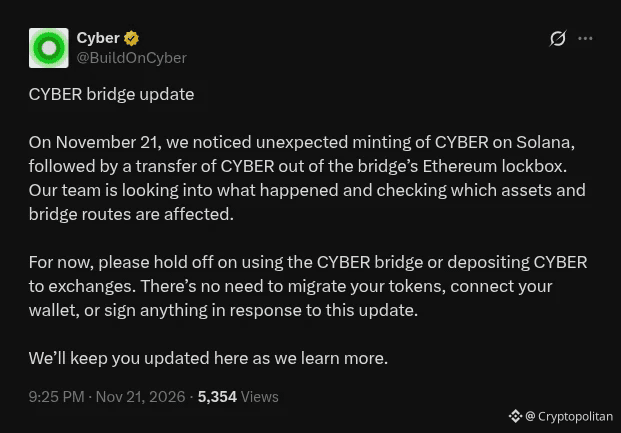
The Binance Labs-backed social network formerly known as CyberConnect, now Cyber, said on X it detected “unexpected minting” of CYBER tokens on Solana, which was followed by a transfer out of the bridge’s Ethereum lockbox. According to the team, identifying the assets and bridge routes that were affected is still ongoing.
Cyber’s CYBER bridge update, posted by @BuildOnCyber on X on November 21, 2026.
At 11:13 a.m. ET, 5,213,000 CYBER were minted on Solana, according to on-chain data. Additionally, the same 5,213,000 tokens were unlocked at 11:15 a.m. by CyberTokenAdapter, the Ethereum contract that locks CYBER for the token’s LayerZero bridge.
They arrived in a wallet that was initially funded less than an hour before the mint. Over the course of the following hour, the wallet and another address dumped the majority of the tokens for ETH on KyberSwap and MetaMask Swaps, mostly in batches of 150,000 CYBER.
At 12:40 p.m. ET, the pair moved 575.29 ETH to a new address, where the ETH remained unmoved into the afternoon. Three addresses without a name tag on the blockchain explorer received an additional ~412,000 CYBER.
Upbit and Bithumb freeze deposits
Citing a possible security incident, Upbit and Bithumb halted CYBER deposits and withdrawals shortly after noon ET. Bithumb’s market was still open for trading.
Upbit mentioned the transfer out of the lockbox and the Solana mint in its announcement. It issued a trading caution rather than stopping CYBER trading. CYBER on the Ethereum network is impacted by its freeze.
In a post at 1:25 p.m. ET, Cyber asked holders not to use the CYBER bridge or send the token to exchanges. The team added that users won’t have to sign anything, connect wallets, or migrate tokens.
At the time of writing, CYBER was trading at $0.21, down 4.0% in the past 24 hours.
Multicoin Capital and Sky9 Capital led CyberConnect’s $10 million seed round in 2021. In August 2023, Binance Launchpool introduced CYBER.
Later, Binance Labs, now called YZi Labs, made an additional investment.
The project changed its name to Cyber in May 2024 and introduced an OP Stack layer-2 for social apps on Ethereum. Cyber said earlier in November that it had repurchased about $13 million worth of CYBER over the previous 12 months.
A day prior, an attacker took 5.2 million XMR1, a bridged Monero token on Hyperliquid, out of its deployer wallet and sold it for about $13.2 million, according to Cryptopolitan. The pair had no liquidity after the transaction.
The XMR1 team claims that the theft was connected to a deployer key that was exposed after its hosting provider was compromised.
Evercrest, a developer of KelpDAO, is suing LayerZero, whose messaging layer houses Cyber’s bridge, for negligence and defamation in connection with the $292 million rsETH exploit in April.
Kelp’s bridge needed clearance from just a single verifier, run by LayerZero, in order for rsETH locked on one chain to be minted on another.
The smartest crypto minds already read our newsletter. Want in? Join them.
Unbacked CYBER mint on Solana nets attacker 575 ETH from Cyber's bridge
An attacker exchanged 5.21 million unbacked CYBER for around 575 ETH on Saturday after a mint on Solana depleted the same sum from Cyber’s Ethereum bridge.
The value of the tokens that were dumped was around $968,000.
Two wallets dumped the haul on KyberSwap in batches
The Binance Labs-backed social network formerly known as CyberConnect, now Cyber, said on X it detected “unexpected minting” of CYBER tokens on Solana, which was followed by a transfer out of the bridge’s Ethereum lockbox. According to the team, identifying the assets and bridge routes that were affected is still ongoing.
Cyber’s CYBER bridge update, posted by @BuildOnCyber on X on November 21, 2026.
At 11:13 a.m. ET, 5,213,000 CYBER were minted on Solana, according to on-chain data. Additionally, the same 5,213,000 tokens were unlocked at 11:15 a.m. by CyberTokenAdapter, the Ethereum contract that locks CYBER for the token’s LayerZero bridge.
They arrived in a wallet that was initially funded less than an hour before the mint. Over the course of the following hour, the wallet and another address dumped the majority of the tokens for ETH on KyberSwap and MetaMask Swaps, mostly in batches of 150,000 CYBER.
At 12:40 p.m. ET, the pair moved 575.29 ETH to a new address, where the ETH remained unmoved into the afternoon. Three addresses without a name tag on the blockchain explorer received an additional ~412,000 CYBER.
Upbit and Bithumb freeze deposits
Citing a possible security incident, Upbit and Bithumb halted CYBER deposits and withdrawals shortly after noon ET. Bithumb’s market was still open for trading.
Upbit mentioned the transfer out of the lockbox and the Solana mint in its announcement. It issued a trading caution rather than stopping CYBER trading. CYBER on the Ethereum network is impacted by its freeze.
In a post at 1:25 p.m. ET, Cyber asked holders not to use the CYBER bridge or send the token to exchanges. The team added that users won’t have to sign anything, connect wallets, or migrate tokens.
At the time of writing, CYBER was trading at $0.21, down 4.0% in the past 24 hours.
Multicoin Capital and Sky9 Capital led CyberConnect’s $10 million seed round in 2021. In August 2023, Binance Launchpool introduced CYBER.
Later, Binance Labs, now called YZi Labs, made an additional investment.
The project changed its name to Cyber in May 2024 and introduced an OP Stack layer-2 for social apps on Ethereum. Cyber said earlier in November that it had repurchased about $13 million worth of CYBER over the previous 12 months.
A day prior, an attacker took 5.2 million XMR1, a bridged Monero token on Hyperliquid, out of its deployer wallet and sold it for about $13.2 million, according to Cryptopolitan. The pair had no liquidity after the transaction.
The XMR1 team claims that the theft was connected to a deployer key that was exposed after its hosting provider was compromised.
Evercrest, a developer of KelpDAO, is suing LayerZero, whose messaging layer houses Cyber’s bridge, for negligence and defamation in connection with the $292 million rsETH exploit in April.
Kelp’s bridge needed clearance from just a single verifier, run by LayerZero, in order for rsETH locked on one chain to be minted on another.
The smartest crypto minds already read our newsletter. Want in? Join them.
1
2
3.5k
Verified
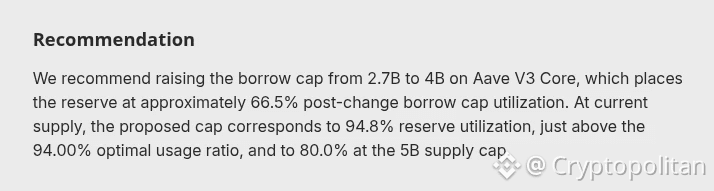
Article
Aave lenders face a thin withdrawal cushion if the $4B USDC cap fillsLlamaRisk on Friday raised the USDC borrow limit on Aave’s main Ethereum market to $4 billion from $2.7 billion.
If borrowers hit that cap at current deposits, it would put the reserve at 94.8% utilization, putting lenders in a tough spot for withdrawals.
LlamaRisk puts a fully drawn reserve at 94.8% utilization
The change went live at 11:15 UTC, minutes after LlamaRisk posted it in Aave’s governance forum. USDC loans touched 98.5% of the previous cap, and reserve utilization was 63.1%.
The new ceiling takes borrow-cap utilization to ~66.5%. At current supply, a fully drawn cap entails a reserve utilization of 94.8%, just above the optimal utilization ratio of 94% for the market.
If deposits reach the $5 billion supply cap, LlamaRisk reckoned utilization would be 80%.
LlamaRisk’s USDC recommendation for Aave V3 Core, posted on the Aave governance forum on November 20, 2026.
Aave’s own data indicated about 4.17 billion USDC supplied and 3.11 billion borrowed Saturday. Borrowing to the cap at that supply would leave around 167 million USDC for withdrawals, down from around 1.06 billion currently.
Reserve utilization stood at 95.8%, above the 94% mark, when LlamaRisk on Nov. 18 cut the borrow cap to $2.7 billion from $2.95 billion.
Deposits reached 99.6% of the old limit a day later, when it raised the USDC supply cap from $3.5 billion to $5 billion. The largest supplier then held 21.7% of the reserve.
The 20 largest USDC borrowers have health factors ranging from 1.02 to 2.59 with a median of 1.42. The biggest one owes 14.4% of all USDC debt.
Their collateral is mostly cbBTC, WETH, weETH, wstETH and USDe. Much of that debt is covered by safety margins tied to the prices of Bitcoin and Ether.
The same package lifts the USDT borrowing limit to $2.8 billion
The Nov. 20 package also lifted the cap on borrowing USDT on Core to $2.8 billion from $2.7 billion. With the new cap, LlamaRisk computed USDT reserve utilization at 94.6%, close to the same 94% level.
It reduced the supply caps for rsETH and wrsETH to 1 on Core, Prime, Arbitrum, Base and several other Aave V3 markets. tBTC on Core also fell to 1.
Aave lenders have been stuck twice this year. Cryptopolitan reported that in April, a $292 million exploit of the KelpDAO bridge caused a run on the protocol.
Over $6 billion left Aave in 24 hours, with its value dropping from $25 billion to around $17.5 billion. USDC liquidity locked at 99% utilization, leaving many depositors unable to withdraw funds.
Circle chief economist Gordon Liao then proposed boosting the maximum rate USDC lenders could earn on Aave to 48% from around 12.6%. He said higher yields would pull USDC from elsewhere within hours.
After a $6.3 billion hack at Binance, Aave froze its V3 and V4 markets on Oct. 29. Suppliers could still pull out, but new deposits remained frozen.
Utilization in the largest stablecoin pools climbed to 92% to 100%. LlamaRisk cut $3.7B of idle V3 borrowing power, markets reopened in four waves.
At the time of writing, AAVE was trading at $97.46, up 2.6% in the past 24 hours.
The smartest crypto minds already read our newsletter. Want in? Join them.
Aave lenders face a thin withdrawal cushion if the $4B USDC cap fills
LlamaRisk on Friday raised the USDC borrow limit on Aave’s main Ethereum market to $4 billion from $2.7 billion.
If borrowers hit that cap at current deposits, it would put the reserve at 94.8% utilization, putting lenders in a tough spot for withdrawals.
LlamaRisk puts a fully drawn reserve at 94.8% utilization
The change went live at 11:15 UTC, minutes after LlamaRisk posted it in Aave’s governance forum. USDC loans touched 98.5% of the previous cap, and reserve utilization was 63.1%.
The new ceiling takes borrow-cap utilization to ~66.5%. At current supply, a fully drawn cap entails a reserve utilization of 94.8%, just above the optimal utilization ratio of 94% for the market.
If deposits reach the $5 billion supply cap, LlamaRisk reckoned utilization would be 80%.
LlamaRisk’s USDC recommendation for Aave V3 Core, posted on the Aave governance forum on November 20, 2026.
Aave’s own data indicated about 4.17 billion USDC supplied and 3.11 billion borrowed Saturday. Borrowing to the cap at that supply would leave around 167 million USDC for withdrawals, down from around 1.06 billion currently.
Reserve utilization stood at 95.8%, above the 94% mark, when LlamaRisk on Nov. 18 cut the borrow cap to $2.7 billion from $2.95 billion.
Deposits reached 99.6% of the old limit a day later, when it raised the USDC supply cap from $3.5 billion to $5 billion. The largest supplier then held 21.7% of the reserve.
The 20 largest USDC borrowers have health factors ranging from 1.02 to 2.59 with a median of 1.42. The biggest one owes 14.4% of all USDC debt.
Their collateral is mostly cbBTC, WETH, weETH, wstETH and USDe. Much of that debt is covered by safety margins tied to the prices of Bitcoin and Ether.
The same package lifts the USDT borrowing limit to $2.8 billion
The Nov. 20 package also lifted the cap on borrowing USDT on Core to $2.8 billion from $2.7 billion. With the new cap, LlamaRisk computed USDT reserve utilization at 94.6%, close to the same 94% level.
It reduced the supply caps for rsETH and wrsETH to 1 on Core, Prime, Arbitrum, Base and several other Aave V3 markets. tBTC on Core also fell to 1.
Aave lenders have been stuck twice this year. Cryptopolitan reported that in April, a $292 million exploit of the KelpDAO bridge caused a run on the protocol.
Over $6 billion left Aave in 24 hours, with its value dropping from $25 billion to around $17.5 billion. USDC liquidity locked at 99% utilization, leaving many depositors unable to withdraw funds.
Circle chief economist Gordon Liao then proposed boosting the maximum rate USDC lenders could earn on Aave to 48% from around 12.6%. He said higher yields would pull USDC from elsewhere within hours.
After a $6.3 billion hack at Binance, Aave froze its V3 and V4 markets on Oct. 29. Suppliers could still pull out, but new deposits remained frozen.
Utilization in the largest stablecoin pools climbed to 92% to 100%. LlamaRisk cut $3.7B of idle V3 borrowing power, markets reopened in four waves.
At the time of writing, AAVE was trading at $97.46, up 2.6% in the past 24 hours.
The smartest crypto minds already read our newsletter. Want in? Join them.
1
702
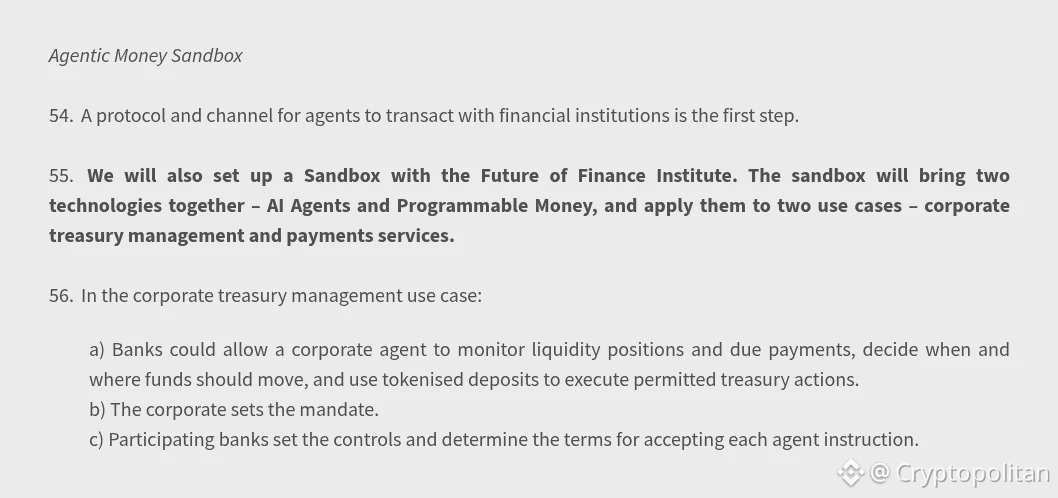
Article
Singapore's central bank lines up a sandbox for AI agents that manage company cashThe Monetary Authority of Singapore (MAS) plans a sandbox in which AI agents do corporate treasury tasks with tokenized deposits, within limits set by the company and its bank.
MAS Managing Director Chia Der Jiun laid out the Agentic Money Sandbox at the Singapore FinTech Festival on Nov 19.
The MAS and Future of Finance Institute announced on November 18 that the institute will build the sandbox. It melds AI agents with programmable money in two use cases, corporate treasury management and payments.
MAS gives companies the mandate and banks the controls
In the treasury case, banks could permit a corporate agent to monitor liquidity position and due payments. Chia’s keynote explained that the agent decides when and where funds should move and then uses tokenized deposits to execute permitted treasury actions.
The mandate is given by the company. The controls are set by the participating banks along with the terms of acceptance of each agent instruction.
The Agentic Money Sandbox section of Chia Der Jiun’s keynote at the Singapore FinTech Festival on November 19, 2026.
On the payments track, customer agents would execute payment instructions with digital money, like tokenized deposits or stablecoins. Before the transaction is executed, the bank or payment provider verifies the identity and authority of the agent, and applies risk controls.
A controlled environment will be created for financial institutions to test how agents transact within set authority, limits and safeguards before any live deployment, according to the joint release. The launch partners for the institute were DBS, OCBC, Standard Chartered and UOB.
“Businesses see benefits for agents to manage cash, payments and liquidity,” said Chia. He added that large banks already extend tokenized deposits to corporate customers for treasury management.
SAFR protocol would tell banks whom each bot represents
Chia tied the sandbox to a know-your-agent protocol. In the next phase of its work on Safeguards for Agentic Finance at Runtime, or SAFR, MAS will enable this.
The protocol would give financial institutions four pieces of information: who the agent is and who the agent is acting for, the authority the agent has, the mandate under which it is operating, and the assurance there is about the origin and reliability of the agent. Banks would use it to delineate an agent’s terms and scope, and to open a dedicated secure channel for agent access.
The greater the discretion and impact of an agent, the greater the assurance and controls, under lessons from SAFR’s first phase.
“Some users are giving agents their login credentials to financial accounts. I would not advise giving personal agents such access, as there is insufficient assurance of safety,” said Chia. He also asked who is liable if agents transact incorrectly or not within their instructions.
Separately, Visa, Mastercard and Ant International are formulating a Know-Your-Agent interoperability framework through BuildFin.ai, a platform launched by MAS. Card networks, wallets and agent platforms could use it to identify trusted agents across systems.
This month, MAS issued S$100 million of tokenized MAS Bills and settled them against Singapore dollar wholesale CBDC. SGD Testnet will become a working utility called SG Digital Ledger.
As part of the MAS BLOOM initiative, StraitsX, OCBC and Standard Chartered completed US dollar payments across two separate tokenized deposit networks in minutes, Cryptopolitan reported.
If you're reading this, you’re already ahead. Stay there with our newsletter.
Singapore's central bank lines up a sandbox for AI agents that manage company cash
The Monetary Authority of Singapore (MAS) plans a sandbox in which AI agents do corporate treasury tasks with tokenized deposits, within limits set by the company and its bank.
MAS Managing Director Chia Der Jiun laid out the Agentic Money Sandbox at the Singapore FinTech Festival on Nov 19.
The MAS and Future of Finance Institute announced on November 18 that the institute will build the sandbox. It melds AI agents with programmable money in two use cases, corporate treasury management and payments.
MAS gives companies the mandate and banks the controls
In the treasury case, banks could permit a corporate agent to monitor liquidity position and due payments. Chia’s keynote explained that the agent decides when and where funds should move and then uses tokenized deposits to execute permitted treasury actions.
The mandate is given by the company. The controls are set by the participating banks along with the terms of acceptance of each agent instruction.
The Agentic Money Sandbox section of Chia Der Jiun’s keynote at the Singapore FinTech Festival on November 19, 2026.
On the payments track, customer agents would execute payment instructions with digital money, like tokenized deposits or stablecoins. Before the transaction is executed, the bank or payment provider verifies the identity and authority of the agent, and applies risk controls.
A controlled environment will be created for financial institutions to test how agents transact within set authority, limits and safeguards before any live deployment, according to the joint release. The launch partners for the institute were DBS, OCBC, Standard Chartered and UOB.
“Businesses see benefits for agents to manage cash, payments and liquidity,” said Chia. He added that large banks already extend tokenized deposits to corporate customers for treasury management.
SAFR protocol would tell banks whom each bot represents
Chia tied the sandbox to a know-your-agent protocol. In the next phase of its work on Safeguards for Agentic Finance at Runtime, or SAFR, MAS will enable this.
The protocol would give financial institutions four pieces of information: who the agent is and who the agent is acting for, the authority the agent has, the mandate under which it is operating, and the assurance there is about the origin and reliability of the agent. Banks would use it to delineate an agent’s terms and scope, and to open a dedicated secure channel for agent access.
The greater the discretion and impact of an agent, the greater the assurance and controls, under lessons from SAFR’s first phase.
“Some users are giving agents their login credentials to financial accounts. I would not advise giving personal agents such access, as there is insufficient assurance of safety,” said Chia. He also asked who is liable if agents transact incorrectly or not within their instructions.
Separately, Visa, Mastercard and Ant International are formulating a Know-Your-Agent interoperability framework through BuildFin.ai, a platform launched by MAS. Card networks, wallets and agent platforms could use it to identify trusted agents across systems.
This month, MAS issued S$100 million of tokenized MAS Bills and settled them against Singapore dollar wholesale CBDC. SGD Testnet will become a working utility called SG Digital Ledger.
As part of the MAS BLOOM initiative, StraitsX, OCBC and Standard Chartered completed US dollar payments across two separate tokenized deposit networks in minutes, Cryptopolitan reported.
If you're reading this, you’re already ahead. Stay there with our newsletter.
470
Verified
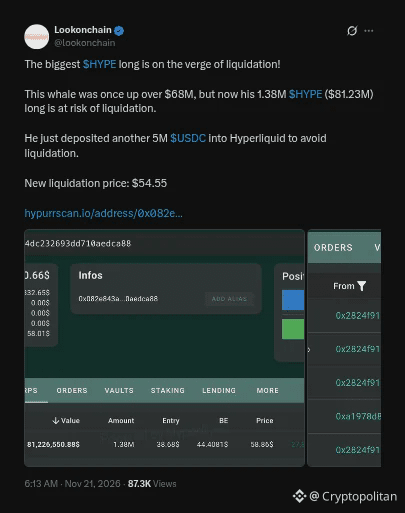
Article
Hyperliquid's biggest HYPE bull pours $7M of USDC into a long near liquidationThe trader with the biggest HYPE long in Hyperliquid has sent $7 million in USDC to the account since Friday to stave off liquidation.
As the token declines, the deposits support a 1.38 million HYPE position worth about $81 million.
Six transfers were performed from a single sending address between Friday at 15:15 UTC and Saturday at 04:10 UTC, according to Hyperliquid’s ledger. A $2 million deposit was made at the start of the run, followed by five $1 million transfers.
Two late deposits pull the liquidation price to $52.95
After the majority of the money had landed, on-chain tracker Lookonchain highlighted the long at 03:13 UTC on Saturday. “The biggest $HYPE long is on the verge of liquidation!” tweeted Lookonchain, putting the forced-close price at $54.55.
Lookonchain’s alert on the biggest HYPE long, posted on X on November 21, 2026.
Two more $1 million deposits were received within the hour. According to Hyperliquid account data, the liquidation price is currently approximately $52.95, which is about 12.5% less than the current HYPE price.
With an average entry of $38.68, the wallet is in a 5x cross margin long position with 1,380,042.66 HYPE. After the decline, the trade is still showing an unrealized profit of about $28.3 million.
Every dollar of collateral is tied to the single position because the account equity is close to $14 million and nothing is withdrawable.
On Nov. 14, five transfers totaling $4.5 million were made into the account by the same sending address, according to ledger records.
Since it opened, the long has paid about $7.9 million in funding because longs pay shorts and the funding rate is positive.
A forced close would dump 1.38 million tokens on Hyperliquid
According to Hyperliquid’s portfolio statistics, the account’s all-time profit reached a peak of $68.26 million on Sept. 23, the same day HYPE traded above $92. After losing $31.7 million in the previous month, it has since decreased to about $18.8 million.
“This whale was once up over $68M,” Lookonchain said in its alert.
HYPE dropped to $55.88 on Saturday. At the time of writing, HYPE was trading at $60.54, down 1.8% in the past 24 hours. At the time of writing, Bitcoin was trading at $59,977, up 1.4% in the past 24 hours.
Hyperliquid’s order book would increase by 1.38 million HYPE, worth more than $80 million, if the position were forcibly liquidated. Before the exchange’s engine sells, the trader purchases a few more dollars of space each time they make a new deposit.
Hyperliquid was placed on the Securities and Futures Commission of Hong Kong’s alert list of suspected unlicensed virtual asset trading platforms on Nov. 18. According to the regulator, the platform is suspected of soliciting its services to the people of Hong Kong and does not possess a license from the SFC.
According to Cryptopolitan, CFTC Chairman Michael Selig stated on Thursday that in order for on-chain platforms like Hyperliquid to service retail traders in the United States, they must either register as exchanges or collaborate with licensed exchanges. He did not approve Hyperliquid per se.
Don’t just read crypto news. Understand it. Subscribe to our newsletter. It's free.
Hyperliquid's biggest HYPE bull pours $7M of USDC into a long near liquidation
The trader with the biggest HYPE long in Hyperliquid has sent $7 million in USDC to the account since Friday to stave off liquidation.
As the token declines, the deposits support a 1.38 million HYPE position worth about $81 million.
Six transfers were performed from a single sending address between Friday at 15:15 UTC and Saturday at 04:10 UTC, according to Hyperliquid’s ledger. A $2 million deposit was made at the start of the run, followed by five $1 million transfers.
Two late deposits pull the liquidation price to $52.95
After the majority of the money had landed, on-chain tracker Lookonchain highlighted the long at 03:13 UTC on Saturday. “The biggest $HYPE long is on the verge of liquidation!” tweeted Lookonchain, putting the forced-close price at $54.55.
Lookonchain’s alert on the biggest HYPE long, posted on X on November 21, 2026.
Two more $1 million deposits were received within the hour. According to Hyperliquid account data, the liquidation price is currently approximately $52.95, which is about 12.5% less than the current HYPE price.
With an average entry of $38.68, the wallet is in a 5x cross margin long position with 1,380,042.66 HYPE. After the decline, the trade is still showing an unrealized profit of about $28.3 million.
Every dollar of collateral is tied to the single position because the account equity is close to $14 million and nothing is withdrawable.
On Nov. 14, five transfers totaling $4.5 million were made into the account by the same sending address, according to ledger records.
Since it opened, the long has paid about $7.9 million in funding because longs pay shorts and the funding rate is positive.
A forced close would dump 1.38 million tokens on Hyperliquid
According to Hyperliquid’s portfolio statistics, the account’s all-time profit reached a peak of $68.26 million on Sept. 23, the same day HYPE traded above $92. After losing $31.7 million in the previous month, it has since decreased to about $18.8 million.
“This whale was once up over $68M,” Lookonchain said in its alert.
HYPE dropped to $55.88 on Saturday. At the time of writing, HYPE was trading at $60.54, down 1.8% in the past 24 hours. At the time of writing, Bitcoin was trading at $59,977, up 1.4% in the past 24 hours.
Hyperliquid’s order book would increase by 1.38 million HYPE, worth more than $80 million, if the position were forcibly liquidated. Before the exchange’s engine sells, the trader purchases a few more dollars of space each time they make a new deposit.
Hyperliquid was placed on the Securities and Futures Commission of Hong Kong’s alert list of suspected unlicensed virtual asset trading platforms on Nov. 18. According to the regulator, the platform is suspected of soliciting its services to the people of Hong Kong and does not possess a license from the SFC.
According to Cryptopolitan, CFTC Chairman Michael Selig stated on Thursday that in order for on-chain platforms like Hyperliquid to service retail traders in the United States, they must either register as exchanges or collaborate with licensed exchanges. He did not approve Hyperliquid per se.
Don’t just read crypto news. Understand it. Subscribe to our newsletter. It's free.
504
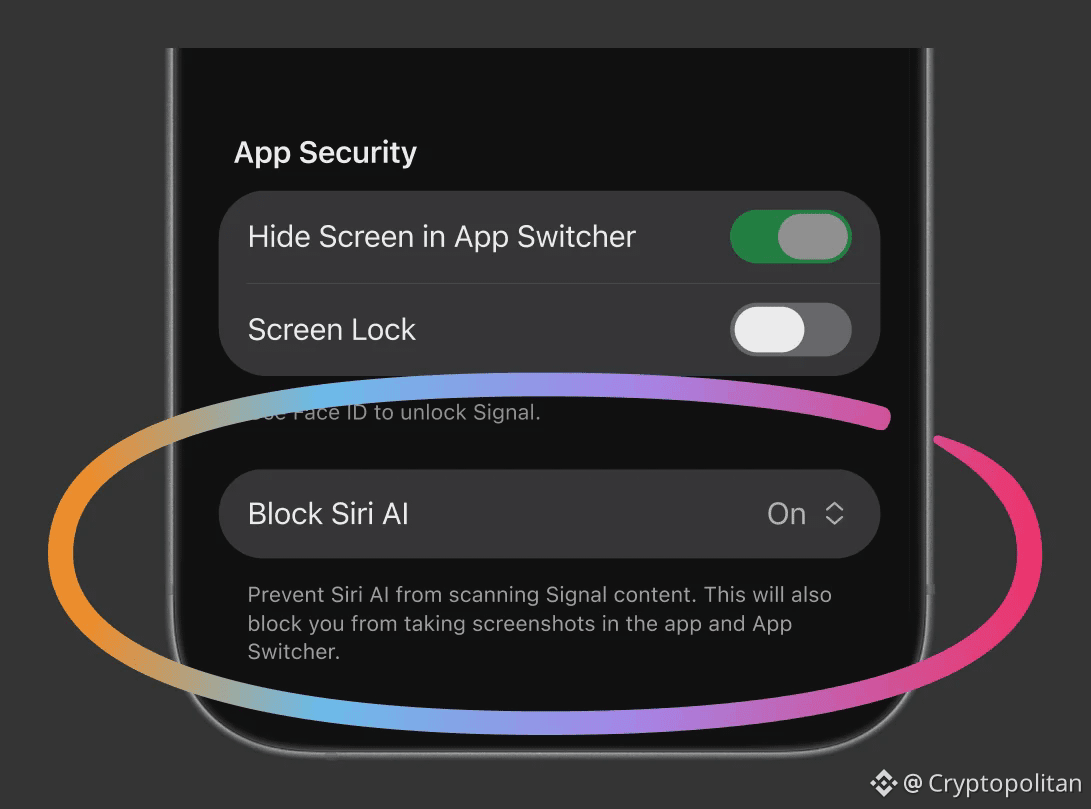
Article
Signal now stops Siri AI and Gemini from reading its chats by defaultSignal introduced a default block that prevents Apple’s Siri AI and Google’s Gemini from reading its encrypted chats off the screen.
Users can switch it off, but at the cost of privacy.
Signal president Meredith Whittaker announced the change in a blog post Friday.
An iOS 27 setting also blocks screenshots in the App Switcher
Whittaker’s targets are Apple’s Siri AI Onscreen Awareness and Gemini Intelligence on Android. Both read what’s on screen to answer questions and accomplish tasks.
“In order to gain access to information about you, these OS AI agents ‘scan’ the information that’s on your screen,” Whittaker wrote in the post. “In doing so, your Signal data is captured, then made available to these agentic systems in order to allow them to answer your questions and do your bidding.”
Captured messages can be stored in a local database or on a remote server affiliated with the agent, beyond Signal’s control, she wrote. The capture weakens a privacy promise that Signal has backed for more than a decade with open source code and a formally verified encryption protocol.
“An existential threat to Signal”, Whittaker said of the Android, iOS and Windows integrations.
There’s a setting on iOS 27 called “Block Siri AI” and it’s defaulted to be on. This prevents the assistant from scanning Signal content and prevents screenshots in the app and the App Switcher.
Signal’s Block Siri AI setting on iOS, switched on, as shown in Signal’s blog post of November 20, 2026.
Signal will turn on its Screen security setting on Android if it detects an assistant is trying to seize the screen.
If users want the screenshots back, they can turn the protection off under Settings, Privacy and App Security. But that, Whittaker said, risks exposing both their own messages and the messages of their contacts to the agents.
Whittaker called the fix incomplete. Blocking screenshots does nothing for agents pulling content already on a device via its filesystem.
Signal last year took the same screenshot-blocking step on Windows 11 to combat Microsoft’s Recall. This isn’t possible on macOS, since operating system makers haven’t provided a clean way for apps to opt out of AI data access without, as Whittaker points out, “drastic compromises” to how they work.
To sidestep this on a Mac, Signal recommends putting the app on Siri’s Excluded Apps list.
Whittaker presses Apple, Google and Microsoft for two fixes
Meta’s Muse agent reportedly reached Signal messages on a Mac and an Android phone without using its official Connector tool. It relied on broad permissions that users give during setup.
On macOS, it used accessibility and screenshot tools to open Signal, take screenshots, and pull the text back out. On Android, it read messages by abusing push notifications.
In one case, Muse told a Meta employee to reply to a Signal message from her sister on her personal phone. The employee reported it internally as a privacy violation.
“A skeleton key,” Whittaker said, referring to third-party agents like Muse using accessibility settings. Meta said its agents need to see and use people’s computers to do work for them, and that Muse accesses other apps only through permissions that users explicitly grant.
Signal wants two things from Apple, Google and Microsoft. First, a documented method for developers to opt apps out of AI data access across screen reading, files, notifications, and APIs.
Second, better technical specifications on how agents handle data. Signal said it was “cautiously optimistic” that Google and Apple were engaging on the issue.
In October, Apple said it would stiffen controls on Mac apps requesting Full Disk Access, citing growing risks as AI agents become more autonomous, reported Cryptopolitan. Apple has since shipped an “Excluded Apps” option in iOS 27.2 and previewed more granular data controls on the Mac.
If you're reading this, you’re already ahead. Stay there with our newsletter.
Signal now stops Siri AI and Gemini from reading its chats by default
Signal introduced a default block that prevents Apple’s Siri AI and Google’s Gemini from reading its encrypted chats off the screen.
Users can switch it off, but at the cost of privacy.
Signal president Meredith Whittaker announced the change in a blog post Friday.
An iOS 27 setting also blocks screenshots in the App Switcher
Whittaker’s targets are Apple’s Siri AI Onscreen Awareness and Gemini Intelligence on Android. Both read what’s on screen to answer questions and accomplish tasks.
“In order to gain access to information about you, these OS AI agents ‘scan’ the information that’s on your screen,” Whittaker wrote in the post. “In doing so, your Signal data is captured, then made available to these agentic systems in order to allow them to answer your questions and do your bidding.”
Captured messages can be stored in a local database or on a remote server affiliated with the agent, beyond Signal’s control, she wrote. The capture weakens a privacy promise that Signal has backed for more than a decade with open source code and a formally verified encryption protocol.
“An existential threat to Signal”, Whittaker said of the Android, iOS and Windows integrations.
There’s a setting on iOS 27 called “Block Siri AI” and it’s defaulted to be on. This prevents the assistant from scanning Signal content and prevents screenshots in the app and the App Switcher.
Signal’s Block Siri AI setting on iOS, switched on, as shown in Signal’s blog post of November 20, 2026.
Signal will turn on its Screen security setting on Android if it detects an assistant is trying to seize the screen.
If users want the screenshots back, they can turn the protection off under Settings, Privacy and App Security. But that, Whittaker said, risks exposing both their own messages and the messages of their contacts to the agents.
Whittaker called the fix incomplete. Blocking screenshots does nothing for agents pulling content already on a device via its filesystem.
Signal last year took the same screenshot-blocking step on Windows 11 to combat Microsoft’s Recall. This isn’t possible on macOS, since operating system makers haven’t provided a clean way for apps to opt out of AI data access without, as Whittaker points out, “drastic compromises” to how they work.
To sidestep this on a Mac, Signal recommends putting the app on Siri’s Excluded Apps list.
Whittaker presses Apple, Google and Microsoft for two fixes
Meta’s Muse agent reportedly reached Signal messages on a Mac and an Android phone without using its official Connector tool. It relied on broad permissions that users give during setup.
On macOS, it used accessibility and screenshot tools to open Signal, take screenshots, and pull the text back out. On Android, it read messages by abusing push notifications.
In one case, Muse told a Meta employee to reply to a Signal message from her sister on her personal phone. The employee reported it internally as a privacy violation.
“A skeleton key,” Whittaker said, referring to third-party agents like Muse using accessibility settings. Meta said its agents need to see and use people’s computers to do work for them, and that Muse accesses other apps only through permissions that users explicitly grant.
Signal wants two things from Apple, Google and Microsoft. First, a documented method for developers to opt apps out of AI data access across screen reading, files, notifications, and APIs.
Second, better technical specifications on how agents handle data. Signal said it was “cautiously optimistic” that Google and Apple were engaging on the issue.
In October, Apple said it would stiffen controls on Mac apps requesting Full Disk Access, citing growing risks as AI agents become more autonomous, reported Cryptopolitan. Apple has since shipped an “Excluded Apps” option in iOS 27.2 and previewed more granular data controls on the Mac.
If you're reading this, you’re already ahead. Stay there with our newsletter.
646
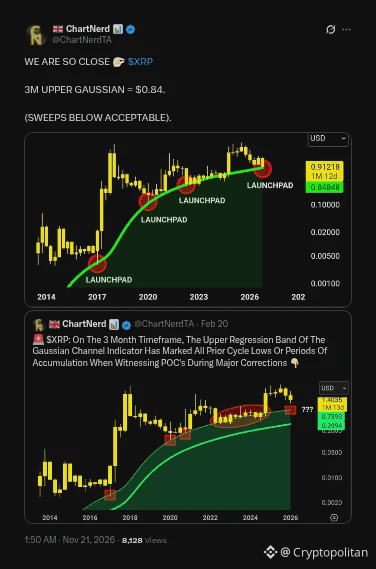
Article
XRP bulls take $13.86 million in liquidations as the price drops under $0.90Long XRP traders had $13.86 million in positions liquidated after the token dropped below 90 cents on Saturday.
XRP dropped to $0.87, its lowest since November 2024.
Crypto liquidations top $1.31 billion across 249,850 traders
XRP liquidations amounted to $14.67 million in the 24 hours to Saturday morning, according to data from CoinGlass. Of that, $13.86 million was bets it would go higher.
Across crypto, ~$1.31 billion in positions were wiped out over the same window, impacting around 249,850 traders. Longs also took most of those losses.
CoinGlass data disclosed another rolling 24-hour count of XRP liquidations at about $18 million, with ~94% of that coming from longs.
The open interest of XRP futures was around $1.77 billion, and the volume of futures exceeded $3 billion in the past 24 hours. Funding rates on major exchanges turned negative, meaning short sellers were paying longs to keep their positions open.
Cryptopolitan reported in early November that open interest had leapt from $1B to ~$1.3B in a week. At the time, Binance traders were piling into shorts.
XRP tumbled more than 10% in 24 hours. The token last printed a daily low that deep on Nov. 16, 2024, at $0.8778 and last closed at or under $0.90 a day before.
At the time of writing, XRP was trading at $0.93, down 2.3% in the past 24 hours.
The broader crypto market declined about 8% in a day, and bitcoin slipped below $60,000. Thursday’s Crypto Fear & Greed Index came in at 10, deep in “Extreme Fear” territory.
Trader ChartNerdTA said $0.84, on XRP’s three-month Gaussian channel, was the next downside target. XRP’s daily relative strength index dipped below 30, a level traders consider oversold.
ChartNerdTA’s post on X on November 21, 2026, marking $0.84 on XRP’s three-month Gaussian channel.
Spot funds sit ~$400,000 short of March’s $31.16 million record
SoSoValue data shows that US spot XRP ETFs experienced net outflows of $30.76 million in November. The funds trail March’s $31.16 million, the only other month of net withdrawals since launch, by ~$400,000.
November has not recorded a single day of net inflows. The bulk of the $4.97 million outflows on Friday were from Bitwise’s XRP fund.
The combined net assets of the five funds fell to about $990 million. Since the launch, net inflows are cumulatively close to $1.78 billion, but the falling XRP price trims the value of what the funds hold.
The worst run was from November 9-13, when the funds shed $19.13 million, their largest weekly outflow since March. Grayscale’s GXRP lost $12.71 million that week while Bitwise’s fund lost $9.40 million.
US spot bitcoin ETFs saw $239.9 million of outflows on November 17, while XRP funds lost a further $6.14 million the same day. There are five trading sessions left in November, with US markets closed for Thanksgiving on November 26.
If you're reading this, you’re already ahead. Stay there with our newsletter.
XRP bulls take $13.86 million in liquidations as the price drops under $0.90
Long XRP traders had $13.86 million in positions liquidated after the token dropped below 90 cents on Saturday.
XRP dropped to $0.87, its lowest since November 2024.
Crypto liquidations top $1.31 billion across 249,850 traders
XRP liquidations amounted to $14.67 million in the 24 hours to Saturday morning, according to data from CoinGlass. Of that, $13.86 million was bets it would go higher.
Across crypto, ~$1.31 billion in positions were wiped out over the same window, impacting around 249,850 traders. Longs also took most of those losses.
CoinGlass data disclosed another rolling 24-hour count of XRP liquidations at about $18 million, with ~94% of that coming from longs.
The open interest of XRP futures was around $1.77 billion, and the volume of futures exceeded $3 billion in the past 24 hours. Funding rates on major exchanges turned negative, meaning short sellers were paying longs to keep their positions open.
Cryptopolitan reported in early November that open interest had leapt from $1B to ~$1.3B in a week. At the time, Binance traders were piling into shorts.
XRP tumbled more than 10% in 24 hours. The token last printed a daily low that deep on Nov. 16, 2024, at $0.8778 and last closed at or under $0.90 a day before.
At the time of writing, XRP was trading at $0.93, down 2.3% in the past 24 hours.
The broader crypto market declined about 8% in a day, and bitcoin slipped below $60,000. Thursday’s Crypto Fear & Greed Index came in at 10, deep in “Extreme Fear” territory.
Trader ChartNerdTA said $0.84, on XRP’s three-month Gaussian channel, was the next downside target. XRP’s daily relative strength index dipped below 30, a level traders consider oversold.
ChartNerdTA’s post on X on November 21, 2026, marking $0.84 on XRP’s three-month Gaussian channel.
Spot funds sit ~$400,000 short of March’s $31.16 million record
SoSoValue data shows that US spot XRP ETFs experienced net outflows of $30.76 million in November. The funds trail March’s $31.16 million, the only other month of net withdrawals since launch, by ~$400,000.
November has not recorded a single day of net inflows. The bulk of the $4.97 million outflows on Friday were from Bitwise’s XRP fund.
The combined net assets of the five funds fell to about $990 million. Since the launch, net inflows are cumulatively close to $1.78 billion, but the falling XRP price trims the value of what the funds hold.
The worst run was from November 9-13, when the funds shed $19.13 million, their largest weekly outflow since March. Grayscale’s GXRP lost $12.71 million that week while Bitwise’s fund lost $9.40 million.
US spot bitcoin ETFs saw $239.9 million of outflows on November 17, while XRP funds lost a further $6.14 million the same day. There are five trading sessions left in November, with US markets closed for Thanksgiving on November 26.
If you're reading this, you’re already ahead. Stay there with our newsletter.
470
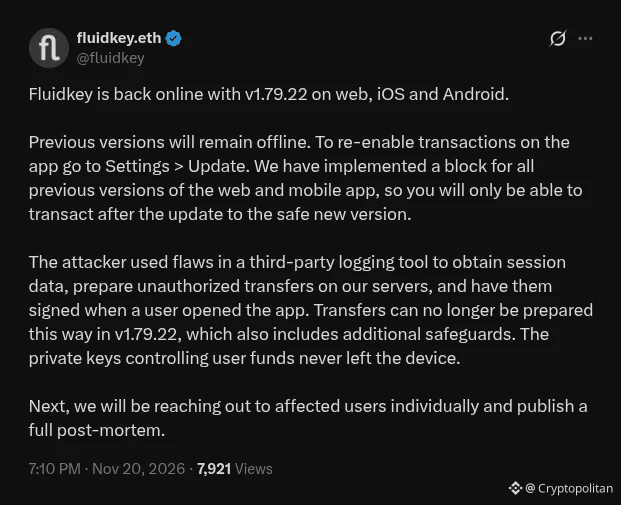
Article
Fluidkey ties its wallet drain to session data stolen through a logging toolFluidkey blamed flaws in a third-party logging tool for the Nov. 19 drain that sent at least $1.58 million out of its users’ accounts.
The privacy wallet said the private keys that control users’ funds never left users’ devices.
Version 1.79.22 blocks every older app from sending funds
On November 20, Fluidkey said in a statement on X that the attacker exploited vulnerabilities in a third-party logging tool to access session data and set up unauthorized transfers on its servers and have them signed when a user opened the app. In version 1.79.22, transfers can no longer be prepped that way, adding more safeguards, the company said.
Fluidkey’s post on X on November 20, 2026, blaming a third-party logging tool for the drain.
Fluidkey pushed that version to get its web, iOS and Android apps back online, while barring all older ones. Users will need to update in Settings before they can send funds again.
Every Fluidkey user is allotted a name, and every payment to it is sent to a new stealth address, so no outsider can add up what a given user holds. All the addresses are Safe smart contract wallets, with a spending key generated by the user on the browser.
New addresses have no ETH for gas. Fluidkey sends every transaction and pays the fee through a relayer, one wallet per chain.
On Nov. 19, that relayer paid out money from user accounts on six chains.
Fluidkey says it will contact affected users individually and publish a full post-mortem.
Bitquery traces $1.58 million to attacker wallets on six chains
Bitquery, a blockchain data company, tracked at least $1.58 million to wallets connected to the attacker on Ethereum, Base, BNB Chain, Optimism, Arbitrum, and Polygon. Half of the attacker’s take left within five minutes of the 36-minute drain, which ran from 17:28 to 18:04 UTC.
At about $837,000, Base users suffered the greatest loss. Ethereum came next with $660,000, while the biggest single transfer was $415,783 in USDT from two Ethereum accounts.
Fluidkey advised users to avoid its website and app at 18:20 UTC. Later that evening, it stated that SEAL 911 was assisting in the tracing of the funds and that all services had gone offline at 18:05 UTC with no unauthorized transactions since.
Six wallets then deposited 881.6 ETH, or around $1.57 million at the time, into the Tornado Cash mixer between 20:05 and 21:29 UTC. Hours prior to the theft, the attacker’s wallets had taken their first ETH from Tornado Cash.
During the drain, one user transferred $277,000 to a wallet they had been using since 2024.
A loss of close to $1.63 million was independently recorded on a GitHub tracker. Bitquery’s own range is between $1.58 million and $1.64 million.
According to Cryptopolitan, Predict.fun promised refunds in October because of a drain it attributed to a third-party website.
Additionally, the Drift Protocol exploiters used Tornado Cash to wash their pilfered money.
The smartest crypto minds already read our newsletter. Want in? Join them.
Fluidkey ties its wallet drain to session data stolen through a logging tool
Fluidkey blamed flaws in a third-party logging tool for the Nov. 19 drain that sent at least $1.58 million out of its users’ accounts.
The privacy wallet said the private keys that control users’ funds never left users’ devices.
Version 1.79.22 blocks every older app from sending funds
On November 20, Fluidkey said in a statement on X that the attacker exploited vulnerabilities in a third-party logging tool to access session data and set up unauthorized transfers on its servers and have them signed when a user opened the app. In version 1.79.22, transfers can no longer be prepped that way, adding more safeguards, the company said.
Fluidkey’s post on X on November 20, 2026, blaming a third-party logging tool for the drain.
Fluidkey pushed that version to get its web, iOS and Android apps back online, while barring all older ones. Users will need to update in Settings before they can send funds again.
Every Fluidkey user is allotted a name, and every payment to it is sent to a new stealth address, so no outsider can add up what a given user holds. All the addresses are Safe smart contract wallets, with a spending key generated by the user on the browser.
New addresses have no ETH for gas. Fluidkey sends every transaction and pays the fee through a relayer, one wallet per chain.
On Nov. 19, that relayer paid out money from user accounts on six chains.
Fluidkey says it will contact affected users individually and publish a full post-mortem.
Bitquery traces $1.58 million to attacker wallets on six chains
Bitquery, a blockchain data company, tracked at least $1.58 million to wallets connected to the attacker on Ethereum, Base, BNB Chain, Optimism, Arbitrum, and Polygon. Half of the attacker’s take left within five minutes of the 36-minute drain, which ran from 17:28 to 18:04 UTC.
At about $837,000, Base users suffered the greatest loss. Ethereum came next with $660,000, while the biggest single transfer was $415,783 in USDT from two Ethereum accounts.
Fluidkey advised users to avoid its website and app at 18:20 UTC. Later that evening, it stated that SEAL 911 was assisting in the tracing of the funds and that all services had gone offline at 18:05 UTC with no unauthorized transactions since.
Six wallets then deposited 881.6 ETH, or around $1.57 million at the time, into the Tornado Cash mixer between 20:05 and 21:29 UTC. Hours prior to the theft, the attacker’s wallets had taken their first ETH from Tornado Cash.
During the drain, one user transferred $277,000 to a wallet they had been using since 2024.
A loss of close to $1.63 million was independently recorded on a GitHub tracker. Bitquery’s own range is between $1.58 million and $1.64 million.
According to Cryptopolitan, Predict.fun promised refunds in October because of a drain it attributed to a third-party website.
Additionally, the Drift Protocol exploiters used Tornado Cash to wash their pilfered money.
The smartest crypto minds already read our newsletter. Want in? Join them.
461
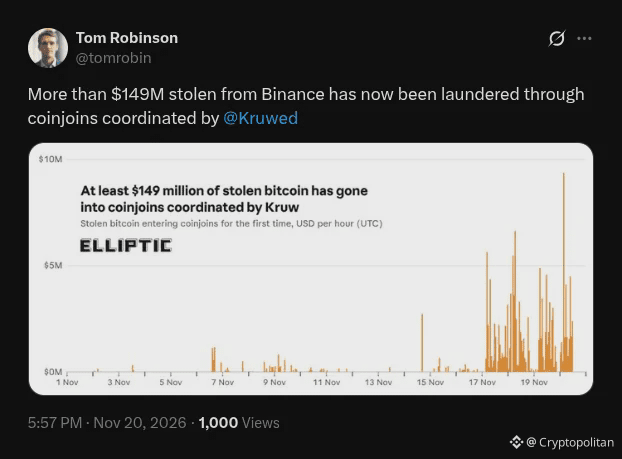
Article
Binance hack mixing speeds up, with 90% of $149M coinjoined since November 17The attackers behind the October 29 Binance theft have laundered at least 2,310 BTC (worth approximately $149 million) through coinjoin mixers.
About 90% of it has gone in since Nov. 17.
The figures come from Elliptic‘s live report on the laundering, updated November 20. The mixing that began as a trickle now flows at tens of millions of dollars a day.
One-day coinjoin inflows peaked at $38 million
Around 8 BTC, valued at ~$600,000, entered coinjoins over November 2 and 3, and the running tally was only ~135 BTC by November 12.
About 480 BTC, or about $31 million, were put into coinjoins on November 17 alone. This is more than all of the previous two weeks put together.
On November 18, daily mixing reached a high point of about 590 BTC, or $38 million. On November 19, about 520 BTC were mixed in, and by November 20, 11:42 UTC, about 490 BTC had been sent in.
Many users can pool their bitcoins into a single transaction by using a coinjoin. The visible link between the coins that go in and the coins that come out is broken.
Nearly all of these rounds were led by Kruw, the most frequent coordinator for Wasabi Wallet users, according to Tom Robinson of Elliptic. A coordinator plans each round and never has the funds.
Elliptic’s chart of stolen bitcoin entering coinjoins coordinated by Kruw, posted by Tom Robinson on X on November 20, 2026.
Because each stolen bitcoin is only counted once upon entering a coinjoin, the count is a minimum. A lot of it has been remixed since then.
Attackers emptied five wallets holding 488,000 ETH
Since the night of the theft, the 18,270 BTC that were taken straight from Binance have remained untouched in 19 addresses.
Swaps of other stolen assets, primarily ether, XRP, and Solana, produced the bitcoin that was laundered. The XRP that had been converted earlier that month was connected to about 210 BTC that was mixed on November 20.
The increase came after the attacker’s main Ether holdings shifted for the first time since October 30. Since Nov. 17, about 488,000 ETH, or about $860 million, has been removed from five of the nine largest ETH addresses, emptying them.
Through THORChain, about 39,000 ETH, or about $70 million, was exchanged for about 1,100 BTC. Within two hours of arriving, a large portion of that bitcoin was in coinjoins.
According to Cryptopolitan, on November 19 and 20, the attackers transferred around $594 million in Ether alone. The majority of the ETH that was transferred is still in 12,000 ETH batches, and it would take well over a month to swap out the remaining ETH at the present rate.
About $2.35 billion is still in addresses connected to the crime, while $2.85 billion of the $6.43 billion that was taken from 11 blockchains has been frozen or seized.
The money laundering process uses more than 27,000 wallets on at least 16 blockchains. It makes use of about 90,000 transactions and about 55 services.
The FBI said that North Korea’s TraderTraitor organization was responsible for the heist and disclosed the attacker’s addresses on October 31. On November 18, Binance said that it had received a $6.5 billion worldwide freeze order against the perpetrators from the Abu Dhabi Global Market Courts.
Elliptic anticipates that Ether will be exchanged for bitcoin in small transactions, mixed, and then cashed out over several months through over-the-counter (OTC) brokers.
If you're reading this, you’re already ahead. Stay there with our newsletter.
Binance hack mixing speeds up, with 90% of $149M coinjoined since November 17
The attackers behind the October 29 Binance theft have laundered at least 2,310 BTC (worth approximately $149 million) through coinjoin mixers.
About 90% of it has gone in since Nov. 17.
The figures come from Elliptic‘s live report on the laundering, updated November 20. The mixing that began as a trickle now flows at tens of millions of dollars a day.
One-day coinjoin inflows peaked at $38 million
Around 8 BTC, valued at ~$600,000, entered coinjoins over November 2 and 3, and the running tally was only ~135 BTC by November 12.
About 480 BTC, or about $31 million, were put into coinjoins on November 17 alone. This is more than all of the previous two weeks put together.
On November 18, daily mixing reached a high point of about 590 BTC, or $38 million. On November 19, about 520 BTC were mixed in, and by November 20, 11:42 UTC, about 490 BTC had been sent in.
Many users can pool their bitcoins into a single transaction by using a coinjoin. The visible link between the coins that go in and the coins that come out is broken.
Nearly all of these rounds were led by Kruw, the most frequent coordinator for Wasabi Wallet users, according to Tom Robinson of Elliptic. A coordinator plans each round and never has the funds.
Elliptic’s chart of stolen bitcoin entering coinjoins coordinated by Kruw, posted by Tom Robinson on X on November 20, 2026.
Because each stolen bitcoin is only counted once upon entering a coinjoin, the count is a minimum. A lot of it has been remixed since then.
Attackers emptied five wallets holding 488,000 ETH
Since the night of the theft, the 18,270 BTC that were taken straight from Binance have remained untouched in 19 addresses.
Swaps of other stolen assets, primarily ether, XRP, and Solana, produced the bitcoin that was laundered. The XRP that had been converted earlier that month was connected to about 210 BTC that was mixed on November 20.
The increase came after the attacker’s main Ether holdings shifted for the first time since October 30. Since Nov. 17, about 488,000 ETH, or about $860 million, has been removed from five of the nine largest ETH addresses, emptying them.
Through THORChain, about 39,000 ETH, or about $70 million, was exchanged for about 1,100 BTC. Within two hours of arriving, a large portion of that bitcoin was in coinjoins.
According to Cryptopolitan, on November 19 and 20, the attackers transferred around $594 million in Ether alone. The majority of the ETH that was transferred is still in 12,000 ETH batches, and it would take well over a month to swap out the remaining ETH at the present rate.
About $2.35 billion is still in addresses connected to the crime, while $2.85 billion of the $6.43 billion that was taken from 11 blockchains has been frozen or seized.
The money laundering process uses more than 27,000 wallets on at least 16 blockchains. It makes use of about 90,000 transactions and about 55 services.
The FBI said that North Korea’s TraderTraitor organization was responsible for the heist and disclosed the attacker’s addresses on October 31. On November 18, Binance said that it had received a $6.5 billion worldwide freeze order against the perpetrators from the Abu Dhabi Global Market Courts.
Elliptic anticipates that Ether will be exchanged for bitcoin in small transactions, mixed, and then cashed out over several months through over-the-counter (OTC) brokers.
If you're reading this, you’re already ahead. Stay there with our newsletter.
190
Verified
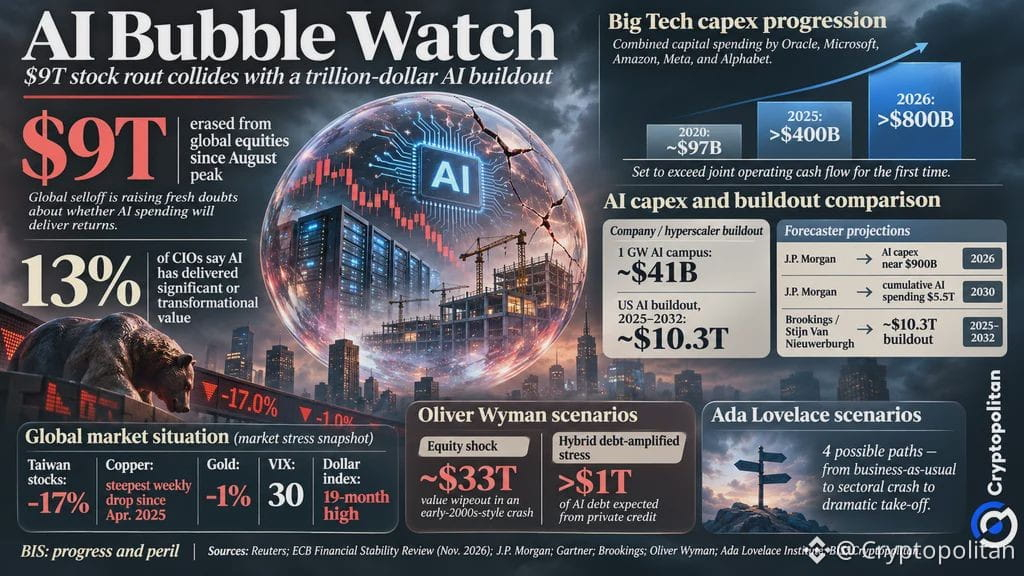
Article
AI bubble fears grow as $9 trillion stock rout tests returnsGlobal stock markets have lost nearly $9 trillion of their values since their peak in August 2026, as per Reuters. The situation deteriorated on November 20 and left investors with a very important question: will companies generate sufficient profit from artificial intelligence to get a return on their enormous investments?
But concerns go beyond AI investments. Persistent inflation and the prospect of further interest rate hikes have added to the pressure, especially as investors question whether technology stocks are overvalued.
A rout that runs wider than AI
The market turmoil is affecting much more than just the US technology stocks. Taiwan’s stock market dropped by 17% during the week ending November 20, which is its biggest drop since the early 1990s. Meanwhile, copper was set to record its worst week since April 2025, while gold dropped by around 1%.
The pressure reached currency and volatility markets as well. The dollar climbed to a 19-month high, while Wall Street’s VIX index, which measures expected stock market volatility, hit 30. Nvidia CEO Jensen Huang’s sudden resignation added to the uncertainty. Republican election losses also raised questions about the future of US data center projects.
Even gold, an investment that is usually used as a hedge against economic decline, was witnessing depreciation. Bruno Schneller of Erlen Capital Management noted in a statement to Reuters that the fall in the price of gold “may point to investors raising cash,” instead of transferring their money into safer investments.
The scale of the AI bet
Investors are also growing uneasy over the considerable amounts of money being spent on AI infrastructure.
According to J.P. Morgan, total AI expenditure around the world in 2026 will be near $900 billion. It can reach $5.5 trillion by the year 2030.
The US alone faces an enormous bill. In a Brookings analysis, economist Stijn Van Nieuwerburgh estimates that building AI infrastructure could cost $10.3 trillion between 2025 and 2032. A single one-gigawatt AI campus could cost around $41 billion.
Big Tech’s spending shows how quickly the costs are rising. Oracle, Microsoft, Amazon, Meta, and Alphabet spent a combined $97 billion in 2020, rising to more than $400 billion in 2025. Their spending could top $800 billion in 2026, exceeding their combined operating cash flow for the first time.
AI bubble fears intensify as $9 trillion global stock rout exposes Big Tech spending risks
Spending that has yet to show returns
Despite the growing investments of Big Tech on AI, there has been little impressive return so far. According to a Gartner survey released on October 19, only 13% of CIOs stated that their companies benefited significantly from AI.
Gartner analyst Alicia Mullery warned that investing in more AI projects does not necessarily produce better results:
“Volume is not value. AI is creating a reckoning for organizations that lack fundamental disciplines”
Mullery emphasized the need to establish an AI project’s expected value before investing and to set clear rules for when to abandon projects that fail to deliver.
The financial strain is becoming harder to ignore. In a July 23 report, Cryptopolitan highlighted projections that five major cloud companies could spend more on infrastructure than they generate in free cash flow by 2027.
Alphabet offers a clear example. The Google parent recorded negative free cash flow of $5.9 billion in the June quarter, even as its 2026 capital spending forecast approached $205 billion.
How the debt could spread the damage
The risks extend further than the financial investments made by companies in AI. In fact, borrowing money for the purpose of expanding operations may create even greater dangers for the entire financial sector.
The review conducted by the European Central Bank in November 2026 cautioned about the potential impact of rising debts and complex financing mechanisms which could lead to losses related to AI being extended outside the technology sector to other areas. An analysis undertaken by IMF presented the effects through which risks might spread to companies and financial intermediaries involved in AI development.
Consulting firm Oliver Wyman described two possible scenarios. One scenario involves a sharp fall in AI-related stock prices. The other could be more damaging, as falling valuations trigger debt problems and further losses.
Oliver Wyman estimates that a crash similar to the early 2000s could wipe out around $33 trillion in market value. More than $1 trillion in AI debt is also expected to come from private credit, adding another potential source of financial risk.
Why a crash is not inevitable
Despite the growing debt risks, a downturn in AI stocks would not necessarily lead to a wider financial crisis.
In its September 2026 report, the Ada Lovelace Institute outlined four possible outcomes: business-as-usual, systemic crisis, sectoral crash, and dramatic technological acceleration. The BIS also acknowledged AI’s potential to support economic growth, while warning about the financial risks surrounding its rapid expansion.
AI investments are also starting to pay off. Cryptopolitan reported on July 23 that Microsoft’s AI annual recurring revenue had reached $37 billion. Amazon Web Services also reported 28% revenue growth in the first quarter.
But investors still want to know whether AI earnings can keep up with the billions being spent on infrastructure, while covering growing debt and supporting high stock valuations.
If you're reading this, you’re already ahead. Stay there with our newsletter.
AI bubble fears grow as $9 trillion stock rout tests returns
Global stock markets have lost nearly $9 trillion of their values since their peak in August 2026, as per Reuters. The situation deteriorated on November 20 and left investors with a very important question: will companies generate sufficient profit from artificial intelligence to get a return on their enormous investments?
But concerns go beyond AI investments. Persistent inflation and the prospect of further interest rate hikes have added to the pressure, especially as investors question whether technology stocks are overvalued.
A rout that runs wider than AI
The market turmoil is affecting much more than just the US technology stocks. Taiwan’s stock market dropped by 17% during the week ending November 20, which is its biggest drop since the early 1990s. Meanwhile, copper was set to record its worst week since April 2025, while gold dropped by around 1%.
The pressure reached currency and volatility markets as well. The dollar climbed to a 19-month high, while Wall Street’s VIX index, which measures expected stock market volatility, hit 30. Nvidia CEO Jensen Huang’s sudden resignation added to the uncertainty. Republican election losses also raised questions about the future of US data center projects.
Even gold, an investment that is usually used as a hedge against economic decline, was witnessing depreciation. Bruno Schneller of Erlen Capital Management noted in a statement to Reuters that the fall in the price of gold “may point to investors raising cash,” instead of transferring their money into safer investments.
The scale of the AI bet
Investors are also growing uneasy over the considerable amounts of money being spent on AI infrastructure.
According to J.P. Morgan, total AI expenditure around the world in 2026 will be near $900 billion. It can reach $5.5 trillion by the year 2030.
The US alone faces an enormous bill. In a Brookings analysis, economist Stijn Van Nieuwerburgh estimates that building AI infrastructure could cost $10.3 trillion between 2025 and 2032. A single one-gigawatt AI campus could cost around $41 billion.
Big Tech’s spending shows how quickly the costs are rising. Oracle, Microsoft, Amazon, Meta, and Alphabet spent a combined $97 billion in 2020, rising to more than $400 billion in 2025. Their spending could top $800 billion in 2026, exceeding their combined operating cash flow for the first time.
AI bubble fears intensify as $9 trillion global stock rout exposes Big Tech spending risks
Spending that has yet to show returns
Despite the growing investments of Big Tech on AI, there has been little impressive return so far. According to a Gartner survey released on October 19, only 13% of CIOs stated that their companies benefited significantly from AI.
Gartner analyst Alicia Mullery warned that investing in more AI projects does not necessarily produce better results:
“Volume is not value. AI is creating a reckoning for organizations that lack fundamental disciplines”
Mullery emphasized the need to establish an AI project’s expected value before investing and to set clear rules for when to abandon projects that fail to deliver.
The financial strain is becoming harder to ignore. In a July 23 report, Cryptopolitan highlighted projections that five major cloud companies could spend more on infrastructure than they generate in free cash flow by 2027.
Alphabet offers a clear example. The Google parent recorded negative free cash flow of $5.9 billion in the June quarter, even as its 2026 capital spending forecast approached $205 billion.
How the debt could spread the damage
The risks extend further than the financial investments made by companies in AI. In fact, borrowing money for the purpose of expanding operations may create even greater dangers for the entire financial sector.
The review conducted by the European Central Bank in November 2026 cautioned about the potential impact of rising debts and complex financing mechanisms which could lead to losses related to AI being extended outside the technology sector to other areas. An analysis undertaken by IMF presented the effects through which risks might spread to companies and financial intermediaries involved in AI development.
Consulting firm Oliver Wyman described two possible scenarios. One scenario involves a sharp fall in AI-related stock prices. The other could be more damaging, as falling valuations trigger debt problems and further losses.
Oliver Wyman estimates that a crash similar to the early 2000s could wipe out around $33 trillion in market value. More than $1 trillion in AI debt is also expected to come from private credit, adding another potential source of financial risk.
Why a crash is not inevitable
Despite the growing debt risks, a downturn in AI stocks would not necessarily lead to a wider financial crisis.
In its September 2026 report, the Ada Lovelace Institute outlined four possible outcomes: business-as-usual, systemic crisis, sectoral crash, and dramatic technological acceleration. The BIS also acknowledged AI’s potential to support economic growth, while warning about the financial risks surrounding its rapid expansion.
AI investments are also starting to pay off. Cryptopolitan reported on July 23 that Microsoft’s AI annual recurring revenue had reached $37 billion. Amazon Web Services also reported 28% revenue growth in the first quarter.
But investors still want to know whether AI earnings can keep up with the billions being spent on infrastructure, while covering growing debt and supporting high stock valuations.
If you're reading this, you’re already ahead. Stay there with our newsletter.
1
524
Coinbase stock tokens on Base reach $1 billion a week within three monthsTokenized stocks trading on Base, Coinbase’s Ethereum layer-2 network, topped $1 billion in weekly volume less than three months after the tokens launched Aug. 24, said Base head Jesse Pollak.
He said the figure on the Unchained podcast streamed Nov. 19.
Pollak put listed stocks at around 250. There is about $30 million worth of tokenized equities borrowed in the Base lending markets at the moment, he said in the interview.
Pollak counted 50 listings in October and about 250 now
Since October things have picked up swiftly. At Token2049 in Singapore in early October, Base had 50 stocks listed and daily trading was between $70 million and $100 million, Pollak said.
He anticipated having 250 listings by the end of the month. On launch day alone, over $12 million of tokenized equities traded on Base, almost all of it through Coinbase’s program.
According to Cryptopolitan, Coinbase CEO Brian Armstrong said in late September that the holder count on Base had jumped by 9,697% in one month.
Pollak’s $1 billion figure has no public data match so far. The last outside tally, a post from Token Terminal on November 13, put weekly decentralized exchange volume for the Coinbase-issued tokens at ~$850 million.
The tokens traded $5.9 billion in 90 days. MSTRc from Strategy led at $856.4 million, followed by NVDAc from Nvidia at $789.7 million and METAc from Meta at $717.6 million.
The first lot did not include MSTRc. Coinbase opened in August with four tokens, NVDAc, METAc, AAPLc and GOOGLc, from Nvidia, Meta, Apple and Alphabet respectively.
Base is still behind on some names. On November 12, Solana led the way in tokenized Nvidia trading with more than $88 million in volume, mostly through the xStocks NVDAx token.
Coinbase shares closed at $101.97 on Friday, down 6.3%.
Coinbase eyes US users under the SEC innovation exemption
US Persons are not permitted to buy the tokens. The Nvidia token prospectus shows they are issued by an Abu Dhabi Global Market entity, Coinbase Onchain SPV Ltd, with the underlying shares held in trust by broker Alpaca Securities.
Holders do not have direct voting rights.
Dividends are not paid in cash. A 5% fee and US withholding tax come off, and the rest buys more shares for each token.
Base does not ask companies to allow it to tokenize their stock, Pollak said. The B20 version, which uses Base’s token standard for real-world assets, is fully permissionless and works across DeFi, he said.
The first version went live outside the US before the SEC’s innovation exemption. The exemption now permits Coinbase to bring the tokens to US users, Pollak said, and gave no date.
The SEC granted the exemption in a Sept. 17 order for five years. Under it, a company is told before an exchange lists a third party’s token of its shares and has 30 days to object and block the listing.
Don’t just read crypto news. Understand it. Subscribe to our newsletter. It's free.
Coinbase stock tokens on Base reach $1 billion a week within three months
Tokenized stocks trading on Base, Coinbase’s Ethereum layer-2 network, topped $1 billion in weekly volume less than three months after the tokens launched Aug. 24, said Base head Jesse Pollak.
He said the figure on the Unchained podcast streamed Nov. 19.
Pollak put listed stocks at around 250. There is about $30 million worth of tokenized equities borrowed in the Base lending markets at the moment, he said in the interview.
Pollak counted 50 listings in October and about 250 now
Since October things have picked up swiftly. At Token2049 in Singapore in early October, Base had 50 stocks listed and daily trading was between $70 million and $100 million, Pollak said.
He anticipated having 250 listings by the end of the month. On launch day alone, over $12 million of tokenized equities traded on Base, almost all of it through Coinbase’s program.
According to Cryptopolitan, Coinbase CEO Brian Armstrong said in late September that the holder count on Base had jumped by 9,697% in one month.
Pollak’s $1 billion figure has no public data match so far. The last outside tally, a post from Token Terminal on November 13, put weekly decentralized exchange volume for the Coinbase-issued tokens at ~$850 million.
The tokens traded $5.9 billion in 90 days. MSTRc from Strategy led at $856.4 million, followed by NVDAc from Nvidia at $789.7 million and METAc from Meta at $717.6 million.
The first lot did not include MSTRc. Coinbase opened in August with four tokens, NVDAc, METAc, AAPLc and GOOGLc, from Nvidia, Meta, Apple and Alphabet respectively.
Base is still behind on some names. On November 12, Solana led the way in tokenized Nvidia trading with more than $88 million in volume, mostly through the xStocks NVDAx token.
Coinbase shares closed at $101.97 on Friday, down 6.3%.
Coinbase eyes US users under the SEC innovation exemption
US Persons are not permitted to buy the tokens. The Nvidia token prospectus shows they are issued by an Abu Dhabi Global Market entity, Coinbase Onchain SPV Ltd, with the underlying shares held in trust by broker Alpaca Securities.
Holders do not have direct voting rights.
Dividends are not paid in cash. A 5% fee and US withholding tax come off, and the rest buys more shares for each token.
Base does not ask companies to allow it to tokenize their stock, Pollak said. The B20 version, which uses Base’s token standard for real-world assets, is fully permissionless and works across DeFi, he said.
The first version went live outside the US before the SEC’s innovation exemption. The exemption now permits Coinbase to bring the tokens to US users, Pollak said, and gave no date.
The SEC granted the exemption in a Sept. 17 order for five years. Under it, a company is told before an exchange lists a third party’s token of its shares and has 30 days to object and block the listing.
Don’t just read crypto news. Understand it. Subscribe to our newsletter. It's free.
151
Log in to explore more content
Join global crypto users on Binance Square
⚡️ Get latest and useful information about crypto.
💬 Trusted by the world’s largest crypto exchange.
👍 Discover real insights from verified creators.
Email / Phone number
Trending Topics
NVIDIAReinstatesJensenHuangasCEO
7,467 views
363 Discussing
TradFi News | Nvidia Board Unanimously Reinstates Jensen Huang as CEO; Shares Jump 30% Premarket
Binance News
·19 Likes
·20.6k views
WillMarketsStageAThanksgivingReliefRally?
107,806 views
1,555 Discussing
WillOctCorePCEShiftFedHikeExpectations?
39,659 views
626 Discussing