

灼见Cryptosighted
1k Posts

灼见Cryptosighted
 Square Verified+
Report
Block User
灼见|K线只是表象,人心才是博弈的终点。
13年实战沉淀,拒绝废话,只做最硬核的技术拆解与宏观透视。帮你看清下一步。如果你厌倦了噪音,这里是你的最后一站。
Open Trade

BTC Holder
Occasional Trader
8.6 Years
763 Following
31.6K+ Followers
12.3K+ Liked
Posts
Portfolio
All
Quotes
Videos
PINNED
🚨 PEPE surged 15.66% in a day! BTC is still grinding along, while some traders have already started piling into Meme coins.
One figure really stands out on the October 28 gainers list:
PEPE: +15.66% in 24 hours
BTW: +26.35%
MemeCore: +13.33%
ZRO: +6.69%
ZEC: +6.45%
Source: CoinGecko, snapshot taken at 09:15 UTC on October 28.
PEPE is the one I’m watching most closely this time.
Not because a gain of more than 10% means it’s bound to keep rising, but because this kind of market can easily reveal short-term capital preferences.
When BTC’s price action isn’t exciting enough, some traders turn their attention to Meme coins with greater volatility.
But that raises a question:
Is PEPE’s 15% gain driven by fresh money coming in, or by short-term traders rushing in early?
I think there are three signals to watch next:
① Trading volume: Can volume stay high after the rise? If the price surges but volume fails to keep up, be careful.
② The pullback: Can it hold on to most of its gains after the spike? If it quickly falls back to where the rally began, its short-term strength may prove fleeting.
③ Sector-wide movement: Are DOGE and other Meme coins following suit? If PEPE is the only one surging, its staying power is questionable.
There’s another number that’s easy to overlook:
After a 15% gain, a 15% drop doesn’t take you back to where you started—it leaves you 2.25% below your starting point.
So I don’t think the most important thing right now is guessing how much further PEPE can rise.
What’s really worth watching is whether buyers can absorb the selling after the first wave of profit-taking.
A surge grabs attention; the pullback is what really tests the market’s appetite.
If you haven’t bought in yet, would you chase PEPE now, or wait for a pullback?
#BTC #ETH #BNB

404
1
14
856

Sherry长得帅不如跑的快1688
·
--
🚨 SAME AI BOOM, VERY DIFFERENT CASH FLOWS!
Microsoft generated $18.6 BILLION in quarterly free cash flow.
Alphabet reported NEGATIVE $9.07 BILLION!
Both cloud businesses are booming. So why are investors reacting so differently?
Latest earnings released October 28:
📊 MICROSOFT
☁️ Azure revenue: $33.17B, up 48% YoY
💰 Quarterly free cash flow: +$18.6B
📊 ALPHABET
☁️ Google Cloud revenue: $30.71B, more than doubled YoY
💸 Quarterly free cash flow: -$9.07B
📉 Shares fell in after-hours trading
Important: These are FREE CASH FLOW figures, not net income.
Four signals matter 👇
🚀 ① AI demand remains strong as cloud revenue expands
💵 ② Investors increasingly want evidence that AI spending generates sustainable cash flow
🏦 ③ The Fed just held rates at 3.75%–4.00%, with two policymakers favoring a hike
₿ ④ BTC, ETH and BNB may respond to tech-sector risk sentiment, but no direct price relationship is guaranteed
THE REAL QUESTION:
AI GROWTH OR CASH FLOW?
CORE VARIABLES:
AI MONETIZATION × CAPITAL SPENDING × FED POLICY
What I'm watching:
👀 Alphabet's future capital spending
👀 Sustainability of Azure growth
👀 Amazon AWS earnings
👀 U.S. PCE inflation and 10-year Treasury yields
👀 BTC, ETH and BNB volume and ETF flows
The AI race is entering a new phase!
It's no longer just about who spends more.
It's about who turns investment into sustainable cash generation.
👇 Which matters more?
🟢 GROWTH: AI expansion comes first
🔴 CASH FLOW: Sustainable cash generation is the real advantage
#BTC #ETH #BNB

86
U.S. stocks are up, but BTC is still struggling around $80,000.
Something about this market feels off to me.
A few data points make it clear:
📈 U.S. market close on October 27
Nasdaq: +1.2%
S&P 500: +0.6%
📊 Crypto market snapshot that evening
BTC: $80,676
ETH: $2,345
BNB: $748
SOL: $101
What’s even more interesting is the flow of funds.
U.S. spot ETFs on October 26:
BTC: $110.3 million in net inflows
ETH: $88.6 million in net outflows
These are both crypto assets, yet their fund flows are clearly diverging.
Looking further back, BTC spot ETFs saw about $525 million in inflows on October 21, followed by about $636 million in outflows on the 22nd.
In just two days, the flow of funds reversed.
So I’m not buying the idea that “when U.S. stocks rise, crypto immediately takes off.”
The real question is:
If Wall Street’s risk appetite is improving, why hasn’t BTC made a convincing breakout yet?
There are also two key events to watch today:
① The Fed’s rate decision. The market cares not only about whether rates stay unchanged, but also about the tone of its guidance on future policy.
② Earnings from Microsoft and Alphabet, Google’s parent company. AI spending, profit expectations, and the reaction in tech stocks could all affect sentiment toward risk assets.
From here, I’ll be watching three signals:
Can BTC hold above $80,000 and move toward the $82,000–$85,000 range?
Can ETH stop underperforming BTC?
Can ETF flows remain positive day after day, rather than buying today and selling tomorrow?
If these three factors don’t align, caution is still warranted on any short-term rebound.
The biggest thing to be wary of right now isn’t that prices haven’t risen—it’s that good news is coming out, yet the market can’t seem to rally.
After the Fed’s decision, do you think BTC will break above $85,000 first, or fall back below $80,000?
#BTC #ETH #BNB

941
19
53
941
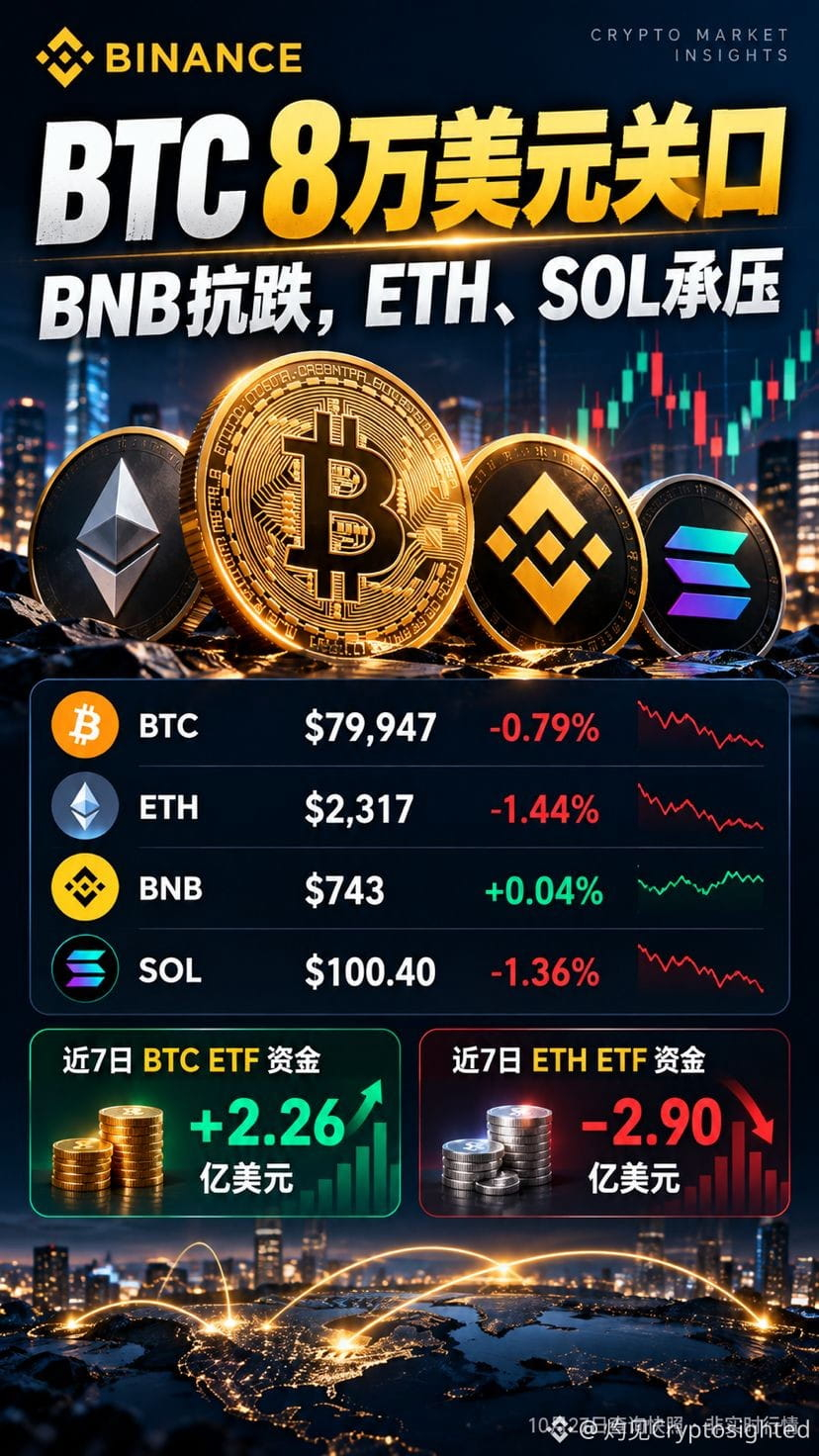
🚨 BTC has fallen below the $80,000 level, while BNB is holding up relatively well! In this market, what exactly are investors avoiding?
On October 27, I checked the latest Binance market data:
BTC: $79,947, down 0.79% in 24 hours
ETH: $2,317, down 1.44% in 24 hours
BNB: $743, up 0.04% in 24 hours
SOL: $100.40, down 1.36% in 24 hours
The most notable thing isn’t how much BTC has fallen, but how differently these four major coins are performing.
BTC, ETH, and SOL are all under pressure, while BNB is holding roughly steady.
Now let’s look at ETF flows:
Over the past 7 days:
BTC spot ETFs: net inflows of about $226 million
ETH spot ETFs: net outflows of about $290 million
That’s a difference of about $517 million in fund flows!
At the very least, this shows that institutional investors have taken different views on BTC and ETH recently.
Now let’s look at the broader market:
The global crypto market cap is about $2.79 trillion, down 2.32% over the past 7 days.
The Fear and Greed Index is at 50, in neutral territory—down 9 points from a week ago.
The market hasn’t entered extreme fear, but buying pressure isn’t particularly strong either.
I’m keeping a close eye on three levels:
① BTC: $80,000
Whether BTC can reclaim and hold this round-number level is the first signal to watch in the short term. If it continues to meet resistance, the strength of any rebound will be questionable.
② ETH: around $2,300
ETH is currently weaker than BTC. Whether it can hold this area and outperform BTC during a rebound matters more than simply rising.
③ BNB: around $740
BNB has been relatively resilient in the short term, but if BTC continues to fall, BNB may not be able to escape the downturn. The key is whether it holds on a pullback and whether trading volume picks up during a rebound.
My take:
It’s still too early to call this a broad market reversal.
BTC needs to reclaim and hold a key level, ETH needs to improve its relative strength, and BNB needs to show that its resilience isn’t just temporary.
What’s truly worth watching out for isn’t a sudden drop, but rebounds that lack volume, alongside funds continuing to concentrate in just a few coins.
One last question:
If BTC gets back above $80,000, would you add to your position, or wait to see whether ETH and BNB catch up?
Sources: Binance market pages, crypto ETF flow statistics, and market sentiment data, checked on October 27. Market conditions change in real time. This is not investment advice.
#BTC #ETH #BNB
318
4
22
361
I used to watch the Fed when trading crypto. Now I have to stay up late waiting for Microsoft and Google earnings, too. 😂
Honestly, the crypto world has changed a lot over the past few years.
Back then, everyone cared most about which project was launching and which coin was suddenly surging.
Things are different now.
U.S. CPI, interest rates, Treasury yields, the Nasdaq—even an earnings call from a tech giant—can all affect market sentiment the next day.
This week, we’re entering another key stretch of the U.S. earnings season.
What I’m most interested in isn’t how much a company earned, but whether the companies that have poured huge sums into AI can deliver returns that satisfy investors.
If results are decent but future spending keeps climbing, the market may not be impressed.
If profits, cash flow, and the outlook all exceed expectations, risk appetite could improve.
And the thing the crypto market fears most is a sudden loss of appetite for risk.
BTC may be the first to feel the shift in capital flows, and major coins like ETH, BNB, and SOL may not be immune either.
But I’ve learned one thing:
Good earnings don’t guarantee a rising share price, and a rally in U.S. stocks doesn’t mean crypto will follow.
What really matters is what the market was expecting, and where the money goes after the earnings come out.
So over the next few days, I’m going to spend less time guessing the direction and more time watching how the market reacts.
Sometimes the most interesting thing about the market is this:
Everyone waits for good news, but when it finally arrives, the price doesn’t go up.
Do you think this earnings season will bring opportunities to crypto, or will it be another test of volatility?
#BTC #ETH #BNB

640
11
43
735
🔥 Earnings season is here! This time, crypto investors may be even more nervous than U.S. stock investors.
When I first started trading crypto, I barely paid attention to the earnings reports of publicly traded companies.
Then I realized that sometimes, even when there’s no news about BTC, a drop in U.S. tech stocks can send the whole crypto market tumbling.
It’s U.S. earnings season again, and the results and guidance from tech giants like Microsoft, Google, Apple, and Amazon are worth watching closely.
But I’m not most interested in how much money they made.
I’m more interested in whether the market will ask: With so much being invested in AI, will these companies really be able to earn it back?
If earnings beat expectations and companies are optimistic about the future, tech stocks could get a boost, and risk appetite across the market may improve.
On the other hand, even if revenue looks good, investors may still sell if AI spending is too high and profit margins come under pressure.
Once that sentiment spreads across the market, BTC, ETH, and even BNB could be affected.
That said, I think it’s important to keep one thing in mind:
A rise in U.S. stocks doesn’t mean cryptocurrencies will necessarily rise too.
Crypto has its own capital flows, leverage dynamics, and on-chain trading demand.
So this earnings season, I’m planning to focus on three things:
① What the tech giants expect from their AI investments and future profits.
② How the Nasdaq actually reacts to earnings—not just the headlines.
③ When U.S. stocks are volatile, do BTC, ETH, and BNB move with them, or do they start to chart their own course?
At the end of the day, just watching candlestick charts may not be enough to trade crypto these days.
We used to wait for crypto news to move the market. Now, even Wall Street earnings calls could become a compass for the crypto market.
This earnings season, are you more optimistic that tech stocks will drive a crypto rebound, or worried that disappointing results could trigger another pullback?
#EarningsSeason #BTC #ETH #BNB

739
16
51
739
With BNB’s recent price action, I actually hope it doesn’t suddenly shoot up in a huge green candle.
Honestly, rather than seeing it gain 10% in a day, I’d rather watch it gradually build a higher floor.
Because sudden rallies are the easiest way to get people carried away.
When it’s going up, you feel like you didn’t buy enough. Then you chase it and worry about a pullback. You finally make up your mind, and one red candle shakes you right out.
There’s one thing about BNB: you can’t just look at the candlestick chart.
You also have to consider BNB Chain activity, the exchange ecosystem, on-chain capital, and the token-burn mechanism.
But those fundamentals don’t guarantee that the price will rise in the short term.
Right now, I’m mainly watching two things with BNB:
First, can it hold above its previous lows during a pullback?
Second, does volume pick up during a rebound, or does the rally fizzle out almost immediately?
If the price keeps making higher lows, it could mean buying pressure is improving.
If every rebound gets sold off quickly, then even the occasional huge green candle isn’t a reason to get too excited.
After holding spot for so many years, I’ve grown less and less interested in guessing how much a coin might rise tomorrow.
More than wondering whether BNB can suddenly take off, I care about whether it can put together a rally that’s easy to hold through.
What’s your take on BNB right now?
Still holding, waiting for a pullback to add, or have you already switched to other coins?
#BTC #ETH #BNB

704
18
51
704
Whenever BTC bounces, someone in the group chat starts shouting, “The bull market is back!”
But then I check my own portfolio, and somehow it’s still in the red. 😂
I think that’s how a lot of people have been feeling lately.
When I look at the market now, I’m less interested in how good a single BTC candle looks and more interested in whether ETH, BNB, and SOL can keep up.
Because BTC going up doesn’t mean the whole crypto market is rising.
Sometimes money just flows back into BTC as a safe haven, while altcoins are still left without buyers. Other times, ETH starts gaining strength, and SOL and BNB begin to show signs of life too—that’s when the market really starts to heat up.
And then there’s the most frustrating scenario:
BTC goes up, but your coins don’t move.
BTC pulls back, and your coins fall faster than anyone else’s.
In a market like this, blindly rotating into whatever’s pumping can easily leave you getting hit from both sides.
Lately, I’ve mainly been watching three things:
First, is ETH gaining strength relative to BTC?
Second, are BNB and SOL rising on solid trading volume?
Third, after altcoins bounce, can they hold on to their gains?
If BTC is the only one going up, I’ll stay cautious.
If several major coins start taking turns leading the way, the market’s profit-making momentum may gradually spread.
At the end of the day, what people are waiting for may not be another big green candle from BTC.
It’s the day their own holdings finally start going up.
Tell me about your portfolio right now:
Has BTC gotten you back to break-even, or are you still waiting for your altcoins to recover? 😂
#BTC #ETH #BNB

827
21
41
827
After spending enough time in crypto, I’ve realized I have a condition: when prices go up, I regret it; when they go down, I regret it too. 😂
A few days ago, when the market was dropping, I thought: “If it falls a little more, I’ll buy.”
Then it actually fell, and I started wondering: “What if it goes even lower?”
When it bounced back, I suddenly thought the price just before was practically a giveaway.
And then I started regretting it.
The funniest part is, sometimes I haven’t even done anything, but I still feel like I missed out on hundreds of millions.
A friend asked how much I’d made trading crypto lately.
I said I didn’t know. All I know is that every day I miss out on a chance to get rich.
After hearing that, he tried to comfort me: “As long as you didn’t lose money, that’s what matters.”
I thought about it for a while, and, well, he kind of has a point. 🤣
I used to think the hardest thing about crypto was understanding the market.
Now I realize the hardest thing is understanding myself.
When prices fall, I wish they were cheaper. When they rise, I wish I’d bought more.
Even if you get the perfect entry point, you might still be waiting for the next one.
So lately, I’ve set myself a little rule:
If I don’t know why I’m buying, I won’t buy yet.
After all, the market is open every day, and opportunities don’t come just once.
Just wondering, does anyone else have the same problem?
Are you the type who buys and then the price drops, or sells and then it goes up?
I feel like I’ve mastered both. 😂
#BTC #ETH #BNB

581
9
34
837
I used to check the market dozens of times a day. Now sometimes I can’t even be bothered to open Binance.
I wonder if anyone else feels the same.
In my first few years in crypto, I was glued to my phone. A little uptick made me happy; a little dip got me down. Even if I woke up in the middle of the night, I’d check the market, afraid I might miss an opportunity.
But after going through more market cycles, I gradually stopped getting so worked up.
Especially when I see some new coin suddenly skyrocket and people in the group chat showing off their gains everywhere—I’d be lying if I said I wasn’t tempted.
But I’ve also seen too many people showing off their profits one day, then going quiet a few days later.
Sometimes I find it kind of amusing.
We’re supposed to be investing to make life a little easier, yet some people end up living like trading bots, watching the charts 24 hours a day.
I still hold my spot assets and keep an eye on the market, but I don’t rush to change my approach just because someone else made a lot of money.
Of course, holding for the long term doesn’t guarantee you’ll make money. Pick the wrong coin, and you can still lose a lot.
I just feel more and more that when it comes to investing, returns aren’t the only thing to consider—we should also think about how much time and emotional energy we put into it.
Making money matters.
But if the money you make can’t make up for all the sleep and peace of mind you’ve lost over the years, can you really call it a profit?
I wonder where you all are at these days.
Are you watching the charts every day, or have you gotten too lazy to check?
#BTC #ETH #BNB

247
3
19
494
🔥 BNB, ETH, SOL—the real winner of the next cycle may not be the one that rises the fastest!
I’ve noticed something really interesting about crypto.
Whenever the market turns bullish, everyone starts arguing:
Is ETH getting old?
Will SOL replace ETH?
Is BNB undervalued?
But I’m increasingly convinced we may have been asking the wrong questions all along.
A blockchain’s true competitive edge isn’t how much its price can rise in a bull market—it’s how many people are still willing to use it in a bear market.
ETH has a mature DeFi ecosystem, a strong developer base, and a Layer 2 network. But it’s still worth examining how value ultimately flows back to ETH after scaling.
SOL focuses on speed and low costs, making it well suited to high-frequency trading and on-chain applications. But it still needs to prove that users stick around for reasons beyond chasing short-term hype.
BNB Chain benefits from its exchange ecosystem and a wide range of on-chain applications. Its user on-ramp is an advantage, but genuine activity and long-term capital retention matter just as much.
Three chains, three different strategies.
These days, I’m less concerned with which one is up the most today.
What I really want to know is:
When the market is no longer euphoric, when new coins aren’t skyrocketing every day, when the airdrop hype fades…
How many people will still open their wallets, use apps, and make transactions?
That’s the toughest part of the competition between blockchains.
Prices can be driven up by sentiment, but it’s much harder to keep users around.
In the next market cycle, perhaps the ecosystem worth watching most won’t be the one making the boldest price predictions, but the one that has built an ecosystem people can’t do without.
If you could follow just one ecosystem for the long term, which would you choose?
🟡 BNB: Exchange ecosystem and user access
🔵 ETH: Developers and financial infrastructure
🟣 SOL: Speed and on-chain app experience
Share your reasons in the comments—don’t just name a coin!
#BTC #ETH #BNB

103
2
6
302
🚨 Visa and Mastercard are both eyeing stablecoins! The biggest money-making opportunity in crypto might not be the next 100x coin?
I saw two pieces of news today, and they gave me a strong feeling:
Something more important than price movements may be happening in crypto.
Visa is partnering with crypto payments network Mesh to bring crypto assets into everyday spending.
Mastercard has also launched a risk detection service for stablecoins.
One is exploring how to make crypto assets easier to spend.
The other is working on making stablecoin payments safer.
Have you noticed?
Traditional finance giants are no longer content to discuss how much Bitcoin is worth.
They’re seriously looking into how money on the blockchain can actually be used.
In the past, people entering crypto cared most about three things:
Which coin should I buy?
When will it go up?
Can it 10x?
But in the future, a more important question may emerge:
Who can get ordinary people using cryptocurrency without them even realizing it?
Imagine this:
In the future, when you shop overseas, send money to family, or pay for services, stablecoins might be used behind the scenes to settle the payment—without you even needing to know what a blockchain is.
That’s the change I think is worth paying attention to.
Of course, growth in stablecoin payments doesn’t mean related tokens will necessarily rise. Who actually benefits will depend on the payment networks, how fees are distributed, and the scale of real-world transactions.
But I’m increasingly convinced:
The next stage of crypto competition may not be about attracting people who trade coins, but about reaching people who actually use money.
If one day USDT and USDC are as convenient to spend as bank cards, will you still treat stablecoins only as a way station for crypto trading?
#BTC #ETH #BNB

556
13
39
556
🚨 JPMorgan brings its bank deposit token to Ethereum! Is Wall Street really here this time?
Here’s something more worth paying attention to than how many points ETH is up today.
On October 19, news emerged of JPMorgan’s latest move: expanding its JPM Coin deposit token to Ethereum to serve institutional clients.
Note that this isn’t just another ordinary altcoin project.
It’s a traditional bank trying to move its financial services onto the blockchain.
That got me thinking about an interesting question:
The crypto world used to constantly say, “Traditional finance will eventually embrace crypto.”
Now traditional finance really is starting to use blockchain. So why are so many people still only concerned with whether ETH will pump tonight?
Because there’s a huge difference in perspective here:
A bank adopting Ethereum doesn’t mean it’s buying ETH in large amounts.
Institutions may be drawn to on-chain settlement, more efficient asset transfers, and programmable financial services.
Whether ETH actually benefits will depend on transaction activity, demand for fees, and which network layer these services ultimately run on.
But I still think this development deserves attention.
If more and more bank deposits, fund shares, bonds, and other financial assets move on-chain in the future, competition between public blockchains will be about much more than retail crypto trading.
ETH, SOL, and various Layer 2s may be competing to become the next generation of financial infrastructure.
So here’s the question I’d really like to ask everyone:
What will be more valuable in the future: tokens on the blockchain, or financial institutions that control access to on-chain capital?
That’s what I think is worth watching over the long term.
#BTC #ETH #BNB

359
8
29
359
🚨 SOL is gearing up for a major move! This time, it’s taking on ETH—not with its price!
While everyone’s been watching BTC’s ups and downs over the past couple of days, I’ve been paying closer attention to SOL.
That’s because Solana is planning an important upgrade, Alpenglow, for October 21.
This isn’t just routine maintenance—it’s a major change to the network’s consensus mechanism.
Put simply:
When people talk about Solana, the things you hear most often are that it’s fast and has low fees.
But for a public blockchain to go the distance, speed alone isn’t enough.
It also needs to be reliable, support real transactions, and give developers a reason to stick around for the long term.
What makes Alpenglow especially promising is its potential to improve transaction finality.
Still, I wouldn’t rush to declare that SOL is about to take off.
A successful tech upgrade doesn’t necessarily mean the token’s price will rise.
What really matters is:
Will the upgrade roll out smoothly?
Will network stability improve?
Will developers, users, and real transaction volume continue to grow?
What’s even more interesting is that ETH and SOL are pursuing two different paths.
ETH puts greater emphasis on its mature ecosystem, security, and scaling infrastructure.
SOL continues to bet on high performance and a low-latency on-chain experience.
In the long run, which one attracts more real users may matter more than whose chart rises faster.
I’ve always felt that one of the most overlooked opportunities in crypto isn’t a token that suddenly skyrockets, but an ecosystem where the technology and user needs are changing.
If Alpenglow rolls out smoothly, SOL will be worth taking another look at. If the upgrade runs into problems, the market will reassess its risks.
Which one do you think has the brighter long-term future?
🔥 SOL: Speed and user experience matter more
🛡️ ETH: Ecosystem, security, and long-term development matter more
#BTC #ETH #BNB

253
9
18
253
🚨 Monday hasn’t even arrived, and the crypto world is already calling it “Black Monday”!
BTC suddenly plunged over the weekend, then quickly bounced back.
Some people panicked and sold at a loss, others seized the chance to buy the dip, and some are wondering whether things will get even worse when markets open on Monday.
But this time, I don’t think the most important thing to focus on is how much BTC has fallen.
It’s a fact that many people overlook:
Crypto markets trade 24/7, yet they’re increasingly being driven by sentiment in traditional financial markets.
During this bout of volatility, BTC briefly dipped to around $80,750 before rebounding to around $82,000. ETH also fell to around $2,360.
Even more notably, some perpetual contracts linked to AI and semiconductor stocks also fell sharply.
This suggests the market may be worried about more than just Bitcoin itself.
Inflationary pressures in the U.S., interest rate expectations, tech stock valuations, and global risk appetite are all influencing where investors put their money.
What worries me most isn’t BTC dropping a few more percentage points.
It’s that many people see a weekend rebound and rush to declare the danger over.
Trading volume and liquidity are usually lower over the weekend than on weekdays. A price bounce doesn’t mean institutional money has returned to the market.
The real test may come after U.S. stocks open on Monday.
Here are three signals I’ll be watching:
① Can BTC hold above $80,000?
② Can U.S. tech stocks stop falling?
③ As BTC rebounds, is spot trading volume rising too?
If all three signals improve, this sell-off may have been nothing more than a sharp release of market anxiety.
If they don’t, the weekend bounce may just be a brief pause for breath.
I’m not going to guess whether prices will definitely go up or down tomorrow.
But one thing is certain:
The market is often most dangerous not when everyone is panicking, but when prices bounce a little and people assume it’s all over.
Do you think Monday will bring a rebound after the panic, or another round of declines?
#BTC #ETH #BNB

390
4
27
706
Verified
🚨 BTC fell below $80K, then bounced back to $82K! But this time, I’m actually more worried…
The market action over the past few days has been really interesting.
U.S. CPI came in hotter than expected, and the market worried that the Fed would keep interest rates high. BTC briefly dropped to around $79,770.
Then the dollar pulled back, and BTC climbed back above $82,000.
Some people say the $80,000 floor is now solid.
But let me ask this:
The price has bounced back, but are real buyers back too?
That’s the question I think is most worth discussing.
The crypto world used to love telling one story: institutions are here, ETFs are here, so Bitcoin will never run short of capital.
But in reality, ETFs provide a way to buy. That doesn’t mean money only flows in and never flows out.
A weaker dollar can drive a rebound, and short covering can drive one too. But without sustained spot buying, the rally may not go far.
Right now, I’m watching three signals:
📍 Can BTC hold above $80,000 and challenge $84,000 again?
📍 Can ETH follow suit, instead of BTC being the only one to bounce?
📍 Are ETF flows and spot trading volumes improving?
After holding spot for years, I’ve increasingly come to feel that:
The most dangerous thing isn’t missing the bottom—it’s treating every rebound as the start of a new bull market.
I’m in no rush to call the bottom this time around.
I’d rather know: when will the next wave of people who are genuinely willing to buy BTC show up?
Do you think around $80,000 is a short-term bottom, or does the market still need a more thorough shakeout?
#BTC #ETH #BNB

378
7
33
439
Nearly $1 billion in liquidations! BTC falls below $80,000—who’s paying the price for this market move?
I’ve noticed a particularly brutal pattern in crypto:
Whenever the market is at its most exciting, someone thinks they’ve cracked the code to getting rich.
Yesterday, people were discussing when BTC would hit a new high. Today, some can’t even hold on to their principal.
The latest market data shows that around $948 million in leveraged positions were liquidated in 24 hours, affecting roughly 177,000 traders. More than 90% of the liquidation volume came from long positions.
The trigger was hotter-than-expected U.S. inflation data. But what really magnified the drop was the crowded leverage in the market.
This might offend some people, but:
A lot of people aren’t actually bullish on Bitcoin.
They just believe that with 20x or 50x leverage, they can make money faster than everyone else.
When BTC drops a few percentage points, spot traders can keep watching.
But highly leveraged traders might not even get the chance to wait for a rebound.
It’s also worth noting that BTC briefly fell below $80,000, while some spot ETF holders are also facing unrealized losses.
This market move left me with one reminder:
The market never rewards the most confident people. It rewards those who survive until the next cycle.
I’ve held spot assets for years, and I increasingly feel that the hardest thing isn’t catching every rally—it’s making sure one mistake doesn’t wipe out everything you’ve built before.
I don’t know if the bull market will return.
But I do know this: if you still have your position, you still have a chance.
#BTC #ETH #BNB

412
4
28
570
🚨 The CPI shock sent the dollar lower instead—but why is BTC still hesitant to really take off?
Just yesterday, markets were worried about a rebound in U.S. inflation. Today, the story has changed.
U.S. CPI rose 3.7% year over year in September, higher than expected.
Normally, hotter-than-expected inflation means more pressure on interest rates, so the dollar should keep strengthening.
But the latest market reaction tells a different story:
The dollar has retreated from an 18-month high, and U.S. Treasury yields have also started to fall.
Meanwhile, BTC briefly surged past $84,000 but failed to hold above that level.
That’s what makes this so interesting.
If macroeconomic pressure is showing signs of easing, why is BTC still struggling to climb?
I think the answer may lie in the flow of capital.
The market isn’t short on reasons for a rebound—it’s short on buyers willing to keep stepping in.
ETFs can bring institutions into crypto, but that doesn’t mean institutions are buying every day.
A weaker dollar also doesn’t guarantee that money will flow into BTC.
Easing macro headwinds is just one condition for a rebound; what really determines how far the market can go is buying demand.
Next, I’ll be watching to see whether BTC can reclaim and hold above $84,000, and whether spot ETF flows improve.
If the rally is driven by headlines alone, without sustained trading volume, it could still be fragile.
The biggest risk in this market isn’t getting the direction wrong—it’s mistaking a burst of sentiment-driven buying for a trend reversal.
#BTC #ETH #BNB

425
10
35
425
🚨 CPI SURPRISE! BTC FALLS BELOW $83,000!
But the market is showing a conflicting signal worth watching!
U.S. September CPI is officially out:
🔴 Headline CPI: 3.7% (expected 3.6%)
🔴 Core CPI: 2.6% (expected 2.5%)
🔥 Core CPI month-over-month: 0.3%
Both inflation readings came in above expectations!
After the data was released:
📉 BTC briefly fell below $83,000
📈 U.S. 10-year Treasury yields surged
🔴 U.S. stocks came under pressure
But on the other hand 👇
Latest full trading day (October 13):
💰 Spot BTC ETFs: +$175.7M
💰 Spot ETH ETFs: +$24.8M
Institutional funds have just returned, but macro pressure has suddenly intensified!
4 signals worth watching:
⚠️ ① Rate-cut expectations face further pressure
🔥 ② Rising Treasury yields increase valuation pressure on risk assets
💰 ③ Positive ETF flows don't mean buying is strong enough to offset the macro shock
👀 ④ Whether ETH and BNB can stabilize alongside BTC is key to market breadth
Here's the real question:
CAN ETF DEMAND BEAT MACRO PRESSURE?
Key variables:
US TREASURY YIELDS + SPOT DEMAND
What to watch next:
👀 Whether BTC can reclaim and hold above 83K
👀 The U.S. 10-year Treasury yield
👀 Whether ETH and BNB can recover in tandem
👀 ETF flows and spot trading volume
👇 What do you think?
🟢 BUYERS RETURN: Inflows drive a market recovery
🔴 MACRO PRESSURE: High rates continue to weigh on the market
#BTC #ETH #BNB

238
2
18
724
Major cryptocurrencies are bouncing back across the board, but I’ve noticed one question: who’s really leading the rally?
I checked the markets today, and finally the sea of green isn’t just wishful thinking. 😂
BTC is back around $83,000, ETH is hovering near $2,500, and BNB is fluctuating around $740. SOL and XRP are also rebounding.
It looks like everything is going up, but on closer inspection, the market isn’t as uniform as it might seem.
BTC is still the market’s anchor. As long as it hasn’t truly broken out of its trading range, gains in other coins can easily be held back.
ETH is worth watching more closely. Compared with BTC, whether it can keep strengthening is often a more useful signal than its one-day gain.
BNB is supported by both its exchange and its blockchain ecosystem, but in the short term, it still depends on whether buyers are willing to keep coming in.
SOL is highly volatile. When the market heats up, it can easily attract trading flows, but pullbacks can also be more severe.
For XRP, the key is whether it can hold on to its gains after a news-driven boost.
I’m not rushing to declare that the bull market is back.
A truly healthy market shouldn’t have BTC doing all the heavy lifting on its own.
If BTC holds steady, ETH starts to catch up, and BNB and SOL take turns outperforming, that’s the kind of market structure I’d rather see.
Over the next few days, the key isn’t who gains the most today, but who can outperform BTC for several days in a row.
A one-day rise is sentiment; sustained strength is what’s worth studying seriously.
#BTC #ETH #BNB

713
6
53
713
Log in to explore more content
Join global crypto users on Binance Square
⚡️ Get latest and useful information about crypto.
💬 Trusted by the world’s largest crypto exchange.
👍 Discover real insights from verified creators.
Email / Phone number