
Block_WaveX 0
24.3k Posts

Block_WaveX 0
Crypto Futures Trader | Risk Managed | Trend Focused | Trade Smart. Stay Ahead.
Open Trade
High-Frequency Trader
11.3 Months
678 Following
13.0K+ Followers
10.0K+ Liked
Posts
Portfolio
All
Quotes
Live
PINNED



VICTORIA _777
·
--
BullishThe labor market just made the Fed’s job harder. 👀
August NFP came in stronger than expected at 162K, while unemployment held at 4.1%.
That tells me the economy isn’t showing enough weakness to force the Fed’s hand toward easier policy.
But now inflation takes center stage.
August PPI came in hot at 0.4% MoM and 5.4% YoY, while rising energy prices could add even more pressure.
So I’m leaning slightly risk-off heading into CPI.
A hotter CPI — especially a sticky core print — could push rate expectations higher, lift Treasury yields and strengthen the dollar. That’s not exactly the setup stocks and gold want.
But here’s where it gets interesting.
If CPI comes in cooler than expected, the entire narrative could reverse almost instantly.
Markets don’t trade the number alone.
They trade the surprise.
Hotter than expected = potentially bearish.
Cooler than expected = potentially bullish.
For now, I’m not picking a side.
I’m watching the gap between CPI and expectations.
That’s where the real volatility could start. 👀
#CPIWatch
$RAYSOL
$KOMA
August NFP came in stronger than expected at 162K, while unemployment held at 4.1%.
That tells me the economy isn’t showing enough weakness to force the Fed’s hand toward easier policy.
But now inflation takes center stage.
August PPI came in hot at 0.4% MoM and 5.4% YoY, while rising energy prices could add even more pressure.
So I’m leaning slightly risk-off heading into CPI.
A hotter CPI — especially a sticky core print — could push rate expectations higher, lift Treasury yields and strengthen the dollar. That’s not exactly the setup stocks and gold want.
But here’s where it gets interesting.
If CPI comes in cooler than expected, the entire narrative could reverse almost instantly.
Markets don’t trade the number alone.
They trade the surprise.
Hotter than expected = potentially bearish.
Cooler than expected = potentially bullish.
For now, I’m not picking a side.
I’m watching the gap between CPI and expectations.
That’s where the real volatility could start. 👀
#CPIWatch
$RAYSOL
$KOMA


Anya_X
·
--
claim reward from Anya _X

Block_WaveX 0
·
--
Bullish📊 CPI INFLATION — WHY IT MATTERS FOR THE MARKETS
The Consumer Price Index (CPI) is one of the most closely watched economic indicators in global financial markets. It measures the average change in prices that consumers pay for a basket of goods and services over time.
When CPI comes in higher than expected, it can signal stronger inflationary pressure. Markets may then anticipate that central banks could maintain higher interest rates for longer. This can influence currencies, bonds, equities, gold, and the broader risk environment.
On the other hand, a lower-than-expected CPI reading may suggest that inflation is cooling. This can increase expectations of easier monetary policy and potentially support risk-sensitive assets.
🔥 Key things traders watch:
• Actual CPI vs. Forecast
• Previous CPI reading
• Core CPI
• Month-over-month inflation
• Year-over-year inflation
• Central bank rate expectations
• Market reaction after the release
⚠️ Important: CPI is not simply about whether inflation is “high” or “low.” The biggest market moves often come from the difference between the actual figure and market expectations.
📈 Higher CPI than expected potentially hawkish rate expectations
📉 Lower CPI than expected potentially dovish rate expectations
However, markets can react differently depending on the broader economic picture, positioning, and what central banks have already priced in.
💡 For traders: Always watch the CPI release together with central-bank statements, employment data, GDP, and other major economic indicators rather than relying on a single data point.
📌 Stay informed. Trade with a plan. Manage your risk.
$龙虾
$LAB
#CPIWATCH
#FedWatch🔥
The Consumer Price Index (CPI) is one of the most closely watched economic indicators in global financial markets. It measures the average change in prices that consumers pay for a basket of goods and services over time.
When CPI comes in higher than expected, it can signal stronger inflationary pressure. Markets may then anticipate that central banks could maintain higher interest rates for longer. This can influence currencies, bonds, equities, gold, and the broader risk environment.
On the other hand, a lower-than-expected CPI reading may suggest that inflation is cooling. This can increase expectations of easier monetary policy and potentially support risk-sensitive assets.
🔥 Key things traders watch:
• Actual CPI vs. Forecast
• Previous CPI reading
• Core CPI
• Month-over-month inflation
• Year-over-year inflation
• Central bank rate expectations
• Market reaction after the release
⚠️ Important: CPI is not simply about whether inflation is “high” or “low.” The biggest market moves often come from the difference between the actual figure and market expectations.
📈 Higher CPI than expected potentially hawkish rate expectations
📉 Lower CPI than expected potentially dovish rate expectations
However, markets can react differently depending on the broader economic picture, positioning, and what central banks have already priced in.
💡 For traders: Always watch the CPI release together with central-bank statements, employment data, GDP, and other major economic indicators rather than relying on a single data point.
📌 Stay informed. Trade with a plan. Manage your risk.
$龙虾
$LAB
#CPIWATCH
#FedWatch🔥


Muzamil Abbas⁷⁵ 穆扎米尔_阿巴斯
·
--
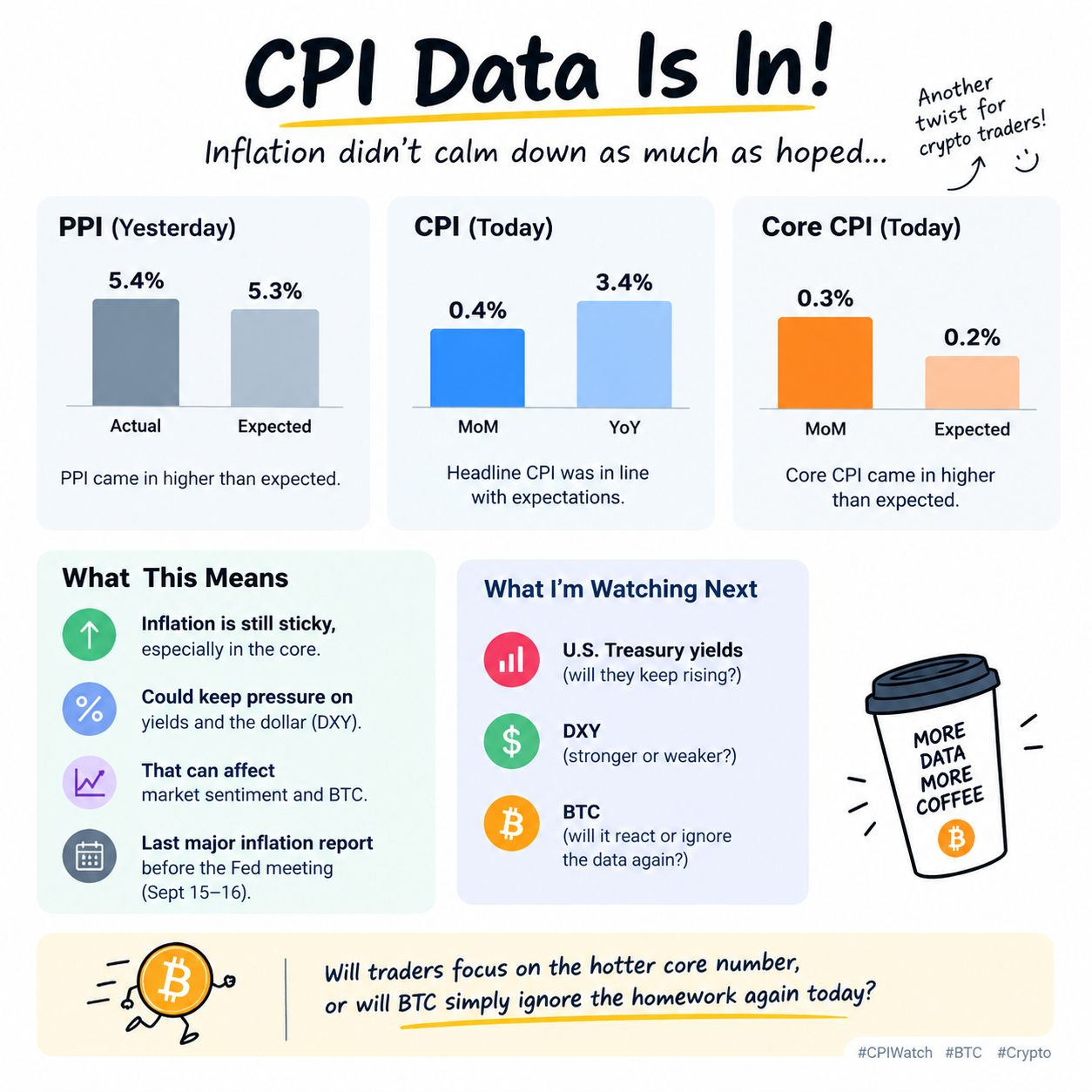
BullishI’ve been watching the CPI reaction today, and honestly, inflation decided to give crypto traders another small headache. Yesterday’s PPI was already uncomfortable at 5.4% versus 5.3% expected, so I was curious whether CPI would calm things down. It didn’t exactly.
Headline CPI came in at 0.4% month-on-month and 3.4% year-on-year, roughly around expectations. The part I’m paying more attention to is core CPI. It printed 0.3% m/m against 0.2% expected, which suggests underlying inflation is still refusing to cool as quickly as everyone would like. That matters for Bitcoin because inflation data can influence Treasury yields, the dollar, and ultimately expectations around the Fed. Basically, one percentage point can make the market behave like it just drank three coffees.
I’m not jumping straight into a bearish BTC call, though. Data can look negative while price reacts completely differently. For me, the next useful signal is the reaction in yields, DXY, and BTC rather than the headline itself. This is also the last major inflation report before the September 15–16 Fed meeting, so the market has plenty to chew on.
Now I’m wondering: will traders focus on the hotter core number, or will BTC simply ignore the homework again today?
#cpiwatch #CPIWatch
Headline CPI came in at 0.4% month-on-month and 3.4% year-on-year, roughly around expectations. The part I’m paying more attention to is core CPI. It printed 0.3% m/m against 0.2% expected, which suggests underlying inflation is still refusing to cool as quickly as everyone would like. That matters for Bitcoin because inflation data can influence Treasury yields, the dollar, and ultimately expectations around the Fed. Basically, one percentage point can make the market behave like it just drank three coffees.
I’m not jumping straight into a bearish BTC call, though. Data can look negative while price reacts completely differently. For me, the next useful signal is the reaction in yields, DXY, and BTC rather than the headline itself. This is also the last major inflation report before the September 15–16 Fed meeting, so the market has plenty to chew on.
Now I’m wondering: will traders focus on the hotter core number, or will BTC simply ignore the homework again today?
#cpiwatch #CPIWatch

Shaheen 69
·
--
🚨 CPI just dropped — now the real test begins!
Headline CPI matched expectations, but Core CPI came in hotter MoM. That keeps Fed policy uncertain and could bring more volatility to BTC, ETH and altcoins. ⚠️
I’m watching price action before taking a position.
Bullish 🟢 or Bearish 🔴?
NFA/DYOR.
Headline CPI matched expectations, but Core CPI came in hotter MoM. That keeps Fed policy uncertain and could bring more volatility to BTC, ETH and altcoins. ⚠️
I’m watching price action before taking a position.
Bullish 🟢 or Bearish 🔴?
NFA/DYOR.


🎙️ Let's talk market trends and invest in BNB spot regularly!
End
03 h 21 m 01 s
16.6k
36
Log in to explore more content