

DVA ANALYTICAL RESEARCH
The European Digital Identity Wallet: What will change for EU citizens after December 24, 2026?
ANALYTICAL FEATURE · NOVEMBER 19, 2026
A date that is changing Europe’s digital infrastructure
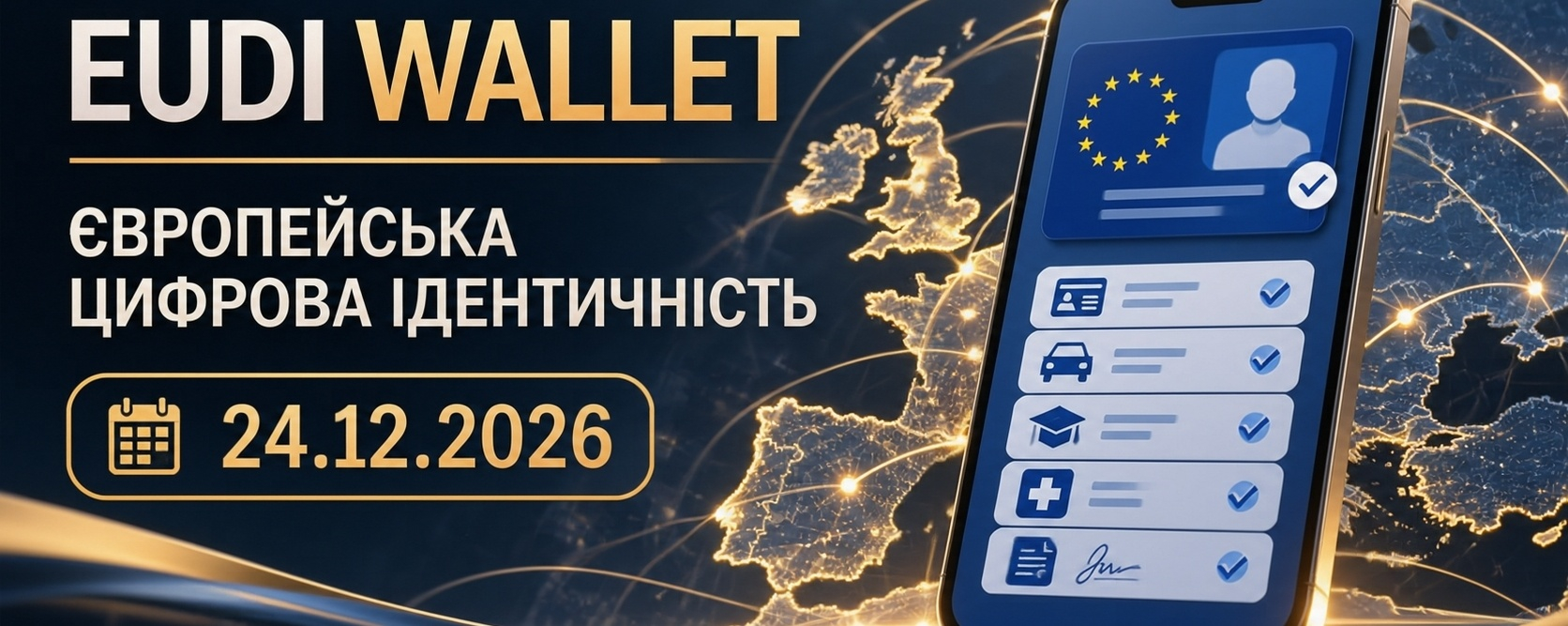
December 24, 2026, is an important date for the digital transformation of the European Union. By this deadline, Member States must ensure the availability of at least one European Digital Identity Wallet, or EUDI Wallet.
This is not simply about the arrival of another mobile app. The EU is building a shared legal and technical infrastructure that is intended to let people verify their identity, present digital documents, prove that they have certain rights or qualifications, and use public and private services across different European countries.
But behind the convenience lies a much broader question: who will control digital identity, what data will organizations be able to obtain, and how real will user privacy be?
1. Where did the date December 24, 2026 come from?
The legal basis for the EUDI Wallet is Regulation (EU) 2024/1183 of the European Parliament and of the Council of April 11, 2024. It amended the previous eIDAS Regulation No 910/2014 and established a new European Digital Identity Framework.
The regulation entered into force on May 20, 2024.
However, the law itself set out general principles, while the technical requirements for how wallets operate were to be specified in separate implementing acts by the European Commission.
The main package of relevant acts was published in December 2024 and entered into force on December 24, 2024.
Article 5a of the regulation provides that member states must ensure the availability of the EUDI Wallet within 24 months of the relevant implementing acts entering into force.
That is where the date December 24, 2026 comes from.
It is important to understand the legal meaning of this deadline correctly: a state must ensure that the wallet is available, not force every citizen to install it or automatically transfer all public services to the new system.
1. What is the EUDI Wallet?
The EUDI Wallet is a digital tool for storing, presenting, and verifying digital credentials for a user's identity and other attributes.
It may bring together:
· digital identity data;
· a driving licence;
· diplomas and educational qualifications;
· professional certificates;
· certain medical documents and prescriptions;
· other electronic credentials provided for by the system;
· the ability to create legally valid electronic signatures.
This does not mean that all the documents listed will be available in every country from day one. Their availability depends on national systems, issuing organizations, technical readiness, and specific use cases.
The main difference from an ordinary digital storage system is the ability not merely to display a file, but to cryptographically verify its origin, integrity, and validity.
1. How will it work in everyday life?
Imagine a few practical situations.
Age verification. When buying an age-restricted product, a user may be able to confirm that they are 18 or older without disclosing their full date of birth.
Employment. A candidate will be able to present a digital credential for a diploma or professional qualification that an employer can verify.
Banking services. When opening an account or completing identity verification, a user will be able to share the necessary identity credentials through a compatible digital wallet.
Travel. Digital documents may make it easier to verify identity and certain rights in cross-border situations, provided the relevant systems and services support this form of interaction.
Public services. Identity verification, document submission, and signing applications may become easier across various EU government systems.
This does not mean that passports, physical ID cards, or other documents will automatically become invalid. The digital wallet is intended to complement existing ways of verifying identity.
1. Control over data: the most important technological feature
One of the key ideas behind the EUDI Wallet is minimizing the disclosure of personal data.
The traditional model often involves sharing an entire document, even though an organization needs only one attribute.
For example, to verify that someone is an adult, it is not always necessary to know their exact date of birth, address, or full name.
In a digital system, it is possible to share only the necessary attribute.
This approach is called selective disclosure.
Some technical mechanisms may use Zero-Knowledge Proofs (ZKPs). They make it possible to verify a claim without revealing the underlying data on which it is based.
However, there is an important technical caveat: not every selective-disclosure scenario necessarily uses ZKPs. These are different mechanisms that may be used depending on the type of digital credential and the protocol.
It is also necessary to distinguish between control over data within the wallet itself and the processing of information by the organization that received a credential. After data is lawfully shared, the organization may be required to retain it in accordance with the law.
Therefore, a wallet does not mean that all digital traces automatically disappear.
1. Will its use be mandatory?
No. The regulation explicitly establishes that use of the EUDI Wallet is voluntary.
Article 5a(15) provides that refusing to use a digital wallet must not restrict or impair a person's access to public or private services, the labor market, or the freedom to conduct business.
Other available means of identification and authentication must remain in place.
This is a fundamental legal safeguard.
However, voluntary use does not mean that digital identification will remain an inconspicuous part of the economy. The more organizations integrate the new system, the more familiar and convenient a way of verifying identity it may become.
Therefore, genuine voluntariness should be assessed not only by the wording of the law, but also by how practically accessible the alternatives are.
1. The EUDI Wallet and a cryptocurrency wallet are different systems
This is important for understanding the digital economy.
The EUDI Wallet is not a cryptocurrency wallet. It is not designed to store BTC, ETH, or USDT, or to manage blockchain private keys.
Its primary purpose is digital identity, authentication, and the verification of attributes.
A crypto wallet, by contrast, provides access to digital assets through private keys or other control mechanisms.
At the same time, these systems can interact.
For example, a cryptocurrency exchange, financial platform, or tokenized-asset service may use the EUDI Wallet to verify a client's identity, if the relevant use case is supported by law and the technical infrastructure.
But identity verification does not automatically verify ownership of a crypto asset.
Identity is who you are.
An attribute is what you can prove.
Ownership is what you own or control.
These are three distinct legal and technical categories.
1. The European Union's economic and political goal
The EUDI Wallet is intended not only to make life easier for citizens.
For the EU, it is an infrastructure project that should:
· reduce fragmentation among national identification systems;
· facilitate cross-border public and commercial transactions;
· reduce the cost of customer verification;
· establish common rules for trust in digital documents;
· support the development of digital services and the data economy;
· reduce reliance on incompatible national solutions and closed platforms.
For businesses, this could be a new channel for identifying customers and verifying documents.
For governments, it is a tool for interoperability and digital administration.
For citizens, it is an opportunity to manage their own digital credentials.
But the interests of these three parties do not always align. Businesses are interested in quickly verifying customers, governments in reliability and compliance, and citizens in privacy, convenience, and minimal data disclosure.
The real quality of the system will depend on balancing these interests.
1. Risks that cannot be ignored
1. Cybersecurity. Device compromise, malware, stolen credentials, or implementation errors can put digital identity at risk.
1. Loss of a device. Reliable procedures are needed to restore access, block the device, and reverify identity.
1. Excessive data collection. Even if the wallet shares minimal information, the receiving organization may demand more data than necessary for a particular service. The GDPR and oversight of recipients' activities are important here.
1. Digital exclusion. People without a modern smartphone, reliable internet access, or adequate digital skills must not lose access to services.
1. Errors and invalid documents. A digital attribute issued incorrectly or revoked may cause problems for the user. Clear procedures for correction and appeal are needed.
1. Concentration of trust. If a significant share of social and commercial processes depends on digital identification, the reliability of its providers and oversight of them become strategically important.
1. Accountability. The system involves document issuers, wallet providers, relying parties, and government authorities. It is important to understand who is responsible for incorrect data, a breach, unlawful processing, or a refusal to provide service.
Standards and certification reduce risks, but do not eliminate them entirely.
1. Are all EU countries ready?
The formal obligation is shared, but readiness varies from country to country.
EU countries differ in:
· the level of development of national digital identity credentials;
· the organization of government registries;
· technical infrastructure;
· digital document management models;
· private-sector readiness;
· cybersecurity certification procedures.
In 2026, the European Commission continued updating technical requirements and implementing acts. ENISA is also supporting the development of national wallet certification schemes.
This means that three distinct stages need to be distinguished:
1. The availability of a national app or prototype.
2. Technical interoperability with EUDI requirements.
3. Compliance with legal requirements, certification, and readiness for actual use.
Success at the first stage does not automatically prove that the other two have been completed.
As of November 2026, the European Commission continues to publish updates on implementing acts, standards, and technical interoperability. Therefore, one should not describe every national wallet as fully certified without checking this separately.
1. Ukraine: where do we fit into this system?
Ukraine is not a member of the European Union, so the December 24, 2026 deadline is not a direct legal obligation for Ukraine as a member state.
However, Ukraine's digital infrastructure matters for European integration.
Ukraine already has experience with digital identification through Diia, electronic documents, and government registries.
European large-scale digital identity pilot projects have involved Ukraine alongside EU member states and partners from the European Economic Area.
This is an important area of technical cooperation, but participation in testing does not mean that all Ukrainian digital documents are automatically recognized in the EU.
Full interoperability requires legal agreements, trust in data sources, technical standards, issuer verification, and recognition procedures.
Ukraine's Diia and the EUDI Wallet are not identical products. Their interoperability will depend on further technical and legal work.
For Ukraine, this is not simply a question of a mobile app. It is a matter of interoperability between government registries, trust in digital documents, and the ability of citizens to use European services without unnecessary administrative barriers.
1. What will change after 2026?
December 24, 2026 marks the start of a new phase, not the completion of the entire process.
The coming years will determine how widely wallets are integrated into public and private services.
A separate legal provision concerns private service providers for whom legislation or contractual obligations require strong user authentication.
Under Article 5f(2), designated private organizations must accept the EUDI Wallet at the user's voluntary request no later than 36 months after the relevant implementing acts enter into force. Micro and small enterprises are excluded from this specific requirement.
Article 5f(3) separately establishes requirements for very large online platforms covered by the DSA definition that require user authentication: they must provide the option to use the EUDI Wallet at the user's request.
This does not mean that all websites, banks, or stores will be required to accept the wallet under the same rules.
Use cases may gradually expand in banking, education, healthcare, transport, telecommunications, and other sectors.
1. Digital identity is not the same as digital ownership
This is a fundamental distinction to understand in the context of the future digital economy.
The EUDI Wallet helps people verify who they are, which documents they hold, and which attributes they can prove.
But, on its own, it does not guarantee ownership of an asset, provide control over a bank account, or replace the private keys of a cryptocurrency wallet.
Digital identity may be necessary to access financial services, but it is not the same as financial independence.
Digital ownership raises other important questions: who controls the asset, who has the right to change records, whether ownership can be transferred, how keys are protected, and which legal mechanisms recognize that right.
That is why future digital infrastructure should be assessed not only by how convenient it makes identification, but also by how well it protects people's rights.
FACT • VERIFICATION • DECISION
FACT
The European Union is moving from fragmented national digital identification systems toward a shared legal and technical infrastructure.
VERIFICATION
The EUDI Wallet has legal safeguards for voluntary use, minimal data disclosure, and alternative access to services. However, the actual level of privacy and security will depend on technical implementation, certification, oversight of organizations, and how the law is applied in practice.
DECISION
Citizens should understand exactly what data they are sharing, with whom, for what purpose, and on what legal basis.
Businesses should prepare for interoperability with European digital infrastructure.
Governments must ensure not only technological availability, but also the protection of citizens' rights, alternative ways to access services, and transparent accountability for the system's participants.
The true measure of success is not the number of digital wallets installed, but whether people's right to privacy, alternative access to services, and control over their own data are preserved.
DVA — facts without hype.
Change your mindset first. Politics, psychology, and finance without illusions.
Preserving values and time.
Analytical material. Not legal advice.
Telega: DVA_Community
Key primary sources for verification
1. "Regulation (EU) 2024/1183 — EUR-Lex" (https://eur-lex.europa.eu/eli/reg/2024/1183/oj)
2. "European Commission — European Digital Identity" (https://commission.europa.eu/topics/digital-economy-and-society/european-digital-identity_en)
3. "European Commission — Status of implementing acts" (https://ec.europa.eu/digital-building-blocks/sites/spaces/EUDIGITALIDENTITYWALLET/pages/915931811/The+European+Digital+Identity+Regulation)
4. "Architecture and Reference Framework — version 3.0.0" (https://eudi.dev/3.0.0/)
5. "European Commission — EUDI Wallet FAQ" (https://ec.europa.eu/digital-building-blocks/sites/pages/viewpage.action?pageId=949256541)
6. "ENISA — Digital wallet certification" (https://www.enisa.europa.eu/news/enisa-advances-the-certification-of-eu-digital-wallets)
7. "EUDI Wallets Launchpad 2026 — Technical testing" (https://ec.europa.eu/digital-building-blocks/sites/spaces/EUDIGITALIDENTITYWALLET/pages/989397497/Launchpad+Testing+2026)
8. "European Commission — State of the Digital Decade 2026" (https://digital-strategy.ec.europa.eu/en/policies/2026-state-digital-decade-package)