"Is it quantum-safe?" is the wrong question.
Nobody can promise "yes, forever." Not a chain. Not a bank. Not anyone.
Quantum computing could break today's crypto. New math, maybe boosted by AI, could expose weak spots. I won't guess when. Neither should you trust anyone who does.
So I ask this instead:
When the math changes, how fast can you adapt?
Strength is a snapshot. Agility is a system.
A strong lock today can be weak tomorrow. A lock you can swap stays useful. I'll take the second one.
WHY $STRK GOT MY ATTENTION
Two design choices stand out:
1. STARKs use hash functions, not elliptic-curve math (the stuff quantum worries target). Different foundation from the start.
2. Accounts are programs. New signature methods can be added account by account, no network-wide fork needed.
The hardest part of any security upgrade isn't the math. It's coordinating everyone to move at once. $STRK removes that friction.
WHAT I'D PUSH ON
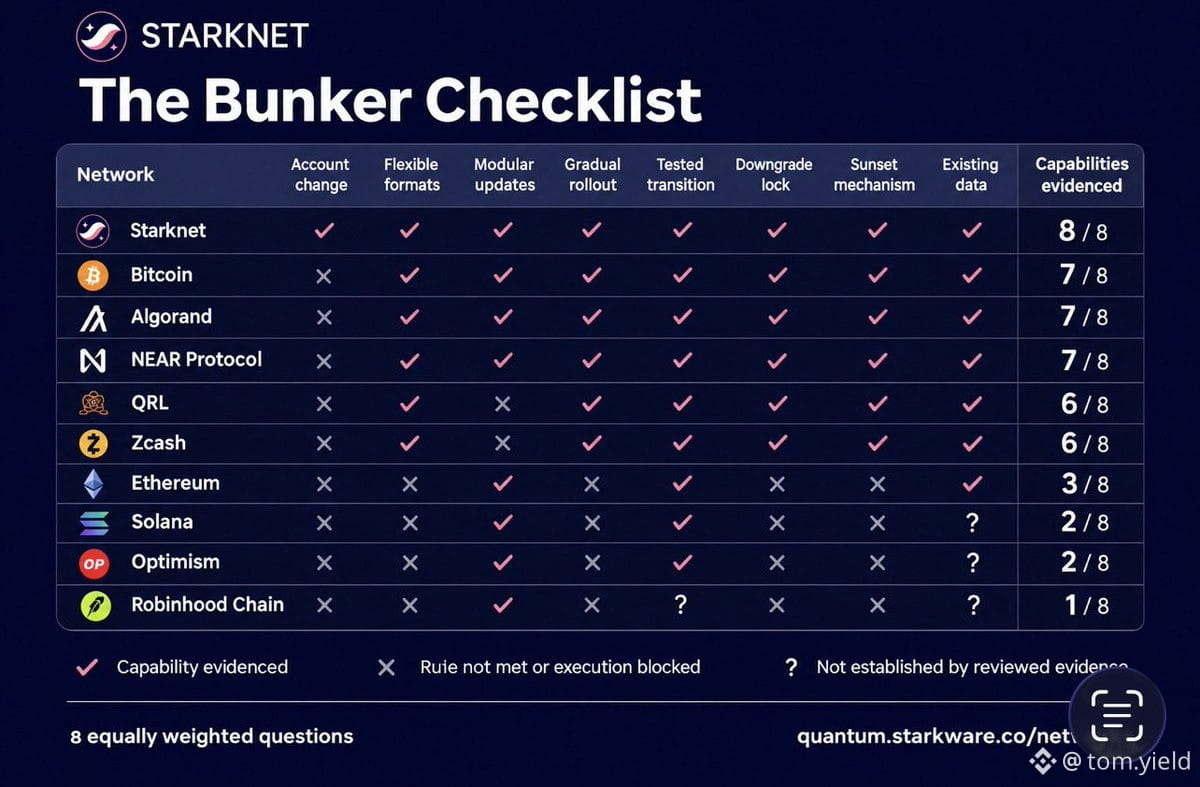
StarkWare built the Quantum Hub checklist. StarkWare is a core Starknet dev. So I treat it as a lead, not a verdict.
Example: Account upgrades.
Live accounts (Argent/Braavos) can swap code in place, keep address + assets. Cool. But the example uses regular sigs, not post-quantum ones.
A demo ≠ adoption.
Status per the Hub (checked Sept 28, 2026):
→ Live on mainnet: v0.14.3 hash swap
→ Demo only: Falcon-512 account. Unaudited. Not user-ready
→ Still waiting: Ethereum bridge + blob data
THE PART I LIKE MOST
The honesty. They split live vs demo vs planned. They timestamp it. The Hub itself says the count isn't a security rating.
That's why I'm paying attention.
WHERE I LAND
$STRK is preparing for quantum threats. It's not done.
Be wary of anyone who says it is. What I want from any project:
Show me how you'd adapt. Tell me the truth about where you are today.
So what would you trust more?
A lock that's strong, or a lock that can be changed?
Dig in: StarkWare Quantum Hub
Nobody can promise "yes, forever." Not a chain. Not a bank. Not anyone.
Quantum computing could break today's crypto. New math, maybe boosted by AI, could expose weak spots. I won't guess when. Neither should you trust anyone who does.
So I ask this instead:
When the math changes, how fast can you adapt?
Strength is a snapshot. Agility is a system.
A strong lock today can be weak tomorrow. A lock you can swap stays useful. I'll take the second one.
WHY $STRK GOT MY ATTENTION
Two design choices stand out:
1. STARKs use hash functions, not elliptic-curve math (the stuff quantum worries target). Different foundation from the start.
2. Accounts are programs. New signature methods can be added account by account, no network-wide fork needed.
The hardest part of any security upgrade isn't the math. It's coordinating everyone to move at once. $STRK removes that friction.
WHAT I'D PUSH ON
StarkWare built the Quantum Hub checklist. StarkWare is a core Starknet dev. So I treat it as a lead, not a verdict.
Example: Account upgrades.
Live accounts (Argent/Braavos) can swap code in place, keep address + assets. Cool. But the example uses regular sigs, not post-quantum ones.
A demo ≠ adoption.
Status per the Hub (checked Sept 28, 2026):
→ Live on mainnet: v0.14.3 hash swap
→ Demo only: Falcon-512 account. Unaudited. Not user-ready
→ Still waiting: Ethereum bridge + blob data
THE PART I LIKE MOST
The honesty. They split live vs demo vs planned. They timestamp it. The Hub itself says the count isn't a security rating.
That's why I'm paying attention.
WHERE I LAND
$STRK is preparing for quantum threats. It's not done.
Be wary of anyone who says it is. What I want from any project:
Show me how you'd adapt. Tell me the truth about where you are today.
So what would you trust more?
A lock that's strong, or a lock that can be changed?
Dig in: StarkWare Quantum Hub