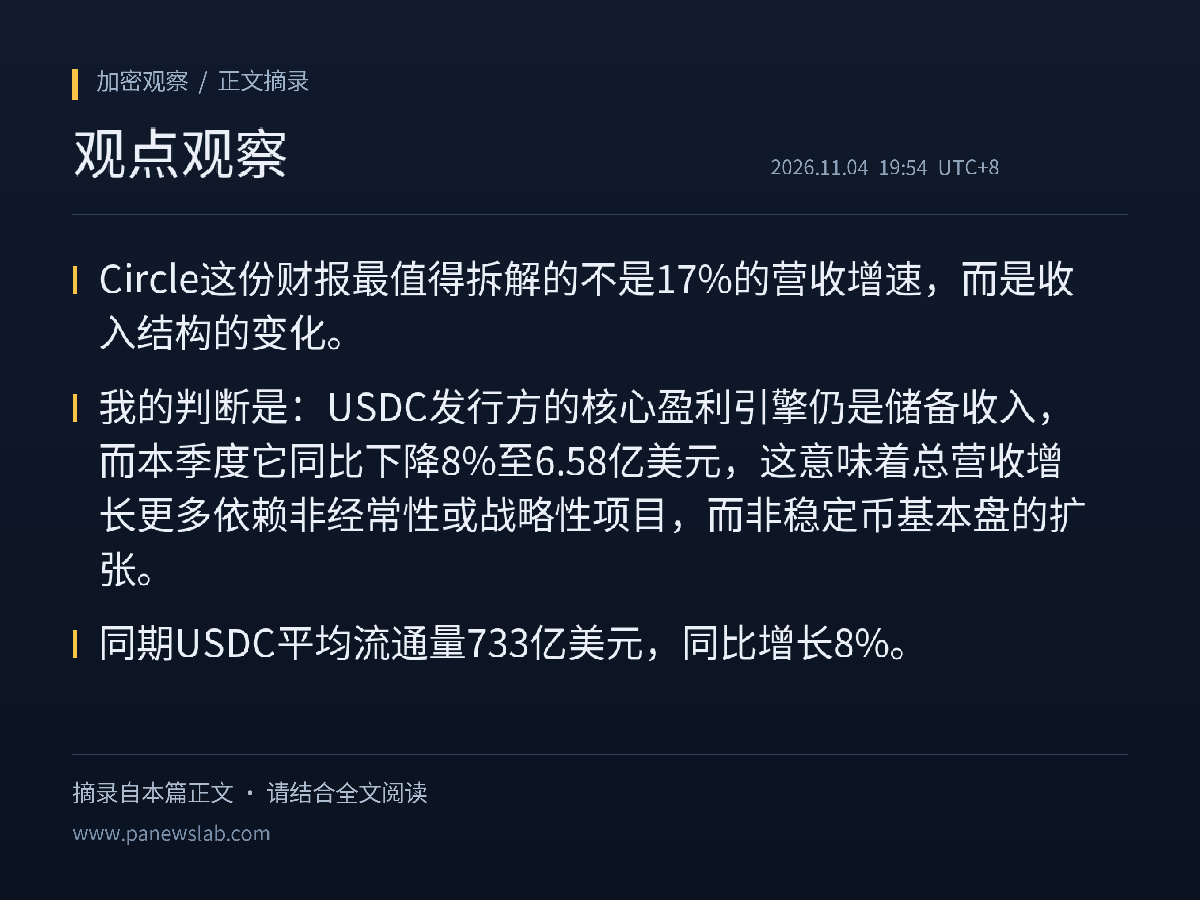
The most important thing to unpack in Circle’s earnings report isn’t its 17% revenue growth, but the shift in its revenue mix. My view is that reserve income remains the core profit engine for the USDC issuer. It fell 8% year over year this quarter to $658 million, which means total revenue growth relied more on non-recurring or strategic items than on expansion of the stablecoin’s core business. This view assumes that reserve income is directly tied to interest rates and the amount of USDC in circulation.
According to a November 4 report by PANews, Circle’s third-quarter total revenue and reserve income reached $865 million, up 17% year over year; the ARC token presale contributed $182 million. During the same period, average USDC in circulation was $73.3 billion, up 8% year over year. In addition, the company signed an agreement to acquire Tazapay, a Singapore-based cross-border payments platform, and Binance announced a $100 million equity investment in Circle.
Based on these figures, excluding the $182 million from the ARC presale leaves approximately $683 million, close to the $658 million in reserve income. This suggests that the main contribution to revenue growth this quarter came from the token presale, not reserve income. The combination of falling reserve income and rising circulation may reflect changes in the interest-rate environment or reserve yields, but the summary does not provide a detailed breakdown, so this remains unknown. The revenue recognition treatment for the acquisition and equity investment has likewise not been disclosed in the material available, so they should not be counted as sustainable revenue.
My takeaway is that, for USDC, growth in token circulation does not automatically translate into revenue growth for the issuer. Revenue quality depends on reserve yields and the share of one-off items. Readers should distinguish between “USDC is growing in scale” and “Circle’s ability to make money is growing.”
This assessment would be invalidated if future disclosures show that the decline in reserve income was mainly due to short-term interest-rate fluctuations, and that continued growth in circulation can offset falling yields. Three indicators are worth tracking: subsequent changes in USDC circulation, reserve income as a share of total revenue, and the interest-rate path. This article does not constitute investment advice.
$USDC
#USDC #CryptoMarket
Sources:
PANews (originally published 11-04 19:37 Beijing Time)
https://www.panewslab.com/zh/articles/01a1a659-d209-72ff-ab6b-8c750b1f57b2