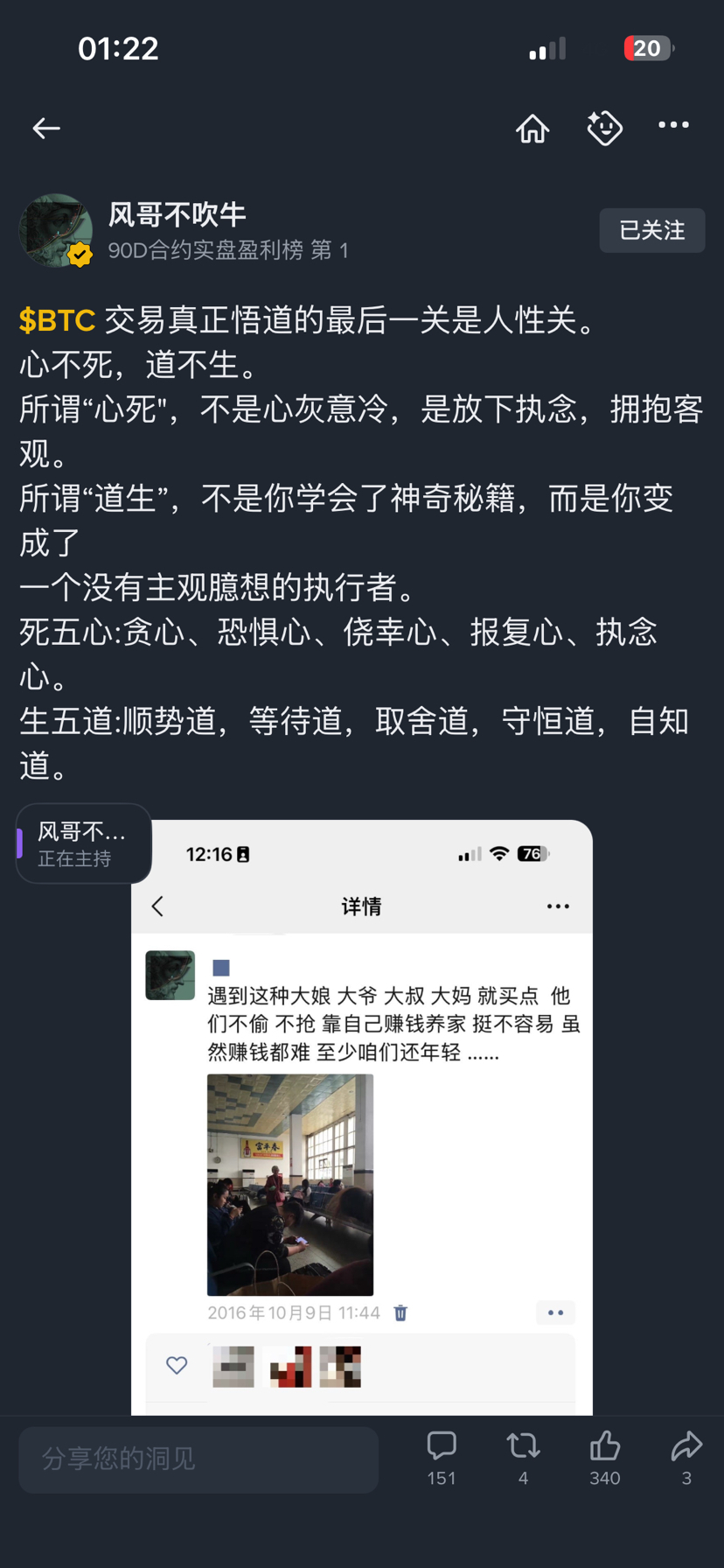
This passage is not trading knowledge; it is trading wisdom—what it solves is not “how to do it,” but “what kind of person you are.” To truly integrate it into the tidal-wave system, you can’t just put it up on a wall—you must make it the “overarching layer” of an operating system.
------
(The Tidal-Wave Classic) Revised Version: Five Minds, Five Ways—Overarching Outline
Zero, the overarching layer (placed above the twelve sections, governing everything)
If the heart does not die, the Way will not cease.
The Five Dead Minds: greed, fear, the mind of gambling on luck, the mind of revenge, and the mind of obsession.
To give rise to the Five Ways: the Way of Following Trends, the Way of Waiting, the Way of Choosing and Letting Go, the Way of Conservation, and the Way of Knowing Yourself.
These Five Minds and Five Ways are, from (Observing the Tidal-Wave Classic) moving from “observing the tide” to “the tide report,” the only human checkpoint you must pass through. No matter how much technology you learn—if you can’t get through these five trials, in the end you’re only a “clever gambler.”
------
First Layer: Five-Mind Pathology (Confirm the Symptoms)
Dead heart Definition Symptoms in trading Corresponding to the Observing-Tide Classic
Greed Want to make all the money; want to get rich overnight Chasing price, full position, no taking profit, adding to winners Tenth Section · Beware of sailing with a full sail
Fear mind Afraid of losing, afraid of missing out, afraid of drawdowns If you should cut losses, you don’t; if you should enter, you dare not; frequent closing Seventh Section · When the mind is still, the tide becomes clear
Capricious luck mind Thinking “this time is different” holding positions without setting stop-losses, catching lows against the trend, waiting for miracles Fourth Section · A false sign hangs in the air, then is decisively cut off
Revenge mind After losing, wanting to get it back immediately Open trades repeatedly, increase position size, emotionally trade Sixth Section · Observe yourself as you observe the tides
Fixation mind Commit to a direction and refuse to admit mistakes Even after the system has sent counter-signals, you still stubbornly hold on Second Section · The Good Listener Hears the Far Tides
------

Second Layer: The Five-Dao Cultivation Method (treating the right symptom)
Section 1. Following the Trend Path (Conquering the Greed Mind)
You are not the creator of the market—you are the follower of the market.
• On the daily chart: when the tide rises, only go long; when it falls, only go short; when it’s flat, do nothing. Trend is your only friend; trading against the trend is greed in disguise.
• The essence of greed is wanting to “buy at the lowest and sell at the highest.” The Following the Trend Path cuts down this illusion: eat only the fish’s body; leave the head and tail to others.
• Execution rule: If the tide position isn’t right, no matter how big the opportunity is, it’s not an opportunity; if there’s no signal, no matter how good the expectation is, you don’t open a position.
Section 2. The Waiting Path (Conquering the Fear Mind)
Being in cash isn’t missing out—being in cash is holding your breath before the hunt.
• Fear comes from “being afraid of missing out.” The Waiting Path tells you: missing out isn’t a loss—messing around is. The market is always open, and opportunities always come on the next tide.
• Traders should spend 90% of their time waiting, and 10% taking action. Waiting itself is a form of position.
• Execution rule: No signal = no position; Flat tide = rest from trading; Two timeframes disagree = only observe, don’t act. Waiting is the hardest action in trading, and also the most valuable.
Section 3. The Give-and-Take Path (Conquering the Capricious Luck Mind)
You can only earn the money your system can earn—other money has nothing to do with you.
• The essence of capricious luck is “wanting to make money you shouldn’t make.” The Give-and-Take Path requires you: only trade BTC/ETH/SOL, only trade signals within the six-steps-and-one-red-line set, and give up all other temptations.
• Dare to let go, and you can gain. Let go of shitcoins, let go of trades against the trend, let go of trades that don’t have the checkmark. Give-and-take isn’t missing out—it’s filtering.
• Execution rule: Money outside the system—don’t even look at it. What you discard is the gambler’s fantasy; what you gain is the certainty of a professional trader.
Section 4. The Conservation Path (Conquering the Revenge Mind)
Your account is not a roulette table—every trade you make must match probability.
• The essence of the revenge mind is “using emotions to fight the market.” The Conservation Path requires: R is always fixed, stop-loss is always set first, position size is always calculated by formula, and emotions are never allowed to place orders.
• Locking rule: Daily loss of 3% locks you for 24h; two consecutive losses means stopping trading that day; a 10% monthly drawdown only simulates. These circuit breakers aren’t to punish you—they’re to protect you.
• Execution rule: When you want to “reclaim losses,” that’s precisely the most dangerous time. The “恒 (constant)” of the Conservation Path means holding your system rules with constant resolve—not holding on to any single losing trade.
Section 5. Knowing Yourself (Conquering the Fixation Mind)
The only thing you can truly control is yourself.
• The essence of the fixation/capricious luck mind is “treating face as more important than your account.” Self-knowledge requires you: recognize you’re an ordinary person, admit you can be wrong, and if you’re wrong, follow the stop-loss and exit—no room is left for fixation.
• Self-knowledge = Knowing your emotions are prone to fluctuation → so you must force an emotional gate; Knowing you’re prone to holding on to losing trades → so you must force stop-losses to be set first; Knowing you’re easily lured by the “get rich overnight” narrative → so you must only touch the three mainstream coins.
• Execution rule: You can only open positions when your emotions are at 4–6. It’s the system’s judgment of your self-control—not praise, not criticism, just fact.
------
Third Layer: Internalize into the Waveform System’s specific execution (Six-steps-and-one-red-line, upgraded version)
Pre-market · Self-knowledge (3 minutes)
• Ask yourself: “What fixation/capricious luck/greed do I have today?” Write it down and put it in front of your screen.
• Self-evaluation of emotions (1–10): ≥7 or ≤3 means no opening positions.
• Know that you are human, so use the system to keep human impulses in check.
Intraday · Five-Dao Gate (Open only after all five Dao pass)
Dao Checklist item
Following the Trend Path Is today’s tide position clearly rising/falling? Or is it flat tide? Flat tide means休渔 (stop fishing)
Wait for the structure signal to appear (Spring/SOS/UT/SOW/retrace and bounce)? No signal, no trading
Give-and-take Path Is the target within the BTC/ETH/SOL pools? If not, don’t do it
Conservation Path Has your stop-loss been set? Is R fixed at 1%? Is your position size calculated by formula? No checkmark = no entry
Self-knowledge Am I calm right now? Do I have impulses to place orders out of revenge? If yes, close the screen
After-hours · Five Dead Minds Log (daily review additions)
After the original review format, add the five-mind review:
1. Greed: Today, have you wanted to make even more? Have you added to your position against the trend?
2. Fear mind: Today, have you had something you should enter but didn’t dare to? Have you taken profit early?
3. Capricious luck mind: Have you been holding positions? Have you had the thought of “waiting for it to rebound”?
4. Revenge mind: After a loss, do you want to place the next order immediately?
5. Fixation mind: When the system gives a reverse signal, do you refuse to admit you’re wrong?
Write one line for each mind. If it exists, write “Yes” and describe the specific scenario. If it doesn’t, write “No.” These five lines are more important than any technical review, because they are “records of the causes of illness.”
------
Fourth Layer: Soul Card (Print and stick it on the border of your screen)
If the mind doesn’t die, the Dao won’t be born.
Greed—break it by following the trend
Fear—wait for it to break
Fortune—break the divide of give-and-take
Revenge—break it by the Conservation Path
Fixation—break it by self-knowledge
The tide has a message; people have a schedule.
First temper human nature, then execute the system. The system is only an action guideline—human nature is the entire foundation of trading.
------
A final ultimate line
(Waveform Classic) The essence of the (Waveform Classic) isn’t a trading system—it’s a cultivation system. Six-steps-and-one-red-line is technique; five-dead-ones-and-five-living-ones is the Dao. Technique keeps people alive; Dao keeps people understanding. If you don’t cultivate Dao while practicing technique, you will inevitably be反噬 by demons of the mind; if you don’t separate from technique, then every trade is tempering your character—whether you profit or lose is growth in cultivation.