#xrp
A new XRPL upgrade could concentrate XRP ownership inside banks instead of retail wallets
A proposed $XRP Ledger (XRPL) upgrade could let banks and fintechs absorb $XRP costs so customers never need to hold the token.
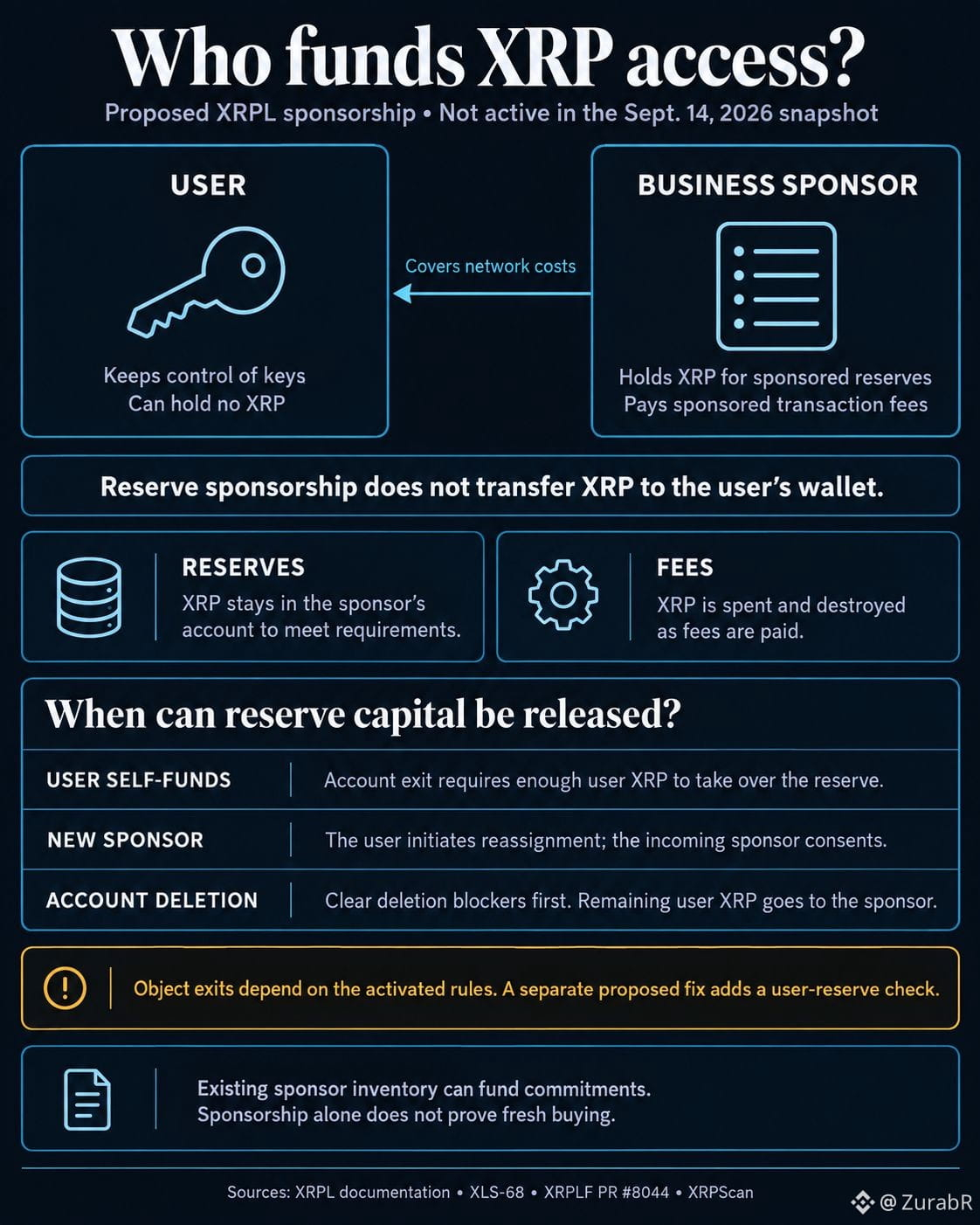
The Sponsor amendment, based on the XLS-68 Sponsored Fees and Reserves proposal, would let a company pay account reserves and transaction fees for another XRPL user while that customer retains control of their account and private keys.
For financial institutions, the change would remove one of the frictions involved in deploying products on the network: requiring every customer to acquire and manage xrp before interacting with tokenized assets, payments or other applications.
Jazzi Cooper, Ripple’s head of product, said the feature is designed so a sponsor such as a bank, issuer or platform can cover those costs on behalf of users. That could allow consumer-facing applications and institutional platforms to keep the underlying xrp mechanics largely out of the customer experience.
The trade-off moves to the sponsor’s balance sheet. Account reserves would still need to be covered in $XRP, while transaction fees would continue to be paid in the token and destroyed when transactions settle. Businesses could therefore become the xrp holders supporting customers who themselves own none.
The proposal remains some distance from activation. As of press time, XRPScan data showed only six validators supporting the amendment, short of the 29-validator threshold, with no activation date scheduled.
Banks could become the xrp holders behind their customers
The structure would alter who carries the capital requirement without eliminating it.
XRPL currently requires a base reserve of 1 xrp per account and 0.2 xrp per standard owner-reserve unit, though validators can change those parameters. Under sponsorship, the xrp allocated to a user’s reserve would remain in the sponsor’s account while the ledger records which party is responsible for the obligation.
#Write2Earn $XRP
A new XRPL upgrade could concentrate XRP ownership inside banks instead of retail wallets
A proposed $XRP Ledger (XRPL) upgrade could let banks and fintechs absorb $XRP costs so customers never need to hold the token.
The Sponsor amendment, based on the XLS-68 Sponsored Fees and Reserves proposal, would let a company pay account reserves and transaction fees for another XRPL user while that customer retains control of their account and private keys.
For financial institutions, the change would remove one of the frictions involved in deploying products on the network: requiring every customer to acquire and manage xrp before interacting with tokenized assets, payments or other applications.
Jazzi Cooper, Ripple’s head of product, said the feature is designed so a sponsor such as a bank, issuer or platform can cover those costs on behalf of users. That could allow consumer-facing applications and institutional platforms to keep the underlying xrp mechanics largely out of the customer experience.
The trade-off moves to the sponsor’s balance sheet. Account reserves would still need to be covered in $XRP, while transaction fees would continue to be paid in the token and destroyed when transactions settle. Businesses could therefore become the xrp holders supporting customers who themselves own none.
The proposal remains some distance from activation. As of press time, XRPScan data showed only six validators supporting the amendment, short of the 29-validator threshold, with no activation date scheduled.
Banks could become the xrp holders behind their customers
The structure would alter who carries the capital requirement without eliminating it.
XRPL currently requires a base reserve of 1 xrp per account and 0.2 xrp per standard owner-reserve unit, though validators can change those parameters. Under sponsorship, the xrp allocated to a user’s reserve would remain in the sponsor’s account while the ledger records which party is responsible for the obligation.
#Write2Earn $XRP