
SignalX 🇻🇳
949 Posts

SignalX 🇻🇳
 Square Verified
Personal analysis and market views only not financial or investment advice.
🤖 This channel is sponsored, built, and powered by SignalX AutoBot.
High-Frequency Trader
5.4 Years
150 Following
17.9K+ Followers
10.1K+ Liked
Posts
All
Quotes
Videos
Live
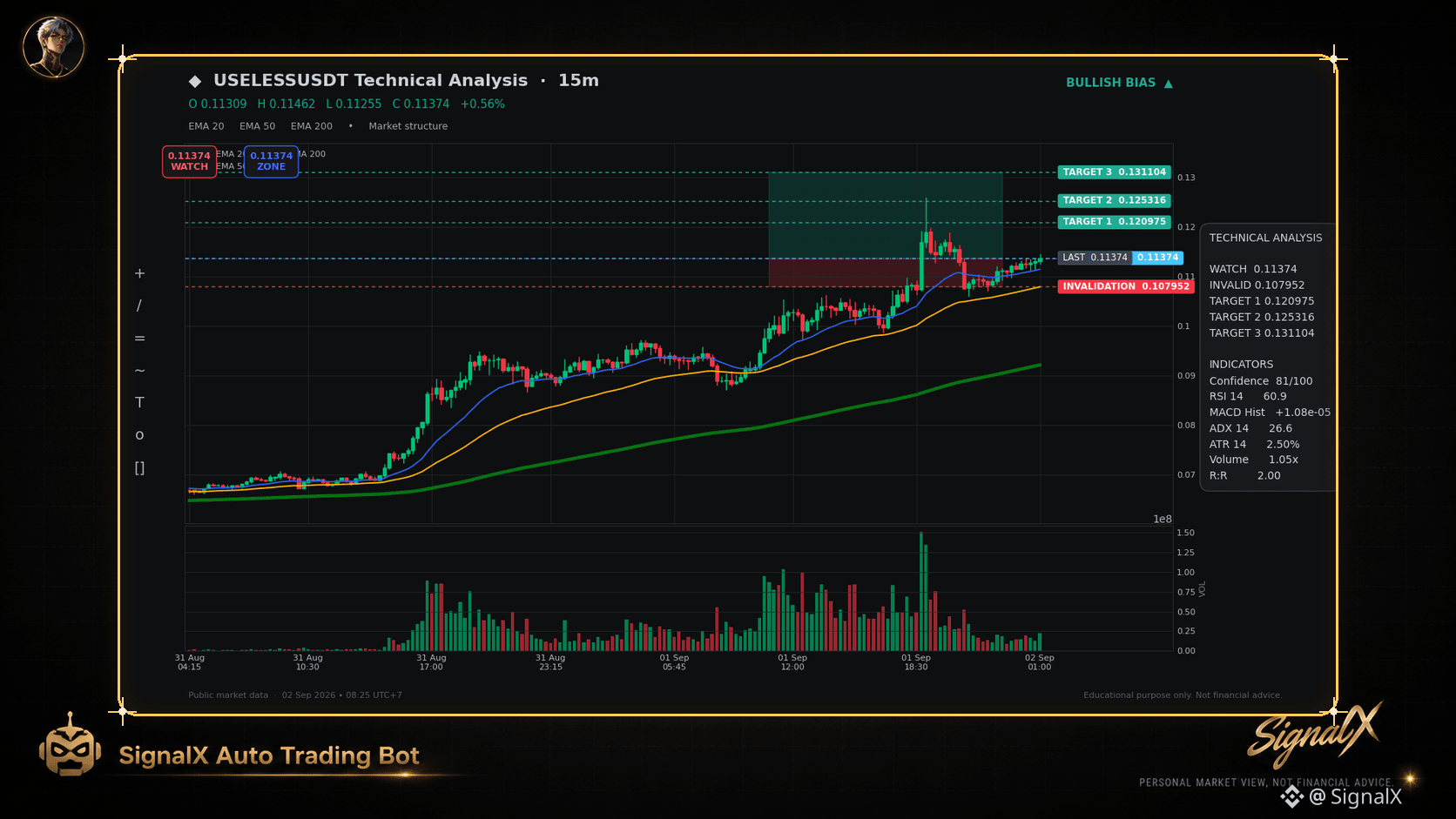
TECHNICAL ANALYSIS — USELESS (15m)
🧭 Market bias: BULLISH BIAS 🟢
🎯 Setup: trend pullback/continuation
⭐ Confidence: 81/100
📍 Price zones to watch: 0.11374
🛑 Scenario invalidation level: 0.107952 (5.09% distance)
🎯 Technical target 1: 0.120975 (1.25R)
🎯 Technical target 2: 0.125316 (2R)
🎯 Technical target 3: 0.131104 (3R)
📊 TECHNICAL INDICATORS
📈 EMA20/50/200: aligned long
💪 ADX14: 26.6
⚡ RSI14: 60.9
🌊 MACD histogram: +1.0796e-05
🌡️ ATR14: 2.50% of price
🔊 Volume: 1.05x average (above 20-candle mean)
⚠️ A 15m close beyond the invalidation level weakens this scenario.
Disclaimer: Educational technical analysis only—not financial advice. Leveraged markets involve substantial risk.
🧭 Market bias: BULLISH BIAS 🟢
🎯 Setup: trend pullback/continuation
⭐ Confidence: 81/100
📍 Price zones to watch: 0.11374
🛑 Scenario invalidation level: 0.107952 (5.09% distance)
🎯 Technical target 1: 0.120975 (1.25R)
🎯 Technical target 2: 0.125316 (2R)
🎯 Technical target 3: 0.131104 (3R)
📊 TECHNICAL INDICATORS
📈 EMA20/50/200: aligned long
💪 ADX14: 26.6
⚡ RSI14: 60.9
🌊 MACD histogram: +1.0796e-05
🌡️ ATR14: 2.50% of price
🔊 Volume: 1.05x average (above 20-candle mean)
⚠️ A 15m close beyond the invalidation level weakens this scenario.
Disclaimer: Educational technical analysis only—not financial advice. Leveraged markets involve substantial risk.
🌍 CRYPTO MARKET UPDATE
How the GTA 6 Leaker Profited $350,000 From CyberLeek
The anonymous leaker behind CyberLeek has reportedly pocketed roughly $350,000, according to on-chain analyst Conor Grogan. The funds allegedly came entirely from liquidity fees rather than direct sales. The withdrawal coincided with a sharp price decline for the CYBERLEEK meme coin. The Mastermind Strategy Behind CyberLeek Grogan stated on September 1 that the person behind The post How the GTA 6 Leaker Profited $350,000 From CyberLeek appeared first on . The Mastermind Strategy Behind CyberLeek Grogan stated on September 1 that the person behind CyberLeek withdrew the funds through various OTC providers , a route that converts digital assets into conventional money without requiring large open-market token sales. That structure differs meaningfully from a typical launch-and-dump scheme. Rather than offloading large CYBERLEEK holdings directly, the wallet tied to the project reportedly profited by collecting fees whenever other traders transacted in its liquidity pool. The GTA 6 hacker, responsible for the Cyberleek coin, has cashed out about $350k, entirely from LP fees. They have washed funds through a variety of OTC providers This is the first hacker that I've ever seen make money solely on liquidity provision (versus dumping a token) pic.twitter.com/ABzjSjYAed — Conor (@jconorgrogan) September 1, 2026 This mechanism depends entirely on sustained trading activity. The viral GTA VI leaks appeared to provide exactly that fuel, drawing in buyers and speculators with each new clip, even as rising volume exposed participants to greater volatility and potential losses. CyberLeek Launch Timeline Blockchain researchers traced the CYBERLEEK token’s launch to August 15.
🕒 Updated: 01 Sep 2026 23:10 UTC
#CryptoNews #MarketUpdate #BinanceSquare
How the GTA 6 Leaker Profited $350,000 From CyberLeek
The anonymous leaker behind CyberLeek has reportedly pocketed roughly $350,000, according to on-chain analyst Conor Grogan. The funds allegedly came entirely from liquidity fees rather than direct sales. The withdrawal coincided with a sharp price decline for the CYBERLEEK meme coin. The Mastermind Strategy Behind CyberLeek Grogan stated on September 1 that the person behind The post How the GTA 6 Leaker Profited $350,000 From CyberLeek appeared first on . The Mastermind Strategy Behind CyberLeek Grogan stated on September 1 that the person behind CyberLeek withdrew the funds through various OTC providers , a route that converts digital assets into conventional money without requiring large open-market token sales. That structure differs meaningfully from a typical launch-and-dump scheme. Rather than offloading large CYBERLEEK holdings directly, the wallet tied to the project reportedly profited by collecting fees whenever other traders transacted in its liquidity pool. The GTA 6 hacker, responsible for the Cyberleek coin, has cashed out about $350k, entirely from LP fees. They have washed funds through a variety of OTC providers This is the first hacker that I've ever seen make money solely on liquidity provision (versus dumping a token) pic.twitter.com/ABzjSjYAed — Conor (@jconorgrogan) September 1, 2026 This mechanism depends entirely on sustained trading activity. The viral GTA VI leaks appeared to provide exactly that fuel, drawing in buyers and speculators with each new clip, even as rising volume exposed participants to greater volatility and potential losses. CyberLeek Launch Timeline Blockchain researchers traced the CYBERLEEK token’s launch to August 15.
🕒 Updated: 01 Sep 2026 23:10 UTC
#CryptoNews #MarketUpdate #BinanceSquare

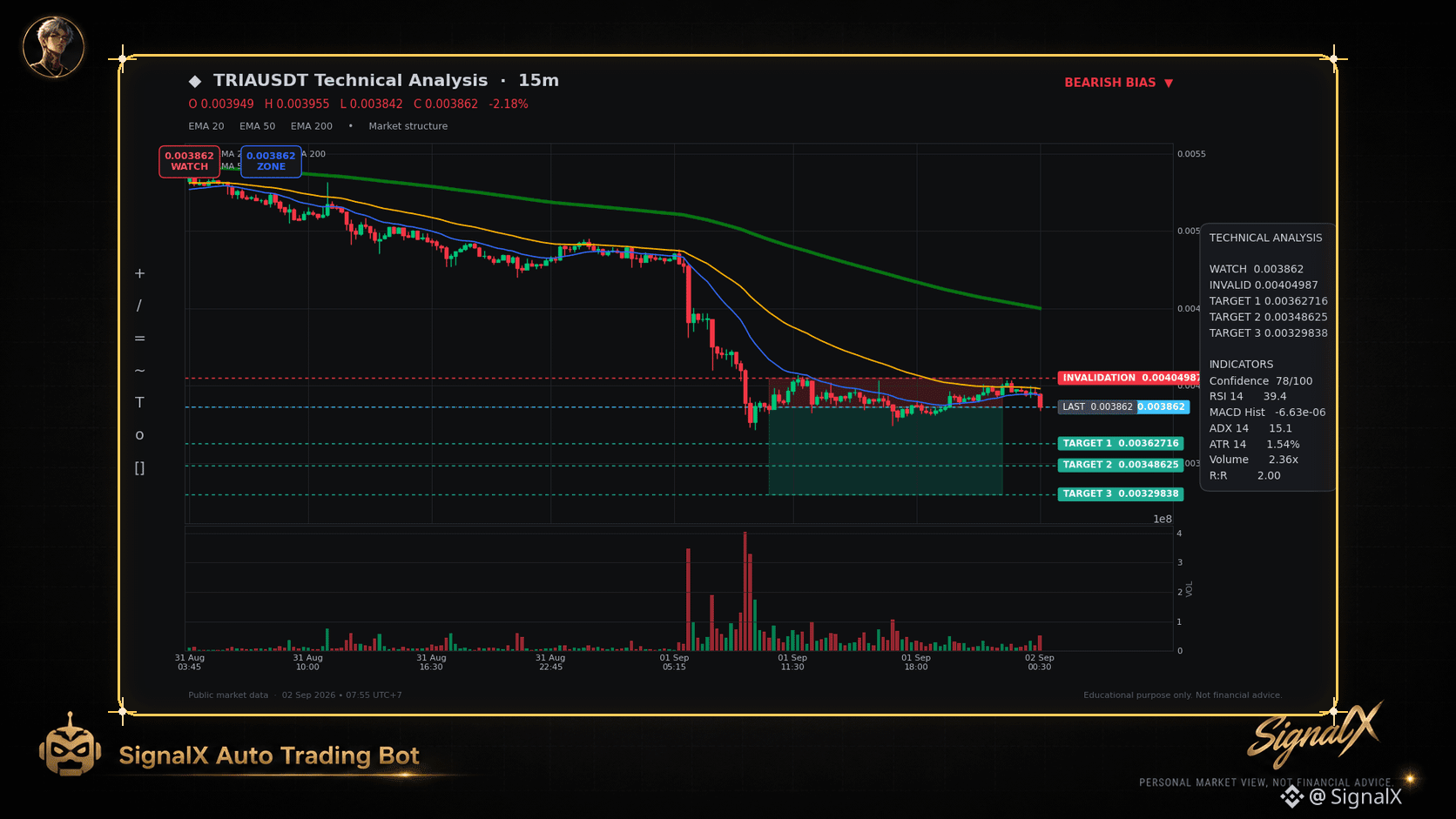
TECHNICAL ANALYSIS — TRIA (15m)
🧭 Market bias: BEARISH BIAS 🔴
🎯 Setup: trend pullback/continuation
⭐ Confidence: 78/100
📍 Price zones to watch: 0.003862
🛑 Scenario invalidation level: 0.00404987 (4.86% distance)
🎯 Technical target 1: 0.00362716 (1.25R)
🎯 Technical target 2: 0.00348625 (2R)
🎯 Technical target 3: 0.00329838 (3R)
📊 TECHNICAL INDICATORS
📈 EMA20/50/200: aligned short
💪 ADX14: 15.1
⚡ RSI14: 39.4
🌊 MACD histogram: -6.6345e-06
🌡️ ATR14: 1.54% of price
🔊 Volume: 2.36x average (above 20-candle mean)
⚠️ A 15m close beyond the invalidation level weakens this scenario.
Disclaimer: Educational technical analysis only—not financial advice. Leveraged markets involve substantial risk.
🧭 Market bias: BEARISH BIAS 🔴
🎯 Setup: trend pullback/continuation
⭐ Confidence: 78/100
📍 Price zones to watch: 0.003862
🛑 Scenario invalidation level: 0.00404987 (4.86% distance)
🎯 Technical target 1: 0.00362716 (1.25R)
🎯 Technical target 2: 0.00348625 (2R)
🎯 Technical target 3: 0.00329838 (3R)
📊 TECHNICAL INDICATORS
📈 EMA20/50/200: aligned short
💪 ADX14: 15.1
⚡ RSI14: 39.4
🌊 MACD histogram: -6.6345e-06
🌡️ ATR14: 1.54% of price
🔊 Volume: 2.36x average (above 20-candle mean)
⚠️ A 15m close beyond the invalidation level weakens this scenario.
Disclaimer: Educational technical analysis only—not financial advice. Leveraged markets involve substantial risk.
🌍 CRYPTO MARKET UPDATE
Wall Street Stock Records Could Move On-Chain. One Trader Punished for Deleting His
The SEC moves to put stock records on-chain, while the CFTC fines a swaps trader $90,000 for deleting his messages. The post Wall Street Stock Records Could Move On-Chain. One Trader Punished for Deleting His appeared first on . The US Securities and Exchange Commission (SEC) proposed new transfer agent rules on Tuesday. A blockchain could become the official record of who owns a share. The same day, the Commodity Futures Trading Commission (CFTC) settled with a swaps trader. He had erased messages regulators ordered him to keep. Both actions turn on what counts as an official record. Stock Records On-Chain Depend on One Obscure Firm Transfer agents sit behind every public company share. They keep the master securityholder file, which is the issuer’s legal list of who owns what; they also route dividends and process transfers. Washington has not rewritten those rules since the early 1980s, but Tuesday’s package amends existing rules and forms, rescinds one rule, and adds several new ones. Commissioner Hester Peirce said on X (twitter) that the proposal took more than a decade. The transfer agent rule proposal, more than a decade in the making, is finally out. We welcome comment on all aspects, including implications for tokenization: and — Hester Peirce (@HesterPeirce) September 1, 2026 “This proposal would streamline and modernize the Commission’s rules to reflect transfer agents’ current processes and operations, including the use of electronic communications and blockchain technology in connection with securities offerings and the transfer of shares,” That line decides whether a token is a share or a wrapper around one. He deleted WhatsApp threads and one text message instead.
🕒 Updated: 02 Sep 2026 00:10 UTC
#CryptoNews #MarketUpdate #BinanceSquare
Wall Street Stock Records Could Move On-Chain. One Trader Punished for Deleting His
The SEC moves to put stock records on-chain, while the CFTC fines a swaps trader $90,000 for deleting his messages. The post Wall Street Stock Records Could Move On-Chain. One Trader Punished for Deleting His appeared first on . The US Securities and Exchange Commission (SEC) proposed new transfer agent rules on Tuesday. A blockchain could become the official record of who owns a share. The same day, the Commodity Futures Trading Commission (CFTC) settled with a swaps trader. He had erased messages regulators ordered him to keep. Both actions turn on what counts as an official record. Stock Records On-Chain Depend on One Obscure Firm Transfer agents sit behind every public company share. They keep the master securityholder file, which is the issuer’s legal list of who owns what; they also route dividends and process transfers. Washington has not rewritten those rules since the early 1980s, but Tuesday’s package amends existing rules and forms, rescinds one rule, and adds several new ones. Commissioner Hester Peirce said on X (twitter) that the proposal took more than a decade. The transfer agent rule proposal, more than a decade in the making, is finally out. We welcome comment on all aspects, including implications for tokenization: and — Hester Peirce (@HesterPeirce) September 1, 2026 “This proposal would streamline and modernize the Commission’s rules to reflect transfer agents’ current processes and operations, including the use of electronic communications and blockchain technology in connection with securities offerings and the transfer of shares,” That line decides whether a token is a share or a wrapper around one. He deleted WhatsApp threads and one text message instead.
🕒 Updated: 02 Sep 2026 00:10 UTC
#CryptoNews #MarketUpdate #BinanceSquare

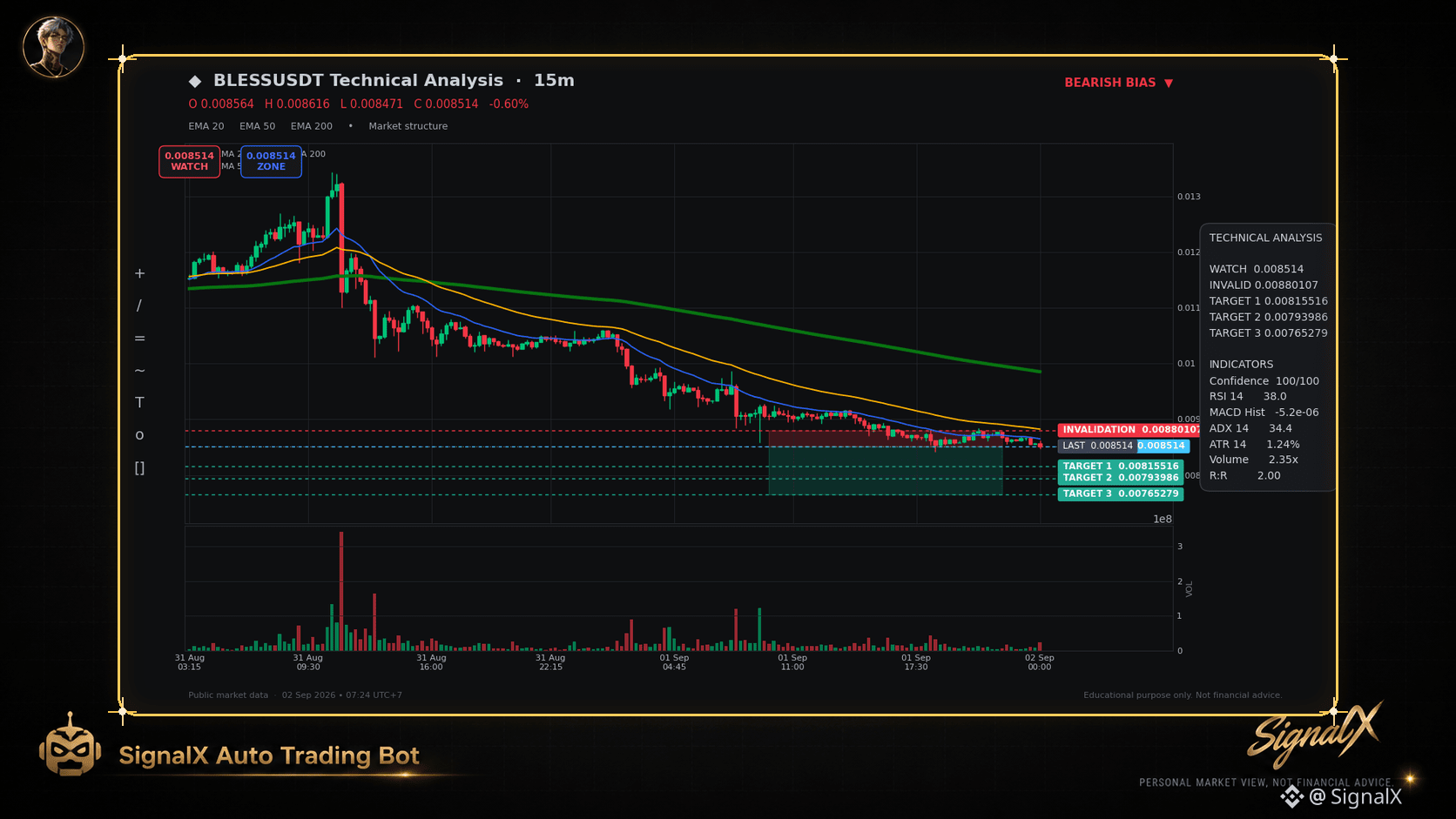
TECHNICAL ANALYSIS — BLESS (15m)
🧭 Market bias: BEARISH BIAS 🔴
🎯 Setup: 20-candle breakout
⭐ Confidence: 100/100
📍 Price zones to watch: 0.008514
🛑 Scenario invalidation level: 0.00880107 (3.37% distance)
🎯 Technical target 1: 0.00815516 (1.25R)
🎯 Technical target 2: 0.00793986 (2R)
🎯 Technical target 3: 0.00765279 (3R)
📊 TECHNICAL INDICATORS
📈 EMA20/50/200: aligned short
💪 ADX14: 34.4
⚡ RSI14: 38.0
🌊 MACD histogram: -5.20289e-06
🌡️ ATR14: 1.24% of price
🔊 Volume: 2.35x average (above 20-candle mean)
⚠️ A 15m close beyond the invalidation level weakens this scenario.
Disclaimer: Educational technical analysis only—not financial advice. Leveraged markets involve substantial risk.
🧭 Market bias: BEARISH BIAS 🔴
🎯 Setup: 20-candle breakout
⭐ Confidence: 100/100
📍 Price zones to watch: 0.008514
🛑 Scenario invalidation level: 0.00880107 (3.37% distance)
🎯 Technical target 1: 0.00815516 (1.25R)
🎯 Technical target 2: 0.00793986 (2R)
🎯 Technical target 3: 0.00765279 (3R)
📊 TECHNICAL INDICATORS
📈 EMA20/50/200: aligned short
💪 ADX14: 34.4
⚡ RSI14: 38.0
🌊 MACD histogram: -5.20289e-06
🌡️ ATR14: 1.24% of price
🔊 Volume: 2.35x average (above 20-candle mean)
⚠️ A 15m close beyond the invalidation level weakens this scenario.
Disclaimer: Educational technical analysis only—not financial advice. Leveraged markets involve substantial risk.
🌍 CRYPTO MARKET UPDATE
This Stablecoin Shift is Reshaping Global Cross-Border Payments
At three in the morning, an AI system can evaluate a trade flow, verify a contract and trigger a cross-border payout in seconds. The payment may still sit in a correspondent bank queue for days. Corporate software now operates at machine speed, while the financial infrastructure beneath it still keeps banking hours. That timing gap The post This Stablecoin Shift is Reshaping Global Cross-Border Payments appeared first on . The financial architecture underneath these autonomous workflows has failed to experience a corresponding modernization. Sophisticated, automated software layers now sit on top of traditional banking rails that remain bound by manual processes, legacy clearing schedules, regional banking hours and standard multi-day settlement timelines. This systemic divergence creates an immediate operational mismatch. An enterprise cannot maximize continuous, automated commerce when its settlement infrastructure relies on decades-old technology designs. Deconstructing the Multi-Intermediary Chain in Global Commerce To understand why traditional clearing mechanisms introduce severe latency, it is necessary to examine the specific structural plumbing of international trade finance. Legacy institutional settlement networks do not transfer value natively; instead, they pass transactional instructions across sequential databases. When a global payment moves across traditional banking channels , the underlying instruction must migrate through a fragmented array of payment gateways, domestic clearing houses, central banking networks, and multiple intermediary correspondent institutions. This prolonged processing latency introduces counterparty risk and ties up critical corporate liquidity.
🕒 Updated: 01 Sep 2026 23:29 UTC
#CryptoNews #MarketUpdate #BinanceSquare
This Stablecoin Shift is Reshaping Global Cross-Border Payments
At three in the morning, an AI system can evaluate a trade flow, verify a contract and trigger a cross-border payout in seconds. The payment may still sit in a correspondent bank queue for days. Corporate software now operates at machine speed, while the financial infrastructure beneath it still keeps banking hours. That timing gap The post This Stablecoin Shift is Reshaping Global Cross-Border Payments appeared first on . The financial architecture underneath these autonomous workflows has failed to experience a corresponding modernization. Sophisticated, automated software layers now sit on top of traditional banking rails that remain bound by manual processes, legacy clearing schedules, regional banking hours and standard multi-day settlement timelines. This systemic divergence creates an immediate operational mismatch. An enterprise cannot maximize continuous, automated commerce when its settlement infrastructure relies on decades-old technology designs. Deconstructing the Multi-Intermediary Chain in Global Commerce To understand why traditional clearing mechanisms introduce severe latency, it is necessary to examine the specific structural plumbing of international trade finance. Legacy institutional settlement networks do not transfer value natively; instead, they pass transactional instructions across sequential databases. When a global payment moves across traditional banking channels , the underlying instruction must migrate through a fragmented array of payment gateways, domestic clearing houses, central banking networks, and multiple intermediary correspondent institutions. This prolonged processing latency introduces counterparty risk and ties up critical corporate liquidity.
🕒 Updated: 01 Sep 2026 23:29 UTC
#CryptoNews #MarketUpdate #BinanceSquare

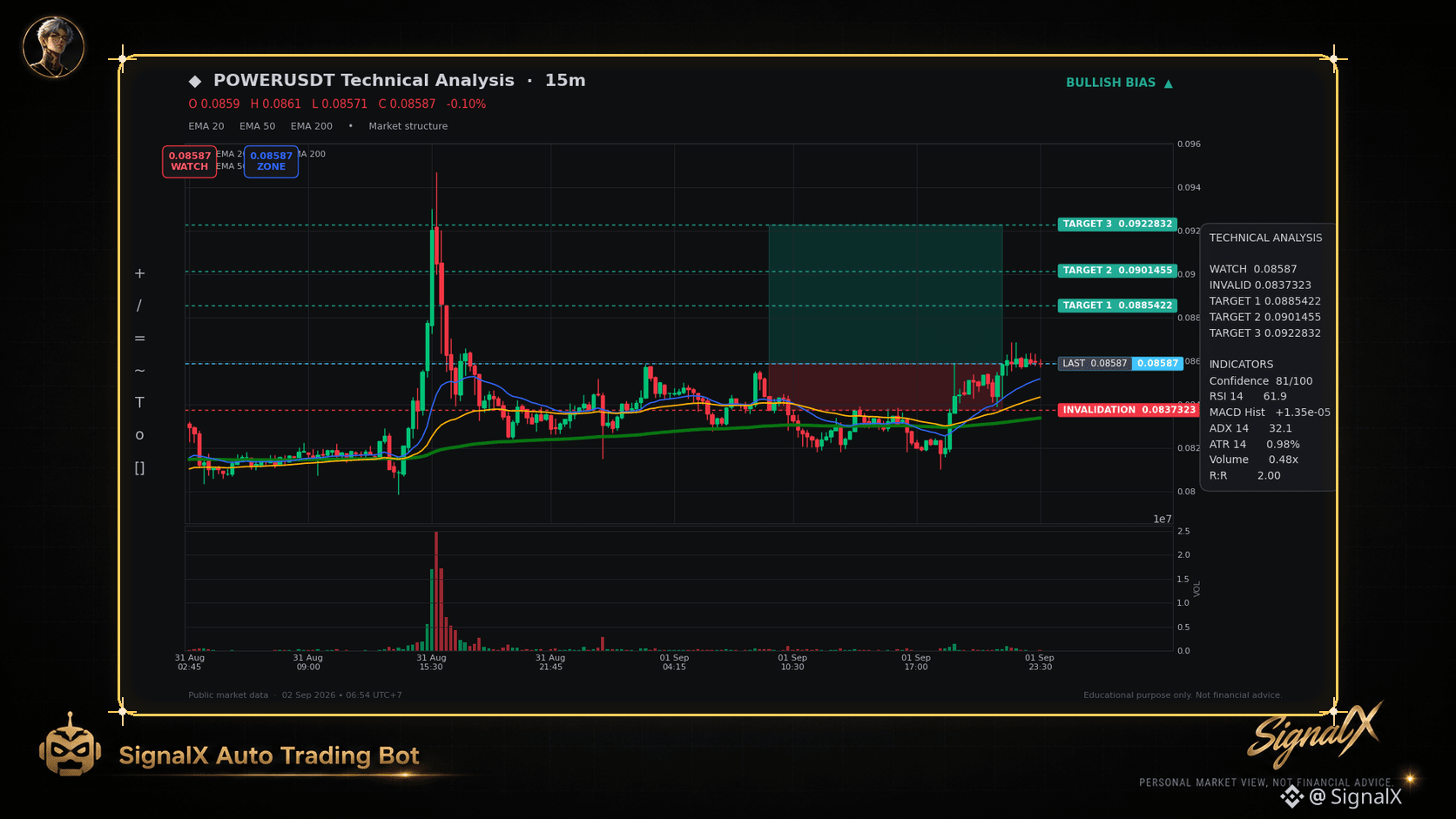
TECHNICAL ANALYSIS — POWER (15m)
🧭 Market bias: BULLISH BIAS 🟢
🎯 Setup: trend pullback/continuation
⭐ Confidence: 81/100
📍 Price zones to watch: 0.08587
🛑 Scenario invalidation level: 0.0837323 (2.49% distance)
🎯 Technical target 1: 0.0885422 (1.25R)
🎯 Technical target 2: 0.0901455 (2R)
🎯 Technical target 3: 0.0922832 (3R)
📊 TECHNICAL INDICATORS
📈 EMA20/50/200: aligned long
💪 ADX14: 32.1
⚡ RSI14: 61.9
🌊 MACD histogram: +1.35278e-05
🌡️ ATR14: 0.98% of price
🔊 Volume: 0.48x average (below 20-candle mean)
⚠️ A 15m close beyond the invalidation level weakens this scenario.
Disclaimer: Educational technical analysis only—not financial advice. Leveraged markets involve substantial risk.
🧭 Market bias: BULLISH BIAS 🟢
🎯 Setup: trend pullback/continuation
⭐ Confidence: 81/100
📍 Price zones to watch: 0.08587
🛑 Scenario invalidation level: 0.0837323 (2.49% distance)
🎯 Technical target 1: 0.0885422 (1.25R)
🎯 Technical target 2: 0.0901455 (2R)
🎯 Technical target 3: 0.0922832 (3R)
📊 TECHNICAL INDICATORS
📈 EMA20/50/200: aligned long
💪 ADX14: 32.1
⚡ RSI14: 61.9
🌊 MACD histogram: +1.35278e-05
🌡️ ATR14: 0.98% of price
🔊 Volume: 0.48x average (below 20-candle mean)
⚠️ A 15m close beyond the invalidation level weakens this scenario.
Disclaimer: Educational technical analysis only—not financial advice. Leveraged markets involve substantial risk.
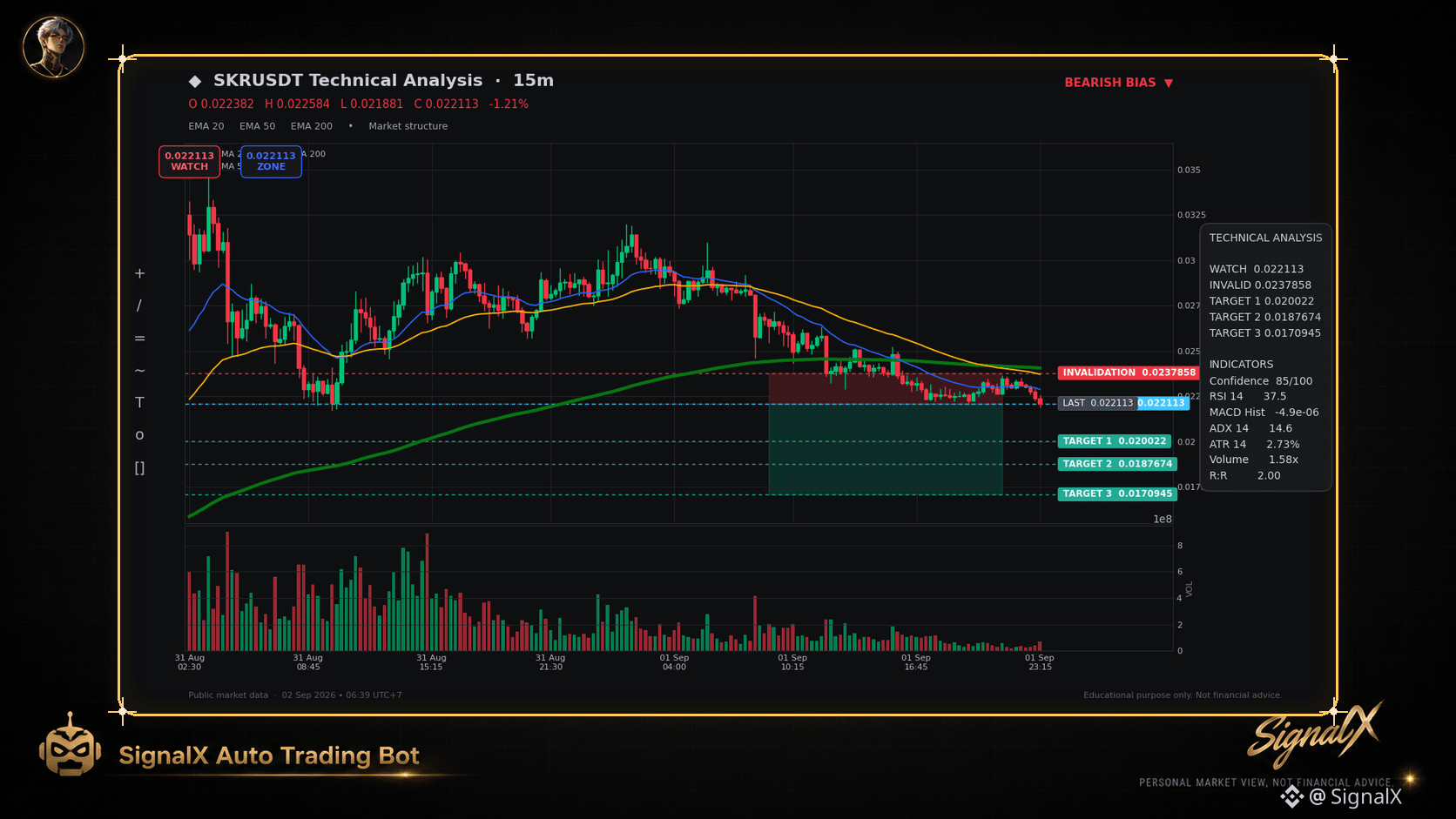
TECHNICAL ANALYSIS — SKR (15m)
🧭 Market bias: BEARISH BIAS 🔴
🎯 Setup: 20-candle breakout
⭐ Confidence: 85/100
📍 Price zones to watch: 0.022113
🛑 Scenario invalidation level: 0.0237858 (7.56% distance)
🎯 Technical target 1: 0.020022 (1.25R)
🎯 Technical target 2: 0.0187674 (2R)
🎯 Technical target 3: 0.0170945 (3R)
📊 TECHNICAL INDICATORS
📈 EMA20/50/200: aligned short
💪 ADX14: 14.6
⚡ RSI14: 37.5
🌊 MACD histogram: -4.89709e-06
🌡️ ATR14: 2.73% of price
🔊 Volume: 1.58x average (above 20-candle mean)
⚠️ A 15m close beyond the invalidation level weakens this scenario.
Disclaimer: Educational technical analysis only—not financial advice. Leveraged markets involve substantial risk.
🧭 Market bias: BEARISH BIAS 🔴
🎯 Setup: 20-candle breakout
⭐ Confidence: 85/100
📍 Price zones to watch: 0.022113
🛑 Scenario invalidation level: 0.0237858 (7.56% distance)
🎯 Technical target 1: 0.020022 (1.25R)
🎯 Technical target 2: 0.0187674 (2R)
🎯 Technical target 3: 0.0170945 (3R)
📊 TECHNICAL INDICATORS
📈 EMA20/50/200: aligned short
💪 ADX14: 14.6
⚡ RSI14: 37.5
🌊 MACD histogram: -4.89709e-06
🌡️ ATR14: 2.73% of price
🔊 Volume: 1.58x average (above 20-candle mean)
⚠️ A 15m close beyond the invalidation level weakens this scenario.
Disclaimer: Educational technical analysis only—not financial advice. Leveraged markets involve substantial risk.
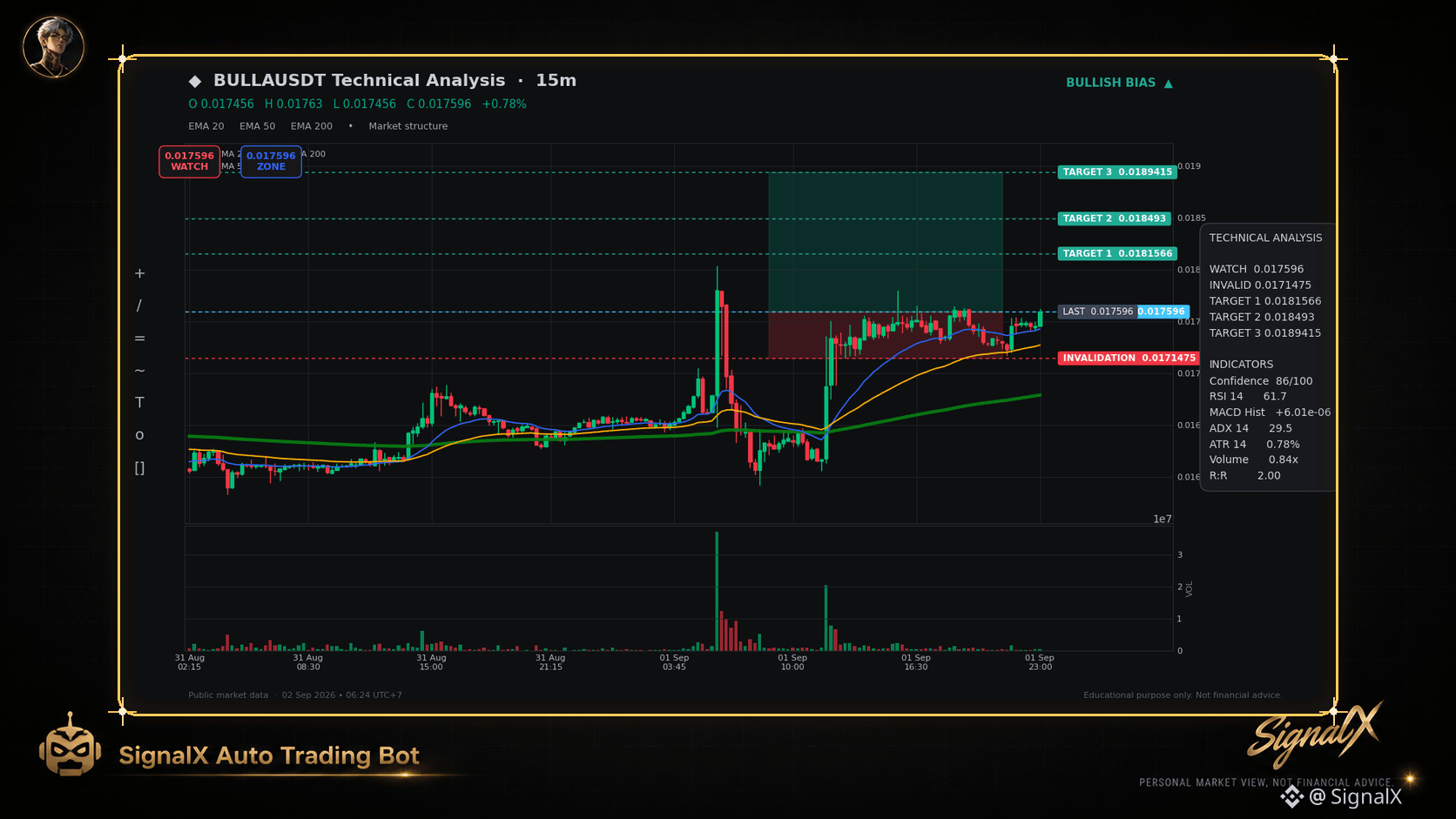
TECHNICAL ANALYSIS — BULLA (15m)
🧭 Market bias: BULLISH BIAS 🟢
🎯 Setup: trend pullback/continuation
⭐ Confidence: 86/100
📍 Price zones to watch: 0.017596
🛑 Scenario invalidation level: 0.0171475 (2.55% distance)
🎯 Technical target 1: 0.0181566 (1.25R)
🎯 Technical target 2: 0.018493 (2R)
🎯 Technical target 3: 0.0189415 (3R)
📊 TECHNICAL INDICATORS
📈 EMA20/50/200: aligned long
💪 ADX14: 29.5
⚡ RSI14: 61.7
🌊 MACD histogram: +6.00778e-06
🌡️ ATR14: 0.78% of price
🔊 Volume: 0.84x average (below 20-candle mean)
⚠️ A 15m close beyond the invalidation level weakens this scenario.
Disclaimer: Educational technical analysis only—not financial advice. Leveraged markets involve substantial risk.
🧭 Market bias: BULLISH BIAS 🟢
🎯 Setup: trend pullback/continuation
⭐ Confidence: 86/100
📍 Price zones to watch: 0.017596
🛑 Scenario invalidation level: 0.0171475 (2.55% distance)
🎯 Technical target 1: 0.0181566 (1.25R)
🎯 Technical target 2: 0.018493 (2R)
🎯 Technical target 3: 0.0189415 (3R)
📊 TECHNICAL INDICATORS
📈 EMA20/50/200: aligned long
💪 ADX14: 29.5
⚡ RSI14: 61.7
🌊 MACD histogram: +6.00778e-06
🌡️ ATR14: 0.78% of price
🔊 Volume: 0.84x average (below 20-candle mean)
⚠️ A 15m close beyond the invalidation level weakens this scenario.
Disclaimer: Educational technical analysis only—not financial advice. Leveraged markets involve substantial risk.
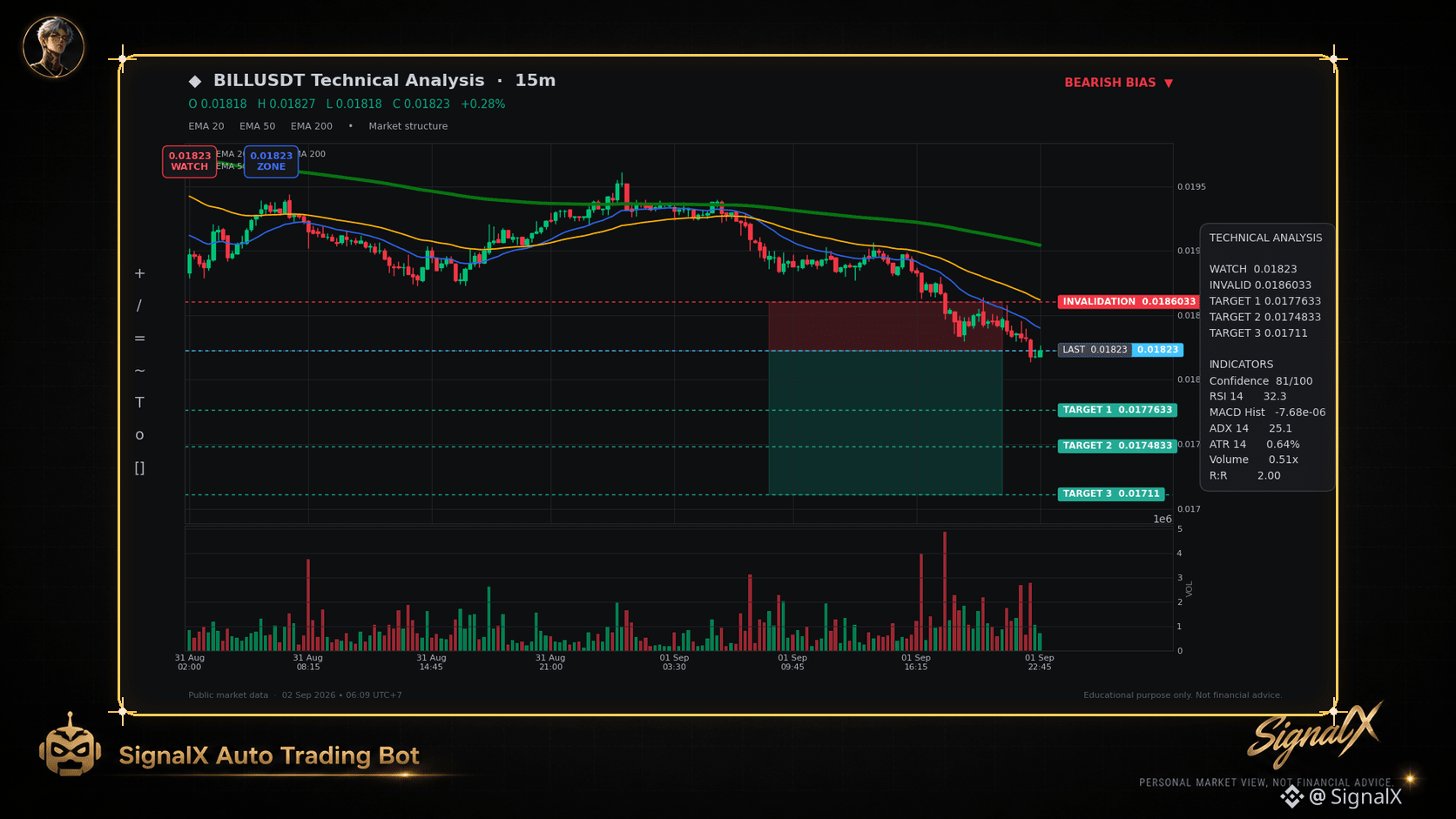
TECHNICAL ANALYSIS — BILL (15m)
🧭 Market bias: BEARISH BIAS 🔴
🎯 Setup: trend pullback/continuation
⭐ Confidence: 81/100
📍 Price zones to watch: 0.01823
🛑 Scenario invalidation level: 0.0186033 (2.05% distance)
🎯 Technical target 1: 0.0177633 (1.25R)
🎯 Technical target 2: 0.0174833 (2R)
🎯 Technical target 3: 0.01711 (3R)
📊 TECHNICAL INDICATORS
📈 EMA20/50/200: aligned short
💪 ADX14: 25.1
⚡ RSI14: 32.3
🌊 MACD histogram: -7.68004e-06
🌡️ ATR14: 0.64% of price
🔊 Volume: 0.51x average (below 20-candle mean)
⚠️ A 15m close beyond the invalidation level weakens this scenario.
Disclaimer: Educational technical analysis only—not financial advice. Leveraged markets involve substantial risk.
🧭 Market bias: BEARISH BIAS 🔴
🎯 Setup: trend pullback/continuation
⭐ Confidence: 81/100
📍 Price zones to watch: 0.01823
🛑 Scenario invalidation level: 0.0186033 (2.05% distance)
🎯 Technical target 1: 0.0177633 (1.25R)
🎯 Technical target 2: 0.0174833 (2R)
🎯 Technical target 3: 0.01711 (3R)
📊 TECHNICAL INDICATORS
📈 EMA20/50/200: aligned short
💪 ADX14: 25.1
⚡ RSI14: 32.3
🌊 MACD histogram: -7.68004e-06
🌡️ ATR14: 0.64% of price
🔊 Volume: 0.51x average (below 20-candle mean)
⚠️ A 15m close beyond the invalidation level weakens this scenario.
Disclaimer: Educational technical analysis only—not financial advice. Leveraged markets involve substantial risk.
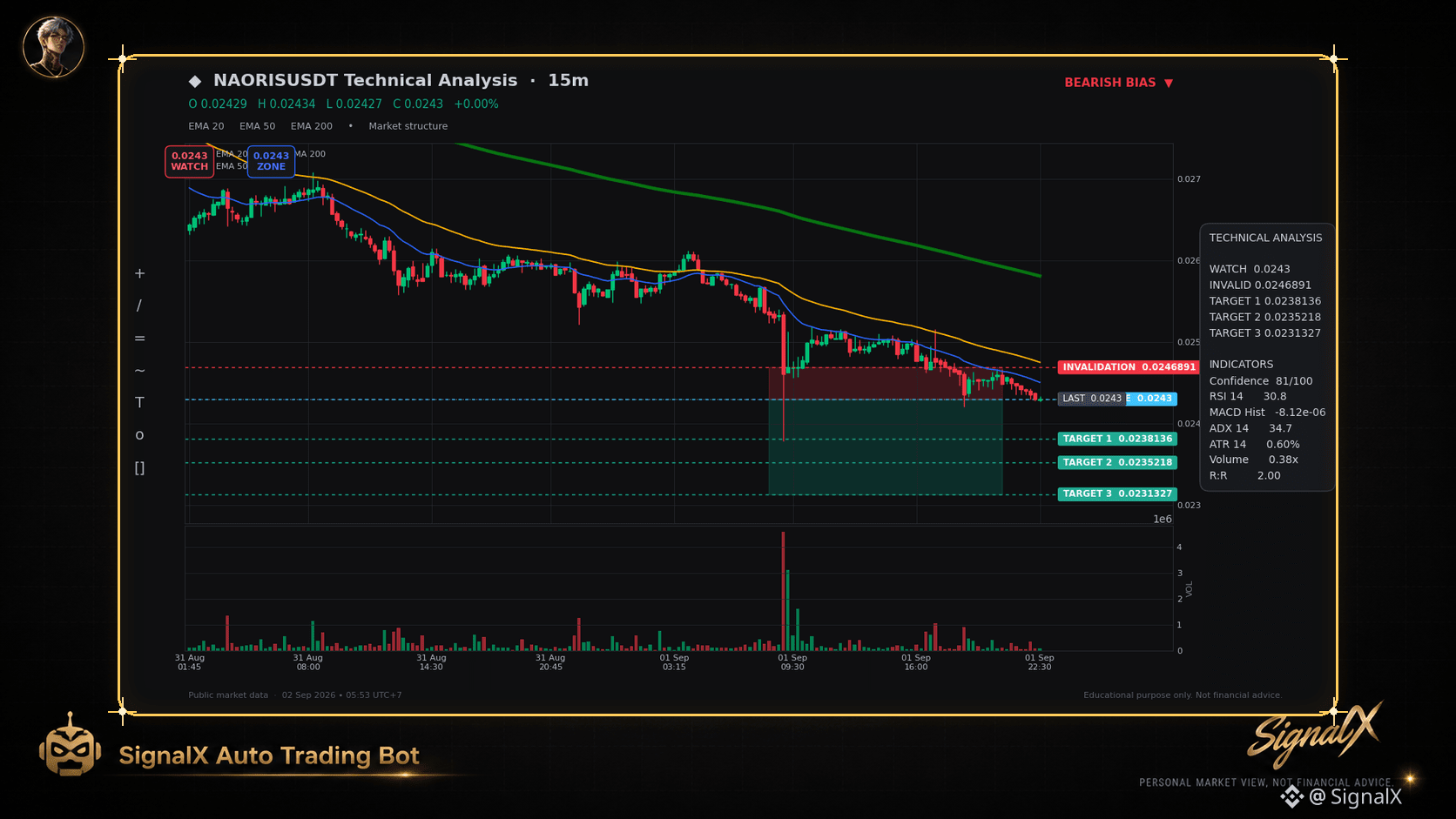
TECHNICAL ANALYSIS — NAORIS (15m)
🧭 Market bias: BEARISH BIAS 🔴
🎯 Setup: trend pullback/continuation
⭐ Confidence: 81/100
📍 Price zones to watch: 0.0243
🛑 Scenario invalidation level: 0.0246891 (1.60% distance)
🎯 Technical target 1: 0.0238136 (1.25R)
🎯 Technical target 2: 0.0235218 (2R)
🎯 Technical target 3: 0.0231327 (3R)
📊 TECHNICAL INDICATORS
📈 EMA20/50/200: aligned short
💪 ADX14: 34.7
⚡ RSI14: 30.8
🌊 MACD histogram: -8.11699e-06
🌡️ ATR14: 0.60% of price
🔊 Volume: 0.38x average (below 20-candle mean)
⚠️ A 15m close beyond the invalidation level weakens this scenario.
Disclaimer: Educational technical analysis only—not financial advice. Leveraged markets involve substantial risk.
🧭 Market bias: BEARISH BIAS 🔴
🎯 Setup: trend pullback/continuation
⭐ Confidence: 81/100
📍 Price zones to watch: 0.0243
🛑 Scenario invalidation level: 0.0246891 (1.60% distance)
🎯 Technical target 1: 0.0238136 (1.25R)
🎯 Technical target 2: 0.0235218 (2R)
🎯 Technical target 3: 0.0231327 (3R)
📊 TECHNICAL INDICATORS
📈 EMA20/50/200: aligned short
💪 ADX14: 34.7
⚡ RSI14: 30.8
🌊 MACD histogram: -8.11699e-06
🌡️ ATR14: 0.60% of price
🔊 Volume: 0.38x average (below 20-candle mean)
⚠️ A 15m close beyond the invalidation level weakens this scenario.
Disclaimer: Educational technical analysis only—not financial advice. Leveraged markets involve substantial risk.
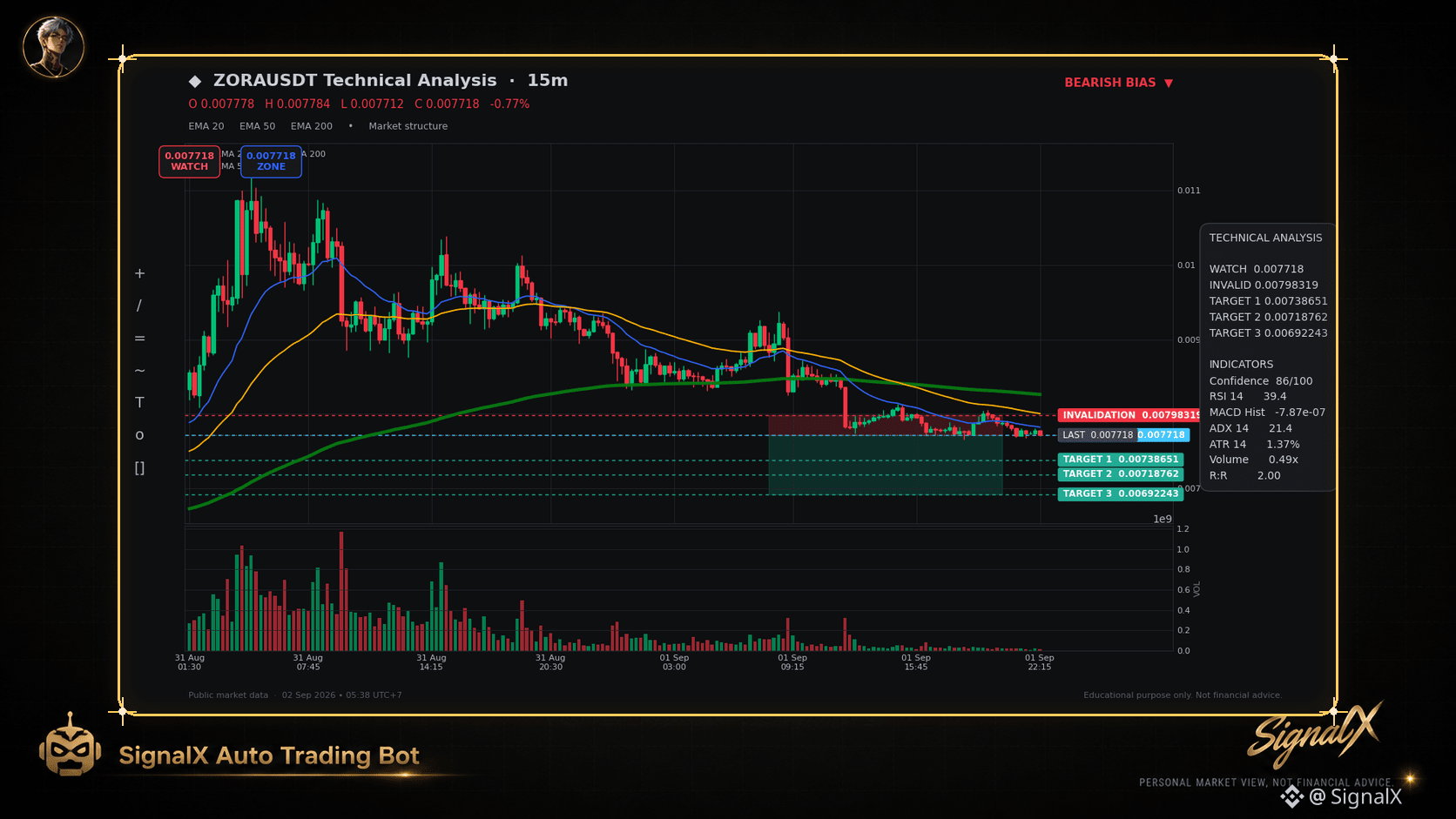
TECHNICAL ANALYSIS — ZORA (15m)
🧭 Market bias: BEARISH BIAS 🔴
🎯 Setup: trend pullback/continuation
⭐ Confidence: 86/100
📍 Price zones to watch: 0.007718
🛑 Scenario invalidation level: 0.00798319 (3.44% distance)
🎯 Technical target 1: 0.00738651 (1.25R)
🎯 Technical target 2: 0.00718762 (2R)
🎯 Technical target 3: 0.00692243 (3R)
📊 TECHNICAL INDICATORS
📈 EMA20/50/200: aligned short
💪 ADX14: 21.4
⚡ RSI14: 39.4
🌊 MACD histogram: -7.86582e-07
🌡️ ATR14: 1.37% of price
🔊 Volume: 0.49x average (below 20-candle mean)
⚠️ A 15m close beyond the invalidation level weakens this scenario.
Disclaimer: Educational technical analysis only—not financial advice. Leveraged markets involve substantial risk.
🧭 Market bias: BEARISH BIAS 🔴
🎯 Setup: trend pullback/continuation
⭐ Confidence: 86/100
📍 Price zones to watch: 0.007718
🛑 Scenario invalidation level: 0.00798319 (3.44% distance)
🎯 Technical target 1: 0.00738651 (1.25R)
🎯 Technical target 2: 0.00718762 (2R)
🎯 Technical target 3: 0.00692243 (3R)
📊 TECHNICAL INDICATORS
📈 EMA20/50/200: aligned short
💪 ADX14: 21.4
⚡ RSI14: 39.4
🌊 MACD histogram: -7.86582e-07
🌡️ ATR14: 1.37% of price
🔊 Volume: 0.49x average (below 20-candle mean)
⚠️ A 15m close beyond the invalidation level weakens this scenario.
Disclaimer: Educational technical analysis only—not financial advice. Leveraged markets involve substantial risk.
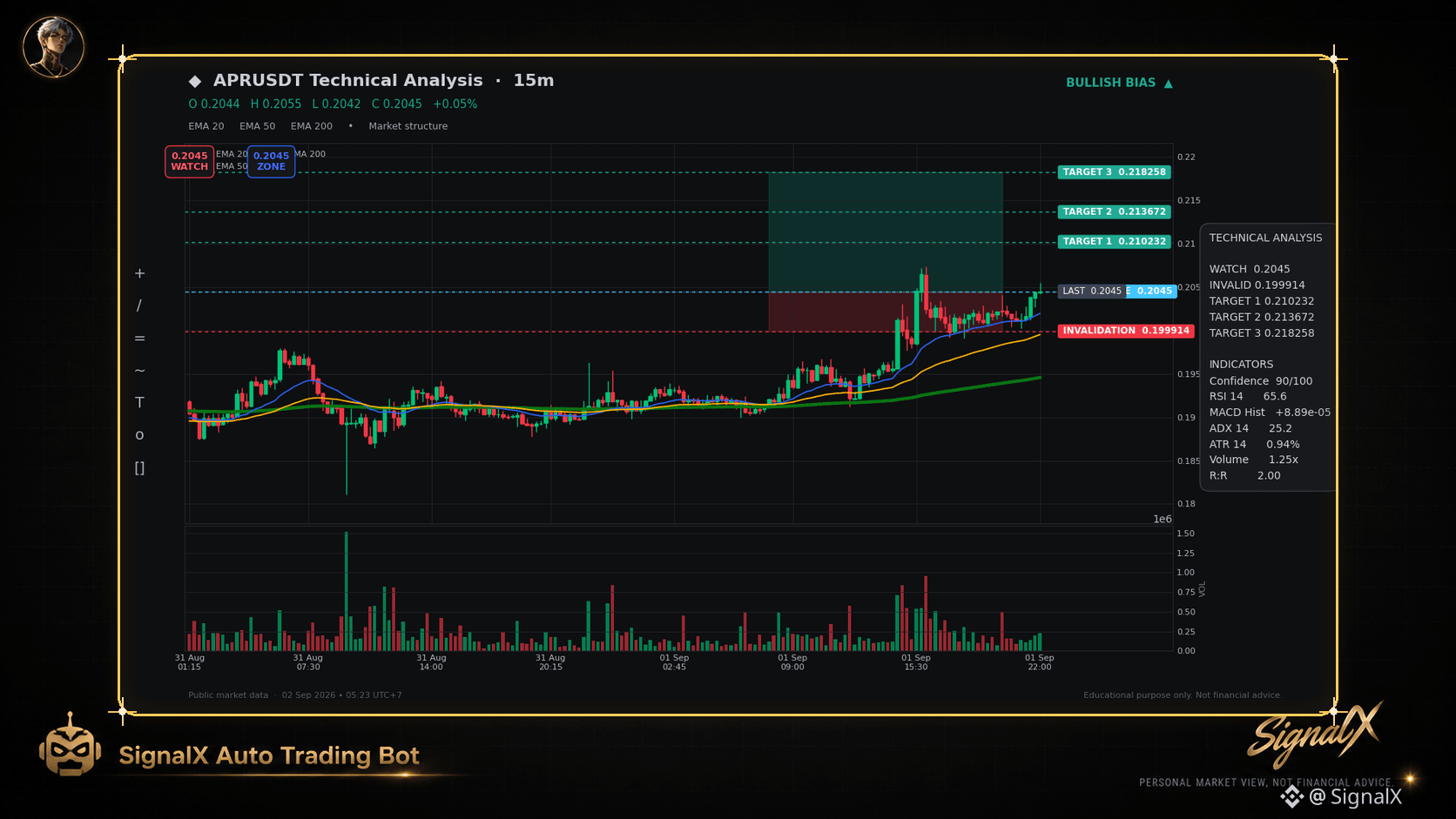
TECHNICAL ANALYSIS — APR (15m)
🧭 Market bias: BULLISH BIAS 🟢
🎯 Setup: trend pullback/continuation
⭐ Confidence: 90/100
📍 Price zones to watch: 0.2045
🛑 Scenario invalidation level: 0.199914 (2.24% distance)
🎯 Technical target 1: 0.210232 (1.25R)
🎯 Technical target 2: 0.213672 (2R)
🎯 Technical target 3: 0.218258 (3R)
📊 TECHNICAL INDICATORS
📈 EMA20/50/200: aligned long
💪 ADX14: 25.2
⚡ RSI14: 65.6
🌊 MACD histogram: +8.89394e-05
🌡️ ATR14: 0.94% of price
🔊 Volume: 1.25x average (above 20-candle mean)
⚠️ A 15m close beyond the invalidation level weakens this scenario.
Disclaimer: Educational technical analysis only—not financial advice. Leveraged markets involve substantial risk.
🧭 Market bias: BULLISH BIAS 🟢
🎯 Setup: trend pullback/continuation
⭐ Confidence: 90/100
📍 Price zones to watch: 0.2045
🛑 Scenario invalidation level: 0.199914 (2.24% distance)
🎯 Technical target 1: 0.210232 (1.25R)
🎯 Technical target 2: 0.213672 (2R)
🎯 Technical target 3: 0.218258 (3R)
📊 TECHNICAL INDICATORS
📈 EMA20/50/200: aligned long
💪 ADX14: 25.2
⚡ RSI14: 65.6
🌊 MACD histogram: +8.89394e-05
🌡️ ATR14: 0.94% of price
🔊 Volume: 1.25x average (above 20-candle mean)
⚠️ A 15m close beyond the invalidation level weakens this scenario.
Disclaimer: Educational technical analysis only—not financial advice. Leveraged markets involve substantial risk.
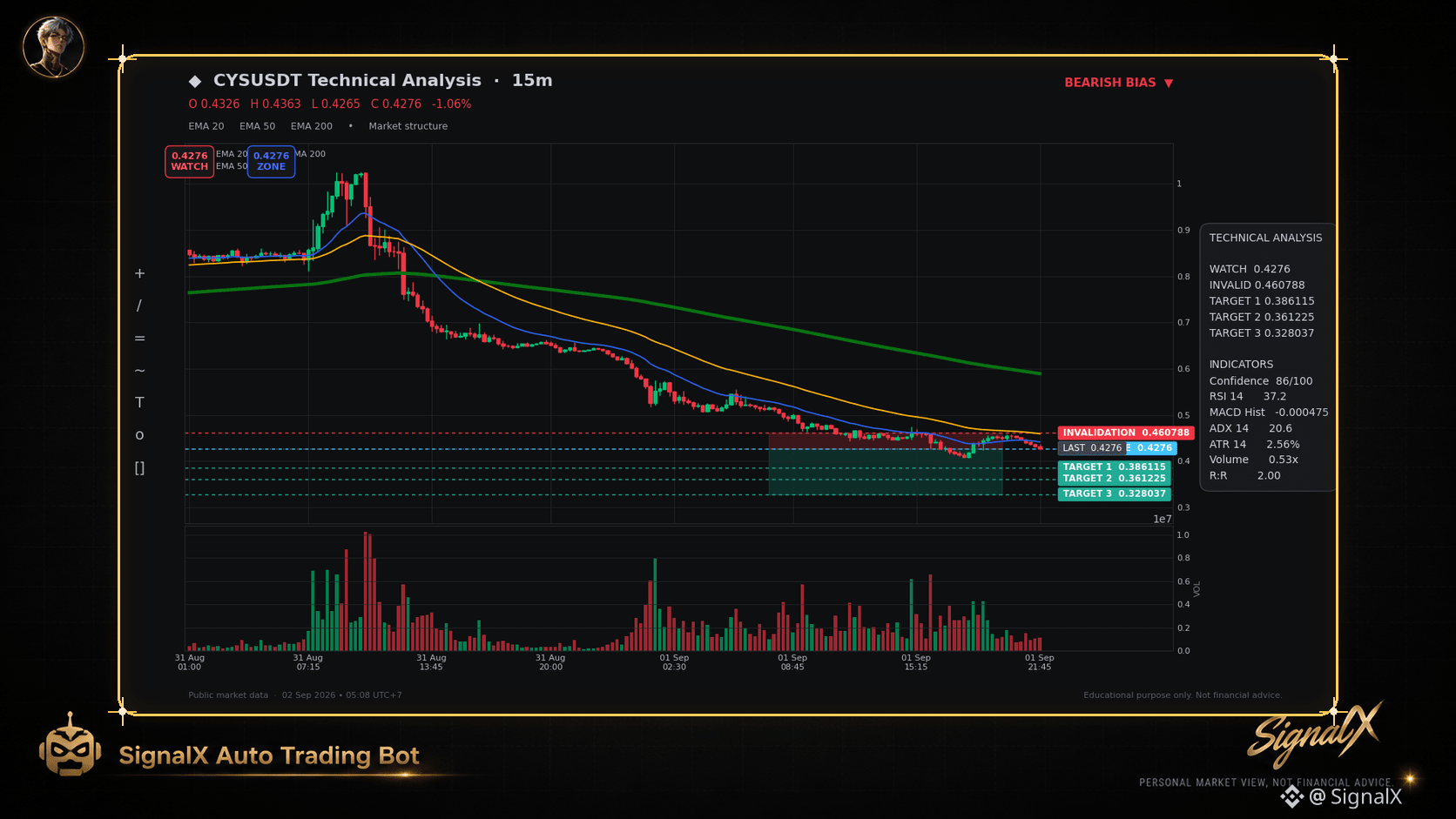
TECHNICAL ANALYSIS — CYS (15m)
🧭 Market bias: BEARISH BIAS 🔴
🎯 Setup: trend pullback/continuation
⭐ Confidence: 86/100
📍 Price zones to watch: 0.4276
🛑 Scenario invalidation level: 0.460788 (7.76% distance)
🎯 Technical target 1: 0.386115 (1.25R)
🎯 Technical target 2: 0.361225 (2R)
🎯 Technical target 3: 0.328037 (3R)
📊 TECHNICAL INDICATORS
📈 EMA20/50/200: aligned short
💪 ADX14: 20.6
⚡ RSI14: 37.2
🌊 MACD histogram: -0.00047489
🌡️ ATR14: 2.56% of price
🔊 Volume: 0.53x average (below 20-candle mean)
⚠️ A 15m close beyond the invalidation level weakens this scenario.
Disclaimer: Educational technical analysis only—not financial advice. Leveraged markets involve substantial risk.
🧭 Market bias: BEARISH BIAS 🔴
🎯 Setup: trend pullback/continuation
⭐ Confidence: 86/100
📍 Price zones to watch: 0.4276
🛑 Scenario invalidation level: 0.460788 (7.76% distance)
🎯 Technical target 1: 0.386115 (1.25R)
🎯 Technical target 2: 0.361225 (2R)
🎯 Technical target 3: 0.328037 (3R)
📊 TECHNICAL INDICATORS
📈 EMA20/50/200: aligned short
💪 ADX14: 20.6
⚡ RSI14: 37.2
🌊 MACD histogram: -0.00047489
🌡️ ATR14: 2.56% of price
🔊 Volume: 0.53x average (below 20-candle mean)
⚠️ A 15m close beyond the invalidation level weakens this scenario.
Disclaimer: Educational technical analysis only—not financial advice. Leveraged markets involve substantial risk.
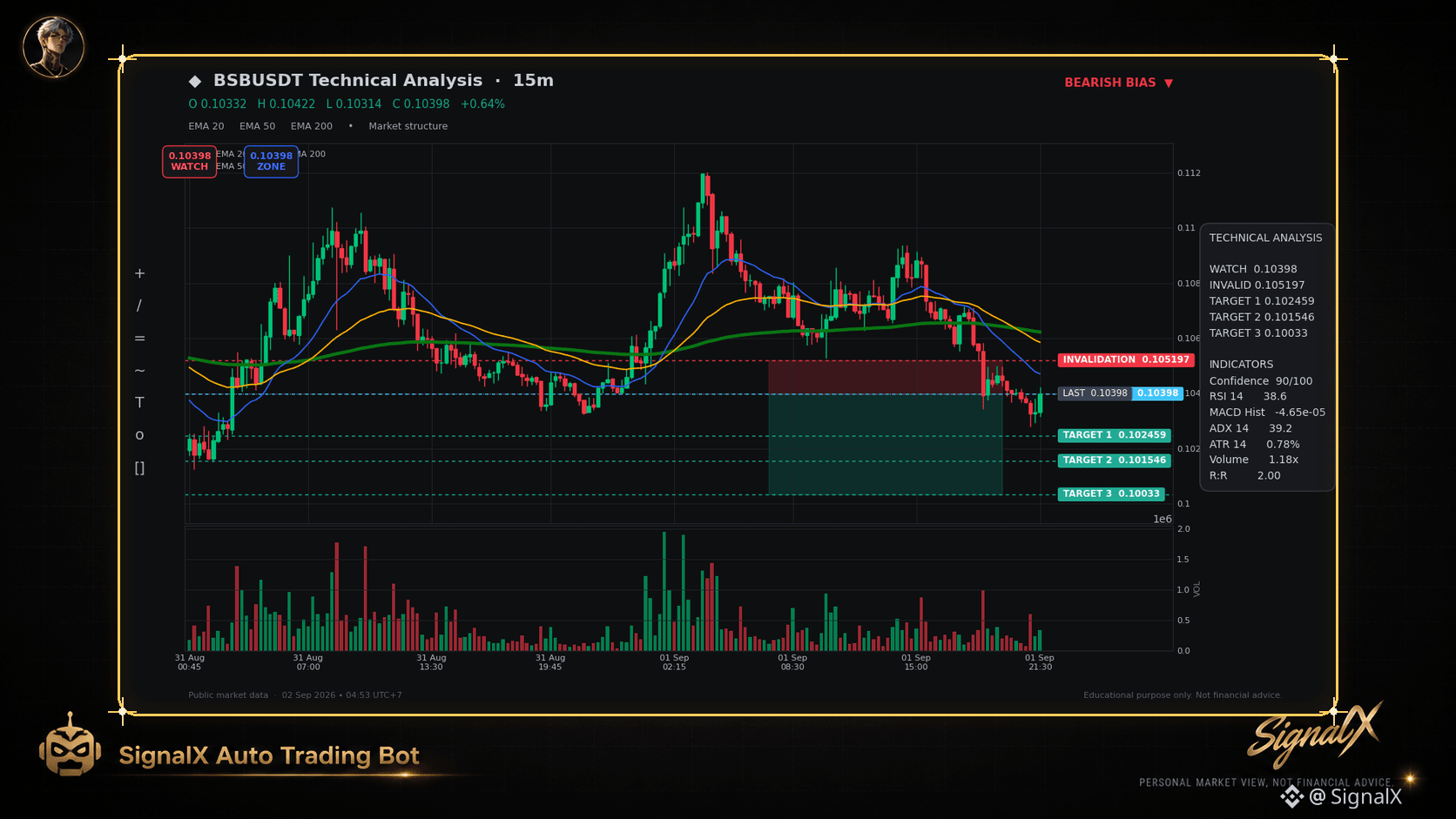
TECHNICAL ANALYSIS — BSB (15m)
🧭 Market bias: BEARISH BIAS 🔴
🎯 Setup: trend pullback/continuation
⭐ Confidence: 90/100
📍 Price zones to watch: 0.10398
🛑 Scenario invalidation level: 0.105197 (1.17% distance)
🎯 Technical target 1: 0.102459 (1.25R)
🎯 Technical target 2: 0.101546 (2R)
🎯 Technical target 3: 0.10033 (3R)
📊 TECHNICAL INDICATORS
📈 EMA20/50/200: aligned short
💪 ADX14: 39.2
⚡ RSI14: 38.6
🌊 MACD histogram: -4.65144e-05
🌡️ ATR14: 0.78% of price
🔊 Volume: 1.18x average (above 20-candle mean)
⚠️ A 15m close beyond the invalidation level weakens this scenario.
Disclaimer: Educational technical analysis only—not financial advice. Leveraged markets involve substantial risk.
🧭 Market bias: BEARISH BIAS 🔴
🎯 Setup: trend pullback/continuation
⭐ Confidence: 90/100
📍 Price zones to watch: 0.10398
🛑 Scenario invalidation level: 0.105197 (1.17% distance)
🎯 Technical target 1: 0.102459 (1.25R)
🎯 Technical target 2: 0.101546 (2R)
🎯 Technical target 3: 0.10033 (3R)
📊 TECHNICAL INDICATORS
📈 EMA20/50/200: aligned short
💪 ADX14: 39.2
⚡ RSI14: 38.6
🌊 MACD histogram: -4.65144e-05
🌡️ ATR14: 0.78% of price
🔊 Volume: 1.18x average (above 20-candle mean)
⚠️ A 15m close beyond the invalidation level weakens this scenario.
Disclaimer: Educational technical analysis only—not financial advice. Leveraged markets involve substantial risk.
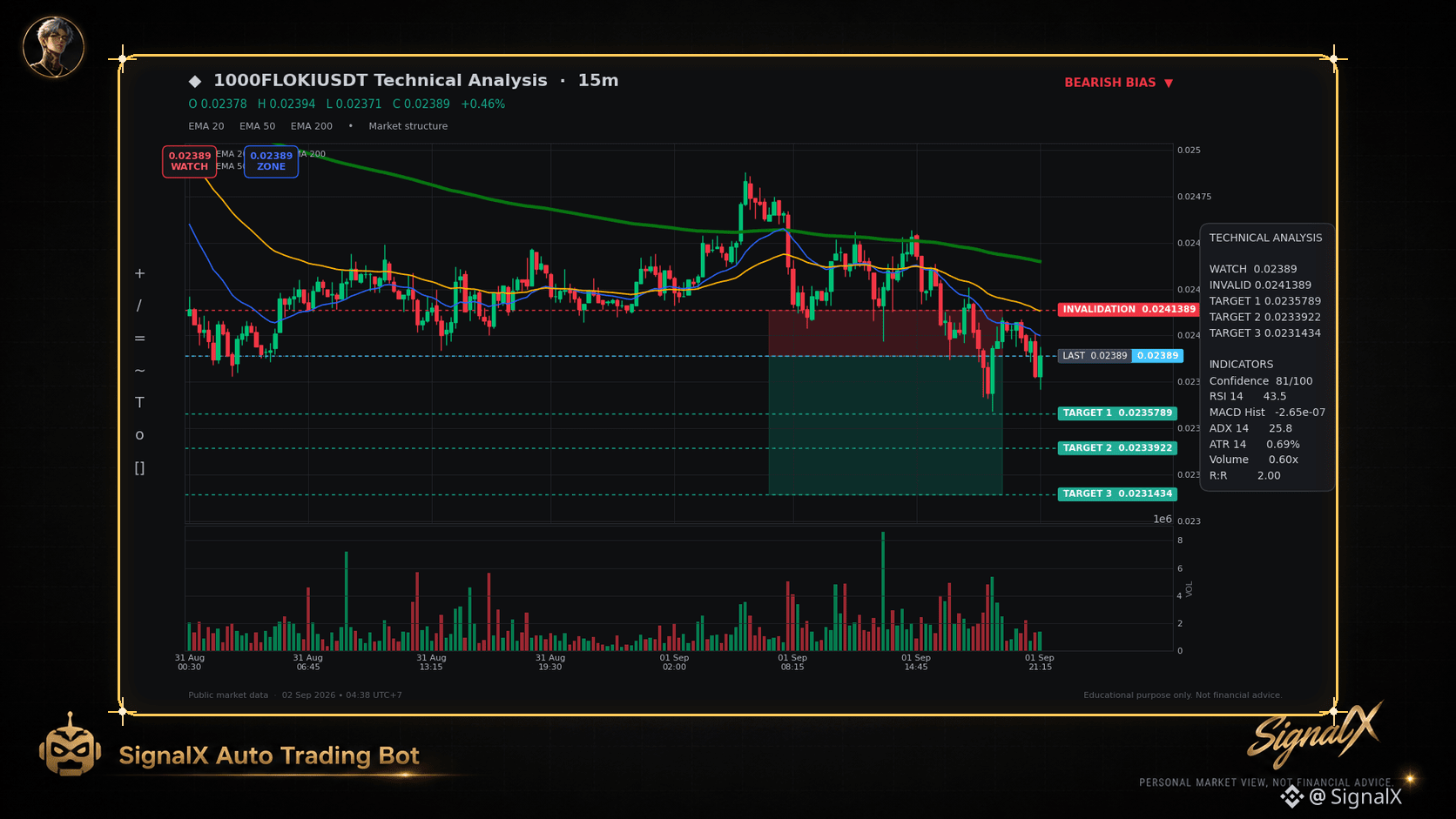
TECHNICAL ANALYSIS — 1000FLOKI (15m)
🧭 Market bias: BEARISH BIAS 🔴
🎯 Setup: trend pullback/continuation
⭐ Confidence: 81/100
📍 Price zones to watch: 0.02389
🛑 Scenario invalidation level: 0.0241389 (1.04% distance)
🎯 Technical target 1: 0.0235789 (1.25R)
🎯 Technical target 2: 0.0233922 (2R)
🎯 Technical target 3: 0.0231434 (3R)
📊 TECHNICAL INDICATORS
📈 EMA20/50/200: aligned short
💪 ADX14: 25.8
⚡ RSI14: 43.5
🌊 MACD histogram: -2.64633e-07
🌡️ ATR14: 0.69% of price
🔊 Volume: 0.60x average (below 20-candle mean)
⚠️ A 15m close beyond the invalidation level weakens this scenario.
Disclaimer: Educational technical analysis only—not financial advice. Leveraged markets involve substantial risk.
🧭 Market bias: BEARISH BIAS 🔴
🎯 Setup: trend pullback/continuation
⭐ Confidence: 81/100
📍 Price zones to watch: 0.02389
🛑 Scenario invalidation level: 0.0241389 (1.04% distance)
🎯 Technical target 1: 0.0235789 (1.25R)
🎯 Technical target 2: 0.0233922 (2R)
🎯 Technical target 3: 0.0231434 (3R)
📊 TECHNICAL INDICATORS
📈 EMA20/50/200: aligned short
💪 ADX14: 25.8
⚡ RSI14: 43.5
🌊 MACD histogram: -2.64633e-07
🌡️ ATR14: 0.69% of price
🔊 Volume: 0.60x average (below 20-candle mean)
⚠️ A 15m close beyond the invalidation level weakens this scenario.
Disclaimer: Educational technical analysis only—not financial advice. Leveraged markets involve substantial risk.
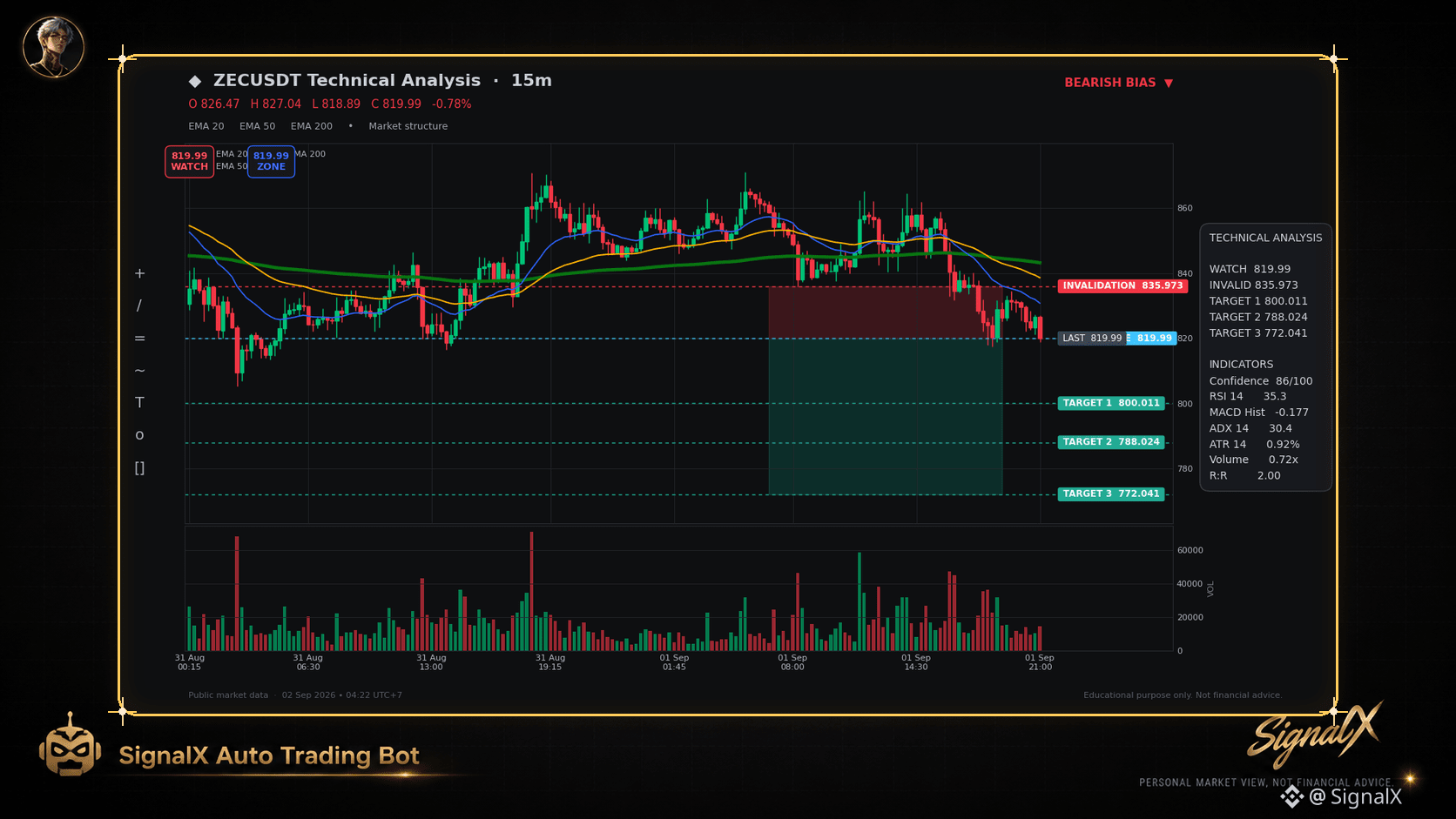
TECHNICAL ANALYSIS — ZEC (15m)
🧭 Market bias: BEARISH BIAS 🔴
🎯 Setup: trend pullback/continuation
⭐ Confidence: 86/100
📍 Price zones to watch: 819.99
🛑 Scenario invalidation level: 835.973 (1.95% distance)
🎯 Technical target 1: 800.011 (1.25R)
🎯 Technical target 2: 788.024 (2R)
🎯 Technical target 3: 772.041 (3R)
📊 TECHNICAL INDICATORS
📈 EMA20/50/200: aligned short
💪 ADX14: 30.4
⚡ RSI14: 35.3
🌊 MACD histogram: -0.176989
🌡️ ATR14: 0.92% of price
🔊 Volume: 0.72x average (below 20-candle mean)
⚠️ A 15m close beyond the invalidation level weakens this scenario.
Disclaimer: Educational technical analysis only—not financial advice. Leveraged markets involve substantial risk.
🧭 Market bias: BEARISH BIAS 🔴
🎯 Setup: trend pullback/continuation
⭐ Confidence: 86/100
📍 Price zones to watch: 819.99
🛑 Scenario invalidation level: 835.973 (1.95% distance)
🎯 Technical target 1: 800.011 (1.25R)
🎯 Technical target 2: 788.024 (2R)
🎯 Technical target 3: 772.041 (3R)
📊 TECHNICAL INDICATORS
📈 EMA20/50/200: aligned short
💪 ADX14: 30.4
⚡ RSI14: 35.3
🌊 MACD histogram: -0.176989
🌡️ ATR14: 0.92% of price
🔊 Volume: 0.72x average (below 20-candle mean)
⚠️ A 15m close beyond the invalidation level weakens this scenario.
Disclaimer: Educational technical analysis only—not financial advice. Leveraged markets involve substantial risk.
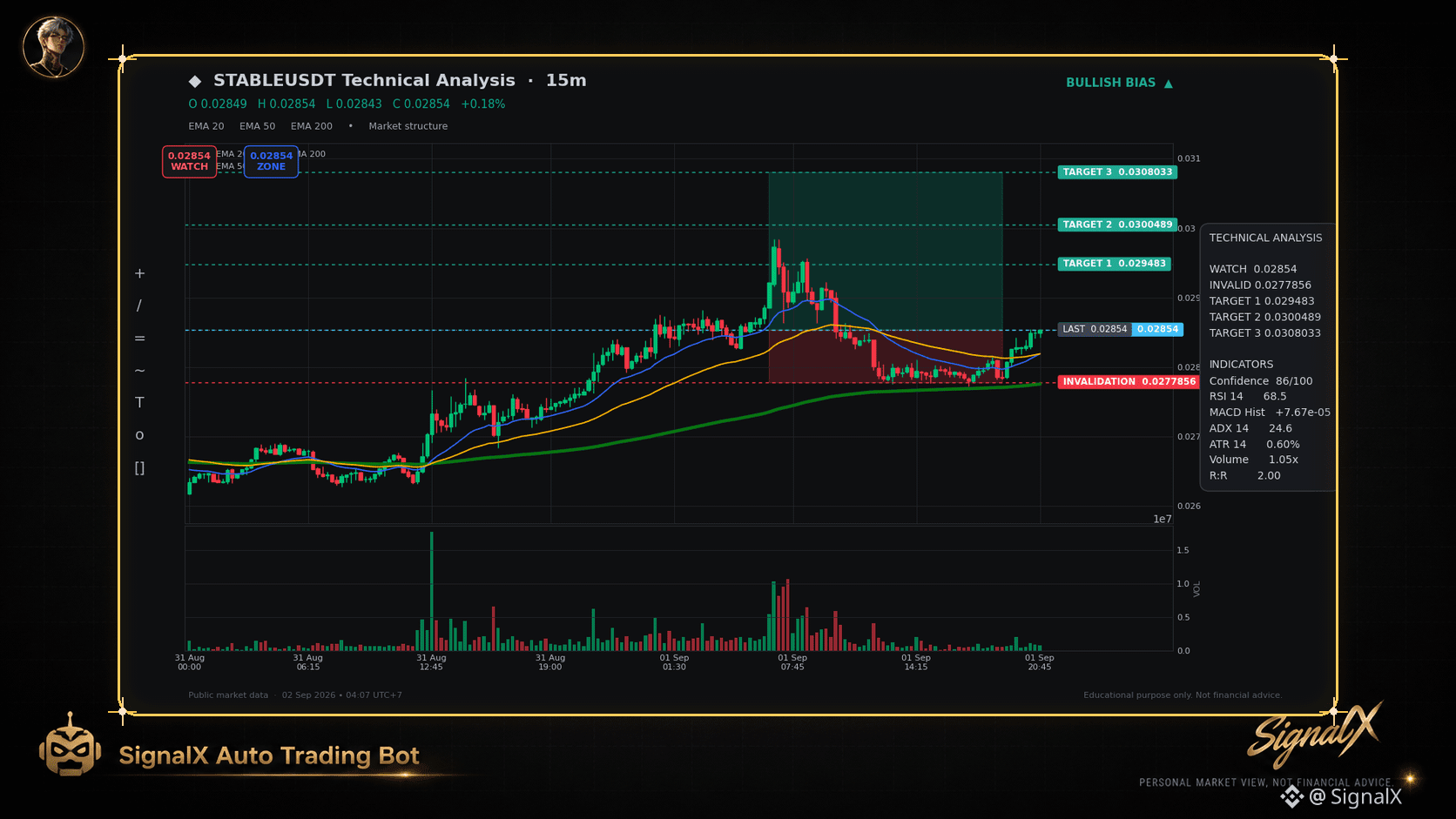
TECHNICAL ANALYSIS — STABLE (15m)
🧭 Market bias: BULLISH BIAS 🟢
🎯 Setup: trend pullback/continuation
⭐ Confidence: 86/100
📍 Price zones to watch: 0.02854
🛑 Scenario invalidation level: 0.0277856 (2.64% distance)
🎯 Technical target 1: 0.029483 (1.25R)
🎯 Technical target 2: 0.0300489 (2R)
🎯 Technical target 3: 0.0308033 (3R)
📊 TECHNICAL INDICATORS
📈 EMA20/50/200: aligned long
💪 ADX14: 24.6
⚡ RSI14: 68.5
🌊 MACD histogram: +7.67357e-05
🌡️ ATR14: 0.60% of price
🔊 Volume: 1.05x average (above 20-candle mean)
⚠️ A 15m close beyond the invalidation level weakens this scenario.
Disclaimer: Educational technical analysis only—not financial advice. Leveraged markets involve substantial risk.
🧭 Market bias: BULLISH BIAS 🟢
🎯 Setup: trend pullback/continuation
⭐ Confidence: 86/100
📍 Price zones to watch: 0.02854
🛑 Scenario invalidation level: 0.0277856 (2.64% distance)
🎯 Technical target 1: 0.029483 (1.25R)
🎯 Technical target 2: 0.0300489 (2R)
🎯 Technical target 3: 0.0308033 (3R)
📊 TECHNICAL INDICATORS
📈 EMA20/50/200: aligned long
💪 ADX14: 24.6
⚡ RSI14: 68.5
🌊 MACD histogram: +7.67357e-05
🌡️ ATR14: 0.60% of price
🔊 Volume: 1.05x average (above 20-candle mean)
⚠️ A 15m close beyond the invalidation level weakens this scenario.
Disclaimer: Educational technical analysis only—not financial advice. Leveraged markets involve substantial risk.
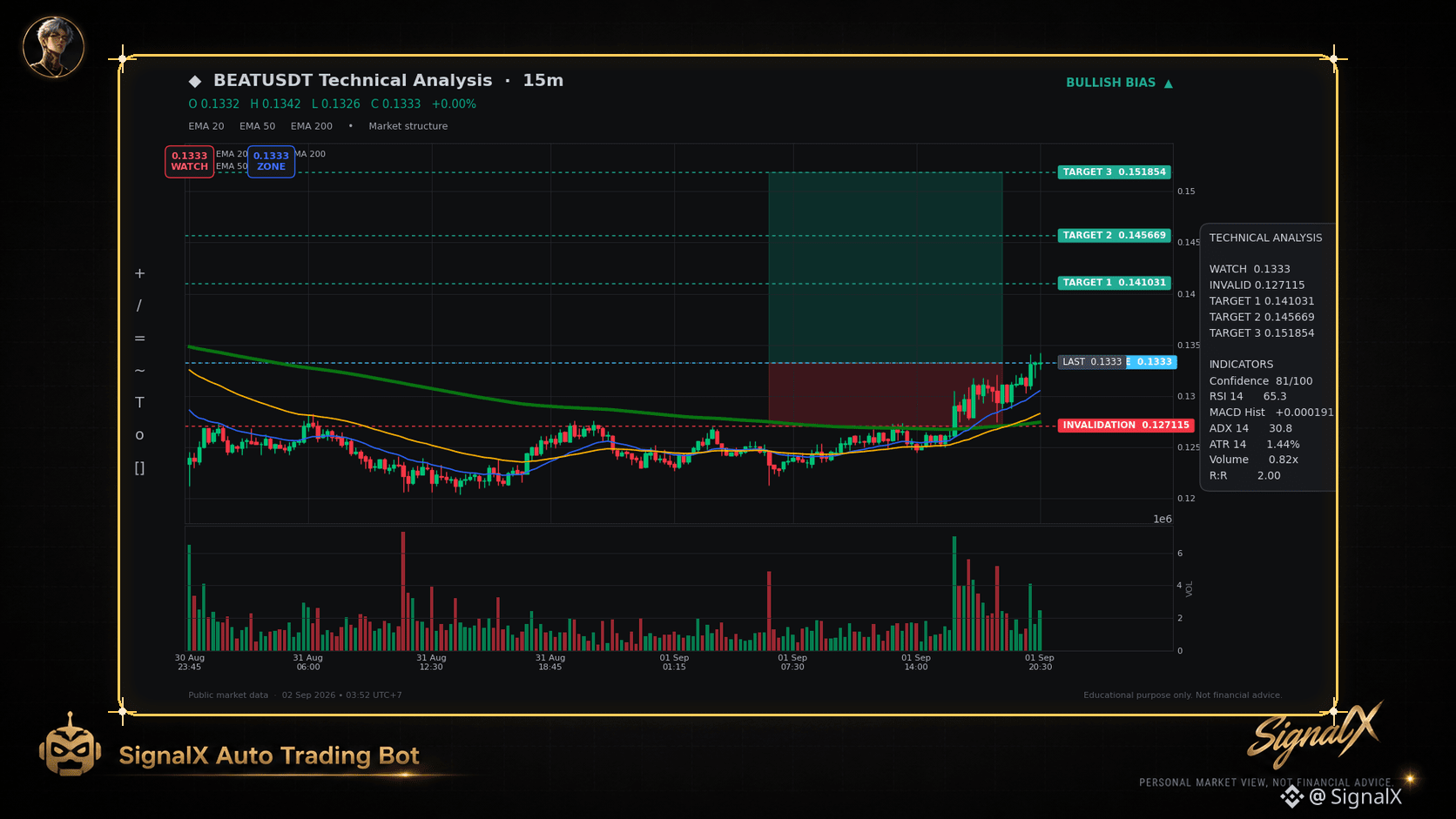
TECHNICAL ANALYSIS — BEAT (15m)
🧭 Market bias: BULLISH BIAS 🟢
🎯 Setup: trend pullback/continuation
⭐ Confidence: 81/100
📍 Price zones to watch: 0.1333
🛑 Scenario invalidation level: 0.127115 (4.64% distance)
🎯 Technical target 1: 0.141031 (1.25R)
🎯 Technical target 2: 0.145669 (2R)
🎯 Technical target 3: 0.151854 (3R)
📊 TECHNICAL INDICATORS
📈 EMA20/50/200: aligned long
💪 ADX14: 30.8
⚡ RSI14: 65.3
🌊 MACD histogram: +0.000190852
🌡️ ATR14: 1.44% of price
🔊 Volume: 0.82x average (below 20-candle mean)
⚠️ A 15m close beyond the invalidation level weakens this scenario.
Disclaimer: Educational technical analysis only—not financial advice. Leveraged markets involve substantial risk.
🧭 Market bias: BULLISH BIAS 🟢
🎯 Setup: trend pullback/continuation
⭐ Confidence: 81/100
📍 Price zones to watch: 0.1333
🛑 Scenario invalidation level: 0.127115 (4.64% distance)
🎯 Technical target 1: 0.141031 (1.25R)
🎯 Technical target 2: 0.145669 (2R)
🎯 Technical target 3: 0.151854 (3R)
📊 TECHNICAL INDICATORS
📈 EMA20/50/200: aligned long
💪 ADX14: 30.8
⚡ RSI14: 65.3
🌊 MACD histogram: +0.000190852
🌡️ ATR14: 1.44% of price
🔊 Volume: 0.82x average (below 20-candle mean)
⚠️ A 15m close beyond the invalidation level weakens this scenario.
Disclaimer: Educational technical analysis only—not financial advice. Leveraged markets involve substantial risk.
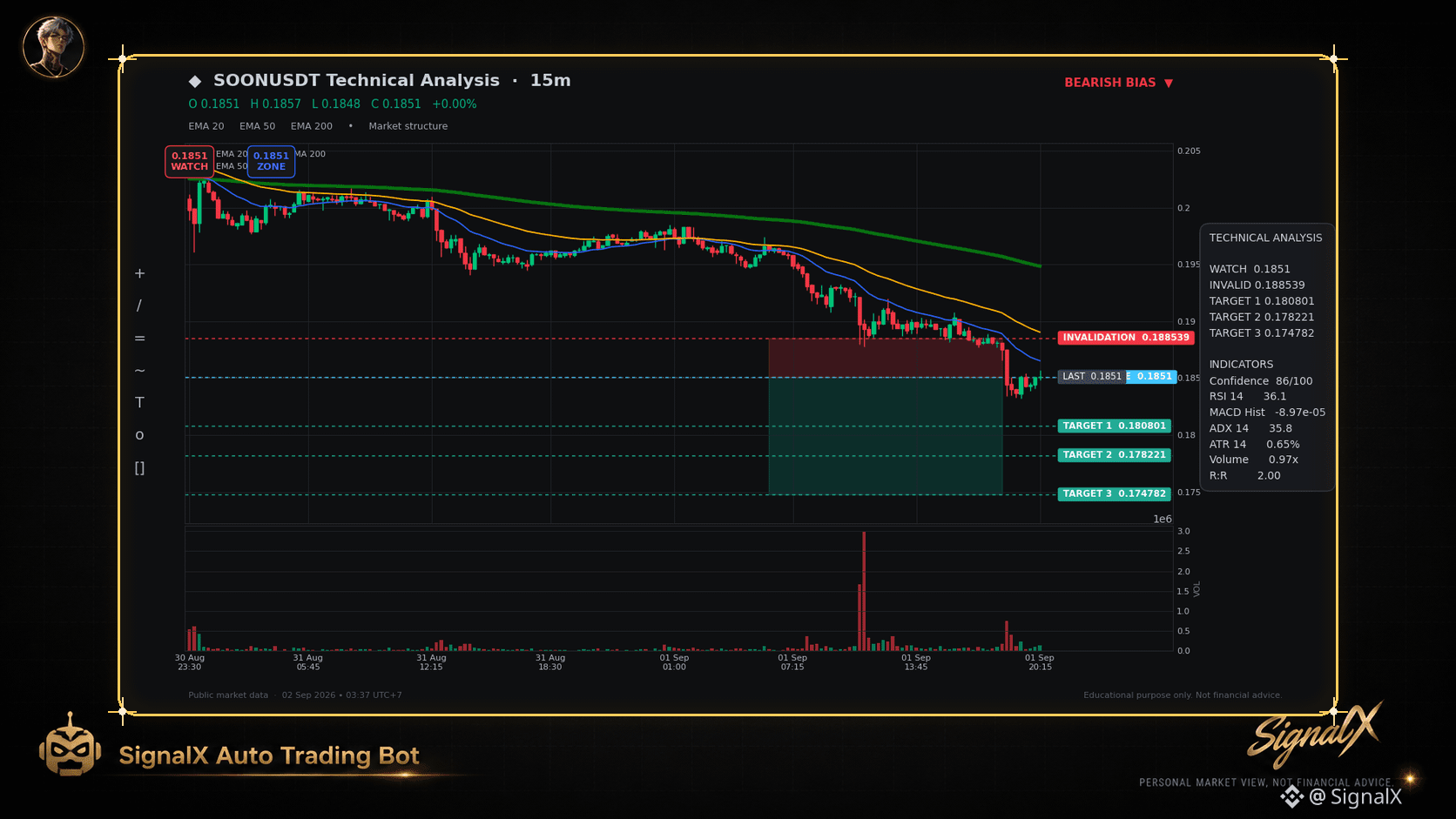
TECHNICAL ANALYSIS — SOON (15m)
🧭 Market bias: BEARISH BIAS 🔴
🎯 Setup: trend pullback/continuation
⭐ Confidence: 86/100
📍 Price zones to watch: 0.1851
🛑 Scenario invalidation level: 0.188539 (1.86% distance)
🎯 Technical target 1: 0.180801 (1.25R)
🎯 Technical target 2: 0.178221 (2R)
🎯 Technical target 3: 0.174782 (3R)
📊 TECHNICAL INDICATORS
📈 EMA20/50/200: aligned short
💪 ADX14: 35.8
⚡ RSI14: 36.1
🌊 MACD histogram: -8.97079e-05
🌡️ ATR14: 0.65% of price
🔊 Volume: 0.97x average (below 20-candle mean)
⚠️ A 15m close beyond the invalidation level weakens this scenario.
Disclaimer: Educational technical analysis only—not financial advice. Leveraged markets involve substantial risk.
🧭 Market bias: BEARISH BIAS 🔴
🎯 Setup: trend pullback/continuation
⭐ Confidence: 86/100
📍 Price zones to watch: 0.1851
🛑 Scenario invalidation level: 0.188539 (1.86% distance)
🎯 Technical target 1: 0.180801 (1.25R)
🎯 Technical target 2: 0.178221 (2R)
🎯 Technical target 3: 0.174782 (3R)
📊 TECHNICAL INDICATORS
📈 EMA20/50/200: aligned short
💪 ADX14: 35.8
⚡ RSI14: 36.1
🌊 MACD histogram: -8.97079e-05
🌡️ ATR14: 0.65% of price
🔊 Volume: 0.97x average (below 20-candle mean)
⚠️ A 15m close beyond the invalidation level weakens this scenario.
Disclaimer: Educational technical analysis only—not financial advice. Leveraged markets involve substantial risk.
Log in to explore more content