Are you getting more chaotic the more you try to recover your losses, and losing more the more you operate?
I once mentored a brother—Xiao Li, a 29-year-old programmer, who had just entered the field for three months and lost over 60,000.
During that time, he stayed up late watching the market every day,
dozing off at work during the day,
and staring at candlestick charts at night until he questioned life.
He said: "Every time I see green, I panic; every time I see red, I rush in, and as a result, I just keep losing more."
— A typical case of emotional trading.
Later, I had him practice according to my organized
"Three Steps to Steady the Mind".
In just four short months,
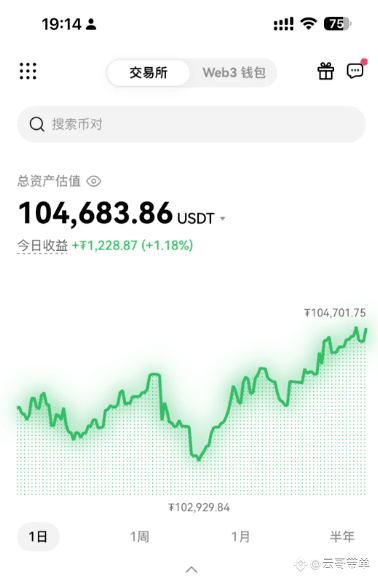
he turned 5,000 in capital into over 60,000,
and he completely changed.
Step One: Diversify positions without chaotic trading
Xiao Li used to like to go all in; when the market was favorable, he'd increase his investment,
only to be stunned by a bearish line.
I had him split his capital into 5 parts,
and only move 20% each time.
If he was wrong, he would stop loss and save bullets for the next battle.
This method seems slow, but it can save lives.
Because in the market—
surviving longer is more important than winning a single trade.
Step Two: Always keep a base position
He used to be the type who "waited for a crash with no position",
only to be left dumbfounded by a massive rally.
I taught him to keep a 30% base position,
only making trades in the direction of the trend.
When the market rises, he has coins in hand;
when the market falls, he can buy low to average down.
He’s not afraid of missing out, nor is he afraid of being stuck.
Step Three: Measure emotions with position size
I told him:
If your heart races and your palms sweat while watching the market, it means your position size is too heavy.
Light positions allow for patience,
and patience leads to profit.
He now maintains a stable position of around 50%,
and he can sleep well when prices drop, and he doesn't act impulsively when they rise.
Interestingly,
Xiao Li now finds it easier to watch the market:
He sets stop-loss and take-profit levels every day,
then goes to the gym, cooks, and spends time with family.
When the market moves, he checks again when the alert goes off.
He laughs and says:
"I understand now, trading cryptocurrencies isn't about IQ, it's about mindset."
The strongest traders
aren't the ones who predict the market most accurately,
but the ones who can control their own rhythm.
In this market,
it's very hard to go far relying on just one person.
Now—I have a repaired road here, will you walk it? @币圈绿灯侠
#币安HODLer空投XPL #RWA热潮 #币安HODLer空投ALLO