


CEX, which represents centralization, and Web3 wallet, which represents decentralization, are essential tools for most people to participate in the crypto market. However, in recent years, the boundaries between the two have gradually blurred.
Exchanges led by OKX have created built-in Web3 wallets. After users deposit money, they can participate in on-chain activities without having to transfer money to other on-chain wallets. Wallets represented by MetaMask integrate deposit and withdrawal channels into their own wallets, opening up a full-process business model for users.
Of course, there are also some centralized exchanges that adopt the method of acquisition or self-developed Web3 wallets for their layout. For example, Binance acquired Trust Wallet in 2018, Bitget acquired BitKeep in March this year, and Coinbase launched Coinbase Wallet.
No matter which layout method the above projects adopt, they are all trying to seize the future traffic position of Web3.
Recently, Binance, the leading centralized exchange, has started grayscale testing for its built-in Web3 wallet. How is the test going? Odaily Planet Daily explored this.
Binance Web3 wallet is not as good as expected, but TWT price hits a record high?
On November 3, based on feedback from the crypto community, the Web3 wallet built into the Binance App invited a group of users to start grayscale testing. (Odaily Note: Grayscale testing refers to selecting a specific group of people to try out an application before it is officially released, and gradually expanding the number of trial users to promptly discover and correct problems)
Binance Web3 Wallet is a self-hosted crypto wallet in the Binance App that aims to lower the barrier for users to enter the world of decentralized finance (DeFi). As a digital gateway for blockchain-based applications (dApps), it provides users with a secure and simplified way to manage their cryptocurrencies, perform token transactions across chains, earn returns, and interact with various on-chain ecosystem platforms.
Binance Web3 Wallet uses MPC (Multi-party Secure Computation) technology to manage each transaction, reducing the possibility of single point failure. In addition, Binance Web3 Wallet uses a complex security mechanism to generate three independent key shares, which are stored separately in locations including your personal cloud and device; to access the Binance wallet, at least two key shares are required. In addition, there are other enhanced security features, such as wrong address protection and malicious contract detection, which will notify users whether there are security risks in tokens and links during transactions.
So, what is the feedback from early test users on this grayscale test?
Searches show that the community's feedback on Binance Web3 Wallet is relatively flat. Some people who have tested it expressed on social media that they cannot export private keys. However, after the author's test, Binance Web3 Wallet currently functions normally, and users only need to download Google Drive to create wallet keys. Since Binance Web3 Wallet is still in the early testing stage and related supporting facilities are not yet complete, the author cannot share more evaluation experiences.
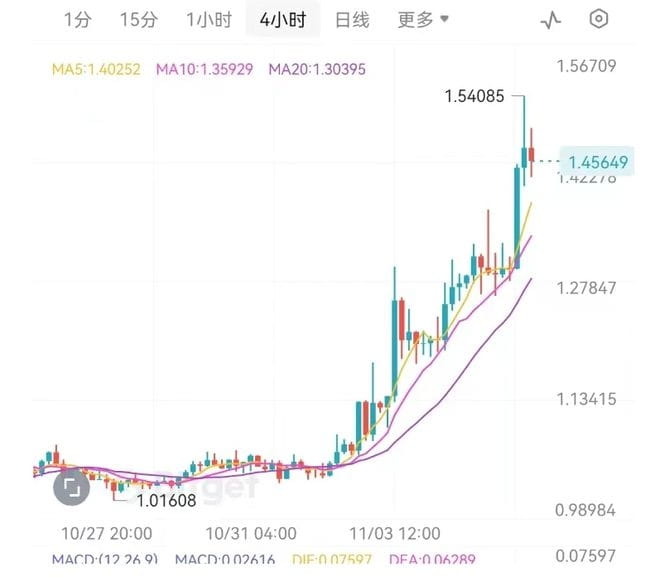
Influenced by the news that Binance tested a built-in Web3 wallet, another wallet project related to Binance, Trust Wallet, has become the focus of speculation in the past few days, and its price has risen sharply. The project was acquired by Binance in 2018, and the reason for the rise may be related to the emotional side of "Trust Wallet helps Binance develop a Web3 wallet" spread by the community.
Bitget market data shows that Trust Wallet token TWT soared from 1.1 USDT on November 3 to a high of 1.55 USDT, reaching a new high since mid-February this year; it is currently reported at 1.46 USDT, with a 24-hour increase of 9.4%.
The boundary between Web2 and Web3 is gradually blurring
The boundary between centralization and decentralization is gradually blurring in the crypto market. Centralized exchanges are deploying Web3 wallets, while Web3 wallets are trying to break the boundary between the virtual world and the real world. The ultimate goal of both is to attract user traffic and keep it in their own ecosystem.
Binance has worked hard to expand the reach of its Web3 activities, leveraging its massive exchange traffic, as well as tools like Trust Wallet and built-in wallets.
However, Binance's built-in wallet is still relatively new and small in scale. In contrast, OKX's Web3 wallet has been developed more maturely, especially in the Bitcoin ecosystem. OKX CEO Star even mentioned that OKX's Web3 wallet may become an independent application in the future.
In short, whether it is centralized exchanges such as Binance and OKX, or Web3 wallets such as MetaMask, they are actively trying to break the boundaries between traditional and emerging networks to make it easier for new users to enter the Web3 field.