


This article briefly:
The BIS recommends proactive supervision to prevent failures like SVB and Signature Bank.
It argues that Signature’s management failed to properly prepare for liquidity risks following the Silvergate collapse and the 2022 cryptocurrency crash.
Banks in regions with cryptocurrency regulation have taken proactive steps to allay concerns about doing business with cryptocurrency companies.

The Bank for International Settlements (BIS) sees the concentration of crypto assets in banks as one of the causes of a banking crisis in 2023. As of the end of June 2022, banks’ direct exposure to crypto assets was $4.2 billion.
The BIS believes that Signature Bank failed to recognize the risks of relying on deposits from the crypto industry, which put it at a disadvantage during the 2022 cryptocurrency crash. It also did not have sufficient liquidity to meet the outflows of non-crypto depositors who were spooked by the Silvergate liquidation.
BIS's "active intervention" may exceed expectations
The BIS said the failure of Silicon Valley Bank (SVB), which held cash reserves backing Circle’s stablecoin USDC, can be attributed to two factors. Its risk policy failed to match the growth of its asset base, and its management failed to notice any problems with the way the business was run or its balance sheet strategy.
Its management also allegedly viewed regulatory interventions as compliance exercises rather than opportunities for self-assessment. Prior to its failure in March, the bank had 31 open regulatory investigations into different aspects of its business model and approach to risk.
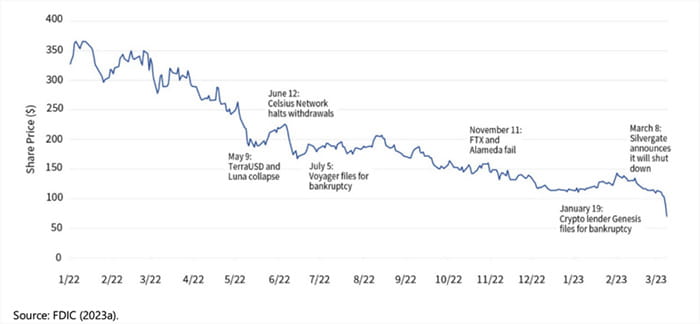 Signature Bank stock | Source: Bank for International Settlements
Looking ahead, the BIS recommends that regulators take a holistic approach that combines rules with proactive intervention when necessary. However, this approach carries legal risks, as banks may resist any intervention that lacks a legal basis.
The first signs of murky legal interference came when the Federal Deposit Insurance Corp. required the acquirer of Signature Bank to sell off $4 billion of its cryptocurrency customers and assets. During the Obama administration, the House Financial Services Committee called similar efforts to stifle certain industries an abuse of power.
Money laundering concerns remain evident
Circle was one of the more notable casualties of the banking collapse, with its stablecoin losing $10 billion in market value two weeks after SVB’s collapse. Since then, many cryptocurrency users have migrated to Tether, a larger but more controversial stablecoin.
But a more interesting story is taking shape as the cryptocurrency crash spurs regulators to create clearer cryptocurrency regulations. Hong Kong, Japan, South Korea and some European countries offer licensing systems for cryptocurrency companies to legalize their operations.
A side effect of this legitimacy is that registered companies need to secure local banking partners. Banks play a vital role in transferring funds to exchanges and cashing out holdings.
However, many banks still worry that poor know-your-customer processes can leave exchanges vulnerable to money laundering. For example, Binance lost its banking and payment partners after the U.S. Commodity and Futures Trading Commission implicated it in money laundering.
Initially, the Asian branches of HSBC and Standard Chartered were hesitant to conduct crypto business due to money laundering associations. British consumer banks NatWest, Chase UK and TSB Bank have all imposed restrictions on cryptocurrency-related transactions.
Banks in progressive regions are taking the initiative
But the ice age is melting. HSBC customers in Hong Kong can invest in bitcoin and ethereum exchange-traded funds as long as they make sure they understand educational materials about investing in virtual assets.
Before opening its fiat-to-crypto payment gateway to licensed exchanges in Hong Kong, ZA Bank operated a sandbox involving 100 companies. It connected its systems with the city’s corporate registry and performed anti-money laundering procedures to minimize risks.
Shinhan Bank, South Korea’s oldest bank, is also testing remittances in a closed sandbox. Stablecoins could make transfers insulated from currency fluctuations and would benefit from the anti-money laundering frameworks that banks already operate.
Do you have anything to say about the BIS report or anything else following the crypto bank collapse? #银行监管 #BIS