


Original title: Crypto's Biggest Use Case: Permissionless Identity
Original author: KERMAN KOHLI
Original source: Kerman Kohli
Compiled by: MarsBit, MK
In the current low point of encryption technology, people generally question its true value. However, encryption technology is not only an emerging technology, but also a tool that can redefine the way of identity authentication. This article will explore the related issues of encryption technology and identity authentication in depth. The following content is compiled by MarsBit:
Today, we are in the midst of a significant crypto bear market. People are asking what the value of this technology is. While there are many plausible arguments, few can articulate why these technologies are superior to traditional Web2 applications. Based on my personal experience, I maintain a relatively positive attitude towards this. This is more than just an article about a system of thought, it goes deeper into technology and standards.
Before we go any further, let's first understand how the existing Internet works.
Web2, Data Generation and Identity
When you sign up for a service on the internet, that service doesn’t really know who you are, because almost all personal information can be tampered with. Whether it’s your IP address, cookies, or device fingerprints, they can all be forged.
This has led to the following mainstream authentication methods:
email address
password
Two-factor authentication
Every time you use an online service, the service provider needs a persistent and secure identity to connect your data and confirm who you are.
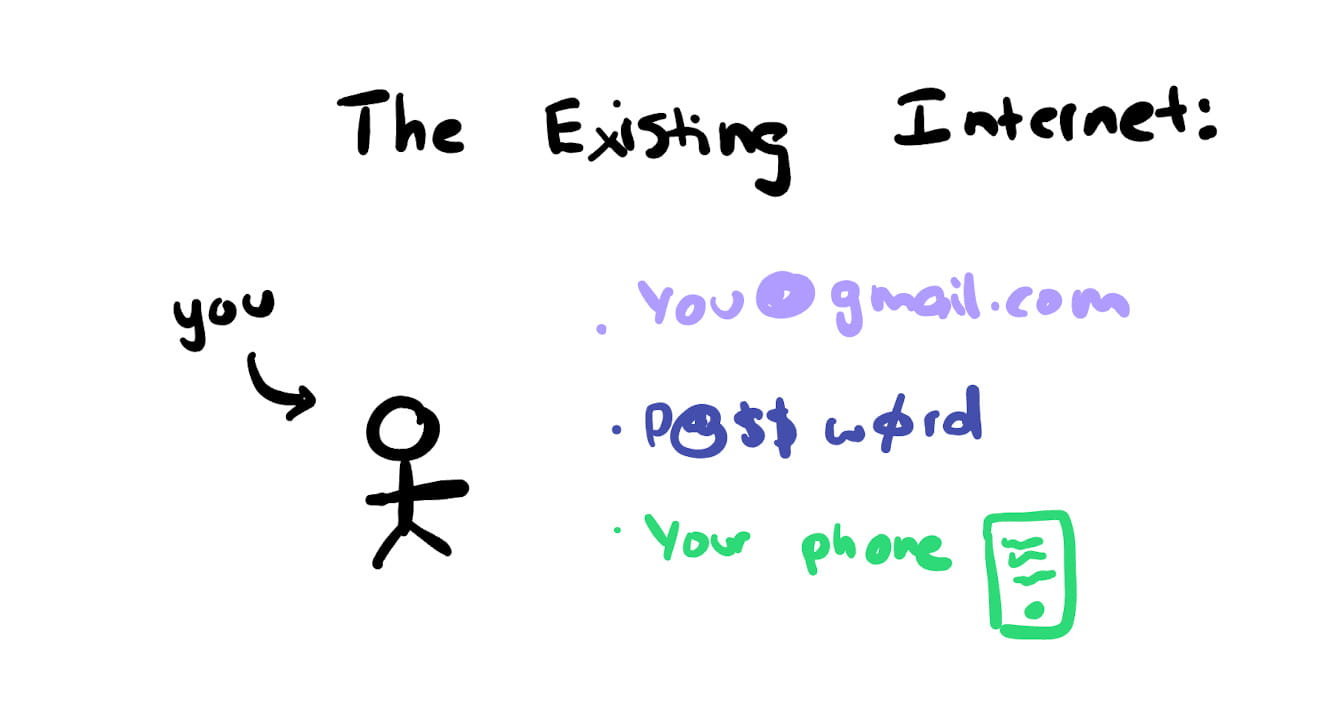
While this approach works, all data associated with you is tied to a unique identifier in a specific database. Different platforms, such as Facebook, Twitter, and Instagram, will create unique identifiers for you in their own databases. When you use OAuth to log in to other services, although these services can reference your identifier on the original platform, they still create a new record for you. OAuth providers are often restricted in sharing user data with third-party developers, and developers will associate the information generated by users in their applications with the newly created record.
This means that you have a separate representative identity in every online service you use. This is not because Web2 has any malicious intentions, but it is the only reasonable approach due to the limitations of existing technical architecture. However, as the Internet has developed, this has caused a series of problems:
Your identity and reputation data is confined to the specific platform you signed up for. For example, your number of followers on Twitter remains Twitter's data and is not directly accessible to you.
Any information created on the Internet is limited to the scope of a specific service. For example, Google Reviews will only show you Google-related information about you.
Every time you sign up for a new online service, you need to re-establish your reputation on the new platform, disregarding your previous online behavior and established credibility.
This leads to a paradox: although our personal information is the only data that can identify us, it is fragmented across different platforms.
This problem is becoming more and more serious as the demand for authenticity and trustworthiness of online information grows. To verify the authenticity and credibility of an article, I usually:
Find the author's identity
Follow them on Twitter and other public profiles
Find information related to this article on other websites
Thoroughly evaluate the author's perspective and possible bias
But I know that not many people do as much research as I do. Most people prefer to accept the information presented directly without delving into the background and authenticity of the source of the information.
The key challenge we all face is how to determine a person's true identity online. Whether browsing a website, receiving a message or emailing, it is no longer enough to identify someone by their screen name. This has begun to lead to major identity authentication problems in our online communications.
I might use "kerman.eth" as my identity on the chain, "kermankohli" on Telegram, and "kermank" on other platforms. But if someone sends you a message on Telegram using the name "kermank", you might mistake it for me. Without public key authentication, trust on the network has become a mess.
Over time, the lack of a strong and durable digital identity verification mechanism has become a global problem.
Now, encryption technology appears to be offering a solution to this problem.
Cryptography, timestamped by Crypto.
Part 1: Encryption
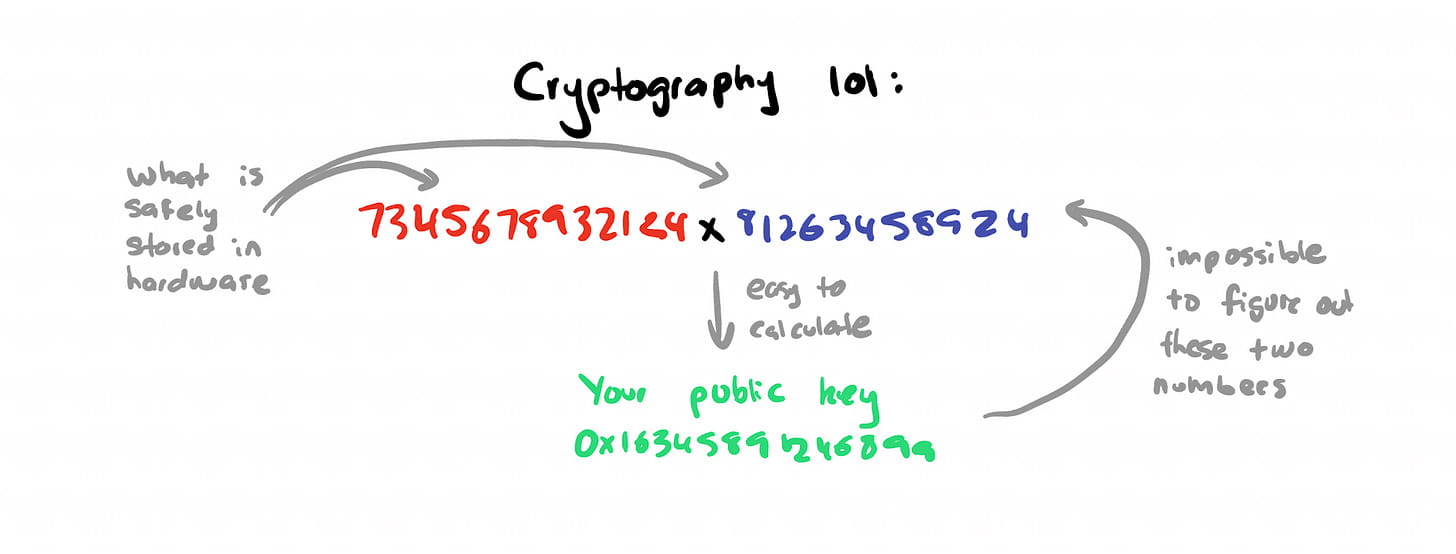
Although encryption and identity encryption sound similar, they are actually two completely different concepts. Identity encryption is based on multiplying two large prime numbers to generate a larger number. Although this process seems simple, the two prime numbers are extremely difficult to predict, making this encryption almost impossible to crack. When you use a private key to authenticate, your device will use specific information to confirm its identity. This technology marks a major change in identity management, that is, a large number known to the identity holder will also be recognized by the other party's public standard. In contrast, traditional network facilities require us to establish a new identity for each new service, which means that we have a unique ID in each database we join.
Part 2: Cryptocurrency
So, where does blockchain come into play? The key question is, how do you verify when a message was transmitted? If you simply sign a message with today's date, how can you be sure that you have dated it correctly? Perhaps you can delegate responsibility for the time to a third party, but what if they can't be trusted? This creates a recursive problem.
The innovation of blockchain is that it provides a high-quality database for recording information with timestamps. They do not rely on the concept of time like humans do, but rely on block numbers to determine when an event occurred. The groundbreaking significance of this mechanism may not be fully understood by everyone. The transaction you submit will not be marked with a specific "occurrence time", but when the transaction is confirmed by the miners, it will be recorded in a block with a timestamp.
Imagine a system where, after you enter a message, the system tells you the exact time it happened. This is unprecedented innovation. We are used to thinking that when we say something or communicate online, that is the moment when that thing "happens". But in the world of encryption, it is different. When we want to pass information on the chain, we just say what we need, and the blockchain tells us the exact moment it happened.
In short:
Encryption technology provides us with a widely accepted and shared authentication standard.
Cryptocurrencies powered by blockchain provide us with a widely accepted shared standard for time.
Why do we need identity?
In our quest for coins and riches, we may have forgotten that blockchain actually represents two core innovations, which means we can start the revolution with one of them and then incorporate the second when appropriate, without having to do both at the same time.
By 2023, with the rise of AI, we urgently need stronger identity standards. Information forms the bedrock of society, but when the trustworthiness and verifiability of information begins to slip, we face serious risks.
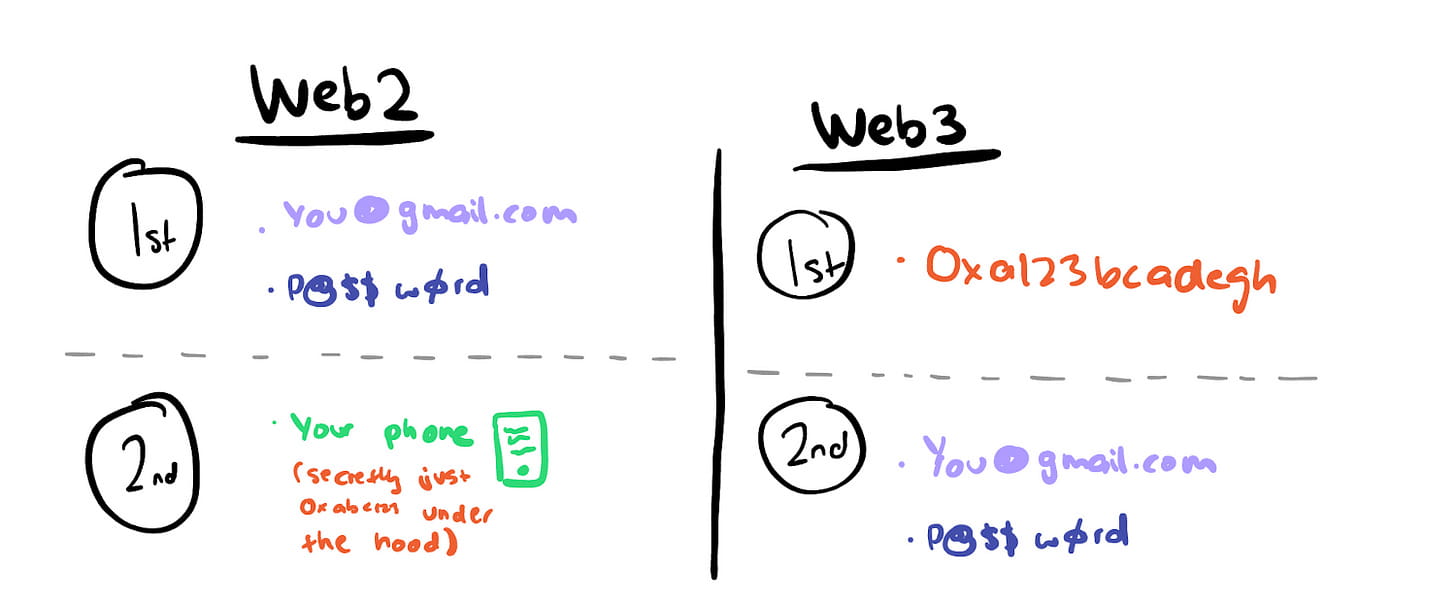
In today's society, cryptocurrency is not just used to send stablecoins or play games, it has wider applications and solves many big problems. Because cryptocurrency is built on encryption technology, it has a larger ecosystem than other networks. Today, with the popularity of technologies such as Apple's PassKeys and one-time password 2FA verification, encryption technology is becoming an industry standard.
In the Web2 era, encryption technology is regarded as a secondary technology.
In the Web3 era, encryption technology has become the core technology.
Now that we have a common understanding, we can dive into the topic of cryptography and identity. I have done some deep research on this topic and I think I have found a key point that has been obscure until now. The biggest potential application of cryptography is not "decentralized identity" or some high-minded idea:
“Take control of your own data and profit from it”
“Upload your passport to the blockchain to optimize the KYC process”
“Link your Twitter, Facebook, and Ethereum addresses to create a whole new identity”
These views are so far removed from the real world that they are more like empty slogans that fail to deliver valuable products to actual users. Such narratives are only meant to justify a lot of money to investors, but have no real value to end users.
To correct these misconceptions, we need to more accurately describe what we are talking about. I think when people talk about “on-chain identity” they often draw the wrong conclusion that everything must be performed on-chain, which is inaccurate. After careful consideration, I think a more appropriate description should be “decentralized identity management”
The way forward
Decentralized identity authentication: "Identity that is portable and persistent, supported by cryptographic technology."
These are the public keys we are familiar with today. It doesn’t matter whether the data is stored on-chain or off-chain. What really matters is that you are identified and authenticated in digital services through your public key. All information is closely linked to your public key, thus achieving interoperability.
But the following features make it significantly superior to the current web2 system:
Created in one scenario, but usable in other scenarios. All your behaviors and data in one ecosystem can be retrieved and utilized in completely unrelated ecosystems.
Persistent existence. Once a private key is derived, it does not disappear. You cannot delete a private key or related data on the chain. Once a prime number is used to generate a public key, you cannot "undo" this operation.
It applies to both on-chain and off-chain. Your identity is made up of all the places you are on-chain or off-chain, authenticated by your public key. The key to innovation lies in this key, not just the blockchain.
New identities (or fragments) can be easily created and coexist with existing identities. Unlike web2, where all identities are ultimately tied to your real-name information (such as phone number, ISP), self-sovereign identities can be created or split without permission.
Anyone with an internet connection and access to the right hardware can get one. There is no centralized “issuing” authority that sets the identity standards. As long as you have the infrastructure to secure it, you can create it. And because it’s cross-border, the possibilities for using it are endless.
in conclusion
Self-sovereign identity basically opens up a whole new application paradigm that is 10 times more powerful than existing web applications! In such a world, every application can enhance the user experience of other applications. This effect is like a flywheel that continues to accelerate. Here are my views:
As crypto consumer applications emerge, they will naturally adopt self-sovereign identity as the authentication standard.
These apps will be able to personalize themselves based on your past behavior in other apps.
This capability provides a superior user experience when acquiring and integrating contextual information from different scenarios.
In order to meet user needs, more and more applications are beginning to support public key-based authentication for login and use.
As the number of applications that support public key authentication increases, the value users gain from self-sovereign identity will also increase.
I firmly believe that the core applications of crypto are already here: applications based on self-sovereign identity. The sooner we realize this, the faster we can create applications that are truly popular with users. I will have more to say about self-sovereign identity and the latest developments in this field in a subsequent article. For now, I am very much looking forward to hearing your thoughts.