


August 2023 Summary
In early August, the dollar strengthened and risk appetite declined, causing volatility in major asset classes. The S&P 500 fell 5.1% from its high, and the Nasdaq Composite Index fell as much as 7.6%. In addition, gold fell as much as 4.4% and Bitcoin fell as much as 11%. At the end of the month, the S&P 500, Nasdaq Composite and gold showed signs of recovery, while Bitcoin remained weak, indicating a weakening risk appetite for cryptocurrencies.
Annual inflation data released in August showed the first significant increase after 12 consecutive months of deceleration. Rising energy costs raise concerns about near-term inflation forecasts. The unemployment rate rose to 3.8% in August (from 3.5% previously). Investors remain cautious about concerns that rising unemployment and continued inflation could lead to stagflation.
Cryptocurrency trading activity remains at yearly lows in August. The Commitment of Traders (COT) report shows that commercial institutions on the Chicago Mercantile Exchange (CME) hold the highest net short position in Bitcoin in 2023, suggesting bearish sentiment.
The massive sell-off in Bitcoin in mid-August triggered the liquidation of over $150 million in long positions. Total open interest fell by $5 billion. This deleveraging event reduced total Bitcoin open interest by approximately 25%.
On August 29, a federal appeals court ruled that the U.S. Securities and Exchange Commission (SEC) must reevaluate its rejection of Grayscale Investments’ application to convert its Grayscale Bitcoin Trust (GBTC) into an exchange-traded fund (ETF). Bitcoin prices rose by about 6%. However, the SEC has not approved any applications for Bitcoin spot ETFs. Therefore, we expect the cryptocurrency market to remain sluggish in the uncertain macroeconomic environment before the SEC approves a Bitcoin spot ETF.
1.0 Macroeconomics
1.1 U.S. long-term bond yields surge as inflation concerns grow
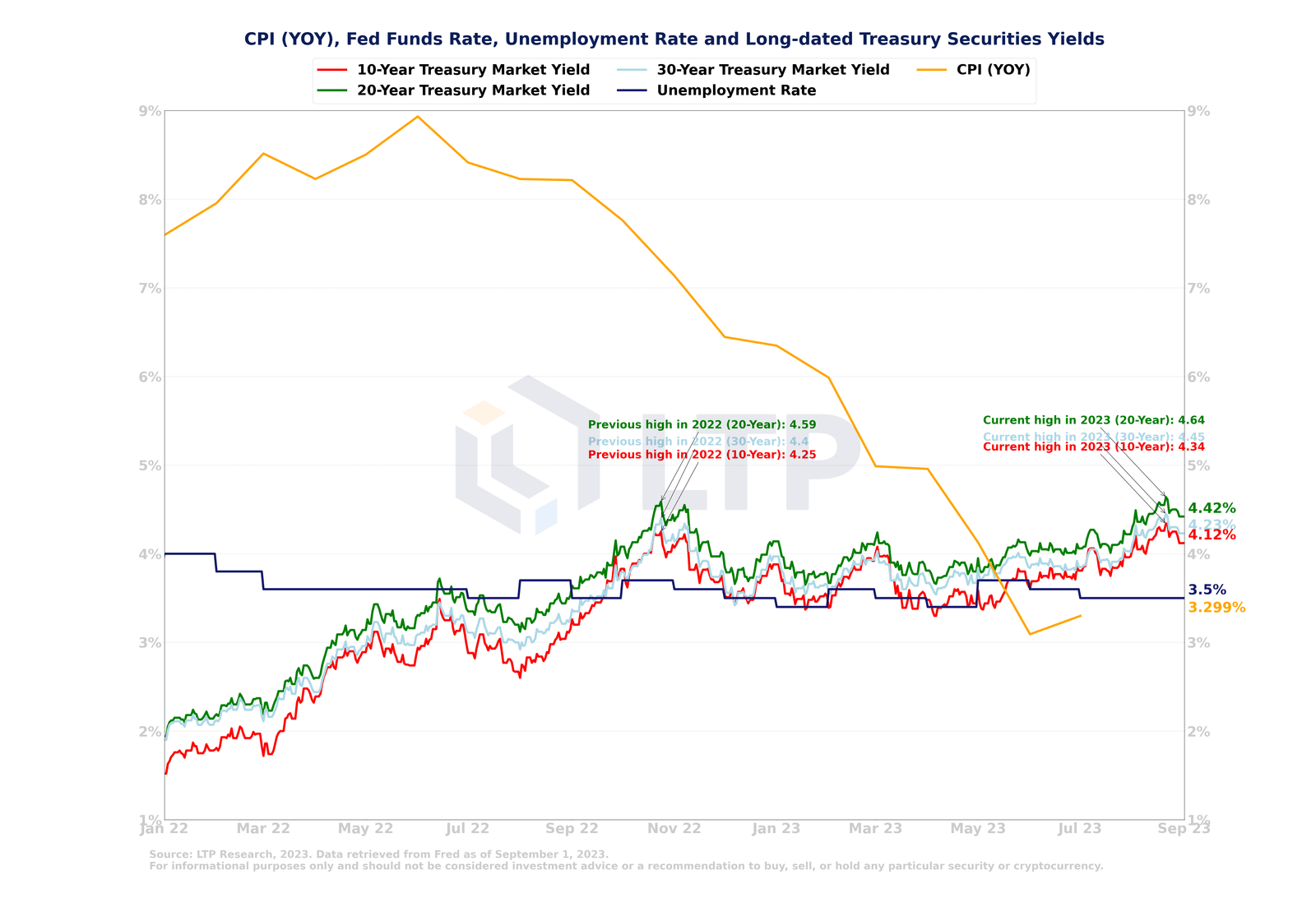
The US Consumer Price Index for July 2023 showed a significant increase in year-on-year inflation, from 3% in June 2023 to 3.29%. This marked the first increase in inflation (CPI year-on-year) after 12 consecutive months of decline, with the inflation rate at 8.93% in June 2022.
At the same time, crude oil and gasoline prices have also risen significantly, bringing inflationary pressures (see Appendix B). Since the beginning of 2023, gasoline prices have risen by more than 20%.
As concerns about inflation grow, long-term Treasury yields have exceeded their November 2022 peak, suggesting investors are growing more concerned about near-term inflation and longer-term higher interest rate policies.
1.2 Bitcoin follows the entire market in its retracement
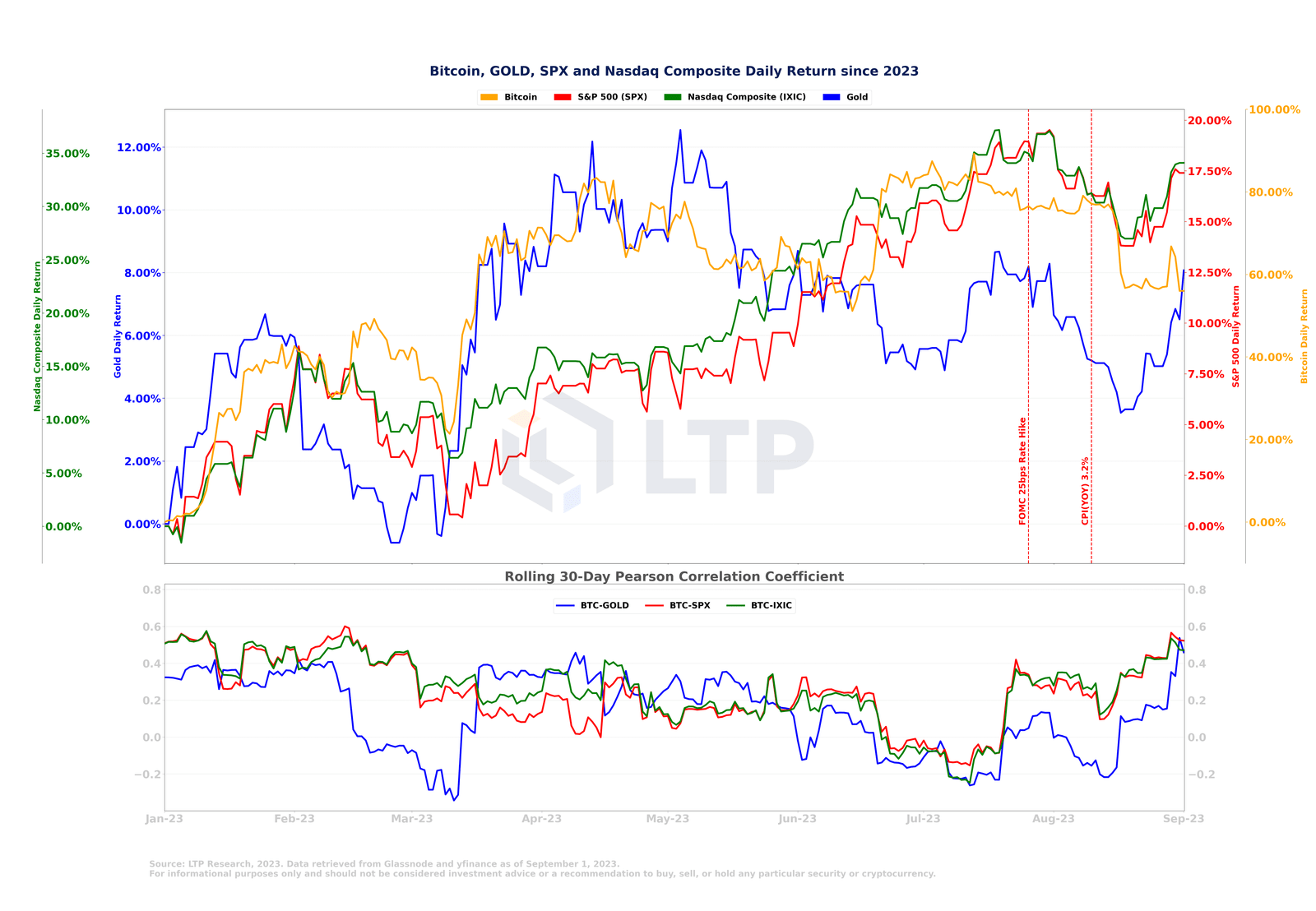
In early August, major asset classes experienced volatility, with the S&P 500 falling 5.1% from its highs and the Nasdaq Composite Index's largest decline reaching 7.6%. In addition, the maximum retracement of gold is 4.4% and the maximum retracement of Bitcoin is 11%. The retracement began at the July Federal Open Market Committee (FOMC) meeting, where Chairman Powell hinted at the possibility of extending the rate hike cycle, and the July Consumer Price Index (CPI), released on August 10, rose year-on-year. 3.2%, the first rise in 12 months, further adding to the downward pressure on the market. At the end of the month, the S&P 500, Nasdaq Composite and gold showed signs of recovery, while Bitcoin remained weak, signaling weakening risk appetite for cryptocurrencies.
2.0 Cryptocurrency Market Review
2.1 Net short positions held by commercial institutions in the Bitcoin Chicago Mercantile Exchange (CME) futures market have reached a record high
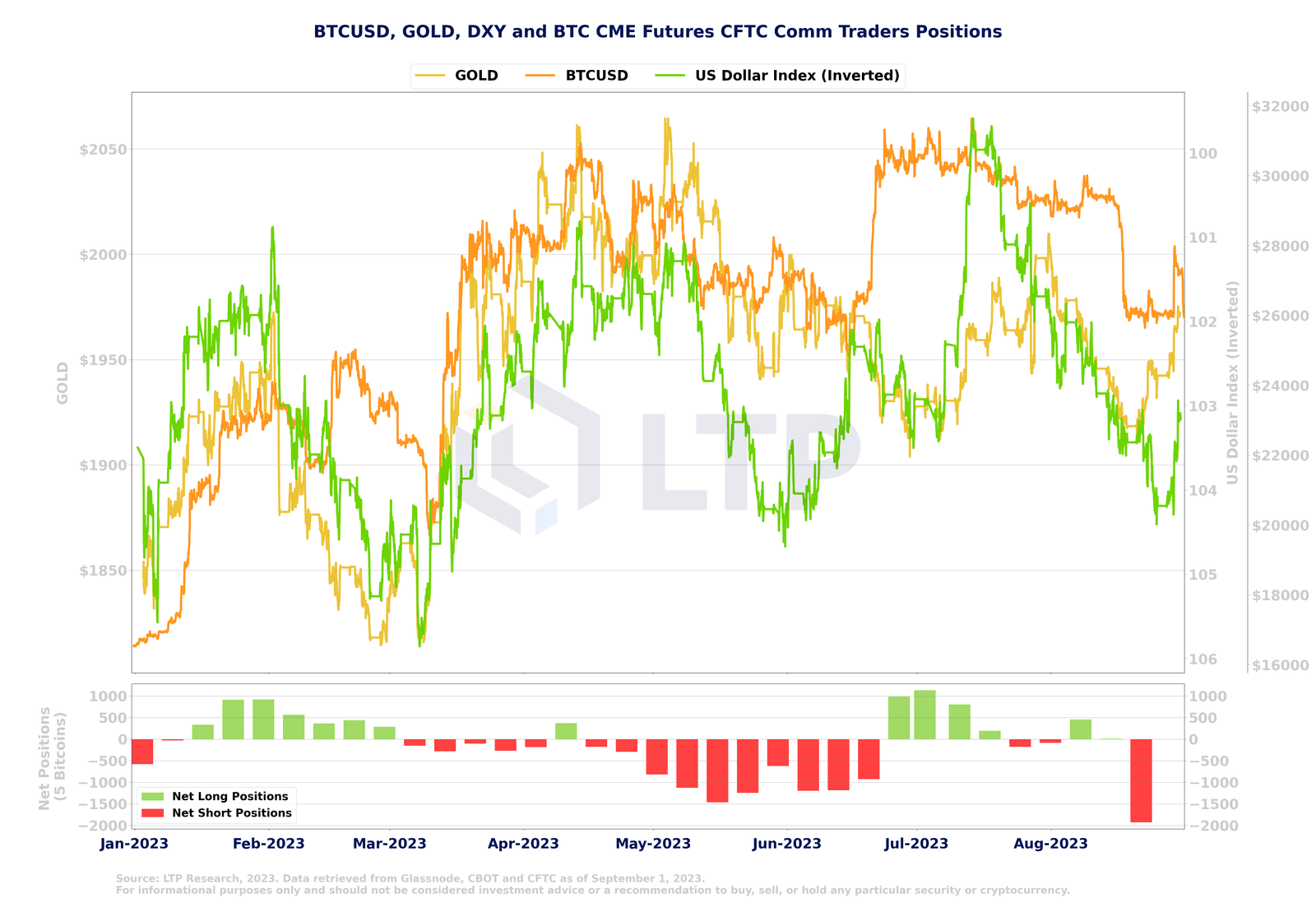
Commercial institutions turned to a net short position in Bitcoin in August. The current net short position of commercial institutions has reached the highest level so far in 2023.
2.2 Bitcoin price falls below short-term holder cost base price
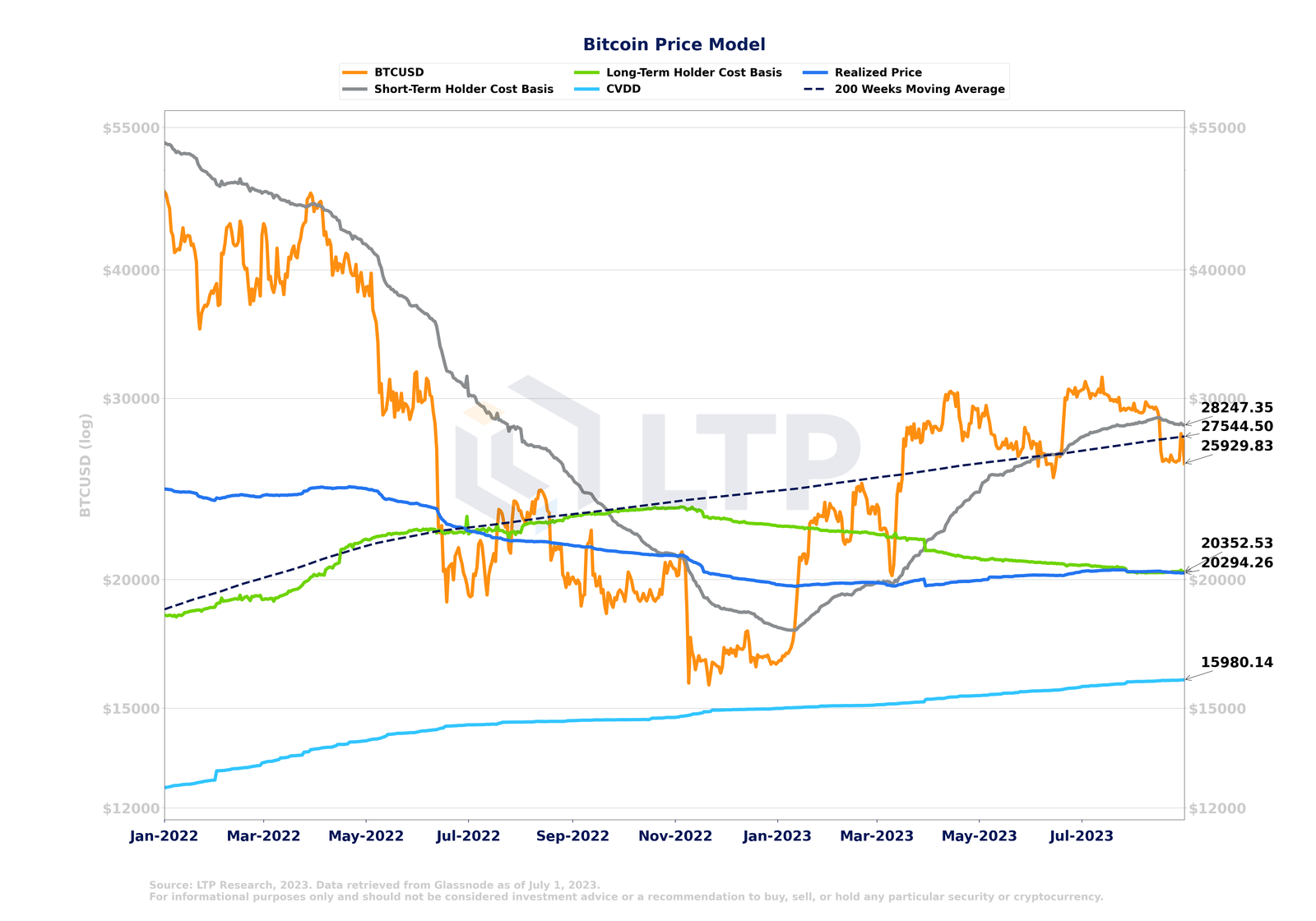
On August 17, the Bitcoin price fell below the short-term holder cost basis. Meanwhile, the long-term holder cost basis and realized price remained at $20,300.
2.3 The total circulating supply of the top 4 stablecoins continues to decline, the amount of ETH pledged increases, and the stablecoin supply rate oscillator indicates that the current Bitcoin price is in the middle range
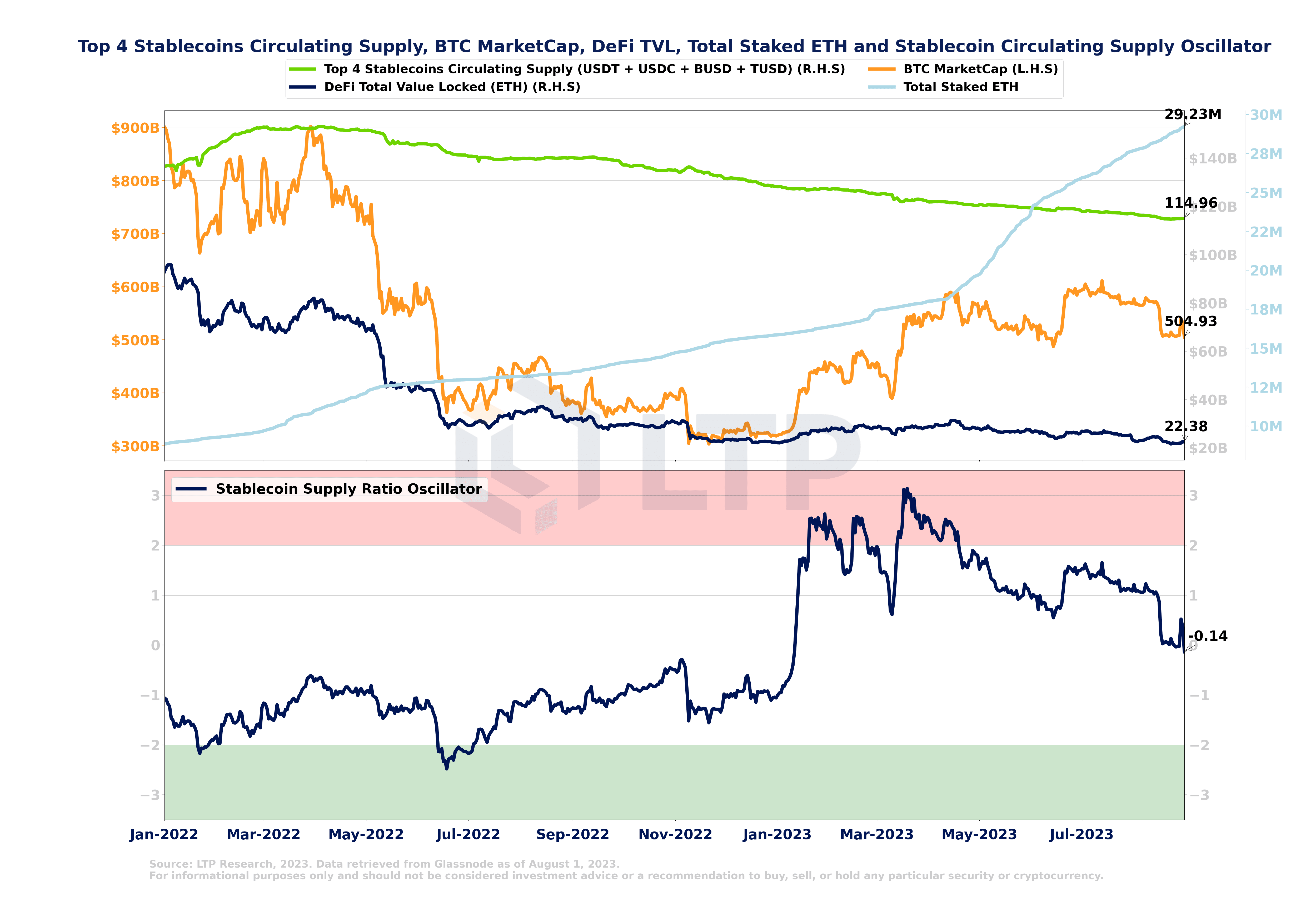
In August 2023, the circulating supply of stablecoins (including USDT, USDC, TUSD, and BUSD) continued to decline, falling to $114.9 billion by August 31. Additionally, the total value locked (TVL) in decentralized finance (DeFi) protocols also declined, falling to $22.4 billion in the same month. However, the total amount staked on Ethereum continues to grow, reaching 29.23 million ETH. Bitcoin’s total market capitalization dropped to $508 billion.
2.4 Cryptocurrency exchange trading volume declined in August
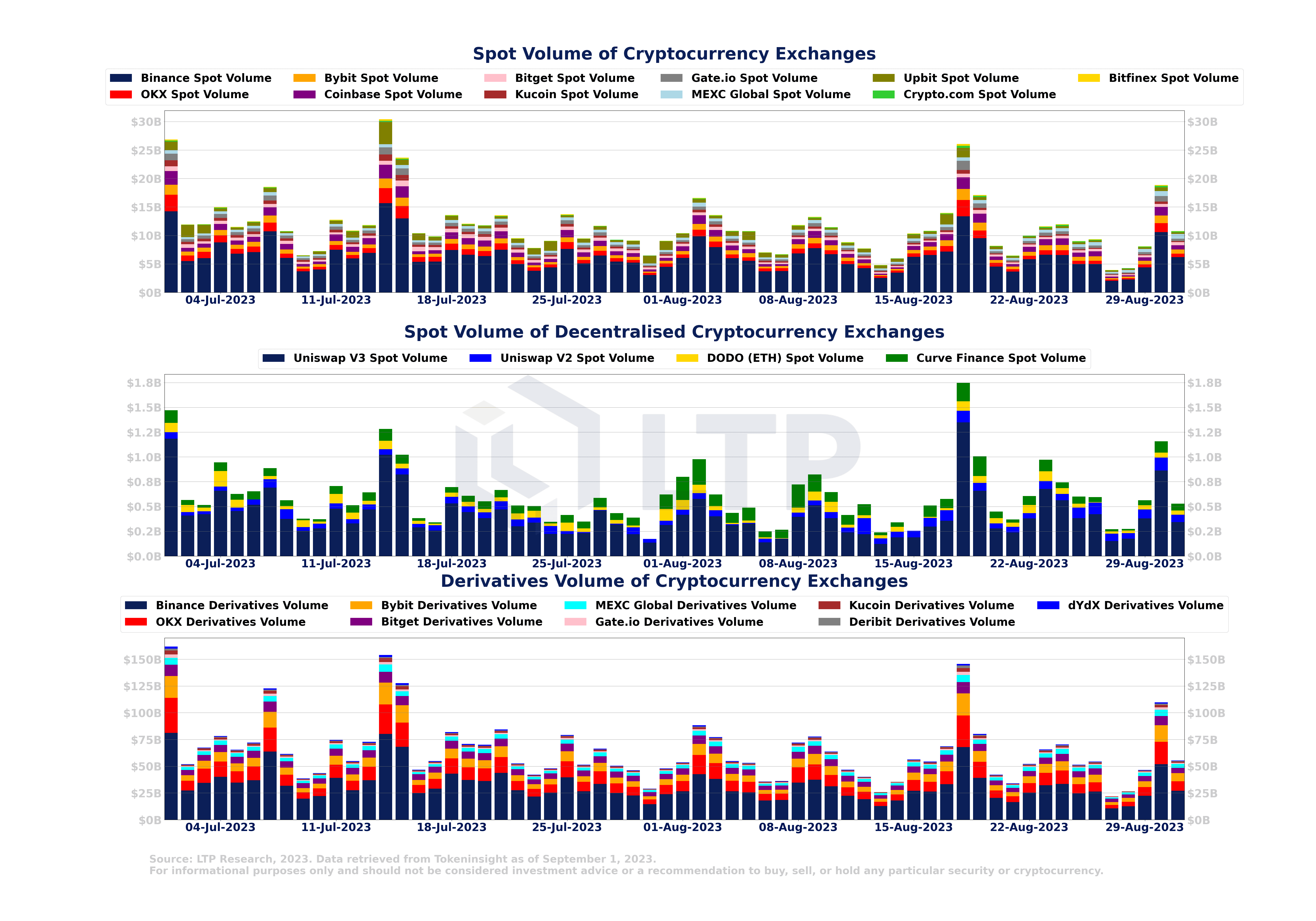
On August 18, trading volumes on exchanges (CEX) and decentralized exchanges (DEX) surged following the previous day’s sell-off. However, overall, trading volumes in August remained at low levels for the year.
2.5 Binance Bitcoin and Ethereum Spot/Perpetual Futures Trading Volume
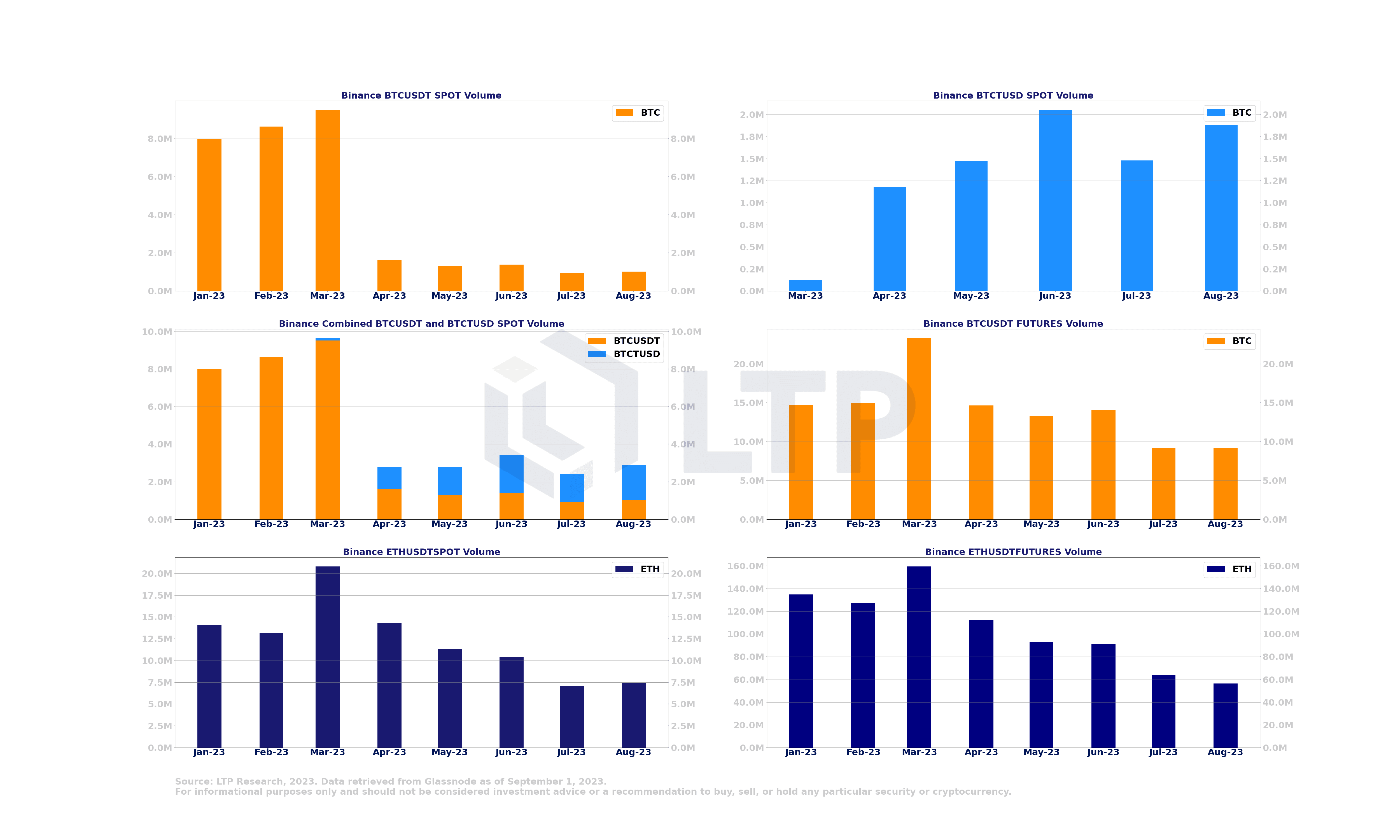
In August 2023, Binance’s Ethereum perpetual futures trading volume continued to decrease. Compared with July 2023, BTCTUSD spot market trading volume increased slightly.
2.6 BYBIT BTCUSDT/ETHUSDT spot and perpetual futures trading volume
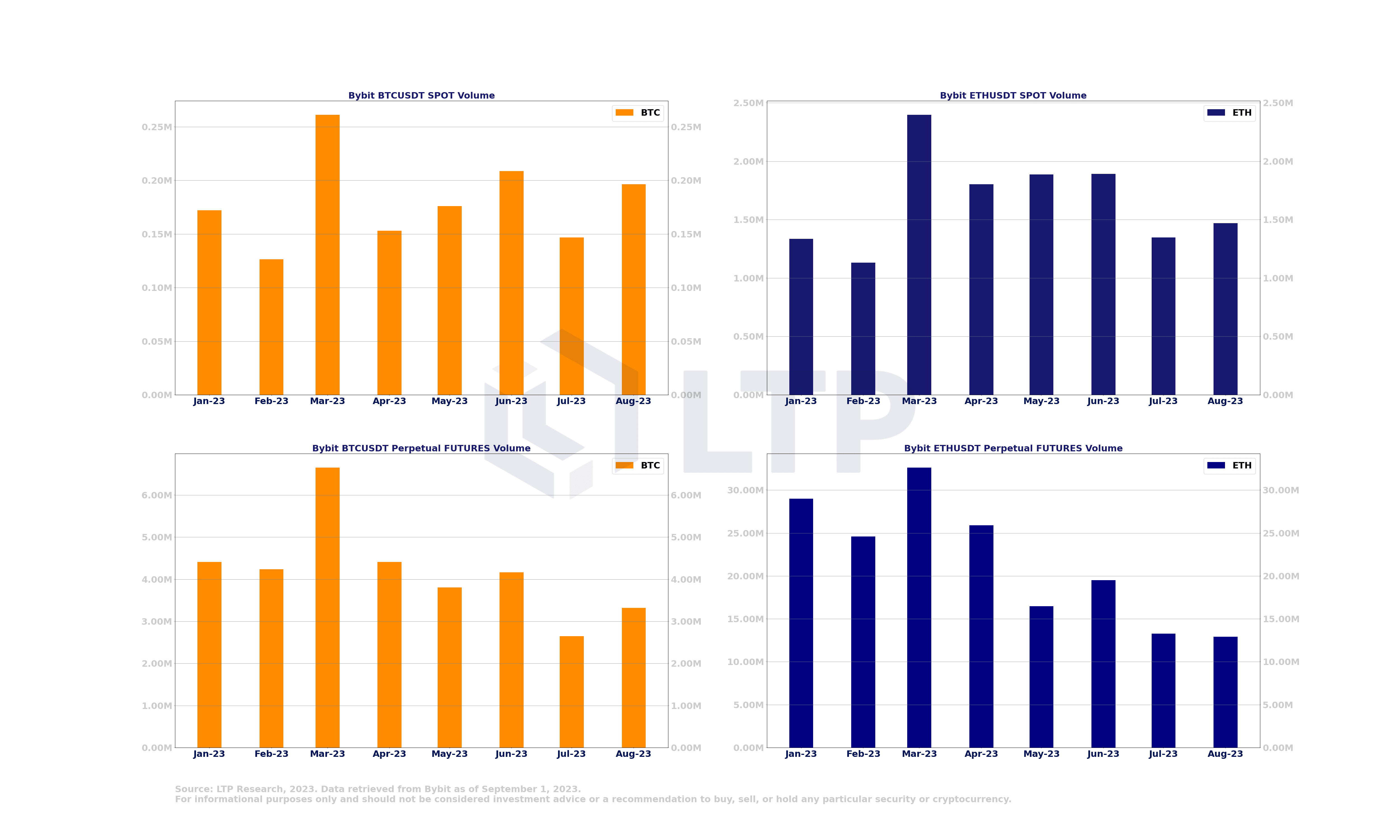
In August 2023, Bybit Ethereum spot trading volume continued to decrease. Compared with July 2023, Bitcoin spot and perpetual futures market trading volume increased slightly.
2.7 OKX BTCUSDT/ETHUSDT spot and perpetual futures trading volume
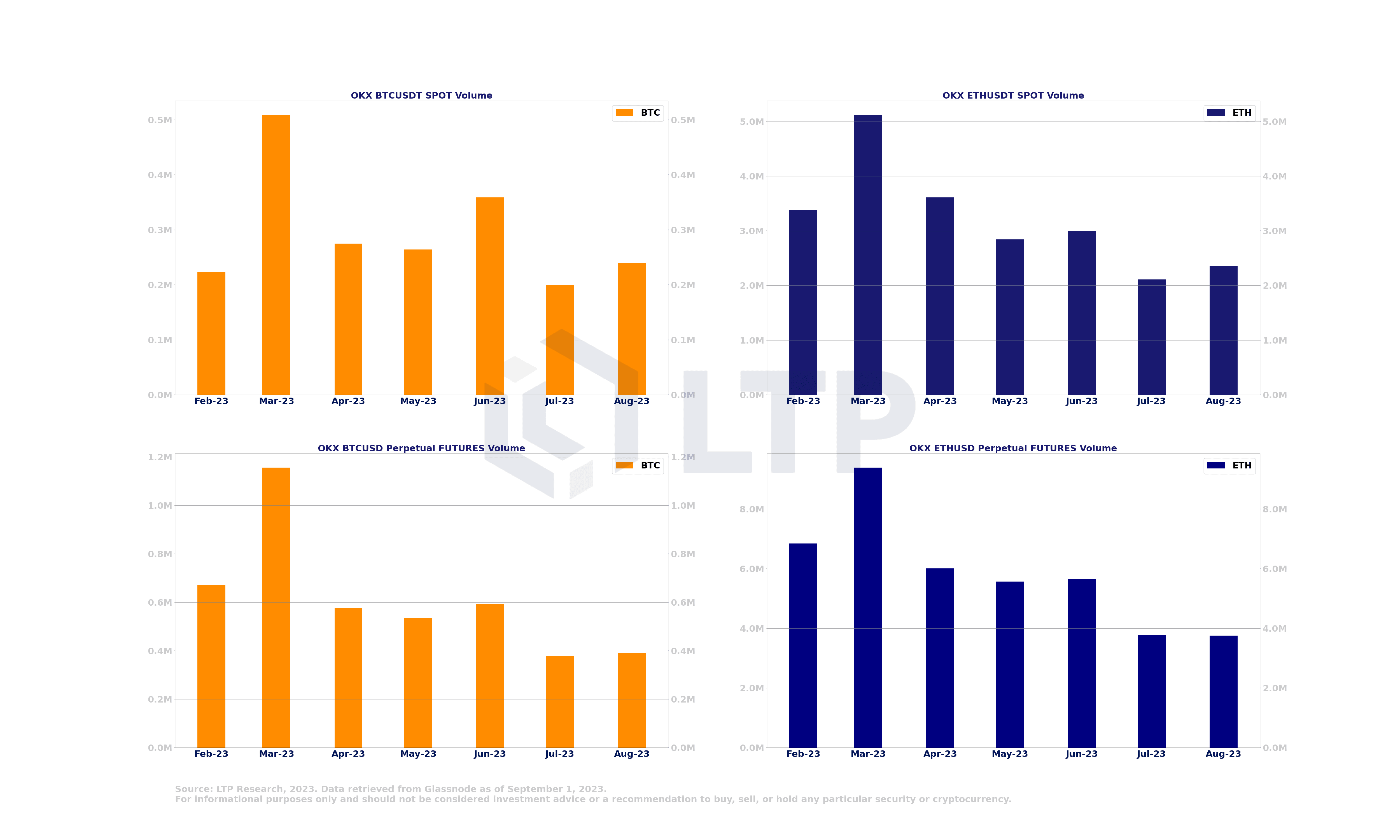
OKX’s Ethereum perpetual futures trading volume continued to decrease in August 2023. Compared with July 2023, Bitcoin and Ethereum spot market trading volumes increased slightly.
2.8 The relative trading volume of mainstream cryptocurrencies fell in August, falling below the 90-day average benchmark
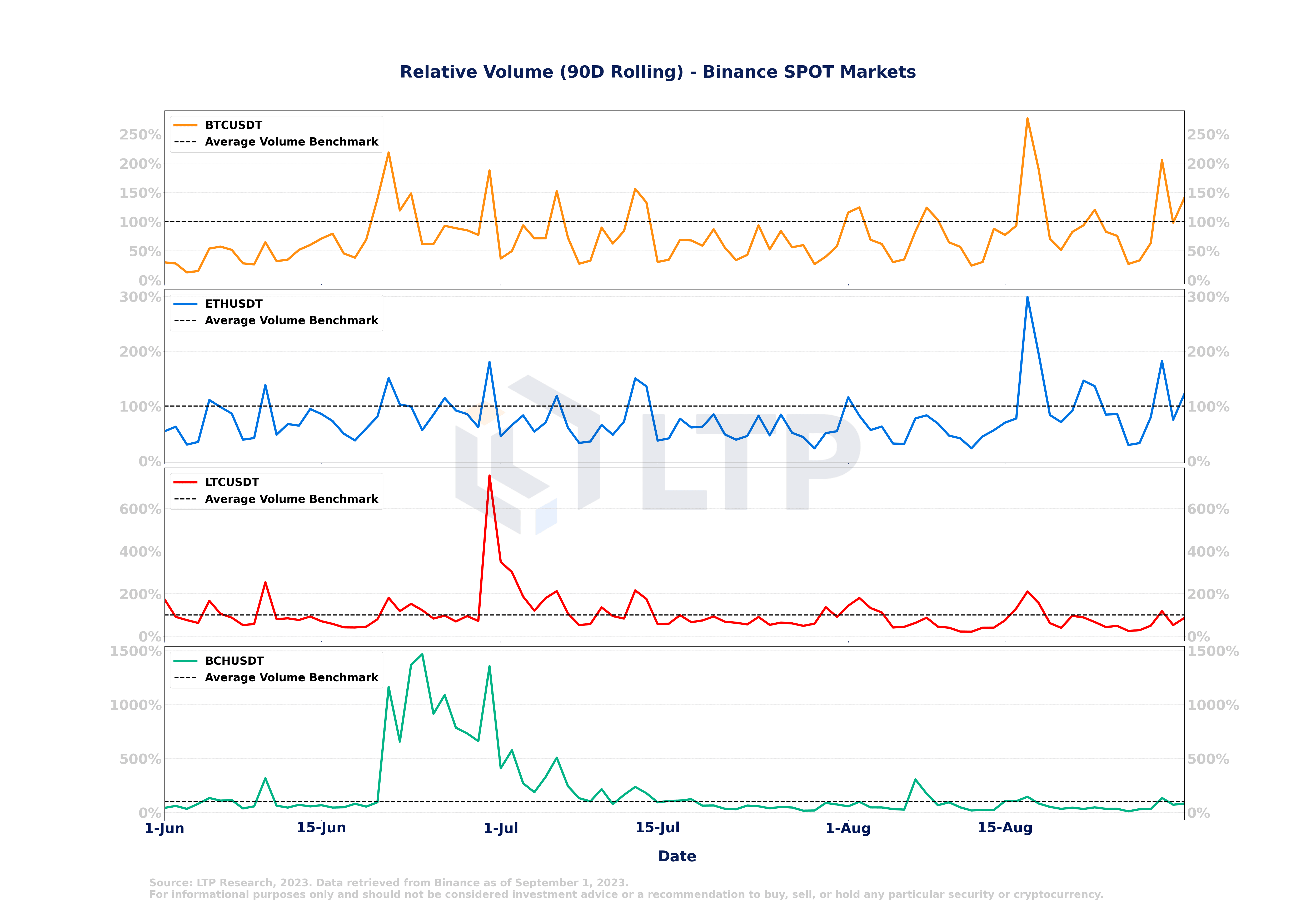
In mid-August, as the market sold off, Bitcoin, Ethereum, Litecoin, and Bitcoin Cash saw significant increases in relative trading volume. However, trading activity in Litecoin and Bitcoin Cash did not continue to heat up, and market trading volume subsequently declined. Relative trading volume fell below the 90-day benchmark, and trading activity was mainly concentrated on Bitcoin and Ethereum.
2.9 Annualized volatility of major cryptocurrencies declined in August
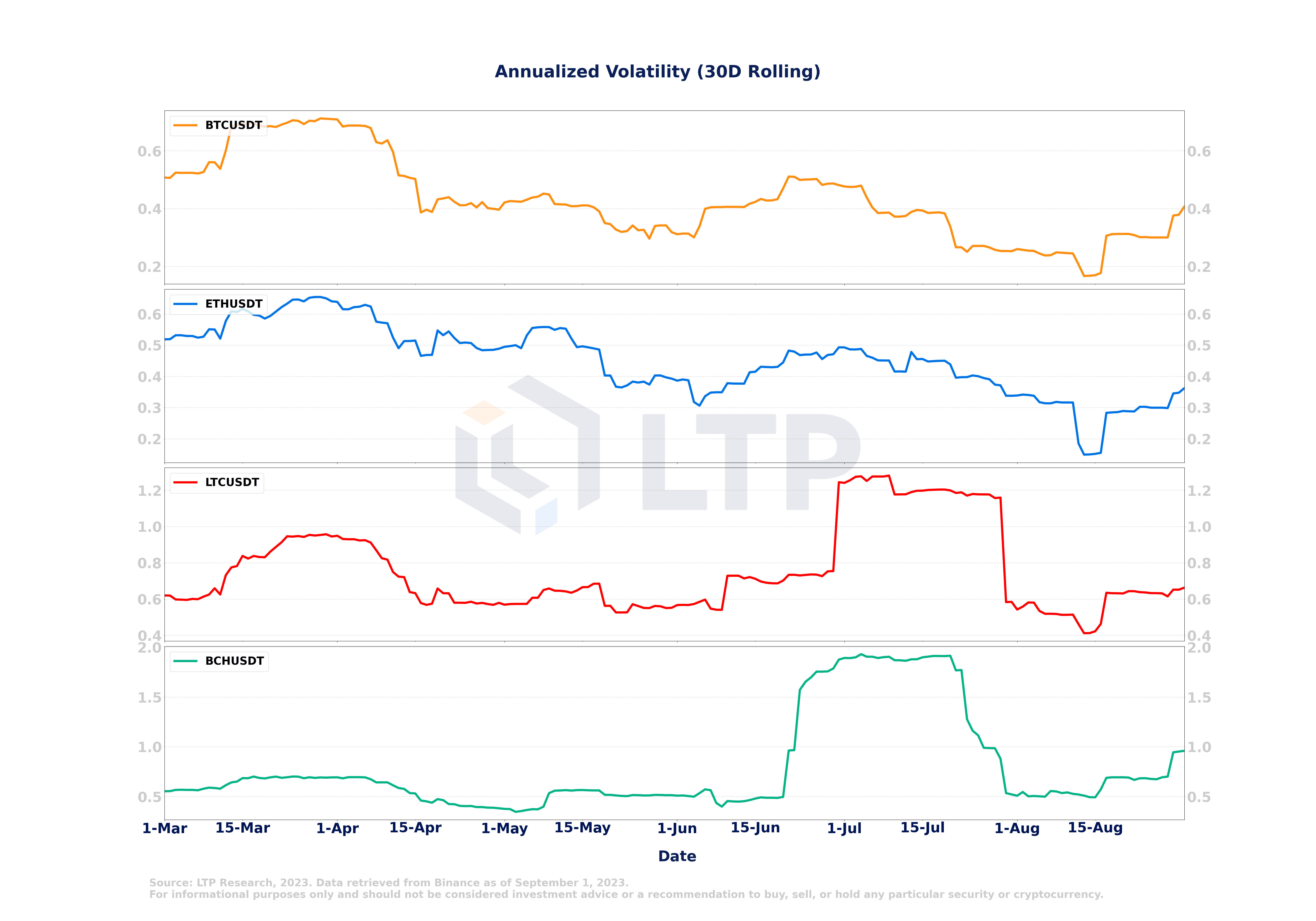
In early August, annualized volatility for Bitcoin and Ethereum reached 2023 lows. However, the subsequent sell-off caused their volatility to rise. Given that current macroeconomic conditions limit risk appetite and that the SEC is still processing applications for a Bitcoin spot ETF, we expect trading activity to remain subdued and that major moves will be driven by industry news.
2.10 Bitcoin transaction flow (UTC)
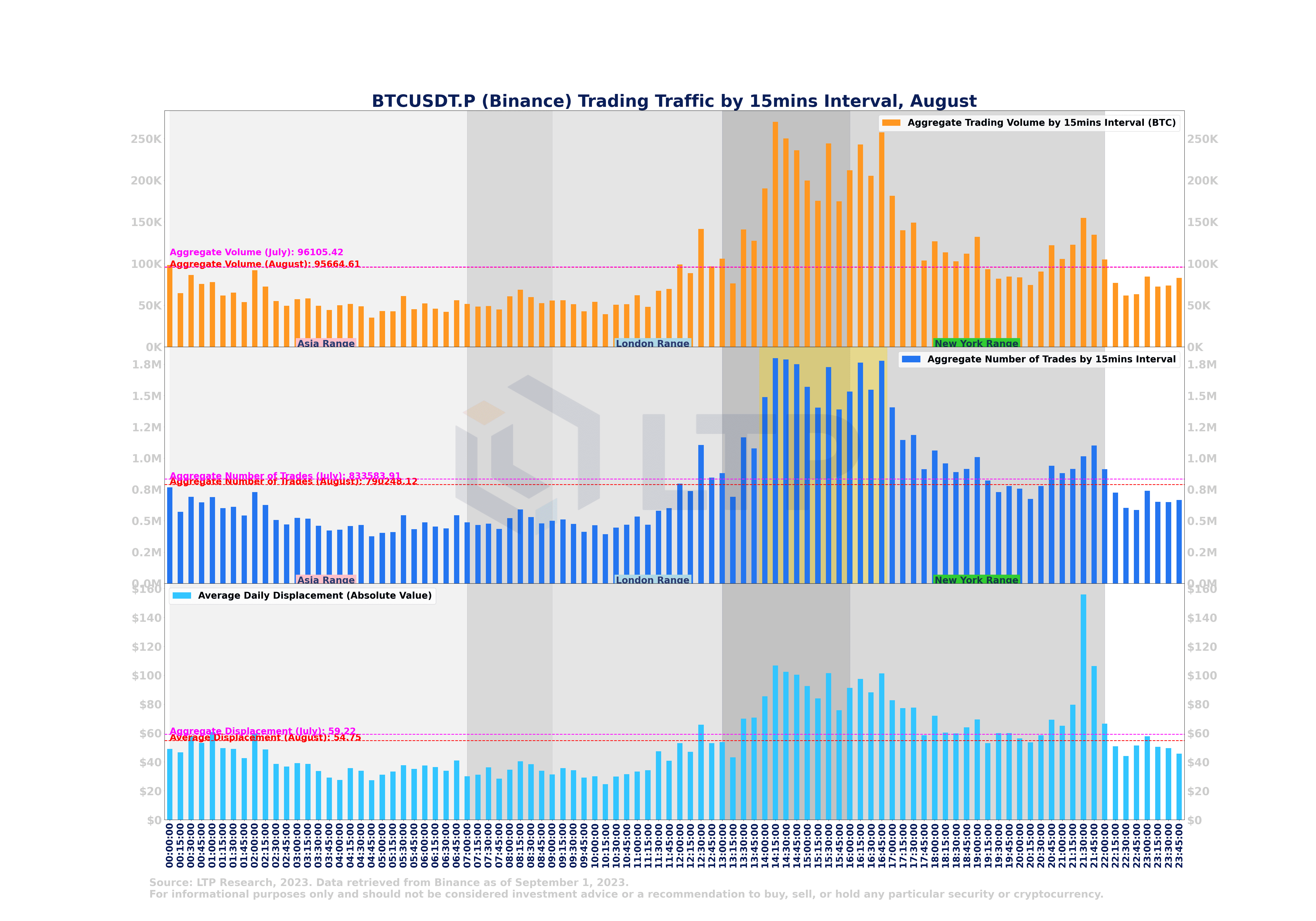
In August, trading activity was concentrated between 14:00 and 16:45 (UTC), when the opening hours of the London and New York sessions overlap. Trading activity also increased at the end of the New York session. The spike in average daily displacement (15-minute periods) at the end of the New York session can be attributed to the sell-off and a series of long liquidations that occurred at 21:30 (UTC) on August 17.
$2.11 $5 billion in total Bitcoin holdings wiped out
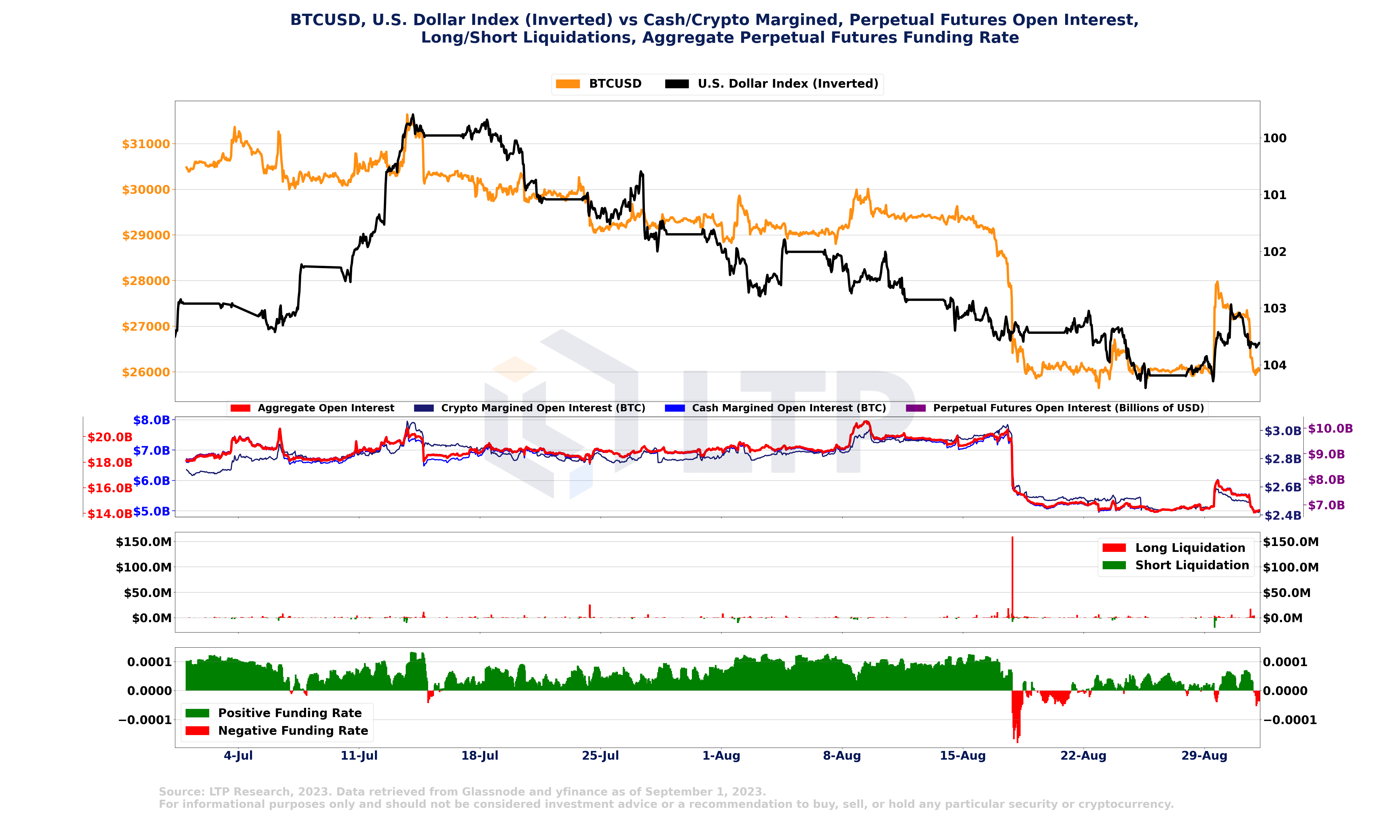
In August, the US dollar index performed strongly. Bitcoin experienced a major sell-off on August 16, which caused a $5 billion reduction in total open interest and triggered a forced liquidation of more than $150 million in long positions. This deleveraging event reduced Bitcoin's total open interest by approximately 25%.
2.12 Bitcoin perpetual contracts saw massive liquidations and seller pressure during the market sell-off
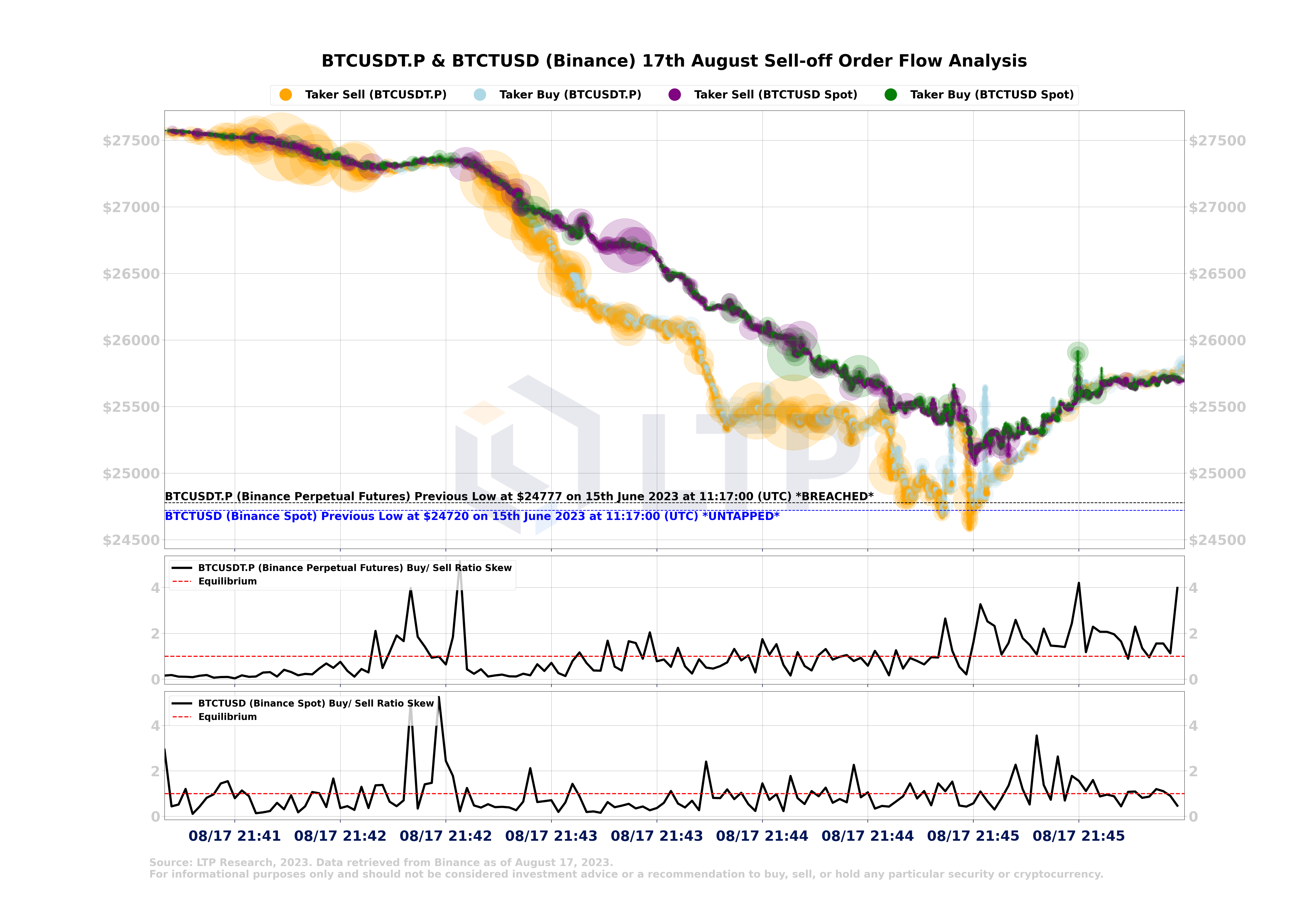
Between 21:41 and 21:45 (UTC) on August 17, a series of long liquidations occurred. The above visualization shows that the Binance Bitcoin perpetual futures market exhibited a clear sell-side bias, causing the price to deviate from the BTCTUSD spot market price during the liquidation period. In addition, starting from 21:45, it is clear that speculative buyers entered the market when the buy-sell bias returned to equilibrium levels. At the same time, the Bitcoin perpetual futures price just fell below its previous low of June 15 ($24777) at 11:17 UTC, which reasonably triggered the remaining stop-loss and liquidation orders. It is worth noting that the spot price did not reach the previous low of June 15 at 11:17 UTC ($24720).
2.13 Ethereum perpetual contracts saw massive liquidations and seller pressure during the market sell-off
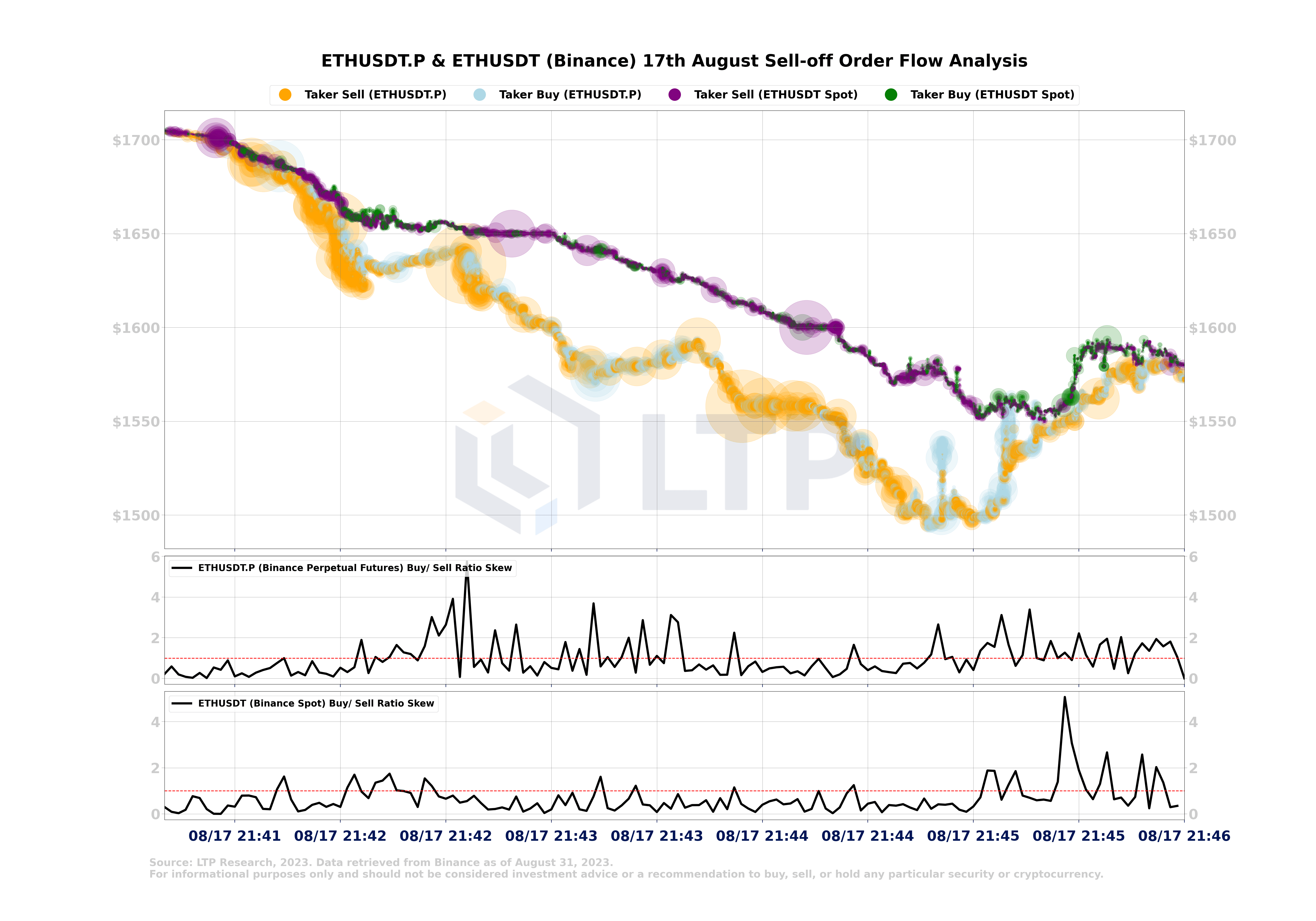
The above visualization shows that the Ethereum perpetual contract market on Binance Exchange showed a clear seller bias, causing the price to deviate from the price of the ETHUSDT spot market during the liquidation period. In addition, it can be clearly seen that at 21:45 (UTC), the buying and selling bias returned to the equilibrium level and speculative buyers entered the market. The ETHUSDT Binance spot market also saw an increase in buyer bias at 21:45, and spot buyers intervened and bought spot.
2.14 Layer 1 Token Performance
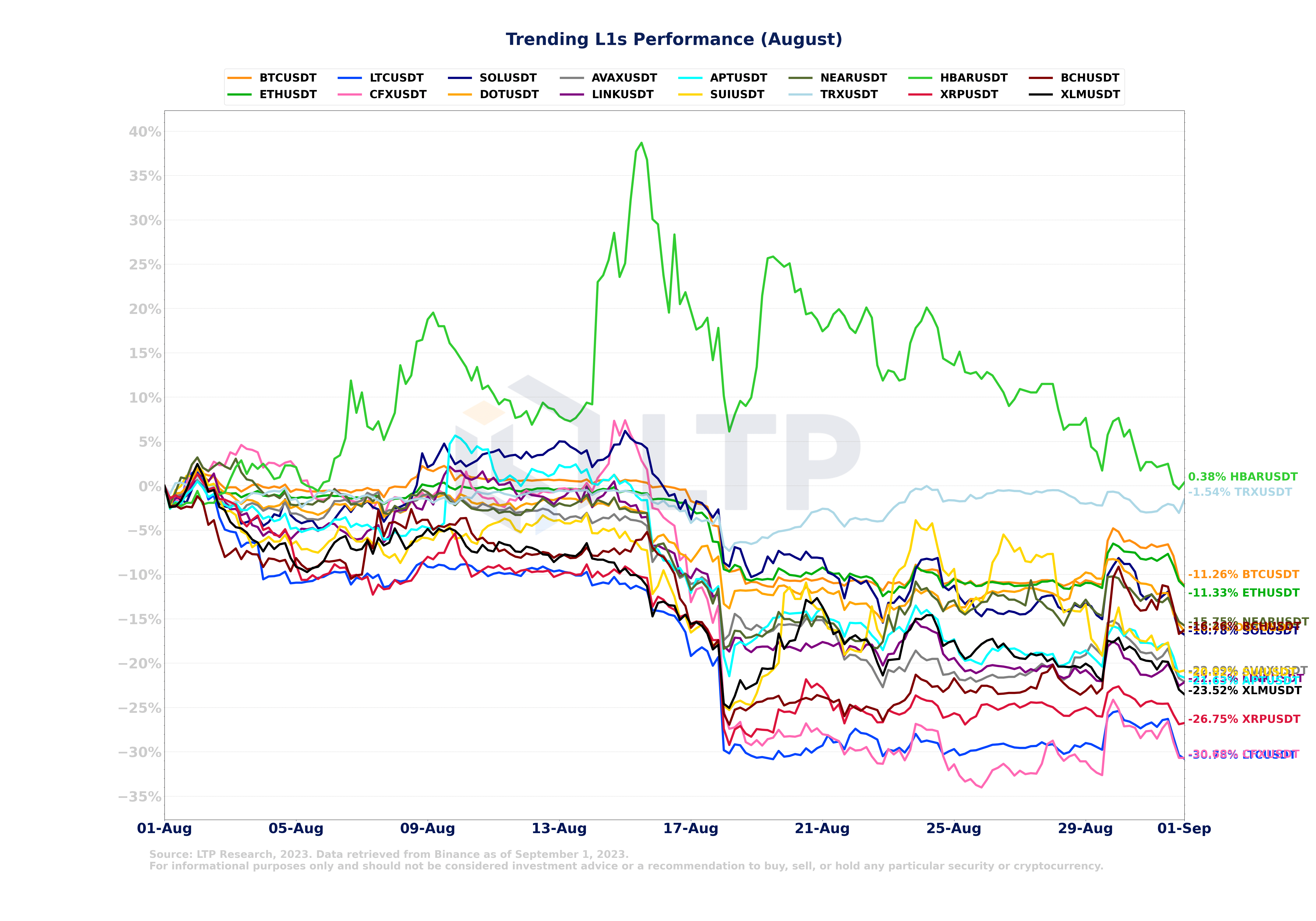
Hedera Hashgraph (HBAR) performed strongly amid the market sell-off as the Federal Reserve’s FedNow listed its micropayments platform Dropp. Most first-layer blockchains saw a drop. Bitcoin and Ethereum recorded an 11% drop, while other popular first-layer blockchains also faced significant declines.
2.15 Performance of popular Layer 2 tokens
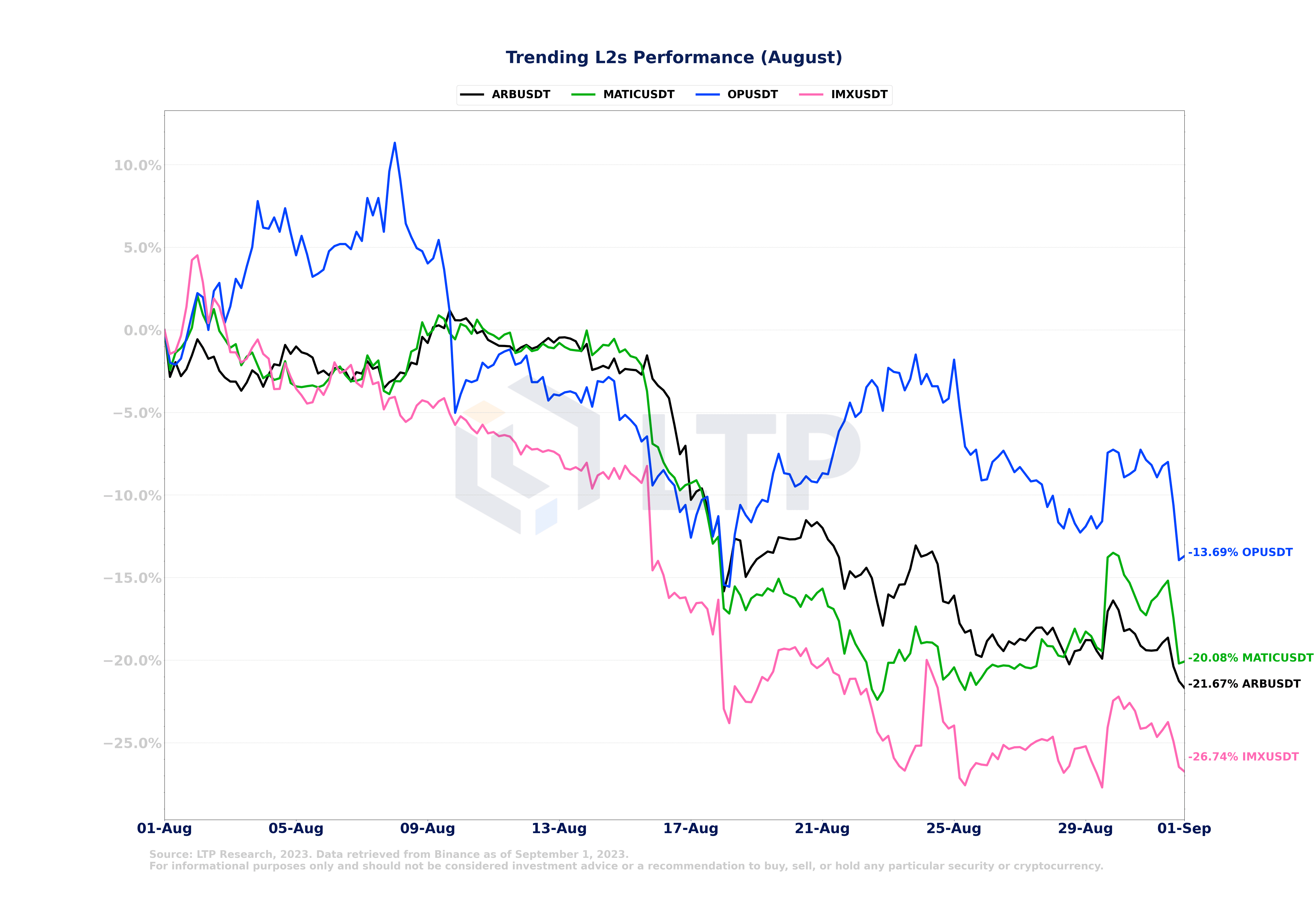
L2s also experienced a sustained sell-off throughout August.
2.16 DeFi Token Performance
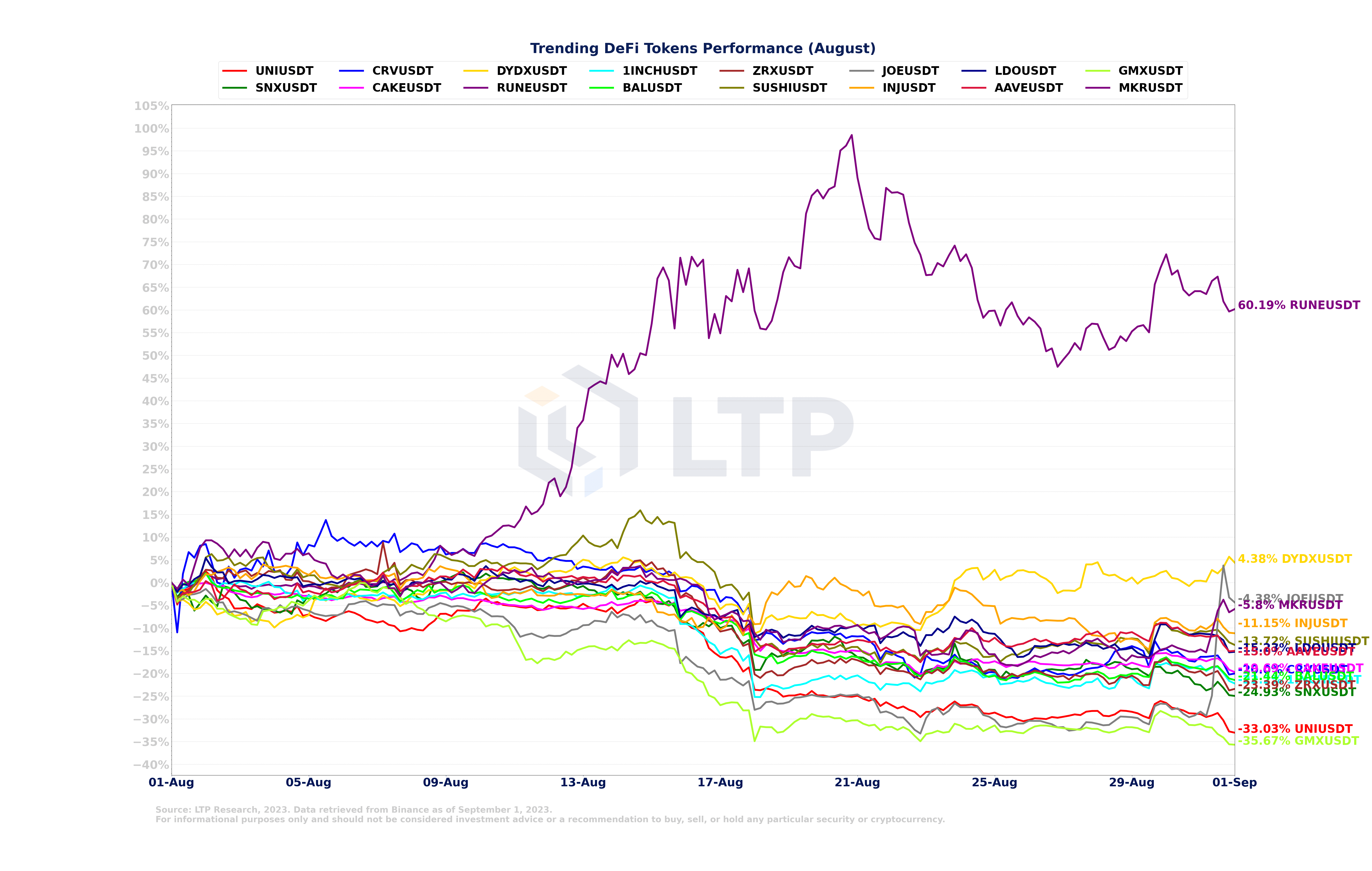
While most DeFi tokens continued to decline, Rune performed strongly amid the market sell-off.
2.17 Performance of popular GameFi/Metaverse tokens
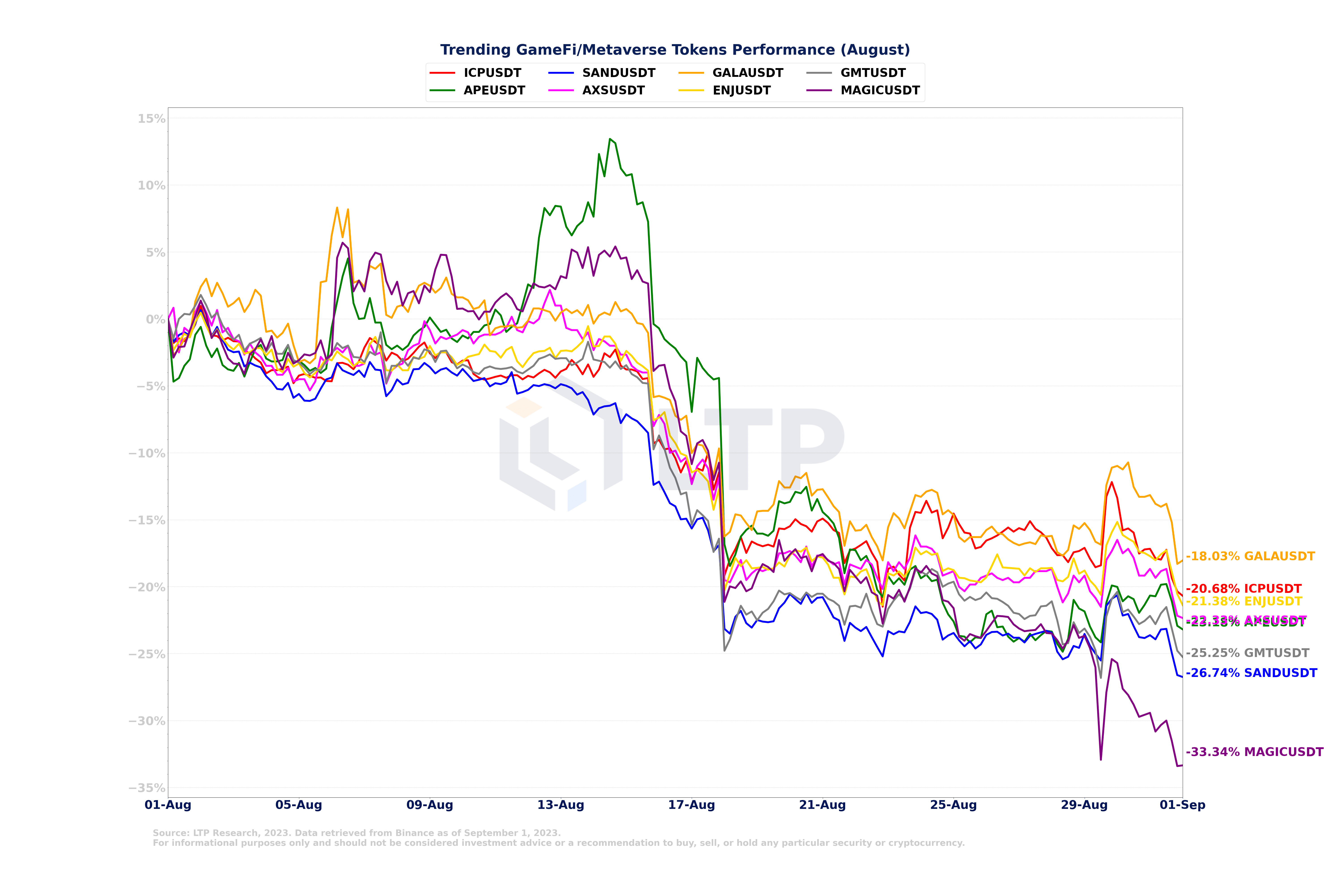
Most GameFi tokens saw a sell-off in August.
2.18 Performance of popular centralized exchange tokens and meme tokens
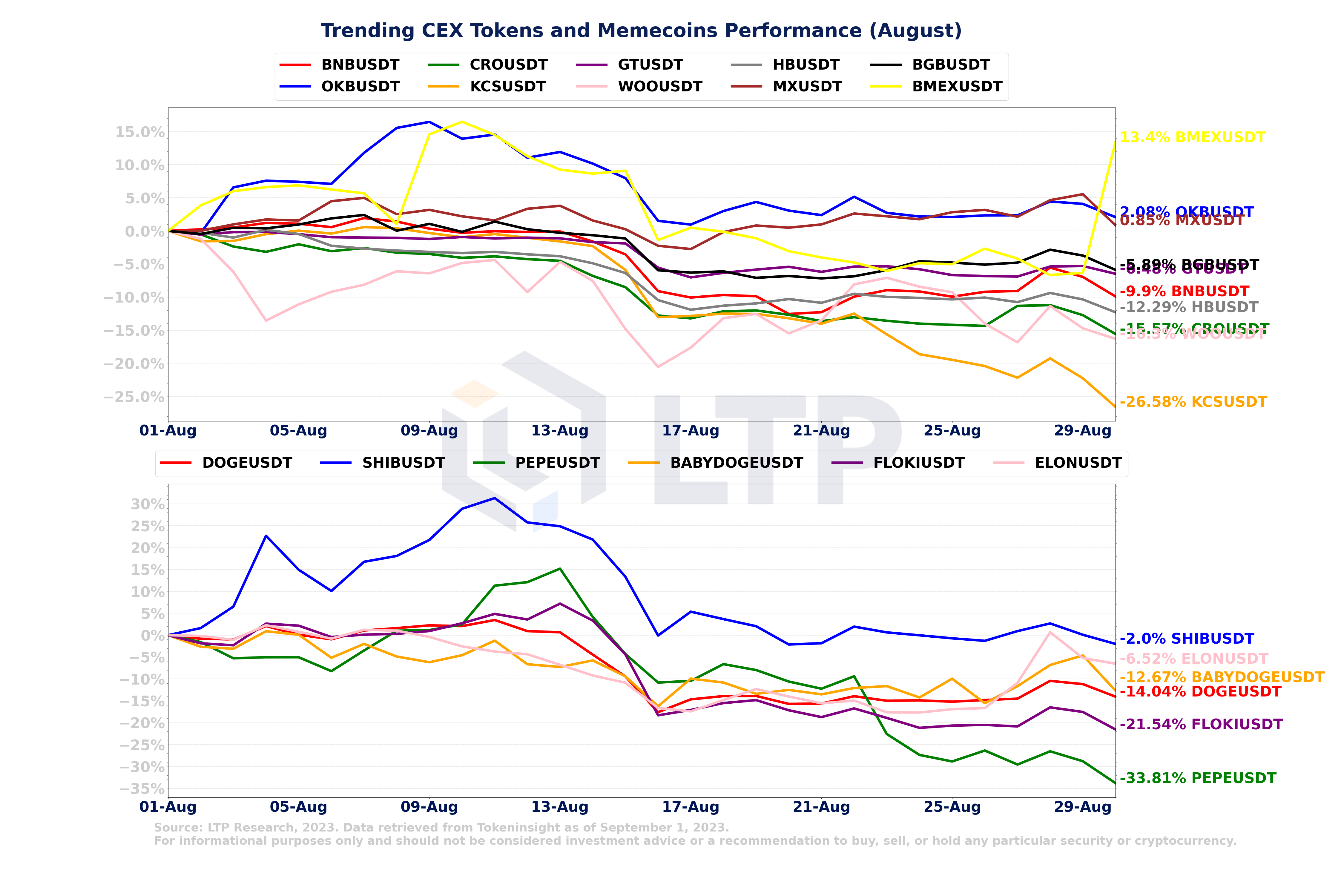
BitMEX Token (BMEXUSDT) outperformed other CEX tokens. Major Memecoins fell.
2.19 September is historically often associated with broader market sell-offs
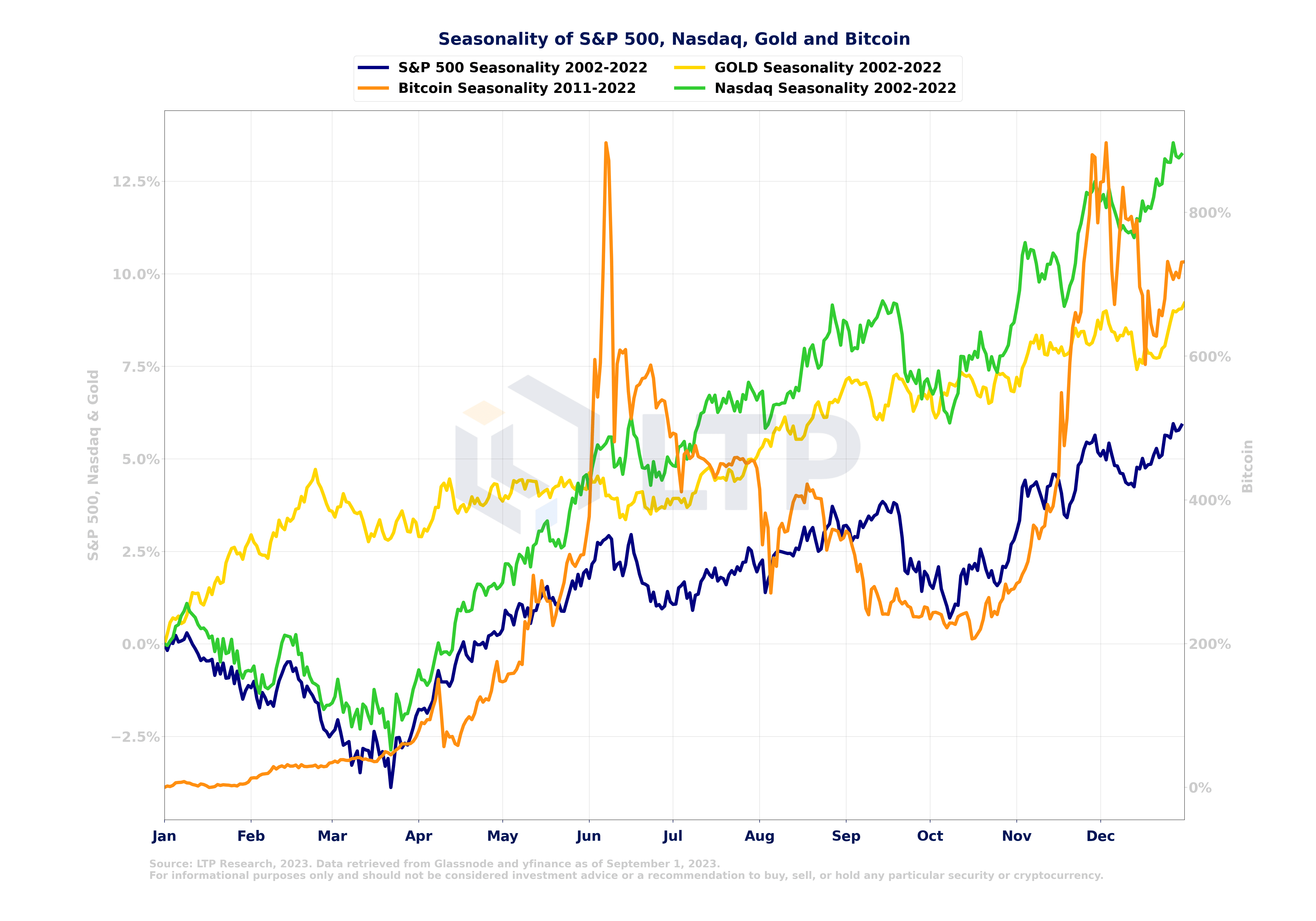
The sell-off that Bitcoin saw in August was in line with the historical seasonality of the month. Looking ahead, September is typically a relatively subdued period, accompanied by a sell-off in broader markets such as the S&P 500 and Nasdaq.
2.20 Greyscale Bitcoin Trust Premium/Discount to NAV
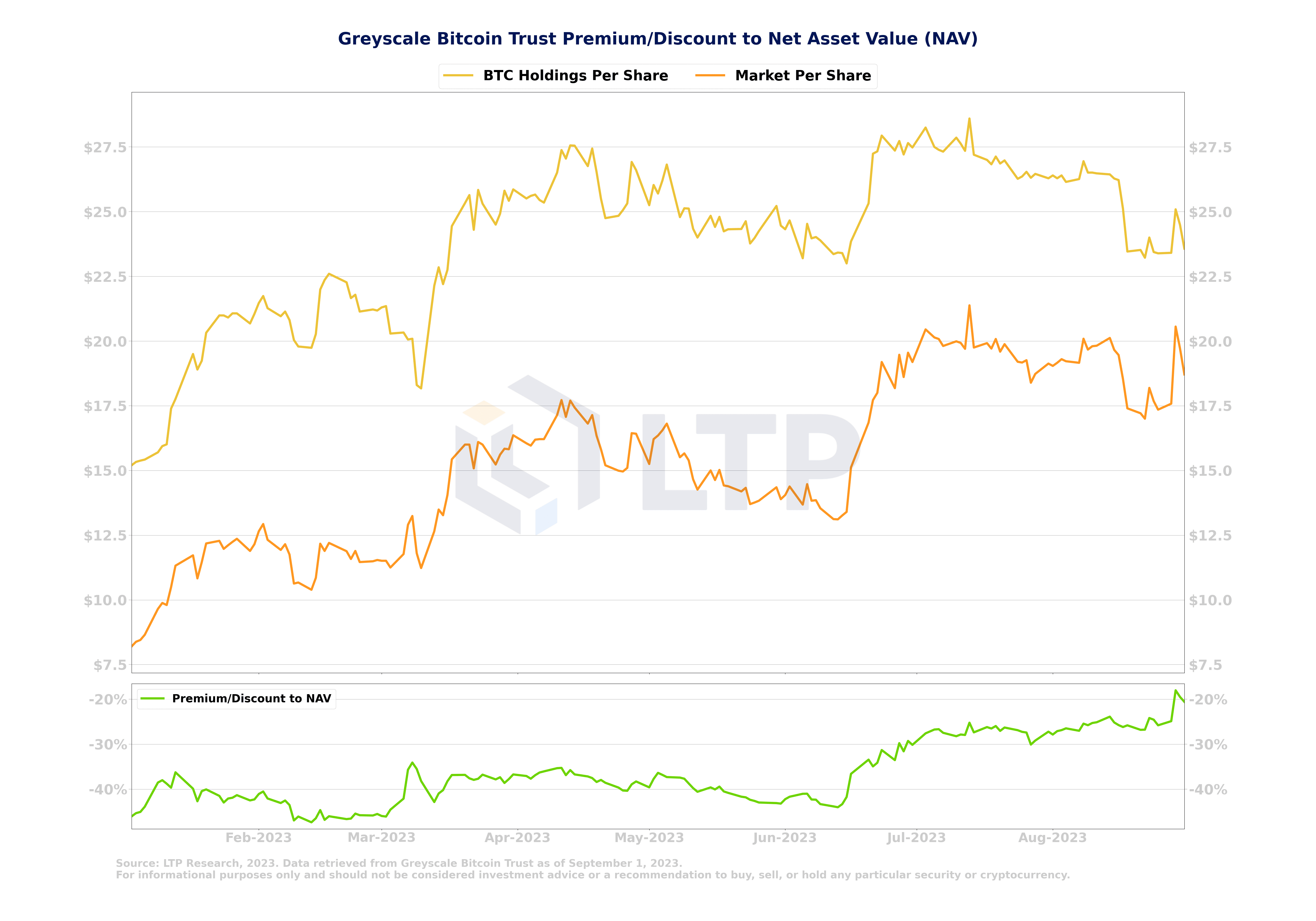
As the SEC needs to reassess its application to convert Greyscale Bitcoin Trust into an ETF based on a court ruling, the gap between Greyscale Bitcoin Trust’s NAV and market price/share price is narrowing, indicating that investors are becoming more optimistic about the near-term developments. GBTC is a closed-end fund that holds Bitcoin. Unlike ETFs, which can create or redeem shares based on investor demand, GBTC has a fixed number of shares. This structure can lead to an imbalance in supply and demand, resulting in a discount or premium in the value of the underlying asset.
3.0 News
Open interest on $CRV futures skyrockets amid recent exploit and its founder’s large loan position
SEC sues Hex founder Richard Heart on unregistered securities and fraud allegations
DCG close to reaching agreement on Genesis Capital’s Chapter 11
Tether reported $850M net profit for Q2 2023
Curve founder deploys new liquidity pool on Curve
Microstrategy plans to raise up to $750M to purchase more $BTC OKX adds new account abstraction feature to its Web3 wallet Six entities have filed applications with the SEC for an $ETH ETF
Curve founder sells $CRV tokens OTC to Justin Sun, DCFGod and others
Binance lists zero-fee BTC/FDUSD and ETH/FDUSD trading pairs
Binance approves Shiba Inu as collateral asset
Coinbase to launch L2 Base on August 9th
Huobi’s stablecoin reserves dipped >30% amid reports of executive arrests
Tether is reportedly the 11th largest $BTC holder in the world
Paypal launches its own stablecoin $PYUSD on Ethereum
Paxos is the issuer of Paypal’s $PYUSD stablecoin
Cathie Wood expects another delay for ARK’s proposed $BTC ETF
Microsoft partners with Aptos to explore innovative solutions related to asset tokenization, digital payments and CBDCs
Europe’s first $BTC ETF gets listed in Amsterdam under the ticker $BCOIN
Crypto custodian Prime Trust files for bankruptcy protection
Chinese Filecoin mining firm charged for orchestrating $83.3M pyramid scheme
SEC delays $BTC ETF approval to early 2024
Valkyrie files for $ETH ETF
SEC to appeal Ripple decision
Hashdex applies for spot $BTC ETF
Binance is considering a full exit from Russia
US appeals court ruled in favour of Grayscale in its ongoing case against the SEC to convert its Grayscale Bitcoin Trust into a spot ETF
X, formerly Twitter has obtained money or currency transmitter licences in seven US states
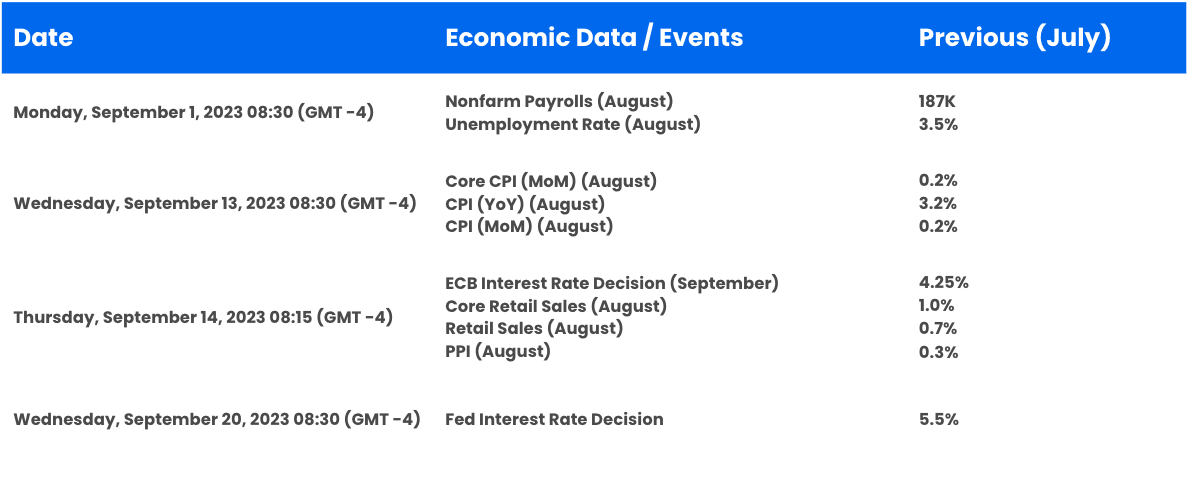
4.0 Volatile days in September
5.0 Appendix
Figure A. Fed Balance Sheet, US Treasury General Account (TGA), Reverse Repo (RRP), and ECB Total Assets
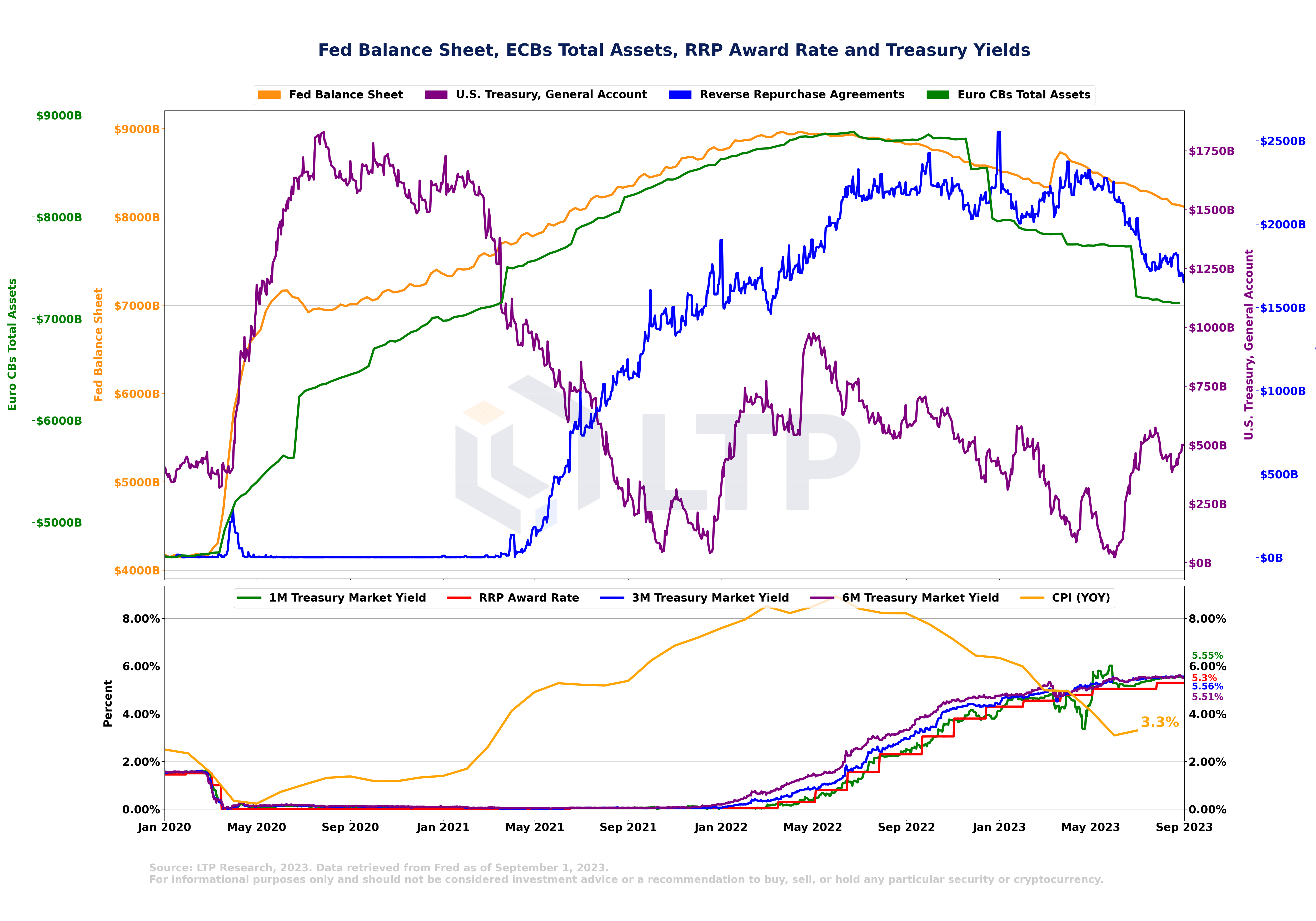
In August, the Federal Reserve's balance sheet and the total assets of the eurozone central banks continued to shrink. In addition, reverse repurchase agreements (RRP) continued to outflow funds as investors sought higher returns on short-term government bonds. As of August 31, the reverse repurchase rate was 5.3%, while the yield on the 1-month Treasury market reached 5.55%, the yield on the 3-month Treasury market was 5.56%, and the yield on the 6-month Treasury market was 5.51%.
Figure B. Year-on-year change in CPI, crude oil prices and gasoline prices
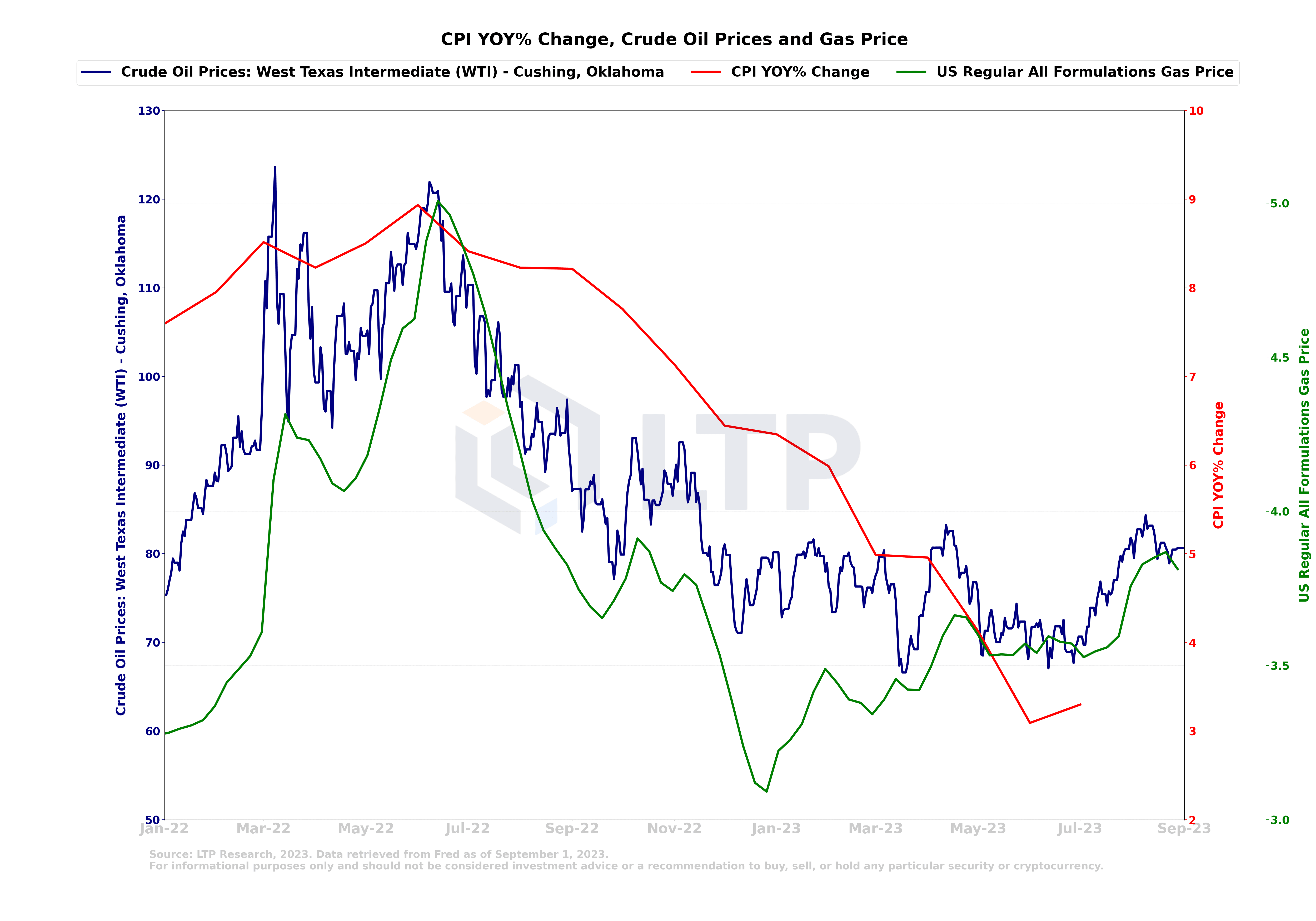
The rise in inflation has coincided with a surge in oil and gasoline prices, which have risen more than 20% since the beginning of 2023.
Figure C. Bitcoin liquidation heat map
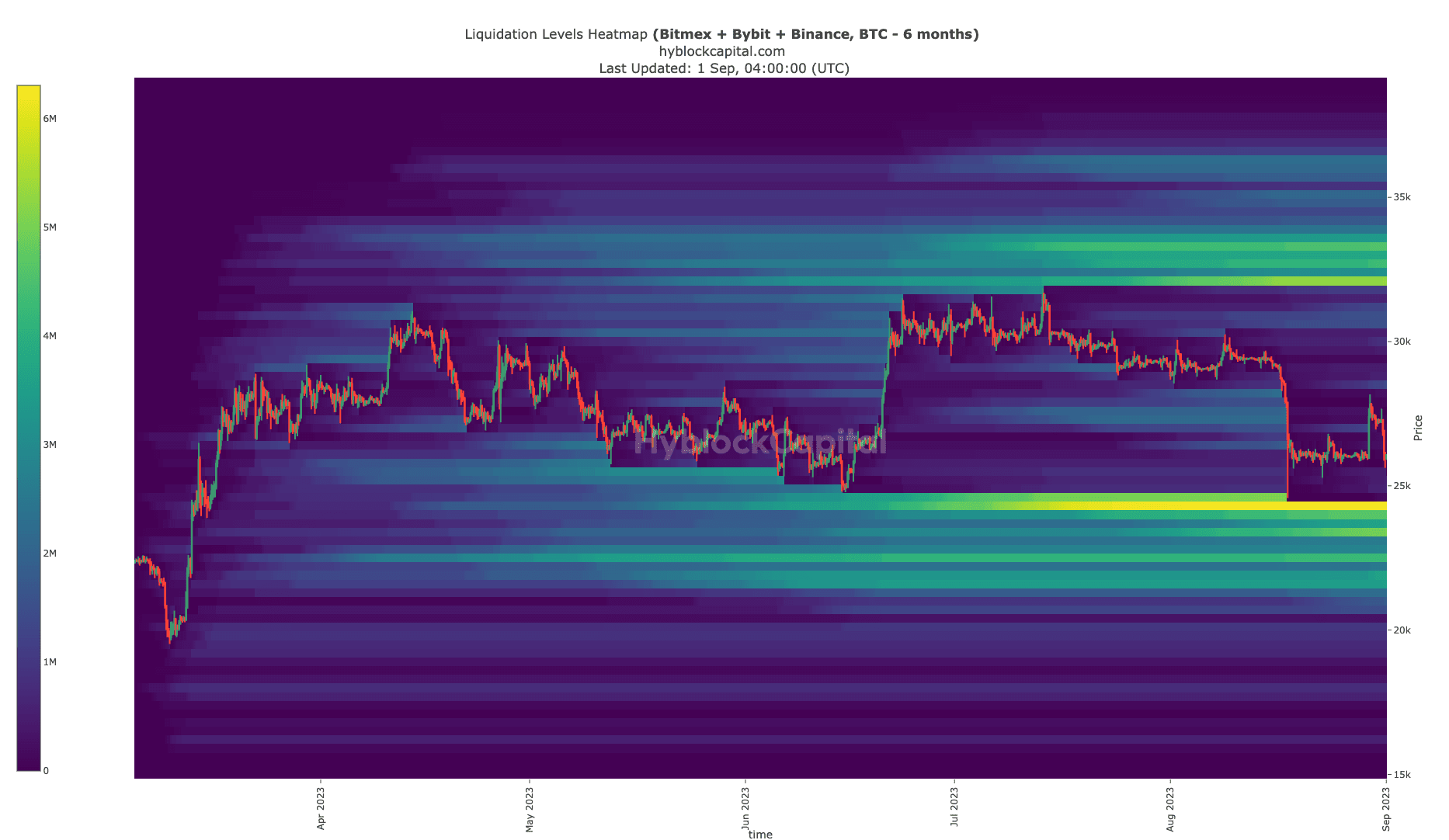
Liquidation zone above market price:
$32,000 - $34,000.
Liquidation zone below market price:
$22,000 - $24,000.
Source: Hyblock Capital, as of September 1, 2023.
It is provided for informational purposes only and should not be considered investment advice to buy, sell or hold any specific security or cryptocurrency.
Disclaimer
The information, opinions, estimates and forecasts contained in this cryptocurrency market review (collectively, the "Information") are provided by Liquidity Technologies Inc. (the "Company"). The Information is provided for informational purposes only and is not intended to provide investors with any formal understanding or recommendation. The Company has made reasonable efforts to ensure the accuracy and validity of the information provided, but does not make any guarantee as to its accuracy or completeness. The financial opinions expressed reflect the judgment of the author as of the date of publication and are subject to change without notice. This Information should not be construed as an offer or solicitation to buy, sell or trade any cryptocurrency, security or financial instrument. It does not take into account the personal investment objectives or situation of any reader. Cryptocurrencies are highly volatile and complex products and are subject to significant risks, including the risk of sudden and large price fluctuations. Investors in cryptocurrencies do not have any legal liability protection in the event of bankruptcy of the Company. Investors whose value of cryptocurrencies may be affected by changes in currency exchange rates, regulatory intervention or other political and economic developments should be aware that the value of their investment may decline and they may not be able to recover. Any historical information contained in this information is based on our own analysis and is provided for illustrative purposes only. Past performance is not an indicator of future results and results may vary. In no event shall the Company, its directors, employees, agents, partners, suppliers or affiliates be responsible or liable for any indirect, incidental, special, consequential or punitive damages, including but not limited to loss of profits, data, use or other intangible losses, arising out of the use of this information. The Company reserves the right to modify, change, add or delete portions of this information at any time and for any reason without prior notice.