

#howey
howey
6,369 views
6 Discussing
Hot
Latest
·
--
🚨 Does Rebuying Tokens Make Them “Legally Safer”?
A new clarification from employees of Authority #SEC says that a crypto project’s announcement to repurchase its tokens does not automatically mean it meets the requirements of Test #Howey or is treated as a security.
In simpler terms:
A buyback may look like a positive development for the community…
But it alone does not settle the project’s legal status.
So here’s the real question:
Do we need clearer laws in crypto, or is the current ambiguity part of the problem?
Write your opinion: laws or freedom?
🚨 Does Rebuying Tokens Make Them “Legally Safer”?
A new clarification from employees of Authority #SEC says that a crypto project’s announcement to repurchase its tokens does not automatically mean it meets the requirements of Test #Howey or is treated as a security.
In simpler terms:
A buyback may look like a positive development for the community…
But it alone does not settle the project’s legal status.
So here’s the real question:
Do we need clearer laws in crypto, or is the current ambiguity part of the problem?
Write your opinion: laws or freedom?
A new clarification from employees of Authority #SEC says that a crypto project’s announcement to repurchase its tokens does not automatically mean it meets the requirements of Test #Howey or is treated as a security.
In simpler terms:
A buyback may look like a positive development for the community…
But it alone does not settle the project’s legal status.
So here’s the real question:
Do we need clearer laws in crypto, or is the current ambiguity part of the problem?
Write your opinion: laws or freedom?
3
60

·
--
SEC CorpFin FAQ: Functional-network buybacks ≠ Automatic securitiesWhat’s worth watching isn’t clickbait like “SEC is letting it slide again”—it’s where the boundary is drawn.
On September 25 in the U.S. Eastern Time zone, the SEC’s Division of Corporation Finance (CorpFin) updated its crypto FAQ, then further broke down the Interpretive Release from March 17: whether repurchases, post-launch development, and marketing could separately pull a non-security token into an investment contract.
1️⃣ The system is already functional: the announcement share repurchase plan itself does not constitute a commitment of the kind of “essential managerial efforts.”
2️⃣ After launch, continuing to secure / maintain / improve— or even push network effects—generally also doesn’t count as the “key efforts” threshold under Howey.
SEC CorpFin FAQ: Functional-network buybacks ≠ Automatic securities
What’s worth watching isn’t clickbait like “SEC is letting it slide again”—it’s where the boundary is drawn.
On September 25 in the U.S. Eastern Time zone, the SEC’s Division of Corporation Finance (CorpFin) updated its crypto FAQ, then further broke down the Interpretive Release from March 17: whether repurchases, post-launch development, and marketing could separately pull a non-security token into an investment contract.
1️⃣ The system is already functional: the announcement share repurchase plan itself does not constitute a commitment of the kind of “essential managerial efforts.”
2️⃣ After launch, continuing to secure / maintain / improve— or even push network effects—generally also doesn’t count as the “key efforts” threshold under Howey.
On September 25 in the U.S. Eastern Time zone, the SEC’s Division of Corporation Finance (CorpFin) updated its crypto FAQ, then further broke down the Interpretive Release from March 17: whether repurchases, post-launch development, and marketing could separately pull a non-security token into an investment contract.
1️⃣ The system is already functional: the announcement share repurchase plan itself does not constitute a commitment of the kind of “essential managerial efforts.”
2️⃣ After launch, continuing to secure / maintain / improve— or even push network effects—generally also doesn’t count as the “key efforts” threshold under Howey.
1
126

·
--
Article
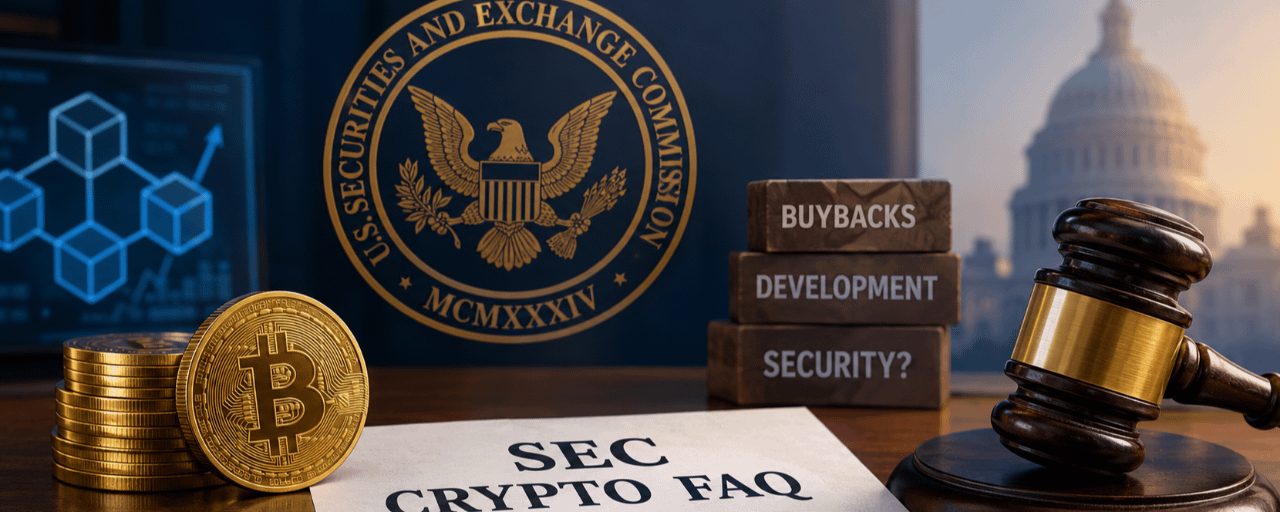
The SEC Just Answered a Question That's Followed Crypto Projects For Years#secsaysbuybacksupgradesdontmaketokensecurity
Token buybacks and ongoing development work have long lived in a legal gray zone — the SEC just gave projects some of the clearest guidance yet on where that line actually sits.
Here's what was clarified: on September 25/26, the SEC's Division of Corporation Finance updated its crypto FAQ, addressing a question many token teams have quietly worried about — does buying back your own token, or continuing to build after launch, turn that token into a security? The staff's answer: not automatically. If a blockchain network is already functional and its native token wasn't originally a security, announcing a buyback to manage treasury reserves, reduce supply, or burn tokens doesn't by itself create an "investment contract" under the Howey test. The same logic extends to ongoing work — maintaining, securing, or upgrading a live network generally doesn't count as the kind of "essential managerial effort" that ties a token's value to a central team's promises. The guidance also touched on liquid staking tokens, suggesting they can be treated as digital commodities rather than securities in many cases. Notably, the analysis flips for networks that aren't yet functional — if a team promotes a buyback there as a source of guaranteed returns, that framing can still trigger securities concerns. It's worth flagging: this is staff-level guidance, not a formal rule or court ruling, and it explicitly doesn't carry the force of law.
Why does this matter? Buybacks have become an increasingly common tool among crypto projects this year, with some newer proposals from L1 and DeFi protocols directly following corporate-style stock repurchase models. Regulatory ambiguity around whether this practice invites securities scrutiny has likely made some teams cautious about adopting it. Clearer staff guidance — even non-binding — gives projects more confidence to design tokenomics around buybacks and continued development without necessarily reopening the security-classification debate every time.
Whether this guidance holds up as market conditions and enforcement priorities shift, or whether it gets tested in an actual case down the line, is something only time will tell.
Does staff guidance like this offer real legal comfort, or is it just clarity until the next enforcement case tests it? 🤔
#SEC #CryptoRegulation #TokenBuybacks #Howey
$PHA $ARK $QI
{spot}(QIUSDT)
{future}(ARKUSDT)
{future}(PHAUSDT)
The SEC Just Answered a Question That's Followed Crypto Projects For Years
#secsaysbuybacksupgradesdontmaketokensecurity
Token buybacks and ongoing development work have long lived in a legal gray zone — the SEC just gave projects some of the clearest guidance yet on where that line actually sits.
Here's what was clarified: on September 25/26, the SEC's Division of Corporation Finance updated its crypto FAQ, addressing a question many token teams have quietly worried about — does buying back your own token, or continuing to build after launch, turn that token into a security? The staff's answer: not automatically. If a blockchain network is already functional and its native token wasn't originally a security, announcing a buyback to manage treasury reserves, reduce supply, or burn tokens doesn't by itself create an "investment contract" under the Howey test. The same logic extends to ongoing work — maintaining, securing, or upgrading a live network generally doesn't count as the kind of "essential managerial effort" that ties a token's value to a central team's promises. The guidance also touched on liquid staking tokens, suggesting they can be treated as digital commodities rather than securities in many cases. Notably, the analysis flips for networks that aren't yet functional — if a team promotes a buyback there as a source of guaranteed returns, that framing can still trigger securities concerns. It's worth flagging: this is staff-level guidance, not a formal rule or court ruling, and it explicitly doesn't carry the force of law.
Why does this matter? Buybacks have become an increasingly common tool among crypto projects this year, with some newer proposals from L1 and DeFi protocols directly following corporate-style stock repurchase models. Regulatory ambiguity around whether this practice invites securities scrutiny has likely made some teams cautious about adopting it. Clearer staff guidance — even non-binding — gives projects more confidence to design tokenomics around buybacks and continued development without necessarily reopening the security-classification debate every time.
Whether this guidance holds up as market conditions and enforcement priorities shift, or whether it gets tested in an actual case down the line, is something only time will tell.
Does staff guidance like this offer real legal comfort, or is it just clarity until the next enforcement case tests it? 🤔
#SEC #CryptoRegulation #TokenBuybacks #Howey
$PHA $ARK $QI
Token buybacks and ongoing development work have long lived in a legal gray zone — the SEC just gave projects some of the clearest guidance yet on where that line actually sits.
Here's what was clarified: on September 25/26, the SEC's Division of Corporation Finance updated its crypto FAQ, addressing a question many token teams have quietly worried about — does buying back your own token, or continuing to build after launch, turn that token into a security? The staff's answer: not automatically. If a blockchain network is already functional and its native token wasn't originally a security, announcing a buyback to manage treasury reserves, reduce supply, or burn tokens doesn't by itself create an "investment contract" under the Howey test. The same logic extends to ongoing work — maintaining, securing, or upgrading a live network generally doesn't count as the kind of "essential managerial effort" that ties a token's value to a central team's promises. The guidance also touched on liquid staking tokens, suggesting they can be treated as digital commodities rather than securities in many cases. Notably, the analysis flips for networks that aren't yet functional — if a team promotes a buyback there as a source of guaranteed returns, that framing can still trigger securities concerns. It's worth flagging: this is staff-level guidance, not a formal rule or court ruling, and it explicitly doesn't carry the force of law.
Why does this matter? Buybacks have become an increasingly common tool among crypto projects this year, with some newer proposals from L1 and DeFi protocols directly following corporate-style stock repurchase models. Regulatory ambiguity around whether this practice invites securities scrutiny has likely made some teams cautious about adopting it. Clearer staff guidance — even non-binding — gives projects more confidence to design tokenomics around buybacks and continued development without necessarily reopening the security-classification debate every time.
Whether this guidance holds up as market conditions and enforcement priorities shift, or whether it gets tested in an actual case down the line, is something only time will tell.
Does staff guidance like this offer real legal comfort, or is it just clarity until the next enforcement case tests it? 🤔
#SEC #CryptoRegulation #TokenBuybacks #Howey
$PHA $ARK $QI
1
10
9.7k
Log in to explore more content
Join global crypto users on Binance Square
⚡️ Get latest and useful information about crypto.
💬 Trusted by the world’s largest crypto exchange.
👍 Discover real insights from verified creators.
Email / Phone number
Trending Topics
1
#ZcashETFPostsFirstWeeklyOutflow$93.6M
8,591 views
39 Discussing
2
#GreekPoliceBustCryptoScamRingArrest17
11,841 views
199 Discussing
3
#BitcoinRejectedAt$87K
73,881 views
106 Discussing
4
#FedOctoberRateHikeOddsFallTo17%
43,195 views
595 Discussing
5
#NvidiaHitsRecordHighUp2.4%
23,535 views
412 Discussing
6
#CanaryFilesAmendedS1ForPEPEETF
9,640 views
273 Discussing
7
#USRussiaUkraineTalksReportedlyIncludeLukoilOilDeal
18,081 views
323 Discussing
8
#BitcoinParesGainsAfterRallyTo$86.5K
41,574 views
155 Discussing
9
#CerebrasSinksNearly20%OnReportNvidiaToPowerOpenAI
94,981 views
918 Discussing
10
#SECProposesCryptoCustodyRules
122,397 views
1,133 Discussing