

#aaplb
aaplb
9,341 views
292 Discussing
Hot
Latest
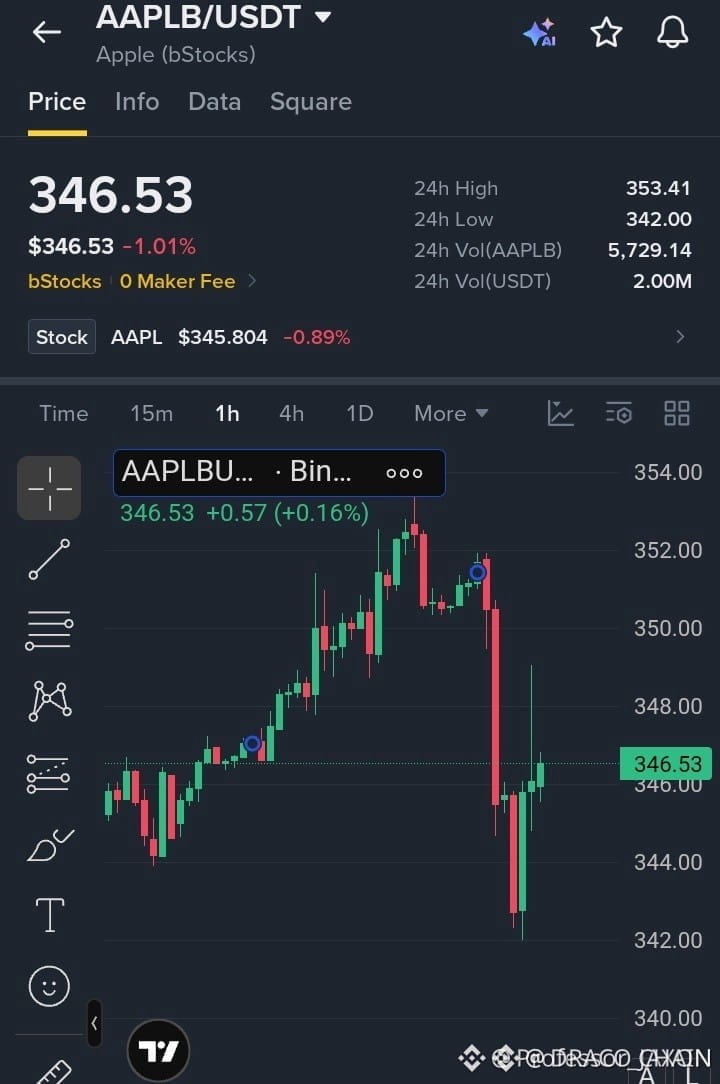
💥 $AAPLB RECLAIMS CRITICAL SUPPORT AS BUYERS STEP IN WITH AGGRESSIVE CONVICTION! 📈
Entry: 345.80 - 346.60 ⚡
Target: 348.00, 350.00, 352.00 🚀
Stop Loss: 342.00 ⚠️
📌 The violent drop into the 342.00 demand pocket met swift absorption, sparking a sharp reaction that shows sellers are running out of steam. Bids are defending 346.00 firmly to flip this territory back into buyer control.
⚡ Maintaining structural acceptance above this pivot paves the way toward the 348.00 to 352.00 overhead liquidity clusters. 💡 With invalidation cleanly anchored below the recent floor, this setup offers crisp asymmetry for disciplined momentum traders.
💬 Are you riding this rebound higher, or waiting for another liquidity sweep? 👇
⚠️ Not financial advice. Always manage your risk. 🛡️
🏷️ #AAPLB #LongSetup #PriceAction #Crypto #Momentum
🎯 🐂

·
--
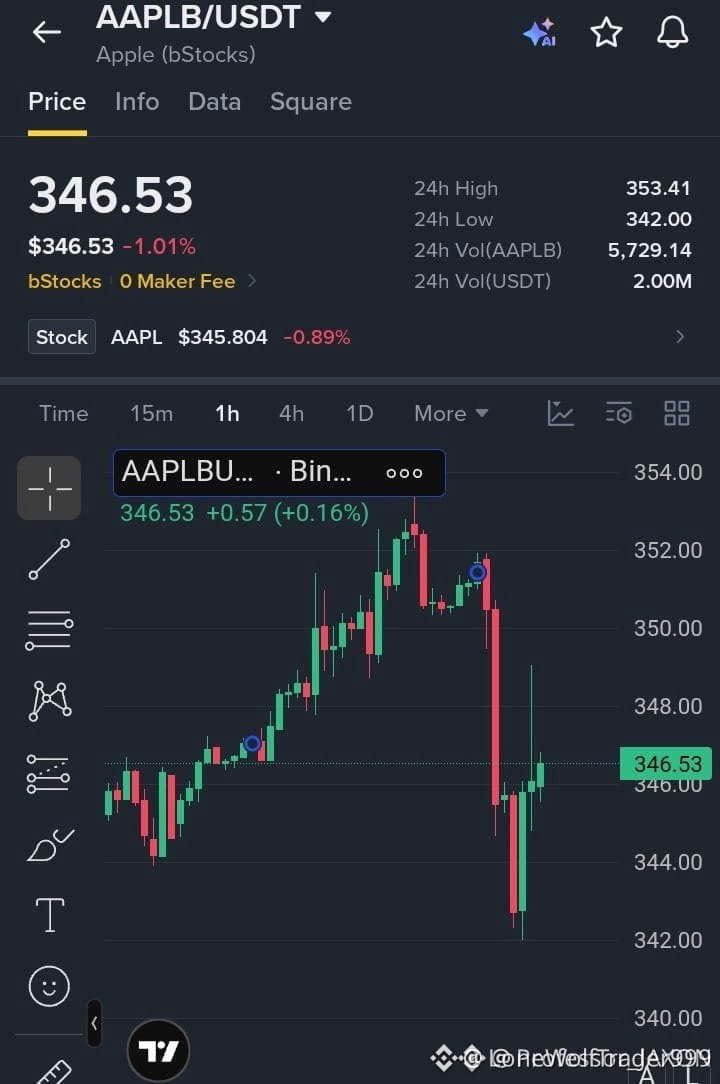
🦈 $AAPLB ABSORBS SELL PRESSURE AT KEY DEMAND WITH SHARP STRUCTURAL RECLAIM! ⚡
Entry: 345.80–346.60 ⚡
Target: 348.00 - 352.00 🎯
Stop Loss: 342.00 ⚠️
📌 Following a sharp liquidity sweep into the 342.00 structural base, $AAPLB demonstrated immediate institutional absorption, creating an aggressive rejection wick on the lower timeframes.
🔍 Sustaining price action above the 346.00 pivot shifts short-term market structure back toward premium liquidity pools sitting overhead. As long as the structural invalidation level holds, the path toward the 350.00 and 352.00 inefficiency targets remains technically sound.
💬 Are you executing within this accumulation zone, or waiting for a clean retest of 346.00 to confirm continuation? 👇
⚠️ Not financial advice. Always manage your risk. 🛡️
🏷️ #AAPLB #MarketStructure #OrderFlow #CryptoTrading #LongSetup
🎯 🦈
7

·
--
CRYPTO MARKET: THE NEXT BIG MOVE IS COMING! 🔥
$AAPLB
{spot}(AAPLBUSDT)
#AAPLB Apple is one of the biggest names in technology, and its tokenized stock brings traditional market exposure into the crypto ecosystem.
👀 Traders are watching for: 📊 Market sentiment 📈 Price momentum 💎 Trading opportunities 🔥 Upcoming market movements
Don't follow hype blindly. Always DYOR and manage your risk.
What's your outlook on AAPL? BULLISH 🐂 or BEARISH 🐻?
CRYPTO MARKET: THE NEXT BIG MOVE IS COMING! 🔥
$AAPLB
#AAPLB Apple is one of the biggest names in technology, and its tokenized stock brings traditional market exposure into the crypto ecosystem.
👀 Traders are watching for: 📊 Market sentiment 📈 Price momentum 💎 Trading opportunities 🔥 Upcoming market movements
Don't follow hype blindly. Always DYOR and manage your risk.
What's your outlook on AAPL? BULLISH 🐂 or BEARISH 🐻?
66

·
--
$AAPLB +1.10% | $XPL +1.10% | $TON +0.95%
#AAPLB nudged up to $350.98, ticking higher by 1.10% on $2.0 M of trade activity.
#XPL climbed to $0.0764, also gaining 1.10% while moving a solid $16.8 M in volume, suggesting fresh interest.
#TON slipped modestly to $1.60, up 0.95% with $7.7 M changing hands, a quieter but still positive flow.
👀 Keep an eye on whether XPL’s strong volume can sustain the upside momentum across the next session.
#Write2Earn #Binance
12

·
--
$AAPLB +0.99% | $DODO +0.95% | $TON +0.95%
#AAPLB nudges up to $350.33, gaining +0.99% on $1.9 M of volume.
#DODO climbs to $0.0244, up +0.95% with $1.4 M changing hands.
#TON edges higher at $1.60, also up +0.95% on a robust $7.7 M flow.
👀 The disparity in volume—TON’s turnover dwarfs the other two—might hint at where buying pressure is concentrating.
#Write2Earn #Binance
2

·
--
📉 AAPLB | SHORT recommendation 🔴
Reference price: 342.5 | 4-hour timeframe
📊 Technical analysis:
* Bearish MACD crossover, indicating weakening buying momentum.
* The signal on the 4-hour timeframe is a stronger indication that the correction may continue.
* The 340 area represents important support.
* A break below support could pave the way for further declines.
🎯 Trade targets:
* TP1: 338
* TP2: 333
* TP3: 328
⛔ Stop loss: 350
Entry: SHORT after confirmation of a break below 340.
⚠️ The signal alone is not enough to confirm a decline; it is preferable to wait for a 4-hour candle to close.
🔥 Look for opportunities
$AAPLB #AAPLB
67

Zhou Qunfei has become China’s richest woman, with a fortune of 127 billion yuan. This news has less—and more— to do with AAPLB than most people think.
Let’s start with the less. The Hurun Rich List looks backward. The 127 billion yuan (128 billion yuan for the couple combined, ranking 33rd overall) is a snapshot of wealth calculated by capitalizing the glass cover orders Lens Technology has received from Apple over the past few years. Her place on the rich list won’t make Apple order one more piece of glass next quarter, nor will it change a single line of cash flow at the parent company behind AAPLB. That’s the classic trap with personality-driven narratives: the story is compelling, but the transmission path is weak.
The more lies in the fact that a supplier’s owner can amass a fortune in the hundreds of billions of yuan from a key component sold to a single customer. That, in itself, is a checkup on Apple’s BOM structure 👑
First, concentration is a double-edged sword. If the glass-cover segment can make someone the richest person in a province, it shows that Apple’s supplier base for key structural components remains highly concentrated. High concentration makes ramping up capacity easier, but price negotiations tougher. Yet the same company is moving into complete-device assembly, which puts downward pressure on assembly prices for Apple. In the same news story, one factor is positive for Apple’s gross margin and the other negative. The net effect is too small to enter the model; what really matters is how market share is allocated over the next two or three years. That’s what AAPLB prices in—not who sits in which row at a state banquet.
Second, when looking at the capital flows behind tokenized stocks, don’t use a crypto framework. AAPLB is anchored to Apple’s underlying stock, and its intraday price movements are driven mainly by news before and after U.S. market hours. Since perpetual contracts for this type of asset can be hedged with the underlying stock, funding rates tend to stay near zero over the long term. It’s difficult for sentiment to push them to extremes as it can with crypto-native products. So changes in open interest are more like a preview of Asian-session sentiment toward overnight U.S. stocks than a measure of speculative fervor in crypto. What’s really worth watching is the premium or discount: when the token price persistently diverges from the underlying stock, it signals that order-book depth on that side can’t absorb orders, and stop-loss orders are most likely to get swept up then.
Third, on-chain, what matters is minting and redemption. Subscription volumes for tokenized stocks indicate that real money is being allocated; open interest in contracts is just a bet. When the two diverge, trust the on-chain data.
Where’s the risk? In the fact that the correlation between the narrative and the asset is far weaker than it sounds. A change at the top of the rich list doesn’t alter Apple’s procurement share at all. Conversely, if Apple increases the share allocated to its second supplier one day, Lens Technology’s fortune may fall first, while AAPLB may not follow. The linkage between these two things is far weaker than the post might lead you to believe.
So the right way to use this news in relation to AAPLB is as a window into supplier concentration—not as a reason to buy. If you’re going to track anything, track gross margins and shifts in assembly share in the earnings reports, not the rich list.
#APPLE #马斯克 #Crypto #AAPLB
3
Apple Stores can now run diagnostics without opening the box: scan the packaging of an unopened iPhone with a device, and it can read the phone’s health status. The results are available before the device even reaches the customer.
First, let’s pin down where this falls financially. It reduces three types of costs: processing returns, determining whether products should be refurbished, and verifying fraud. These are operating expenses. It doesn’t generate revenue or affect the trajectory of service revenue. So for a stock like AAPLB, which is anchored to Apple’s parent stock, this is news that matters only in the “second decimal place.” Trading on it as a boost to service revenue would be getting the direction wrong. Conversely, shorting it because it “isn’t good news” would be just as badly mistaken: it does save money, and that will show up in the expense ratio—just gradually.
The second point is more noteworthy: this news has barely registered as a consensus view among Chinese traders. Of the two Apple hardware-related posts on the Plaza, one has 3 likes and 1 comment, and the other has 1 like and no comments. That’s four comments and four likes in total. Those numbers don’t mean the topic “isn’t hot enough”; they show that retail traders lack a pricing mechanism for this kind of operational news. There’s no discussion, no disagreement, and therefore no change in positioning. Price discovery for AAPLB is still driven by institutional money in the parent stock. The token merely absorbed a very weak sentiment impulse outside trading hours, then stalled.
The risk lies on the other side, and it points in the opposite direction. The iPhone Duo failed JerryRigEverything’s dust-resistance test. Negative quality-control news like this spreads far more efficiently in consumer electronics than “improved store efficiency.” Neither development has any impact on revenue, but the market typically reacts to bad news an order of magnitude faster. For AAPLB, this is short-term pressure on sentiment, not a fundamental event. But if it coincides with a period of thin liquidity, volatility could be amplified.
There’s another structural detail: this kind of operational news usually breaks while the stock market is closed, so the token moves first and the parent stock opens later. That can easily produce a false breakout without support from spot trading. Once the over-the-counter price comes in, the token may retrace. The odds of success when chasing this kind of breakout are far lower than when you assess the nature of the event yourself.
My view: this news is neither a bullish nor a bearish reason to trade AAPLB. It points in the right direction, but carries little weight. The two biggest costs on Apple’s retail side are return processing and fraud verification; condensing both into a scanning device is a form of cost engineering. Its effects will accumulate in the operating expense ratio over several quarters, leaving no trace in any single quarter’s revenue. Pricing it in requires expense-ratio data from several consecutive quarters, so the earliest opportunity will be after the next earnings report. Until then, any intraday move in AAPLB is just a liquidity fluctuation at the token level.
Risk warning: Premiums, discounts, and off-hours pricing discrepancies in tokenized assets are more likely to cost you money than getting the direction wrong.
#AAPLB #Apple #Crypto
14

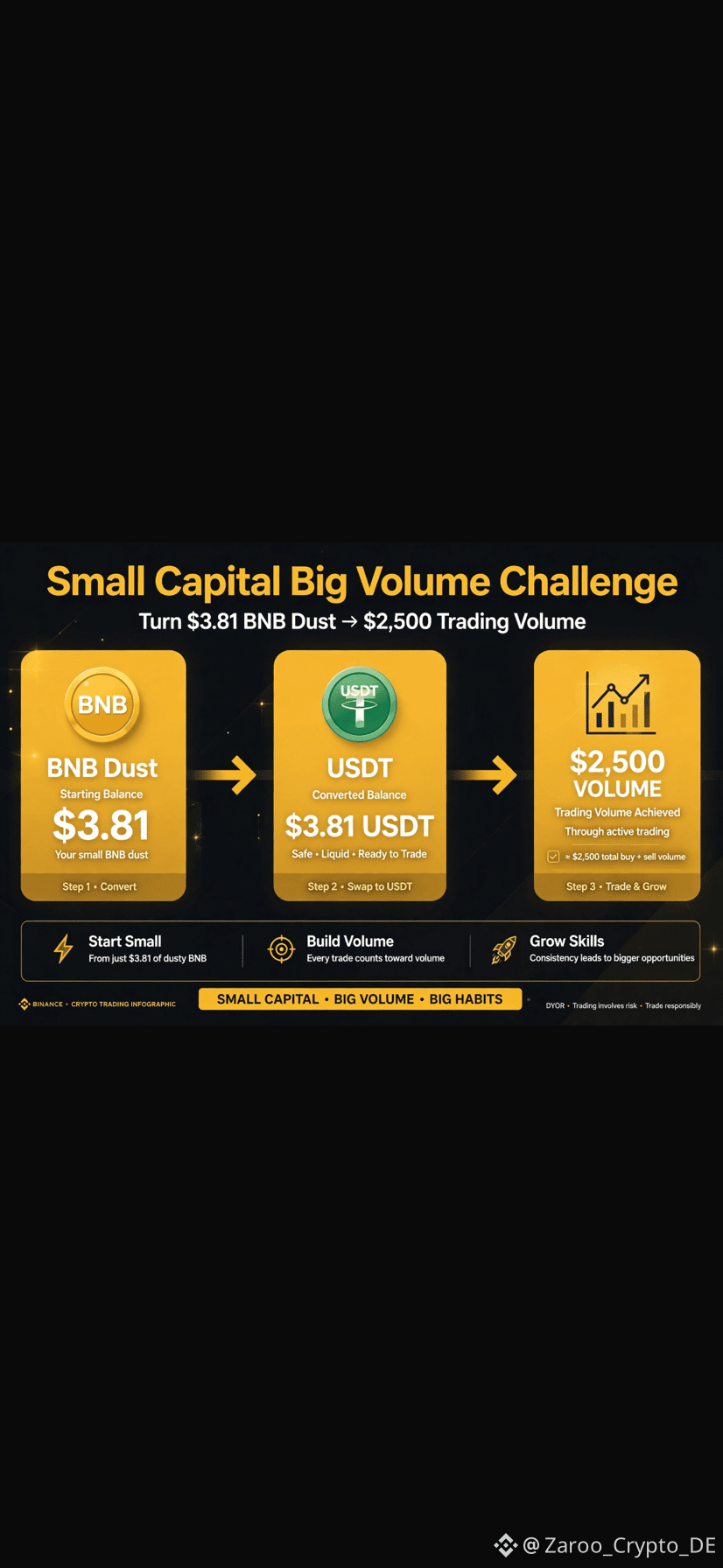
Small Capital Big Volume Challenge Day 1!
I just converted my $3.81 $BNB Dust to $USDT
My goal is to make $2,500 volume for $AAPLB trading event with only $4!
Is it possible? Yes, if I do 625 trades of $4
Follow me, I will post daily profit/loss.
Should I start with $BTC or $ETH? Comment!
BNB $USDT $ETH
{spot}(BTCUSDT)
{spot}(AAPLBUSDT)
{spot}(BNBUSDT)
#EarningsSeason #BinancePick #AAPLB #bnb #BTC
Small Capital Big Volume Challenge Day 1!
I just converted my $3.81 $BNB Dust to $USDT
My goal is to make $2,500 volume for $AAPLB trading event with only $4!
Is it possible? Yes, if I do 625 trades of $4
Follow me, I will post daily profit/loss.
Should I start with $BTC or $ETH? Comment!
BNB $USDT $ETH
#EarningsSeason #BinancePick #AAPLB #bnb #BTC
90

⚡ $AAPLB SHAKES OFF WEAK HANDS IN A CLASSIC TEXTBOOK LIQUIDITY FLUSH! 🦈
A minor pullback on the chart has weak-handed market participants panicking, but smart money sees this routine dip for what it truly is: a calculated leverage reset. 🦈 Whales are simply clearing out late longs and building fresh momentum before the next leg higher.
📊 Spot order books show heavy bids waiting just beneath the surface to absorb panic selling without breaking structure. 💡 Panicking on a routine pullback right before institutional bids step back in is how retail gets left behind.
💬 Are you letting this minor dip shake your conviction, or are you tracking where smart money is accumulating next? 👇
⚠️ Not financial advice. Always manage your risk. 🛡️
🏷️ #AAPLB #Crypto #Altcoins #SmartMoney #Bullish
🚀 ⚡
7
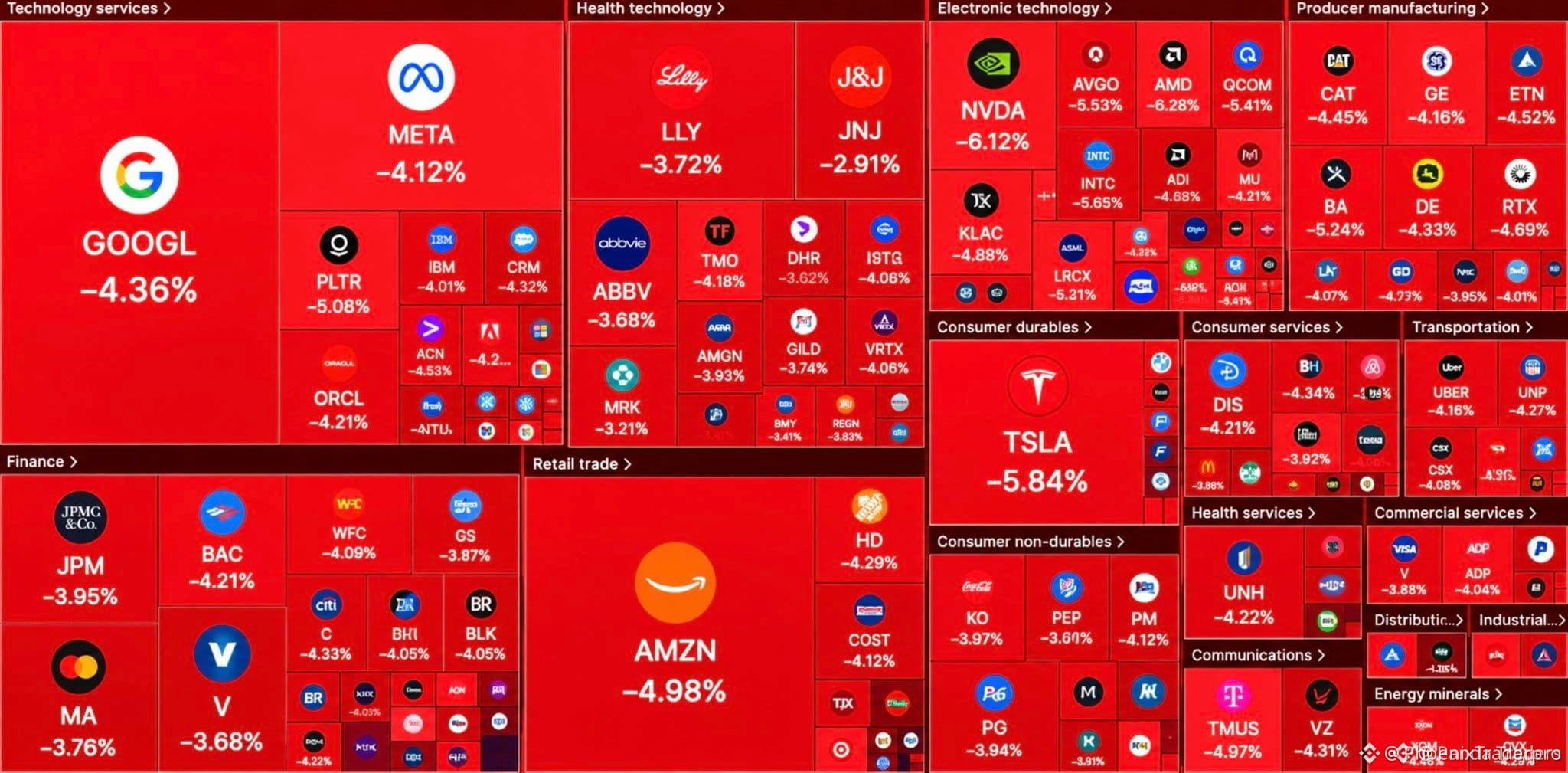
🚨 $AAPLB $NVDAB $AMZNB PLUNGE INTO CHAOS AFTER $500B US STOCK CRASH! 💥
📊 The opening bell ripped a $500 B market cap off US equities, triggering a brutal liquidity sweep that spilled into tech‑heavy ADRs. Smart‑money sharks are already re‑positioning, dragging these symbols into a steep sell‑off as order flow flips to the downside. 🦈
⚡ Volume on the 1‑minute chart spiked 3×, and the RSI is screaming overbought territory, hinting the next wave could be a forced liquidation cascade. 📈 Traders, are you bracing for a deeper dip or hunting the rebound after the panic sell? 💬
⚠️ Not financial advice. Always manage your risk. 🛡️
🏷️ #AAPLB #ShortSqueeze #MarketCrash #Crypto
🔥 🦈
17

·
--
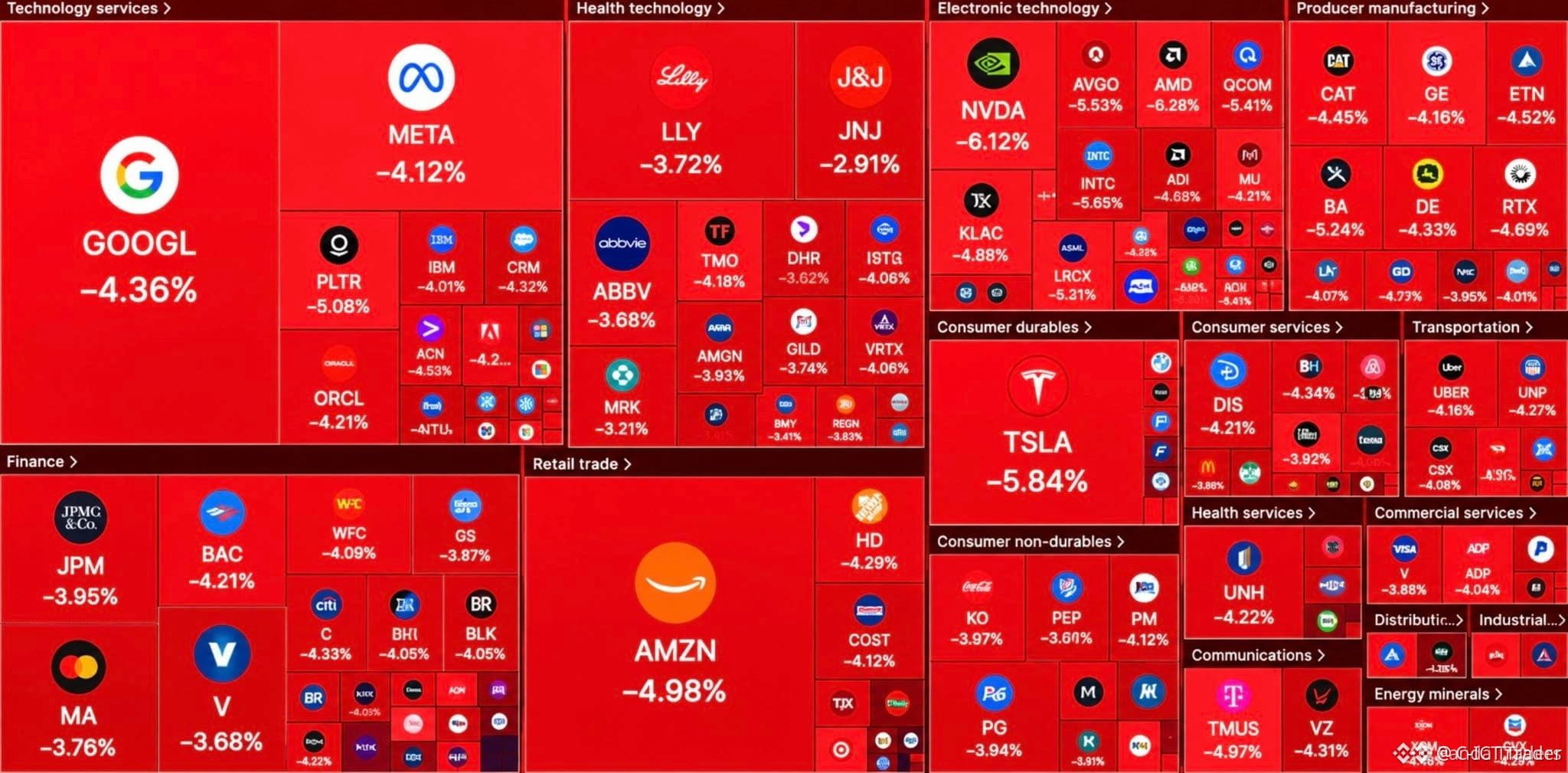
🔴 $AAPLB $NVDAB $AMZNB $500B SELL‑OFF UNLEASHED AT OPEN! 🚨
The opening bell saw a coordinated liquidity sweep across the $AAPLB , $NVDAB and $AMZNB clusters, erasing roughly $500 B of market cap in seconds. 🦈 Smart‑money order blocks were breached, exposing deep sell pressure that institutions have been accumulating.
Volume spikes on the 5‑minute chart confirm an aggressive short‑side, while the price broke through the prior demand zone, turning a historic support into a new resistance corridor. 📊 The next liquidity pool sits just below the broken order block, offering a potential trigger for further downside.
💬 Are you aligning your short exposure with the emerging liquidity trap? 👇
⚠️ Not financial advice. Always manage your risk. 🛡️
🏷️ #AAPLB #Selloff #LiquiditySweep #MarketStructure #Crypto
🚀 🦈
10
The iPhone Duo reviews posted by JerryRigEverything and He Tongxue on X certainly caught the attention of overseas viewers, but the reposted post on the feed stalled at 5 likes and 5 comments. The buzz is real, but it’s all concentrated on “who can make the phone look better on camera”—not a single comment touches on shipment volumes, BOM costs, or launch-day conversion. For an asset like AAPLB, which is pegged to Apple’s parent stock, this is the most dangerous kind of bullish signal: sentiment is leading, while the fundamentals haven’t caught up. 📉
Here are the four things I’m actually watching.
First, positive reviews validate engineering capability, not demand. The two KOLs’ reviews show that things like hinge feel, crease control, and image tuning have been “made real.” But whether foldables can make money depends on bringing down the costs of three components: the hinge, ultra-thin glass (UTG), and dual-layer OLED. Each one weighs on gross margins. Apple’s gross margin structure is supported by services revenue and high-priced slab phones, so the first-generation foldable is more likely to dilute margins than boost them. In other words, the better the Duo’s reviews are, the more they suggest Apple will need to keep investing in this form factor—and investment won’t show up on the income statement as profit.
Second, AAPLB has a structural gap in its price discovery mechanism. It’s a tokenized stock priced in USDT and trades continuously, 24/7; Apple’s actual stock trades only five days a week, with regular sessions lasting just 6.5 hours a day. That means during Asian trading hours, AAPLB gets almost no fresh fundamental information. Its price is driven by positioning and sentiment, making it prone to building up a premium before the U.S. market opens, only for that premium to get wiped out afterward. When you chase it over the weekend or during the Asian session, what you’re really paying is a “time-zone” premium—not a price based on Apple’s cash flows.
Third, the only factors that can truly feed into valuation are the replacement cycle and buybacks. Foldable shipments still make up a very small share of total iPhone shipments, so they can’t change the length of the replacement cycle in the short term. What can change earnings per share is the growth rate of services revenue, along with the reduction in shares outstanding driven by massive annual buybacks. Neither has any link to “foreigners being amazed.” If you want to trade the Duo narrative, you’re trading a product cycle; if you want to trade AAPLB, you’re trading capital-return policy. They’re two different things.
Fourth, there are holding costs that are easy to overlook. Tokenized stocks typically don’t pass through dividends, so you can only capture part of the per-share value gains from Apple’s dividends and buybacks through price appreciation—you don’t receive the cash dividends. On top of that, you’re exposed to USDT premiums or discounts and platform counterparty risk. With multiple variables layered into one quote, the volatility may look like Apple’s, but is likely higher than that of Apple’s actual stock.
My view is straightforward: the Duo reviews are worth watching, but they’re a product signal, not a buy signal for AAPLB. If I were waiting for a catalyst, I’d watch for a turning point in the foldable model’s cost curve, and for signs in the next earnings report that the replacement cycle and services revenue are improving in tandem. Until then, I’d be more inclined to see any sentiment-driven spike in AAPLB as a liquidity window, not the start of a trend. Position sizing and timing always matter before getting the direction right.
#BINANCEPICK #Crypto #AAPLB
1
📢 BINANCE STARTER CARNIVAL OFFERS REWARDS ON AAPLB TRADE
$AAPLB $IOST $ALT
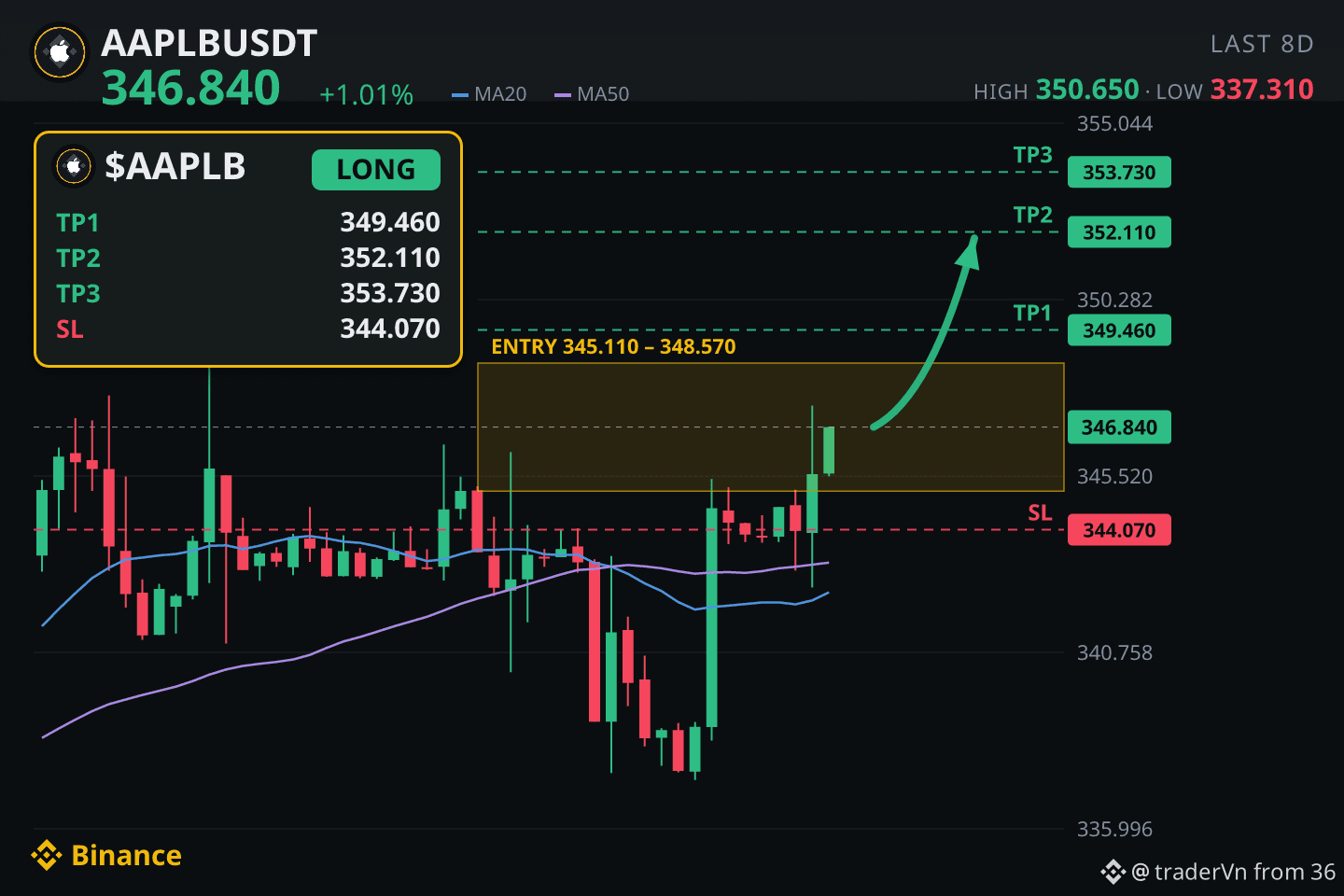
AAPLB is at 346.84 USDT · +0.68% over 24h · Vol 1M
🏷️ Event type: CAMPAIGN · published by Binance on 22/10/2026
The market continues to absorb mixed signals, with major bStock promotions providing short‑term liquidity to selected assets. Binance’s Starter Carnival aims to boost trading activity in AAPLB, while broader sentiment remains pressured by recent declines in other high‑volume tokens.
📈 Live market data — TRENDING UP
• AAPLB 346.84 · +0.68% · Vol 1M
• IOST · -52.1% · Vol 18M
• ALT · -35.2% · Vol 30M
• LUMIA · -21% · Vol 7M
Exchange announcements pull attention onto the named asset, and attention arrives fast and leaves just as fast.
#AAPLB #Binance
Source: https://www.binance.com/vi/support/announcement/ed8ff1366f0e4d4687eb1e105e7f61f1
For reference only, not financial advice (DYOR).
13

·
--
📡 Event | Binance Newcomer Carnival: Trade bStocks and share up to 60,000 USDT in AAPLB and NVDAB rewards!
$AAPLB Let's watch for now. Announcements related to your positions should be acted on the same day.
#AAPLB
Personal note, not a specific trading recommendation.
📡 Event | Binance Newcomer Carnival: Trade bStocks and share up to 60,000 USDT in AAPLB and NVDAB rewards!
$AAPLB Let's watch for now. Announcements related to your positions should be acted on the same day.
#AAPLB
Personal note, not a specific trading recommendation.
$AAPLB Let's watch for now. Announcements related to your positions should be acted on the same day.
#AAPLB
Personal note, not a specific trading recommendation.
1
3

·
--
Binance Newbie Carnival: Trade bStocks and share up to 60,000 USDT in AAPLB and NVDAB rewards!
Before joining trading promotions, do the math: estimate the rewards, fees, and risk from price fluctuations. Participate only if it’s worth it.$AAPLB Current price: 344.07.
Follow us for timely announcements.
#AAPLB
Before joining trading promotions, do the math: estimate the rewards, fees, and risk from price fluctuations. Participate only if it’s worth it.$AAPLB Current price: 344.07.
Follow us for timely announcements.
#AAPLB
2

·
--
🐋 When a promotion launches, trading volume often gets a boost.
Binance Newbie Carnival: Trade bStocks to share up to 60,000 USDT in AAPLB and NVDAB rewards!
$AAPLB Watch for organic buying during the promotion—the key is whether trading volume can hold up after it ends.
#AAPLB
🐋 When a promotion launches, trading volume often gets a boost.
Binance Newbie Carnival: Trade bStocks to share up to 60,000 USDT in AAPLB and NVDAB rewards!
$AAPLB Watch for organic buying during the promotion—the key is whether trading volume can hold up after it ends.
#AAPLB
Binance Newbie Carnival: Trade bStocks to share up to 60,000 USDT in AAPLB and NVDAB rewards!
$AAPLB Watch for organic buying during the promotion—the key is whether trading volume can hold up after it ends.
#AAPLB
3

$AAPLB
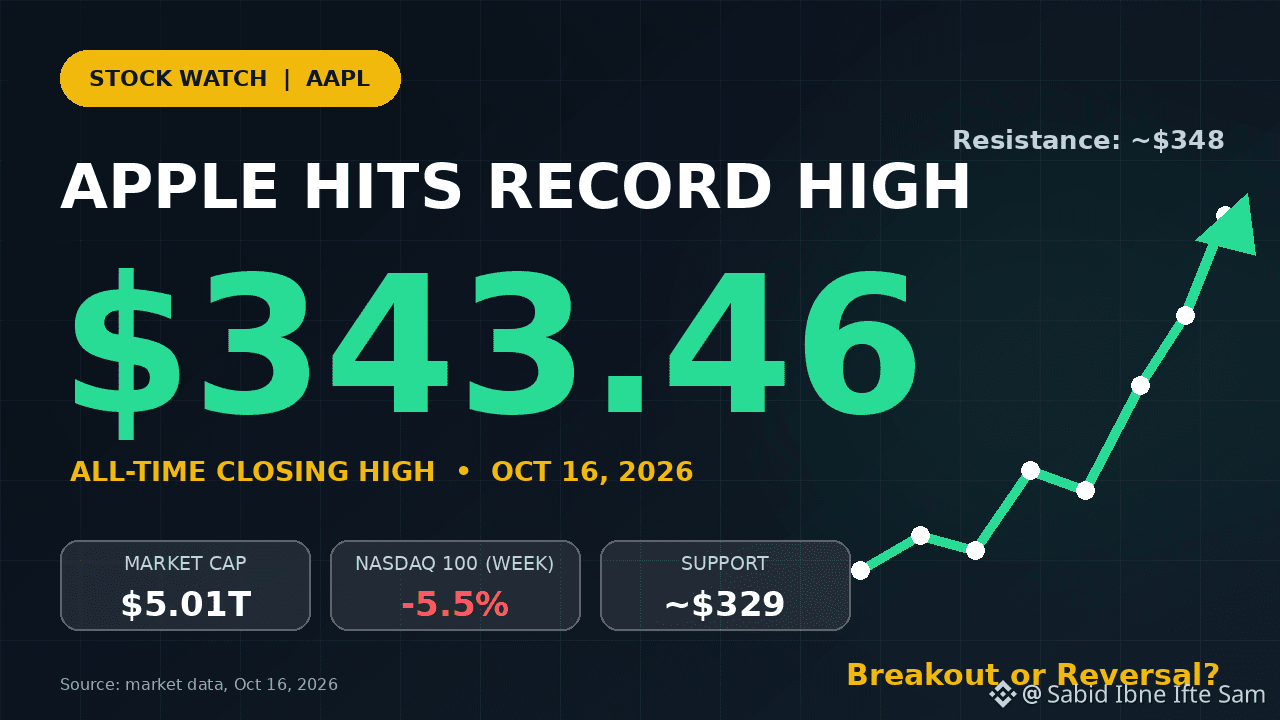
Apple ($AAPLB ): Record High While Nasdaq Bleeds
The Nasdaq 100 fell 5.5% this week, but Apple( $AAPLB ) closed at a record $343.46 on October 16, with a market cap near $5 trillion. (kucoin) (macdailynews)
🔹 Technicals
Price is above the 50-day average (~$325.7) and the 200-day average. (financhill)
RSI is about 62: strong momentum, not yet overbought. (financhill)
Support is near $329. Resistance is the record high around $348. (journalarta)
🔹 Catalyst
The $1,999 iPhone Duo reportedly sold out within minutes of preorders opening. Evercore has a $380 target, while UBS warns demand could fade. (benzinga) (defenseworld)
🔹 Risks
The P/E is about 39, and the average analyst target (~$328) sits below the current price. Macro pressure from the 6.3% PPI and high yields also remains. (Yahoo Finance) (tickernerd)
🔹 Scenarios
Bullish: a close above $348 could open the way toward $350 and higher.
Bearish: a break below $329 could send it toward $325.
{spot}(AAPLBUSDT)
#AAPLB #TechnicalAnalysis #Nasdaq #stockmarket
$AAPLB
Apple ($AAPLB ): Record High While Nasdaq Bleeds
The Nasdaq 100 fell 5.5% this week, but Apple( $AAPLB ) closed at a record $343.46 on October 16, with a market cap near $5 trillion. (kucoin) (macdailynews)
🔹 Technicals
Price is above the 50-day average (~$325.7) and the 200-day average. (financhill)
RSI is about 62: strong momentum, not yet overbought. (financhill)
Support is near $329. Resistance is the record high around $348. (journalarta)
🔹 Catalyst
The $1,999 iPhone Duo reportedly sold out within minutes of preorders opening. Evercore has a $380 target, while UBS warns demand could fade. (benzinga) (defenseworld)
🔹 Risks
The P/E is about 39, and the average analyst target (~$328) sits below the current price. Macro pressure from the 6.3% PPI and high yields also remains. (Yahoo Finance) (tickernerd)
🔹 Scenarios
Bullish: a close above $348 could open the way toward $350 and higher.
Bearish: a break below $329 could send it toward $325.
#AAPLB #TechnicalAnalysis #Nasdaq #stockmarket
67

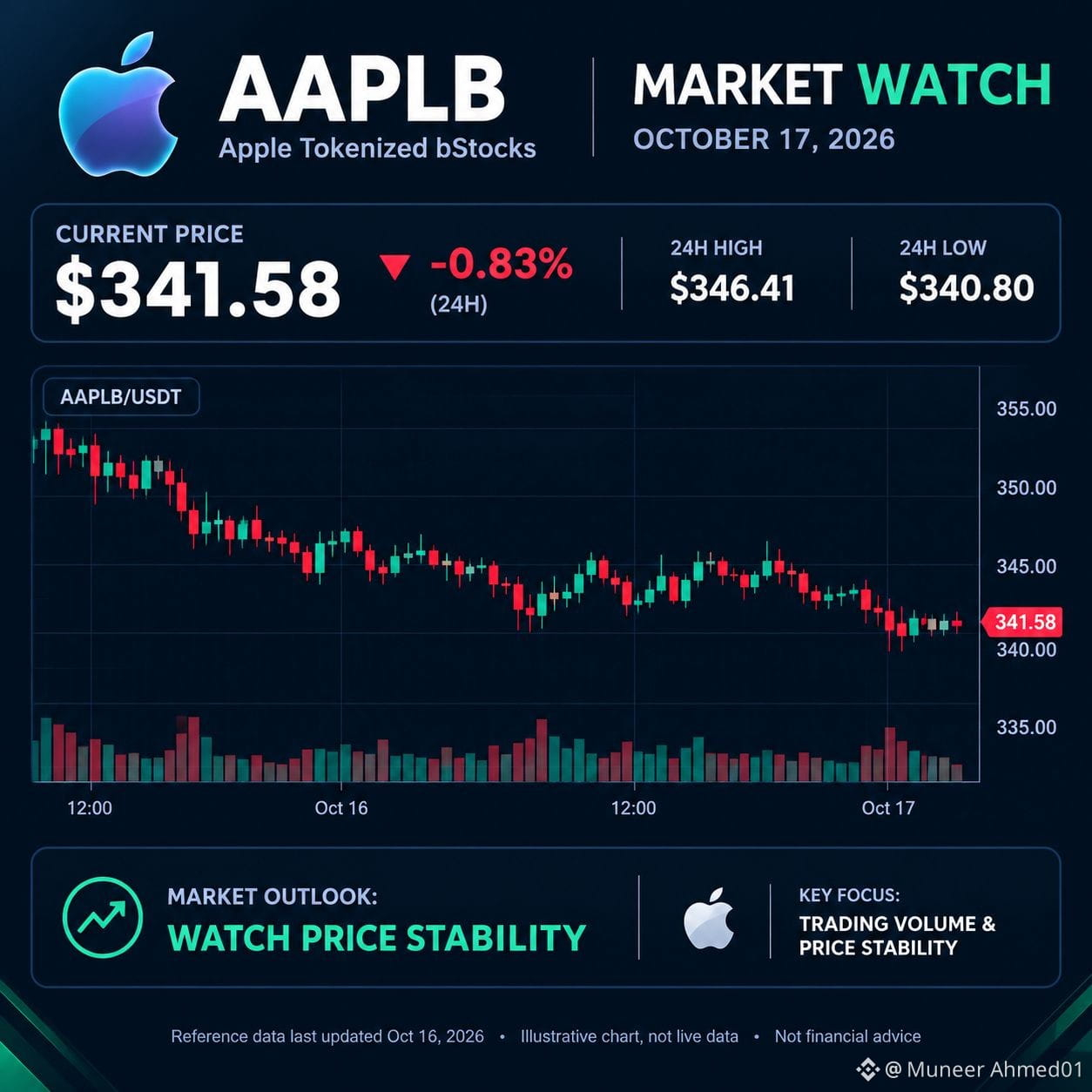
🍎 AAPLB Market Update | October 17, 2026
$AAPLB , Apple Tokenized bStocks, provides tokenized exposure to Apple’s stock. Its price is influenced by Apple’s share price and broader market sentiment.
📊 Key Market Watch
🔹 Trend: Watch for price confirmation
🔹 Focus: Trading volume and price stability
🔹 Outlook: Monitor Apple’s stock performance and key market levels.
⚠️ AAPLB is a tokenized security, not the same as directly owning Apple shares. Always do your own research.
#AAPLB #coinaute #ArgentinaUSDTPriceTops1600Pesos
{spot}(AAPLBUSDT)
🍎 AAPLB Market Update | October 17, 2026
$AAPLB , Apple Tokenized bStocks, provides tokenized exposure to Apple’s stock. Its price is influenced by Apple’s share price and broader market sentiment.
📊 Key Market Watch
🔹 Trend: Watch for price confirmation
🔹 Focus: Trading volume and price stability
🔹 Outlook: Monitor Apple’s stock performance and key market levels.
⚠️ AAPLB is a tokenized security, not the same as directly owning Apple shares. Always do your own research.
#AAPLB #coinaute #ArgentinaUSDTPriceTops1600Pesos
78

·
--
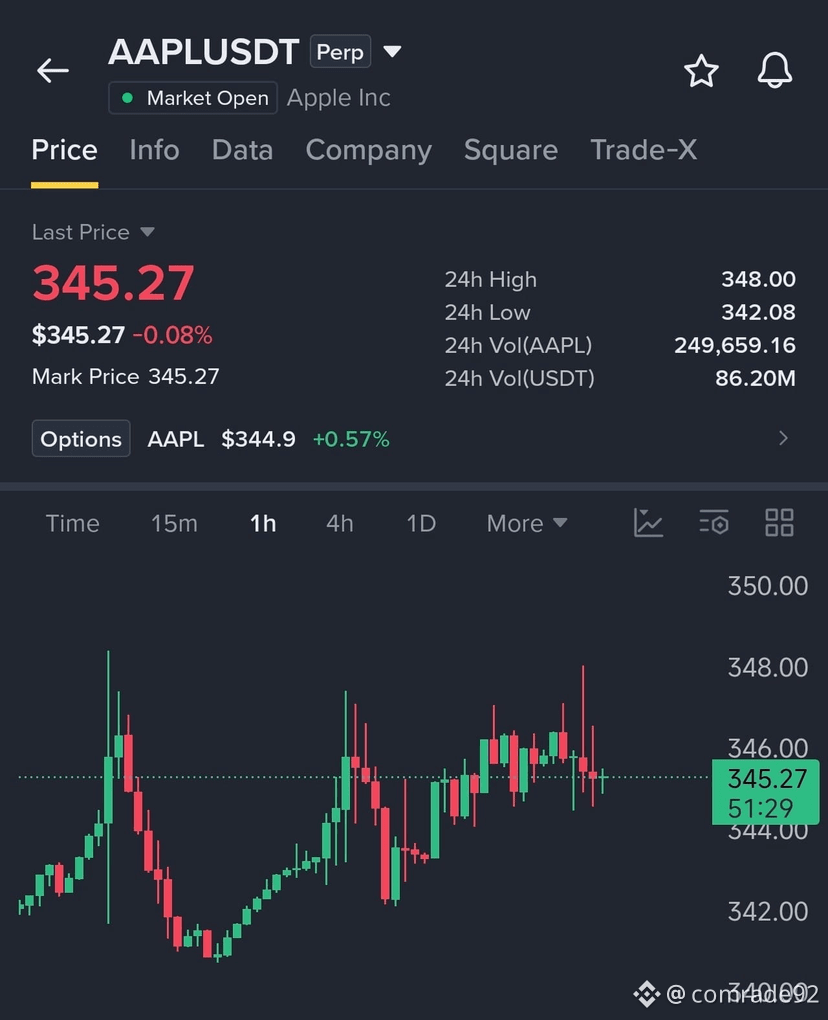
TRADE SIGNAL: $AAPLB
Action: BUY / LONG
Leverage: 15x
Entry Range: 341.07 - 344.5
Take Profit: 348.36
Stop Loss: 338.5
Valid Until: 20 Oct 26
#AAPLB #AAPLUSDT #NEARRisesNearly10% #SouthKoreaTightensOversightOfOverseasPerpetualContracts #RiksbankUrgesLawmakersToPrepareDigitalKronaLegislation
{future}(AAPLUSDT)
TRADE SIGNAL: $AAPLB
Action: BUY / LONG
Leverage: 15x
Entry Range: 341.07 - 344.5
Take Profit: 348.36
Stop Loss: 338.5
Valid Until: 20 Oct 26
#AAPLB #AAPLUSDT #NEARRisesNearly10% #SouthKoreaTightensOversightOfOverseasPerpetualContracts #RiksbankUrgesLawmakersToPrepareDigitalKronaLegislation
Action: BUY / LONG
Leverage: 15x
Entry Range: 341.07 - 344.5
Take Profit: 348.36
Stop Loss: 338.5
Valid Until: 20 Oct 26
#AAPLB #AAPLUSDT #NEARRisesNearly10% #SouthKoreaTightensOversightOfOverseasPerpetualContracts #RiksbankUrgesLawmakersToPrepareDigitalKronaLegislation
193
Log in to explore more content
Join global crypto users on Binance Square
⚡️ Get latest and useful information about crypto.
💬 Trusted by the world’s largest crypto exchange.
👍 Discover real insights from verified creators.
Email / Phone number
Trending Topics
1
#UniswapA16zSeekDeFiExemptionFromIllinoisCryptoTax
28,158 views
783 Discussing
2
#HKDollarStablecoinHKDAPToLaunchOnSolana
21,194 views
497 Discussing
3
#$1.5BInLeveragedCryptoBetsLiquidated
45,858 views
253 Discussing
4
#TrezorSaysCryptoBilisSoldWalletMayContainMaliciousComponents
3,732 views
73 Discussing
5
#KOSPIFalls3.53%BackBelow6000
65,106 views
1,109 Discussing
6
#AmazonSharesFallAbout7%InPremarketTrading
29,789 views
599 Discussing
7
#USMidtermElections
258,046 views
2,374 Discussing
8
#StrategySTRCReaches$99.95ForFirstTimeIn165Days
30,185 views
95 Discussing
9
#BinanceWillListPredictPREDICT
98,845 views
1,411 Discussing
10
#SwitzerlandFirstSpotBitcoinETFExpectedToTradeInNovember
3,246 views
112 Discussing