



Carefully! Lots of text.
MakerDAO is a decentralized finance (DeFi) project. Its native stablecoin, DAI, is backed by cryptocurrency and pegged to the US dollar. DAI is governed by token holders through a decentralized autonomous organization (DAO). Users issue DAI by locking the cryptocurrency in the Maker Vault at a set liquidation rate. For example, a liquidation rate of 125% would require $1.25 in cryptocurrency collateral for every dollar of DAI.
To reduce the risks associated with cryptocurrency volatility, this stablecoin is overcollateralized and charges a stability fee. If the value of your collateral cryptocurrency falls below the liquidation ratio, the collateral will be liquidated to recover losses.
The DAO ensures the stability of the DAI token by adjusting the stability fee and the DAI savings rate. Stability fees affect the supply and issuance price of DAI. The savings rate determines the demand for the coin and investors' earnings from staking DAI. When DAI deviates from its peg, DAO uses these two mechanisms to adjust.
DAI has the same benefits as other stablecoins and crypto assets: it can be easily transferred anywhere in the world, used for payments or to record profits and losses. DAI can also be used as leverage and invested in a DAI Savings Ratio contract at interest.
Users can participate in governance and execution votes using MKR tokens. Token holders can vote on changes to the stability fee, DAI savings rate, team composition, smart contract operation, and more.
Introduction
Stablecoins are very popular cryptocurrencies that straddle the line between traditional finance and digital assets. Because these tokens mimic fiat currency but operate like a cryptocurrency, they are extremely attractive for “locking in” profits and losses.
Today, the largest stablecoins by market capitalization are backed by fiat. They keep a reserve of funds in fiat for their own security. However, cryptocurrency-backed stablecoins are also quite popular. In this article, we will look at one of the most famous examples of such a stablecoin, issued by MakerDAO, and also understand how exactly it maintains a peg to $1 with volatile cryptocurrency collateral.
What is MakerDAO?
MakerDAO is an Ethereum (ETH) project launched by Rune Christensen in December 2017. It issues DAI, a cryptocurrency-backed stablecoin pegged to the US dollar. MakerDAO is not led by a group of developers or any organization. Instead, the MakerDAO ecosystem uses the MKR governance token to make decisions and make proposals. ENS has launched a governance token as part of the transition to a decentralized autonomous organization (DAO).
You can access MakerDAO through the Oasis DApp. Here you can post collateral for loans, take part in the management and monitor your Maker Vaults. The application is powered by smart contracts and game theory, which allows DAI to maintain a relatively stable price. The DAI token offers the same benefits as fiat-backed stablecoins and can be used in the same way.
What is DAI
DAI is MakerDAO's USD-pegged stablecoin, which is one of the largest stablecoins and cryptocurrencies by market capitalization. This ERC-20 token has an unlimited supply by having users provide collateral to issue more DAI.
MakerDAO maintains a peg to the US dollar using cryptocurrency rather than fiat collateral. You may rightfully wonder: how can a cryptocurrency known for its volatility support a stablecoin? In short, the cryptocurrency that a user contributes to create DAI has a higher value than the stablecoin that is created. This creates additional space for the price of cryptocurrency collateral to fall without harming the lender.
Like any stablecoin, DAI offers certain advantages:
1. Suitable for payment due to its stability. Retailers and individuals do not always accept payment in cryptocurrency due to fear of sudden changes in its price.
2. Takes advantage of blockchain. Stablecoins can be freely transferred around the world without providing bank details. In addition, when stored correctly, they guarantee complete safety.
3. Can be used to record profits and losses and hedge risk. DAI offsets some of the overall portfolio risk and allows you to enter and exit positions while remaining on the blockchain.
How collateral works
Collateral is widely used in traditional finance, and you've probably come across this concept before. For example, to take out a loan, you must leave something valuable as collateral. If you are unable to repay the funds, the collateral will be used to cover your loan.
Physical and fiat collateral
Let's take a pawn shop as an example. You leave your jewelry (collateral) at the pawnshop and receive cash. After that, you either return the money along with the commission and get your deposit back, or the pawnshop keeps the jewelry for itself. The collateral system serves as insurance for the lender and is also used in mortgages and car loans where real estate or a car are used as collateral.
As the name suggests, fiat-backed stablecoins like BUSD are backed by fiat currencies. The user transfers his money (collateral) and receives tokens in return. He can return the tokens to the issuer, but even if he does not, the issuer will still have money. This mechanism allows for arbitrage that supports the peg of the stablecoin. You can learn more about this in our article What are stablecoins?
Cryptocurrency support
Crypto-backed stablecoins, such as DAI, accept cryptocurrency as collateral rather than fiat. These coins are governed by a smart contract with the rules: issue X stablecoin tokens for the amount of Y ETH deposited and return Z ETH when X stablecoins are returned. The exact amount of collateral required will depend on the project issuing the token, as well as the volatility and risk of the collateral asset.
What is DAI Overcollateralization?
Typically, stable, relatively low-risk assets such as fiat, precious metals and real estate are used as collateral. As mentioned earlier, using cryptocurrencies as collateral is quite risky for the lender as their price can change dramatically. Let's say a project requires collateral of $400 in ETH for 400 tokens pegged to USD.
If the price of ETH suddenly drops, the collateral will not cover the loan issued. To avoid this, the project requests excess collateral: instead of $400, the lender receives $600 in ETH for 400 tokens of its USD-pegged stablecoin.
What are collateralized debt positions (CDP)
The MakerDAO project has used overcollateralization to maintain a secure peg for years. The release of DAI is controlled by smart contracts, and therefore is efficient and does not require human intervention. To borrow the DAI stablecoin, you need to lock the cryptocurrency in a CDP smart contract. The CDP sets a liquidation ratio of, for example, 1.5x: $150 in ETH must be pledged as collateral for $100 in DAI. If desired, you can add even more to reduce risks. If the collateral amount falls below 150% (1.5x), the borrower will have to pay a penalty. The user also runs the risk of being liquidated if he fails to repay his DAI debt along with the interest (stability fee).
What are Maker Vaults?
In Maker Vaults, users stake collateral and issue DAI. This system allows you to simultaneously use several different cryptocurrencies as collateral. Also, Maker Vault burns DAI as soon as the user returns it. This is done as follows:
1. Supported cryptocurrencies are included in the Maker protocol.
2. The deposit opens a position in Maker Vault.
3. The user deposits the amount of DAI corresponding to the collateral amount and also pays a stability fee.
4. To return the cryptocurrency collateral, the user redeems the received DAI tokens.
You can create and return DAI, as well as add or withdraw collateral at any time. However, you must always maintain the disposal rate specified in the repository. If it falls below this ratio, the vault will liquidate your collateral.
How DAI Price Remains Stable
The CDP mechanism not only reduces the risk for MakerDAO as a lender, but also helps maintain the DAI peg to USD. MakerDAO can also vote to change the stability fee and DAI savings rate (the interest paid to stakers in the DAI savings rate smart contract) to manage the supply and demand of DAI. These three instruments work together to keep DAI pegged to $1. Let's look at this in more detail:
1. When DAI falls below the peg, the system incentivizes users to pay off their debts, return collateral, and burn DAI. This comes at the expense of higher stability fees, which makes borrowing more expensive. A DAO can also increase the savings rate of DAI, increasing demand for investment in the token.
2. The opposite situation occurs when DAI rises above the peg. With reduced stability fees, the DAO creates additional incentives for issuing DAI. As a result, the total supply of DAI increases and the price of each token decreases. MakerDAO may also reduce demand for the DAI token, lowering its savings rate and forcing investors to seek alternative interest-earning opportunities.
DAI Use Cases
As mentioned earlier, DAI can be used like any other stablecoin and offers the same benefits. It doesn’t even have to be released independently, but can be purchased on cryptocurrency markets such as Binance. DAI also has several unique use cases:
1. Leverage. Let's say you have $1000 in ETH and you expect the price to rise. However, you currently do not have the funds to purchase ETH. In this case, you can use ETH as collateral, issue DAI, and use it to buy ETH. If the price of ETH rises and you want to withdraw your tokens, you can exchange them for DAI tokens and return your collateral.
2. DAI Saving Rate. You can earn interest by depositing DAI tokens into the DAI savings rate smart contract. As the DAO attempts to control the price of DAI, this ratio may change.
Where can you buy DAI?
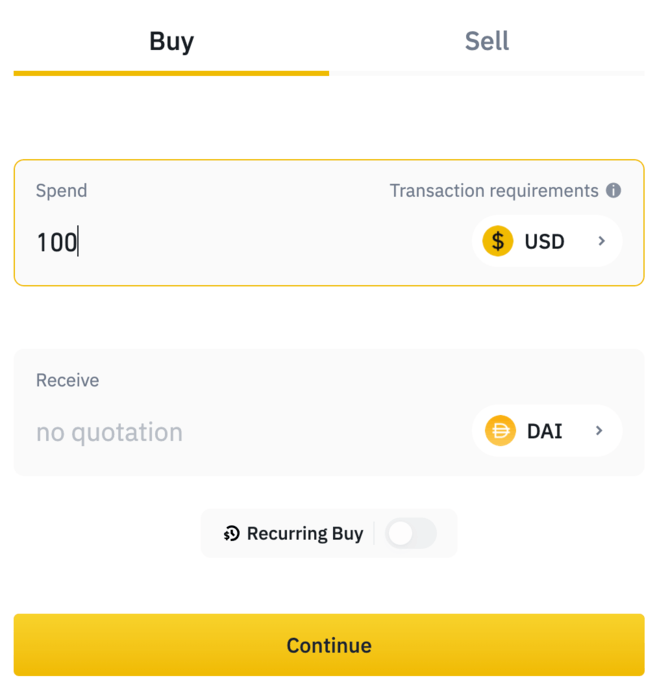
DAI can be purchased on cryptocurrency exchanges such as Binance. Once you create an account and complete KYC verification, you will be able to purchase DAI tokens using a credit or debit card.
Select fiat for payment in the top field, and select DAI in the bottom. You will be presented with instructions on how to add a card to your account. If you wish, you can use the exchange overview to exchange DAI for another cryptocurrency.
How to participate in the MakerDAO governance system
To have voting rights in MakerDAO, you must purchase the project's governance token MKR. The maximum supply of MKR is 1,005,577 tokens, and approximately 40% of this was distributed between the team and early investors during the rollout. The remaining tokens were retained by the DAO for future sales.
MKR holders make decisions about changes on the platform related to, for example, stability fees, savings and liquidation rates and much more. The weight of the vote is proportional to the amount of DAI the holder has. To participate in ongoing voting, please visit the MakerDAO Governance Portal.
Governance votes
By participating in governance votes, users can put forward non-technical proposals to be voted on by MKR holders. These suggestions may involve changes to management, goals, team composition, or budget. Governance votes use an instant trigger mechanism, giving you the opportunity to rank your choices from multiple options.
Voting by performance
Execution votes affect technical changes to the smart contract. Proposals use a rolling approval voting system, meaning new competing proposals can be submitted at any time. At the execution vote, serious proposals are put forward that could lead to important changes to the smart contract code, such as adjustments to fees or collateral levels. Such a vote is necessary to implement changes put forward in governance votes.
Summary
The DAI token is the dominant cryptocurrency-backed stablecoin with proven performance. It allows you to reduce the volatility of cryptocurrency without fiat collateral, which is an achievement. Also, let's not forget the importance of MakerDAO in the history of DAOs: this project became one of the oldest and largest DAOs and paved the way for many others. If you decide to experiment with the DAI token, be aware of the risks inherent in all stablecoins.