


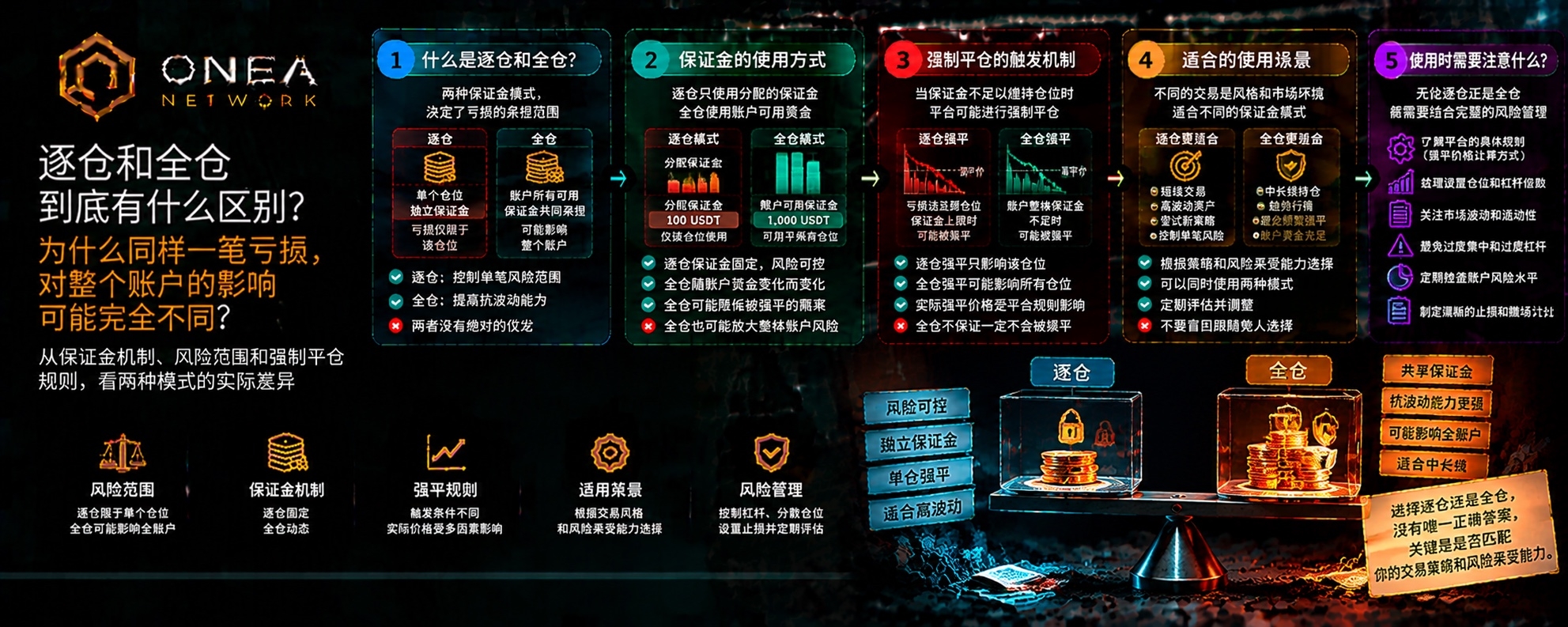
What exactly is the difference between isolated and cross margin? Why can the same loss have a completely different impact on your entire account?
In crypto futures trading, many people focus on leverage, entry prices, and stop-loss levels, but overlook an equally important question:
Are you using isolated margin or cross margin?
These two margin modes affect how margin is allocated, how account funds are used to absorb risk, and how far losses on a position may spread.
The key difference between isolated and cross margin isn’t that one is necessarily safer than the other, but how margin is used to absorb risk.
I. What Is Isolated Margin?
In isolated margin mode, a position bears risk independently using the margin allocated to it.
Suppose you have 1,000 USDT and allocate 100 USDT as margin for a contract position.
Under a typical isolated margin mechanism, the risk of the position is managed primarily against the margin allocated to it. If the position incurs losses and is liquidated, the platform generally will not automatically use all other available funds in your account to maintain it.
However, the specific rules depend on the trading platform. Features such as adding margin or auto-adding margin may change the actual scope of risk.
The main features of isolated margin are:
The risk of each individual position is relatively independent.
It is easier to set a margin budget for each trade.
Other funds generally will not automatically bear all the risk of that position.
If a position is liquidated, you may lose the margin allocated to that position and any related fees.
II. What Is Cross Margin?
In cross margin mode, eligible available margin in your account may be used to support multiple positions collectively.
Let’s still assume you have 1,000 USDT.
If you use cross margin mode and one position incurs a loss, other available margin in your account may help keep the position open, depending on the platform’s margin calculation rules.
This means a single position may have a larger margin buffer.
At the same time, however, the risk may affect a broader portion of your account funds.
The main features of cross margin are:
Available margin may be shared across multiple positions.
In some cases, it can improve capital efficiency.
The gains and losses of multiple positions may jointly affect your account’s margin level.
When the market moves sharply against you, your account equity as a whole may be affected more broadly.
Cross margin does not mean you will necessarily lose all the funds in your account, but it also does not mean that other funds can protect a losing position indefinitely.
III. A Simple Example to Understand the Difference
Suppose your account has 1,000 USDT in total, of which 100 USDT is allocated to a contract position.
If that position incurs a loss of 100 USDT, the risks may differ between isolated and cross margin modes.
In isolated margin mode, if that 100 USDT is all the margin allocated to the position and no additional margin is added, the position may be liquidated due to insufficient margin.
In cross margin mode, if the account still has enough available margin, the platform may allow the position to remain open.
However, if the market continues to fall and losses grow, cross margin mode may also use up more of the account’s available funds and eventually trigger liquidation.
Note that liquidation does not necessarily occur only when the loss reaches exactly 100 USDT. Maintenance margin requirements, trading fees, position size, and platform rules may all cause liquidation to happen sooner.
Therefore, you cannot determine the liquidation price based only on the margin amount, nor should you treat the example above as the liquidation calculation formula used by any specific platform.
IV. How Should You Choose Between Isolated and Cross Margin?
Isolated margin may be more suitable if you:
Want to clearly limit the risk exposure of each individual position.
Run multiple strategies at the same time and want to isolate risk more clearly.
Want to set a separate margin budget for each trade.
Do not want one position to easily use up other available margin.
Cross margin may be more suitable if you:
Need to share available margin across multiple positions.
Want to use your account’s overall equity to maintain positions.
Can continuously monitor your account’s overall risk exposure.
Understand the platform’s margin calculation and liquidation rules.
These are only common use cases, not definitive recommendations. The right choice also depends on your strategy, position structure, platform rules, and risk tolerance.
V. Four Things to Keep in Mind, Whatever Mode You Choose
First, don’t focus only on leverage.
Even with the same leverage, actual risk may differ depending on position size, margin allocation, and stop-loss distance.
Second, pay attention to your overall account risk.
Even when using isolated margin, multiple highly correlated positions may lose value at the same time. Isolated margin cannot eliminate portfolio-level risk.
Third, understand the platform’s rules.
Different exchanges may have different rules for maintenance margin, liquidation prices, adding margin, and auto-deleveraging.
Fourth, set exit conditions in advance.
Don’t treat liquidation as a stop-loss, and don’t wait until your account margin is close to a dangerous level before managing risk.
Finally, there is no single right answer for everyone when it comes to isolated versus cross margin
Isolated margin emphasizes risk isolation for individual positions, while cross margin emphasizes the shared use of account margin.
Neither can eliminate market risk or guarantee that you will avoid losses.
What really matters is whether you know how much you could lose on each trade and which funds in your account could be affected if a trade goes wrong.
Before choosing a margin mode, understand how risk can spread. Before entering a trade, think about the maximum loss you are willing to accept.
Question for discussion: If you hold multiple crypto contracts at the same time, do you prioritize isolating the risk of each position or flexibly allocating account margin? What factors would guide your decision?
Next article: Why might you be liquidated for insufficient margin even when your account still has funds? We’ll break down how maintenance margin and liquidation prices are calculated.
#Crypto #Trading #RiskManagement