

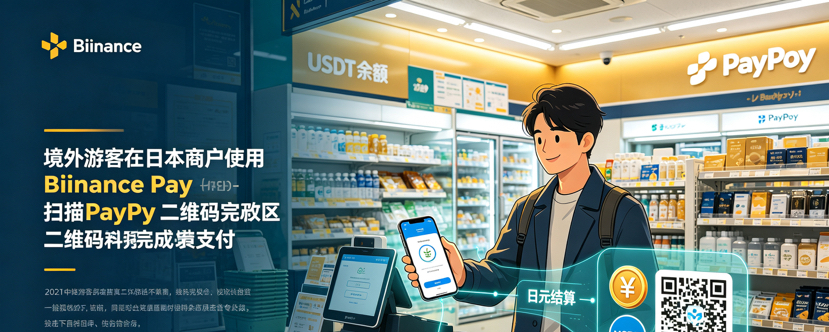

Binance Pay recently announced that eligible inbound international visitors to Japan can use cryptocurrencies to pay at merchants that support PayPay in Japan, with the merchants ultimately settling in Japanese yen. This means that digital assets such as USDT are entering Japan’s offline consumer scene for the first time via a more mainstream QR payment network. However, this service is not a “full-scale opening of crypto payments in Japan,” but rather a limited attempt aimed at inbound tourists, leveraging existing payment infrastructure. This article analyzes the practical usage conditions, payment process, promotional mechanisms, industry significance, and potential risks to help readers judge whether it is a genuinely usable consumer tool—or just another marketing event.
1. Core of the event: tourists pay with USDT, and merchants receive JPY
The partnership between Binance Pay and PayPay, on the surface, is “crypto for offline consumption in Japan.” More accurately, its structure is:
Overseas tourists use their crypto balance in the Binance app to initiate a payment → the system completes the exchange and settlement → the merchant receives JPY.
According to Binance’s official information, this service connects the Binance Pay and PayPay acceptance networks through the HIVEX payment network, and will open to eligible overseas users traveling to Japan starting from September 30, 2026. The key in this design isn’t making merchants hold crypto; instead, it keeps the “crypto part” inside the payment platform, so merchants can continue using existing PayPay flows and receive JPY.
This lowers the acceptance onboarding threshold for merchants, and also reduces how difficult it is for ordinary consumers to perceive the “crypto price fluctuation during the payment process.” For tourists, the payment logic is close to common QR code payments: find the PayPay QR code, open the Binance app, select the payment entry point, enter the amount, and confirm.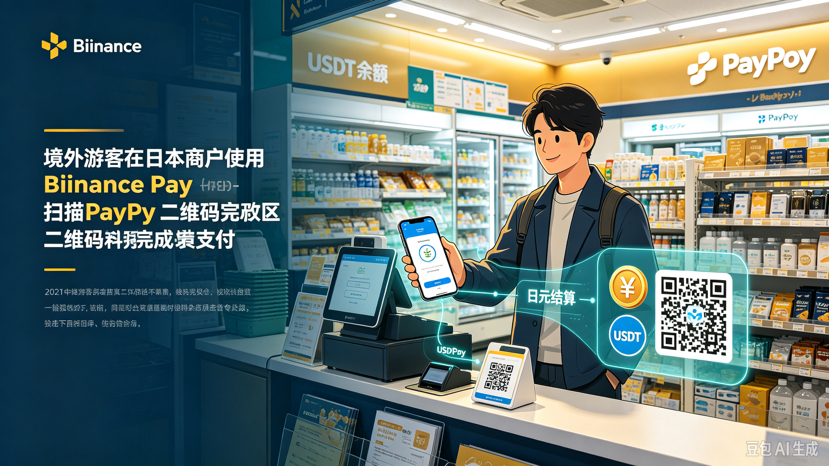
2. The real prerequisite for it to work: not everyone can use it directly
The easiest place for this feature to be misunderstood is the idea that “it can be used at all merchants in Japan.” In reality, there are several layers of limitations:
1. Only for eligible overseas visitors to Japan;
2. Japanese residents are not included in the scope of this service for now;
3. The user’s region must support Binance Pay;
4. Users must complete Binance identity verification;
5. The merchant must support PayPay;
6. The specific payment method depends on the entry points available within the app.
Therefore, it’s better defined as a “supplementary payment solution for tourists who hold crypto,” rather than a crypto payment tool for everyday use by Japanese residents.
This positioning is important. Because if you understand it as a full opening of crypto payments in Japan, you’ll overestimate the policy significance; but if you understand it as just a marketing campaign, you may underestimate its real value in cross-border tourism payment scenarios.
3. Payment flow: one less step than “exchange first, then spend”
For users planning a trip to Japan and who already hold USDT, the main appeal of this service comes from shortening the operational journey.
The traditional path is usually:
Hold digital assets → exchange into JPY → withdraw to a bank account → turn into cash or bind to a payment instrument → make purchases in-store.
And the path for Binance Pay is:
Binance account holder assets → enter the PayPay payment entry → scan or display the payment code → the system completes the exchange → the merchant receives JPY.
The official also states that this payment does not charge a fuel fee. For users, this means that at least in the payment step, there’s no need to handle on-chain gas or complicated exchange steps separately.
Based on already published user experience, in some merchant scenarios the whole payment process can be completed in about 15 seconds. However, the actual speed is still affected by the network, the merchant’s system, the availability of the payment entry point, and the settlement status at the time.
4. A 10% instant discount: real benefits, and also a tool for user education
To drive usage, Binance offers a limited-time 10% instant discount. This kind of promotion isn’t uncommon when a payment product first launches. It has at least three layers of purpose:
1. Lower the psychological barrier for first-time users to try;
2. Encourage tourists to use it in small-amount spending scenarios;
3. Turn “holding crypto” into the real experience of “spending money.”
However, it’s important to note that discounts are usually not unconditional. Before users participate, they should verify:
• Whether it is limited to eligible overseas tourists;
• Whether there is a per-transaction discount cap;
• Whether there is an activity time limit;
• Whether a specific merchant category is required;
• Whether it needs to be actively enabled in the app;
So the 10% discount can be seen as a real short-term benefit, but it shouldn’t be treated as something lasting long-term, nor should it be the only standard for judging whether a payment product has matured.
5. Industry significance: stablecoins start entering real “tourism payment” scenarios
From an industry perspective, the value of this partnership isn’t about the amount of any single payment, but about stablecoins starting to enter real, high-frequency, small-amount offline consumption scenarios.
In the past, USDT’s main use cases were concentrated in:
• Crypto asset trading;
• Cross-border transfers;
• Funds movement between exchanges;
• Hold as a safe-haven asset.
After Binance Pay is integrated with PayPay, USDT gains a more practical exit route: travel spending.
This scenario is important because it has three favorable conditions for promoting payments:
1. Users already have clear payment needs: dining, shopping, transportation, accommodation;
2. The merchant network is already mature: there’s no need to rebuild the acceptance system;
3. Users are not sensitive to the conversion process: as long as the outcome is stable, tourists care more about speed and convenience.
If crypto payments used to mostly stay in the “proof of concept” stage, then this one is closer to a combination of “user education + scenario deployment.”
6. But this doesn’t mean crypto payments have become widespread
Even though there are breakthroughs in certain scenarios, it’s still not wise to overestimate the current level of adoption.
First, it only covers the available portion within the PayPay merchant network
Seeing a PayPay QR code doesn’t necessarily mean you can use Binance Pay. Whether you can pay depends on user eligibility, regional restrictions, the app entry point, and the merchant’s payment status at that time.
Second, the user group is limited.
The service is mainly for overseas tourists, not Japanese residents, and not all Binance users. This means its usage frequency and potential user base are naturally limited.
Third, the payment experience still depends on the underlying network and settlement reliability
The biggest fear with QR code payments is: “The user paid but the merchant didn’t receive it,” or “payment amount confirmation is delayed.” Once the network is congested, systems time out, or exchange-rate conversions run into issues, the user experience will quickly deteriorate.
Fourth, the boundaries for regulation and compliance are still clear
Japan has a clear regulatory framework for crypto assets and stablecoins. This service hasn’t changed the basic structure of “merchants receive JPY, and users pay with their crypto asset balances.” It’s more like expanding payment entry points within the existing compliance track, rather than breaking regulatory boundaries.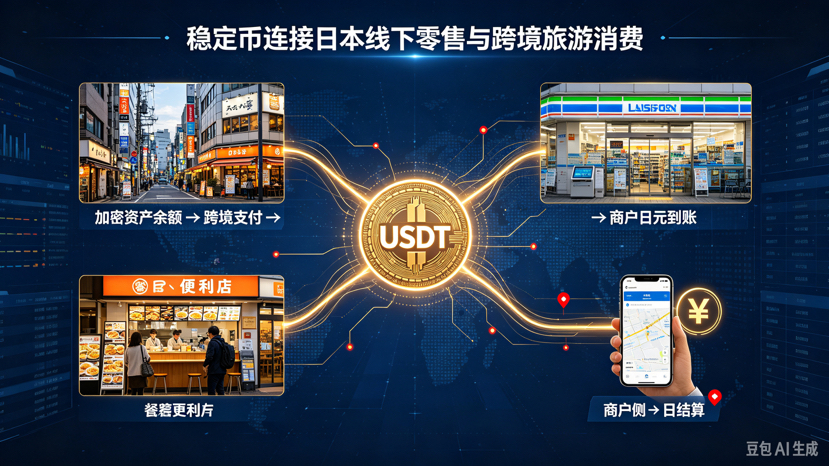
7. Practical advice for users: confirm eligibility first, then decide whether to use it
For people planning to travel to Japan and who hold digital assets, the most practical approach isn’t to try it only after arriving—it’s to complete four things in advance:
1. Confirm that Binance Pay is available
In the Binance app, check the PayPay entry point, and confirm account verification, region, and service coverage.
2. Check the discount rules
If the goal is to enjoy a 10% discount, confirm the promotion period in advance, the applicable merchants, the per-transaction cap, and participation requirements.
3. Prepare a backup payment method
Don’t put all your consumption needs on a single payment method. Credit/debit cards, cash, and local payment instruments are still more stable primary options.
4. Pay attention to payment limits and exception handling
Learn in advance how to handle payment failures, duplicate charges, abnormal amounts, etc., so you don’t have to wait too long at the merchant’s cashier counter.
8. Go one step deeper: Is this a “payment tool” or a “marketing event”?
To judge the progress of a crypto payment, there are usually three criteria:
• Whether it truly enters high-frequency consumption scenarios;
• Whether it lowers the barrier for users to use it;
• Whether it forms sustainable user habits.
If you only look at short-term exposure, this partnership is more like a successful marketing push; but if you look at scenario expansion, it really moves USDT from a trading account into real offline consumption.
But the real test is whether users will want to keep using it after the event ends. Only when payment speed, stability, coverage, and costs reach usable levels will it move from “trying it out” to “regular use.”
9. Conclusion: crypto assets are moving from investment products to payment tools, but they are still in the early stage
The significance of Binance Pay integrating with PayPay isn’t that Japan suddenly opens crypto payments across the board; rather, it’s that stablecoins are entering the real offline consumption path of overseas tourists for the first time through a mainstream QR payment network. For outbound users holding USDT, it’s a more convenient payment option. For the industry, it’s another step in the evolution of digital assets from “trading instruments” toward “payment tools.”
However, it is still a supplementary payment method with clear conditions and a limited scope. Users should verify eligibility, the entry point, and the promotion rules first, rather than assuming that all PayPay merchants support it.
Looking ahead, the value of such partnerships is worth tracking: once stablecoins increase in usage frequency in tourism, cross-border consumption, and small-amount payments, the narrative won’t be limited to “volatile assets” or “safe-haven assets,” but will gradually move into more practical payment infrastructure.#比特币资金费率升至10%未平仓合约回升 #比特币站上8.6万美元涨2.99% #Zcash较9月峰值回落21% #美国9月非农仅增2.9万人失业率升至4.2% #BNB链代币化股票规模破10亿美元占市场30% $BTC


