


Byline: Rita
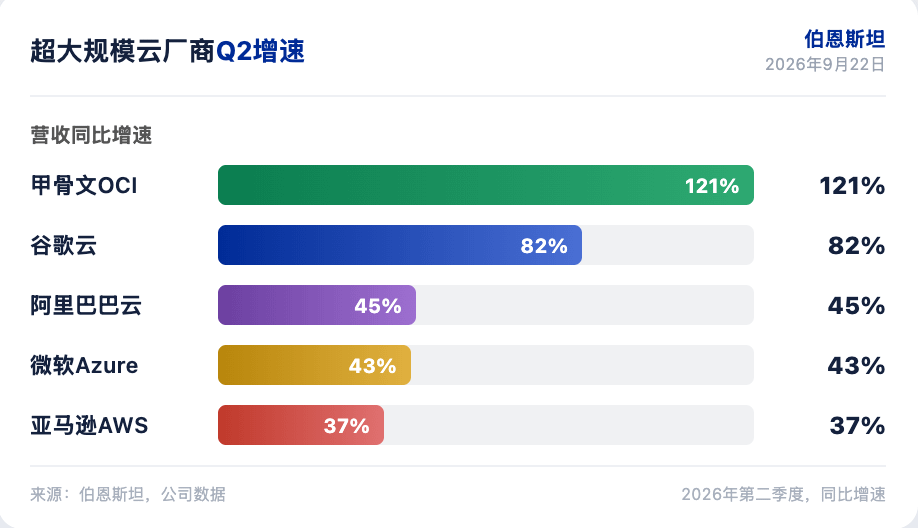
The second quarter saw a collective acceleration among hyperscale cloud providers, but the return paths began to diverge. In a cloud quarterly report released on September 22, 2026, Bernstein noted that Microsoft Azure grew 43%, Google Cloud grew 82%, and Oracle OCI grew 121%. Google is leading in AI cloud competitiveness, while Microsoft—supported by cash flow and self-funding ability—is positioned as a defensive target. This report for the first time includes CoreWeave in the comparison set, and Bernstein gives it an underperform rating versus the broader market.
Bernstein analyst Mark Moerdler pointed out that the hyperscale market has become the infrastructure layer supporting traditional cloud and generative AI, with capital expenditure growth far outpacing revenue growth. Google’s vertically integrated advantages are becoming evident, Oracle is growing at high speed from a smaller base, and Microsoft is charting an independent path backed by self-funded capital and first-party applications. In total, the four major U.S. cloud providers added approximately $14.4 billion in cloud revenue in the second quarter.
Microsoft Azure accelerates growth
Microsoft Azure grew 43% in the second quarter, exceeding guidance by 300 basis points and beating market consensus by 200 basis points. Management guided for 45% growth in the next quarter and continued to expect acceleration in the second half of 2026. Commercial Remaining Performance Obligations (RPO) reached $678 billion, up 84% year over year. Quarter-over-quarter growth came entirely from enterprise customers and excluded new commitments from frontier model companies. Excluding OpenAI, RPO increased 25% year over year.
Microsoft capital expenditures in the second quarter were $41 billion, up 70% year over year. About two-thirds went to short-term assets, mainly GPUs and CPUs. Microsoft maintained its full-year 2026 calendar capex guidance at $190 billion; after lease reclassification adjustments, it was $175 billion. Microsoft extended the useful life of data center assets from 15 years to 25 years, converting some short-term financed leases into operating leases.
Microsoft’s defensive attributes come from three places. First-party applications are consuming capacity at an accelerating pace, with Copilot paid seats up 50% quarter over quarter to 30 million. Third-party contracts come from OpenAI as it diversifies into more large enterprise customers; contract duration matches equipment useful life. Management guided that free cash flow for fiscal 2027 will be positive and will not require additional debt issuance. Bernstein rates Microsoft as outperforming the broader market, with a target price of $660.
Google Cloud grew 82%
Google Cloud revenue grew 82% year over year to $24.8 billion in the second quarter. Operating profit was $8.8 billion, doubling year over year; operating margin was 35.6%, versus about 20.7% in the same period last year. Cloud backlog orders reached $514 billion; new additions in the quarter exceeded $50 billion. Management said that even after excluding sales of Tensor Processing Unit (TPU) systems that began shipping in the current quarter, cloud growth would still accelerate significantly.
Monetization of TPU systems begins this quarter. Google for the first time confirmed revenue from TPU system sales; management emphasized that the current contribution is still small. Existing TPU agreements are already reflected in cloud backlog orders, and most of the related revenue is expected to be confirmed in 2027 as deployments ramp up. Google is the only hyperscaler that truly has vertically integrated both its own frontier models and custom TPU chips.
Enterprise AI adoption is widespread. Among the Fortune 100, nearly 90% use Gemini Enterprise. In the past year, nearly 500 cloud customers processed more than 1 trillion tokens, and more than 2,000 enterprises consumed over 100 billion tokens. Google Cloud capacity is still constrained; it plans to use additional third-party infrastructure capacity in the third quarter. Bernstein rates Google with a market performance rating and a target price of $385.
High-growth Oracle RPO puts pressure on capex
Oracle Cloud Infrastructure (OCI) revenue in fiscal 2027 first quarter reached $7.4 billion, up 121% year over year. RPO reached $664 billion, up 46% year over year, and up $209 billion quarter over quarter. Most of the quarter-over-quarter increase comes from prepaid contracts or AI contracts with customer-supplied hardware, requiring very low Oracle cash outlays. Capital expenditures in the first quarter were $28.5 billion; net spending was $18.0 billion after excluding customer prepayments. Fiscal 2027 guidance for capex is $90 to $95 billion, including $20 to $25 billion of customer prepayments, for net cash outlays of $70 billion.
Oracle completed a $20 billion equity financing in the quarter, with $20 billion of remaining financing capacity for the current fiscal year. Management guided that Oracle will not issue additional debt in fiscal 2027. Oracle added 850MW of capacity this quarter, bringing the total to over 2GW. Over the next three years, it has already locked in more than 10GW of data center capacity, most of which has been contracted. Oracle does not build data centers; capital expenditures are mainly directed toward hardware. Bernstein rates Oracle as outperforming the broader market, with a target price of $325.
Amazon accelerates profit-margin improvement at Alibaba
Amazon Web Services (AWS) grew 37% in the second quarter, the fastest in 18 quarters. Backlog orders reached $496 billion, up about 50% quarter over quarter. AI revenue annualized run rate reached $25 billion, versus $15 billion in the prior quarter. The annualized run rate for custom chip business exceeded $25 billion, versus $20 billion in the prior quarter. AWS management provided a payback framework: servers recoup investment in 2 to 3 years, corresponding to 5 to 6 year contracts. Amazon led on net dollar adds sequentially: in the second quarter, it added about $4.6 billion.
Alibaba Cloud’s second-quarter revenue grew 44.9%; adjusted EBITA margin was 11.6%, up 250 basis points quarter over quarter. AI-related product revenue posted three consecutive quarters of triple-digit growth for the twelfth consecutive quarter, accounting for 35% of external cloud revenue. Model as a Service (MaaS) and AI-native software subscription annual recurring revenue (ARR) reached RMB 16 billion, keeping the target of exceeding RMB 30 billion in fiscal 2027 Q4. This quarter’s capital expenditures were RMB 67.6 billion, a sharp increase from the previous quarter’s RMB 30.0 billion run rate. Bernstein rates Alibaba Cloud as outperforming the broader market, with a target price of $165.
CoreWeave receives an underperform rating versus the broader market
Bernstein initiates coverage of CoreWeave with an underperform rating versus the broader market and a target price of $74. CoreWeave’s second-quarter revenue was $2.58 billion, up 112% year over year. Backlog orders were about $104 billion, up 246% year over year. Management disclosed that in early Q3 it signed net new customer commitments of more than $25 billion. For 2026 revenue guidance, it was raised to $12.4 to $13.2 billion, and capex guidance was raised to $35 to $39 billion.
Bernstein believes CoreWeave’s business model is to act as a provider of temporary capacity for hyperscalers and large AI customers. Near term, it benefits from scarcity of power and GPUs, but in the long run it faces challenges such as high customer concentration, evolving buyer incentives for building in-house, and structurally constrained return-rate profiles. CoreWeave’s long-term target is at least 8GW of active power by 2030, versus the current 1.5GW. Execution reliance is high, and it faces risks of delays, cost inflation, financing constraints, and supply-chain disruptions.
Hyperscalers’ cash capex in 2026 is expected to reach about $600 billion; if Meta is included, it approaches about $800 billion. Other vendors besides Microsoft are turning to external financing this year. Revenue and backlog orders began accelerating in recent quarters, while demand continues to outpace supply. Microsoft has become a defensive target by funding in-house and leveraging first-party applications; Google leads the competitive AI-cloud race through vertical integration; Oracle supports growth with RPO visibility; and CoreWeave’s supply shortage tailwind faces long-term tests.
Disclaimer
This article is an整理 and interpretation of a third-party securities brokerage research report (Bernstein, September 22, 2026) by 潮向研究, combining with publicly available market information. The ratings, target prices, earnings forecasts, and related judgments cited in the article are all the views of the brokerage’s analysts only, representing the position of their institution, not the views of 潮向研究, and do not constitute any investment advice.
Risks are inherent in the market; decisions should be made independently. This article should not be used as the basis for buying or selling any securities.